Positions: Antagonistic ... Solution: Uncertain
"Russia should be in no doubt that further military aggression against Ukraine would have massive consequences and severe cost in response.""We reaffirm our unwavering commitment to Ukraine's sovereignty and territorial integrity, as well as the right of any sovereign state to determine its own future."Group of Seven statement
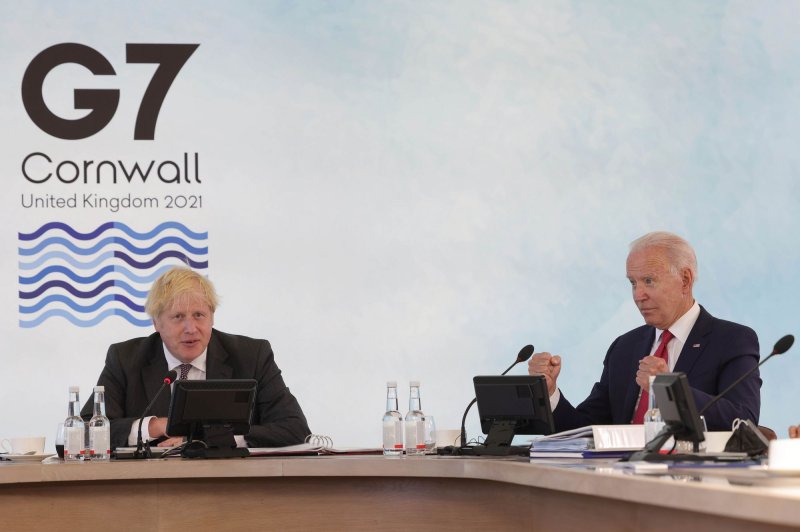 |
| British Prime Minister Boris Johnson and U.S. President Joe Biden during the G7 Summit in Cornwall, United Kingdom in June. The G7 alliance has unanimously warned of consequences if Russia were to attack Ukraine. File Photo by Andrew Parsons/No 10 Downing Street/UPI |
A concerted Western response to what American intelligence points out that the Kremlin plans an invasion of Ukraine in the new year, as they steadily mass up to 175,000 Russian troops and military equipment at the border next to Ukraine. It may be difficult to recall that this group was once the G8, when Russia was part of it, before its decision to appropriate for itself the Crimean peninsula with the claim that it always was part of Russia and would remain so, not with Ukraine, despite that Vladimir Putin also claims that Ukraine has always been part of the beating heart of Russia and will remain so.
Moscow responded that NATO's expansion into Russia's eastern European sphere of influence contravenes the West assurances to Russia following the collapse of the Soviet Union in 1991. Prior to the release of the joint G7 document, the Russian Embassy in London remonstrated that Britain's frequent phrasing of "Russian aggression" during the Liverpool meeting was misleading, designed only to create a 'cause' for the G7 to rally 'round.
"Russia has made numerous offers to NATO on ways to decrease tensions.""The G7 forum could be an opportunity to discuss them but so far we hear nothing but aggressive slogans."Russian Embassy statement, London
Russia is concerned with its "red line" which must not be permitted to be crossed. President Putin demanded legally binding security guarantees that further east expansion of NATO, or that it place weapons close to Russian territory be abandoned altogether, with Washington repeatedly responding that no country has the power to veto hopes nurtured by Ukraine to become part of NATO.
President Putin, according to the Kremlin, informed U.S. President Biden that Russian troops are a threat to no other country; Moscow was being demonized for simply moving troops within its own territory. Ingenuous to the Nth degree. Dmitry Peskov, spokesman for the Kremlin, spoke of very serious conceptual variances between Russia and the United States on Moscow's "red lines". A stated understatement.
 |
| Russian President Vladimir Putin has asserted that Russia does not pose a threat to Ukraine. EPA-EFE/Maxim Shipenkov |
The West was trying to turn Ukraine into a "bridgehead against Russia", wrote Mr. Putin in a July article. "It would be no exaggeration to say that the course of forced assimilation, the formation of an ethnically pure Ukrainian state aggressively oriented against Russia, is comparable in its consequences to the use of a weapon of mass destruction against us", he wrote.
In fact, the meeting was consumed more with a focus toward China and President Xi Jinping's aggressive strategies. It is Beijing's long-term goals that directly impact on the world order as China elbows its way toward recognition as a world power second to none, including the world's sole recognized world power which is unprepared to surrender its unipolar status any time soon. There were "very, very intense discussions especially on China", one official noted.
It is the standoff between Russia, NATO, the United States and now the G7 that is front and centre for now; China in the rear-view mirror. The emphasis for the moment is Russia's plans for Ukraine, which Western powers view through the lens of oppressive military threats meant to intimidate and to bring the country back under Moscow's tender orbit. Despite Ukraine having ousted the Kremlin's previous choice of Russian-linked president of the country in 2014.
"We call on Russia to de-escalate, pursue diplomatic channels and abide by its international commitments on transparency of military activities.""We reconfirm our support for the efforts of France and Germany in the Normandy Format to achieve full implementation of the Minsk Agreements in order to resolve the conflict in eastern Ukraine."Group of 7 statement
 |
| Ukrainian President Volodysmyr Zelensky (L) welcomes U.S. Defense Secretary Lloyd Austin (R) during their meeting in Kyiv, Ukraine in October. EPA-EFE/Presidential Press Service |
Labels: "Red Lines", G7, Invasion, NATO, Russia, Standoff, U.S., Ukraine, Warning
posted by Pieface | 8:37 PM
|
0 comments