Politic?

This is a blog dedicated to a personal interpretation of political news of the day. I attempt to be as knowledgeable as possible before commenting and committing my thoughts to a day's communication.

Monday, October 08, 2018

Illusions Dissipated: Israeli Security, Russian Trajectory

"Russian Defense Minister Sergey Shoygu rejects the Israeli version of events, according to which the Israeli planes were already back over Haifa when the Ilyushin was shot down. The Russians argue that the radar picture showed an Israeli plane using the Ilyushin as a shield."
"A possible explanation for this, revealed by the Israeli daily Haaretz, is that the radar picture available to the Russians was not actual, but a product of Israel’s electronic warfare."
"Given that this will continue to be part of any future Israeli bombing, the advanced Russian missile defense systems will be rendered no longer marketable."
"Perhaps this is why the Russians, upon announcing that they will deliver S-300s to Syria, simultaneously announced their willingness to negotiate with the United States on this delivery, in order to avert any possible clashes with Israel and their ramifications."
Yigal Carmon, JNS org. the algemeiner
Russian President Vladimir Putin alongside Syrian dictator Bashar al-Assad during a December 2017 visit to Hmeymim air base in Latakia Province. Photo: Reuters/Mikhail Klimentyev.
"Iran needs to leave Syria — that is not something new for you [Vladimir Putin]."
"We will continue to take strong action against any trickle [of fire] and any infiltration into Israel's airspace or territory."
"First, we will not tolerate the establishment of a military presence by Iran and its proxies anywhere in Syria — not close to the border and not far away from it."
"Second, we will demand that Syria, and the Syrian military, strictly uphold the 1974 Separation of Forces Agreement [a deal that set out a demilitarized zone along their frontier and limited the number of forces each side can deploy within 15 miles of the zone]."
Israeli Prime Minister Benjamin Netanyahu
Netanyahu meets Putin in Russia to discuss Syria, Iran, security issues
Russian President Vladimir Putin speaks with Israeli Prime Minister Benjamin Netanyahu during their meeting at the Kremlin in Moscow on July 11, 2018. (Yuri Kadobnov / AFP / Getty Images)
Syria has been busy covertly transferring advanced weapons to Hezbollah in Lebanon; Israel has been busy bombing sites in Syria where stockpiles of Iranian weapons meant for transfer to Hezbollah have been detected by intelligence, 'intercepting' the deliveries while delivering an indelible message to both Iran and Syria. Benjamin Netanyahu was fairly convinced that his explanations to Vladimir Putin of the existential threat to Israel deemed it a requirement that such weapons be destroyed.

The result of consultations between the two was an agreement to consult and coordinate airspace attacks, that the IDF would not undertake a mission over Syrian airspace without forewarning Russia, just as the U.S. and Russia have agreed on consultation over airspace both are engaged in, ostensibly for the permanent removal of terrorist groups located in parts of Syria. A testy situation where Washington supports the safety of rebel Syrian Sunni groups and Moscow takes the Syrian regime's line that such groups are themselves terrorists in line for extermination.

In Ukraine, the Russian military supplied ethnic Russian rebels with a Buk missile which was used to shoot down a Malaysian passenger jet flying over rebel-held Ukraine airspace leading to the deaths of hundreds of innocent people. Although there is ample evidence, Moscow continues to deny that anything remotely involving them or one of their missiles might have been involved. The loss of life of 283 passengers and 15 crew of Malaysian Airlines Flight 17 in 2014 doesn't appear to upset the Kremlin one bit.
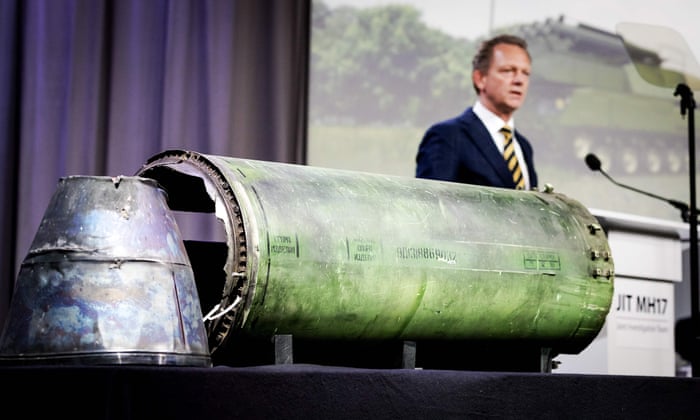

Fred Westerbeke, the chief prosecutor, stands next to a part of the Buk missile fired at MH17. Photograph: AFP/Getty Images
On the other hand, supplying the Syrian military with S-200 anti-missiles resulting in the shooting down of a Russian military plane with 15 aboard represents an unforgivable and avoidable tragedy for which it places blame on Israel, despite the Israeli military's intensive investigation revealing that it had nothing to do with that unfortunate occurrence, its fighter planes targeting a Syrian installation long before returned to their base in Israel. However, though it was the Syrian military's gross error in targeting the Russian plane it mistook for an Israeli warplane, Putin who was initially content to consider it an "unfortunate accident", has recanted.

He may be Russia's president, but his military subordinates would have none of his generosity toward Israel, real or feigned. And it was the bellicose, thunderous accusations of the Russian military that had Israel not been in the airspace on a mission to prevent Syria from getting on with deliverables to Hezbollah, their confusion in hitting the wrong plane with S-200 missiles would never have occurred. Not that the Syrian military mismanaged the weapons they were provided with, but that Israel in defending itself provoked the disaster.

There is no feigning the situation in real-time now, however. Russian military fury has resulted in S-300s, more technically-advanced anti-aircraft missiles that Russia touts as an antidote to both Israeli and U.S. flights going undetected in airspace so vital to Russia's ongoing bombing campaign against Syrian Sunnis under the pretext of targeting Islamic State group, being provided to Syria. Once again, Russia supplying hugely destructive weapons to clumsy, untrained and inept users. In the interim, it will be Russian military technicians in charge of the S-300s until such time as it is felt their Syrian counterparts have received sufficient training.

It appears abundantly clear now that the feigned support of Israeli security by Vladimir Putin has come to an abrupt end. More to the point, perhaps, a situation now presents itself where, should an Israeli or an American warplane find it necessary to target a S-300 missile site manned by Russian technicians the danger of a serious escalation in hostilities leading to a widening conflict, or outright war looms as a possible outcome, advantaging no one. Russia has overstepped itself in its volatile fury.

At the very least, should Israeli warplanes demonstrate they can fly undetected in Syrian airspace despite the S-300s, that touted product becomes unsaleable by Russia, a cause of great embarrassment. A much preferable outcome than the former. And as long as Iranian military installations continue to pop up in Syrian territory those Israeli airstrikes will continue; the IDF is fairly confident the S-300s will present no impediment to their vital task of defending Israel's security from the designs of Iran, Syria and Hezbollah and the indifference of Russia.
 

Labels: , , , , , , , ,

Monday, March 05, 2018

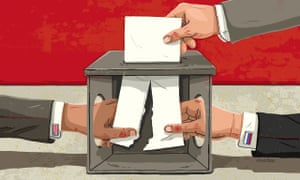
United States vs Russia ... Foreign Election Interventions

"It was completely wrong of Vladimir Putin to intervene in this way [to influence the outcome of the 2016 U.S. presidential election]."
"That said, the methods they used in this election were the digital version of methods used both by the United States and Russia for decades, breaking into party headquarters, recruiting secretaries, placing informants in a party, giving information or disinformation to newspapers."
Richard M. Bissell Jr., former chief of C.I.A. operations

"If you ask an intelligence officer, did the Russians break the rules or do something bizarre, the answer is no, not at all."
"[The United States] absolutely [has carried out such election influence operations historically], and I hope we keep doing it."
Steven L. Hall, retired, former chief, C.I.A. Russian operations
Illustration by Eva Bee
Illustration: Eva Bee

The difference in how the United States and Russia carry out their covert operations to influence political outcomes in their rival states is very real and unequivocal, however, both retired C.I.A. heads claim. While American interventions have been structured of late to aid non-authoritarian candidates with their challenges to dictators or in some manner help to promote democracy, Russia focuses on intervening for the purpose of disrupting democracy. As why would an autocratic post-Communist state not, after all? Democracy is not their chosen schtick.

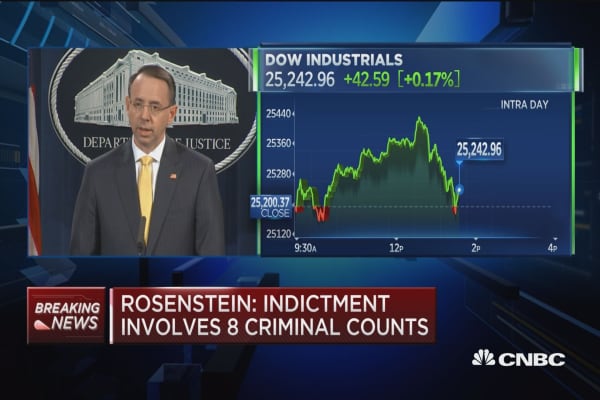
American intelligence has given fresh warning that Russia is once again preparing to reiterate in 2018 its interventions that took place in 2016; hacking, leaking, social media manipulation for starters. This was followed by the announcement by Robert Mueller, special counsel looking into the 2016 election interference, that thirteen Russians and three companies have been indicted for their roles in close Kremlin ties, for the three-year scheme using social media to attack Hillary Clinton while boosting Donald Trump.

In this, the C.I.A. is at a disadvantage in that Vladimir Putin has taken precautionary steps to neutralize challengers to his bid for another term at the Russian presidency. Laying questionable criminal charges against the most influential and popularly supported opposition leader Alexei Navalny, Putin went on to bar Navalny from entering the race based on criminal charges brought against him. The remaining opposition candidates simply haven't the support to make significant inroads in the election results that will result in Putin's re-election by a wiiide margin.

 According to Loch K. Johnson whose career spanned the 1970s forward on a Senate committee as a staff member investigating the C.I.A., Russia's operation in 2016 quite simply represented the cyber-age version of standard American practices "We've used posters, pamphlets, mailers, banners -- you name it. We've planted false information in foreign newspapers", explained Mr. Johnson from his new perch at the University of Georgia.

The C.I.A. famously gave aid in the overthrow of elected leaders in Iran and Guatemala in the 1950s, backed violent coups in the 1960s, plotted assassinations and supported anti-Communist governments in Latin America, Africa and Asia, irrespective of how brutally they treated their populations. That kind of devious and morally unsupportable interventions, hasten Messrs. Hall and Johnson to assure, no longer reflect American policy which now focuses on strengthening democracy abroad.

On the other  hand, election meddling in other nations' sovereign affairs while certainly unethical, is accepted as -- albeit political as in Realpolitik -- meddling. Dov H. Levin, a Carnegie Mellon scholar, scoured the historical record to determine the extent and depth of election influence operations mounted by both the U.S. and Russia, to discover 81 such events conducted by the United States, and 36 by the Soviet Union or Russia between 1946 and 2000 which he could discern.

The C.I.A.'s intervention in Chile in 1964 is clarified in a declassified report hat reads approvingly of the "hard work" done by the agency in supplying "large sums" to the candidate of its favour, portraying him as a "wise, sincere and high-minded statesman", while portraying his leftist opposition as a "calculating schemer." Over a prolonged period there were greater instances of American influence operations mounted by the State Department and affiliates. The U.S. funded an ultimately successful effort to defeat Slobodan Milosevic in Serbia's 2000 election.

President Bill Clinton became involved in a drive to aid Boris Yeltsin's re-election in 1996 as president by dangling the carrot of an assured American support to achieve a $10-billion international Monetary Fund loan to Russia four months before voting day. Vladimir Putin views more recent American ventures  in support of foreign groups, teaching basic campaign skills and how to build democratic institutions and the training of election monitors as a malign threat, not the benign good Americans feel it to be.

Understandably, given that one group, the National Endowment for Democracy, rendered a $23,000 grant to an organization that employed Aleksei Navalny in 2006, years later to become Vladimir Putin's major political nemesis. "I assume they're [the U.S.] doing a lot of the old stuff, because, you know, it never changes. The technology may change, but the objectives don't", said William J. Daugherty, who worked from 1979 to 1996 for the C.I.A.

Deputy AG Rosenstein: Indictment involves 8 criminal counts

Declassified CIA files are replete with examples of agency interference in foreign elections, including state elections in India and West Germany and provincial elections in Australia, Canada, and Japan...
In the 1950s, the CIA provided massive support to the West German Christian Democrats, which were led by Chancellor Konrad Adenauer. The CIA also did its best to suppress supprt for the West German Social Democrats and the far-right nationalist German Party in Berlin, Hesse, and Bavaria.
In 1967, Indian Foreign Minister M. C. Chagla charged that the CIA "meddled" in India's election, mainly through financial donations to parties in opposition to the ruling Indian Congress party. The CIA particularly targeted Communist parties in West Bengal and Kerala states.
Former Canadian Prime Minister John Diefenbaker of the Conservative Party charged in 1967 that CIA funds were used to bolster the Liberal Party, which contributed to Diefenbaker's electoral losses in two general elections held between May 1962 and June 1963. Diefenbaker's successor, Prime Minister Lester Pearson of the Liberal Party, discovered that the CIA funneled cash to the pro-Liberal Canadian Union of Students in 1965 and 1966.
The CIA did everything possible to defeat for re-election the New Zealand Labor Party government of Prime Minister David Lange. The CIA provided propaganda support to the opposition National Party, which was opposed to Lange’s policy of denying entry to New Zealand waters of US nuclear-armed and nuclear-powered warships. The CIA ensured that pro-American media in New Zealand harped on about New Zealand record-high 6 percent unemployment, the nation’s foreign debt being half of its gross domestic product, and $1 billion budget deficit. The CIA also attempted to suppress traditional Maori support for Labor in the August 15, 1987 election, a cynical use of race-based politics to alter an election outcome.
Between 1965 and 1967, the CIA station in Brazil, working in conjunction with the AFL/CIO union in the United States and its international arm, the American Institute of Free Labor Development (AIFLD), were discovered to be interfering in union elections in Brazil. The Sao Paulo office of the AIFLD, which was nothing more than a CIA front, made cash payments to Brazilian officials to corrupt union elections in the Brazilian petroleum sector. An itemized list of CIA bribes to Brazilian officials was discovered by a Sao Paulo union official: “Bonus to Jose Abud for collaboration – $156.25; Special payment to Dt. Jorge M. Filho of Labor Ministry – $875.00; Trip for Mr. Glaimbore Guimasaes, our informer at Fegundes St. – $56.25; Photocopies of books and documents of Petroleum Federation – $100.00; Assistance to Guedes and Eufrasio to defeat Luis Furtado of the Suzano Union – $140.64.”
Prior to the September 4, 1964 Chilean presidential election, the leftist Popular Action Front opposition discovered that US chargé d’affaires Joseph Jova was assisting the Christian Democratic Party candidate. Christian Democrat Eduardo Frei Montalva, with the CIA’s help, defeated Allende.
A CIA memo dated October 3, 1955, describes CIA support for the pro-Western. Masjumi Party in the Indonesian election, the nation’s first since independence. CIA director Allen Dulles appeared to be hopeful about the chances of a Masjumi victory due to Indonesia’s “large percentage of illiterates.” In the 1984 El Salvador presidential election, the CIA supported Christian Democrat Jose Napoleon Duarte over the more extreme-right winger, Roberto d’Aubisson. Republican US Senator Jesse Helms of North Carolina charged that the CIA “meddled” in the election on behalf of Duarte. It was even discovered that the “invisible ink” used on the fingers of those who had voted was supplied from the CIA.

Labels: , , ,

Friday, April 07, 2017

Course Correct

"It would seem that, at least so far, the Trump Syria policy is more or less a continuation of the Obama policy. This may reflect the fact that after allowing the carnage, to coin a phrase, to go on for six years the options left to the administration range from bad to catastrophic, but allowing this to go on interminably is probably not going to work."
"Not only is the situation horrific in a humanitarian sense, but it is generating a migration catastrophe that is overwhelming Europe. It doesn't seem to be an accident that the attack came after the administration signalled it could live with Assad, which once again is more or less a continuation of the Obama policy."
Eric Edelman, former U.S. ambassador to Turkey

"The question is what comes next. There are options, starting with military strikes that harm Assad's capacity to make war and would almost certainly persuade him never to use chemical weapons again."
"The administration is caught right now: As Assad's actions become worse and worse our rhetoric gets tougher, which is as it should be -- but then inaction seems less and less defensible."
"Even a very limited strike [of the sort Obama had in mind and then walked away from] would gain widespread support, and would be a powerful message to Putin and Chinese President Xi Jinping that the president is going to be a tough contender."
Elliott Abrams, former deputy national security adviser
Experts weigh in on the U.S. launching missiles at Syria after deadly chemical attack
U.S. Navy
A few days back the United Nations Security Council presented yet another resolution damning Bashar al-Assad's atrocity-laden agenda against his civilian population, leading to sanctions, and for the seventh time in as many years both Russia and China vetoed it. China, which is not involved in the Syrian civil war debacle, is alert over its own conundrum with North Korea, its abiding fear being that should Kim Jong-un's regime be held to account for its nuclear and ballistic missile threats, a flood of North Korean refugees would inundate its borders.

It is completely deaf and disinterestedly blind to that very phenomenon that is drowning Europe's ability to cope with an immense influx of refugees fleeing Syria's agonizing dismemberment. As for Russia, the very fact that Europe is desperately attempting to cope with that influx of refugees and migrants speaks of bitter vengeance by default as well as malicious design, a product of the Russian airforce generously aiding and abetting the Syrian military's vendetta against its Sunni Syrian population, bombing civilians, their hospitals and schools and the humanitarian groups striving to aid them.

When all eyes swivelled over the years of barbaric attacks by a government on its civilian population by chemical attacks, incessant barrel bombing, sectarian-based revenge attacks by Shiite militias and Hezbollah terrorist groups working in comfortable tandem with the Iranian Republican al Quds force to maintain a winning momentum for Bashar al Assad, invoking the scourge of Islamic State as their true focus, not innocent civilians, the United States under the Obama administration sat tight.

Simple enough expedients enforced by a U.S.-led coalition of willing European partners could readily have established a workable no-fly zone, could have struck the regime's air force to persuade Assad to palaver with his opponents rather than resort happily to the barbarism that comes so naturally to him, but recalling the failure that Libya's rescue from its tyrant has become, no less than that of Iraq, both of which suffered the advantage of U.S. involvement, caution overruled the moral imperative.

The Middle East, it is true, is a cesspool of raving tribal and sectarian hatred, revelling in the pathology of vengeance and the honour that meting out death restores. Yet the routines established whereby slaughter of innocents took place so matter-of-factly while the leaders of other nations winced and recoiled in horror, elicited no intervention. Well, now that 59 Patriot missiles were launched from shipboard toward installations on an airfield said to have been the source of the Sarin attack, that gesture's consequences are yet to be seen.

For its part, Russia has abrogated the agreement with the U.S. on coordinating air sorties over Syria to avoid accidental dust-ups. And a Russian warship is now headed toward the area where the two U.S. destroyers are situated in the eastern Mediterranean; what, so they can glare threateningly at one another? As for Bashar al-Assad's airforce, barely a hiccough, since there are other military airstrips in good working order and the regime's military planes took off as usual on their bombing missions the 'morning after'.

This new American administration, however, has put those against whom its attention has been newly riveted, 'on notice'. In a way that former President Obama never did. His reactions to events requiring a response, became  quite predictable; signifying low-key anger, annoyance, petulance, but no meaningful action. This new gesture of a willingness to act, despite potential consequences prudently avoided, opens up a new era in international relations.

Above all, the very fact that President Trump is anything but predictable appears to represent the most deadly arrow in the quiver that the returning American reality has presented of late.

Russian frigate in the eastern Mediterranean
Russian warship heading toward U.S. navy destroyers  FoxNewsworld

Labels: , , , , ,

Saturday, November 19, 2016

The Hallucination of Strategic Jihadi Intervention

"It makes perfect sense [to use community safety hubs across the city and more across Canada to try to apprehend violent extremism] because we already have these mechanisms that respond to situations of risk."
"At the heart of it, it's about connecting people to services to reduce the risks that they face, whether it's extremism or something else."
Scott McKean, City of Toronto 

"For a certain proportion of people who are moving into that radicalized space, I think that what the Toronto Police Service is doing will catch and hopefully help to re-engage those people on a different trajectory."
"We're all flying by the seat of our pants right now based on a small number of studies, and growing the knowledge base is so important to getting this right."
Sara Thompson, associate professor, Ryerson University Department of Criminology

"It's an issue that our citizens, our communities, are concerned about and that we recognize is out there. It's no different than the concern that their child may be starting to get into drugs. Maybe they need a mentor to help them navigate what they're going through."
"We don't have all the answers. We're putting what we think is a good initiative forward. We may have to tweak it along the way or make some changes as we move forward, but I think we've done our due diligence."
"I think it has huge potential. Everybody is watching to see what happens."

Det.Sgt.Kelly Gallant, 30-year police veteran, firearms instructor, tactical team member, negotiator
Jack Boland / Toronto Sun / QMI Agency
Jack Boland / Toronto Sun / QMI Agency      James Ramer speaks at Police HQ.

Violent radicalization has surfaced as a problem just about everywhere in the world, with Islamist jihad proving to be an attractive provocation in inciting interest among young Muslim men and women eagerly subscribing to the ideology of a reborn Islam, returning to its roots of triumphant coersion through violent conquest; from the 7th Century of its inception to the 21st Century of its reinvention as a barbaric tool of religious conversion.

Canadians in significant numbers have taken to travelling abroad for combat training in the Islamist hotspots of the world -- from North Africa to the Middle East and places in between. Although al-Qaeda had its attractions, impelling Muslim men to make the trek in obeisance to the call to jihad, it took the advent of a caliphate calling itself the Islamic State of Iraq and the Levant which proudly and with the aid of social media celebrated its public relations agenda of wanton slaughter through inventive atrocities to rally the minds and hearts of recruits.

Recruits who have involved themselves in terrorist plots, who have been arrested and placed on peace bonds, who have been apprehended from travelling outside Canada to join terrorist groups, or those who have returned to Canada after having received terrorist training and gained experience on the jihadist battlefield championing violent Islamist triumphalist conflict. They will remain the concern of the RCMP. The Toronto Police Service decided it would absorb a counter-extremism function into a standing community safety program to address the problem of emerging jihadists.

Deputy Police chief James Ramer tasked  two officers, Sgt. Donald Locke and Det.Sgt. Kelly Gallant on their return to Canada in 2014, from mentoring women police officers in Kundiz province, Afghanistan to formulate a protocol to address the concerns of Toronto residents recruited into Al Shabab, Hezbollah, al-Qaeda, Islamic State, the Tamil Tigers and the Ku Klux Klan. The team of two initiated their assignment by attending American conferences, by consulting academics, by reading research papers and visiting interventionist programs in countries like Britain.

They concluded through that research that often people became radicalized through their own vulnerable mental health issues, personal identities, or family problems. A program to address similar problems began in Glasgow, Scotland, was picked up by Saskatchewan as a working model, and the Toronto team saw fit to emulate it, extending what had basically been a tool to tackle guns, drugs and gangs into an extended project to encapsulate Islamist terrorism as well.

People at risk were to be identified and intervention to take place at weakly "situation tables" involving police, the city and the United Way community services agencies. Each case was studied and strategies devised to counter addiction, social housing, education, employment and other issues which might be involved in helping to divert people from the alternate paths they choose leading to societal isolation, resentment, crime and radicalization.

Ottawa Citizen
Ottawa Citizen     A tourist shot this photo of Michael Zehaf-Bibeau during his attack near Parliament Hill.

"Misfits", "wannabes", "hangers-on", on the cusp of committing to extremism considered to reflect a proportion of those being radicalized were to be identified by members of the associated community; anonymity was guaranteed to community members to give them confidence that coming forward to police to report concerns about extremists would be kept confidential in the process of bringing the cases to the situation tables. Concerned individuals could convey their impressions of radicalization to police without fear of community identification.

"I don't think it's a panacea", doubtfully commented Stephanie Carvin, an assistant professor specializing at Carleton University, School of International Affairs. Equating issues underlying those representative of drugs and gangs with those of extremist Islamist jihadists simplifies the concerns of terrorism by normalizing it into a common stream of criminality, when it is far more than that; a vicious, threatening existential threat, no mere societal non-convention.

Even while cases are initially screened to ensure that any who have committed criminal or terrorist activity are excluded from the program of hoped-for rehabilitation and referred directly to the RCMP for investigation: "We are not going to send somebody like that to the hub", stated Deputy Chief James Ramer reassuringly. Experts are divided on the potential effectiveness of the police program for intervention.

To the present time, although the interventionist team has been in service for well over a year there has been a total of two events they have been involved with, one respecting parents worried their child was fixated on viewing ISIL videos. The outcome of that investigation was the conclusion that mental health issues were involved. The second, the case of a girl missing from home, and found to have crossed at Fort Erie into the United States. In her possession was an Pakistan-bound airline ticket.

Like her gullible counterparts in the United Kingdom and elsewhere, she was en route to meet an utter stranger who had romantically convinced her via social media that she could join him in the jihadist camp to become his wife. Instead, the chagrined young woman was returned by authorities, to the care and custody of her parents.
Postmedia News
Postmedia News    Fighters with the Islamic State of Iraq and the Levant — also known as Daesh — are seen in an undated photo
"So you're basically treating the two populations [drugs and gangs, and jihadist-attracted youth] as being very similar. And it's not a good fit, at least not in a Canadian setting, for violent radicalization."
"This is all a work in progress. We're going to see if it works."
Phil Gurski, former investigator, Public Safety Canada

Labels: , , , , ,

Wednesday, October 07, 2015

Interpretive Reality on a Collision Course

"Syria is a four-dimensional civil war that we all are losing, except for ISIS. One dimension is government versus anti-government. A second is Sunni versus Shia. A third is primarily within the Sunni community, radicals versus moderates. And the fourth is tribal, generating dozens and dozens of crosscutting tensions and conflicts."
The reason for U.S. policy failures to this point and Russian foreign policy failures to come is that each is focused on only one dimension—the government versus anti-government dimension, to which they then add the war against ISIS, creating a two-dimensional response to a multi-dimensional problem."
"Russia has very real reasons to fear the success of ISIS, not least because more than 2,000 Russians, Azerbaijanis, and Central Asians have joined ISIS, and will at some point come home on a mission. But striking ISIS comes second for the Russian military to salvaging the Assad regime’s military position, and, given the immediate threat to that, this means attacking the opposition forces, including those supported by the United States, Saudi Arabia, and the others."
Robert Legvold, professor emeritus, Department of Political Science and the Harriman Institute, Columbia University

Russian Sukhoi Su-24 tactical bombers at an airfield near Latakia, Syria. Photo: RIA Novosti
With all the interrelated issues driving the divisions in Syria; tribal, ethnic, sectarian, political, government-driven, rebel-driven, and support by outside sources of foreign Islamist interventions, and given the complicating factors of foreign governments pledging to destroy the ambitions of the most visible and dreaded Islamist terrorist group, the situation in Syria represents a puzzle within a mysterious conundrum appearing as an enigma, baffling solution.

The violent turmoil and attempts to destroy the unsettling capabilities of the various actors are all part of the backdrop, with the main drama still represented by the gruesome reality of a government that has declared a vicious war upon its own civilians. And it is that vicious war by the Alawite government of President Bashar al-Assad that is more civilizationally troubling than the existence of fundamentalist Islamist terrorists.

It is, after all, Assad's military that has consistently preyed on the Sunni Syrian population, first dashing their hopes of achieving equality in a political-sectarian society that has oppressed them as second-class citizens, then leaping to confronting their protests with military helicopters and artillery, warplanes and chemical attacks, and finally the endless dropping of barrel bombs, destroying the infrastructure of the country's cities, and the lives of its people. 

Resulting in an endless stream of refugees flooding Europe.

The first order of business for civilized Western democracies is the removal of Assad from his position of tyrannically destructive power. With his absence from Syria, the Sunni factions that represent the majority Syrian population would have the opportunity to restructure the country's social and political underpinnings, although given the experience in Iraq with the removal of the Sunni minority power structure with Saddam Hussein's ouster, equality did not result, only bitterness and chaos.

Russian President Vladimir Putin decided that his military would give support to Assad from the aspirations of the Sunni rebels, and just incidentally strike as well at the Islamic State that has captured fully one-third of the entire country to create a seamless whole with the one-third of Iraq it has also captured for its caliphate. The U.S.-led airstrike coalition had been too timid to be effective in destroying ISIL's dominating capabilities in warfare and commission of atrocities.

A Russian pilot near a Su-34 aircraft at the Khmeimim airbase in Syria's Latakia. Photo: RIA Novosti

Enter Russia, which appears to have mislaid its memory of its years in Afghanistan and its eventual inconclusively miserable departure, a lesson in humility not learned. In the greater picture of events in Syria the issue of Russia's air incursions targeting not ISIL primarily, but the Sunni Syrian enemies of Assad appear almost destined to represent an accidental cause of conflict on a far wider scale, between NATO/US and Russia/Iran. 

Russia's arrogance is exemplified by its entry into Turkish airspace, causing Turkish planes to finally escort the second Russian incursion out of its territory. As well, Turkey echoed its NATO allies in criticizing Russia for targeting and bombing Syrian opposition forces rather than Islamic State targets. This, ironically, while Turkey itself targets and bombs Kurdish forces which just happen to be the most effective fighting forces against ISIL.

The appearance of so many conflicting interests in a single dissolving country which has fallen into vicious wrack and ruin, its people fleeing death, dismemberment, dislocation and terror, speaks volumes of accidental encounters of a potentially disastrous consequence.

Labels: , , , , , , ,

Monday, September 21, 2015

Taking Islamic State Off The Twitterverse

"My motivation is to stop the brutality. I knew that someone had to stop them."
"I take time out of my day to do this because the world is in danger, humanity is in danger. It is my duty, as a human being, to stand up."
JhonJoe, #OpISIS hacker
Anonymous OpISIS via  @lexinerus on Twitter
Anonymous OpISIS via @lexinerus on Twitter

Well, it's heartening to know that Anonymous in particular, along with other hacker groups is finally putting its web-based expertise and influence to good use. That same cannot be said for a lot of its previous incursions into the field of hackery. This time, no one could fault their choice of hacktivism. What they're doing is tackling a problem of global significance in a venue that is of great use to the jihadist terrorists of Islamic State of Iraq and the Levant.

Without the use of instant communication through all manner of social networking sites, and apparently Twitter in particular, ISIL would be in a huge disempowering quandary. Their ability to flash their psychotic videos of gruesome torture and horrifying murders to attract recruits to jihad would be in jeopardy. The disadvantage that would descend on their recruiting techniques would certainly retard their growth in numbers.

And this is precisely what the allied groups that together make up #OpiSIS are motivated by. The groups involved are GhostSec, CtrlSec and the collective Anonymous whose operations take a multitude of forms. Some of the hackers are able to strike ISIS websites offline, while others attack ISIS social media accounts, and others yet pursue the people responsible for the accounts.

Evidently, with the use of Twitter, recruits locate someone expressing views that support their own, and from there make contact through the direct message function on Twitter. "We ran a sting operation to uncover this", JhonJoe remarked in a interview conducted on Twitter. The recruiters attempt to convince their potential recruits to travel to Syria to fight jihad with ISIL.

"They give you phone numbers and addresses to go to", and from there guide their targets through the resulting process. Should the targeted individual state they're unable of travelling, then the ISIL recruiter launches a convincing argument that terrorist attacks are useful to the global jihad wherever they occur. The recruiter insists that to "kill" people wherever the recruit happens to be is the goal.

"Stab them, then stab some more, and after that, keep stabbing, until they are all dead."

One of the amateur recruiters, according to the hackers, spoke to them directly: "@TheBinarySec@AnonTerminal hack my account Kuffar if you can!"

The response to that challenge was a two-day delay, then the hackers released his personal information, inclusive of phone number and home address in the Philippines, sending him a message on Twitter complete with screenshot of the FBI tips page: "your location was sent to the FBI".


Embedded image permalink
Anonymous@AnonyOpNews
89 Jihad sites #offline & 1,200+ Twitter accounts suspended. #OpCharlieHebdo

Labels: , , , , ,

Sunday, March 22, 2015

Presidential Tantrums

"Get over your temper tantrum, Mr. President."
 "Look, there was a free and fair democratic election, the only nation in the region that will have such a thing. The president should get over it. Get over your temper tantrum, Mr. President. It's time that we work together with our Israeli friends and try to stem this tide of ISIS and Iranian movement throughout the region, which is threatening the very fabric of the region."
"The president is letting his personal feelings toward Netanyahu get in the way of important policy issues. I am convinced of it, because, either that, or [Mr. Obama] is delusional. I am not sure which."
"Bibi's rhetoric concerning an election campaign pales in comparison as to the threat, the direct threat, to the United States of America of ISIS. The president has his priorities so screwed up, that it's unbelievable."
"If he does that,[accept the PA's urging of a UN security resolution] then -- and it would be approved by the U.N., then the United States Congress would have to examine our funding for the United Nations. It would be a violation because of the president's anger over a statement by Bibi, by the prime minister of Israel. It would contradict American policy for the last at least 10 presidents of the United States."
Senator John McCain, Senate Homeland Security committee 

"This is about the mutual concern we have for Iran obtaining a nuclear weapon. I will tell you that the special relationship that America has with the Israeli people transcends any of the politics. This administration should be better than this, that Prime Minister Netanyahu has been re-elected."
House Majority Leader Rep.Kevin McCarthy, R-California

"We take him at his word when he said that it wouldn’t happen during his prime ministership. That’s why we’ve got to evaluate what other options are available to make sure that we don’t see a chaotic situation in the region."
"We’re going to make sure that regardless of disagreements we have on policy that our military and intelligence cooperation to keep the Israeli people safe continues. And that cooperation also helps the American people to stay safe."
"We indicated that that kind of rhetoric was contrary to what is the best of Israel’s traditions."
"Israeli democracy had been premised on everybody in the country being treated equally and fairly; I think that is what is best about Israeli democracy. If that is lost, then I think that not only does it give ammunition to folks who don’t believe in a Jewish state."
U.S. President Barack Obama
President Barack Obama meets with Prime Minister Benjamin Netanyahu in the Oval Office at the White House in Washington, Friday, May 20, 2011. (photo credit: AP Photo/Charles Dharapak)

Well, well, a monumental hissy-fit over the unmitigated gall of the head of another country's government disagreeing with the American President, both in public and in the most prestigiously powerful forum in the United States: Congress. Upstaging the President of the United States? Castigating the Commander in Chief for his decision to court a country whose government is a direct threat to world stability, and certainly to the existence of another Middle East State? What has the U.S. got to lose?

And what, in contrast, has Israel got to lose over the Islamic Republic of Iran gaining grudging permission to proceed with its nuclear aspirations, sanctions removed? And therein lies the truth of the matter, that the U.S. has no right to dictate to Israel how it should react over the catastrophic decision of a egotistical President whose focus on his historical legacy overrides his responsibility to the world, to the U.S., to American allies. His bullying tactics as opposed to Netanyanhu's refusal to bend to Obama's will.

Mr. Obama speaks rather unconvincingly of the American interpretation of Israeli functional events. As though the Prime Minister of Israel requires a lesson on parliamentary democracy. While in reality the President of the United States did deserve a lesson in Middle East politics. Barack Obama is fuming over the insult to his integrity, his honourable performance, his executive status as the most powerful man on the planet whose policies and decisions a mere regional politician dares to refute.

"I don't want a one-state solution; I want a sustainable, peaceful two-state solution, but for that, circumstances have to change. I was talking about what is achievable and what is not achievable. To make it achievable, then you have to have real negotiations with people who are committed to peace", explained the post-election Prime Minister Benjamin Netanyahu. And that is a twofold message; that Israel must have a partner in peace negotiations whose commitment to peace and arriving at a solution to enmity must be met halfway.

And the other part of the message is that in dealing with a human-rights-abusing, terrorist-funding, proxy-international-assaulting, nuclear-weapons-searching country like Iran, to place trust in the country that negotiations will result in a reliable, verifiable agreement that matches the concerns of Iran's neighbours and the expectations of the international community, the United States must be bargaining with a trustworthy partner. Which is quite simply not the case.

The Obama administration made it quite clear that their preference was to have a replacement for Benjamin Netanyahu and his political party. And covert means were put in place to effect that change, along with belligerent overt interventions. Despite which the Israeli electorate preferred the democratic route of their own selection, one that would give them the most reliable hope for security in defence of their country, notwithstanding America's 'guarantees' that it stands behind Israel, come what may.

The American President is furious over the ingratitude that he sees on the part of a nation that has relied heavily on the goodwill and concern of his great country. But in his administration goodwill and concern have been spectacularly missing and this, more than anything -- well almost, if one overlooks the fact that American policy under this president has resulted in a chaotic collapse of relations between the U.S. and its former allies -- motivates Israelis to look closer to home for answers to the challenges of their future.

Labels: , , , , , , , , ,

Friday, March 13, 2015

Whoppers and Deceit

"I'm not falling into your trap, brother. It's not (about) the Muslim community. It's about violence. It's about radicalization. It's about many, many communities who are witnessing (radicalization) and demanding that they want to be part of the solution. ... Frankly, it would be a very big mistake to focus on one community (over) others. What we are doing is providing tools so that parents, no matter where they are coming from, or teachers or volunteers have some tools to work with if they are facing a situation. But it has nothing to do with a community."
"We’re not freaking out here. We’re saying (for) many many months we have to work on the ‘live together,’ and the ‘live together’ is to have a balance between openness and vigilance."
Montreal Mayor Denis Coderre
Montreal Mayor Denis Coderre and Montreal Police Chief Marc Parent CBC
"We think we do have a problem. We have our kids going to die in Syria and for the parents of those kids, this is a catastrophe. ... This is a problem that we have to face."
"How can they call what they are doing prevention? The phone line goes straight to the police. It is OK to have security, but don't call it prevention. That is not serious."
"Radicalization is due to discrimination and actions that make people feel rejected by their own society. Islamophobia, racism and discrimination push people toward radicalization, because they feel they don't belong to their own society; they feel a greater sense of belonging to a terrorism group 9,000 kilometres away."
Haroun Bouazzi, co-president, Association of Muslims and Arabs for a Secular Quebec

Verbal gymnastics and ingenuous circumlocution is the politically correct order of the day in denying the obvious. Tying himself into a pretzel of denials against the backdrop of Islamist terrorism threatening to invade Canada at a more ramped-up pace to the point where public security agencies tasked with protecting the country from the violent plans of Islamofascists are stretched too thin for effectiveness, yet anxious not to appear anti-Muslim, Montreal's Mayor Denis Coderre had his antennae up and his blustering response prepared.

The country has a problem, the province has a problem, the city has a problem, and its Muslim families either have a problem or are part of the problem. Whatever, the primary responsibility of families, mosques and clerics and community organizers in the Muslim community is to take charge of the radicalization process that is enrapturing their young men and women who have grown up with the Koran and the qualities of mercy described therein, for whom the appeal to violent jihad seems irresistible? Connect the dots ....

But, isn't it typical that people will defend what they believe, that is enshrined in their minds, clouding their will to be enlightened. The 'discrimination' of which Mr. Bouazzi speaks in echoing the feelings of Canadian Muslims emanates from the non-Muslims who observe the actions of pious Muslims preferring the method of violent jihad as a tool of prosetylization in their haste to bring about a worldwide caliphate. The threats to peace and security that pop up around the world wherever Muslims congregate cannot be ignored.

Place responsibility and blame where it is due, rather than scapegoating people who feel threatened by violent jihadist Islamism. Death suddenly appearing out of nowhere does focus the mind. In acknowledging that the Muslim community has a 'problem', go a little further and address the problem with meaningful action, to counteract the messages that have been mesmerizing Muslim youth and impelling them to the kind of activities that their parents fear will lead to their deaths. While leading to the deaths of innocent non-Muslims and sectarian-clashing Muslims as well.
"In the present context, my concern is that this hotline will be inundated by people who are anti-Muslim. It will be like in the olden days when people were asked to denounce anyone who could be a Communist. How will they weed out the real threats? What will be the checks and balances to ensure people are not falsely accused."
"You have to wonder if it was well thought out, because the community partners were not there ... We do have to combat violence and terror, but we have to be careful when every week another report about Muslim wrongdoing is in the news. I worry this will create a frenzy, and increase paranoia. I think it was a serious faux pas, reflecting haste and a lack of cultural sensibility."
Fo Niemi, executive director, Centre for Research-Action on Race Relations

Well, yes, there is always the danger of cranks coming forward and there is always the danger of wrongly accused, and there is the danger of increased fear, but consider what it is that creates it: ongoing violent attacks undertaken by Muslims and converts to Islam against those whom they believe are out to do harm to Islam in a religious community already consumed by paranoia, but of a type deliberately infused in them by clerics and recruiters to jihadist movements within the community and over the Internet.

"Things are going to move very quickly. The phone line is up and running and the city is acting fast in creating this prevention centre. That should reassure parents and teachers and others that we are taking care of this", assured Jocelyn Belanger, a radicalization expert and an academic in the psychology department at the Universite du Quebec a Montreal, one of the partners in the tip line project. "It’s a great thing that the city and the SPVM are taking the lead on this."

The staffing of the hotline for the Radicalization Prevention Centre by Montreal police constables, he assured, was a temporary measure. As the centre spins itself into action, the hotline is meant for parents, teachers or others reporting concerns over individuals in possible danger of radicalization to be put in touch with helping professionals. "What propels people to join radical groups is a quest for personal significance. They want to be someone who counts, who matters, who is respected. If you alienate them … isolate them, this quest for significance is awakened."

"You need to provide these people with vocational education, with jobs, you make sure they are connected to a positive social network. They are usually people who want to change the world; they see injustice and this motivation can be channelled into something positive. Eighty per cent of the lone wolf style attacks can be thwarted. How? Because in 80 per cent of those cases, peers or teachers or family members knew the person was plotting something. This can save a lot of lives.”

Labels: , , , , ,

Wednesday, December 24, 2014

Rehabilitating Jihadi Terrorists

"Today we are going to talk about how they control their anger. And this is very important for them. We use just the psychology theories, besides what comes in Koran, and what the prophet Muhammad says about controlling anger."
Nasser al-Arifi, U.S.-trained Saudi criminal psychologist 

"Without the program, thousands of those who were released would have been exploited by terrorist organizations."
"No rehabilitation program could be 100 percent successful."
Major General Mansour al-Turki, Saudi Interior Ministry spokesman

Local and international media representatives are given a tour of a center for the rehabilitation of suspected terrorists.  Credit: AFP/Getty Images

Mr. Arifi's lectures provide an example of the program’s focus on using a mixture of Western therapy and Islamic teachings to "cure" the young men who appear before him in the official Saudi Arabian rehabilitation program, to relieve fanatical Salafists of their extremist leanings. Which is rather interesting in and of itself, since Wahhabist Saudi Arabia is wedded to extreme Islam of the Salafist variety. Its immense oil wealth enabled it to set up Wahhabist-style madrassas all over the world.

From Pakistan and Afghanistan, Somalia to Libya, New York to Canada, Paris to Berlin, Saudi-financed, Salafi-modelled madrassas exist to expose young Muslim men to the version of Islam noted for its 'purity', dating back to its origins as a scimitar-rattling, 'pacifier' of regions of the world not then yet introduced to the religion of peace that used force of arms as its superior proselytizing tool.

Saudi Arabia's forward-looking rehabilitation system for terrorists was originally set up in 2004, taking in members of al-Qaeda, in an effort to turn them away from their preoccupation with violent jihad. More latterly, it is the large numbers of young Saudi men who have, or attempted to travel to Syria to join the Islamic State of Iraq and Al-Sham. It is instructive to note that without the radicalizing effect of the madrassas, such jihadi groups would never have emerged.

And now Saudi Arabia is busy with deradicalization after having radicalized through its madrassas. Mostly because of the realization that they have created a monster which not only seeks to terrorize those among other Islamic sects, but the Crusader class into which all Westerners neatly fit, along with their democratic virtues so inimical to the pure presence of Islamism. And since Saudi Arabia has long looked upon its traditional alliance with the U.S. as of benefit, it too was targeted by al-Qaeda.

But according to Major General al-Turki, the country's Mohammed Bin Naif Counseling and Care Center is doing an excellent job of turning away the young men wearing long unkempt Islamist beards and the short white tunics that distinguish them as the puritanical Salafist Islamists featuring violent jihad conceptions of honour and tradition in Islam. That, despite the 12 percent recidivism rate, where those having gone through the program return to terrorist activities.

Rehabilitation of terrorists is not unique to Saudi Arabia, even taking into account the paradox of the creator of the disease now attempting to inoculate against it. There are versions of such types of deradicalization schemes in Singapore and Yemen and elsewhere in the Arab and Muslim world. Two former al-Qaeda graduates of the Saudi program were welcomed by former British Prime Minister Gordon Brown in 2008.

Originally the Saudi system proclaimed its program to be one-hundred percent successful. In 2009 however it emerged that a number of former Guantanamo Bay detention centre prisoners, sent on to Saudi Arabia to begin rehabilitation ended up with senior positions in al-Qaeda in the Islamic Maghreb. A not-entirely-unusual result of the one-hundred-percent solution. 
Pictured in 2002, the Guantanamo Bay military detention camp in Cuba became a repository for the worst terrorists captured after the 9/11 attacks in 2001

While al-Qaeda has been hugely financially supported by wealthy Saudis, an upsurge in domestic terrorism resulted in the creation of the program. Which hasn't stopped those wealthy Saudis from continuing to finance jihad, more latterly ISIS being added to the al-Qaeda support. The hundreds of Saudi citizens who have gone off to fight with ISIS, haunt the imagination of the Saudi regime; what happens when they return?

A Sunni extremist group was linked recently with an attack on a Shiite village. Of course there are thousands of Islamic nationals from Europe as well as the Middle East, along with North America who have pursued the dream of presenting as "foreign fighters" for jihadi groups, leaving the West uncertain about their response to these realities. Denmark goes so far as to offer returning 'fighters' counselling and assistance with their careers.

Britain and Canada, on the other hand, remove the passports of people who travel to fight with Islamist extremists. One of the Saudi rehabilitation school alumni now has a $5-million reward on his head.
 was Ibrahim al-Rubaish
Ibrahim al-Rubaish was let go from Gitmo in 2006 along with 16 other prisoners, and quickly returned to al-Qaeda in the Arabian Peninsula – becoming its Mufti, or spiritual leader

Less than two years after leaving Guantanamo along with 16 others captured by American troops in 2001,  and having spent five years as a Guantanamo prisoner, and after going through the Saudi corrective program, Ibrahim al-Rubaish rejoined al-Qaeda in Yemen and by 2009 the Jamestown Foundation, a think tank specializing in terror-tracking, identified him as AQAP's chief religious authority. He has a college degree in Islamic shariah law.
The college graduate/Guantamo/Saudi rehabilitation camp alumni, according to the Middle East Media Research Institute (MEMRI) called in 2013 to open a holy war against Americans: "It is my duty to spur the Muslims to kill the Americans, to get them out of the Muslims' land."
An almost verbatim quote from al-Qaeda's founder, Saudi national Osama bin Laden, who didn't need to go through a Saudi rehabilitation camp to spur him to action, only the lesson learned when he fought with the mujahideen as a foreign jihadist whom the United States and Pakistan trained, armed and incited to fight against the Soviet occupation of Afghanistan.


Labels: , , , ,

Friday, December 19, 2014

Getting It Right

"As a result of concerted Iraqi and coalition pressure, ISIL's initial momentum has been stopped. Iraqi forces demonstrated recently that they can reclaim their territory as we've seen in Baiji, Kirkuk and Irbil."
Col. Daniel Constable, commander, Canadian Joint Task Force, Iraq
CF-18 Operation IMPACT
A Royal Canadian Armed Forces CF-18 Hornet fighter jet from 4 Wing Cold Lake, Alberta lands in Kuwait after the first combat mission over Iraq in support of Operation IMPACT on October 30, 2014. Photo: Canadian Forces Combat Camera, DND
While the U.S.-led coalition using air strikes against the Islamic State of Iraq and Al Sham makes claims to having made a huge difference in the forward momentum celebrated by ISIS and feared by Iraq and Syria, let alone its neighbours having to cope with additional refugees on top of the millions the Syrian civil war has created, there are reports out of the battlefields signalling that all is not quite as glowing as the coalition reports.

ISIL jihadists pushed Iraqi forces from the city of Baiji north of Baghdad on Wednesday. Local tribes fighting ISIL, as well as Iraqi police have complained that support from the Iraqi military and the government has been less than ideal, with the expected ammunition not appearing, causing them to withdraw and retreat, leaving ISIL in place and in control. Obviously coordination is less than ideal.

ISIL terrorists took control of another village in Anbar province and the city of Haditha is still being fought over while remaining under the control of government forces. An Iraqi military helicopter was shot down last week by ISIL forces using a shoulder-fired missile, the result of captured military bases by ISIL when fleeing Iraqi military gifted their adversaries with state-of-the-art military equipment.

Despite months of coalition airstrikes, according to Iraqi analysts, ISIS has suffered the loss of little of the territory it took possession of earlier in the year. The Islamic State remains in control of large areas of Iraq, as it does in Syria. Causing Iraqi security experts to name the situation a stalemate. The result of the airstrikes is that ISIS has closed in on its holdings.

In control of 85 percent of Anbar province, ISIL has launched fresh attacks against Ramadi the provincial capital, according to Reuters. When prodded to respond to the question of how much territory ISIS may have lost resulting from coalition strikes, Col. Constable stated: "They're stopped. They're contained."

It will "at least take a minimum of three years" before a turning point against the ISIS forces is reached, according to U.S. Lt.-Gen. James Terry, commander of the American forces fighting in Iraq. He too states unequivocally that ISIS forces have been halted in their advance. They are now focused on holding the territory previously seized.

"I think they're having a hard time in terms of communicating right now, in terms of resupply", he stated. As for Canadian attacks; among the successes are listed machine-gun emplacements, artillery pieces and a factory producing improvised explosive devices.

Labels: , , , , , ,

Thursday, December 18, 2014

How Goes The War?

"[Islamic State] is very much affected by the successes of the air campaign. We are seeing that they (Islamic State) are far less offensive and far more defensive. They are changing their tactics."
"Many months ago they were openly and overtly on the move throughout Iraq, exploiting their momentum. That is absolutely no longer the case. They are having to hide. They have had to stop using bigger weapons systems like tanks, artillery. Right now they are setting up defensive positions and using asymmetrical tactics such as [Improvised Explosive Devices]."
"The assessment still is that ISIL presents enough of a threat that I know that as it sits right now there are targets being surveilled, detected and prosecuted."
"From a military perspective I have got a sense the Canadian media have been very respectful of the op sec (operational security)piece. It truly is a matter of protecting our people and taking the threat very seriously."
"With what happened with Cpl. (Nathan) Cirillo and Warrant Office (Patrice) "Vincent, (it) drove home to Canadians that this is an enemy that is ruthless and has to be taken seriously. As commander here my number one goal is the protection of my people."
Col. Daniel Constable, Kuwait City, Kuwait
Aircrew aboard a CC-150T Polaris from Air Task Force-Iraq conduct night air-to-air refueling operations with Canadian fighter aircraft in support of Operation IMPACT. (OP Impact/DND)
Aircrew aboard a CC-150T Polaris from Air Task Force-Iraq conduct night air-to-air refueling operations 
with Canadian fighter aircraft in support of Operation IMPACT. (OP Impact/DND)
"We're not at risk [in Canada] from ISIL [Islamic State] because we're fighting them. We're fighting them because we are at risk from them."
Prime Minister Stephen Harper, Ottawa

Matters have ostensibly moved so successfully with the U.S.-led coalition of airstrikes against the Islamic State of Iraq and Al-Sham that they have had to huddle in situ rather than set out in mechanized columns as in the past, moving on schedule toward one target after another; towns and cities, Iraqi military bases, vital dams and water plants, uprooting the regime's defense and taking possession of oilfields to exploit and enrich their conquest of the country.

The setback that is being described is that of a hitherto-successful major force whose reputation for extreme brutality and battlefield techniques lodged blind terror in the minds of the Iraqi military which melted away at the first sign of the oncoming ISIS convoys. What Iraq could not accomplish for itself, on its own, the allied intervention of the West and a few MidEast countries has done for them, placing them on the brink of setting their timetable for full push-back.

Prevailing conditions, stated Col. Constable, provide for "Iraqi forces to decide when the time is right to go on the offensive to clear those areas that were taken by ISIL". He was speaking to a Postmedia journalist, the peripatetic Matthew Fisher, from Kuwait near the Canadian bases where 600 Canadian personnel, six CF-18 Hornets, two CP-140 Aurora reconnaissance aircraft and a CC-150 Polaris in-air refuelling tanker are based.

"[Compared to Libya] where we were not as well co-ordinated with the forces on the ground that were being attacked by (Gadhafi's) forces, what I see different in this war [is coalition aircraft improved] preciseness of targeting because of Baghdad's involvement. For example, when F-18s are assigned to do close air support and strike missions the ultimate target engagement authority is the government of Iraq."

A CP-140 Aurora aircraft pilot from Air Task Force-Iraq conducts a mission during Operation IMPACT on December 13, 2014.   (OP Impact/DND)
A CP-140 Aurora aircraft pilot from Air Task Force-Iraq conducts a mission during Operation 
IMPACT on December 13, 2014. (OP Impact/DND)

The RCAF's Auroras, it was pointed out were "a tremendous asset to the coalition". Their electro-optical and infra-red cameras, state-of-the-art synthetic aperture radar, permit crew "to determine if a vehicle has a weapon on board that has been recently fired", and "to see through the weather". The Aurora, given its impressive flying time is able to "record the impact of weapons as they fall", lingering "to record post-blast effects, which amounts to near real-time battle damage assessment."

Reports that Iranian F-4 Phantoms had also carried out strikes against Islamic State targets is an impolite, impolitic topic, given the Republic's status among coalition partners. "The only thing I can say about the Iranian forces is that I am in the same boat as you. I have only read open source materials that have said that what purport to be Iranian assets (are) flying in Iraqi air space. I honestly don't know if the Iranians are doing this. I cannot really comment on the Iranian piece."

How morally embarrassing. It certainly does gall when a self-respecting democracy proud of its human rights record, prepared to damn the truly brutal record of a country that has insinuated into the same fight, must swallow the gall threatening to choke off those statements of condemnation in the reality of unfortunate consequences of taking sides.

Labels: , , , , , ,

() Follow @rheytah Tweet