Politic?

This is a blog dedicated to a personal interpretation of political news of the day. I attempt to be as knowledgeable as possible before commenting and committing my thoughts to a day's communication.

Friday, November 04, 2022

The Firm Hand of Experienced Administration Back in Israel

"[We will set up a government that will] look after all the citizens of Israel, without exception, because the state is all of ours." 
"We'll restore security, we'll cut the cost of living, we'll widen the circle of peace even further, we'll restore Israel as a rising power among the nations."
"I will establish a nationalist government that will see to all Israeli citizens without any exceptions."
"[I shall form a] stable national government [to act responsibly avoid] unnecessary adventures [and] expand the circle of peace."
"[The people] want a Jewish state. A state that respects its citizens, but this is a Jewish state, our national state, that we dreamed of and fought for, and spilled seas of tears and blood to achieve."
Newly re-elected Israeli Prime Minister Benjamin Netanyahu
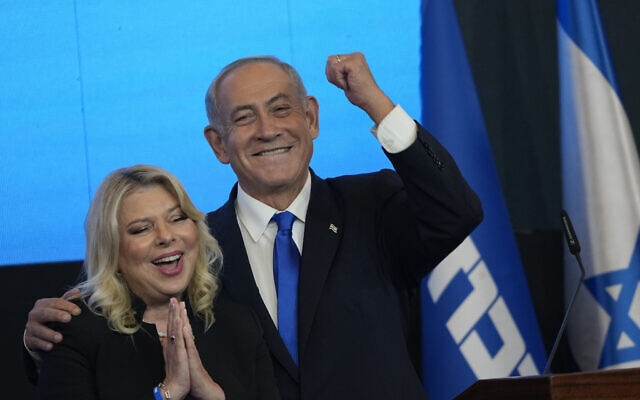
Likud leader Benjamin Netanyahu addresses supporters at the party’s campaign headquarters in Jerusalem early on November 2, 2022, with his wife Sara at his side. (AP Photo/Tsafrir Abayov)

"We want to make a total separation between those who are loyal to the state of Israel -- and we don't have any problem with them -- and those who undermine our dear country."
"[I will work on behalf of -- in an anticipated ministry appointment] everyone, including those who detest me.”
Itamar Ben-Gvir, Religious Zionism party 
The sweep of Benjamin Netanyahu's Likud party, gaining 64 seats for a clear majority does not exclude the need for him to make accommodation with other winning parties for a ruling coalition. His choices are limited by necessity to other parties in the realm of considered right-wing ideology, among them Orthodox religious parties who tend to be right-wing in the sense of stout nationalism. A fact that makes some of Israel's strongest allies rather nervous.
 
Israel's most recent flirtation with its vocal left-wing factional parties gave ample \proof to the majority of Israeli voters that a less concessional, more assertive hand was required in dealing with Israel's opponents in the Arab world, most particularly its Palestinian neighbours, but hugely inclusive of Iran and its satellites: Iraq, Syria and Lebanon. By extension and seriously endangering the Jewish state, Hamas in Gaza and Hezbollah in Lebanon with their more sophisticated rocketry stockpiles.
 
Israelis, living through more recent months of a serious uptick in attacks by Palestinians, through deadly knifings, car-rammings, shooting, rioting and rock-throwing, snipers and rockets have experienced unnerving times. The rhetoric that continues to damn Israel from the mouths of the Palestinian Authority which continues to incite violence against Jews and defiantly continues its 'pay-for-slay' program, extolling the virtues of killing Jews and paying handsomely for those acts proves there is no 'partner-for-peace' in that arena.
 
The fifth election in less than four years, controversial but determinizing, delivered a clear message; conciliatory overtures to Israel's legions of enemies hasn't worked, and will not work in a geographic region where civility is viewed as weakness and respect goes to those who demonstrate the strength of a firm authoritative response to violence. Israel's military has its role in maintaining security as does its internal and external intelligence and policing agencies.
 
In the shadow of the Religious Zionism party, third in seats in the new Knesset, its leader is known to chant "Death to terrorism", an alumnus of the old (Jewish Defence League) Kach Party, now outlawed in Israel. Its leader, ben Gvir, calls for a tougher reaction against Palestinians who respond to the PA's incitement to violence, and to Palestinian Israelis who choose, despite their Israeli citizenship, to mount attacks on the military and on Jewish Israelis.
 
And nor have many Palestinian Isrraelis, democratically voted into office as Members of the Knesset, proven themselves loyal to the nation of their citizenship, infamously supporting terrorist acts and Hamas terrorism against Israelis, some going so far as quietly collaborating with groups like Hamas and Palestinian Islamic Jihad. Their sympathies and actions in sharp contrast to the many Israeli Palestinians who serve in the military, join the judiciary, are appointed to elite medical service and are loyal to Israel.
 
While the Palestinian Authority speaks of Israeli 'racism' and 'extremism' it is a reality that Israel has absorbed as citizens over a million Palestinian Arabs, while the PA has pledged that not one single Jew can become a citizen of a nascent 'Palestine'. And while among the religious zealots in the settlements there are youth who harass and commit violence against their Palestinian neighbours they are outliers in Israeli culture, whereas Palestinians who murder Jews are celebrated martyrs. 

Labels: , , , , ,

Wednesday, June 17, 2020

Justin Trudeau's UN Security Council Leverage For Influence and Impact and Engagement

"Getting a seat on the UN Security Council itself is not an end to itself, it's a means to an end. It is a way for Canada to continue to be influential and have an impact."
"We are more engaged and we will continue to be more engaged on the world stage."
"One of the things we have seen through this pandemic is just how interconnected and interdependent the world is. Now is the time for us to reflect on our multilateral institutions and how they can be improved given this crisis."
Prime Minister Justin Trudeau

"There was a lot of activity on the ground going from mission to mission, literally ringing the doorbell [In Canada's campaign for a revolving seat on the UN Security Council during the 1988 atempt]."
"There is a lot riding on the ambassador and the relationships he has established. I can't think of anyone better suited to do this [whip votes among the UN membership in support of Canada's bid]."
"You need the support at the highest level, you need the support for your prime minister."
"My feeling is that Canada has a very good chance to make up for that shameful defeat [when in 2010 Canada's bid lost out to Portugal, under the former Conservative government led by Prime Minister Stephen Harper]."

Yves, Fortier, former Canadian ambassador to the UN, 1988 to 1992
Prime Minister Justin Trudeau delivers remarks during the Nelson Mandela Peace Summit plenary session at the United Nations headquarters on Sept. 24, 2018. (Adrian Wyld/The Canadian Press)


This government decided to swerve from its normal stance of either voting against or abstaining when votes targeting Israel are brought with stunning regularity before the General Assembly as the UN's perennial whipping state through resolutions usually brought forward by members of the Arab League, the Organization of Islamic Cooperation, or the Non-Aligned Group supported by 'socialist' countries such as Venezuela and Cuba. In the last round, Canada directed its UN ambassador to vote with a condemnation of Israel.

A thinly disguised gambit to curry favour with the influential Muslim and Arab voting blocs. One that failed to impress, however. As 'pro-Palestinian' groups in Canada put it, such as Canadians for Justice and Peace in the Middle East, the defeat "proves that Canada's failure to demonstrate leadership on human rights and international cooperation has isolated it from world opinion. In recent months, Trudeau has also been relatively quiet on the threats of Israeli annexation, especially when compared to the vocal and long-standing condemnations from competitors Norway and Ireland."

So there's that perspective and that voting group heard from. Which remains dedicated to the fallacious narrative that their historical version supercedes that of boundless documentation from the Old Testament to ancient chroniclers such as Josephus in ancient Rome writing about the Jewish struggle to remain within heritage Judean land, much less the archaeological evidence of Judeans as the original inhabitants of their portion of the Middle East, soon to be called Palestine, which Arab 'Palestinians' now claim as their own.

Justin Trudeau reviled the government of his immediate predecessor, Stephen Harper, and to this very day refers to his prime ministerial conservative counterpart as a catastrophe for Canada as a governing agent. Yet the contrast between the two men could not be greater. One of whom was a resolute, authentic, intelligent and reliable steward of the nation's democratic values, supporting justice and equality, while meting out equal treatment to provincial interests; whose personal agenda was never to enrich himself or gain personal power.

And that description is not one that fits Justin Trudeau's years of administering Canada's affairs. He, rather, has a history of mean-spiritedness in persecuting those he feels have failed to bow to his commanding presence, a prime minister who curried favour with influence and power, expressing admiration for dictators' effectiveness in governing, a hypocrite of the first water in claiming to be a feminist, shunning racism and supporting Aboriginal claims for justice and equality.

None of the issues that darkened his rule, like his malignant campaign against Vice-Admiral Norman, his exploits in embarrassing Canada while making an theatrical ass of himself in India, his pursuit to suborn justice in the Quebec-based SNC Lavalin affair in harassing then-Minister of Justice and Attorney General Jody Wilson-Raybould, his man-handling of a female reporter in B.C., his shameful blackface poses, his conceited selfies, and above all, his sidestepping Parliamentary democracy during COVID-19.

All instances writ large in modern history as personal failures impinging on public duties as failures to rise to the occasion of minimal expectations in administering a nation's weal, where among the most serious of his deficiencies was his constant undermining of the fortunes of the province of Alberta which had long been the major support for equalization payments doled out to the 'have-not' provinces of confederation. His alienation by interference and neglect of Canada's Western provinces produced a two-tier nation of resentment and threats to secede from an unequal status imposed by a hostile government.

Now, to top off all his other failures in government aside and apart being a major embarrassment on the world stage in Justin Trudeau's handling of sensitive relationships with other democratic countries and his failure to defend Canada's interests from countries whose malign influence has been inimical to Canada's stability and fortunes such as Iran and China, his lavishly sought-after legacy project that he focused with laser vision on, to be elected to the UN revolving Security Council for a two-year stint for the prestige and glory it would drape this vain entitled man in, has also failed.


Labels: , , , ,

Saturday, June 13, 2020

The Rush to Join a Dysfunctional, Corrupt World Organization

"We will phone member states to ensure they got out to vote, a lot like a usual election. We'll want to make sure that the voters that we've identified as supporting Canada go out and express their vote."
"Haiti had a peacekeeping mission from 2004 to 2020 and it was focused on security and on human rights, but very little focus on development."
"In Sub-Saharan Africa, you have 70 percent of the population that is below 30 years old. Half of that population is without an occupation even before the pandemic. This is a big security issue."
"If that multilateral world doesn't exist, then you're in a situation where only the strongest will prevail. And we know where it leads, because we're only a middle power."
"When you're around that table, you are more influential, if you're more influential, you've more relevant and if you're more relevant, that will represent opportunities for Canada."
Marc-Andre Blanchard, Canada's permanent representative at the United Nations
The United Nations Security Council meets to discuss the situation in Venezuela in the Manhattan borough of New York City, U.S., in January 2019. Canada is vying with Ireland and Norway for two open seats at the council, which will be allocated in a vote on June 17. (Carlo Allegri/Reuters)
Next Wednesday UN ambassadors will begin voting at the General Assembly in groups, to avoid crowding, in respect of the need for social distancing in the time of COVID-19. They will be voting to bring into the two-year temporary revolving Security Council one candidate from the competing countries in this vote; Ireland, Norway or Canada to sit on the 15-member council that complements the permanent Security Council, comprised of the United States, Russia, France, Great Britain and China.
"We know that engaging around the world is important both for Canadians' health and well-being, but also for the good of our economy."
"Even as some of our allies, including the United States, seem to withdraw from the world, Canada is engaging."
Prime Minister Justin Trudeau

"Them [sic] looking at the UN Security Council seat without looking at Canada's foreign policy, and understanding where we are in the world, and what our relationship with our allies and our adversaries alike should be, means that they didn't know what they were going after."
"Justin Trudeau has made some really damaging actions to our relationship and eroded our reputation on the world stage. We don't know what they're willing to trade away to get the seat."
Leona Alleslev, Opposition Conservative Member of Parliament
This would be Justin Trudeau's crowning achievement, his legacy project, his on begging, borrowing or buying votes to bring Canada to a seat on the UN Security Council. This is not a project supported by most Canadians, to whom the very project itself is simply a yawn, acknowledging yet another vanity project by a politician who revels in attention-getting and absurd declarations such as Canada, under his guardianship has 'returned'. What it has returned to is the usual Liberal brand of hoodwinking the electorate, with a special Trudeau touch of cynical sanctimony.

But this project to attain a two-year seat is dear to this man's idea of elevating himself in the esteem of the movers and shakers in the world body, to attain a level of influence and the aura of power that Justin Trudeau feels should be accorded him. He has himself personally taken the time and trouble to speak with as many world leaders in the past weeks as he could possibly tuck into a schedule that includes having his government tackle critical issues such as the handling of the COVID-19 pandemic's effect on Canada, both in medical terms and economic.

There are ongoing protests headed by Black Lives Matter resulting from the murder of George Floyd in the United States, and the allied issues of the desecration of national monuments, history's heroes now revealed by Indigenous and Black groups to be racists. The icons of Canadian history, according to the protest groups, preyed on native populations, were bigots and racists and their statuary must come down, public institutions such as schools, libraries, municipal buildings, street names, must be dismantled, their memories erased.

Canada's ongoing problems with the United States in trade issues, with Saudi Arabia, in arousing the Kingdom's ire over perceived interference in its human rights record, its problems with China whose human rights record is rarely raised, but when an issue such as a request through an American court of justice for the extradition under an agreement between Canada and the U.S. saw China's tech giant Huawei's CFO arrested on a U.S.warrant, spurring China to kidnap two Canadians doing business in China.

None of these issues, apparently, occupy too much time and energy for the prime minister, that he is unable to muster gaps of opportunistic time to engage in cajoling, jollying, and pleading and bribing sometimes unsavoury governments to cast a vote for Canada's bid in the U.S. Both Ireland and Norway, the other two candidates for the vacant seat, have somewhat greater sway in the corridors of the UN. Both give a higher percentage of their GDP to global equity support, and are more involved in UN peacekeeping.

The former U.S. ambassador to the United Nations, placed Trudeau's eagerness not to be too morally or ethically particular about where his votes come from in context, when Nikki Haley in outrage over an executive order from Justin Trudeau to Canada's UN representative to have it on record that Canada supported an anti-Israel motion at the United Nations last year, that he prepared himself to dance with the devil to achieve his end.

Israel, after all, swings one vote, whereas the Organization of Islamic Cooperation can be counted on for at the very least the votes of 53 countries, not to discount the influence the OIC has with the Non-Aligned group of countries within the UN which curries favour with the Arab League and the OIC. But no cost to Canada's moral dignity is too dear to pay for Junior Trudeau's vanity project to sit with the Big Boys of Global authority. For he believes that the world needs more Trudeau, which he deliberately conflates with Canada.

Ms. Alleslev points out the embarrassment on the world stage that Canada suffered with Trudeau's visits to India, or how petty and childish his behaviour was seen during the Trans-Pacific Partnership trade talks as he stalled negotiations and insisted on his version of worker equality, female entitlements and LGBTQ-2 and union issues be considered. According to Canada's Blanchard, Canada's focus is on economic security issues, to rectify the UN's focus on short-term security needs, ignoring long-term economic needs that play into violence and chaos.

Haiti, he points out, still sees ten percent of its population malnourished, with 40 percent dependent on humanitarian assistance. Canada, on the other hand, the sterling representation of a wealthy nation where equality of opportunity is paramount, guaranteeing everyone the chance to live a full and happy and healthy life, has hundreds of food banks to give aid and assistance to the homeless, to the unemployed, to welfare recipients and people living under the poverty line.

This is the first prime minister who has managed to suspend democracy in Canada. He has effectively dismissed the House of Commons. Parliament no longer sits for the purpose for which it was designed, allowing this government and this prime minister to simply proceed with initiatives they feel will benefit them, over the needs of Canadians. He has stilled his critics from the House of Commons by disallowing them the opportunity to question his government's decision-making while he ransacks the nation's economy.

This is tyranny, not democracy. And he would, in fact, fit right in with many of the other members of the Security Council, both temporary and permanent. 

Senegal's President Macky Sall, left, walks alongside Prime Minister Justin Trudeau after arriving at the presidential palace in Dakar, Senegal, Wednesday, Feb. 12, 2020. Trudeau received Senegal's support for a seat on the UN Security Council. (Cheikh A.T/The Associated Press)

Labels: , , , ,

Friday, June 12, 2020

The Ignomy of Incomplete Disclosure

"...But the minister’s latest disclosure was only made on June 4, just a few days ago."
"So did the minister disclose both mortgages when he was elected in 2015 or not?”
"[Canadians may bank all over the world], but there’s a big difference between a Canadian having a mortgage at a Chinese bank and Canada’s most senior diplomat being indebted to the PRC."
"Owing someone over a million dollars — that’s pretty big leverage."
Andrew Scheer, Leader of the Official Opposition, Parliament of Canada
Conservative Leader Andrew Scheer wants Foreign Affairs Minister Francois-Philippe Champagne, pictured, to explain how his holding two mortgages with a Chinese bank doesn’t compromise his ability to deal with the People’s Republic.
Francois-Philippe Champagne, Minister of Foreign Affairs, Canada

"The arrangements of your private affairs should bear the closest public scrutiny.This is an obligation that is not fully discharged by simply acting within the law." Advice/guidelines clear enough in a mandate letter Minister Champagne received on his appointment as Minister of Foreign Affairs. for any halfway intelligent individual to fully understand. Yet, a Minister of the Crown, serving Canada, allowed himself to be compromised in a very sensitive position, making him vulnerable, if not to blackmail, then at least gentle coercion.

This is a man who, as a private businessman operating out of London, England, bought two costly properties, and to finance their mortgages, he turned to the Bank of China, entirely state-owned, explaining that he hadn't been successful in trying for mortgages from British banks. When he left private life and ran for Parliament as a member in the House of Commons, representing Saint-Maurice—Champlain. 

There are two mortgages on the two London properties, totalling $1.2 million. Although the matter was not in the public domain, Minister Champagne, on his election as a Member of Parliament in 2015 divulged the matter to the Ethics Commissioner. At a time when he should have been seriously counselled to dscharge the debt, either by selling one or both of the properties, or financing one t the cost of the other, and ridding himself of the debt.

It is well enough known that Canada has an uneasy relationship with China, and that China is a belligerent state with a reputation of bullying its near neighbours in its determination to expand its territories on land and at sea. The Peoples Republic of China under the Chinese Communist Party spires to spread its influence the world over as a trading Goliath and a infrastructure investor in Africa and among other emerging economies, loaning out funds to countries that will never be able to repay them and will be forever indebted to China.

In his previous posts as infrastructure, then trade minister before taking on the most important and prestigious of the ministries, his financial indebtedness to a Chinese bank would not have elicited as much attention as it does at the present. The two properties in London, purchased in 2009 and 2013 while a temporary resident in London, await a solution. Previous statements of his have now come back to haunt him: "China", he said in 2017, is "a beacon of stability, predictability, a rules-based system, a very inclusive society".

The very fact that a Canadian minister, much less the most senior of minsters' portfolios is indebted to The Chinese communist Party to the tune of over a million, is as far from doing the right and the legal things as possible, leaving the unfortunate perception that, the man who must be found to be without blemish in character and rectitude may be anything but. Borrowing substantial funds from the domineering Peoples' Republic is ill-considered at the best of times, threatening to engulf this portfolio in deep discredit. 

"It is inconceivable that this is not at the back of his mind as he deals with the government of China, his most difficult file", stated Margaret McCuaig-Johnston, senior fellow at the China Institute at the University of Alberta, once a senior Ottawa bureaucrat herself, shaking her head in disbelief from her perspective as a senor diplomat with 37 years' experience of an issue more serious than she can recall ever having encountered.

China’s Foreign Minister Wang Yi and Canada’s Foreign Minister Francois-Philippe Champagne attend the plenary session at the G20 Foreign Ministers’ Meeting in Nagoya, Japan, November 23, 2019. REUTERS/Kim Kyung-Hoon

Labels: , , , , ,

Monday, June 08, 2020

Consigning Canada's Seniors to COVID-19

"With the onset of the pandemic it revved  up that discussion [the issue of hospital emergency department avoidance on the part of long-term care homes]."
"There was very little that could be offered in the hospital that could not be offered in the nursing home [feeding assistance, oxygen, hydration, ever control]."
"It wasn't part of the planning to transfer individuals to emergency departments."
"Both the prime minister and the premier said they were going to target the more frail and vulnerable population around the end of March, but the reality was there wasn't a lot of help happening."
Dr.Fred Mather, president, Ontario Long-Term Care Clinicians

"I think residents that are sick with COVID-19 should be in the hospital."
"How we care for this age cohort is so tragically unsuccessful compared with how other countries dealt with the same problem it really demands a thorough investigation and it demands an adjustment in real time."
"The pandemic is not over. This is just the first wave and there is no need for us to continue to operate in the same way."
Michael Hurley, President, Ontario Council of Hospital Workers

"Many people died in situations that were very horrendous because they weren't sent to hospital."
"Long-term care, no matter what the government has said in the past, cannot give proper palliative care in these situations."
"We have heard of homes that had written policies not to send people to hospital without the doctor's OK. We have had many callers say that they had to force homes to call an ambulance for their loved ones."
Jane Meadus, staff lawyer, institutional advocate, Advocacy Centre for the Elderly
An employee serves a resident at CHSLD Éloria Lepage in Montreal. As the pandemic continues to take lives in seniors' homes, the federal government is being pressed to fund the repair and construction of long-term care facilities. (Ivanoh Demers/Radio-Canada)

Canadian authorities at all levels had long before the appearance of the global pandemic, been informed of the vulnerability of the health-impaired, the elderly, those with compromised immune systems, living in inadequately regulated long-term care institutions. Inadequate staff numbers, poorly paid, poorly trained and equipped staff, staff due to an inability to get enough working hours to make a decent living, working in a number of care centres making transmission of illness almost inevitable.

The result was that when COVID-19 arrived on the scene, government orders went out generally for social isolation and lockdown procedures to defend against wholesale transmission in t he face of a novel coronavirus with a raging appetite for infection, and for many people, a devastating impact on their health and longevity prospects. There was a fear that hospitals would be overwhelmed by the sheer crush of patients succumbing to the disease, requiring respirators and isolation. But evidently no thought wasted on the welfare of elderly people unable to self-isolate.

An elderly woman seen sitting in a room at the Lynn Valley Care Centre seniors facility in North Vancouver, B.C., on March 14. It was the first nursing home in Canada to experience an outbreak among its residents. (Darryl Dyck/The Canadian Press)
There were disturbing conversations taking place between authorities and emergency room physicians of difficult choices having to be made potentially; that when confronted with a young patient whose future prospects for recovery were contingent on heroic measures, and an elderly patient whose symptoms appeared dire, that those heroic measures would be withheld in a deliberate choice to make them available to the younger patient with a future.


That kind of 'difficult choice', appears to have permeated on a long-standing basis, the protocol at long-term care homes when an inmate became very ill, to refrain from sending them to hospital and just more or less muddle along; death was 'imminent' in any case, for elderly and frail individuals, why fight it? Except that this attitude led invariably to a horrific number of elderly and health-impaired dying painfully without adequate treatment and end-of-life comfort. The death count among the elderly in long-term care homes accounts for 80% of all deaths in Canada due to COVID-19.

When it was discovered weeks ago that such facilities in Quebec and Ontario were losing an astonishing number of patients to the novel coronavirus, that infection also afflicted long-term staff who may themselves have infected the elderly in their care, as they moved from home to home to home as workers, the home managers and the provincial governments in alarm, pleaded for aid from health workers from local hospitals.

That helped, but more assistance was badly needed, and the military was requested to deploy member of their health-care delivery system. Some nurses re-assigned from  hospitals were aghast at the conditions they discovered at the homes -- in lapses in sanitary conditions, in responding to the needs of the patients, in drug management -- but little heed was taken. And then the Canadian military produced a report that shook the nation.
An Armed Forces member walks out of CHSLD Yvon-Brunet on April 18. About 125 military nursing officers, medical technicians and support personnel were sent to help after Quebec asked Ottawa for assistance. (Graham Hughes/The Canadian Press)
That report detailed inadequate nutrition and hygiene procedures, poor infection control, residents left in soiled diapers, a lack of wellness checks, lack of response to residents crying out for help, and many other instances of institutional dysfunction. At the best of times, pointed out institutional advocate Jane Meadus, such homes are not equipped to offer the care and pain relief that hospitals can and do to end-of-life situations. Family members of patients who ordinarily arrived to help care for their elderly loved ones were no longer admitted to the homes when COVID-19 struck.

By no means were all provincial long-term care homes in such a deplorable state, and many had no cases whatever of COVID-19, though others that did, were able to manage the situation fittingly, as opposed to those who were overwhelmed by the demands placed on them as home residents became ill in droves and many perished of the COVID effects.

Ms. Meadus points to alarming reports out of Italy in the early stages of the global pandemic, alerting health-care workers to the dire situation faced in Europe and the focus on ventilator use for patients. "The decision of whether to send long-term care residents who have COVID-19 to hospital is made on a case-by-case basis by a physician in consultation with the resident and their family", a Ministry of Long-Term Care spokesperson explained. "If residents who tested positive for COVID require medical attention that the long-term care home is unable to provide, these residents are transferred to hospital to meet their health-care needs."
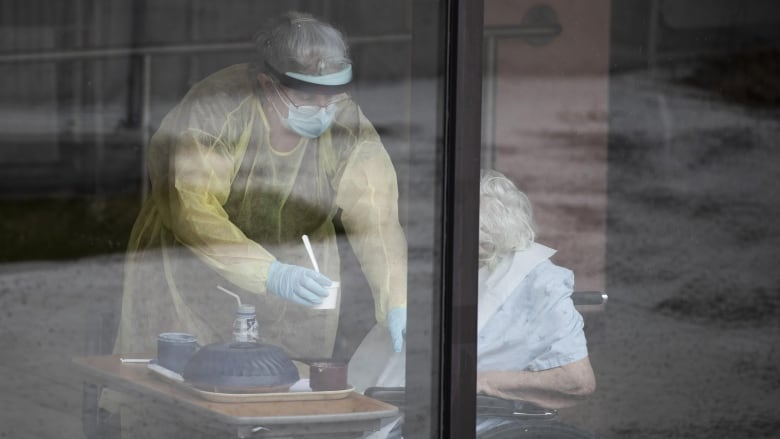
A man wearing a protective suit and a mask is pictured at the Lynn Valley Care Centre in North Vancouver, B.C., on March 9. (Ben Nelms/CBC)

A logical explanation which manages to sidestep the culture in nursing homes of retaining patients in the home, and refraining from sending them to hospital emergency rooms, under the belief that hospitals were there for intensive care and "heroic measures". There were, pointed out Dr.Fred Mather of the Ontario Long-Term Care Clinicians, no clear policy decisions on transferring long-term care residents to hospital even though emergency department avoidance was an active topic before the onset of the pandemic.

The confusion over the situation, where government inspections of the homes failed to detect problems, overlooked what problems they might identify of a minor nature, and seemed not to notice that some homes where up to 50 residents died, were inadequately staffed, the patients left on their own, wallowing in their own fecal matter, crying for help, dehydrated and unfed is one requiring deep and determined investigation -- both of the homes involved and of the inspection units' commitment to ensure safe and secure environments for the elderly prevailed.

At the federal, provincial and municipal levels, governments have been embarrassed at the very least, horrified and guilt-ridden as well perhaps, maintaining their intention to change the system completely from the dreadful mess the military report described -- to one that meets the minimal standards of dedication to care of the elderly. Typically of this Liberal federal government that promised a transparent, open government, the military has been ordered not to publicly air any further such reports of malfeasance and neglect on the part of the nursing homes.

The Ontario Nurses’ Association (ONA) has asked a judge to order three homes, including Eatonville Care Centre in Etobicoke, to stop “breaching” directives made by Ontario’s chief medical officer meant to protect the vulnerable seniors and the staff that serve them.

Labels: , , , ,

Wednesday, June 03, 2020

Courting the UN Vote, Revealing Unsubtle Bias -- It's The Liberal Way

"All the plans offered to us in the past included renouncing parts of Israel, withdrawing to the 1967 borders and dividing Jerusalem while allowing refugees to enter Israel."
"This plan offers the opposite. We are not the ones required to give up [territories], the Palestinians are."
Israeli Prime Minister Benjamin Netanyahu
Canadian Press
"I've been very direct with the Israeli leaders. We deplore such actions, which are going to delay any prospect of lasting peace in the Middle East."
"So, we should be working while respecting the concept of dialogue. And we are very concerned."

"I have highlighted both publicly and directly to Prime Minister Netanyahu and alternate Prime Minister Benny Gantz the importance of staying away from measures that are unilateral and our deep concerns and disagreement with their proposed policy of annexation."
"We think that the path forward is a two-state solution reached to by dialogue between the parties involved and anything that is unilateral action by either side is unhelpful in the cause of peace."
Canadian Prime Minister Justin Trudeau

"The comprehensive U.S. Peace Plan is the only viable peace initiative currently on the table trying to solve the Israeli-Palestinian conflict. Israel has accepted its foundations, despite concessions which will be required on our behalf. However, the Palestinians have rejected it outright, once again closing the door on any option to negotiate a peaceful future."
"While it is dismaying that diplomats would choose to attack Israel rather than try to facilitate dialogue between the two sides — or at the very least urging the Palestinians to return to direct peace negotiations – Israel will nevertheless remain committed to the U.S. peace plan, in hopes that we eventually find a way to resolve our differences."
Ohad Kaynar, chargé d'affaires at the Embassy of Israel in Canada

"Annexation of the West Bank is clearly an issue that most UN members disagree with and this is likely to be seen favourably by those states still trying to gauge what kind of Canada they would get on the coveted UNSC [United Nations Security Council]."
Bessma Momani, Middle East expert, University of Waterloo

"Today's comments by the prime minister do not change this long-standing entrenched track record of acting as an asset for Israel."
"Ireland and Norway have not voted against any UN resolutions on support of Palestine during this century."
Karen Rodman, spokeswoman, Just Peace Advocates
Israeli Prime Minister Benjamin Netanyahu, left, and his wife Sara, with Prime Minister Justin Trudeau, attend ceremonies at the Arc de Triomphe Sunday, Nov. 11, 2018 in Paris. (Francois Mori/The Associated Press)
Peace negotiations? They've stalled, the Palestinian Authority refuses to rejoin Israel at the negotiating table. Time and again. A reasonable proposal was made to carve out areas in Israel with majority Arab-Palestinian populations to transfer them to Palestinian rule, while doing the same with the Israeli 'settlements' in what the world insists on calling the 'occupied' West Bank, an equal measure of territory that would be governed and held by Israel. Made part of a potential plan for peace, that too was rejected by the Palestinians.

Tellingly, the Palestinians with Israeli citizenship living in those areas of Israel that were proposed as transferable to Palestinian rule, themselves rejected the proposal, preferring to live under Israeli governance as opposed to Palestinian. As Israelis, they have their elected Arab legislators, as Members of the Knesset -- the Israeli parliament -- who advocate on their behalf and who also agitate to the extent that some of their actions can be construed as anti-Israel. In contrast, the Palestinian Authority has made it clear that no Israeli Jews will ever live among the Palestinians.

Countries of the European Union, Canada and others who insist that Israel keep sacrificing itself to satisfy the ever-growing demands of the Palestinian leaders have never had to live under the constant threat of a neighbour inciting its people to violence against them. Constant vigilance to ensure that as many of the violent threats that can be apprehended as possible takes its toll, both on the civilians being targeted and the security forces tasked with their protection.

In insisting that Israel maintain its laser focus on a peace settlement without exerting pressure on the Palestinian Authority to do likewise, Israel's critics are satisfied to hold the Jewish state to account for not living up to its critics' expectations, while forgiving the Palestinians all their blatant, obvious efforts to destabilize Israel by attacking its people with knives, vehicles, rockets and suicide attacks, expecting nothing better of them and signalling that whatever they do is justified.

Someone like Justin Trudeau who has mismanaged the governance of a peaceful, prosperous country like Canada to the extent that east and west have become disengaged from one end of the country to the other has nothing whatever to teach a nation of survivors like Israel. Justin Trudeau, as prime minister of Canada, has constantly exhibited himself as a selfish narcissist, a thin-skinned ideological partisan, a hypocrite and vindictive in character.

His personal assault by proxy on the second in command of the Canadian military, Vice-Admiral Norman, his aggravated harassment of the nation's former Minister of Justice to flout the law in favour of a Liberal stronghold in Quebec, his shocking lack of ethics in matters of personal gifts by influential wealthy government lobbyists, his lack of leadership in failing to support a vital energy sector in extracting fossil fuels in part of the country that has traditionally given financial support to economically weaker provinces, all paint a sordid picture of failure.

He and the party he represents have nothing whatever to teach the executive branch of other nations. Not only is Justin Trudeau preciously sanctimonious, flaunting himself as a theatrical superstar, he is also a shallow ideologue, an intemperate egotist whose presence on the theatrical stage would never have done the harm to the country he now governs that his decision-making has caused to national unity, Canadian pride and civil functioning. He has succeeded in destroying the Democratic process in Parliament under guise of a necessary response to SARS-CoV-2.

His ambition to have Canada under his imprimatur be voted a temporary two-year seat on the revolving UN Security Council where he believes he would have access to the movers and shakers of the world as his just due, directs many of his actions in his preoccupation with prestige for himself on the world stage. And his statement regarding Israel's decision to reclaim its heritage rights against the claims of wrongful ownership of Arab 'settlers' on heirloom Judean land is meant to favour Canada's UNSC bid with the voting blocs that the UN's Organization of Islamic Cooperation, the Non-Aligned Movement and the African Group represent.

Amusingly enough, right in Canada he has opposition to his ambition for that UN revolving Security Council seat, with a coalition of 100 organizations and people which collectively support 'justice for the Palestinians', which equates with destruction of the State of Israel, in their demands for 'right of return', to swamp the population of Israel with majoritarian Arabs, over and above the million and a half who now hold Israeli citizenship.

Israeli soldiers taking position as Palestinian demonstrators gather during a protest against the expansion of Israeli settlements, in the West Bank village of Beita, near Nablus, March 2, 2020.
Israeli soldiers taking position as Palestinian demonstrators gather during a protest against the expansion of Israeli settlements, in the West Bank village of Beita, near Nablus, March 2, 2020.  Credit: Majdi Mohammed/AP

Labels: , , , , , , ,

Saturday, May 23, 2020

Notes On A Second COVID Wave

"No one in Canada still alive is used to these types of sacrifices or public policy moral quandaries. Things will not be normal until we get a vaccine."
"There's an overwhelming sense internally that people won't take to a second lockdown. One thing is for certain, we need to give the public some freedom or they won't accept even basic limits."
Name-protected Ontario government official

"An issue of concern is, the longer this drags out, the more restrictions are applied, then lifted, then applied, the more people are going to get social distancing fatigue, and we can probably expect to see an increase of non-compliance with social distancing."
"People are resilient and will eventually adapt to new restrictions, but it's important that they have a realistic idea of how long it's going to last. That requires good data to forecast the trajectory of the pandemic and governments willing to level with their citizens."
"That's going to scramble the system. It's going to confuse people [different messages from the federal government and the provinces]. People are going to downplay or dismiss the messages they don't want to hear." 
"So people might say, well, we're locked down but people in the other province are out partying. That's going to diminish the credibility of the last message."
Steven Taylor, psychologist, expert, psychology of pandemics, University of British Columbia
Medical staff in protective gear work at a 'drive-thru' testing centre for COVID-19 in Yeungnam University Medical Centre in Daegu, South Korea, on March 3. Because Asian nations experienced the outbreak much earlier, Canada can take lessons from them about preventing a second wave of infections. (Kim Kyung-Hoon/Reuters)

"People say that's a very distinct possibility [tackling hotspots as they arise, as opposed to closing down the entire country], it's standard, and we're gonna put out the fires."
"We're not going to close the country, we're going to put out the fires."
"There could be, whether it's an ember or a flame, we're gonna put it out. But we're not closing our country."
U.S.President Donald Trump, Washington

"We know particularly in those areas that are still working to get the spread of the virus under control it is going to be important to increase testing now ... but also make sure that as we move forward through the summer and into the fall, we are ready to act extremely quickly, so that the population at large won't be in situations of having to go back into confinement."
"But that depends on citizens doing their part, and also depends on having that testing capacity."
"We need to continue to do everything we can to prevent the need for any further lockdowns the way we've had up till now."
Prime Minister Justin Trudeau, Ottawa
COVID-19 test
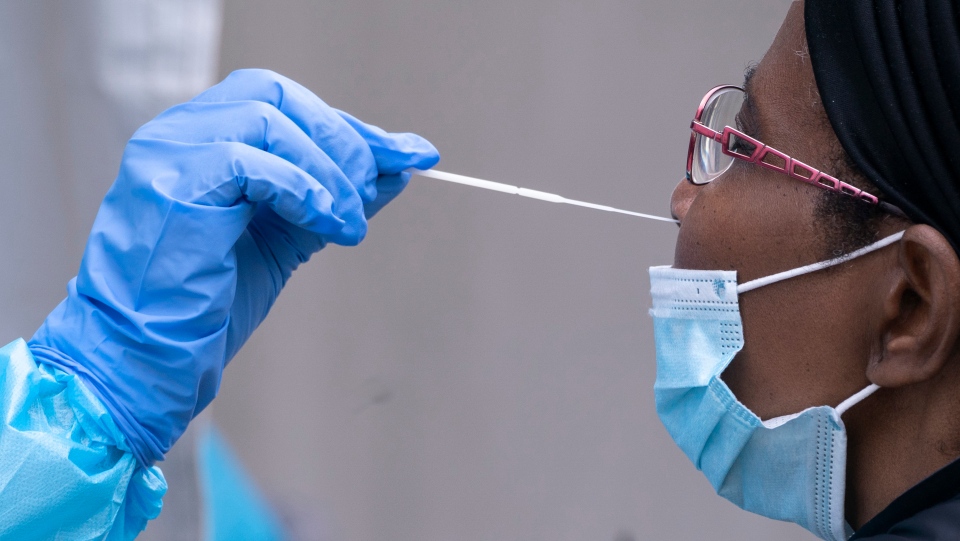
A woman is tested at a temporary COVID-19 test clinic in Montreal, on Friday, May 15, 2020. (THE CANADIAN PRESS / Paul Chiasson)

There certainly are differences in attitudes and outcomes respecting the SARS-CoV-2 virus causing COVID-19 between the two countries. Where Donald Trump hasn't self-isolated, continues to make public appearances, balks at wearing a face mask, and goes out of his way to encourage States of the Union to begin to open their economies and their societies to bring both back to normal in hopes of rescuing their financial situation, along with those of the U.S. He defies both public opinion and scientific recommendations by making use of a malarial drug whose usefulness against COVID is unproven.

And then there is Justin Trudeau, who wears a mask, daily addresses the Canadian public from the steps of his 'cottage', urging caution, and who has shut down Parliament but for virtual sittings, and who has self-isolated for the past two months, preferring to run his minority government like a majority government, issuing new news of new sectors of society and business becoming eligible for public-supported financial assists. Justin Trudeau is operating the country like a private fiefdom, throwing loaned money at every problem due to COVID-19 as a solution. In isolating himself he makes no public appearances in pursuit of his position as prime minister.

The United States has been hit particularly hard in the number of COVID cases being racked up, including a huge death toll, particularly in New York State and City both acutely impacted by COVID. In Canada, with about one-tenth the population of its southern neighbour, both case load and deaths have been much lower per capita population base, but both countries have suffered devastating losses to their economies, suffering high unemployment and have been borrowing heavily to shore up industries in trouble, and people whose livelihoods have vanished.

And though both countries now appear to feel that they've succeeded in 'flattening the curve' of infection, they also acknowledge the possibility that what has thus far occurred may be but an initial flush of the disease -- which until a reliably efficacious and safe vaccine is discovered, produced and mass inoculation taken place -- rebounds of additional waves can be expected with equally devastating effect. Both countries know that to effectively protect their vulnerable populations, testing must be increased to contain their outbreaks.

In Canada and in the United States, each federal government enacts pandemic-reactive legislation, but both the provinces and the states have taken their own separate interpretations of how they will proceed. Since some provinces and states have been impacted more seriously than others, it makes sense that coming out of total lockdown the lesser-impacted will be more aggressive about opening up. Yet there is also the knowledge among authorities that populations are likely to react with resistance against schools, daycares and businesses opening, then closing again with a second viral wave.
Canadian cases
CONFIRMED
83,608
(Today: +1,139)
DEATHS
6,355
(Today: +105)
RECOVERED
43,084
(Today: +477)
1,493,327 tests administered  (Today: +19,572)
Retaining physical distancing will continue to present as a problem in opening workplaces, whether offices or production centres where the option of working-from-home is not viable. A diminished number of work stations will have to be addressed on its impact on the workforce and on the economy. And should the situation continue to fester, by next winter it is anticipated that the wearing of face masks may become mandatory everywhere. Aside from which the danger of mental breakdowns with a continuation of uncertainty and isolation measures represents a real danger.

Science, one of the world's top academic journals, published a paper evaluating the outcome of a possible second wave, and governments' possible reactions. The paper recommends thresholds for enacting strict physical distancing measures to be reinstated, should infection numbers reach 35 cases per 10,000 people, a threshold determined by local factors, including area hospital capacity. A study by the Center for Infectious Disease Research and Policy at University of Minnesota looks at the variety of forms by which a second wave can manifest.

Where a "fall peak" scenario was examined, of the possibility of a massive, single wave of infections, greater in impact than the initial wave the world has and continues to be occupied with. Where a "slow burn" might still be manageable to contend with -- if difficult to comprehend how that might be possible -- with a series of "peaks and valleys" bringing along three or four additional waves each approximating the size and impact of the first one the world is trying to recover from.

COVID-19
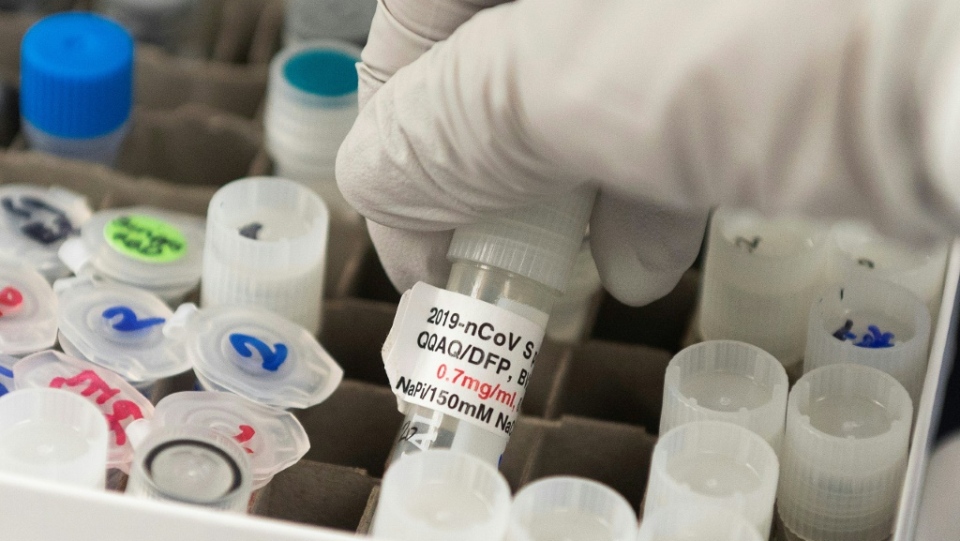
At Novavax labs in Rockville, Maryland, Dr. Nita Patel lifts a vial with a potential COVID-19 vaccine. (AFP)

Labels: , , , ,

Tuesday, May 19, 2020

Governing On-The-Cuff By Remote Decree

"The Liberal government has presented social distancing measures as a stark choice -- either selflessly shut down the economy to save lives or selfishly worry about the economy and condemn thousands to a vicious illness."
"[That approach] is being pursued at an almost incalculably large cost to the well-being of Canadians."
"The rationale for the lockdown seems to have morphed subtly from managing the outbreak by 'flattening the curve' to preventing the illness from infecting Canadians at all, pushing the timeline for a return to some economic activity into the summer and a return to 'normal' a year or more into the distance."
Macdonald-Laurier Institute letter: 24 scientific and industry representative signatories

"What's happening now is they're convincing people to continue being afraid, when what we need is a message of reassurance and confidence from government."
"They're contributing to an atmosphere of fear and uncertainty that is completely unhelpful as we try to move toward a more measured response to the virus."
"It's becoming clearer and clearer that the fear we experienced at the beginning, when we knew so little about the virus, is exaggerated."
Brian Lee Crowley, managing director, Macdonald-Laurier Institute

"More people are taking the view that the risk-benefit calculation here, where you avert the risk of transmission in return for suppressing the economy, that it's not a worthwhile sacrifice."
"We spooked people so well into staying home, to avoid social contact, that it is extremely difficult now to reverse that message."
"[There is a] growing chorus [of medical professionals beginning to question strict lockdowns that have carried on for months]."
Dr.Neil Rau, infectious diseases specialist, medical microbiologist, Oakville, Ontario

According to critics who take umbrage at Prime Minister Justin Trudeau's penchant for slamming critics of his policies as illiberal, racist and selfish, when they question his decision-making and claim that with the shutdown of the economy due to the novel coronavirus threat, having gone on to 'shifting the goalposts' for opening the country back to normalcy, his wildly disparaging comments and unwillingness to listen to advice from the source of the criticism has motivated a coalition of health experts and business executives to sign a joint letter of discontent.

Debate surrounding the severity and length of economic shutdowns cross-country which has resulted in the majority of Canadian business being shuttered, millions of people being put out of work, and the corporate and government balance sheets having been effectively eviscerated. No one disputes the initial necessity to effect a lockdown as a measure to respond to the COVID outbreak, but at the present juncture people question why a more limited shutdown hadn't been considered, in its effectiveness to keep from overwhelming the health care system.

Economic restrictions enforced under provincial emergency orders were the responsibility of provincial governments, yet the provinces and the federal government have been at loggerheads, with Ottawa failing in its responsibility to guide the country as a whole toward returning the economy to full capacity. While fully realizing the real risks to the public from the pandemic, it is vital, the letter-signers indicate, to rescue the country from its current predicament.

To that end, economic concerns should not be dismissed by the federal government as callous in the face of evidence suggesting the economic shock has deprived millions of people of a sense of stability as they have undergone a sense of shock, the question of whether a more limited shutdown might have been equally effective to ensure the health-care system was not overwhelmed. A heavy psychological toll has been taken on people's mental and physical health, alongside forms of violence such as a rise in domestic abuse.

Close to eight million Canadians have applied for federal financial support, having lost employment. Stock markets and public pension funds have suffered a beating in recent months, with vast sums of wealth and savings lost. Hospitals across the country remain below capacity, the expected surge of COVID patients suffering respiratory distress failed to arise, thanks in large part to the population's having adhered to the social isolation policy to 'flatten the curve'.

Sweden, which had taken a relaxed view on social restrictions, allowing bars and restaurants to remain open for business, along with schools for younger children, has become a focal point in the debate regarding the degree of lockdown required for a successful outcome. Where at present, though COVID-related deaths are higher than that of its neighbours, health experts in Sweden anticipate mortality rates will even out.

Governing by casual remote.
Prime Minister Justin Trudeau holds his daily COVID-19 briefing at Rideau Cottage in Ottawa on May 15, 2020. Sean Kilpatrick/The Canadian Press

Labels: , , , , ,

Monday, April 06, 2020

Manufacturing Crises Over Crises

"Ceasing all export of respirators produced in the United States would likely cause other countries to retaliate and do the same, as some have already done."
"If that were to occur, the net number of respirators being made available to the United States would actually decrease."
"That is the opposite of what we and the administration, on behalf of the American people, both seek."
3M Statement

"We are receiving essential supplies from the United States, but the United States also receives essential supplies and products and indeed health-care professionals from Canada every single day."
"These are things that Americans rely on, and it would be a mistake to create blockages or reduce the amount of back-and-forth trade of essential goods and services, including medical goods, across our border."
Canadian Prime Minister Justin Trudeau
A 3M mask — one of the items of protective equipment health care workers around the world badly need to cope with the COVID-19 pandemic. (Nathan Denette/The Canadian Press)


"To say that I'm infuriated with the recent actions of President Trump of the United States is an understatement."
 "I cannot believe for a second, in a time of crisis, that President Trump would even think about banning key medical supplies to Canada."
Newfoundland and Labrador Premier Dwight Ball


"[Ontario has just one week's worth of critical personal protective equipment for front-line health-care workers as it waits for more shipments]."
"[Around three million masks ordered from the U.S. have been held up by American officials, but 500,000 masks are being released today]."
"We're putting pressure on the U.S. government from all sides. [Those 500,000 masks] will buy us another week."
"What I understand is we had three million masks that were stopped by U.S. officials coming out of 3M in South Dakota."
"I just was briefed not long ago saying we were able to get 500,000 N95 masks moving forward that should be released today coming into Ontario."
Ontario Premier Doug Ford
Pushing back against orders from the White House to stop its export of surgical-grade face masks to Canada and Latin America -- equipment critical to the effort to control COVID-19 -- 3M, which manufacturers protective medical gear and sells their products to Canada, is contesting White House orders. Defiance against U.S. President Donald Trump's refusal to allow medical equipment to leave the United States has consequences for the company, but the Trump order also has consequences for the United States. Firm neighbours and trade partners do not abandon the need of neighbours by reserving vital emergency supplies exclusively for themselves.

As a "critical supplier" of the N95 respirators among other badly-needed emergency medical supplies, the company pointed to the "significant humanitarian implications" inherent in denying protective equipment to health-care workers as they man the front lines of a struggle against a global pandemic. The reminder to the Trump administration that there was a long-standing agreement between the two countries on trade, much less a more recent one occasioned by the COVID emergency to maintain the movement of goods, services and commerce across the border, was a lesson in diplomacy.

The fact is that U.S. manufacturers of medical equipment are in turn dependent on materials sourced from Canada to manufacture their products. As in the case of a Nanaimo, British Columbia mill that makes a special recipe of pulp for surgical masks, gowns and other medical supplies which has had to double  its production for American customers amid the COVID-19 crisis. According to Harmac Pacific president, Levi Sampson, round-the-clock mill production was diverted to make the medical-grade pulp.
“We’ve never had a doubling for this grade of pulp, so you can tell that there’s some supply problems out there. Every day it seems to be more and more health-care professionals are talking about either lack of supplies or worried about it in future", noted Mr. Sampson. As he also noted that his 300 full-time workers at the mill take tremendous pride that the product they're producing is so vital to the medical community in its fight against the scourge of the global pandemic.

Well over a million confirmed cases of COVID-19 have surfaced in short order around the globe, with in excess 60,000 deaths, of which 7,000 deaths occurred in the United States alone; far greater numbers in Spain and Italy, the virus hot-spots of Europe. There is no country in the world, developed and wealthy or developing and hobbling along that hasn't been stricken with the virus, and that find themselves short on medical supplies and personal protective equipment for their medical staff.

A World Trade Organization study found that China, Germany and the U.S. together produced 40 percent of all exports of personal protective equipment in 2018, inclusive of masks, and soap, sanitizer and protective goggles. In addition to which the U.S. holds roughly16 percent of the export market for ventilators and respirators, second to Singapore, at 18 percent. Today, U.S. President Donald Trump announced a deal with 3M to produce over 166 million masks and the company confirmed that both Canada and Latin America would continue to receive N95 respirators.

The 166 million masks that 3M committed to producing for the U.S. market, will be imported from China, from 3M's manufacturing sites located there (“3M will import 166.5 million respirators over the next three months primarily from its manufacturing facility in China, starting in April”). The products produced in the United States by 3M on the other hand, will be exported under the agreement, to Canada and Latin America.

"The Administration is committed to working to address and remove export and regulatory restrictions to enable this plan. The plan will also enable 3M to continue sending U.S. produced respirators to Canada and Latin America, where 3M is the primary source of supply." Warning, the U.S.Administration under the Trump White House has a penchant for surprises and off-the-cuff 'solutions' to pressing problems that confound rational thinking.

"I am very pleased that a resolution has been reached between 3M and the U.S. administration. I want to thank 3M and officials on both sides of the border for their support to ensure Canada’s continued access to vital PPE", was Ontario Premier Doug Ford's last, relieved comments. Leaving President Trump to hug himself with self-congratulations for once again exercising his very special deal-making skills as outlined in his book "The Art of the Deal", where he doesn't mind gambling with life-and-death situations in search of a 'deal'.

Labels: , , , , , ,

Friday, April 03, 2020

Hospitals Gearing Up for COVID Rush, Emergency Admissions Decrease

"Before that trip [visit to New York] we were obviously all hearing about COVID, but everything was mostly business as usual. Now, going into the hospital, COVID is everywhere."
"I am hearing this is fairly similar across other emergency rooms in the Toronto area. We are seeing way, way, lower volumes of admissions overall."
"We're certainly hearing stories of people with abdominal pains and chest pains and all sorts of bad symptoms, like stroke symptoms, who are just not coming to the hospital because they're too afraid. It's actually somewhat of a tragedy."
Dr.Brett Belchetz, Emergency Room doctor, Scarborough, Ontario
An emergency department in Toronto prepared to screen patients who could be infected with COVID-19 earlier this month. (Craig Chivers/CBC)

"Emergency volumes have plummeted all over the country. People are so fearful of hospitals, understandably, they just aren't coming in."
"I'd be scared as a lay person to come in to the hospital with something unrelated to COVID. I'm very concerned that there are people who are having heart attacks and strokes and significant injuries at  home -- deep cuts that aren't getting sutured."
"I think this crisis is going to [cause] huge collateral damage to the medical system for non-COVID-positive patients."
"Very fortunately, we haven't seen this big surge in the super sick, which we were prepared for, and have been expecting. God willing, we'll never see it, but the next two weeks will tell."
Dr.Daniel Kalla, head, emergency department, St.Paul's Hospital, Vancouver

"There are less heart attacks coming to the emergency department now."
"And I don't know why, but I presume that some of the people who are having heart attacks are just not coming in."
"We can't help you with your heart attack if you stay home. Similarly, if you'r ehaving your severe abdominal pain, you're vomiting, you [have] shortness of breath, and you stay at home, we're not going to be able to help you."
Dr.Ari Greenwald, emergency medicine, Toronto and Hamilton
'We just know we have to be ready,' said Dr. Carolyn Snider, medical director of the emergency department at Toronto's St. Michael's Hospital. (Michael Wilson/CBC)

There is plenty of fallout and to spare, from the sudden emergency situation that hospitals and their medical staff are now facing. Although hospitals are any society's first line of defence against the onset of an epidemic, this global pandemic has proven an arduously, mysteriously difficult one to handle; too much is as yet unknown about it, and its indomitably sinister spread alongside the novel coronavirus's death rate has shaken both the confidence of the medical community and the trust of the public.

A disease of this virulent nature ensures a hospital setting will have an even greater teeming of communicable pathogens than usual. And where hospitals' vital role in diagnosing and treating calamitous maladies is acknowledged, entering one in a medically vulnerable condition, and thus exposing oneself to a potentially deadly infection on top of the medical condition that might have spurred a visit to a hospital emergency room becomes infinitely less palatable as a first choice, even at the cost of self-harm, the fear is that great.

The health community has made no secret of its trepidation and concern over a firestorm of emergency admissions with people suffering grievous consequences of having contracted COVID-19. and nor have their concerns over a shortfall of essential medical equipment such as ventilators and personal protection equipment for medical staff been kept from the public, much less the health communities' own fears respecting their personal safety, given that quite a number have now been diagnosed with the coronavirus.

Dr.Belchetz had been away to New York on a trip before COVID-19 had fully descended on the city to mark it out as the central point of infections in the U.S. He had gone into self-isolation at home following his two-week trip, and in the interim the hospital he works an emergency shift in had undergone a sea change, where reworked triage procedures had been designed, and his colleagues were in a state of deep anxiety. Yet, to his astonishment, he discovered that the emergency department itself was uncharacteristically quiet.
Quiet ERs could be a sign that social isolation is working. But doctors warn it could also foreshadow a significant problem to come. Getty Images

All over the country -- and this phenomenon could fairly be considered representative of hospitals globally, given similar conditions prevailing -- hospitals have been seeing a significant decrease in emergency admissions. Word of mouth between emergency room physicians appears to validate that startling new situation where, with the arrival of the pandemic, as in Seattle, Washington State, admissions to emergency rooms have fallen between ten and 20 percent at six large hospitals. In one there was a 40 percent drop while the pandemic savaged the region.

There could be several interpretations; the good-news optimistic one is that fewer admissions reflect people diligently practising social distancing, as required to stem the tide of infection. Fewer people out and about equates with fewer vehicle accidents, drunken fights and other social dysfunctions that often bring victims to a hospital ER. Most doctors, however, attribute the drop in admissions to stark fear of contracting the coronavirus; that in the current climate, the last thing anyone wants to do is go to a hospital.

With serious health collapses such as heart attack, stroke and appendicitis, early intervention is critical to a hoped-for outcome. Hospitals have done their best to separate COVID treatment areas from low-risk treatment areas, to lower chances of an opportunistic virus rampaging through hospital departments, infecting the already ill and vulnerable. On the other hand, quieter emergency rooms translates as a respite and the chance for medical personnel to breathe a little easier before the anticipated flood begins to overwhelm the system everyone depends upon.

A B.C. ambulance paramedic is seen outside the Lions Gate Hospital in North Vancouver on Monday. Contrary to what one might think, several emergency room doctors report relatively quiet ERs these days. (Jonathan Hayward/The Canadian Press)

Labels: , , , , ,

() Follow @rheytah Tweet