Politic?

This is a blog dedicated to a personal interpretation of political news of the day. I attempt to be as knowledgeable as possible before commenting and committing my thoughts to a day's communication.

Friday, July 01, 2022

Crimping the Russian Revenue Faucet Fueling Ukraine Conflict

"We want to go more into the details. ... We want to make sure that the goal is to target Russia and not to make our life more difficult."
"We need to have a clear common understanding about what are the direct effects and what could be the collateral consequences."
Charles Michel, head, European Union council of governments

"At current prices, this entails massive profits for the Kremlin."
"Should the G7 agree on a price cap for Russian oil, that would be a very important step to limit Putin's windfall revenues."
Simone Tagliapietra, energy policy expert, Bruegel think tank, Brussels 
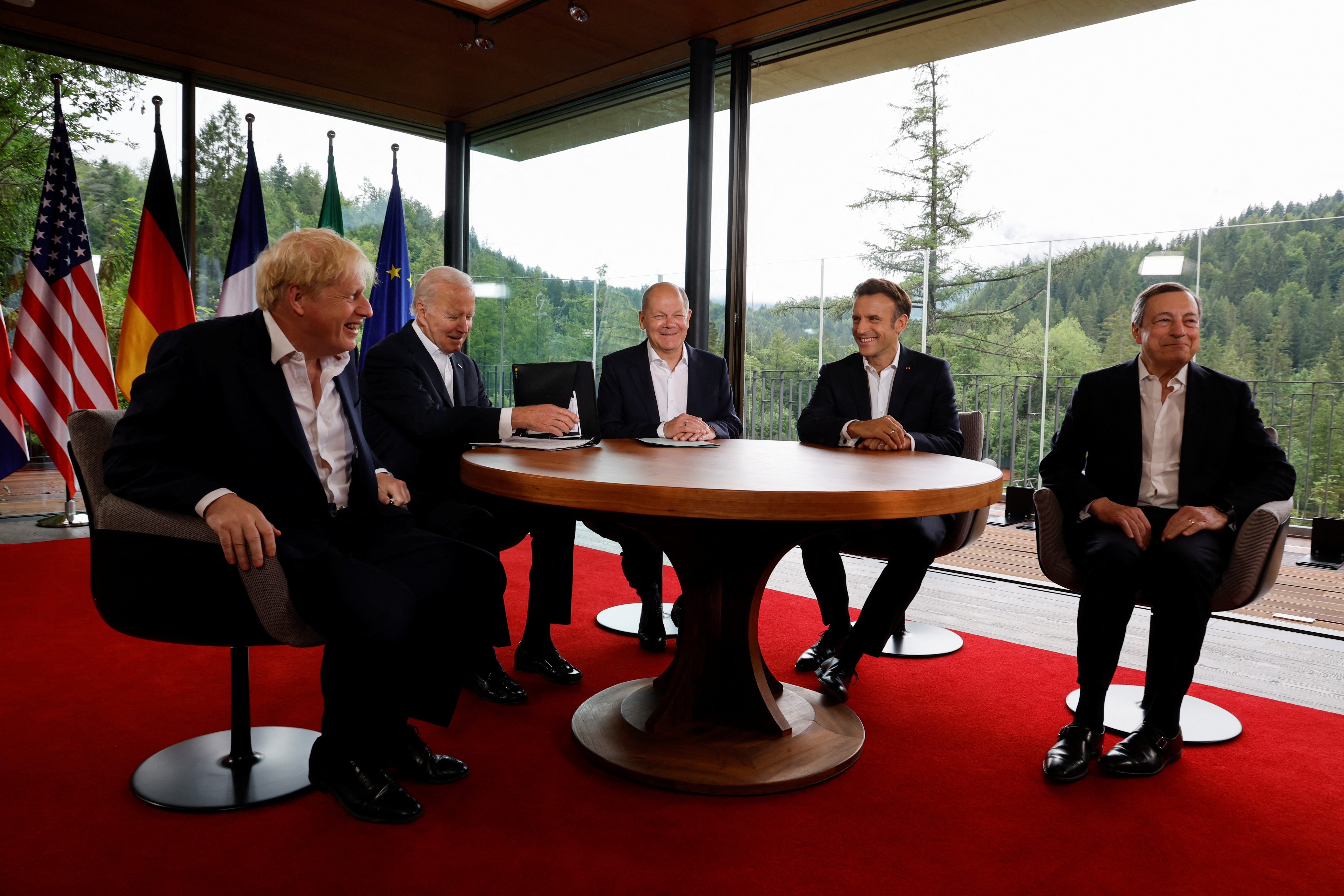
G7 leaders summit
U.S. President Joe Biden meets with German Chancellor Olaf Scholz, French President Emmanuel Macron, Italian Prime Minister Mario Draghi and British Prime Minister Boris Johnson alongside the G7 leaders summit at Bavaria's Schloss Elmau, near Garmisch-Partenkirchen, Germany June 28, 2022. REUTERS/Jonathan Ernst
 
The leaders of the world's largest developed economies are exploring any and all options to continue to bring economic, political and social pressure to bear on Russia in hopes of finally breaking the back of the violently aggressive bear that is pulverizing Ukraine, leaving its towns and cities in smouldering ruins, creating millions of displaced people, killing thousands of innocent civilians to satisfy Russia's rage over an implacably determined neighbour that sees its future with the West, struggling to leave the Kremlin's orbit.

Vladimir Putin's pretext of concern over the salvation of Ukrainians from the stranglehold of fascism that Ukraine's leaders purportedly exert on the country, evidenced by its drive toward EU and NATO membership is thin gruel as an explanation for mounting a violent invasion of its neighbour no matter how the issue is dressed in terms of ideology and the camouflage of Russian predation of territories that comprise part of Ukraine's vast land holdings.

The Group of Seven summit in Germany has discussed practical, workable methods to reduce Russia's income from its sale of energy products, profiting Russia's tremendous financial outlay to prosecute its conflict in Ukraine. The functionality of a price cap tied to services allied to trading in Russian oil and gas would see insurers barred from dealing with shipments above the cap. Service providers based largely in the EU and UK would see Russia finding it difficult to source large-scale workarounds.

Price limitations are foreseen to reduce the income the Kremlin now accesses from oil and gas and affect inflation in energy costs for consuming countries reliant on Russian energy. The plan would rely as well on countries in Asia agreeing to accept such a price cap. Another issue is enforcement as well as caution around potential side-effects. 90 percent of Russian oil reaches the EU by ship, an embarrassment to the EU which has relied heavily on Russian oil and gas.

There are warnings from economists that to proceed with such a plan there is a possibility of a recession being triggered in Europe. Recovering demand from the COVID pandemic and global markets hungry for energy are additional constraints that could hamper the plan. Although Russia is selling less oil to Western countries and diminishing its gas exports, it has seen no fall in revenues given the atmosphere of rising prices erasing the loss to state finances.

Russia, according to Western officials, has used its energy as a weapon to penalize the countries in Europe that have isolated it and applied crippling sanctions, by delivering less gas, for example, than contracted for. Moscow's success in replacing its European importers with willing replacement buyers in China and India has helped Russia out in its income dilemma. 

The new import arrangements in Asia sees India importing Russian crude and refining it, then selling it on the international market where Russian oil refined into gasoline or blended with other crude makes it difficult to determine its source. Countries hungry for energy have no inclination to delve into the issue of the finished product's origins, and that includes the United States, buying India's refined products which originated in Russian crude.
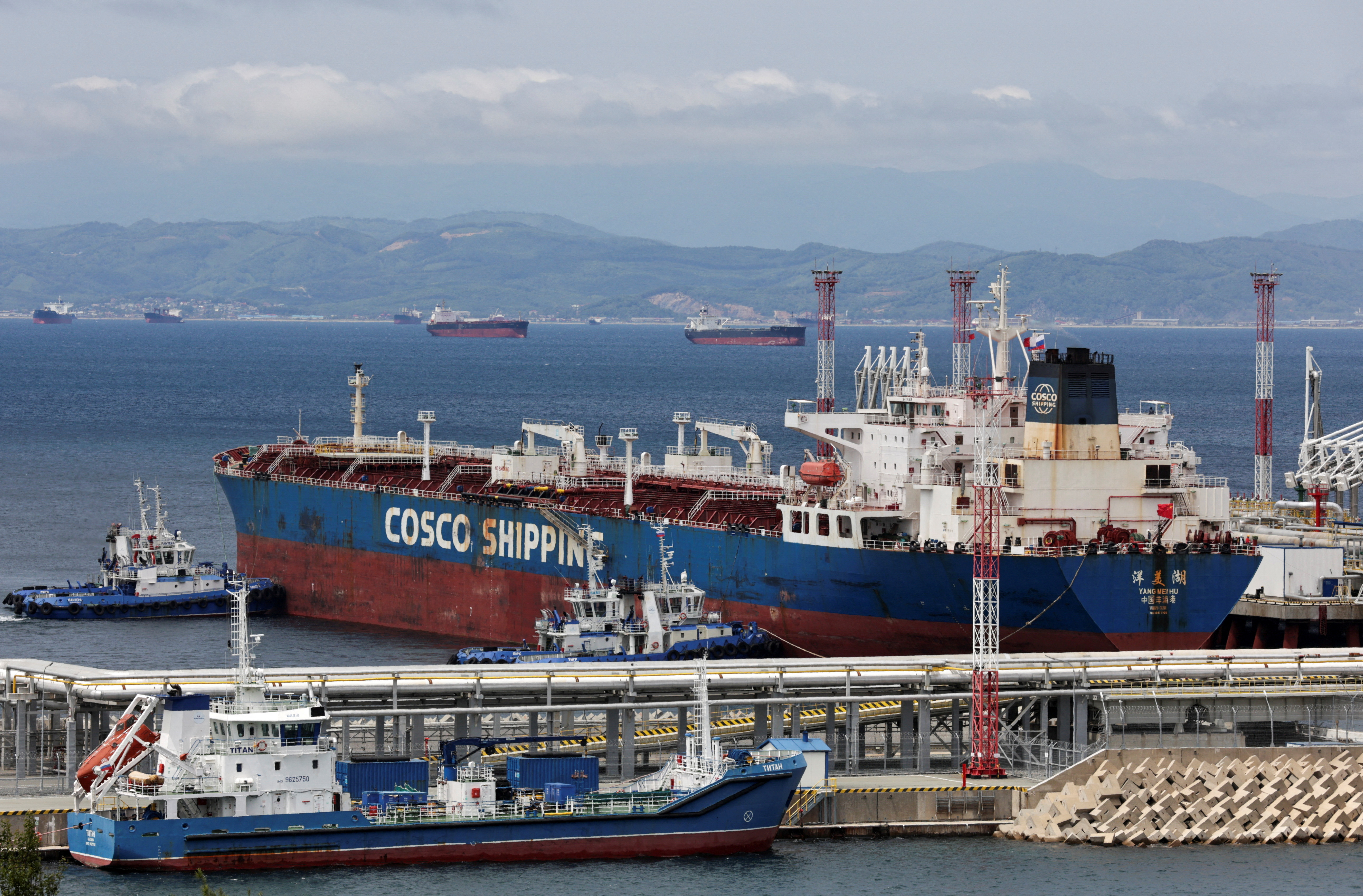
A tanker gets moored at oil terminal Kozmino near Nakhodka
Yang Mei Hu oil products tanker owned by COSCO Shipping gets moored at the crude oil terminal Kozmino on the shore of Nakhodka Bay near the port city of Nakhodka, Russia June 13, 2022. REUTERS/Tatiana Meel/File Photo

Labels: , , , , ,

Monday, December 13, 2021

Positions: Antagonistic ... Solution: Uncertain

"Russia should be in no doubt that further military aggression against Ukraine would have massive consequences and severe cost in response."
"We reaffirm our unwavering commitment to Ukraine's sovereignty and territorial integrity, as well as the right of any sovereign state to determine its own future."
Group of Seven statement
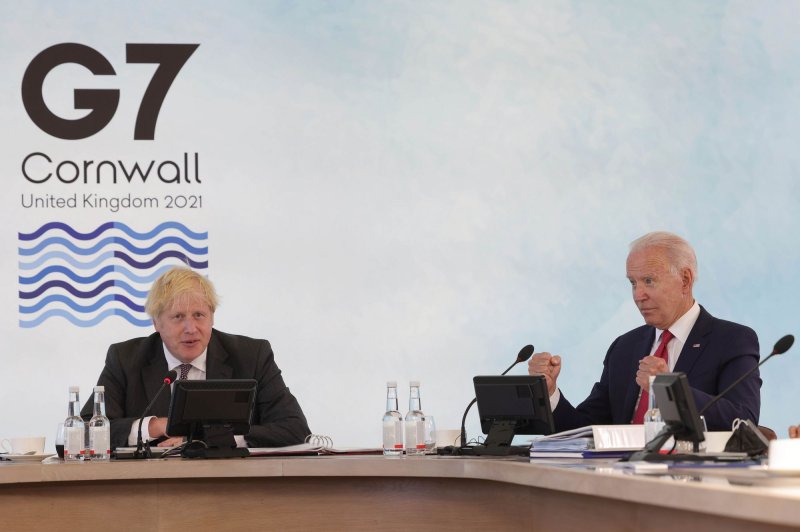
British Prime Minister Boris Johnson and U.S. President Joe Biden during the G7 Summit in Cornwall, United Kingdom in June. The G7 alliance has unanimously warned of consequences if Russia were to attack Ukraine. File Photo by Andrew Parsons/No 10 Downing Street/UPI

A concerted Western response to what American intelligence points out that the Kremlin plans an invasion of Ukraine in the new year, as they steadily mass up to 175,000 Russian troops and military equipment at the border next to Ukraine. It may be difficult to recall that this group was once the G8, when Russia was part of it, before its decision to appropriate for itself the Crimean peninsula with the claim that it always was part of Russia and would remain so, not with Ukraine, despite that Vladimir Putin also claims that Ukraine has always been part of the beating heart of Russia and will remain so.
 
Moscow responded that NATO's expansion into Russia's eastern European sphere of influence contravenes the West assurances to Russia following the collapse of the Soviet Union in 1991. Prior to the release of the joint G7 document, the Russian Embassy in London remonstrated that Britain's frequent phrasing of "Russian aggression" during the Liverpool meeting was misleading, designed only to create a 'cause' for the G7 to rally 'round.
"Russia has made numerous offers to NATO on ways to decrease tensions."
"The G7 forum could be an opportunity to discuss them but so far we hear nothing but aggressive slogans."
Russian Embassy statement, London
Russia is concerned with its "red line" which must not be permitted to be crossed. President Putin demanded legally binding security guarantees that further east expansion of NATO, or that it place weapons close to Russian territory be abandoned altogether, with Washington repeatedly responding that no country has the power to veto hopes nurtured by Ukraine to become part of NATO.

President Putin, according to the Kremlin, informed U.S. President Biden that Russian troops are a threat to no other country; Moscow was being demonized for simply moving troops within its own territory. Ingenuous to the Nth degree. Dmitry Peskov, spokesman for the Kremlin, spoke of very serious conceptual variances between Russia and the United States on Moscow's "red lines". A stated understatement. 
 
Russian President Vladimir Putin has asserted that Russia does not pose a threat to Ukraine. EPA-EFE/Maxim Shipenkov

The West was trying to turn Ukraine into a "bridgehead against Russia", wrote Mr. Putin in a July article. "It would be no exaggeration to say that the course of forced assimilation, the formation of an ethnically pure Ukrainian state aggressively oriented against Russia, is comparable in its consequences to the use of a weapon of mass destruction against us", he wrote.
 
In fact, the meeting was consumed more with a focus toward China and President Xi Jinping's aggressive strategies. It is Beijing's long-term goals that directly impact on the world order as China elbows its way toward recognition as a world power second to none, including the world's sole recognized world power which is unprepared to surrender its unipolar status any time soon. There were "very, very intense discussions especially on China", one official noted.

It is the standoff between Russia, NATO, the United States and now the G7 that is front and centre for now; China in the rear-view mirror. The emphasis for the moment is Russia's plans for Ukraine, which Western powers view through the lens of oppressive military threats meant to intimidate and to bring the country back under Moscow's tender orbit. Despite Ukraine having ousted the Kremlin's previous choice of Russian-linked president of the country in 2014.
"We call on Russia to de-escalate, pursue diplomatic channels and abide by its international commitments on transparency of military activities."
"We reconfirm our support for the efforts of France and Germany in the Normandy Format to achieve full implementation of the Minsk Agreements in order to resolve the conflict in eastern Ukraine."
Group of 7 statement
Ukrainian President Volodysmyr Zelensky (L) welcomes U.S. Defense Secretary Lloyd Austin (R) during their meeting in Kyiv, Ukraine in October. EPA-EFE/Presidential Press Service

Labels: , , , , , , , ,

Tuesday, June 15, 2021

NATO, Viewing Beijing Challenges

"China's stated ambitions and assertive behaviour present systemic  challenges to the rules-based international order and to areas relevant to alliance security." 
NATO
 
"I want all Europe to know that the United States is there. NATO is critically important to us." 
"[Russia and China are not behaving] in a way that is consistent with what we had hoped."
U.S.President Joe Biden

"If  you look at the cyber threats and the hybrid threats, if you look at the co-operation between Russia and China, you cannot simply ignore China."
"But one must not overrate it, either ... we need to find the right balance."
German Chancellor Angela Merkel

"China is coming closer to us. We see them in cyberspace, we see China in Africa, but we also see China investing heavily in our own critical infrastructure [ports and telecom networks]"
"We need to respond together as an alliance."
NATO Secretary-General Jens Stoltenberg
 
China's steadily increasing military presence stretching from the Baltics to Africa, alarms NATO. It is presenting "systemic challenges", it announced at the recently-concluded summit with member-nations. The alliance, originally created as a force to defend Europe during the days of the Soviet Union and the Cold War, while still having Russia in its sights, has swerved its attention as well to the actions of the Chinese Communist Party in Beijing.

China is outraged at its global reputation being besmirched by false allegations it claims, emanating out of the G7 and NATO. China, to be sure, finds itself in an awkward position. While it is aggressive and provocative, it also attempts to be ingratiating, helpful, interested in amity and harmony among itself and other nations of the world. The mystery is how it expects to be viewed favourably by democratic
countries when it provokes India over territorial rights in dispute, and does the same with territory in dispute over its claims in the South and East China seas.

There is the Belt and Road initiative whereby China has set out to substantially 'help' poorer countries gain entry to its new 'silk road' economy by handing out loans in generous payback conditions for the building of critical infrastructure; roads, bridges, seaports and the like. Gargantuan sums of financing arranged, which poor countries are eager to take advantage of until they realize they will face enormous difficulties paying back the loans.

China's generosity evokes gratefulness in those it assists, even as it creates conditions of loyalty to its agenda with a frisson of resentment at both the dependency on China's largesse and a burden of unaffordable repayment. One of the issues at the G7 summit was the announcement of a global infrastructure plan meant to counter China's Belt and Road Initiative by a more generous plan the G7 collective would design and initiate without crippling recipient nations' fragile economies.
 
 
China's soft power and its hard power, both on full display, has earned a lash-back from the influential, wealthy democracies that once harboured the hope and expectation that China would join the world of orderly, restrained, cooperative world politics. Instead, its insatiable hunger for resources, territory, influence, control and respect while marauding other nations' secret military, industrial, scientific and social secrets and indulging in cyberintelligence theft has aroused suspicion and push-back.

China's soft power seen in its vaccine diplomacy with the potential to raise its reputation worldwide, has boomeranged. Sinovac and Sinopharm shipped COVID-19 vaccines to Africa, Asia and the Middle East, occasionally cost-free as a gift, to mollify global opinion over suspicions that the virus that appeared in Wuhan was poorly handled to prevent it becoming a pandemic. Apart from the fact that China's generosity with its vaccines failed to gain it acclaim, partially on the basis of their low efficacy, that impact fizzled even as the world demands more clarification over SARS-CoV-2 origins.

The origins secrecy and deceptions succeeded in renewing calls for deeper investigations, and for China to hand over documents it refused to release to the World Health Organization investigators when they travelled to Wuhan for their initial report which ended up being inconclusive in reflection of that lack of cooperation, while keeping the investigators under their watchful eye and pressing thumb. China remains obdurately obstructionist.

A round of sanctions developed based on a number of glaring issues that Beijing declares to be of no outside interest to anyone or any nation other than China. They include the 're-education' and slave labour imposed upon the Xinjiang Uhghurs and other minority Turkic Muslim populations whom China is committed to de-Islamizing, and re-Communizing for full integration into Chinese CCP culture and social-political expectations of all populations within China. 
 
Courtesy Reuters
 
Beijing's unification threats to Taiwan, its bulldozing of Hong Kong's move toward full democritization, its provocations against its neighbours in disputed territorial ownership, its aggression over international G5 telecommunications and Internet servicing by Huawei and its grudge-fights against countries like Australia and New Zealand, its aggressive interest in the Arctic for navigable trade routes, all arouse suspicion over its ultimate goals. Its micro-military skirmishes with India over Himalayan-area border issues, its strengthened alliance with Russia, altogether paint an unsavoury picture of entitlements.

And then there is the massive expenditure on military infrastructure, modernizing and ultra-equipping its military, on land, sea and air. Western democracies have painted themselves into a troublingly unpalatable position. On one hand, trade and manufacturing and services alongside political infiltration have woven a web of interdependence. Wealthy countries are indebted to China for its production capabilities, even while they welcomed Chinese investment in critical national enterprises and natural resources.

If and when they 'cut off their nose' it will be to spite their face.

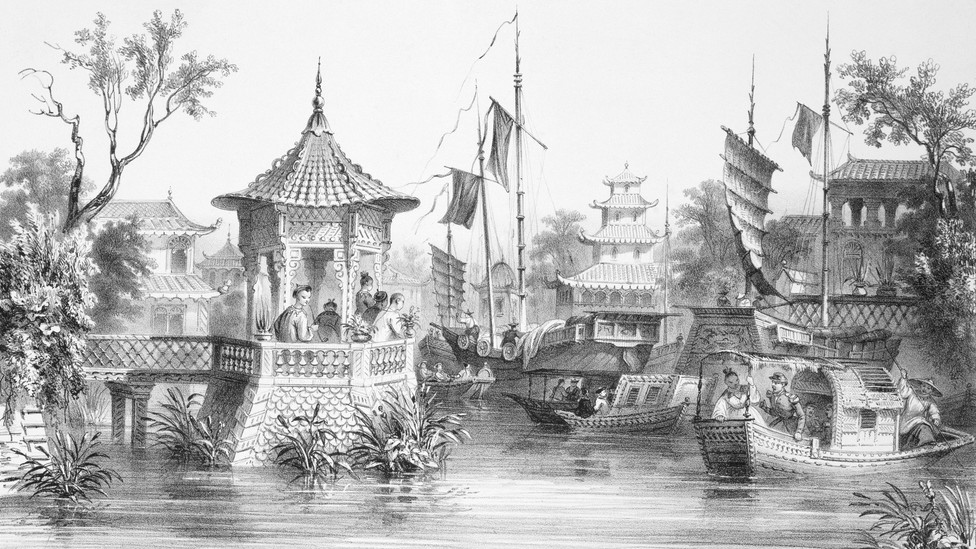
Lithograph View of Canton or Guangzhou
The arrival of the Portuguese in Guangzhou, pictured here, in the early 16th century. (Corbis Historical / Getty)

Labels: , , , , , , , ,

Monday, June 14, 2021

Countering China

"We will promote our values, including by calling on China to respect human rights and fundamental freedoms, especially in relation to Xinjiang and those rights, freedoms and high degree of autonomy for Hong Kong enshrined in the Sino-British joint Declaration."
"[We stress] the importance of peace and stability across the Taiwan Strait, and encourage the peaceful resolution of cross-Strait Issues."
"We remain seriously concerned about the situation in the East- and South-China Seas and strongly oppose any unilateral attempts to change the status quo and increase tensions."
G7 Closing statement of joint agreements
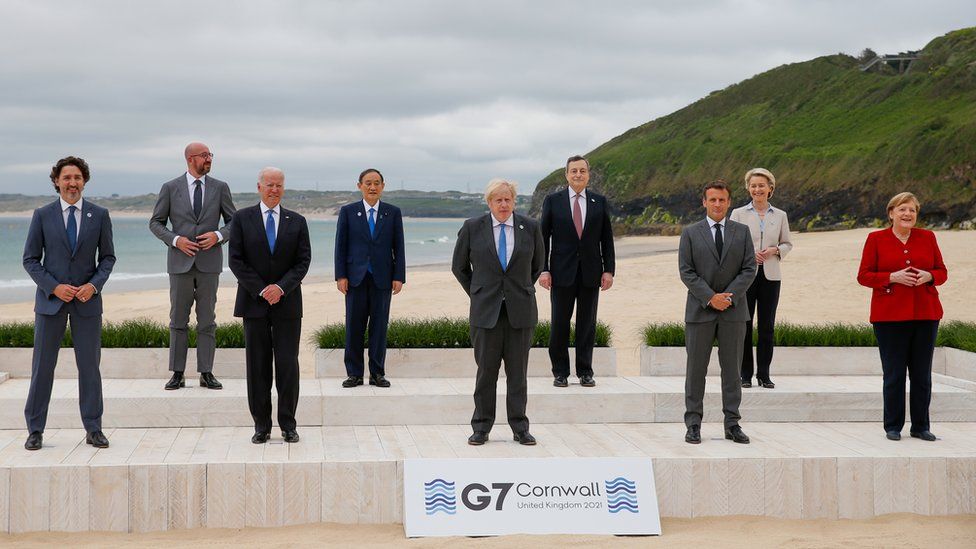
A photo of leaders at the G7 summit
"We're in a contest, not with China per se ... with autocrats, autocratic governments around the world, as to whether or not democracies can compare with them in a rapidly changing 21st Century."
"As I've told [Chinese President] Xi Jinping myself, I'm not looking for conflict. Where we cooperation, we'll cooperate; where we disagree I'm going to state this frankly, and we are going to respond to actions that are inconsistent."
U.S. President Joe Biden
The group of economically advanced Western democracies that comprise the G7; the United States, Japan, Germany, France, Britain, Italy and Canada expressed its concern over the issue of forced labour in global supply chains inclusive of the agricultural, solar and garment sectors. All of which issues Beijing has repeatedly and forcefully rejected. From its perspective, efforts by Western powers to contain China are doomed to failure.
 
 As far as Beijing is concerned -- and its concern was conveyed by China's mission in the United Kingdom -- responding to Western assertions over China's growing influence, in efforts to counteract that influence and to contain China, it charges that Western powers remain gripped by an outdated imperial mindset, expressed by humiliating China.
 
Clearly one gross humiliation represents the G7 demanding a complete and thorough investigation of the origins of the coronavirus that appeared in Wuhan and that has gone on to devastate populations worldwide, along with the global economy. The final agreed-upon G7 communique, highly critical of Beijing, delved into areas that China insists are off limits to any outside interference of its sovereignty. The call for a transparent Phase 2 COVID-19 Origins study to be convened by the World Health Organization is anathema to Beijing.

Again and again China has responded to allegations citing its treatment of the Uyghurs, Hong Kong independence, and Taiwan's status as a free independent state, that these are internal issues; matters of no interest to any other country. Such efforts by Western powers to rein in China's ambitions have been characterized by Beijing as doomed to fail. Western powers' attempts to contain China reflect major powers still in the grip of an outdated imperial mindset following years of humiliating China.

That United Nations experts in human rights issues claim that over a million people, mostly Uyghurs and other Muslim minorities have had their freedom and liberty dramatically curtailed as they have been detained in vast camps n Xinjiang in northwest China. Accusations that China characterizes as preposterous, nothing but slander. That all accusations of forced labour or abuse is without substance.

The camps, Beijing stresses, are in reality vocational centres, designed to eradicate extremism and having nothing whatever to do with forced labour. They are no longer even in operation, counters China.  Since late 2019, all those in the camps had "graduated".  "Stop slandering China, stop interfering in China's internal affairs, and stop harming China's interests", protested a spokesman from the Chinese Embassy in London.
"[China is a peace-loving country that advocates cooperation, but also has its bottom lines]."
"China's internal affairs must not be interfered in, China's reputation must not be slandered, and China's interests must not be violated,"
"We will resolutely defend our national sovereignty, security, and development interests, and resolutely fight back against all kinds of injustices and infringements imposed on China."
China's U.K. Embassy
The Chinese national flag is seen in Beijing, China. Photo: Reuters


Labels: , , , , , , , ,

Sunday, September 09, 2018

Trudeau & Company

"Canada is leading by example to address the issue of gender equality in the G7 energy agenda. We will continue to engage key private sector and public sector leaders on this important issue and take actions to improve gender equality, particularly in the energy sector."
"We want to influence current and future leaders of Canadian industry to commit to meaningful action in the area of gender equality."
Minister of Natural Resources Amarjeet Sohi

"Canada's energy industry is gender-imbalanced. [The Right Honourable Justin Trudeau] has made gender a equality a priority for Canada's G7 Presidency."
Natural Resources Canada
Alberta mayors hold “Go East” signs in support of the East Energy pipeline project while Lisa Holmes, president of Alberta Urban Municipalities Association, left, takes a selfie with Alberta Premier Rachel Notley at a mayors’ caucus in Edmonton on March 9, 2016. Postmedia News

The current Liberal-led government identifying the most critical area of concern at the moment for the G7 to be energy is rather amusing, given that this Liberal government has been incapable of leading Canada to the point where its vast natural resources in energy have been so ill-managed that the one province that had always been depended upon for its wealth lifting other provinces into the great Canadian net of 'haves' now teeters in uncertainty.

A teeter-totter of inequity solved by confederation evoking a responsibility from the wealthy to even out social advantages for the entire population.

'Wealthy' Calgarians agreeing to ensure that Montrealers have equal access to social welfare as anyone living in Alberta, thanks to that province's oil bounty. Quebec spurns oil, its energy needs served by water power for electricity, but it still needs gas to operate vehicles and heat homes. Yet Quebec finds it offensive that a pipeline should convey oil as well as gas from one geographic area of the country to the other; better to rely on imported oil from unstable, human-rights-abusing Middle East countries.

Canada is open for business, Trudeau smiled ingratiatingly at international investors. And then he set about beefing up his environmental agenda, and his gender equity agenda, making doing business all the more complex to meet environmental standards and human rights' employment hurdles for potential investors for whom the red tape and the stalling became too fraught with risk. But Canada is special and under Trudeau has a mission, to bring the rest of the world around to his views on solving all social ills through manipulating safeguards for the vulnerable into trade and investment and energy development.

And that's kind of amusing, too. Since Canada has a global reputation through its expertise and wide investments in developing nations in mining, as a predator and a human-rights abuser of other nations' aboriginal populations whose heritage traditional villages happen inconveniently to be located just where those Canadian mining vultures are poised and set to begin their operations in contracts signed by the various governments with which they do business and share profits. Not too concerned over the environmental and human rights impacts abroad.

Now that the revolving presidency of the G7 has fallen into Justin Trudeau's ever-so-capable hands, he plans to guide his G7 counterparts toward accepting and implementing his very own virtuous gender-equality insights and programs having chosen "Climate Change, Oceans and Clean Energy" as his major theme for the Halifax G7 meeting in September. Climate change, oceans and clean energy cannot be addressed in the absence of gender equality, just as international free trade is a non-starter without gender equality and recognition of LGBTQ-2 rights.

Canada is leading the pack. This is the Canada incapable of bringing its oil and gas resources to world markets, safely and efficiently conveying those energy resources from Alberta to the B.C. coast, much less pipelining it to the rest of Canada in the east and efficiently to the U.S. to enable it to start charging the going price rather than the marked-down price to American refineries. Venezuela's vast oil resources haven't kept pace with the need to upgrade its infrastructure and refining capabilities and the country is imploding in poverty and social welfare backwardness. See any resemblance?

But the issue of Canada's clumsy inability to govern itself takes second place to Advancing Gender Equality and Women's Empowerment in the energy industry. At the present time, women's representation in the Canadian energy industry stands at 24 percent. Rather than view that number as a voluntary representation in that women by and large are not represented in as great numbers as men because they don't naturally gravitate to the industry, Trudeau insists it is because they are deliberately shut out of the industry.

Which brings us to a summit of "gender equity in the energy industry" led by a government incapable of rising above its level of incompetence to solve the issue of opening up two pipelines summarily dismissed and paving the way for the TransCanada to finally get built, but that doesn't square with Trudeau's dedication to the "Path forward".

Canadian Prime Minister Justin Trudeau speaks as the seat of US President Donald Trump sits empty during the Gender Equality Advisory Council working breakfast on the second day of the G7 Summit on June 9, 2018 in Quebec City, Canada.Leon Neal/Getty Images

Labels: , , , , , ,

Thursday, May 31, 2018

Condemning Venezuela's Nicolas Maduro

"I would like to see the states from the G7 agreeing to refer the matter of crimes against humanity to the International Criminal Court for a prospective investigation and prosecution."
"We have a persistent and pervasive culture of impunity finding expression in a massive assault on the rule of law [in Venezuela]."
"There is no independent judiciary. There is no independent prosecutors. There is no independent justice system."
"This is the archtypical example of why a reference is needed, as to why the ICC [International Criminal Court] was created."
"The testimony that we heard in our public hearings, of the graphic examples of torture and rape and imprisonment, and then the humanitarian crisis -- we can't forget that behind all these findings of fact and conclusions of law are suffering human beings. They need justice. They need relief."
Irwin Cotler, former Canadian Liberal Cabinet Minister, human rights lawyer, activist

"We are appalled, though not surprised, by the evidence the panel found supporting the allegation that crimes against humanity have been committed in Venezuela."
"...It is because of the Maduro regime's ongoing abuse of its people and attacks on democracy that Canada has taken a series of punitive actions, including imposing targeted sanctions."
Canadian Foreign Minister Chrystia Freeland
Hungry, sick and increasingly desperate, thousands of Venezuelans are pouring into Colombia
Venezuelans cross the Simon Bolivar International Bridge into Colombia. (Fernando Vergara / Associated Press)
 
The legacy of Hugo Chavez, he of the infamous 'Bolivarian Revolution' using the Cuban revolutionary political model for his guide in socializing Venezuela and in the process setting it on the road to wrack and ruination, has been nicely completed by his chosen successor and protege, Nicolas Maduro, who like his predecessor, is determined to make common cause with those other models of statescraft and superior executive administration of a nation's affairs, taking cues from Iran, Cuba and North Korea.

Venezuela, a once-moderately well-off nation with vast oil resources and related revenues which Chavez as its long-time president sprinkled generously among his neighbours, providing free oil to Cuba and neighbours like Bolivia, neglected to use some of that largesse to upgrade infrastructure in the country, including oil extraction facilities and to build refineries for that oil. Corruption and mismanagement in the extreme have resulted in a breakdown of all the normal parameters of civil administration resulting in critical medical and food and energy shortages.

Like Zimbabwe, under its long-time tyrant Robert Mugabe, now deposed, the country has soaring unemployment rates, violent crime, shortages of all consumer goods, and no hope for the future. Criticism of the government is viewed as a crime resulting in imprisonment. Inflation continues to soar, and desperate Venezuelans exit their country of birth, anxious to find haven anywhere else, crowding into neighbouring countries to escape Venezuela's violence and social breakdown.

Now, a report issued by the Organization of American States calls for the removal of the Maduro regime, accusing it of murder, extra-judicial executions, torture and allied human rights abuses. Canada, under its Liberal government, seeking as always to 'punch above its weight', has become the first country to 'take action' on this file on which Luis Almagro, secretary general of the OAS stated "nobody could do worse" in governing than the Maduro claque.
A Venezuelan woman is vaccinated against measles in Cucuta, Colombia, at the Simon Bolivar International Bridge on the border with Venezuela.
A Venezuelan woman is vaccinated against measles in Cucuta, Colombia, at the Simon Bolivar International Bridge on the border with Venezuela. (Schneyder Mendoza / AFP/Getty Images)
 
A specially assigned OAS panel of which Mr. Cotler was a member, heard from victims, witnesses and human rights crimes experts, to find Maduro responsible for murders, thousands of extra-judicial executions and tens of thousands of arbitrary detentions, cases of torture, of attacks against the judiciary and a "state-sanctioned humanitarian crisis", leading hundreds of thousands of people to become refugees.

Canada has decided -- to step up to the plate, jump the gun on others, call it what you will -- to impose sanctions on 14 Venezuelan elite with connections to the regime, inclusive of Maduro's wife, as part of larger efforts by the U.S. to bring the Maduro government to an end. Yet Canada made no effort to sponsor the OAS panel report to mount a formal investigation by the International Criminal Court. Which, years ago, in the wake of the Darfurian humanitarian outrage in Sudan, sat in judgement of Sudanese President Omar al-Bashir, accusing him and others in his entourage of being war criminals.

A judgement that none of Bashir's Arab leader colleagues seemed to take seriously, since they all without exception ignored their responsibility as signatories to the ICC, to apprehend him while in their countries, and turn him over to the ICC for trial. Canada will be hosting a meeting of the G7 next week at Charlevoix, Quebec, where the issue of Venezuela's plight will be further discussed among the leaders of Canada, the United States, the United Kingdom, France, Germany, Italy and Japan.

It will be their collective opportunity to round out the initial work of the 'little country that could' by imposing meaningful pressure on the Maduro government, including referring the OAS file to the ICC since they all together rejected Venezuela's presidential elections of the last week stating the obvious, that Maduro was solidifying an "authoritarian grip" causing great suffering to his unfortunate people.

Leonardo Albornoz, an unemployed heavy equipment mechanic from Venezuela, stands with his family as he tries to sell candy for coins to passing motorists. "I'm being forced to beg because there is no work," he said.
Leonardo Albornoz, an unemployed heavy equipment mechanic from Venezuela, stands with his family as he tries to sell candy for coins to passing motorists. "I'm being forced to beg because there is no work," he said. (Chris Kraul / For The Times)

Labels: , , , , , , , , ,

Wednesday, May 31, 2017

Asserting Trump Control

"MASSIVE trade deficit with Germany, plus they pay FAR LESS than they should on NATO & military. Very bad for U.S. This will change."
"[Most of other 28 NATO member states fail to pay their fair share of defence; [not fair to the people and taxpayers of the United States."
U.S. President Donald J. Trump
Video for trump elbowing aside european leader
Stills from video with Trump elbowing Montenegrin president aside: I'm in charge here!

Is it because he cannot believe he actually persuaded enough American voters that he has what it takes to make America great again, to vote him into office, that President Trump throws his considerable weight around, in the process reassuring himself, while alternately infuriating, amusing and alienating other world leaders by his abrupt, uninformed, arrogant and insulting manner? Or could it even be remotely possible that this man thinks of himself as not only the first but the only authority among world leaders?
"The time when we could completely count on others is a little bit in the past. That is what I have experienced in the past few days. That is why I say that we Europeans must really take our own fate into our own hands ..."
"We have to know that we must fight for our own future and destiny together as Europeans."
German Chancellor Angela Merkel

"[That interminable grip of a handshake] was not innocent. We don't make little concessions, even symbolic ones."
French President Emmanuel Macron

"The future of Europe is perhaps in our hands. [Europeans must] speak more forcefully than in the past."
"[But] that does not mean that we forget the importance of our transatlantic relationship. The United States remains an important ally but that does not mean that we renounce certain principles about which Italy is very clear."
Italian Prime Minister Paolo Gentiloni

"Leaders who think we can hide from these changes [climate change, trade, refugees] or turn back the clock are wrong. It is our responsibility to harness these changes and make them work for people."
"[Yes, the stakes are high and] yes, the United States was an important part of the discussion..."
"We have to recognize that on matters of values and the desire to give our citizens the same opportunities, we share the same values as the United States."
Canadian Prime Minister Justin Trudeau
So a united G7 and NATO have become somewhat insecure and a trifle disunited of late. The United States has long been the essential glue that kept the disparate parts together in a common contract, based on similar values and aspirations. During the eight years that former President Barack Obama occupied the leaders' throne thee was a gap in the role and a little insecurity crept in now and again but goodwill remained constant and so did a self-assuring future that the compact was secure.

Now, the gruff and crude entrance of a man whose instincts are firmly lodged on his imagined personal magnetism that brooks no dissent when his abrasive rejection of all that the aggregate in the alliances rely upon to maintain integrity of purpose and trust has been destabilized leaving the others gasping for the oxygen of a leadership assurance that has been summarily kicked out of alignment. The parameters have been re-aligned and any who disagree will be shoved aside.

The issues of immigration, inter-faith relations, free trade versus protectionism, defence spending and the Paris Agreement on climate change have been yanked out of their common agreement and they lie in disarray, twitching in an agony of uncertainty. Just as Trump's first instinct was to deny American interest in the Trans-Pacific Partnership, leaving it dead in the water, the G7 are now wondering whether their alliance has been permanently pulled asunder.

As for NATO, the musketeer approach of "one for all and all for one" appears to be in jeopardy. The nation that always represented itself as the foremost among almost-equals appears no longer to be prepared to act as the big brother whom all the little brothers call upon to face up to the schoolyard bully. NATO's ultimate principle of self-defence lies in an agonizing funk of leaderlessness.

At least one thing has been resolved; the nervousness and trepidation with which other G7 leaders viewed the entrance of the new president has been resolved; he is every bit as churlishly ignorant in his state of arrogance as they feared.
President Trump at the NATO summit with world leaders in Brussels on Thursday. Credit Matt Dunham/Associated Press


Labels: , , , , , ,

Sunday, June 21, 2015

That Proverbial Molehill According To Moscow

"We are having a discussion on the shared interests of the Western democratic world. Mr. Putin, who is in no way part of that, has no place at the table, and I don't believe there's any leader who would defend Mr. Putin having a place."
"I came of the view, some time before the invasion of Ukraine, that his presence at the table of the G7 was not productive -- in fact was inhibiting the kinds of discussions, the kinds of co-operation we could be having on a broad range of international issues." 
Canadian Prime Minister Stephen Harper -- G7 summit, Schloss Elmau, Germany

"I don't want to offend anyone, but if the United States says Russia should be returned to the G8, the prime minister will change his opinion."
Russian President Vladimir Putin -- St.Petersburg International Economic Forum
Putin said that sanctions against Russia have hurt the global economy, not just his own country.
Putin said that sanctions against Russia have hurt the global economy, not just his own country. (Alexander Zemlianichenko/Reuters)

The influential group of nations which morphed from the G7 to welcome Russia expanding the group to the G8, by general consensus returned to the G7 designation after Moscow appropriated part of Ukraine's geography by annexing the Crimean Peninsula last March. Russian authorities shrugged at the decision claiming Russia would continue to interact with members of the group.

Last month German Chancellor Angela Merkel, the only head of state of the G7 to remain in regular contact with Mr. Putin, stated that Russia would be welcomed to rejoin the group only if Moscow decided to respect the values of the G7; values as fundamental as freedom, democracy and adherence to respect for the territorial sovereignty of all nations.

That represents two members of the G7 heard from with respect to how they view the legitimacy of Moscow's actions respecting Ukraine, taking into account the clandestine arming of ethnic Russian Ukrainian rebels and the presence of Russia's military within Ukraine and massed along its border; using intimidation, force and threats disguised as cooperation to manipulate the rebels into a better position to continue destabilizing Ukraine, with a view to taking the country back into the Russian orbit.

Despite which, it would appear that Russia is making plans to rejoin the G8. If other members continue to resist that inevitability, Mr. Putin feels assured that pressure from the Obama White House will bring resisters into line. Russian authorities, it would seem, appear convinced they are on the cusp of achieving a deal between the Washington and Moscow to welcome Mr. Putin at the next summit, simply waving away the two summits that he missed attending, because he had been disinvited, as it were.

An acutely accommodating White House, it would appear, seems prepared to waive consensus and exert the heft of power and leadership. If it can be held to be leadership when the most influential and powerful leader of the free world is prepared to concede to an autocratic aggressor that though he has orchestrated an internationally illegal occupation of another country's resources, all will be forgiven in the greater interests of achieving harmony, however lopsided that might appear to many.

President Obama, the great Nobel Laureate conciliator living up to his peace prize, seems to have nestled himself with some comfort into the game plans advanced by Vladimir Putin, be it forgiveness of Syrian war crimes, accepting Iran's arguments of nuclear entitlements, and the Russian propaganda that Crimea historically belongs to Russia in any event, as though the shooting down of a passenger airliner with the death of all aboard, the chemical bombing of Syrian Sunni citizens, the threat of nuclear warheads, are mere details to the greater gift of being nice and choosing diplomacy.

Just as sanctions will be relaxed for Iran freeing up billions to enable it to continue funding terrorist groups and get on with its nuclear file, sanctions hobbling Russia's full thrust toward conventional and nuclear weapons updates will also be relaxed as a good will gesture to a country whom its neighbours are unjustifiably paranoid about, and whose intentions are only those of a peace-loving, friendly regional powerhouse.

Labels: , , , , , , ,

Thursday, March 27, 2014

Brazil, China, India rally round Russia after G7 snub

  • G7 leaders and top EU officials met on the margins of a summit on nuclear security in the Dutch capital (Photo: consilium.europa.eu)

Brazil, China, India rally round Russia after G7 snub

25.03.14
BRUSSELS - The G7 club of wealthy nations has cancelled a summit with Russia over its annexation of Crimea, but emerging economies have protested against its exclusion from a G20 meeting.

The G7 leaders – from Britain, Canada, France, Germany, Italy, Japan, and the US – announced the move in a communique published after their meeting in The Hague on Monday (24 March).
The June summit, which was to be held in the G8 format with Russia in Sochi, on the Black Sea coast, will now be held in Brussels.

The communique said Russia’s actions “are not consistent” with the G7’s “shared beliefs” and that they will “suspend” the G8 “until Russia changes course”. It also said G7 states “remain ready to intensify actions, including co-ordinated sectoral sanctions … if Russia continues to escalate this situation”.


“The custodianship of the G20 belongs to all member states equally and no one member state can unilaterally determine its nature."

With Brazil and China now wealthier than some G7 countries, Russian foreign minister Sergei Lavrov noted the G7 has lost its monopoly on global governance.

“If our Western partners believe this format [G8] has exhausted itself, let it be. We are not clinging to it. As an experiment, we can wait a year or a year and a half and see how we live without it,” he said.
Lavrov in The Hague met with his Ukrainian counterpart, Andrey Deshchytsia, for the first time since the crisis began.

But he did not agree to launch bilateral talks to resolve the dispute, as demanded by the EU and US.
He noted only that Ukraine must undertake unspecified “constitutional reforms” and repeated the Kremlin line that Ukraine’s revolution is a form of Western expansionism.

Meanwhile, Ukraine circulated a draft UN General Assembly resolution which says Crimea’s recent referendum on secession has “no validity".

It got backing from UN head Ban Ki Moon, who said Russia’s violation of the Budapest memorandum – a 1994 treaty giving Ukraine security guarantees in return for nuclear disarmament – has “profound” implications “both for regional security and the integrity of the nuclear non-proliferation regime”.

Russia on Monday also hit back at Western sanctions by blacklisting 13 Canadians.
It has mocked EU and US blacklists and economic threats.

But its own deputy economy minister, Andrei Klepach, on Monday forecast that Russia’s first quarter economic growth will be zero and that $70 billion of capital will leave the country in developments he linked to “worsening of relations”.

Russia’s state-owned Sberbank the same day said capital flight could reach $100 billion.

Labels: , , , ,

Wednesday, March 26, 2014

Action and Consequences

"I am not surprised at the kind of cavalier reaction of Putin and then to strut and shrug off any reaction. That is how he handles these things."
"We believe that these actions being taken by ourselves and our partners in the G7 ... are meaningful. Russia's increasing diplomatic isolation is not, we believe, trivial."
"The reaction to the illegal occupation of Crimea is not going to be brief. This is going to be ongoing pressure to indicate that a large part of the world community is simply never going to accept this because it is a precedent that is just too dangerous for global peace and security."
Canadian Prime Minister Stephen Harper
Canada's Prime Minister Stephen Joseph Harper, left, and Denmark's Prime Minister Helle Thorning-Schmidt, right, attend the opening session of the Nuclear Summit in The Hague, Netherlands, on Monday, March 24, 2014.   Photograph by: AP Photo/Yves Herman, Pool
- See more at: http://www.princegeorgecitizen.com/news/world/harper-fellow-g7-leaders-to-suspend-g8-meetings-1.918600#sthash.eUsqoGBJ.dpuf

BC-Harper-G7-Summit--10th-W.jpg
Yves Herman/AFP/Getty Image -- Prime Minister Stephen Harper and Denmark's Prime Minister Helle Thorning-Schmidt attend the Nuclear Security Summit, The Hague, Netherlands


"International law prohibits the acquisition of part or all of another state's territory through coercion or force. To do so violates the principles upon which the international system is built. We condemn the illegal referendum held in Crimea in violation of Ukraine's constitution. We also strongly condemn Russia's illegal attempt to annex Crimea in contravention of international law and specific international obligations. We do not recognize either."
"This clear violation of international law is a serious challenge to the rule of law around the world and should be a concern for all nations."
"We remind Russia of its international obligations and its responsibilities, including those for the world economy. Russia has a clear choice to make. Diplomatic avenues to de-escalate the situation remain open, and we encourage the Russian government to take them."
G7 statement affirming "Our support for Ukraine's sovereignty, territorial integrity and independence."
Russia is now quite isolated. Diplomatically, that is. In Western spheres most certainly. However, as a member of the BRICS nations representing upcoming economic powerhouses; Brazil, Russia, India, China and South Africa, there is tepid support there for one of their own. China, which usually vetoes or abstains in the Security Council when resolutions against rogue states like North Korea, Iran or Syria come to the fore, is more reserved on this occasion.

"China has always held a 'just and objective attitude' toward [the] Ukraine crisis", according to the Xinhua news agency, quoting President Xi Jinping after his meeting with U.S. President Barack Obama on Monday. An international co-ordination mechanism was put forward as a proposal by China, in an effort to solve the crisis, urging all parties in the issue not to commit to anything "that might lead to the further deterioration of the situation."

Beijing abstained from voting on a resolution condemning Russia's annexation of Crimea, instead of siding with Russia at the UN Security Council last week. A very sensitive issue, that of annexing other countries' geographic entities for a country that strives for 'harmony' and detests 'splittism', a country whose grasp of Tibet should never be spoken of in polite society for it too is a heritage right of possession, just as Crimea is for Russia, though the Tibetans never took a vote to join China.

Receding into the dim background of concern on the world stage are the crises unfolding in Iran and Syria, North Korea and Afghanistan/Pakistan, let alone in restively conflicted Africa. The very country that continually and stolidly votes 'nyet' on all the Western-inspired resolutions to condemn violence and conflict and nuclear concerns as they pop up around the world, is itself now the subject of criticism and opprobrium.

The Russian bear, for the past few decades, had only gone into hibernation. The Cold War a nightmare of the past, the bear retreated, trying to puzzle out how its habitat had become so altered from the unions it had prided itself on for generations. Deciding it had nothing whatever to do with rejection of the Russian iron grip on its helpless satellites, but represented a base and malignant conspiracy of the West, the bear lunged to retake what it considers its own.

And now that it has bitten off a few lumps of Georgia and Moldova, Ukraine looked ready and the rest is a footnote in history, with more to come. The G8 is no more. World leaders' invitation to draw Russia in to their economic union become a farce, needful of repercussions relating to Russia's judgement and actions.

Russia's foreign minister, Sergiy Lavrov met with Ukraine's acting foreign minister and U.S. Secretary of State John Kerry.

Mr. Lavrov offered the formula for Ukraine to achieve peace and stability: "large-scale constitutional reform is needed, which will involve all regions". This, while Ukraine's military is limping home from the Crimea, their former home on the Black Sea peninsula.


Labels: , , , , , , , ,

Friday, March 21, 2014

On The Agenda

"The world is watching with great concern as Russia positions its military in a way that could lead to further incursions to southern and eastern Ukraine. [The sanctions] will not only have a significant impact on the Russian economy but could also be disruptive to the global economy. However, Russia must know that further escalation will only isolate it further from the international community."
U.S. President Barack Obama
President Barack Obama makes a statement on Ukraine on Thursday, March 20, 2014, on the South Lawn at the White House in Washington before departing for Florida. President Barack Obama said the US is levying a new round of economic sanctions on individuals in Russia, both inside and outside the government, in retaliation for the Kremlin’s actions in Ukraine. AP PHOTO/CHARLES DHARAPAK
"It is time for the president to tell the nation why a co-operative world order is in jeopardy due to Russia's unilateral actions. I think there is a spirit in Putin's speech that is vengeful and triumphalist at the same time and committed to this notion of a new union ... an empire with a capital in Moscow."
Former U.S. national security adviser Zbigniew Brzezinskin
Russia has taken steps to close the border to Ukrainian goods. Ukraine's largest trading partner has always been Russia, and now, no more, and for how long and how deeply will that bite? With Kyiv's recent alignment with the European Union through an agreement led by the new interim government will trade with EU countries take up the slack and give Ukraine's plunged economy some breathing room for recovery?

Journalists and activists have been targeted by pro-Russia thugs in Crimea, making it abundantly clear to anyone representing the world in the West that they and their criminally biased reporting are not welcome, and they'd do best to decamp, perhaps with a bit of roughing up to set them on their way. "We have seen a serious worsening of the human rights situation in Crimea", stated a White House official.

Tatar homes have been marked to identify them as places where Muslims live in Crimea; a place where Tatar Muslims once exclusively lived before, historically. Under Soviet rule, Russians were urged to flood the peninsula and the Tatars were exiled. The pro-Russian movement in Donetsk along with other industrialized cities near the border are on the edge of expectation. Though Vladimir Putin announced he had no wish to take east Ukraine, hopes are high there that he will.
Pro-Russian protesters chanted outside of the Donetsk Prosecutors Building before storming into it.
Jessica Rinaldi/globe staff
Pro-Russian protesters chanted outside of the Donetsk Prosecutors Building before storming into it

Russian flags and even old Soviet flags are sited in those cities demonstrating the fond hopes of those Ukrainians of Russian heritage being clasped once again to the bosom of Mother Russia. Those showing up to protest represent the offspring of Russians who migrated to the Donbass area to work in the coal industry, which still generates most of Ukraine's GDP. Celebrating Crimea's union with Russia, they would appreciate a little bit of that for themselves.

They take comfort and confidence in the fact that thousands of Russian soldiers remain camped some 80 kilometres from Ukraine. Any time President Putin makes up his mind, those troops could mass over the border in no time at all. Lugansk, Kharkiv and Dnipropetrovsk where anti-Ukrainian protests have taken place, are all prepared to welcome those troops, should they finally make the move, on order from the Kremlin.
Pro-Russian protesters rallied in Donetsk.
Pro Russian protesters rallied in Donesk -- Jessica Rinaldi/globe staff

It's an issue high on the agenda when the G7 leaders convene their emergency summit in The Hague on Monday. How best to countenance that possibility, how best to comport themselves in view of Crimea's fait accompli.

The wealthy Ukrainian businessmen elevated to governorships over the past several weeks by Kyiv's acting government have managed to stabilize things in the east, but there will be some incentive in store for them to recognize their new political status, fattening their bottom lines.

Donetsk's new governor, Sergei Taruta, a billionaire, demands greater autonomy from the capital. He has bitterly denounced Russia for flooding the area with Russians in an effort to create problems in the east; a provocation, geared to enabling the Kremlin to justify ordering its troops to a further invasion and entirely for the purpose of protecting ethnic Russians.

Labels: , , , , , , ,

() Follow @rheytah Tweet