

Asymmetrical Warfare
"This is making the missile the preeminent weapon of the 21st century, with the potential to undermine deterrence and stability.""[Warfare followed a simple physical law: The further you fired your projectile, the less accurate it became. Overcoming distance was a problem supplanted by the solution of] mass and energy.""Now, wars are won by information.""[These new technologies allow] the many and the small -- ] Iranians, Houthis, Hezbollah, Hamas -- ] to slip the heavy punches of their opponents, because they are well hidden and can strike back with accurate blows of their own."Professor emeritus of defense analysis U.S. Naval Postgraduate School
 |
David vs. Goliath: Cost Asymmetry in Warfare Photo by parilov/Adobe Stock |
Disparity in Power: At its core, asymmetric warfare hinges on a significant imbalance in military strength. The weaker side, lacking the resources and conventional military might of a state actor, must innovate and adapt unconventional strategies to level the playing field.Unconventional Tactics: Guerrilla warfare, ambushes, sabotage, and terrorism are quintessential tactics of asymmetric warfare. These methods aim to maximize damage to the stronger force while minimizing losses for the weaker side, showcasing the ingenuity and resourcefulness of asymmetric actors.Blurred Lines: Asymmetric warfare often blurs the distinction between combatants and civilians. Insurgents may operate within civilian populations, making it challenging for the stronger force to discern between military targets and innocent bystanders, complicating the ethical and strategic dimensions of conflict.Terrorism: In the arsenal of weaker actors facing off against more potent adversaries, terrorism emerges as a potent tool for disrupting stability and exerting influence. Characterized by its asymmetrical nature, terrorism encompasses a spectrum of violent acts aimed at civilian populations or non-combatant targets, leveraging fear and intimidation to achieve political, ideological, or strategic objectives. Whether through bombings, shootings, or cyberattacks, terrorist groups exploit vulnerabilities in security systems to inflict disproportionate harm and sow chaos. Strategically employed, terrorism aims to erode the morale of the adversary, undermine confidence in government institutions, and provoke reactions that may inadvertently galvanize support for the terrorist cause. As such, terrorism remains a defining feature of asymmetric warfare, presenting complex challenges for security and counterterrorism efforts on a global scale.Hamas and Hezbollah serve as prominent examples of non-state actors engaged in proxy warfare against Israel, receiving support from Iran. Employing rocket attacks and other unconventional tactics, these groups highlight the intricate interplay between asymmetric and proxy warfare in the region, further complicating conflict dynamics.
It was a strike of genius, a scheme whose planning was exquisite in nature, secretive and ultimately successful catching the enemy -- in this case Hezbollah -- off guard when on September 17 and 18 of 2024 pagers and other handheld electronic devices used by members of the terror group, their fighters, officers, medics and civilian supporters became victims when Israel detonated them in a surprise attack that did not require the presence of IDF soldiers. Dozens were killed by the surprise explosions and an estimated 3,000 wounded. Altogether some 1,500 Hezbollah fighters put out of business due to their injuries.
A fairly small quantity of explosives cunningly lay in wait for the unsuspecting users of those handheld electronic communication devices. They were remotely ignored on schedule. It took but a few hours for Israel's scheme to demoralize an implacable enemy when a significant number of Hezbollah fighters were killed and wounded. The scheme's success owed to vital information that afforded Israel that rare one-time opportunity. Knowledge of how, where and when to strike for the greatest impact. Low-tech allied with clever manipulation of physical resources and knowledge of the enemy.
 |
| People gather as smoke rises from a mobile shop in Sidon, Lebanon September 18, 2024. REUTERS/Hassan Hankir |
Israel, however, is not the only entity that is making great use of the supreme utility of information/intelligence and low-cost technology in a combination that frustrates and demoralizes an enemy while allowing the users to make the gains of time and stalemate. This was not Israel's only venture into that low-key, big-impact type of warfare, confusing and confounding its enemies. In February, Israel acting with U.S. intelligence snuffed out over 40 senior Iranian leaders at a high-level meeting where they gathered in a single Tehran compound. Iran's national security elite wiped out with one accurately-aimed airstrike.
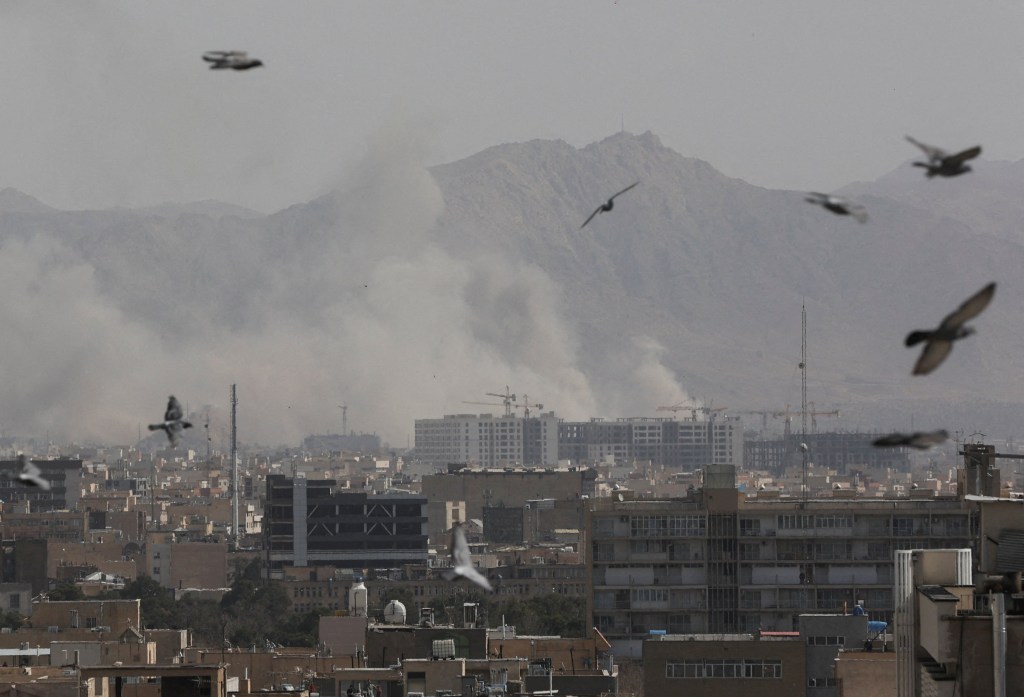 |
| Smoke rises following an explosion, after Israel and the United States launched strikes on Tehran, Iran, on February 28, 2026. Majid Asgaripour/WANA (West Asia News Agency)/Reuters |
This was followed by the Iranian regime's own cunning plan to undercut the American victory that had levelled its airports, destroyed its seaports, smashed its political/military infrastructure, left it leaderless, the elite commanders of the Islamic Revolutionary Guard Corps decimated, but not without canny intellectual resources that conspired to unsettle the globe when it closed off the Strait of Hormuz to shipping and relentlessly bombed surrounding Arab/Muslim countries that allowed their territory to house American military outposts.
Long under economic sanctions Iran still was able to develop a massive arsenal of missiles and drones, with a little help from its friends in China and Russia to gain more sophisticated technology. Its fairly inexpensive missiles and drones saw it fighting back at Israel and the United States, while inflicting some considerable damage to U.S. assets in the region. The U.S. aircraft carrier Abraham Lincoln with its almost 5,700 personnel found itself under duress of restocking supplies when Iranian missiles and attack drones destroyed the Bahrain-based American supply base.
That coup was followed up with an Iranian missile destroying a $500-million radar operating a Terminal High Altitude Area Defense (THAAD) missile defense system at a U.S. air base in Jordan signalling "a potentially transformative moment" in the "strategic contest" between Iran and the United States and Israel according to the Defence Security Asia journal. The IRGC sent their missile to strike the THAAD radar system maneuvering it in flight for a flanking attack on the radar striking it at a vulnerable angle, after having evaded detection and interception.
 |
Vessels near the Strait of Hormuz, as seen from Musandam, Oman, Aug. 31, 2026. Stringer | Reuters |
Labels: Asymmetrical Warfare, Guerrilla Warfare, Islamic Republic of Iran, Israel/U.S. Joint Air Attacks, Missiles, Smart Drones, Suicide Missions
posted by Pieface | 9:19 PM


0 Comments:
Post a Comment
<< Home