

Post-WWII Nazi Criminals and Collaborators in Canada -- The Futility of Too Little, Too Late
"Frankly, I think the opening of the report, if that actually happens any time soon, is a non-event. There's likely nothing in the report that's not already known, or at least suspected by the Jewish community.""I think the bigger story is how hard over the years the Canadian government has fought the Jewish community on every level regarding this issue.""The non-release of this report until now is just a symptom of that."Steven Rambam, founder, CEO, Pallorium, Inc. Brooklyn investigative agency"We deserve the opportunity to learn from our past and to come to terms with the shortcomings of Canada.""Rather than try to sweep that history under the rug and to fight about whether or not that history should be disclosed to the public, our government should be exercising its ability in acting with moral fortitude, and leadership."Richard Robertson, director of research and advocacy, B'nai Brith
 |
| Helmut Rauca was accused of more than 11,000 murders but lived in Canada after the war. A 1990 document on the “highest-ranking Nazi presently under investigation in Canada,” said the case would be “recommended for closure, due to the advanced age of the subject (87 years old).” Global News |
According to a recent Federal Court ruling, the 1985 618-page report commissioned y the Government of Canada to examine the arrivals following the end of World War II of Nazi war criminals should be released for public scrutiny. Justice Simon Fothergill issued a 21-page ruling stating that public interest in the historical record, despite the decades that have passed, weighed in favour of increased disclosure of the Rodal Report, taking into account the weakness of the reasons for continued secrecy by the government.
Years of effort all in vain to obtain the uncensored version of the study by historian Alti Rodal titled Nazi War Criminals in Canada: The Historical and Policy Setting from the 1940s to the Present have finally realized fruition. The Rodal Report had been prepared for the Commission of Inquiry on War Criminals in Canada -- the Deschenes Commission -- examining the circumstances whereby Nazi war criminals and collaborators arrived in Canada following war's end.
 |
| Toronto lawyer Mark Freiman, the son of Holocaust survivors, has been fighting to unseal Canada’s Nazi investigation files. Global News |
Significant passages of the report remain concealed from public view, despite substantial portions of the unpublished study having been released. According to Rodal's analytical investigation, weak screening processes had enabled some perpetrators of Nazi crimes to enter Canada. In February 2024, Library and Archives Canada had released segments of the report, responding to an access-to-information request from B'nai Brith. Revealed were a number of passages previously censored; even so seven pages in one sectkon still held redactions, along with 14 endnotes in RCMP file references.
The withheld text, argued Library and Archives Canada, remained protected by section 15(1)(a) of the Access to Information Act, permitting government to refuse disclosures whose release could harm Canada's international relations. One passage: an American official's assessment of American immigration law that Canad had received in confidence from the United States was also redacted.
RCMP file numbers covering intelligence information whose release could undermine efforts to detect, prevent or suppress subversive or hostile activity also fell under the protected category, not to be released. All but one of Library and Archives Canada's exemption arguments were rejected by Justice Fothergill, finding the institution had failed to establish that Canada's international relations or national security would be damaged with the release of information of clear historical importance, even today.
The net result, he emphasized, of greater public knowledge of the country's past would tend to promote informed discussion, reinforcing democracy. The continued withholding of the quoted U.S. official's remarks under section13, was permitted since the material was received from a foreign government, in confidence. The contents appeared to the judge as 'innocuous' nonetheless, and he felt that U.S. permission to disclose should be sought by Canada.
Pallorium's Steven Rambam and associates had compiled a list of 2,000 likely Nazi war criminals in Canada in the mid-1990s, whittling them down to 200, of the most egregious Nazis that should be investigated. 170 suspected Nazi war criminals had been located by him, along with other collaborators living in Canada. Mr. Rambam and his associates had interviewed some 70 of those they earmarked, under cover.
 |
| Yaroslav Hunka, right, waits for the arrival of Ukrainian President Volodymyr Zelenskyy in the House of Commons in Ottawa on Sept. 22, 2023. (Patrick Doyle/The Canadian Press) |
In September of 2023, Members of Parliament in the House of Commons had given a standing ovation to Yaroslav Hunka, an elderly Ukrainian who had during World War II been a member of the notorious Waffen-SS Galicia Division, Ukrainian volunteers who served complementary roles alongside German SS groups known to have committed mass murder of Jews and Poles. The occasion in Parliament was the guest presence of Ukrainian President Volodymyr Zelenskyy, when the Speaker of the House of Commons introduced Mr. Hunka as a Ukrainian 'hero' who had fought against the Soviets.
Ignorance of World War II facts and events among those present in Parliament that day resounded in their celebration of the presence of the 98-year-old Mr. Hunka, bypassing the reality that Soviet Russia was at that time part of the Allied effort against the Axis fascists that had once included the Soviets, until Germany turned on Russia, invading it, and Stalin aligned himself with the Allies. It was in fact, Hitler's invasion of Russia that turned the war in favour of the Allies, almost as much as the U.S. late entry.
That contretemps that occurred in the House of Commons caused great embarrassment internationally for Canada, while prompting a renewed scrutiny of Canada's immigration, vetting and historical-record practices where Nazi war criminals and collaborators had such easy entrance to Canada. Nor was the United States to be admired for its welcome of Werner von Braun, the Nazi German rocketry specialist who helped the U.S. develop its own science of rocketry post-WWII.
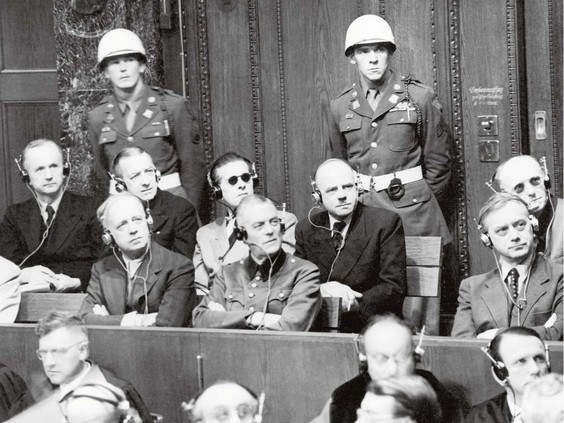 |
| Top Nazi leaders faced war crimes trials after the Second World War but many others who took part in the Holocaust went unpunished. The Canadian government is examining whether to release a list of 900 alleged Nazi war criminals that was compiled in 1986 by the Deschênes Commission. PHOTO COURTESY OF THE U.S. NATIONAL ARCHIVES (RECORD GROUP 238 / NAID 540127), PUBLIC DOMAIN |
"I can personally attest to the fact that all the war criminals were known decades ago. The Canadian government could have done much, much more.""There's no war criminal that entered Canada that wasn't known to the RCMP. That, I feel confident in saying.""What will the unsealing of the few remaining portions of this report, if it happens, actually reveal to Canadians or to the Jewish community in particular?""Nothing that hasn't already been known for decades."Steven Rambam, founder, CEO, Pallorium, Inc.
Labels: Deschenes Commission, Inc., Justice Simon Fothergill, Nazi War Criminals in Canada, Pallorium, Release of Alti Rodal Report, Rodal Report, Steven Rambam
posted by Pieface | 9:58 PM


0 Comments:
Post a Comment
<< Home