Politic?

This is a blog dedicated to a personal interpretation of political news of the day. I attempt to be as knowledgeable as possible before commenting and committing my thoughts to a day's communication.

Sunday, November 30, 2025

Pope Leo's Two-State Solution

 
"Türkiye has a number of, if you will, qualities about it; it is a country with the vast majority being Muslims, and yet the presence of numerous Christian communities there, although a very small minority, and yet people of different religions are able to live in peace. And that is one example, I would say, of what I think we all would be looking for throughout the world."
"To say that in spite of religious differences, in spite of ethnic differences, in spite of many other differences, people can indeed live in peace. Türkiye itself has had, of course, in its history various moments when it was not always the case, and yet to have experienced that and to have been able to speak also with President Erdogan about peace, I think, was an important element, a worthwhile element of my visit."
Pope Leo XIV
https://ichef.bbci.co.uk/news/1024/cpsprodpb/3989/live/2459bf40-cba1-11f0-84f7-7db748a6619f.jpg.webp
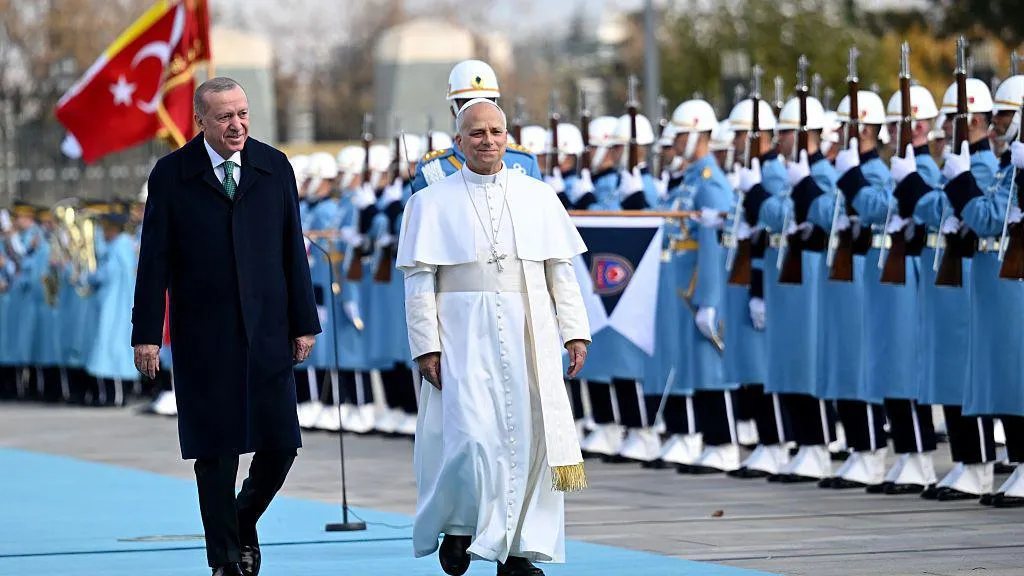
Pope Leo (C) was welcomed to Ankara by Turkey's president, Recep Tayyip Erdogan   Anadolu via Getty Images
"Christians in Türkiye face everyday discrimination for their faith. Foreign Christians with Turkish spouses and children have been banned from entering or re-entering the country. Religion is recorded on the Turkish ID card, making it easy to discriminate against Christian job applicants. Even Greek and Armenian Christians who attend traditional churches aren't considered full members of Turkish society. Their churches struggle with legal obstacles and red tape intended to obstruct the practice of their faith."
"Historical Christian groups, such as the Armenian and Assyrian (Syriac) churches, face high pressure and hostility in the southeastern region of Türkiye. For decades, they have been caught between the rivalries of the Turkish army and Kurdish resistance groups. Most Christians from those churches no longer live in their ancestral regions but have moved to western areas of Türkiye."
Open Doors International 
"Ramazan Arkan, the pastor of the Antalya Evangelical Churches in Turkey, spoke during the meeting.
“Turkish churches face many difficulties and much discrimination, and unfortunately, when we have tried to address those issues with the Turkish authorities, we have most often been ignored because Christians are the religious minority in Turkey,” he said."
"Missionaries are also being deported. Their residence permits are not being renewed, and they are labeled as possible security threats. Fearing they could be deported at any time, many foreign missionaries in Turkey avoid participating in church meetings or activities to go undetected."
"Members of the Christian community are not free from hate crimes, either. Many of them face threats and social isolation online."
"We encounter speech filled with insults and profanity directed at official church social media accounts, church leaders, Christianity, Christian values, and Christians in general,” the Turkish Association of Protestant Churches stated in its latest Human Rights Report."
Persecution.Org. International Christian Concern 
Hagia Sophia in Turkey
“We will not allow you to brainwash our Muslim youth!” the man shouted from his car. “Oh, infidels, you will be defeated and swept up into hell!”  Persecution.Org
 
Pope Leo  travelled to Turkey to attend the historic Nicaea gathering dating from the Christian gathering at the Turkish city of Nicaea in A.D.325 of bishops from the Eastern and Western churches in unity with one another; Catholic, Orthodox, Protestant; where the Nicaean Creed originated. While he was in Turkey he met with Turkish President Recep Tayyip Erdogan, where discussions took place related to the conflict in Gaza. Pope Leo asked Mr. Erdogan to work toward bringing peace to Gaza.
 
Just as Pope Leo has exonerated Turkey from persecution of Christians in Turkey -- where significantly, ancient Constantinople was the eastern seat of Christianity under Emperor Constantine whose mother Helena, an early convert to Christianity, persuaded her son to support Christianity. Constantinople's  transition to Istanbul, Turkey's largest city and its cultural capital took place in 1080 when Seljuk Turks invaded, installing Islam and wrenching the country from Christianity -- so too does he overlook the very fact that it is Erdogan himself that supports Gaza's terror against Israel. 
 
He cannot be unaware that President Erdogan's Sunni Islamist ideology is one of conquest achieved by violent force. Nor can he be ignorant of the fact that Erdogan has given haven to Hamas leaders, and along with Qatar, arms and supports Hamas and other Palestinian terrorist groups on a cohort with the Islamic Republic of Iran. Yet this pope has chosen to foster amicable relations with a dictator who persecutes his own country's Christians and actively engages in the jihadist Islamofascist plot to destroy Israel.
 
Catholics, in their faith creed universally recite "I believe in one God, the Father almighty...", yet give no mind to the fact that their monotheistic religion owes its existence to Judaism. In humble deference to the source of their one-God creed it might behoove the Catholic Church to recognize its indebtedness to the Judaic YHWH, the source of all they hold dear in their faith. That it was a Jewish man whose Judaic prescriptions they revere, and that the welfare of that crux of civilization would be of concern to Catholics and to the Pope.
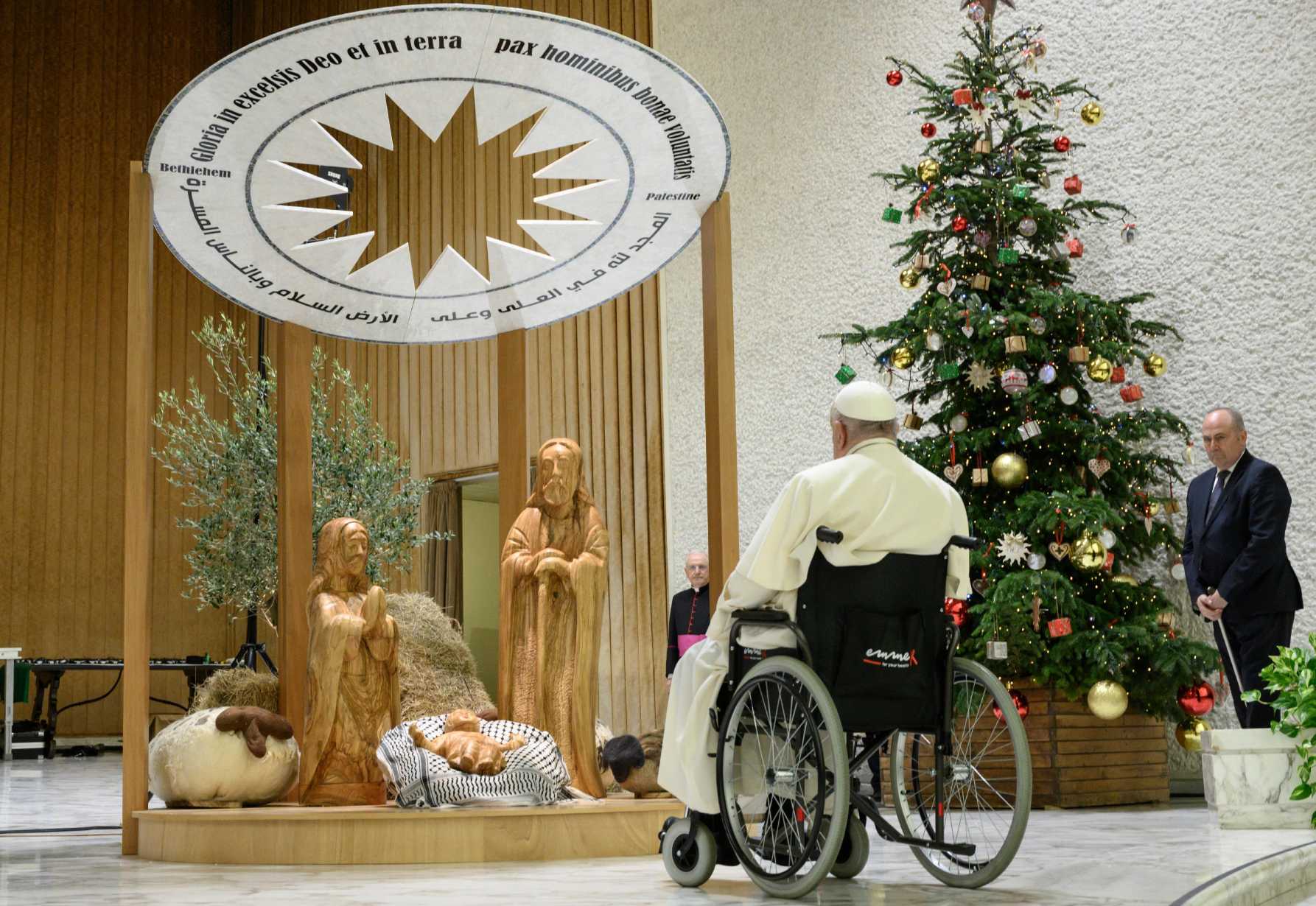
 
https://www.usccb.org/sites/default/files/styles/article_news_full_detail/public/2024-12/20241210T0800-POPE-CRECHE-TREE-1786397.JPG.jpeg?itok=-bM3-JHf
Pope Francis stops to pray in front of a Nativity scene from Bethlehem in the Vatican audience hall Dec. 7, 2024. The baby Jesus is lying on a white and black kaffiyeh, a Palestinian headdress. Around the star, written in Arabic and Latin, are the words of the angels: "Glory to God in the highest and on earth peace to people of good will." (CNS photo/Vatican Media)
 
Instead, Israel, the home of the Jewish world, is held by this Pope, as it has been by his predecessors as a condemned entity, itself persecuted throughout the ages by the Catholic Church itself, a tradition that continues, now honouring a narrative of victimhood of those calling themselves Palestinians, oppressed by an 'occupying force' engaged in the commission of genocide. Pope Francis's honouring of a 'Palestinian' Jesus before his death spoke volumes of a willing abandonment of the source of Christianity, preferring to honour an Arab pretender to a Jewish originator of the religion 1.4 billion people worship globally.
 
Insisting that a two-state solution is an absolute necessity to see an end to the 80-year old conflict between the Jewish world and that of Islam that focuses on a 'Palestinian State' when since 1947 onward that Palestinian State has been rebuffed time and again in favour of castigating and casting out a Jewish presence on land 'consecrated to Islam', yet representing Judaic ancestral land, only a small portion of which is occupied by the State of Israel, a mere sliver in the total geography of the Middle East, as an intolerable affront which must be destroyed. 
 
A two-state solution, a concept originally accepted by Israel, and offered time and again in negotiations which Palestinian leadership turned away time and again, is a purely Western-supported ideal, one which Palestinians have no interest in whatever, holding out for Israel's destruction, and a one-state Palestinian solution. Israel has surrendered its support of that elusive two-state 'solution' to achieve a longed-for peace, when its people will no longer be targets for murder by its neighbours, solidified into a stone etching reflective of the  tablets of the Ten Commandments' 'thou shalt not kill', when to protect its own it must do just that. 
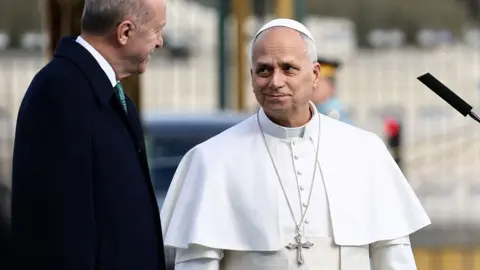
Reuters Pope Leo smiles as he looks towards Erdogan while wearing a white robe with a silver cross on a necklace while standing outside the Presidential Palace on Thursday.
The Pope met Turkish President Recep Tayyip Erdogan at the Presidential Palace in Ankara on Thursday Reuters


Labels: , , , , , , ,

Tuesday, December 03, 2024

Syrian Surprise Assault --Turkish Game of Regime Change

"Hayat Tahrir al-Sham, part of an alliance of terrorist groups active in Syria and with links to the Islamic State (ISIS) and Al-Qaeda, was formerly known as Jabhat al-Nusra, and served as Al-Qaeda's affiliate in Syria. The organization is a jihadist group that upholds Sharia law, occupies Syria's Idlib area and cooperates with the Turkish military and Turkish-backed groups in Syria. Abu Bakr al-Baghdadi, the leader of ISIS, was also involved in HTS's formation."
"Turkey is unleashing another gruesome jihad in Syria. The city of Aleppo is now effectively under the control of Turkish-backed jihadist groups. Tens of thousands of Christians, Kurds and other minorities are in danger of extermination. Videos of jihadists abducting Kurdish women have also surfaced on social media."
Uzay Bulut, Gatestone
"MISSING FROM MEDIA REPORTS ON ALEPPO: 'Rebels' taking city are NOT Freedom Fighters but Turkish-backed Islamists with same ideology as ISIS that target Yazidis, Christians and other religious and ethnic minorities.
"The USCIRF reports they 'target religious minorities, especially Yazidis, for rape, assassination, kidnapping for ransom, confiscation of property, and desecration of cemeteries and places of worship.'
USCIRF Factsheet says Hay's Tahrir al-Sham (HTS) 'remains a potent source of a Salafi-jihadism that restricts the religious freedom of non-conforming Sunni Muslims and threatens the property, safety, and existence of religious minority groups such as Alawites, Christians, and Druze.' They also report 'torture, forced disappearance, rape and other sexual violence, and killing in detention.'
"Expect the same horrific crimes from these Turkish-backed Islamist militias (including HTS) that we have seen from them in other parts of Syria. They learned from the international response to ISIS to not make an immediate public display of this violence.
".... [A]reas under government control are also horrible as they endure 'egregious human rights abuses such as arbitrary detention and torture, enforced disappearance.'                Nadine Maenza, the Former Chair of the United States Commission on International Religious Freedom (USCIRF)
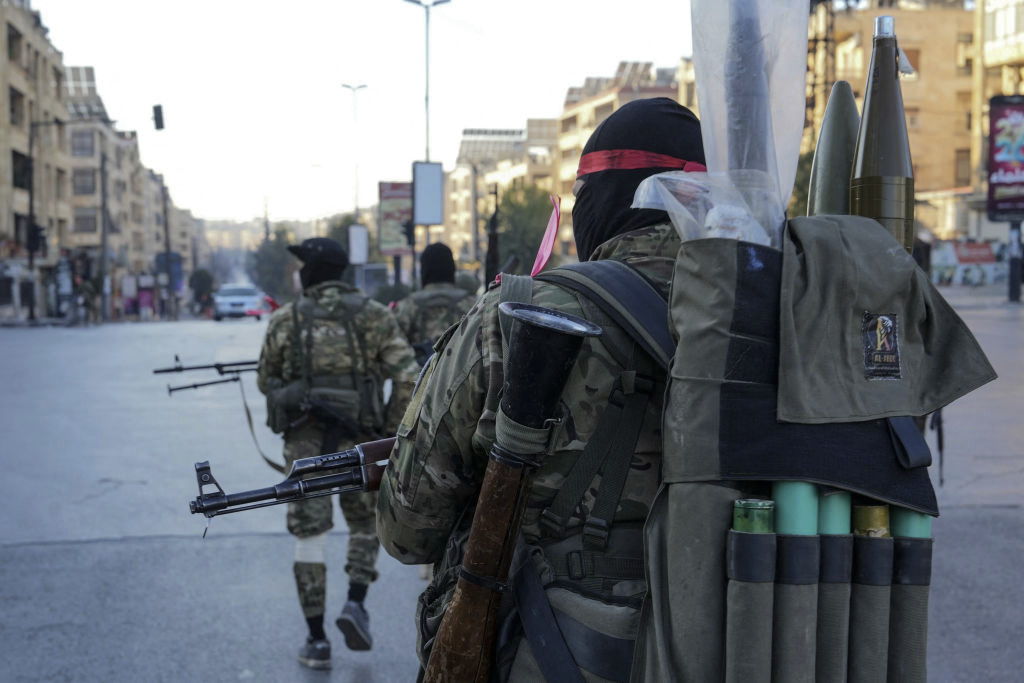
https://www.gatestoneinstitute.org/pics/5229.jpg
 Pictured: Turkish-backed jihadists patrol in central Aleppo on November 30, 2024. (Photo by Muhammad Haj Kadour/AFP via Getty Images)
 
Syria's 13-year-old uncivil war that witnessed an estimated half-million deaths assigned to the country's regime under President Bashar al-Assad spurred by Sunni Syrians demanding equal treatment to the minority Alawite Shiites represented by Assad, ignited a destructive response from the Syrian military that turned a protest into a civil war. It did not take long for the country to be flooded with the presence of Sunni terrorist groups eager to contest the Syrian military in an exchange of tribal/secular conflict.

Now, a complex patchwork of terrorist fighters whose focus is on opposing a number of various enemies have converged to challenge the regime once again. A lightning assault last week against government forces in the northwest of the country is in the process of altering the front lines in the conflict. The Hayat Tahir al-Sham (HTS) Islamist salafist group poses a formidable challenge to the Assad regime. It is predicted by Middle East experts that this current and growing conflict has the potential to go beyond the country itself.
 
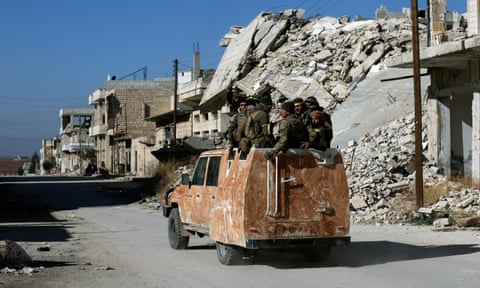
Syrian opposition fighters sit on a vehicle moving past a ruined building
Syrian opposition fighters ride on a truck in Khan Sheikhoun, south-west of Aleppo. Photograph: Ghaith Alsayed/AP

The United States has distanced itself from the offensive, while Russia and Iran, both involved in giving dedicated support over the years of conflict to Syria, both distracted at present by their own disparate conflicts -- as well as Hezbollah in Lebanon -- may yet be drawn more into the Syria defensive. The HTS group, over a period of a decade was involved in disabling the Syrian government in its bid to establish Islamic rule in Syria as the successor to al-Qaeda affiliate Jabhat al-Nusra, now on the  ascendancy.

It has in the last few years, attempted to soften its harsh image of Islamist intolerance, claiming recently it will protect Aleppo's cultural and religious sites, including churches. Troops loyal to Assad have to this point managed to fend off efforts to topple his regime, since 2011. Assad's forces back then with its violent crackdowns on protests moved the situation from protest to full volume rebellion. Opposition rebels had until recently been contained within part of north-western Syria with the help of Iran, Russia and Hezbollah.

Suddenly, government forces seem to have abandoned their upper hand in the face of growing resistance from opposition rebels, wresting control of Aleppo, although the military claimed it was redeploying troops from areas controlled in Aleppo and Idlib provinces, aided by joint Syrian-Russian air force bombardments. Jake Sullivan, U.S. national security adviser, spoke of the rebels' advance in connection with Russia, Iran and Hezbollah, weakened through conflicts elsewhere.

According to Turkey's state-operated Anadolu Agency, the Syrian National Army -- a loose coalition of Turkish-backed forces -- took part in the recent rebel offensive. The SNA in joining the latest fighting did so primarily against Kurdish fighters in northern Syria who have in the past fought Assad's government, as well as HTS and Islamic State Islamists. Turkey's goal is its fight against Syrian Kurdish fighters considered by Turkey to be terrorists for their links to the  Kurdistan Workers' Party (PKK) which launches attacks against Turkey for Kurdish independence.

https://www.eiu.com/n/wp-content/uploads/2024/12/aleppo-2048x1365.jpg
Aleppo, Economist Intelligence
 

Labels: , , , , , , ,

Sunday, December 01, 2024

Violating Syria's Sovereignty -- Allies? What Allies?


"Of course, this is a violation of Syria's sovereignty in this region."
"We urge Syria's authorities to reassert control and restore constitutional order as soon as possible."
Dmitry Peskov, Kremlin spokesman 
 
"[Syria] will continue to defend its stability and territorial integrity."
"[Damascus is capable of beating back the advance] with the help of its allies."
Syrian President Bashar al-Assad

"No one expected Aleppo to be taken, which means there were no real defensive lines within the city." "Once they got there it seems like it was all open."
"I think the regime didn’t expect such a quick move, the operation started just a few days ago." 
Jerome Drevon, International Crisis Group
 
"[The overwhelming number of fighters] and the multiplicity of battlefronts prompted our armed forces to carry out a redeployment operation aimed at strengthening the defence lines in order to absorb the attack, preserve the lives of civilians and soldiers, and prepare for a counterattack."
Syrian Military statement
https://ichef.bbci.co.uk/news/1024/cpsprodpb/6da2/live/c31b7150-af1e-11ef-907d-d11d58b97d6a.jpg.webp
HTS had shown little sign of attempting to reignite the Syrian conflict until this week  Getty Images
 
"Certainly some areas in the Aleppo countryside could be difficult for HTS and their allies to hold on to if they come under really withering air strikes or artillery fire. [Insurgent rule inside Aleppo itself could prove far more difficult for Assad and his allies to repel in the long term]."
"It’s not clear what kind of capabilities Damascus is now able to bring to bear and mobilize from elsewhere in Syria, also critically how much capacity Russia now has in Syria, given its current involvement in Ukraine which has diverted some of their forces to that front."
Sam Heller, analyst, Century Foundation
Aleppo, considered Syria's second-largest city, has been breached by Islamist insurgents. Two car bombs were blown up on Friday and insurgents were fighting with government forces on the western edge of the city, according to war monitor Syrian Observatory for Human Rights, based in London, who stated that the insurgents had seized control of Saraqeb, south of Aleppo, strategically located at the intersection of highways that link Aleppo with the Syrian capital Damascus and the coast.

As a result of missiles and gunfire, residents fled neighbourhoods on the city's edge. A shock offensive launched on Wednesday led the advance on Aleppo with thousands of fighters sweeping through towns and villages in the northwestern countryside. A region already reeling from the wars in Gaza and Lebanon with Israel, led uncertainty to the surprise attacks, atop the unresolved Syrian civil war that commenced in 2011.

https://ichef.bbci.co.uk/news/1024/cpsprodpb/9753/live/8b338a00-afca-11ef-8e95-674489b763e2.jpg.webp
Getty Images
 
 Thjere was no evidence of a significant pushback from either government forces or their allies; reports of government forces shedding their responsibilities in the face of advances, was reminiscent of the sweep of the Islamic State advances in Iraq and Syria when it was establishing its Caliphate, absorbing a third of each country, when its offensive campaign and its reputation for vicious ruthlessness entirely cowed the militaries in both countries who failed to directly counter those advances, leaving the way clear for the Islamists to take control of great swaths of government territory.

The offensive seemed planned to take advantage of the Israeli attacks on Hezbollah and Iran, which backed the Syrian regime forces since 2015, now distracted in the need to defend themselves from Israeli Forces who were responding to the violent cross-border provocations by Lebanon's Hezbollah.
Which leaves only Russia to continue its backing of the Alawite Shiite Bashar regime against the Sunni insurgents. And Russia is fully occupied in Ukraine.

The very day the Syrian opposition factions made public an announcement of their offensive, a ceasefire in the two-month-long war between Israel and Hezbollah took effect. Additionally, Israel escalated its attacks against both Hezbollah and Iran-linked targets in Syria within the past few months. Syrian government attacks on opposition held areas presaged the attack on Aleppo. According to Turkish security officials, Syrian opposition groups (that Turkey supports) launched a long-planned "limited" offensive on Aleppo. When Syrian government forces began their retreat, the offensive expanded.

The Kremlin made it clear that the attack is considered by them to represent an encroachment on Syria's sovereignty. A Friday statement by Syria's Armed Forces claimed they had been clashing in the countryside around Aleppo and Idlib with the insurgents, destroying drones and heavy weaponry, vowing to repel the attack, accusing the insurgents of spreading false information regarding their advances. 

Opposition factions led by Salafist Hayat Tahrir al-Sham are engaging in the most intense fighting in northwestern Syria since 2020, when government forces seized areas occupied and controlled by opposition forces. Dozens of fighters from both sides were killed in the battles that began on Wednesday. Hezbollah, "the main force" in the government's control of Aleppo, is unfortunately for Bashar al-Assad, out of commission.
 
A Syrian opposition fighter takes a picture of a fellow rebel stepping on a portrait of Bashar al-Assad in Aleppo
A Syrian opposition fighter takes a picture of a fellow rebel stepping on a portrait of Bashar al-Assad in Aleppo. Photograph: Ghaith Alsayed/AP


Labels: , , , ,

Monday, December 25, 2023

Where Does Hamas Get Its $2 Billion Annual Operating Budget?

"A good life is a sign of success and power."
"[And it isn't just the Hamas leadership abroad] I have been once or twice to the Kerem Shalom crossing [with Gaza]. You would not believe the number of Jacuzzis going into the Strip."
Israeli Brig.Gen. Yosef Kuperwasser
 
"Hamas's leadership both inside and outside Gaza steals money from Gazans, who live in bad conditions, to build military infrastructure and for private purposes, including to maintain their expensive lifestyles."
IDF Maj.Gen. Yaakov Amidror
 
"It was the Israeli government's policy to allow Qatar to send funds to the Gaza Strip."
"The thinking was that it would buy quiet. [For Qatar], maintaining ... long-standing ties to terror organizations is part of the country's grand strategy."
"Giving terror groups a safe haven is a form of security for Qatar. It insulate the royal family. In the past, terror groups targeted ruling families in the Gulf countries, but never in Qatar."
"It is very unlikely that Turkey would ever expel Hamas. U.S. pressure might even be counterproductive in this scenario."
Brandon Friedman, senior research fellow, Moshe Dayan Center for Middle Eastern and African studies, Tel Aviv University
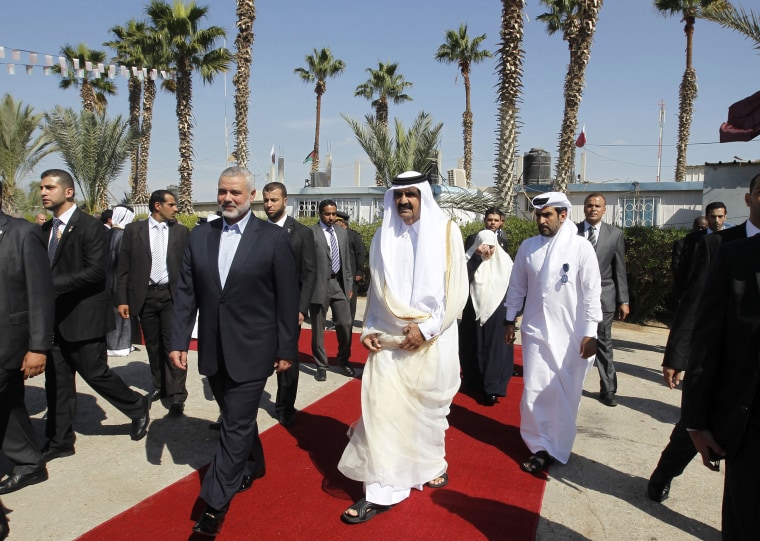
Gaza's Hamas Prime Minister Ismail Haniya, center left, walks alongside Qatari Emir Sheikh Hamad bin Khalifa al-Thani during a welcome ceremony
Gaza's Hamas prime minister, Ismail Haniya, center left, walks alongside Qatari Emir Sheikh Hamad bin Khalifa al-Thani at a welcome ceremony at the Rafah border crossing with Egypt in 2012.  Mohammed Abed / Pool / AFP via Getty Images
 
The top leaders of Hamas; Ismail Haniyeh, Moussa Abu Marzouk and Khaled Mashaal are not going begging for charity, even as hunted, outlawed terrorist leaders, who find haven with sympathetic Qatar and Turkey. Their personal net worth has been estimated at $11 billion. Which does not come as a great surprise to anyone interested in video snippets and photographs that find their way through social media advertising their penchant for living the good life.
 
 Just as Yasser Arafat siphoned off international funding for Palestinian refugees. And the corruption that reigns within the Palestinian Authority with Mahmoud Abbas and other West Bank leaders known to have amassed their own private fortunes. So where does all that lifestyle funding come from? The focus on Hamas alone sees it being recognized as the second richest terror group in the world, with a $2 billion annual budget.
 
Funded itself by the international community, the Palestinian Authority transfers an estimated 33 percent of its total annual budget to Hamas meant in theory to pay salaries of Fatah officials along with goods and services for Gaza residents; staples such as water, electricity and medical treatment. Although
Hamas and Fatah are virulently hostile rivals to one another, by transferring funding  to Hamas the PA extracts a level of influence in Gaza. 

Hundreds of millions are raised by Hamas from taxes it imposes on goods arriving through Egypt's Rafah crossing and Israel's Kerem Shalom crossing, along with tariffs on contraband entering Gaza through its vast network of smuggling tunnels; goods from kitchen appliances to luxury vehicles. The Islamic Republic of Iran is good for an estimated $250 million yearly. Tehran also generously supplies Hamas with weapons and training, and its financial contributions to Hamas coffers is increasing.
 
https://media-cldnry.s-nbcnews.com/image/upload/t_fit-560w,f_auto,q_auto:eco,dpr_2.0/rockcms/2023-10/231025-hamas-parade-mjf-1156-3ace53.jpg
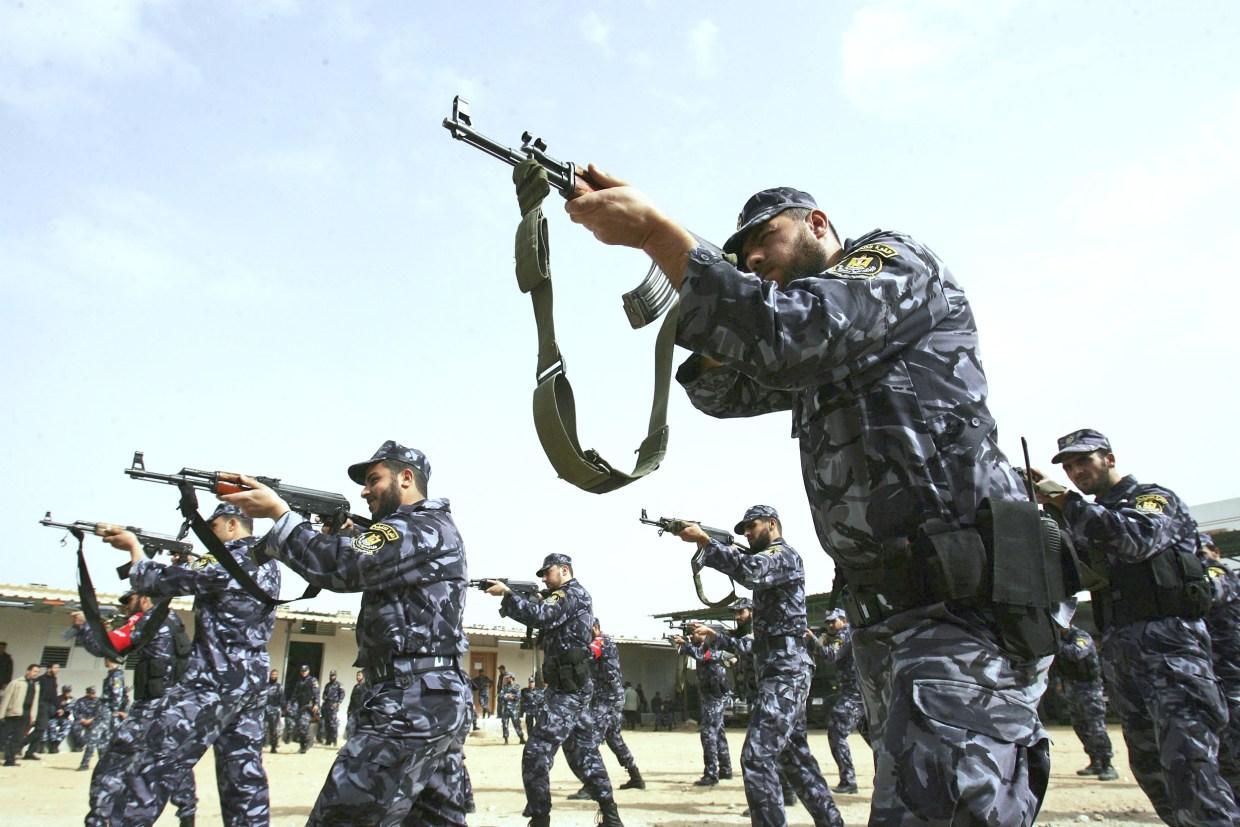
Members of Hamas security march in a military parade at a graduation ceremony in Gaza City last year.  Majdi Fathi / NurPhoto via Getty Images
 
There are endless sources of ongoing funding for the terrorist group, including hundreds of millions from aid groups alongside its own web of 'charitable' organizations. UN agencies spent close to $4.5 billion in Gaza from  2014 to 2020, over 80 percent of which gets channelled through UNRWA for Palestinian refugees, comprising 3/4 of the population of Gaza. Germany has banned charities with Hamas links, such as the Samidoun Palestinian Prisoner Solidarity Network, which is active in less alert countries such as Canada, collecting funds in support of Hamas.

It was revealed through an investigation by Focus on Western Islamism which exposes Islamist extremism and finances, that over $260 million was raised for Hamas by charities in the United States that are aligned with the terrorist group. Qatar has transferred tens of millions in cash monthly to Hamas, reaching close to $400 million annually. Members of al-Qaeda, Islamic State and the Taliban have been hosted by Qatar, along with Hamas executives. Qatar's state-run Al Jazeera network spreads Hamas propaganda.

President Recep Tayyip Erdogan of Turkey defends Hamas as a legitimate fighting force against Israeli 'oppression' and 'genocide': "Hamas is not a terrorist organization, it is a liberation group, 'mujahedeen' waging a battle to protect its lands and people". Erdogan has provided Hamas leaders with Turkish passports. In early 2023 Israel seized 16 tons of explosive materials originating from Turkey bound for Gaza.
 
https://media-cldnry.s-nbcnews.com/image/upload/t_fit-1240w,f_auto,q_auto:best/rockcms/2023-10/231025-hamas-gaza-2007-mjf-1147-2757bc.jpg
Members of the Hamas-led government executive security forces take part in an armed exercise inside their base.  Abid Katib / Getty Images
 
 
In the weeks since the attack, the issue of what domestic and international anti-money laundering (AML), fraud and sanctions teams are doing – and doing differently – to identify terror-tinged or laundered funds tied to Hamas has also been on the minds of top U.S. Treasury agencies and lawmakers.
In rapid succession, over three days – October 18th through Oct. 20th – the U.S. Treasury’s Office of Foreign Assets Control (OFAC) and Financial Crimes Enforcement Network (FinCEN):
  • OFAC acts: Issued a bevy of sanctions against key Hamas terrorist group members, operatives, and financial facilitators located in Gaza and elsewhere, including Sudan, Turkey, Algeria, and Qatar, according to congressional witnesses.
  • Virtual value villain: The action “specifically targeted those managing assets within a secret Hamas investment portfolio, a Qatar-based financial facilitator with close ties to the Iranian regime, a key Hamas commander, and a Gaza-based virtual currency exchange and its operator.”
  • FinCEN alert: Issued an alert covering refreshed red flag indicators tied to Hamas money movements and terror finance more broadly.
  • FinCEN targets crypto mixers: FinCEN also proposed a new regulation to prevent crypto mixers from helping terror groups and their financiers.

The NPRM goes beyond one designated group and seeks to highlight the “risks posed by the extensive use of CVC mixing services by a variety of illicit actors throughout the world.”

If enacted, the new rule would “increase transparency around CVC mixing to combat its use by malicious actors including Hamas, Palestinian Islamic Jihad, and the Democratic People’s Republic of Korea (DPRK),” according to FinCEN. 

Association of Certified Financial Crime Specialists


Labels: , , , , , , , , , ,

Sunday, February 26, 2023

Little Trust in Turkish Gov't Through Earthquake Relief

?There is a lack of trust when it comes to these organizations [the Turkish government's own organizations receptive to receiving charitable contributions from citizens] and people gravitate toward organizations civilians are involved in."
Gulfem Saydan Sanver, expert, political communication, Turkey

"[The Syrian humanitarian response for the year is already] severely underfunded, [with only half of what is needed funded."
"The international community is called upon to urgently increase funding so that] those affected by this emergency, within an emergency, get the support they need."
International Rescue Committee of the UN
https://www.washingtonpost.com/wp-apps/imrs.php?src=https://arc-anglerfish-washpost-prod-washpost.s3.amazonaws.com/public/Y2GPOEFSDD2TOBVBJ45ZP5FXDQ_size-normalized.jpg&w=691
Civil defense workers and security forces search through the wreckage of collapsed buildings in Hama, Syria, on Monday. (Omar Sanadiki/AP)

When the first of the February 6 tremblors hit, the major impact was in southern Turkey, and that is where about 43,000 Turks perished. In northwest Syria, four million displaced Syrians were already living in deprived conditions as a result of the Syrian civil war, a sectarian conflict which saw Syrian President Bashar al Assad, an Alawite Shiite Baathist regime, targeting Syria's majority Sunni population considering the rebellious among them clamouring for equal treatment as citizens to be 'terrorists'.

And while international assistance along with the  country's emergency services sprang into action in Turkey, no government action was undertaken in Syria to aid the refugees living in tent camps, buildings that had been bombed by Syrian and Russian warplanes, and other makeshift settlements where medical aid and the basic necessities of life were in short supply. There, the Syrian White Helmets, a self-help charitable group, did their best with inadequate rescue equipment to free people trapped in the rubble of collapsed buildings. 

The international community responded to the catastrophe that struck Turkey, by sending out search and rescue teams, providing winter clothing, medicines, food, but little trickled through to Syria. Turks themselves were quick to provide funding to internal NGOs rather than to their government for the rescue of their fellow citizens, and the provision of emergency supplies of food and water to  the wounded and earthquake survivors. Many of the worst-hit zones were evacuated, people bused elsewhere for safety from robust after-shocks and the danger of more buildings collapsing.

Most people in the international community sent their charitable funds to help the stricken Turks through the Red Cross, Doctors Without Borders and other reputable aid agencies. Turks had an NGO that was initiated by a Turkish rock star, which raised a billion Turkish lira in donations, equal to $53 million US. to help the victims of the quakes. They were openly opposed to donate to state-operated organizations.

The country's state Disaster and Emergency Management Authority with its affiliation to the Interior Ministry saw criticism by people across the earthquake-hit south for tardiness in arriving and inadequate response. Accusations of incompetence abounded. The Authority claimed it provided the correct response immediately the earthquakes struck. On the other hand, Turkish President Tayyip Erdogan expressed his own view that rescue was incomprehensibly tardy.

There was an alternative that most people in Turkey turned to with infinitely more confidence that their donations would reach those badly in need of assistance. The NGO AHSAF founded by musician Haluk Levent. Turkey's government has expressed its doubts over how the NGO plans to use those donations, and questions its mission. In giving needed aid to survivors the funding given to the NGO will find ample good use.

The sheer scale of the disaster which killed over 43,000 in Turkey alone is a difficult number to comprehend. This was not supposed to happen. After the 1999 Turkish earthquake when 19,000 lives were lost, attributed largely to the poor construction of multi-story buildings in the country whose building codes were routinely flouted, Mr. Erdogan campaigned on a promise to ensure that all buildings would strenuously follow the code for earthquake safety.

One town directly in the earthquake zone did exactly that on the initiative of the municipality itself. As a result there were no buildings there that collapsed, and there was not one death that occurred from the earthquake, while all around the town mass destruction ensued. Corruption is endemic in the country and shortcuts in the construction industry led to poor construction, responsible for the thousands of buildings unable to withstand the effects of the earth movement.

Under President Erdogan's direction authorities have charged and arrested hundreds of owner of construction companies, engineers, company lawyers and others involved in the construction trade. Facing a spring election. the current president of Turkey is eager to ensure that the grumblings of anger assailing the government's inadequate response to citizens in their time of dire need, don't stick too closely to him personally. But his office is where such decisions to enforce laws are carried out and the calamitous situation that ensued befouls him as the nation's executive administrator.

Millions of Turks are now without homes. The Turkish Red Crescent and the government AFAD received donations from within and without the country, as did smaller local charities and international organizations. 115 billion lira was raised through a television campaign and public institutions like the Central Bank and public banks turned in another 80 billion lira.

Turkish Red Crescent volunteers hand out hot drinks and food to people affected by the 6 February earthquakes. Syrian Arab Red Crescent volunteers arrive in an ambulance to provide urgent health assistance to those injured.

Turkish Red Crescent volunteers hand out hot drinks and food to people affected by the 6 February earthquakes. Syrian Arab Red Crescent volunteers arrive in an ambulance to provide urgent health assistance to those injured. Photo: Turkish Red Crescent and Syrian Arab Red Crescent

Labels: , , , ,

Thursday, February 16, 2023

Syrian Rescue and Survival

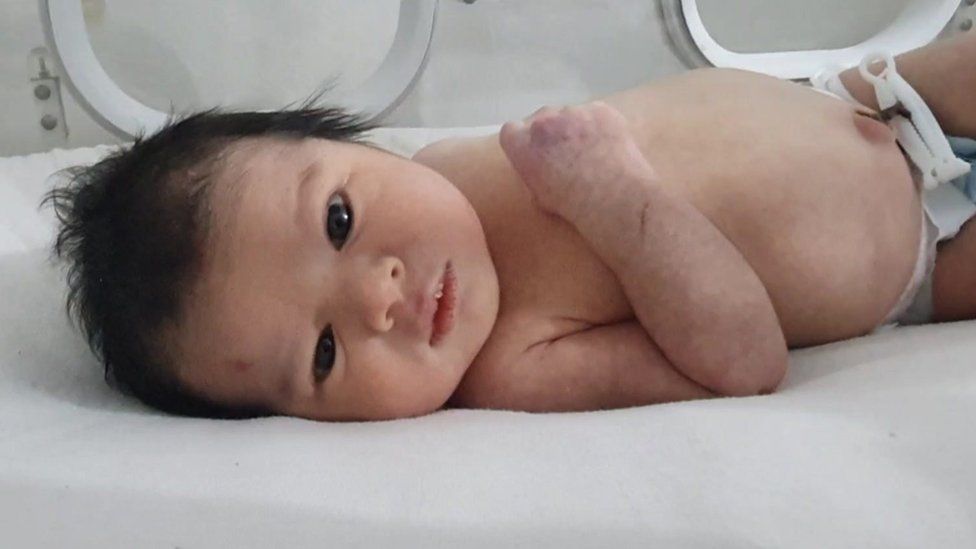
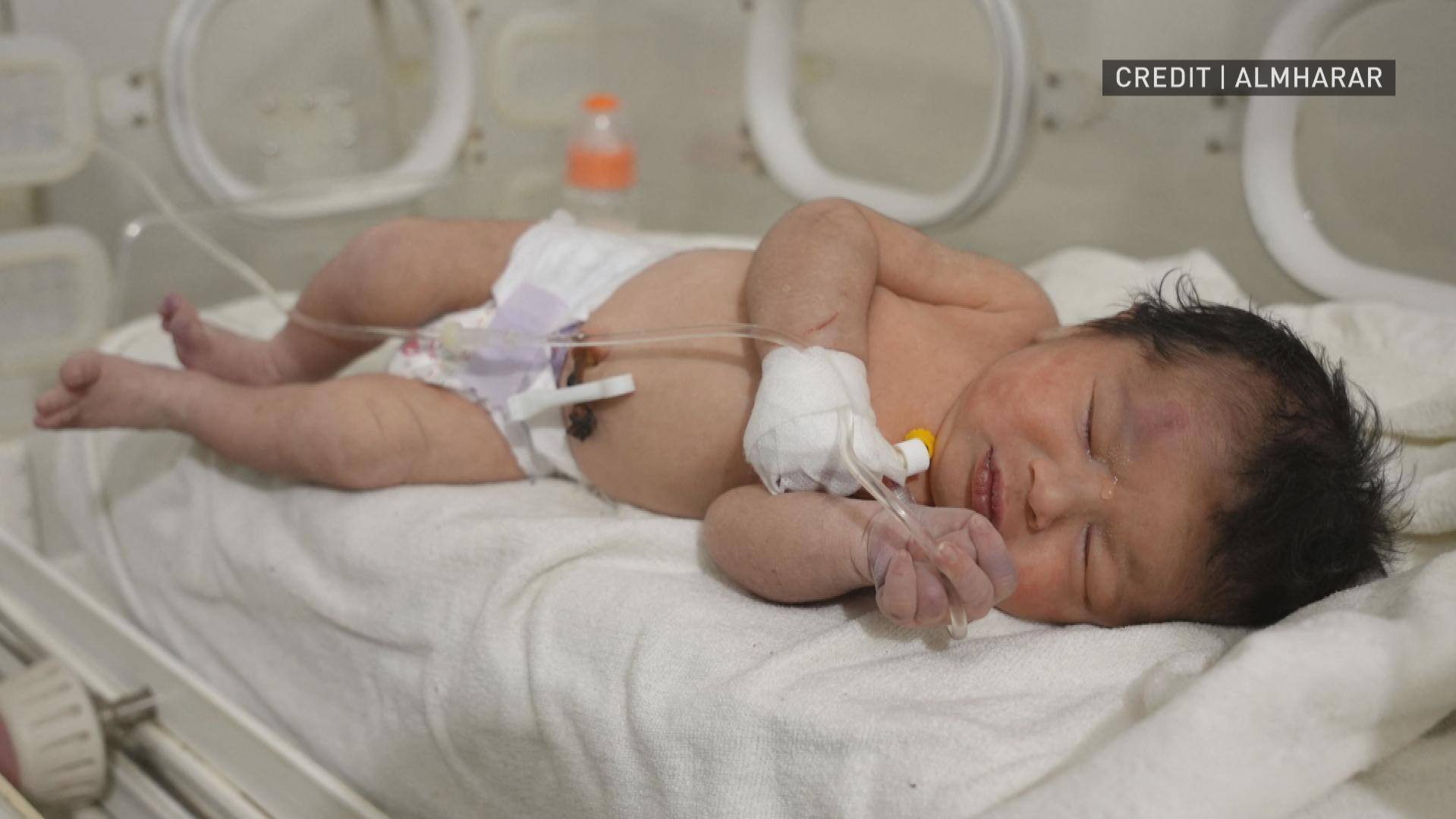
Baby Aya in hospital
"[We have received dozens of calls from people all over the world wanting to adopt baby Aya]."
"I won't allow anyone to adopt her now. Until her distant family return, I'm treating her like one of my own."
Hospital Manager, Khalid Attiah
 
"The rescuers can end up being victims too because of how unstable the building is."
"We just pulled three bodies out of this rubble and we think there is a family in there that is still alive - we will keep on working."
Mohammed al-Kamel, White Helmets rescue group, Jindayris, Syria
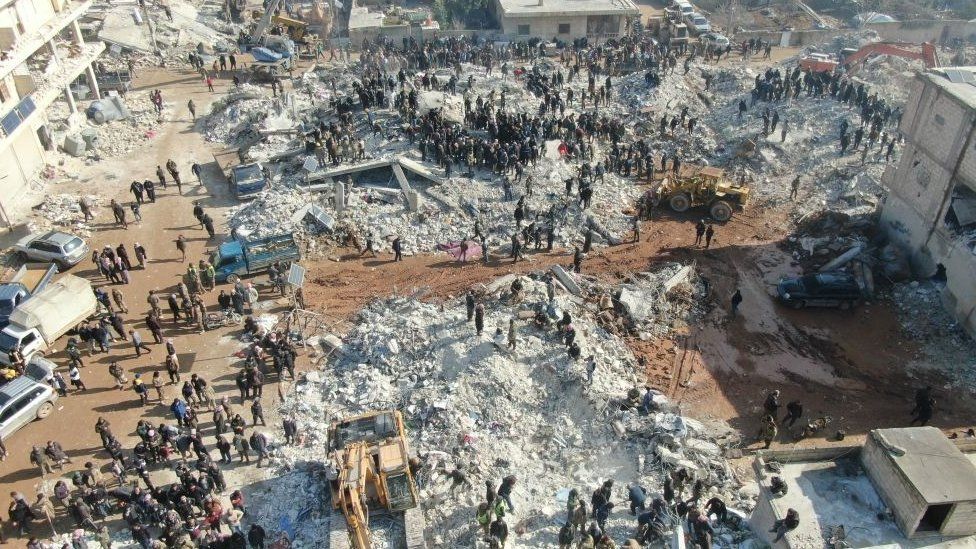
Aerial shot of Jindayris
Rescuers from the White Helmets organisation, who are all too familiar with pulling people out of the rubble for over a decade during Syria's civil war, have been helping in Jindayris.Getty Images
 
 A newborn child, umbilical cord still attached to her dead mother, was found alive by members of the Syrian rescue group White Helmets and taken to hospital for care. "She arrived on Monday in such a bad state, she had bumps, bruises, she was cold and barely breathing", the paediatrician looking after her, Hani Marouf explained. In other circumstances, baby Aya would have four siblings to play with and grow up with. All four perished along with their mother and father. When the earthquake struck Aya's mother went into labour and gave birth; she may never even have seen her baby daughter before dying.

A lot of publicity surrounded this child; the video of her rescue was posted to social media resulting in a response from people all over the world, offering help, many wanting to adopt the child whose name in Arabic means "a sign from God". One of the nurses at the hospital treating the baby aroused suspicion when he was seen photographing the tiny girl.The hospital manager whose wife was breastfeeding Aya thought the male nurse might be planning to abduct the baby, so he fired the nurse.

Before long the nurse returned along with two thugs with guns who set about beating the hospital director. The gunmen informed local police officers they intended to punish the hospital director for firing their friend, with no interest in kidnapping the baby. False claims of being relatives to the baby have been made by people showing up at the hospital, indicating a need for a police guard. In fact, a close relative, her great-uncle has stated that the baby's paternal aunt plans to raise the baby together with her own she recently gave birth to.
 
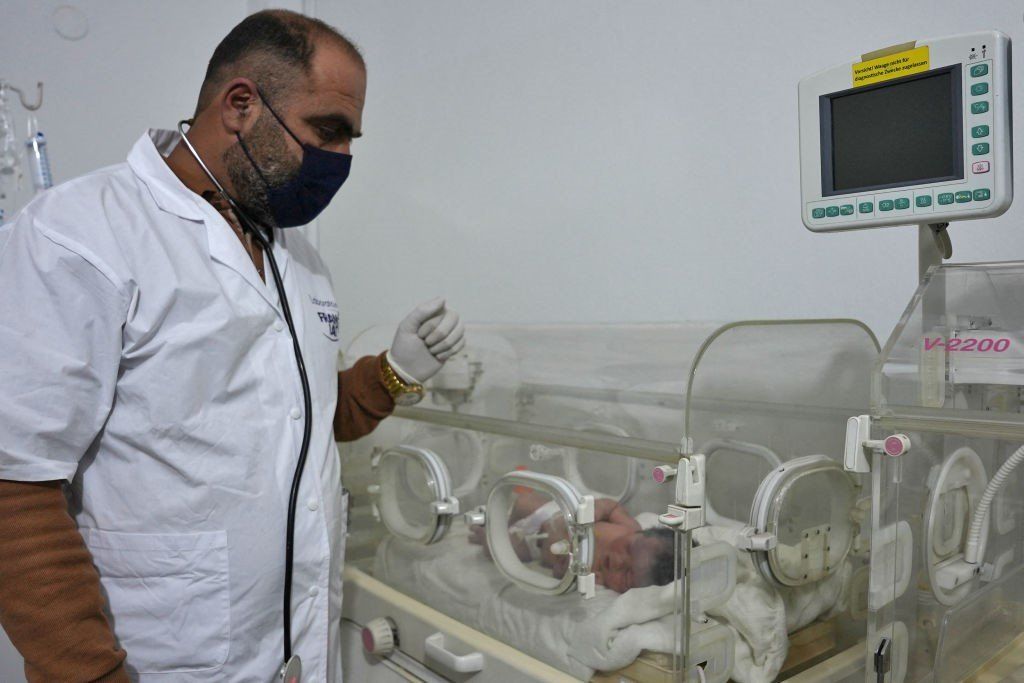
Doctor looking after orphaned baby in hospital
Getty Images
 
Ten hours after the February 6 quake struck, rescue workers in Jindera in Syria's north discovered the baby while digging through the rubble of a five-storey apartment building where her parents lived. She has been cared for at the hospital in Afrin ever since. Dozens of housing units in the town of Jinderis were destroyed. Her father, originally from a village in eastern Deir el Zour province, left it when the village was captured by the Islamic State group.

Many of the towns and cities where millions lived were reduced to fragments of concrete and twisted metal following the initial quake, another almost as strong, and a series of tremors striking southeastern Turkey and northern Syria. Over a week following the disaster hundreds of thousands have been left homeless and struggling to find the basics required to sustain life; shelter, warmth, food, water, medical attention. The brutal winter weather itself represents a danger to sustained life for the survivors.
 
Moving aid into the large area impacted by the tremblors in Syria is hampered by the difficulty in access to crossings into the area as a result of the 12-year civil war where millions of Syrian Sunnis fled to escape the assaults by the Syrian regime's military. Aid agencies have found it difficult to deliver life-saving winter clothing, food and potable water. The Turkish military is still bombing Kurds nearby the disaster zone in Syria. There are warring factions nearby, including Islamic State.
 
People desperate for aid in Syria in difficult-to-reach areas still have received nothing. In Turkey survivors have been put up temporarily in rail cars. In northwest Syria, 190 families sleep on the floor of a basketball court in Afrin, lying on mats used for training. Children are wrapped in blankets and sleep on the court floor, some of them becoming ill from conditions of privation. Local officials are awaiting the delivery of tents.
 
The United Nations reached an agreement with Damascus to deliver aid through two more border crossings from Turkey to rebel-held areas of northwest Syria. A $397 million appeal for "desperately needed, life-saving relief for nearly 5 million Syrians" for three months has been launched by the United Nations. 

People walk past collapsed buildings on Thursday in the town of Jinderis, in Syria's Aleppo province, days after a massive earthquake devastated the region. Ghaith Alsayed/AP


Labels: , , , ,

Sunday, February 12, 2023

The Sheer Scale of the Tragedy

“We have so far failed the people in north-west Syria."
“They rightly feel abandoned. Looking for international help that hasn’t arrived."
"My duty and our obligation is to correct this failure as fast as we can."
Martin Griffiths, UN relief chief
 
"We will follow this up meticulously until the necessary judicial process is concluded, especially for buildings that suffered heavy damage and caused deaths and injuries."
Turkey’s vice-president, Fuat Oktay
Collapsed buildings in Antakya, Turkey
Collapsed buildings in Antakya, Turkey. Photograph: Hassan Ayadi/AFP/Getty Images

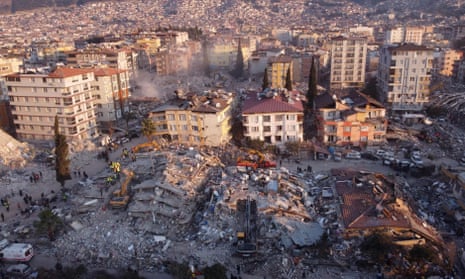
The disastrous earthquake that struck Turkey and Syria has brought out the best and the worst in both people and their national representatives. The international community responded quickly, almost 30 countries sent search-and-rescue teams in a desperate bid to save as many people as possible, trapped under the rubble of thousands of collapsed buildings in towns and cities all over northeast Turkey and across the border into Syria where 4 million Syrians, displaced in the ongoing civil war sought refuge in a crowded area with only one cross-border site, blocked by Russia.
 
In Syria, the White Helmet rescue group did their best with inadequate, basic tools to try to extract as many still-living people trapped and crying for help. UN aid trucks finally managed to get through several days following the series of quakes, and to the intense disappointment of the White Helmets no life-saving equipment better than the picks and sledgehammers they were using were made available to them. Hundreds of thousands of quake survivors, now homeless, are sleeping rough, hungry and fearful.
 
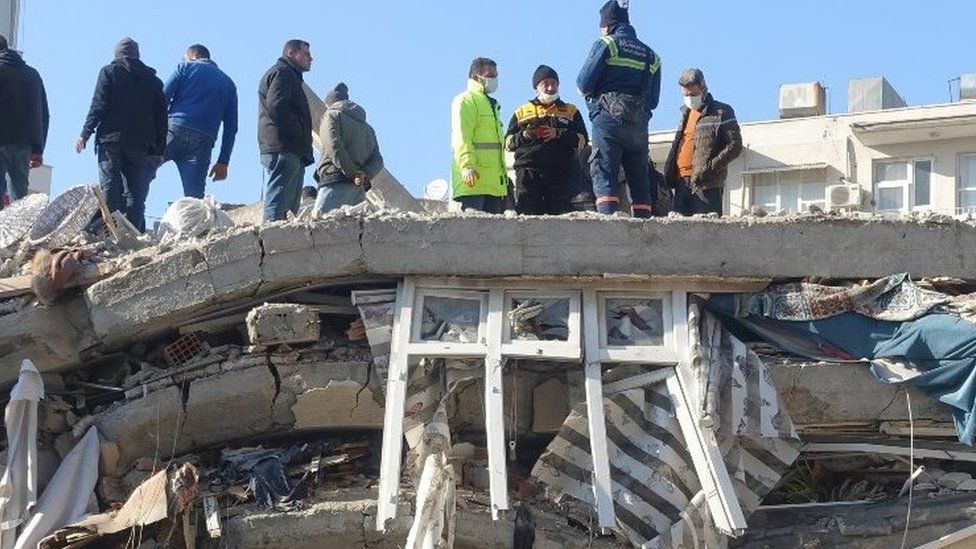
People stand on top of rubble. An intact window is visible in the layers of rubble.
 
The Turkish military is still bombing border sites in Syria against the Kurds they mark as terrorists. Military personnel that could more usefully be deployed to rescue missions in both countries. The governments of both countries are facing accusations from their populations of a tardy, insufficient response to the urgency of the tragedy. President Erdogan's popularity has taken a tumble and like most autocrats looking to place blame has started legal action against building contractors, holding them responsible for poor construction.
 
Over 100 arrest warrants resoectung collapsed buildings have been issued by Turkish authorities amid warnings that the death toll from the earthquake that struck parts of Turkey and Syria could double from the current total of 33,000.  A dozen people are in custody; contractors, architects and engineers with links to some of the tens of thousands of buildings collapsed or seriously damaged in the 7.8- and following 7.6-magnitude quakes.

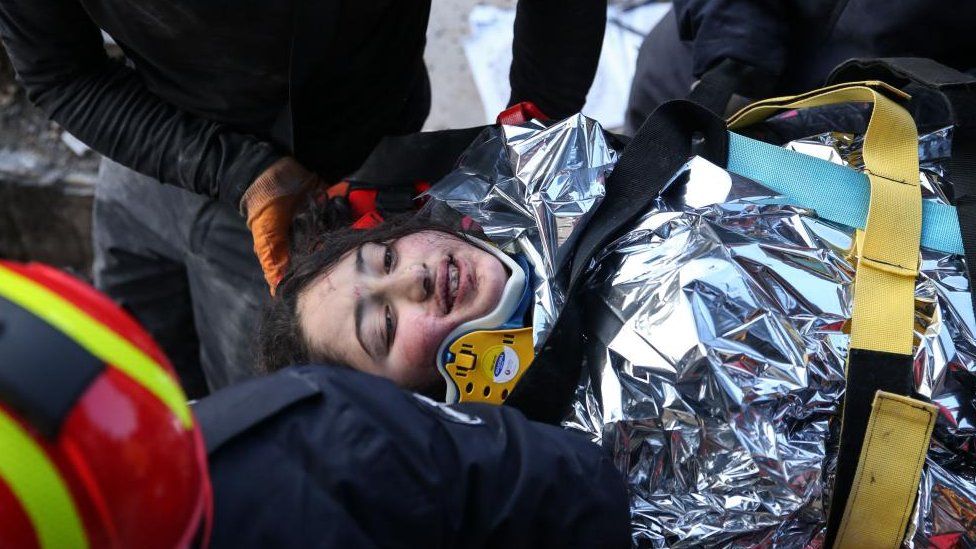
A girl on a stretcher
Rescuers carry 12-year-old Cudie from the rubble of a collapsed building, in Hatay, southern Turkey, 147 hours after the quake    EPA

Rescue teams from Austria and Germany withdrew temporarily to a base camp used by international volunteers, citing the dangers they've come across from firepower in the conflict between Turkey and Kurdish militias. Not far from the search-and-rescue areas, there was an attack on civilians, leaving 11 dead, at the hands of Islamic State terrorists. Because of threats, one of the Israeli search-and-rescue teams was forced to withdraw.

Beside collapsed buildings, others standing whole are experiencing looting. Some stores have begun to empty their shops of merchandise to keep them from being looted. Contrast that behaviour with that of desperate bystanders using their bare hands in the first three days after the tremblors to try to rescue trapped victims under steel and concrete.  In Hatay province several days ago rescuers crouched under concrete slabs as they carefully reached into the rubble to rescue a ten-day-old newborn. His mother, also alive, they were carried to a field hospital.

This is winter, extreme cold and snow blankets the area. People trapped under the collapsed buildings would die from exposure as much as from their wounds. Those too exhausted and in pain to continue calling for  help, would never see help arrive. In time their bodies would be exhumed and they would be identified, and buried. Miraculous recoveries of victims were still sporadically taking place days after the initial earthquake, but hope of finding more diminished as time consumed hope.

Now, attention turns to the struggle of survivors, homeless and traumatized, trying to maintain body heat in the winter weather, looking for food and water. "Especially in this cold, it is not possible to live here. If people haven't died from being stuck under the rubble, they'll die from the cold", said survivor Ahmet Tokgoz, calling for his government to evacuate people from the Turkish city of Antakya. Chances of finding anyone else yet alive are fast dwindling.

Winter weather, road and airport runway damage all conspired to hamper emergency responses. Both governments will have much to answer for; the Syrian regime in its fracturing of the country, the plight of the millions of Syrians who fled government attacks on its citizens whom Bashar al Assad called terrorists, and Turkey's Recep Tayyip Erdogan for the lacklustre response to the catastrophe that struck his country."Such things have always happened," he said. "It's part of destiny's plan."

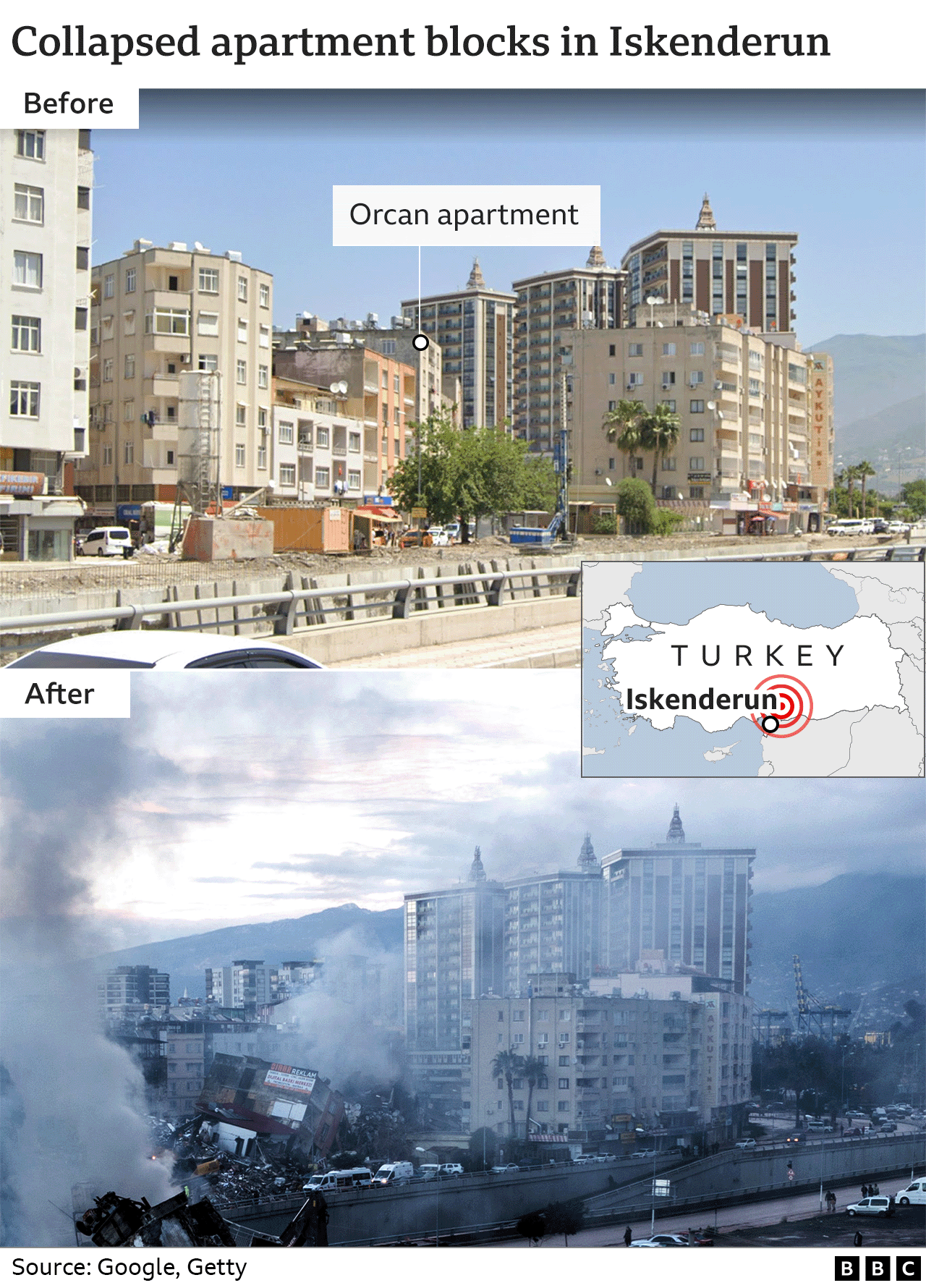
Before and after images show apartment blocks which have collapsed in Iskenderun, Turkey as a result of the earthquake
 

Labels: , , , , ,

Thursday, February 09, 2023

The Agony and the Sorrow

"The first 72 hours are considered to be critical."
"The survival ratio on average within 24 hours is 74 percent; after 72 hours it is 22 percent; and by the fifth day it is six percent."
Steven Godby, natural hazards expert, Nottingham Trent University, England

"As of today, there is no hope left in Malatya."
"No one is coming out alive from the rubble."
Ozel Pikal, journalist
People wait for news of their loved ones, believed to be trapped under collapsed buildings on February 09, 2023 in Hatay, Turkey
More than 20,000 people are now known to have been killed in Monday's earthquakes in Turkey and Syria, though the UN warns the disaster's full extent is still unclear. Getty Images
 
The widespread scale of the catastrophe caused by the powerful earthquake that struck Turkey and Syria on Monday led to desperate measures in the hopes of rescuing an untold number of victims trapped in the rubble of thousands of destroyed buildings. The very widespread ground area of devastation meant that rescue teams would never be able to cover the entire area in a timely manner; the time-consuming, careful work involved in a single site, extracting survivors and pulling out dead bodies mitigates against swiftly leaving one site and moving on to another.

Most rural areas were left of necessity to their own resources, leaving people to try with their bare hands to move rubble and respond to the waning voices of the trapped begging for rescue. The more isolated the town, the more devastatingly shocking the trauma in the realization that there would be no speedy rescues. The work involved in identifying victims and burying them is monumental in nature, reflecting the scope of the misery and horror.

The first, most destructive magnitude7.8 quake, shallow in depth, followed by a cascade of aftershocks including one of 7.5 magnitude in strength, almost equal to the original, brought down more buildings, left more victims; tens of thousands of injuries and an entirely traumatized generation of survivors. The destruction stretched hundreds of kilometres across southeastern Turkey and neighbouring Syria where thousands of buildings were toppled.
 
A woman in a red helmet and covered by a gold emergency blanket lies down while people in red helmets carry her.
Rescuers carry Zeynep Polat, who was pulled from a collapsed building in Kahramanmaras in southern Turkey on Thursday. Thinly stretched rescue teams continue their around-the-clock work to try to find any survivors or recover bodies from the rubble in Turkey and Syria. (Ismail Coskun/IHA/The Associated Press)
 
Hatay province in Turkey was among the hardest hit with entire neighbourhoods destroyed and where residents criticized the government's slow response. The earthquake had destroyed Hatay's airport runway disrupting the response of rescuers. From over two dozen countries search and rescue teams joined with tens of thousands of local emergency personnel in both countries. Experts warn the survival window for the trapped under rubble, along with survivors in desperate need of necessities was closing rapidly.

Excavators were used by rescue teams at times, and alternately the debris was tackled delicately where there was cause to believe people were trapped close to the surface of the rubble. The sheer numbers of those trapped is impossible to imagine given the number of buildings toppled. The plan is to photograph unidentified bodies and to bury them within five days once DNA tests and finger-printing was completed. 

The toll of the dead is inexorably rising, and has now eclipsed an earlier earthquake that took 19,000 lives decades earlier. The cold of winter, destroyed roads, a lack of supplies, hamper the work of the estimated 100,000 rescue workers and threaten survival of the now-homeless. The news of 20,000 dead being surpassed and concerns over the final number lend a sense of hopelessness to the ongoing search for survivors. Those who survived and are homeless sleep wherever they can; food, water, medical supplies and shelter slowly trickling in.

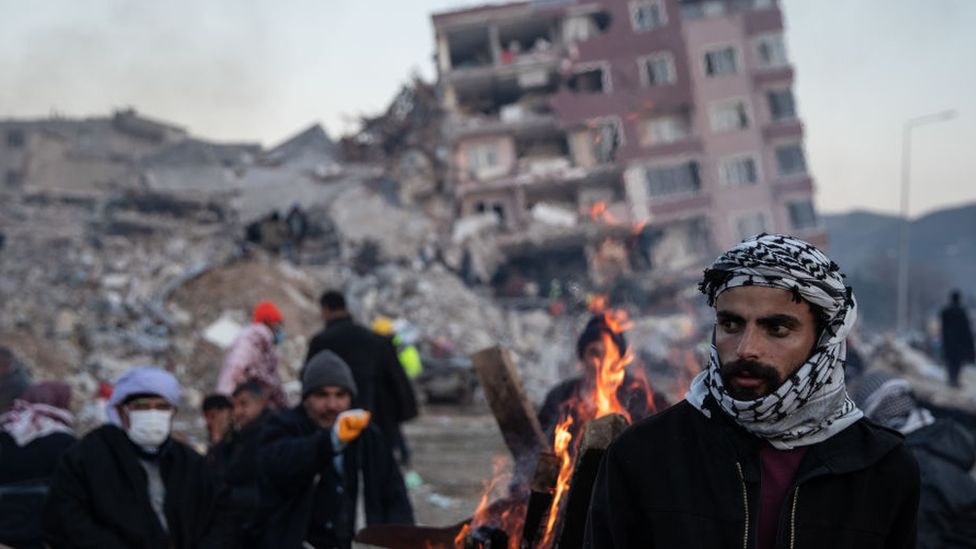
Two people sit near a fire, which lights up their faces in the dark. In the background, a digger and rescue crews work on a pile of rubble.
Hundreds of thousands of people are homeless after Monday's quake hit Turkey and Syria. Here, people warm around a fire as rescuers continue their work on Thursday night in Kahramanmaras, Turkey. (Petros Giannakouris/The Associated Press)

Labels: , , , , ,

Tuesday, February 07, 2023

Hell on Earth

Still from Video:  In this brief video, a man is shown rushing an infant to safety in Jindires, Syria, after the child was born Monday in a site that collapsed because of the earthquake
"It's a race against time because the weather is so, so cold. It's been raining. It's been snowing. There have been heavy rains, heavy winds and the temperatures are below zero."
"So we need to find people as soon as possible because people are stuck under [the] rubble."
Hombeline Dulière, British charity Catholic Agency for Overseas Development 

"We barely escaped from inside the house. We have four children and we left the house with them at the last moment."
"I guess there are several people trapped inside. It was a huge disaster."
Survivor Neset Guler, Kahramanmaraş, Turkey

"There are possibly hundreds more buildings like this."
"Thousands are currently under the rubble. They [Turkish authorities] won't let us save them by our means, but they don't send anyone to help either."
Ahmet Alinak, Turkish city of Malatya
A man stands on a pile of snow-covered debris, holding a jacket, while a woman is sitting in front of him and holding a child.
People sit by a collapsed building in Malatya, Turkey on Tuesday. (Emrah Gurel/The Associated Press)
 
People trapped under rubble scream in pain and despair, calling for help, but help is not always there. The area affected by the massive 7.8 on the Richter scale earthquake that hit both Turkey and Syria in the early hours of Monday, then repeated itself with a 7.5 tremblor twelve hours later is so vast, that even with an influx of foreign disaster relief groups from the international community the spread is too vast for rescuers' relatively thin ranks to be everywhere they're needed. Residents of towns afflicted by the quakes haven't the equipment and the expetrtise to engage in search and rescue in a scene this catastrophic.

Survivors of the quakes camp out on the streets beside the destroyed buildings that housed their family members. Imagining that they're alive still, under the rubble, but unable to do anything, forbidden by government edict to even try, informed to wait until rescuers arrive, when and if they will. The agony of holding vigil, waiting, imagining the sound of people screaming out in extremis hangs like the deathly pall it is, over the scenes of hellish destruction.

Some of those buried under rubble have been found and area hospitals are desperately trying to cope with the numbers and with the wide extent of their injuries. Infants are discovered and rushed to hospital. A newborn child was dug out of the rubble. Children are traumatized, silent and fearful. Some people able to use their phones livestream where their addresses are, begging to be rescued. One of the worst-hit Turkish cities was Diyarbakir where residents spoke of the ground shaking intensity so severe they were unable to stand.

People sit on benches outdoors, surrounding a small fire, with a damaged concrete structure in the background.
People sit near the damaged historical New Mosque following an earthquake in Malatya, Turkey. (Stringer/Reuters)

Rescuers hush the atmosphere, asking for silence, to detect any possible screams of trapped people under destroyed buildings. And there are thousands of destroyed buildings. Night passed, dawn arrived, and the rising sun on Tuesday illuminated vast devastation in the destruction of entire neighbourhoods. The official figures of the dead steadily rise. Experts calculating the situation, the intensity of the quake, the intensely crowded population augmented by millions of refugees from Syria's civil war, warn of the likelihood of the total death count approaching 20,000.

As for the injured, their numbers will eclipse those of the dead. The physical injuries may heal over time, but the memory of the sudden explosive events of mass destruction will have embedded memories for a lifetime of disturbed mental health. The multiples of tens of thousands left homeless by the disaster in both countries slept out in the cold on Monday. People in Gazientep, a provincial capital close to the epicentre, took shelter in shopping malls, stadiums and community centres,while mosques in the region opened to provide shelter.

In Syria, both government-held territory and the opposition-held enclave saw families trapped in rubble, reported the humanitarian rescue group, the Syrian White Helmets. Packed with roughly four million people displaced from elsewhere in Syria by the war, many live in buildings whose integrity had already been compromised by the ravages of wartime bombardment. Health facilities filled with the injured; over 6,400 people were rescued across ten provinces, reported Turkey's disaster management authority. 

In an area extending from Aleppo and Hama in Syria to Turkey's Diyarbakir, over 330 kilometres to the northeast, thousands of buildings had collapsed. Over 5,600 buildings were destroyed in Turkey alone. Among them hospitals. An expert in natural hazards noted that the bitterly cold temperatures could reduce the time rescuers are given to save trapped survivors. Along with the difficulty of working in areas involved in civil war, to complicate rescue efforts.

People sit around a small fire at night.
People warm up around a fire following an earthquake in Antakya, Hatay Province, Turkey. (Guglielmo Mangiapane/Reuters)
 

Labels: , , , , , ,

Sunday, October 18, 2020

Sow Instability ... Live With It ... Or Deal With It

"Russia is not the dominant power in any of the regions of the former Soviet Union."
"[The current trio of upheavals] really shed light on the situation."
"[The Kremlin may not have stretched itself too thin with its foreign policy agenda, but] it certainly has to pay more attention to its neighbourhood now, more attention to its alliances."
"The people in Belarus are very close to the people in Russia -- basically you have the same language and very much the same culture."
"So I think that on that score, people in the Kremlin are looking very closely at the techniques used by the organizers of these demonstrations."
"They're studying it very, very closely because they believe something like that could be used, will be used, in Russia when the situation is appropriate."
Dmitri Trenin, director, Carnegie Moscow Center 

"Russia's influence there [Central Asia] remains extremely high."
"The new post-Soviet generation does not suffer from nostalgia for the Soviet times and does not consider Moscow a political trendsetter."
Arkady Dubnov, political analyst, expert, Central Asia
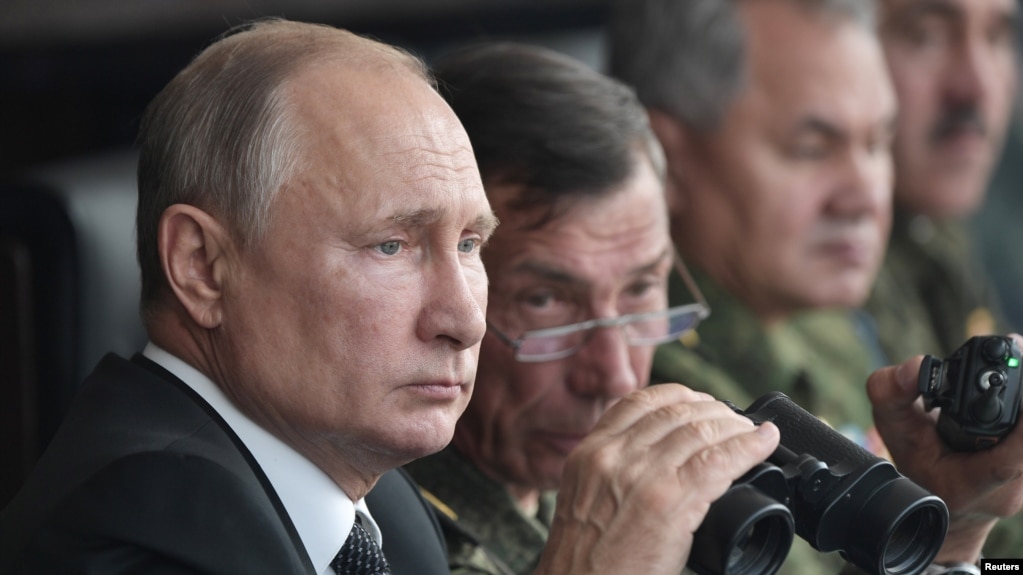
Credit...Sergey Ponomarev for The New YorkTimes
 
Vladimir Putin is fast closing in on 70 with two more years to go, but he plans on many more long years of active executive administration of the Russian Federation. He has gone to great manipulative lengths to change the constitution, forcing 'democratic' votes where he has garnered a huge majority of assent from Russian voters to enable him to reign undisturbed by nuisance contenders for a position that looks remarkably like a Czarist throne. These are irritatingly contentious efforts on the part of challengers who feel an obligation to Russia to dethrone Mr. Putin.

Alexei Navalny and his wife, Yulia, at Berlin’s Charité hospital in September
Alexei and Yulia Navalny. Photo: @navalny/Instagram
They have a following, but the authority to charge them with putative offences and send them to prison sits in the Kremlin,which can choose alternately to have them assassinated which usually puts them out of contention. The latest such disabling adventure went badly for Mr. Putin when political opponent Alexci Navalny failed to die of Novichok poisoning, to be rescued by German medical science, the poison identified by British forensic science and the wrath of additional sanctions on Russia, Putin and other notables invoked as a lesson that will never be learned.

President Putin yearns for the lost days of the Soviet Union, when Russian power and influence was at its height and neighbouring near-abroad countries were but colonies embraced by the tentacles of the great political octopus that was the USSR. When Soviet Russia held sway in the Middle East, and held the balance of power that accompanies the status of a world-class superpower, a status it shared with the United States through decades of conflicted relationships marked by suspicion, distrust, propaganda and tension in the competitive atmosphere of nuclear threat.

It has been a great disappointment to the Kremlin that former satellite states in eastern Europe, in Russia's near-abroad continue to feel so ill-done-by that they shrink in fear at the very notion they would wish to continue a firm alliance that would surely grip them with an iron vice. They have turned toward the West, looking for NATO membership, an alliance that would purchase them a guarantee of military defence against the memory of the giant that once strode the world stage.

Still, the consanguinity of closely-shared geography, ideology and a continuation of totalitarian-style governance continues to link Russia with a number of its former clients, and that a number of them are experiencing political-social upheaval with stirrings of democratic ambition is a worrying sign that there is an impending breakaway from the solid footing Russia has maintained in Kyrgyzstan, Belarus, Armenia and Azerbaijan. Following in the determined footsteps of Ukraine and Georgia, a dreaded apparition of sovereignty and democratic choice.

Absence, in Russia's attention turned elsewhere did not make hearts fonder of the Russian Federation's position in eastern Europe. Where former satellites still shudder at the prospect of military invasion and the spectre of the Crimean Peninsula looms large as a warning. Just how thin can a country whose petroleum and gas industry was struck a blow in the double whammy of falling prices and a world oversupply, faltering under sanctions and a restive population, spread itself? 

Well, when ambition to make friends and influence nations leads to entering the fray in the mid-abroad as when Mr. Putin committed to aiding his Syrian counterpart in destroying the lives of Sunni Syrians and airbombing hospitals, medical clinics, schools and civilian enclaves of Sunnis in exchange for an air base and a deep seaport in the Mediterranean, reclaiming its former high profile position in the Middle East, it constituted a distraction from its near-abroad.

Now, the Kremlin faces a backyard rebellion with former Soviet republics and regions from Central Asia through the Caucasus and into Eastern Europe, in a turmoil of mass dissent and a turn toward the West.  Even as competitors, from Turkey to China challenge the once-dominant role of the former Soviet territory with their very similar ambitions. Nagorno-Karabakh presents a dilemma for Russia between Armenia and Azerbaijan. Russia's military treaty with Armenia, it specified, refers only to Armenia proper, not the breakaway, majority-Armenian Nagorno-Karabakh. So it was quite inconvenient that Azerbaijan admitted to bombing inside Armenian borders in their violent fracas.

Keeping a watchful eye on Russia's “near abroad   Reuters

With Turkey fully in support of Muslim Azerbaijan, a threat to Russia's interests in the region hovers with the arrival of Syrian mercenaries to fight for Azerbaijan, recruited by Recep Tayyip Erdogan. Russia's foreign intelligence chief, Sergei Naryshkin warned the situation could introduce Islamist militants entering to infiltrate Russia. After all, Russian air power entered Syria to bomb not only Syrian Sunnis involved in a civil war, but terrorist militias that threaten the Alawite regime of Bashar al-Assad.

When Turkey shot down a Russian jet it claimed had entered its airspace from Syria, conditions were tense between the two nations, but soon enough smoothed over, as each side saw benefits from ongoing collaboration. A collaboration that eventually turned from lukewarm to frigid in competing positions over Syria and Libya. In Belarus embattled Lukashenko's rival, opposition leader Svetlana Tikhnovskaya, exiled from Belarus, living in the haven Lithuania has provided for her is increasingly turning to the West for help and future support. 

The 2014 political uprising where Ukraine disposed of Viktor Yanukovych as a Russian stooge, installing their own choice for president and doing so democratically in two elections to follow, the country's firm and growing relationship with the West is the feature of the Kremlin's worst nightmare.
The disputed election in Kyrgyzstan, along with that of Belarus are following in a familiar path. As is Armenia's growing warmth with the West, fed largely by its large and politically active diaspora.
 
Illustration of a map of Russia with Belarus, Kazakhstan, Armenia and Azerbaijan highlighted.
Illustration: Aïda Amer/Axios

Labels: , , , , , , , , ,

() Follow @rheytah Tweet