Politic?

This is a blog dedicated to a personal interpretation of political news of the day. I attempt to be as knowledgeable as possible before commenting and committing my thoughts to a day's communication.

Tuesday, March 11, 2025

Canada's new Trump-averse "Buy Canada" Mantra

"It's shocking that our view of the U.S. is now veering closer to how we feel about Russia, a country that is viewed very unfavourably." 
"In 25 years of polling I don't recall it ever being this low. And to see the United States viewed only a little more positive than say China, with whom we've had problems, shows how much damage has been done to a relationship with a country that has long seen us as its closest ally."
Jack Jedwab, president, Association for Canadian Studies, Montreal
https://smartcdn.gprod.postmedia.digital/nationalpost/wp-content/uploads/2024/11/iStock-508632322-1-e1740060430521.jpg?quality=90&strip=all&w=564&h=423&type=webp&sig=USiJS1H_I_r7IZ0aqufMDw

A historic 'realignment' regarding the countries that the Canadian population view as their main allies has become sharply evident in the very short reign to date of American President Donald J. Trump. Mr. Trump's hostility toward Canada has reshaped public opinion in Canada to a degree never before countenanced in reaction to his economic and sovereignty threats against Canada. Although he himself signed a trade agreement (Canada-Mexico-United States -- or CUSMA) he has now unilaterally negated it with his imposition of massive tariffs on goods imported into the United States from his North American neighbours.
 
With that imposition of tariffs, interrupting the flow of manufactured and raw materials in a continent-wide intertwined economy in production, has come a warning from the man himself that his more malign intention is to impact Canada's economy to an extent that his invitation for Canada to fold itself into the United States as its 51st state will find favour with a population he has beggared. His conceit of himself as a great 'negotiator' is to go for the jugular and he has done this with gusto, leaving former friends and allies dazed at the swiftness of their inter-relationship's demise.
 
Canadians now look to the European Union and United Kingdom as the countries most likely to remain their friends, allies and trading partners. The wreckage of the Canada-Mexico-U.S. free trade relationship will lead both Canada and Mexico to search out other countries with which business can be conducted on a trustworthy basis. There is now scant-to-none left with the United States whose moves can be characterized as dishonourable.
 
https://smartcdn.gprod.postmedia.digital/nationalpost/wp-content/uploads/2025/02/Donald-Trump-hostages.jpg?quality=90&strip=all&w=564&type=webp&sig=VMS1dxXwIAvSg8lGRfyhUA
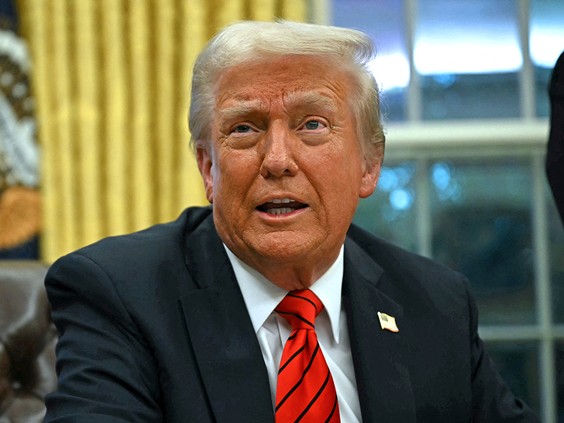
U.S. President Donald Trump speaks to reporters after signing an executive order in the White House, on February 10, 2025. Photo by ANDREW CABALLERO-REYNOLDS/AFP via Getty Images

Some two-thirds of Canadians feel that Mr. Trump's "expressed interest to make Canada the 51st American State" must be taken "very seriously", with a slim majority of respondents to the Leger poll commissioned by the Association for Canadian Studies going on to state that they are personally willing to defend Canada should the situation turn into a military threat of invasion. The historical view by Canadians of Americans has been one of deep friendship, trade and military alliance aside. That has now dwindled remarkably.
 
Positive opinions of various countries from June to the present day had been tracked by the survey, with the sole country's opinion on a steep downward trend in Canadian eyes being the United States. The current survey of 1,548 respondents indicates positive opinion of the United States remains most common among young respondents, 25 to 34, a 42 percent. Among an older demographic, 55 upward, it is 27 percent. Asked the same question relating to the American people, rather than their government, positive numbers leap, still reaching overall just 50 percent.
"While the 50 percent is low compared to past surveys, it still shows that a distinction is being made between our views of Americans and our view of their current government."
"Clearly for the time being, President Trump has soured our relationship."
Jack Jedwab 
Over the past year, all other countries' favourability rating remain stable, moving no more than two percentage points: Ukraine at 66 percent, Israel at 36 percent, China at 30 percent, Iran at 17 and Russia at 18. Young Canadians, 18 to 24 appear fairly negative about Israel, just 25 percent with a positive opinion in comparison to 46 percent of people over 65 years of age. Young people on the other hand, are relatively positive on China, at 38 percent, compared to just 28 percent older than 65.
 
Interestingly enough, the young in Canada appear quite a bit more interested on Iran and Russia in comparison with older people, at 30 percent of those age 18 to 24 holding positive opinions of both. Those over 65 are just 12 percent positive on Iran and nine percent on Russia. Men appear more positively disposed than women to the U.S., Israel and Russia. The split is 12 points for Israel with between 42 percent of men with a positive view as compared to 30 percent of women.
 
As for defending their country, fully 38 percent of those 18 to 34, would do so, in comparison to respondents older than 55 seeing 17 percent commitment. Two thirds of Canadians overall agree a travel boycott is an effective response, while among young people that falls to 56 percent. Among those older than 55, 78 percent agree on a travel boycott. "Buy Canada" has become a popular message. 
https://www.readthemaple.com/content/images/size/w2000/2025/02/presidents.png
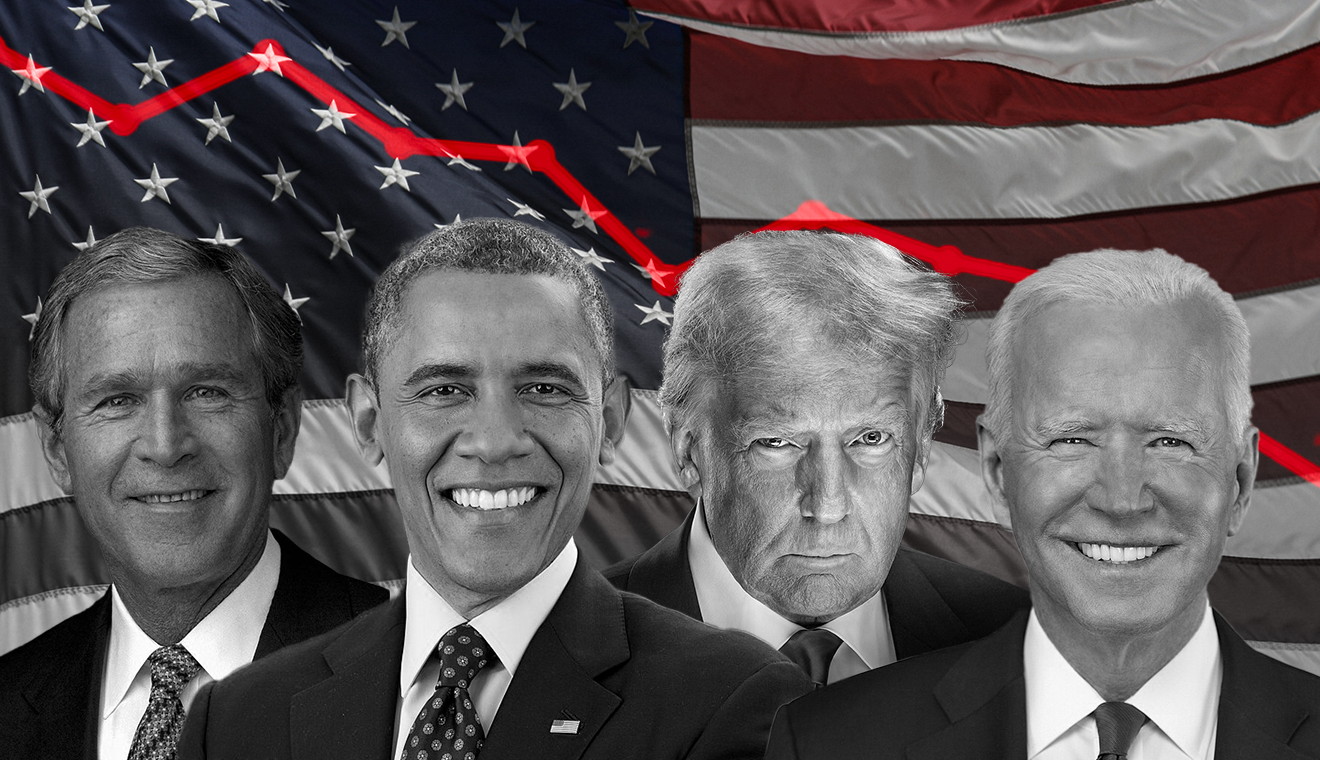
Graphic assembled by The Maple staff using photo of the American flag by Charles "Duck" Unitas via Unsplash and official presidential portraits via Wikiepdia.

Labels: , , , , , , ,

Sunday, December 30, 2018

Collegial Business Ties: Canada/China

"One of the punishments that is applied for such charges [drug-smuggling] is the death penalty, and China executes more people than any other country in the world."
"My worry is that he [Canadian Robert Lloyd Schellenberg] may be more likely to be sentenced to death than would have been the case before the current breakdown in relations between Canada and China."
Michael Byers, professor of global politics, University of British Columbia

"Is it going to be affected by the current situation [Huawei dispute]? That would not be surprising."
"It would not be surprising if he gets a harsh sentence, but it may be the amount in question already justifies a death sentence [under Chinese law]."
Donald Clarke, Chinese law specialist, George Washington University Law School

"Another Canadian accused [charged with smuggling a] huge [quantity of drugs]."
"[One must] really admire the courage of this Canadian man to actually dare to smuggle drugs in China. We must know that Chinese criminal law has no sympathy for drug crimes."
runsby.com website, Lianing province, northeastern China

"China has not abolished the death penalty based on its own history and current conditions."
"Chinese courts ... won't give the wrongdoer a way out simply because the criminal is a foreigner."
Global Times, branch, Communist Party's People's Daily
A police officer stands outside a prison in Dalian in northeastern China's Liaoning Province. China still has the death penalty for drug trafficking. (Masao Mizuno/Kyodo News via AP)

Obviously it doesn't take courage but stupidity and a measure of careless audacity for a Canadian to smuggle drugs into China, and get caught doing it. Particularly as even the most dim-minded moving drugs must be aware of the penalties imposed particularly on foreigners, in south-east Asian countries which struggle with their own epidemics of drug abuse. That anyone is senseless enough to smuggle drugs into China, a country infamous for its production of chemical-laboratory-produced drugs of lethal power probably deserves to face some level of punishment.

The death penalty?

This fellow, Schellenberg, has been in a Chinese prison for "several years". He has suddenly come to the attention of Chinese authorities: a Canadian in a Chinese prison for the criminal act of drug-smuggling, what an opportunity for the Chinese government to demonstrate its full-bore displeasure with Canada, an upstart nation that has roiled ill feelings from the powerful trading giant the government of Canada is so eager to do business with in a free trade deal.

Of course, care might have been exercised through official channels to advise Meng Wanzhou that she faces arrest should she venture into Canada, even to visit her two splendid 'summer homes' in Vancouver, now that a U.S. court has issued an alert for her arrest and extradition to the U.S. Canada in honouring its treaty with the U.S. speaks earnestly of its obligation under the law to proceed as it did, naively taken by surprise at the strength of the ensuing Chinese outrage.

Surprise? That a technological communications giant linked to the Communist Government of China has suffered the humiliation of one of its chief executives and daughter of the CEO has been arrested? After all, there's a trade war ongoing between the two trade colossi, China and the U.S. With Canada whom the U.S. has done no favours to in its revision of NAFTA into the USMC trade pact and China playing it cool with a potential free trade agreement with Canada as background.

Chinese punishment under its law for the smuggling of a kilogram or more of heroin or methamphetamine ranges from 15 years to the finality of execution. The two other Canadians arrested, a businessman and a former diplomat are still in play; the third, an English teacher with an expired work permit has been released and returned to Canada. What manner of punishment that can be meted out to the other two is questionable; they can be accused of 'endangering Chinese security', but it is likely only Chinese who face such accusations will also face the death penalty.

The country that executes more prisoners than any other nation on Earth would without doubt balk at extending the final solution to a diplomat and a businessman, not one of their own, but not a drug smuggler. This, from a country that produces immense amounts of deadly fentanyl and even deadlier carfentanil, both drugs increasingly responsible for overdose deaths throughout Canada and the United States, and whose disinterest in cooperating to keep Chinese Internet operators from selling them so freely at bargain rates is partially responsible for the death toll.


On Saturday, Robert Schellenberg who was given a 15-year prison sentence for drug smuggling last month, appealed to the Higher People's Court of Liaoning Province. At the hearing, Chinese prosecutors argued that Schellenberg was, in their opinion, part of an international drug smuggling operation. The appeals court ruled that the "light punishment" of 15-years was "obviously inappropriate", sending the case back to the Dalian Intermediate People's Court for retrial.

"I can't see inside the judge's head or what his instructions from the party might be, but this is just not a good time. We're not going to get the benefit of doubt and the penalties may be more severe."
"Their system works very much more differently than ours. There is potential for party intervention in sensitive cases, in a way that's simply not possible in Canada."
Gordon Houlden, director of the the University of Alberta's China Institute

Labels: , , , , ,

Friday, October 12, 2018

Marketplace 101: Oversupply? Dial Back Production

"It is very unusual. I am guessing -- [U.S.Trade Representative Robert] Lighthizer may have worried that unrestricted Canadian exports globally could suppress global and hence U.S. prices, and putting a cap on them would prevent this."
Robert Litan, fellow, Brookings Institution, Washington

"A Canadian cheese processor who was buying from the U.S. could suddenly buy from a Canadian producer just as cheaply. So it changed things."
"If everything had been left the way it was, the Canadian milk industry would have been left to drown in its own skim."
"We found a way to clear it, now we'll have to find something else."
Al Mussell, lead researcher, Agri-Food Economic Systems

"So when the U.S. negotiated to get rid of Class 7 pricing, it clearly also sought to put limits on how much of that milk could be exported to third parties."
Andrew Novakovic, professor of agriculture, Cornell University

"[The changes in the USMCA reflect an ongoing effort by the U.S. administration to] manage and reduce trade, not increase it."
"This is clearly designed to deal with the underlying problem which is the potential for excess production of those products in Canada leading to incentives for Canadian producers of those three products to dump them on to global markets."
Chad Bown, senior fellow, Peterson Institute for International Economics, Washington
The new United States-Mexico-Canada Agreement includes greater access to the Canadian market for dairy products from south of the border. (CBC)
The year of trade talks to refurbish the NAFTA free trade agreement between Canada, Mexico and the United States was a tense, dramatic and often Byzantine affair, the United States as the 'senior' partner in terms of size and influence, power and determination, conducting the orchestra, putting the minor instrumental players in their subordinate place throughout the process while re-arranging the seating order in the orchestral pit. What the big guy wants is what the big guy gets.
"We're extremely disappointed with what we understand has been agreed to, with the almost 3.6 per cent access — dairy market access — being given to the U.S., as well as eliminating some of our competitive dairy class, so that will obviously have a majorly negative impact on our industry."

"It's death by 1,000 cuts. Every time there's a trade deal, they're giving another portion of our markets away. It seems as though they wait until the 11th hour and then they give away a portion of it and it simply is devastating for the industry."
"[While Americans get more access to the Canadian market, the USMCA decreases Canada's access to the U.S. market]. So it'll have a double impact. It's a major blow for dairy farmers in Canada but also for the other 200,000 people who are, in one way or another, involved in the dairy industry."

David Wiens, dairy producer, Grunthal, Man., chair, Dairy Producers of Manitoba 
Canada's supply management was not exactly eviscerated to rescue Canada from its solitary side-lining, but the inroads made of surrendering 3.6 percent, hasn't delighted the dairy industry one bit, foreseeing a future when the agreement will begin to noticeably bite. Canadian dairy farmers and their organizations found truly inventive ways to skirt whatever inroads their American counterparts relied upon in bringing their products to Canada. Among the issues was an abundance of protein concentrates and powders.

A Class 7 designation was brought to bear linking to reduced pricing; at one time when American milk products like excess skim milk flooded the Canadian market, Canadian farmers began to produce their own basic product upon which processing of higher-level dairy products could rely, and the importation of the U.S. variety was reduced; a kind of milk-war between nations. At the same time the glut of skim milk from domestic markets was solved for Canadian dairy farmers.

The issue of U.S. dairy producers being stuck with their own oversupply infuriated them no end, and they lobbied furiously in Congress to have Canada's supply market system opened and to have access to the Canadian market for their skim milk surplus for protein concentrates and powders. The thing of it is, the U.S. dairy oversupply problem wouldn't be solved even if it could supply all of Canada's Class 7 skim milk, since Canada hasn't a large enough market to absorb all the U.S. product to begin with.

The American problem is oversupply altogether; in most instances with such a huge population, ten times that of Canada's, the U.S. can absorb most of everything it produces in all consumer areas. Now restrictions have been placed on Canada's global exports of some dairy products, signed into the USMCA through unrelenting pressure. At one time the global community was obsessed with fat-free dairy products and skim milk powder was in high demand. Now, despite obesity a growing public health problem, suddenly people are turning away from lighter products, wanting creamier dairy.

And supply management itself which should logically move farmers to produce less of an unpopular product hasn't yet seemed to kick in. It's a problem shared both by Canada and the U.S. The answer to which is to shed whatever warehoused surplus there is, however that will be managed, and then to gear down production to match market demand. The Class 7 designation meant that Canada could sell its low-fat products at  home and abroad, far different from other Canadian dairy products with their higher prices reflecting supply management.

The result on the global scale of undercutting U.S. dairy prices enraged U.S. dairy farmers who didn't appreciate the competition in international markets leading to lost sales; Canada was taking advantage of high dairy prices for some products in exchange for selling others at lower prices. A new remediating scheme is now installed under USMCA, incorporating U.S. pricing, Canadian processor margins and yields with the final price analogous to Class 7.

The hitch for Canada, however, is that exports are now limited to 55,000 tonnes of milk protein concentrates and skim milk powder in the first year of the agreement and reduced to 35,000 in the second year, the threshold increasing by 1.2 percent each following year with exports in excess of the stipulated amount subject to export taxes of 54 cents per kilogram Canadian.The Canadian dairy industry shipped 75,000 tonnes of skim milk powder in 2017 and that differential reduction stings. 

And the problem on both sides of the border of a huge excess of skim milk hasn't been solved to anyone's satisfaction, nor could it be through this mechanism. Is the American dairy industry happy? Despite the introduced restrictions to Canada's dairy exports there are those in the U.S. who feel the restrictions don't address the severity of the issue.

Dairy farmers in Ontario are expressing concern about the new USMCA trade deal. (CBC)

Labels: , , , ,

Monday, October 01, 2018

Making Friends and Influencing an American President

"We are very unhappy with the negotiations and the negotiating style of Canada. We don't like their representative very much."
"We are not getting along with their negotiators. Canada has treated us very badly."
"[Why deciding not to meet with Trudeau at the venue of the UN's general meeting?] Because his tariffs are too high and he doesn't seem to want to move and I told him, 'forget about it'."
U.S. President Donald Trump

"Everybody knows what each other's position is on all of the major issues and it's really a question of whether or not the U.S. wants to have a deal."
Canadian ambassador to the U.S. David MacNaughton
Foreign Affairs Minister Chrystia Freeland walks out of the U.S. Trade Representative's office in Washington in August. Freeland said Trump's steel and aluminum tariffs were illegal, to no avail. (Chris Wattie/Reuters)

Well, that's a big surprise. Donald Trump doesn't much care for Canada's Minister of Foreign Affairs Chrystia Freeland. On the other hand, not such a big surprise. Minister of the Crown though she is and presumably aware of the delicacy with which her department is tasked to communicate at all times in a diplomatic manner with all of the country's international executive contacts, she nonetheless seems to approach diplomacy with all the grace of an untethered bull in a cow pasturage. The show-off thespian streak in her personality has no place in the position she occupies.

When in June, Minister Freeland went to Washington as the recipient of the Diplomat of the Year Award from Foreign Policy Magazine her acceptance speech was replete with criticism of all things Trump. In her acceptance speech, Minister Freeland, speaking directly to those Americans present at the event, and knowing that her remarks would find their way into print, she raised concerns of the Trump administration's (read President Trump) concerning utterances, implied threats and directions on matters as diverse as trade, NATO membership and international relations.

She did this, knowing full well that most Canadians loathe President Trump. She did this irrespective of the fact that she has a responsibility to comport herself with due consideration as to how her words and her attitude would impact the relationship between Canada and the United States. Long before Trump came on the scene, the U.S. acted the bully in its relations with other countries, including Canada. On the other hand, without the United States, in its famed role as Global Sheriff, the world would be a more dangerous place.

Chrystia Freeland did Canada no favours in her adverse behaviour, but then she does have the manner and impoverishment of restraint due to the heady entitlement of being a "progressive" to fall back on, emulating her boss on the world stage, swaggering and elitist, attention-seeking and gloating over his own perfection as the leader of the country that returned from obscurity. It most certainly did, leaving behind Stephen Harper's resolute courtesy to his peers (Putin aside), his probity and his intelligent governing style.

The Harpers too visited India and went along to the Taj Mahal, but it was the Trudeaus that eyes swivelled toward in disbelief at their mawkish behaviour and elaborately inappropriate sartorial splendour, much less his insulting-to-his-host meeting with a convicted terrorist, a Kalistan separatist, a group with which Modi is not exactly on gracious terms with. When Stephen Harper talked trade with China, India, the EU and Pacific trading partners, he left any preoccupation with gender roles where they belonged, at home.

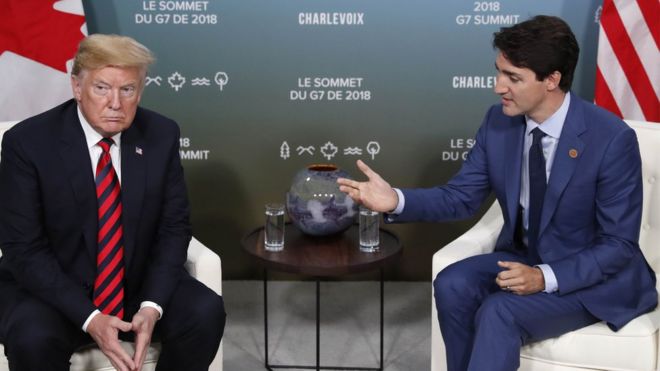
Still, Canada now has a deal in the eleventh-hour free trade agreement encompassing the interests of the three countries on the North American continent, the United States-Mexico-Canada (USMCA) free trade agreement. Had Justin Trudeau not insulted and infuriated the President of the United States of America whom he hosted along with other members of the G7 by scornfully asserting that Canada wouldn't be 'pushed around' by its U.S. trading partner, an insult that Trump, who had assumed that a comfortable relationship existed personally between himself and Trudeau, there is little doubt that Trump wouldn't have doubled down as he did on demands and concessions.

Is everyone happy? Trudeau proclaimed the agreement "A good deal for Canada". Of course the federal government will have to face Quebec's wrath over the further loosening of supply management. And Canada's aluminum and steel industry isn't too thrilled at the prospect of the deal's setting limits. Ditto for the auto industry, since in both cases it will ultimately limit growth. Nor will the provinces' cost in pharmaceutical products increasing with the lengthier patent rights protection go over very well. But a deal is a deal is a deal despite Trudeau averring that "No deal is better than a bad deal". Someone should ask him to define a bad deal.

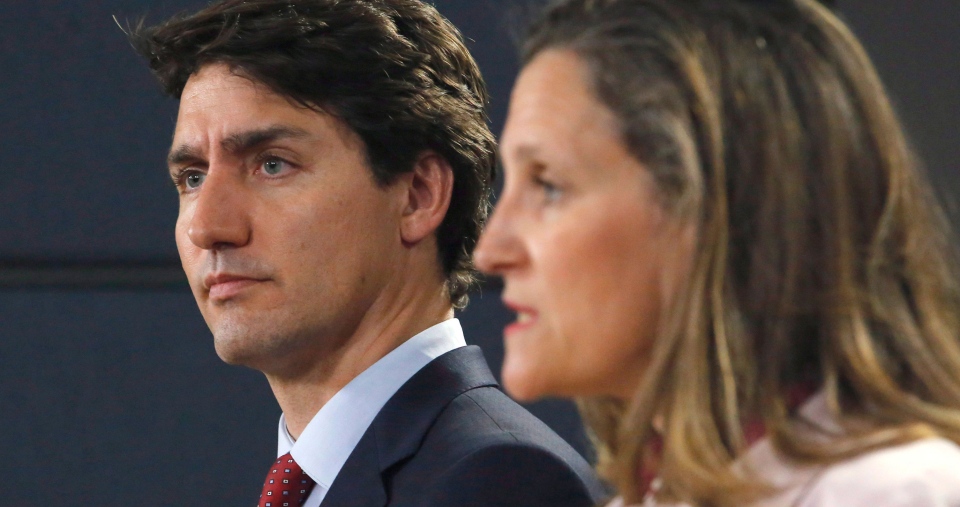
Foreign Minister Chrystia Freeland arrives with Prime Minister Justin Trudeau to discuss the United States Mexico Canada Agreement (USMCA) in Ottawa on Oct. 1, 2018. Sean Kilpatrick/The Canadian Press

Labels: , , , , , , ,

Saturday, September 01, 2018

So, How're We Doing, Folks? (Whistling in the Dark)

"We're not there yet. [But] this is a very complex agreement and we're going to continue working at it."
"Our objective in these talks is to update and modernize NAFTA in a way that is good for Canadians, good for Americans and good for Mexicans."
"We know that a win-win-win agreement is within reach." [Have you noticed my new outfit?]
Foreign Affairs Minister Chrystia Freeland

"Canada conceded a whole bunch of things. Canada gave a ton of things."
"Canada was making concessions and Canada needed something, and the U.S. was agreeing to nothing."
Insider source

"The talks were constructive and we made progress."
"Our officials are continuing to work toward agreement."
U.S. Trade Representative Robert Lighthizer office

"[Any deal with Canada would be] totally on our terms."
"[I'm prepared to sign a deal with Mexico in 90 days ... and include Canada] if it is willing, in a timely manner, to meet the high standards for free, fair and reciprocal trade."
"Off the record: totally on our terms. Totally. Here's the problem. If I say no -- the answer's no. If I say no, then you're going to put that, and it's going to be so insulting they're not going to be able to make a deal ... I can't kill these people [Canadian negotiators]."
"At least Canada knows where I stand!"
U.S. President Donald Trump
U.S. President Donald Trump issued several tweets about the North American Free Trade Agreement (NAFTA) Saturday, saying 'NAFTA was one of the WORST Trade Deals ever made.' (Kevin Lamarque/Reuters)

Trust Trudeau. He knows what he's doing. Relax, Canada. There are things that are important in life, agreed? Social justice as an example. Doesn't that beat trade for trade's sake? So the economy takes a hit, we'll get over it. Thousands unemployed; too bad, so sad, but they'll find something else to do. Like I did, when I got bored teaching drama at that exclusive boys' school in Vancouver, then moved on to teaching snowboarding techniques. And there were all those invitations for speaking engagements; good money there, folks. Unemployed? Give it a try!

The sky's the limit! Look at me, now, Prime Minister of Canada. Negotiating with the Most Important Person in the World. That's me. No, I mean Trump. I must be the second-most important person in the world. After all, who had the guts to confront that guy who thinks he's the world's upcoming political superstar in China? Me! Told him, want a free trade deal with Canada, then bring in workers' rights, gender parity and LGBTQ-2 human rights, wrap it all up in free trade and it's a done deal! Turned down that opportunity, didn't he? His loss.

Same thing with the Trans Pacific Partnership and the deal with the European Union. Made them see the light, but I was also generous about it, allowing them to export some dairy products into Canada. Gotta leave your trade opponents some measure of dignity, right?  Even my good friend Trump believes in that kind of diplomatic courtesy. There's another guy who gets things done. Matter of fact, we've got a lot in common; he tells people who criticize him where to go, names them for what they are; sound familiar?

We're both confident of our abilities and cerebral functioning, and with damn good reason. He also has confidence in leaders who get things done, like Xi Jinping, Vladimir Putin, Recep Tayyip Erdogan, MbS (psst, if you don't know, that's Mohammad bin Salman, nice guy), Rodrigo Duterte, Nicolas Maduro, and Ali Khamenei (don't know him? think Supremo Leader) and not to forget Kim Jung-un, eh? Guess what, as a supreme judge of leadership characteristics, me too!
Prime Minister Justin Trudeau, left, reached out to former prime minister Brian Mulroney, centre, about the NAFTA negotiations. He was involved in tough negotiations for the Canada-U.S. Free Trade Agreement, which preceded NAFTA. (Paul Chiasson/The Canadian Press)

Anyway, about NAFTA. Anyone with an ounce of intelligence knows that if this falls through the fault can be directly placed with the previous government of Stephen Harper; it pains me to even put the words 'prime minister' in front of his unworthy name. If he hadn't been such a miserable failure for Canada, I wouldn't have had to spend so much time reversing all of his faulty government initiatives. Ask Amed Hussen our Immigration Minister; he knows that "we inherited a massive backlog of asylum claims after a decade of short-sighted and damaging policies under the Harper Conservatives".

So bad that we've got a backlog of 55,000 claims; impossible to hold the fort, leading to the current crisis of all those poor people clamouring to get into Canada. My Canada, you know ... If there hadn't been a backlog of asylum claims of 10,000 when he was kicked out of office by all the voters who preferred me, we wouldn't be in this position now. But I'm putting things right; remember my pledge to legalize marijuana? We're on it, folks, opening up the store in November, and it's party time!

Guess what? All that loot coming into government coffers through taxing pot sales is gonna clear up that damned deficit and we'll be on easy street. Meanwhile, I've been consulting with former Prime Minister Brian Mulroney, a nice guy who was unfortunate enough to have been a Conservative, but we'll overlook that since he's the guy who oversaw the original Free Trade Agreement that morphed into NAFTA and he's been advising me. And gosh, if things go south, I can always pin the blame on him, he's used to that kinda stuff.

Labels: , , , , ,

Tuesday, August 28, 2018

The Art of the Trumpian Deal

"We're starting negotiations with Canada, pretty much immediately. If they'd like to negotiate fairly, we'll do that."
"If not, the easiest thing we can do is to tariff their cars coming in ... It could end in one day and we take in a lot of money the following day."
"This is a tremendous thing. They used to call it NAFTA, we're gonna call it the United States-Mexico trade agreement. We'll get rid of the name NAFTA, has a bad connotation because the United States was hurt very badly by NAFTA for many years."
"It's an incredible deal [the U.S.-Mexico agreement], it's an incredible deal for both parties.We'll start negotiating with Canada relatively soon."
U.S. President Donald J. Trump

"This [protecting of intellectual property] would require a significant overhaul of Canadian intellectual property law." 
"These provisions ... are at odds with the Canadian government's commitment to modern intellectual property laws that adequately balance the interests of all stakeholders [as with adding years of patent protection from generic drug competition]."
Michael Geist, intellectual property expert, University of Ottawa
Canadian Foreign Affairs Minister Chrystia Freeland arrives at the Office Of The United States Trade Representative, Tuesday, Aug. 28, 2018, in Washington.Andrew Harnik / ASSOCIATED PRESS

The simple fact is, negotiating a fair and mutually useful agreement on free trade with the three partners representing two supplicants and one powerful bully, the prospect of fairness becomes a lost cause. When the balance of power is held unevenly it represents a big stick to wallop the weaker links in a three-way deal with. Where the U.S. yielded in some areas in the original NAFTA agreement, that time is long gone; now the reality is that the one with that big stick is prepared to use it, as a very effective 'negotiating' device.

Beginning with the unexpected U.S. tariffs on steel and aluminum, and going on, in Canada's case, to target lumber, along with other vulnerable items, even if it ends up hurting American consumers as much as it does Canadian producers. Donald Trump may wax threatening about fairness, when he demands that Canada's Supply Management System be dropped -- an antiquated, anti-consumer farm monopoly that should be rethought -- but it has been repeatedly and pointedly observed that the U.S. has its own farm subsidies more than equal to Canada's.

None of the three major political parties in Canada is prepared to submit on the demand to dissolve supply management; there's too much political interest, as in danger, at stake, in the form of critical votes from a well-oiled lobby group. The Dairy Farmers of Canada, as an example, is not above using the threat of political boycott for any party that seriously considers abolishing the dairy supply management. Its threatening overtures ensures that none of the parties would dare speak to the issue in a conciliatory tone to NAFTA.

At the just-concluded Conservative Party of Canada's annual conference a briefing book produced by the Dairy Farmers of Canada was discovered by the press amplifying the extent of their influence, as when it warns that "Members of the Conservative Party of Canada have sent a clear signal that they do not support Canadian farmers" and "Canadians will remember the position taken by Conservatives today". There was no clear signal, no committed position, not even a discussion on the agenda relating to supply management; the issue was deftly set aside; dead in the water.

But had it not been, and the conference had that debate with a majority deciding that their party would do well to scrap supply management, the little book of instructions cautioned the Conservative Leader not to forget the power vested in his position: "The powers of the Leader are far-reaching in preventing a policy from being in the party platform. DFC has been told by the Leader's office that he will exercise this power ... regardless of the outcome at convention." There's the lobby telling the party how it will act; the party indebted to the vote.

Well, Justin Trudeau has an interesting decision to make. The Liberal Party is firm that this is a non-negotiable issue. And "Canada will not be pushed around". If the farm lobby cannot depend on the Liberals, they can't depend on any party. Oh, yes, of course, the New Democrats; and how likely are they to form government -- heaven forfend. It is a desperate situation when a three-party agreement deliberately cuts out one of the three. Six weeks of negotiations took place between the U.S. and Mexico, Canada clearly informed its presence not only unneeded but unwanted.

The idea being, as senior U.S. trade negotiator Robert Lighthizer noted confidently, to strike an agreement with the slightly more malleable Mexican negotiators and when it's done, allow Canada to enter the negotiations with the knowledge that the U.S. is prepared to conclude a bilateral deal without Canada, and leave Canada out entirely, if they feel the need to do so. Canada cannot afford not to sign on to a renewal of NAFTA; the U.S. represents its trade lifeboat; the U.S. doesn't need trade, Canada does. This is indeed the proverbial rock and a hard place.

Accede to U.S. demands that supply management be dissolved to please Trump, and the Liberals limp, defeated into the October 2019 election. Refuse to drop supply management and retain the dignity of making one's own sovereign decisions over the value placed in Canadian-made internal agreements -- almost all other nations, including the U.S. commit to agricultural subsidies of some sort, to ensure self-reliance on national self-sufficiency of the necessities of life-sustenance -- and the Liberals eat humble pie while the Canadian economy tumbles and the voting public takes its revenge.

No sleeping easy in Ottawa for the next five days, the time-frame the U.S. has given Canada to make up its mind whether it is serious about concluding a deal with its Mexican and U.S. free trade partners. This is one very large lemon to suck on.
United States Trade Representative Robert Lighthizer leaves the Office Of The United States Trade Representative, Tuesday, Aug. 28, 2018, to walk to the Eisenhower Executive Office Building, in Washington, ahead of Canadian Foreign Affairs Minister Chrystia Freeland. Canada, America’s longtime ally and No. 2 trading partner, was left out of a proposed deal Trump just reached with Mexico and is scrambling to keep its place in the regional free-trade bloc. Andrew Harnik / ASSOCIATED PRESS

Labels: , , , , , , , ,

Thursday, June 14, 2018

Making a Silk Purse Out of a Sow's Ear - On Trudeau's Watch

"There has never been a better time to diversify."
"In a world where preferential access is the critical ingredient for success, particularly for an economy the size of ours, Canada is poised to become literally the most connected to global consumers."
"This is potentially one of the most exciting pivotal moments in Canadian trading history."
Joseph Pickerill, spokesman, Trade Minister Francois-Philippe Champagne

"Suddenly you've got agreements that matter. Weve got more than enough friggin' work on our hands just trying to get business up to speed on the EU and to get business up to speed on the (CPTPP). These are huge markets, huge potential and it's going to take an inordinate amount of work."
Carlo Dade, Canada West Foundation

"People often overstate the actions they will personally take in response to an issue of concern, so care should be taken in forecasting a northern customer backlash."
"But that having been said, the potential for customers to look for simple ways to tell Americans how upset they are is there [in boycotting American-sourced goods] -- and for some segments of the U.S. economy, the impacts could easily be meaningful, depending on how things unfold."
Bruce Anderson, chair, Abacus Polling

"How the hell can you have an unemployment rate of 3.8 percent if your trade arrangements are so bad? The answer is they're not."
"I told [U.S. Commerce Secretary] Wilbur Ross that if I had a 3.8 percent unemployment rate, I'd still be prime minister of Canada."
Former Prime Minister Brian Mulroney
US President Donald Trump and Canadian PM Justin Trudeau
The Canada-US trade relationship has soured   Reuters
Actually, he wouldn't still be prime minister of the country. Brian Mulroney was an exceedingly unpopular prime minister. He did, however, have excellent country-to-country, diplomatic and personal relations with Ronald Reagan, and as such could be assured to have a sympathetic ear in the American president. It was, of course, Brian Mulroney as Canada's then-prime minister whose trade team successfully negotiated first the bilateral Canada-U.S. Free Trade Agreement, and its follow-up to trilaterally include Mexico, in the North American Free Trade Agreement.

An agreement that served all three countries well. And which ended up integrating their economies and their industrial production to make it an overall success for all three of the trade partners. Until, that is, Donald Trump showed up on the presidential campaign trail and stated up front his rejection of the NAFTA agreement, claiming it took advantage of American generosity at the expense of American workers and he would reject it; either renegotiating to U.S. advantage to address trade imbalances or cancel it outright.

And this, it appears, is precisely what he is aiming for, leaving Canada and Mexico in a trade quandary. What this obnoxious personality that is the American President who enjoys making news by throwing his considerable weight around has done in the process of reasserting American power politics is not only to have violated the trust held by its political and economic partners, but alienated them to the point where the structure of the G7 advanced economies is now in complete disarray. While Trump has abandoned America's friendly relations with its allies, he has embraced its challengers.

The bravado being expressed over Canada's intention to 'diversify' its trade and no longer be so wholly dependent on the U.S. market is just that; bravado. As it happens, Justin Trudeau's father, Pierre E. Trudeau as prime minister before him, went off on just such a tangent himself, determined to be less reliant on being pushed around by the U.S., likening the relationship to a mouse sleeping with an elephant, and exploring enlarging trade with Europe, as an alternative. And that fizzled monumentally. The bulk of Canada's trade is, naturally enough, with the U.S.; their market enormous, their population ten  times the size of Canada's, as next-door neighbours.

Justin Trudeau, in fact, has done more than his share of bungling trade agreements with other countries in an effort to be less dependent on the U.S. While the Trans Pacific Partnership agreement came close to being signed during a 'final' meeting between the countries' heads, Justin Trudeau chose to throw a spanner in works to the surprise of Japan and other nations, after he had introduced Canada's non-negotiable focus on women, gays and workplace standards and nothing was signed. Now, in a panic, Canada is prepared to be the first to ratify the CPTPP whose original name he insisted be changed to include the words "comprehensive and progressive", which neatly sums up his ideological vision.

After he scuppered that deal, he went directly to China where his ideals including "comprehensive and progressive", his arrogance in teaching China what a free trade deal should entail to please Canada's Liberal-led government -- concerned with the treatment of women and gays in the context of a free trade agreement excited both puzzlement and outrage in China -- that one was left floundering for air and nothing was signed. His trip to India which showed the world Trudeau's focus on beguiling costumery, also came up short of trade deals.

And now his absolute Liberal dedication to preserving Quebec's fondness for ripping off the Canadian consuming public in protectionism through quotas on milk, eggs and poultry drew anger first from the European Union which in trade talks attempted to steer Canada away from that degree of subsidies, although needless to say the EU does its own share of the very same as does the United States, despite President Trump's denials and protestations of Canada playing unfair with its traditional supply management system in view of the Quebec lobby and voting patterns.

"That's going to cost a lot of money for the people of Canada", Trump promised, after initiating a trade war, insisting on American protectionism in steel and aluminum imports was a matter of national security. Evidently considering extending it to the auto sector as well, again invoking national security. So Trudeau tells Trump that Canada won't be pushed around, and Trump tells Trudeau he's an ungrateful wretch and the contest for dumbfoolery is on.
“There’s a bit of a patriotic boost going on these past few days,” chuckled Prime Minister Justin Trudeau at an event hosted the other day by the supply-managed farmers who have been celebrating that we’re all blaming Trump for this mess instead of their politically powerful protectionist racket, the primary culprit. They were even giving out free milk and eggs near Parliament Hill, Tuesday. Trudeau has reason to raise a glass himself, now that this rush of pent-up anti-Trump Canadian catharsis has obscured how much he too is to blame for this trade-war disaster.
Largely missed in the sudden and furious reaction to Trump’s salty tweets Sunday was a report by CBC’s Rob Russo on The National that night, which clarifies just how wonderfully it appears trade talks were going between Canada and the U.S. That is, until Trudeau held his post-G7 press conference to remind Trump that Canada would “not be pushed around” by any American president and called the president’s treatment of Canada “kind of insulting.”
Trudeau wasn’t wrong, of course, but his comments were clearly ill-timed. Russo reported that Trump had offered a major giveaway to Trudeau in a NAFTA meeting on the G7 sidelines, finally agreeing to waive his longstanding demand for a sunset clause, the automatic expiry of the deal if it wasn’t renewed every five years, which had been one of the last sticking points. Russo said that Trump’s sudden concession was “surprising (to) his own chief negotiator, according to people who were there, and people (there) think that it’s great.” At the end of the summit, with a NAFTA deal perhaps within grasp, the celebrating was underway. Then came the news conference.
Kevin Libin, Financial Post


Labels: , , , , , , , ,

Thursday, April 26, 2018

 The Trudeau Government: Canada For Sale, China May Apply

Canada's Prime Minister Justin Trudeau met with China's Premier Li Keqiang in December.   Fred Dufour / Associated Press
"Law in China -- despite the term 'rule of law' and the deliberate attraction of expectations about what the rule of law means -- is something quite different altogether, and it really is submission to Party rule."
"What is described in China as the rule of law is more, in fact, the rule by law -- in other words, the use of formal rules, statutes, institutions, and so on to carry out policies."
"[China's rule of law] is nothing more than an instrument for carrying out Party purposes."
Pitman Potter, professor, University of British Columbia A. Allard School of Law

"In that context it seems to me that it's very difficult for the government to approve the Aecon acquisition without incurring significant risk to national security."
"[It would] certainly not be my recommendation [to permit the deal to move forward]."
"It will not make them [proposed Chinese buyer] anything other than an opaque entity operated entirely in accordance with the goals of the state of China."
Ward Elcock, former director, Canadian Security Intelligence Service

"It's not aiming [Chinese take-overs] at profit but market share -- particularly in developed countries."
"We could harm ourselves if we insist on opening our doors wide to a state who does not believe in the private property rights and free market system, but is using its SOEs [state-owned enterprises] in the disguise of commercial entities."
Duanjie Chen, senior fellow, Macdonald-Laurier Institute think tank
China Communications Construction Co. proposed to buy the Canadian construction firm Aecon late in 2017.  Cole Burston/Bloomberg

The Trudeau government seemed fairly unperturbed that China may come into possession of a Canadian construction firm that would most certainly result in sensitive Canadian data being made available to the Chinese state. But there are warning signs everywhere that scream !caution! that the government doesn't seem inclined to notice. They did, months ago, accede to some level of concerns deciding to instigate an investigation to satisfy critics. Which include other Canadian construction companies claiming the takeover of Aecon by the China Communications Construction Co. would imperil locals in bidding on contracts.

The Liberal government of Justin Trudeau is anxious to sign off on a free trade deal with China, cognizant that should the Aecon deal not go in China's favour that elusive free trade deal that Trudeau thought his trade experts in consultation with their Chinese counterparts had all wrapped up and just needed his signature on a trip to China found himself in an embarrassing situation when the Chinese declined to forward that free trade agreement to a conclusion during that trip and Trudeau returned home empty-handed.

Not a very auspicious conclusion to an agreement that was considered to be a wrap, particularly when he had just returned from a high-echelon Trans-Pacific Trade mission when all the other countries concerned were prepared to take the agreement to the signing table and Trudeau decided at the last moment in conversation with Japanese Prime Minister Shinzo Abe, that Canada had second thoughts, which situation enraged his other TPP counterparts.

Prime Minister Trudeau's next huge international success was his visit to India, where among trade discussions he distinguished himself playing Mr. Dress-up with his adorable family posing in Bollywood get-ups, amazing in their garish costuming to Indians who had no doubt thought that the Canadian sunny-ways Prime Minister was a doltish clown. And then matters turned a little more serious when his entourage suddenly entertained a Sikh-Canadian who had once been found guilty of attempted murder of an Indian cabinet minister while visiting Canada.

So, should it be decided that the China Communications Construction Co., aka an arm of the Chinese Communist Party, not be allowed to take over Aecon in a $1.5-billion deal, there would be consequences, with China convinced that it was being treated differently in foreign take-overs in Canada than other countries' industries investing in Canada. Of course, other nations do not view their corporations as being answerable to their governments as China does.

Developed nations of the world of which Canada is one, alongside Australia, the United Kingdom and others have accused China of influence peddling and political bribery. Centrally owned enterprises have of late rapidly developed their itineraries in acquiring overseas assets. In the 1990s those Chinese investments abroad were valued at $79 billion. Currently, their value has swelled to over $900 billion, in service to China's interests in controlling markets.

It is a growth that fits neatly into China's global influence, with its Belt and Road initiative, expanding the means by which the vast nation with its impressively huge manufacturing facilities can deliver products globally, by its expansion of road, rail and sea infrastructure elsewhere in the world, linking to China. China's geopolitical manoeuvring is fairly transparent at this point. Aecon itself has defended the proposed takeover, pointing out that the construction sector in Canada is inundated as it is by foreign conglomerates from Europe, the U.S., South Korea and elsewhere.

Which may be true, but certainly not representative of the whole picture, since none of those countries seek to further their trade futures and geopolitical influence through monopolization of the world order in production and trade as does China. Experts pointing out that Chinese state-owned enterprises' function is to service the Communist Party of China; they are in fact compelled by Chinese law to surrender any idea of autonomy to the Chinese government.

In 2011, CCCC had been barred, as a result of charges of fraudulent practices, from bidding on any World Bank-backed road or bridge projects.

Labels: , , , , , ,

() Follow @rheytah Tweet