This is a blog dedicated to a personal interpretation of political news of the day. I attempt to be as knowledgeable as possible before commenting and committing my thoughts to a day's communication.
"China
is always willing to work together with the Canadian side, by following
the principle of mutual respect, seeking common ground while reserving
differences."
"But China also opposes any country using China as a bargaining chip when it deals with other countries."
"But
of course, to reach such an agreement [free trade deal], both sides
need to work in the same direction toward the same goal."
"When
I was having conversations with Canadian friends from all walks of
life, all sectors here in Canada, I heard a strong voice that China and
Canada should strengthen co-operation."
"But unfortunately, at the same time, oftentimes we see some disrespect and smearing and attacking of China's core interests."
"China firmly supports Canada’s sovereignty and territorial integrity
just as China supports that of all the other countries, but of course we
hope this kind of respect is mutual."
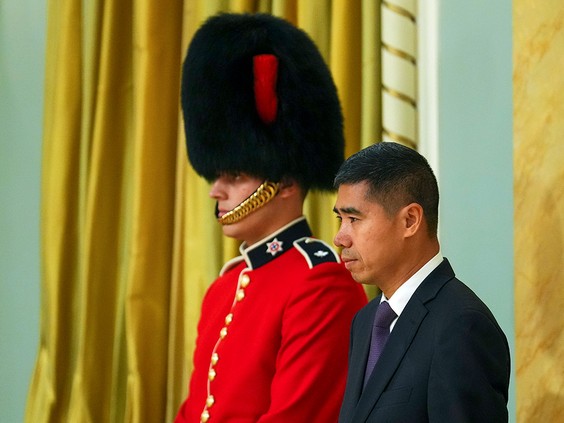
China's Ambassador to Canada, Wang Di
"I hope that companies between our two countries
can enjoy a transparent, open and non-discriminatory business
environment," says China's Ambassador to Canada Di Wang.Photo by Sean Kilpatrick/The Canadian Press/
China's
core interests are wound up in its approach to world dominance in trade
and achieving the status of a world power equal to that of the United
States of America. Everything that Beijing does is calibrated to achieve
those ends. And China is relentless in its self-actualizing mission of
achieving its divinely inspired destiny as a super-hegemon. Its links
throughout the world -- in North America, Europe, Australia, Africa, the
Middle East are geared to creating a type of dependence beginning with
trade and ending with dominating world markets in chemicals and organic
matter critical to new-age technology.
China
first ingratiates itself internationally, then demands respect and
collaboration as it paternally guides countries which have been
infiltrated by expatriate mainland Chinese through cultural
indoctrination to instill admiration for the Peoples Republic of China.
Its intelligence agents are everywhere, its social media sites dominate
markets, its modern version of the Yellow Silk Road -- Belt and Road
Initiative through investment and critical domestic infrastructure loans
throughout the world have created dependencies inimical to the
countries involved, becoming indebted beyond their ability to persevere.
And
nothing seems to stop China's subterfuges and self-entitlements in
maneuvering its operatives subtly into local culture and positions of
social and academic, scientific and political advantage to Beijing,
where infiltrated operatives deliver what they glean to their sponsors.
Trade secrets, scientific advances, political positions, military
situations, are all grist for the Beijing mill of conquest and control.
As for respecting other countries' borders, Chinese interest in the
Arctic to challenge Canada's North West Passage in the interests of vast
mineral resources' acquisition is another story.
The
government of Canada is warned by China's ambassador against using it
as "bargaining chip" in its trade negotiations with the United States,
even while holding out the carrot of pursuing a bilateral free trade
agreement as long as Canada remove barriers to Chinese investment.Those
barriers are there for a specific reason, that Canada has no interest in
having its natural resources under the control of a foreign government
which has on many occasions displayed its acquisition agenda to the
detriment of Canada's national interests.
Diplomatic
relations between Ottawa and Beijing which is at present Canada's
second-largest trading partner have cooled considerably beginning when
Huawei Technologies Co. executive Meng Wanzhou had been detained in 2018
at the request of the U.S. through an extradition warrant at
Vancouver's International Airport which led to China arresting two
Canadian businessmen then in China, as retaliatory hostages in claims of
espionage charged against the two. More recently four Canadians were
sentenced to death on charges of drug smuggling in China. The
dual-citizens were executed over their presumed 'drug crimes'.
In
August, Canada announced its intention to match the U.S. higher tariffs
on Chinese electric vehicles, aluminum and steel, prompting China to
enact retaliatory measures against Canadian canola, pork and seafood,
impacting Western Canada. Chinese investment in critical mineral
projects have been curbed in Canada, Huawei has been banned from
fifth-generation wireless networks, and TikTok's parent, ByteDance Ltd.
was ordered to close its Canadian subsidiary.
China,
however, is consumed with its energy needs to power its growing
technology functionality and Canada is more than willing to sell energy
to China in the form of oil exports and liquefied natural gas. As for
claims by security intelligence officials in Canada that China, along
with countries that include India and Russia, may attempt interference
in the federal election now underway in Canada, Mr. Wang characterized
them as "completely unjustified, groundless accusations", despite ample evidence in the not-so-distant past that Beijing has done just that.
"At the core of the Chinese strategy is asymmetric interdependence that
allows for its weaponization of trading relations … on other countries
that cannot easily pivot away from a reliance on Chinese sources."
"By
pre-emptively diversifying exports of easily substitutable products
that are vulnerable to asymmetrical transactions, we could reduce the
leverage that adversaries might otherwise seek to exploit."
University of Toronto political scientist Lynette Ong
China's Ambassador-designate to Canada
Wang Di presents his credentials to Governor General Mary Simon during
ceremony at Rideau Hall in Ottawa on Wednesday, June 26, 2024. THE
CANADIAN PRESS/Sean Kilpatrick
The Firm Hand of Experienced Administration Back in Israel
"[We will set up a government that will] look after all the citizens of
Israel, without exception, because the state is all of ours."
"We'll
restore security, we'll cut the cost of living, we'll widen the circle
of peace even further, we'll restore Israel as a rising power among the
nations."
"I will establish a nationalist government that will see to all Israeli citizens without any exceptions."
"[I shall form a] stable national government [to act responsibly avoid] unnecessary adventures [and] expand the circle of peace."
"[The people] want a Jewish state. A state that respects its citizens, but this is a
Jewish state, our national state, that we dreamed of and fought for, and
spilled seas of tears and blood to achieve."
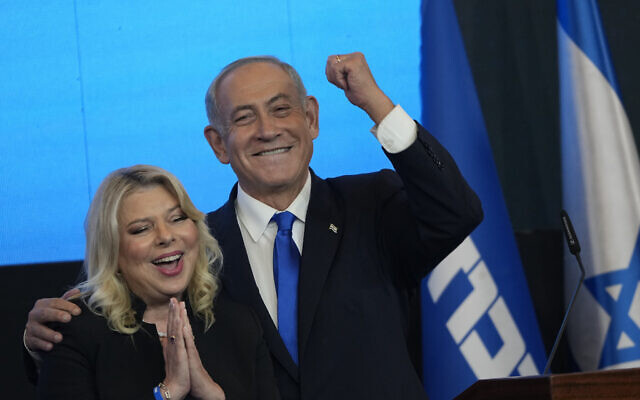
Newly re-elected Israeli Prime Minister Benjamin Netanyahu
Likud leader Benjamin Netanyahu addresses supporters at the party’s
campaign headquarters in Jerusalem early on November 2, 2022, with his
wife Sara at his side. (AP Photo/Tsafrir Abayov)
"We want to make a total separation between those who are loyal to the state of Israel -- and we don't have any problem with them -- and those who undermine our dear country."
"[I will work on behalf of -- in an anticipated ministry appointment] everyone, including those who detest me.”
Itamar Ben-Gvir, Religious Zionism party
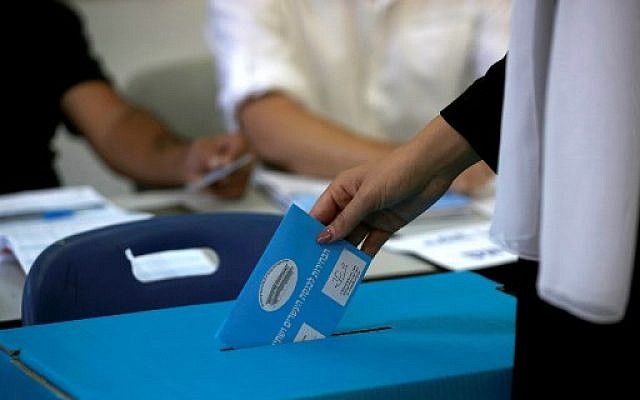
The sweep of Benjamin Netanyahu's Likud party, gaining 64 seats for a clear majority does not exclude the need for him to make accommodation with other winning parties for a ruling coalition. His choices are limited by necessity to other parties in the realm of considered right-wing ideology, among them Orthodox religious parties who tend to be right-wing in the sense of stout nationalism. A fact that makes some of Israel's strongest allies rather nervous.
Israel's most recent flirtation with its vocal left-wing factional parties gave ample \proof to the majority of Israeli voters that a less concessional, more assertive hand was required in dealing with Israel's opponents in the Arab world, most particularly its Palestinian neighbours, but hugely inclusive of Iran and its satellites: Iraq, Syria and Lebanon. By extension and seriously endangering the Jewish state, Hamas in Gaza and Hezbollah in Lebanon with their more sophisticated rocketry stockpiles.
Israelis, living through more recent months of a serious uptick in attacks by Palestinians, through deadly knifings, car-rammings, shooting, rioting and rock-throwing, snipers and rockets have experienced unnerving times. The rhetoric that continues to damn Israel from the mouths of the Palestinian Authority which continues to incite violence against Jews and defiantly continues its 'pay-for-slay' program, extolling the virtues of killing Jews and paying handsomely for those acts proves there is no 'partner-for-peace' in that arena.
The fifth election in less than four years, controversial but determinizing, delivered a clear message; conciliatory overtures to Israel's legions of enemies hasn't worked, and will not work in a geographic region where civility is viewed as weakness and respect goes to those who demonstrate the strength of a firm authoritative response to violence. Israel's military has its role in maintaining security as does its internal and external intelligence and policing agencies.
In the shadow of the Religious Zionism party, third in seats in the new Knesset, its leader is known to chant "Death to terrorism", an alumnus of the old (Jewish Defence League) Kach Party, now outlawed in Israel. Its leader, ben Gvir, calls for a tougher reaction against Palestinians who respond to the PA's incitement to violence, and to Palestinian Israelis who choose, despite their Israeli citizenship, to mount attacks on the military and on Jewish Israelis.
And nor have many Palestinian Isrraelis, democratically voted into office as Members of the Knesset, proven themselves loyal to the nation of their citizenship, infamously supporting terrorist acts and Hamas terrorism against Israelis, some going so far as quietly collaborating with groups like Hamas and Palestinian Islamic Jihad. Their sympathies and actions in sharp contrast to the many Israeli Palestinians who serve in the military, join the judiciary, are appointed to elite medical service and are loyal to Israel.
While the Palestinian Authority speaks of Israeli 'racism' and 'extremism' it is a reality that Israel has absorbed as citizens over a million Palestinian Arabs, while the PA has pledged that not one single Jew can become a citizen of a nascent 'Palestine'. And while among the religious zealots in the settlements there are youth who harass and commit violence against their Palestinian neighbours they are outliers in Israeli culture, whereas Palestinians who murder Jews are celebrated martyrs.
Lod As Template? What Is It About Living in Israel, a Jewish State, That Its Arab Citizens Don't Understand?
"They say they wanted to come to a quiet place, not where there is this
kind of background noise, and where they have to be afraid."
"Things here
now are a mess, and they say they didn’t pick up and move to Lod to live
in a mess. If you ask me, it is sad – sad that a Jewish family has to
leave this city, eight minutes from the airport, because they are
afraid."
"You never know, one day someone is your friend, you buy your groceries
at his store, you have friendly relations, and today you just don’t
know. My mechanic is connected to the family of the Arab who was killed
on the first night of the rioting – Hasuna – I called him up to ask if
we were still okay. He said to bring my jeep by."
"We live here together. Why are you going to boycott an Arab store? Then
next month you will go back and buy there. So what have you
accomplished – that will only widen the rift."
"If you ask me what needs to be done, I think the police have to
take more initiative, provide people with a sense of security – Jews and
Arabs. It can’t be that Arabs can build here illegally and nothing
happens, or they fire off firecrackers whenever they want, testing the
response, and nothing happens. That creates a perception that they are
in charge."
"[The police do not enforce the law because they simply don’t want to ruffle feathers], they want quiet]."
"I asked people what happened, and they replied, ‘You touched al-Aqsa.’
The fanatics live in paranoia. They believe the Jews, the Garin Torani,
are coming to kick them out, that they are from the Shabak [Shin Bet].
They are paranoid that we want to kick them out and destroy al-Aqsa. Go
convince them otherwise. Most of the people don’t have a problem, but
the fanatics and the religious incite things."
Assaf Weiss, young
religious Jew who moved into Lod 15 years ago
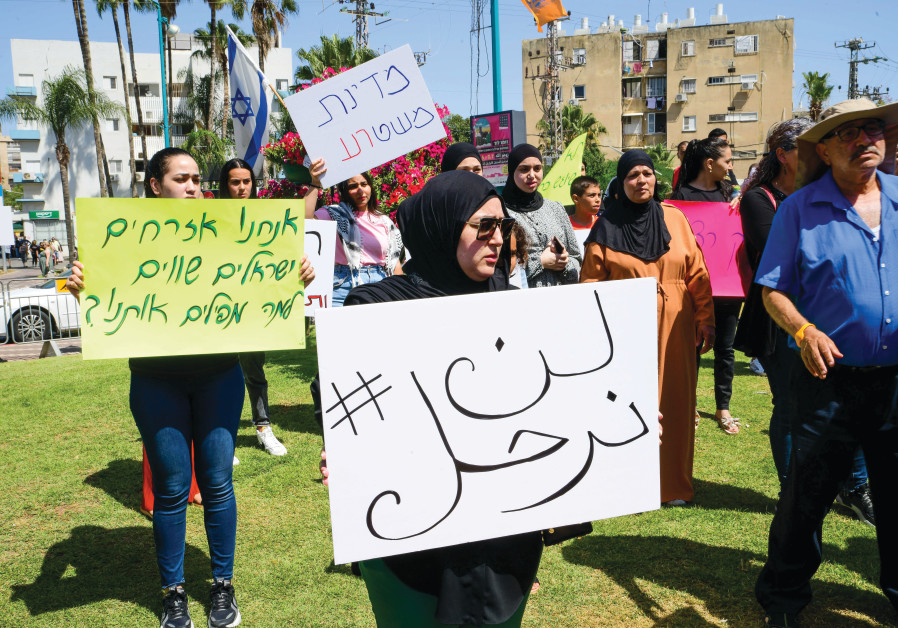
Coexistence crisis in Lod. (photo credit: MIRIAM ALSTER/FLASH90)
"They [Jewish thugs from the far-right Lehava and La Familia] walked with sticks and looked for cars, Arab cars. Then they bashed the windows in."
"Jews live in my building, I have no problem with them. The problem is the settlers [catch-phrase used to refer to those associated with the pre-army academy, or the Garin Torani]."
"If you look deeply, the Jews cannot live here without the Arabs, and
the Arabs cannot live here without the Jews. We need each other. I don’t
want to live in an Arab state. I’m used to it here, used to the laws.
In the Arabs states the law is not straight."
"[Lod Mayor Yair] Revivo
says he also does for Arabs. But what does he do? Only demolish homes.
He only gives to the Jewish neighborhoods."
"They
want to bring in settlers, and the settlers are racists. And so are
those they brought in two weeks ago who caused all the problems."
"They [Jews] could offer me five million shekels, and I wouldn’t sell [to a Jew]. Besides, where would I go?"
"I have three apartments. A settler will come here and say he wants
to pay double. I’ll sell and he will live next to my parents – a
settler who was raised on hating Arabs. They don’t study Torah, only
hating Arabs."
"I
have no problems with Jews, I am only talking about the settlers who
were living in the West Bank and Gaza, and who are now looking for a
place to live where Arabs live. I’m not talking about regular Jews. On
our first floor there is a religious Jew. But not a settler."
Sheik Yusuf Adam Bassam, Arab Lod resident
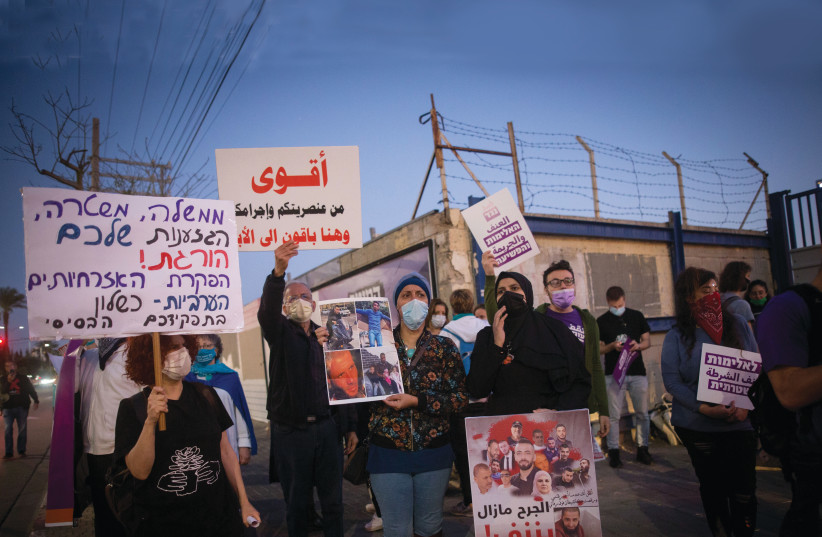
ARAB
RESIDENTS and activists protest the death of Musa Hasuna, killed during
Jewish-Arab clashes, outside Lod District Court on May 28. (AVSHALOM
SASSONI/FLASH90)
"We have a problem when a group of Jews is coming not only to live,
but to Judaize the urban space, coming into Arab neighborhoods or close
to Arab neighborhoods."
"If you come to
an Arab neighborhood and you find a very old building nobody is using,
and they are passing it on to NGOs – very Zionist radical NGOs – who
convert it to a synagogue or a center for young Jews. Judaizing the
urban space means instead of making it available to young Arabs,
offering it instead to Jewish people."
"What is
happening in Sheikh Jarrah is really connected. It is the same policy of
the evacuation of Arabs and replacing them with specific Jews, with
settlers. It is the same policy that is happening in the old city of
Jaffa, for example, in the historical Palestinian cities. This is
frustrating the Arabs in those cities.
It is pent-up anger that was waiting for a specific moment to explode. And these kinds of policies bring it to an explosion."
Thabet Abu Rass, co-executive director, Lod-based Abraham Initiatives NGO
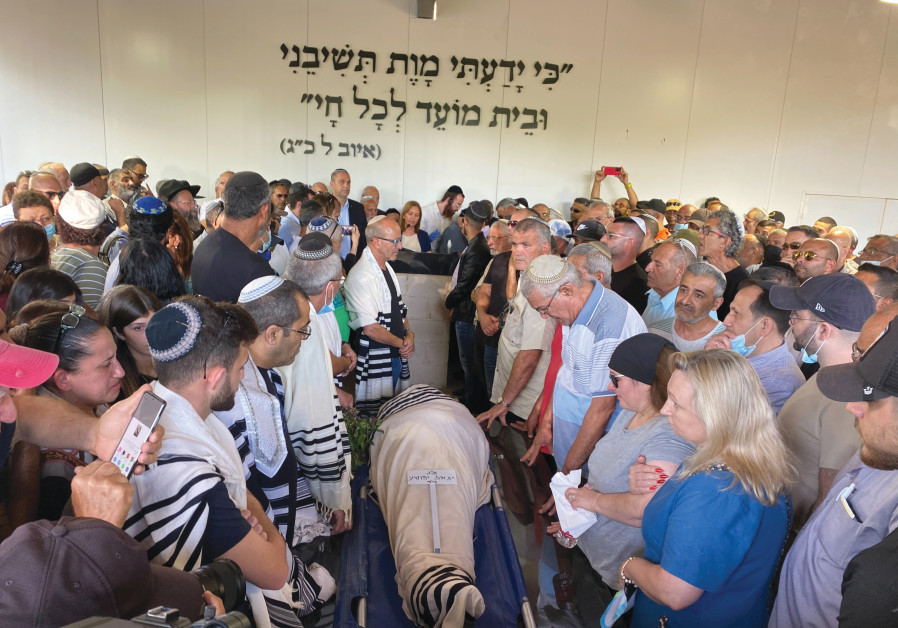
THE
FUNERAL of Yigal Yehoshua, who succumbed to injuries sustained during
rioting in Lod, on May 18. His family later donated one of his kidneys
to a Palestinian woman. (AVSHALOM SASSONI/FLASH90)
"We decided to join the government in order to change the balance of political forces in the country."
"I say here clearly and frankly: when the very establishment of this government is based on our support ... we will be able to influence it and accomplish great things for our Arab society."
Mansour Abbas, leader, United Arab List party
In the frantic drive to oust Prime Minister Benjamin Natanyahu, a left-wing and a right-wing Jewish Israeli party linked in their hatred of the current prime minister, if not in their ideologies, invited an Islamist party head to join their coalition to achieve enough momentum through a slender majority of seats in the Knesset to drive the prime minister from power. The tiny Islamist action brings just enough lead for a paper-thin majority, making the United Arab List the first Arab party to join the governing executive of the country.
Mr. Abbas; MK Abbas, a Palestinian with Israeli citizenship, has deigned to ignore the differences he cannot but hold as vitally important against a leader representing a major Jewish settlement group, an advocate of annexing most of the West Bank for the larger purpose in his opinion of advancing the cause of the 21percent minority Arab citizens of Israel. His hope, said MK Abbas is to improve conditions for Arab Israeli citizens mired in complaints of discrimination and neglect by government.
There is more than a bit of dissonance in this association, since Mr. Abbas's party is the political wing of the southern branch of the Islamic Movement in Israel, established in 1971, its origins with the Muslim Brotherhood. As an Islamist party and as an arm of the Muslim Brotherhood the party, its members and its leader are fundamentally opposed to the State of Israel and diligently work toward its elimination. Their mandate is little different, in effect, from that of Hamas.
The appeal for Mr. Abbas was the allocation of over 53 billion shekels to improve infrastructure and curb the violent crime that plagues Arab towns. In other words, a party dedicated to the violent overthrow of the Jewish state, seeks funding and dedication from that Jewish state to quell the violence and crime plaguing Israeli Arabs in their towns, brought to them courtesy of their Muslim Arab restive youth whom the Arab authorities in those towns appear incapable of controlling in their constant rampages.
Approval for his initiative in agreeing to join the coalition to oust the prime minister, came from the Islamic Movement's advisory Shura Council, a religious body from whom Mr. Abbas sought guidance, the very source of direction given to the party in past votes in the Knesset on LGBT rights and other like issues. There are Arab Israelis who are critical of Mr. Abbas's decision to join the coalition, querying his justification in being part of a government that imposes a 'military occupation' over West Bank and Gazan Palestinians including a Gaza blockade.
Loyalty to Israel is not writ large on Palestinian sentiments.
"He should be commended for trying something new, but if there's another war with Gaza, and he's in government, there will be pressure on him to abandon ship", noted Moussa al-Zayadna, from the Bedouin town of Rahat in southern Israel. "He is a traitor. What will he do when they ask him to vote on launching a new war on Gaza? Will he accept it, being a part of the killing of Palestinians?", rhetorically queried Badri Karam in Gaza.
Joint List member Sami Abou Shehadeh, from whose party Mansour Abbas split to form his own party, claimed that the Islamist party led by Abbas "dramatically changed its historical political behaviour" joining with Bennett and other right-wing leaders, "a very big crime. Bennett was the head of the Yesha council (settler umbrella group). We're talking about dangerous people, and supporting them means that Mansour Abbas has chosen to stand with the extreme settler right against the interests of our people."
From left, Yair Lapid, Naftali Bennett and Mansour Abbas signing a coalition agreement.Credit...United Arab List Raam, via Agence France-Presse — Getty Images
"It's a political crisis that we have never gone through before or even anticipated." "We have never been in a situation where a political candidate did not succeed in putting together a government, and that happened now not only once, but twice." "[The bind has resulted from both] weaknesses in our system and the unique situation of a popular prime minister who is charged with severe crimes." Yohanan Plesner, president, Israel democracy Institute
"We are kind of running on autopilot." "But it means the government really has no flexibility in dealing with any crisis that might arise, there can't be any changes in budgets, and it loses all degrees of freedom to run the country." Dan Ben-David, professor of economics, Shoresh Institution, and Tel Aviv University
"In the United States, when you have a problem, you can call your representative in Congress. But here there is no one to represent you, no one to hold the administration accountable." "We have completely forgotten how a functioning democracy works right." Tal Schneider, senior diplomatic and political correspondence, Israeli business newspaper Globes
Israel's Prime Minister Benjamin Netanyahu, seen at a Dec. 18 Likud
party supporters meeting, declared victory in his primary election
battle for leadership of the party on Thursday. (Jack Guez/AFP/Getty Images)
Legally embattled though he is, Prime Minister Benjamin Netanyahu has succeeded in fending off his leadership challenger to remain head of the Likud Party, and as such he continues on as a dominant figure in Israeli politics with few contenders that can match his legendary popularity, his history as the longest-serving, born-in-Israel prime minister of the Jewish state. Easily submerging his challenger in the flood of majority votes cast in his favour, he now prepares to lead the country in its third election within a single year.
Israeli Druze community September 2019, Daliyat al-karmel,
northern Israel. (Jalaa Marey/AFP)
There are, however, no guarantees that third time around will reach success. In fact, the current political turmoil points to yet another stalemate -- and then what? This inability to come to an agreement, a political 'understanding' for the good of the country is unfortunately an expression on a larger scale of a fairly typical Jewish cultural trait of argumentative illogic; to gain a point by destroying a contested supposition. Netanyahu's appeal to the Israeli public to proceed with ventures certain to see widescale condemnation on the world stage, thrills some, and worries others.
He has the wind at his back in concurrence by the Trump administration determined to take Washington in directions historically hinted at but never committed to in its support of Israel. His amicable relations with Vladimir Putin, the growling bear whose latest adventures in the Middle East place him at odds with Israeli interests, still reflect a soft landing when military missions are deployed that annoy the Kremlin.
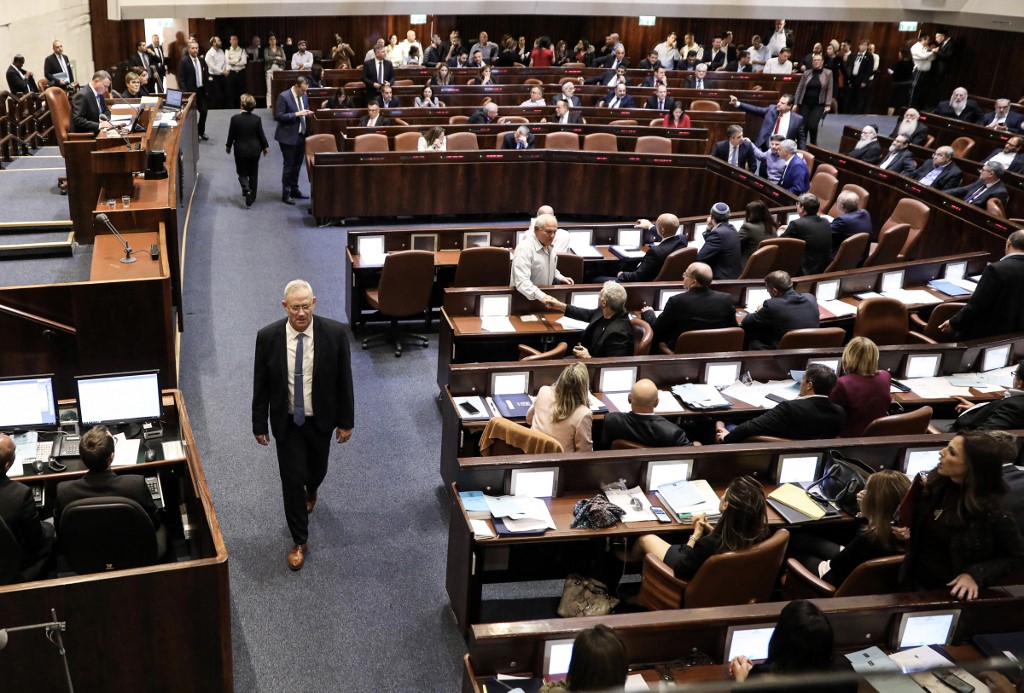
Benny Gantz walks during a session of the Knesset in Jerusalem on December 11, 2019.(Gali TIBBON / AFP)
The parliamentary democracy that Israel is, has been temporarily placed on hold, its prime minister viewed by some as heading a "caretaker government" with executive and legislative functions placed on the backburner absent the formation of a working government. Few laws have been approved by the Knesset, no state budget approved for the new year, senior appointments put on hold. Government offices, institutions limited to the past year's budget spending.
Indicted in three cases that center on bribery, fraud and breach of trust, this is an embattled prime minister characterizing charges laid against him as a political witch hunt by enemies determined to force him from office. As a matter of mere coincidence and comparison, the parliamentary democracy which is Canada also has a prime minister popular among those constituents who returned him to office, despite having engaged in the very same morally, ethically questionable conduct, and other than reducing his already-challenged reputation, has paid no political price.
Israel's Supreme Court awaits an opinion on the issue of whether a prime ministerial candidate facing prosecution should be allowed to form a government, having requested such a draft from Attorney General Avichai Mandelblit who indited Netanhahu in November, for their perusal. Meanwhile, Mr. Netanahu's cabinet continues its weekly meetings, the military goes on training and conducting security operations. The nation's hospitals, schools and public transport remain operational.
Waiting ... waiting ... on tenterhooks. March 2 cannot come soon enough. And.then.what?
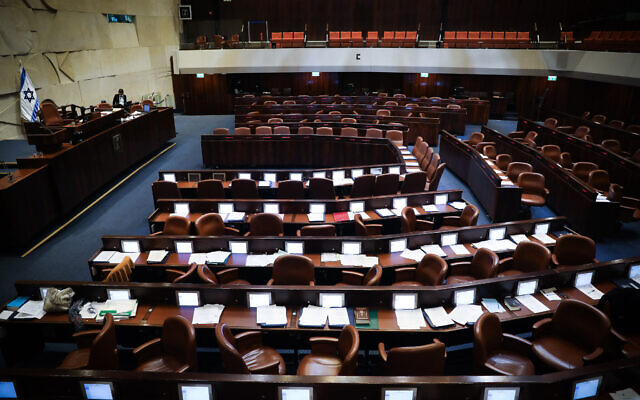
A general view of the Israeli parliament
during a vote on a bill to dissolve the parliament, at the Knesset, in
Jerusalem on December 11, 2019. (Hadas Parush/Flash90)
"We know that thousands leave every day, so if you do the math,
I think if we're not there [yet], we'll be at the same scale of the
Syrian displacement quite soon." "We're talking about forced displacement. These people leave Venezuela because if they do not leave, they don't survive." Feline Freier, professor,
researcher, Universidad del Pacífico, Peru
"The region had to respond to an emergency that in some areas of
concern was almost similar to a massive earthquake. We are indeed facing
a humanitarian earthquake." "The reasons these people left are ranging from pure hunger to
violence and lack of security ... We at UNHCR believe many have valid
reasons to seek international protection." Eduardo Stein, joint special representative, UN refugee
agency UNHCR, International Organization for Migration (IOM)
"We witnessed a transparent, secure, democratic and orderly electoral and voting process." "Our delegation was impressed by the electoral process and felt confident that the results of the elections represent the will of the majority of Venezuelans who voted." Common Frontiers report, May 2018 "The notion that free and fair elections could possibly be taking place when you not only criminalize those who are on the opposition ... but when you don't have any allowances for expressions of freedom of speech, assembly, association and the like, simply is a non-sequitur." "I think part of the problem with the labour groups who went down there is that they seem to be acting reflexively out of a political agenda rather than a human rights agenda. Out of a left-right agenda rather than a right-wrong approach." Irwin Cotler, former Canadian Justice Minister "While groups such as the Lima Group [led] by Canada are screaming fraud and government interference in the election process, not one shred of evidence has been produced to back up such claims." Don Foreman, spokesman, Common Frontiers
Protests, Venezuela in Crisis CNN
Once a wealthy country, endowed with the kind of natural resources in petroleum products the world was clamouring for, Venezuela is now riven with poverty, with a massive inflation rate, a scarcity of food and medicines, collapsed employment, social violence and a desperate population that sees no chance for survival other than to leave in massive numbers to seek haven and aid in neighbouring countries that are themselves now struggling to accommodate the flood of refugees.
Hugo Chavez's socialist-inspired Bolivarian revolution squats now, a malevolent splotch of deadly failure, over the country, as his protege, Nicolas Maduro allows his supporters to do as he does, in a corrupt skein of malice, to absorb whatever profit they can to their personal credit in a country they have ransacked and enfeebled through a death blow of totalitarian misrule. For years Venezuelans have been assembling in protest marches against the poverty and hopelessness that have been imposed upon them.
Comfort is hard to find anywhere. The United States, Australia, New Zealand, Canada and many European nations, alongside most of Venezuela's Latin American neighbours are condemning Maduro and his supporters wholesale, recognizing his re-election as an outright fraud leaving him free to continue his focus on dismantling whatever is left of the state apparatus as the country continues to descend into chaos, violence and malfunction.
On the opposite side, encouraging Maduro there is Russia, China, Turkey, Iran and many others both dictatorial and socialist in politics and ideology. And then there are the trade unions, who espouse undying solidarity for a movement they recognize as one of their very own and which as a result can do no wrong, yet is being slandered by the very nations those unions ply their trade within. In Canada, one of the leading nations attempting to persuade Maduro to step down, quick to acknowledge the legitimacy of Venezuela's legislative assembly's leader Juan Guaido as temporary president, an unholy alliance has taken place. Unifor, the Canadian Union of Postal Workers, the Ontario Secondary School Teachers' Federation, the United Church of Canada, and the Internet group Rabble.ca speak admiringly and supportively of Venezuela's "strong and vibrant democracy". They formed a common group to represent their interests in the support of Venezuela's socialist dictatorship; Common Frontiers. Post-election, the United Steelworkers and a law firm in Toronto were also acknowledged as having provided "delegation support" as election monitors during the May election. This is the same Venezuela that an Organization of American States panel of human rights experts having concluded hearings and deciding that on the evidence Maduro's regime should be referred to the International Criminal Court to stand trial for crimes against humanity, cited thousands of murders, torture and imprisonment against political opposition. The same country that Argentina, Chile, Colombia, Paraguay and Peru along with Canada decided to refer to the International Criminal Court and for the same reasons. On the website of the Canadian Union of Public Employees, supporters are invited to petition the government of Canada against its leadership of the Lima Group hose foreign ministers met Monday to discuss support for interim President Guaido. Common Frontiers has been funded by among others, the Canadian Union of Public Employees reflecting their "global justice work". CUPE claims that Maduro was "duly elected", criticizing the Canadian government for aiding a "coup d'etat". As for the United Church of Canada, it generously parted with $1,500 to help defray costs associated with their umbrella group Common Frontiers sending its election monitors to Venezuela to validate the legitimacy of the May election returning Maduro to power. Their Latin America program's Jim Hodgson, with the delegation, wrote for Rabble.ca after the trip questioning why Canada chose not to defend Venezuelan sovereignty against "U.S. aggression." Staggeringly, the Ontario Secondary School Teachers' Federation representative claims Canadian could "learn a lot" from elections conducted in Venezuela, while the representative for Rabble.ca stated the Venezuelan elections should be an "international gold standard". These reprehensible social lunatics have much in common; they also, all together, support BDS and the defamation of the State of Israel.
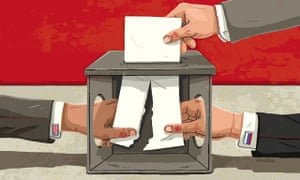
United States vs Russia ... Foreign Election Interventions
"It was completely wrong of Vladimir Putin to intervene in this way [to influence the outcome of the 2016 U.S. presidential election]." "That said, the methods they used in this election were the digital version of methods used both by the United States and Russia for decades, breaking into party headquarters, recruiting secretaries, placing informants in a party, giving information or disinformation to newspapers." Richard M. Bissell Jr., former chief of C.I.A. operations
"If you ask an intelligence officer, did the Russians break the rules or do something bizarre, the answer is no, not at all." "[The United States] absolutely [has carried out such election influence operations historically], and I hope we keep doing it." Steven L. Hall, retired, former chief, C.I.A. Russian operations
Illustration: Eva Bee
The difference in how the United States and Russia carry out their covert operations to influence political outcomes in their rival states is very real and unequivocal, however, both retired C.I.A. heads claim. While American interventions have been structured of late to aid non-authoritarian candidates with their challenges to dictators or in some manner help to promote democracy, Russia focuses on intervening for the purpose of disrupting democracy. As why would an autocratic post-Communist state not, after all? Democracy is not their chosen schtick.
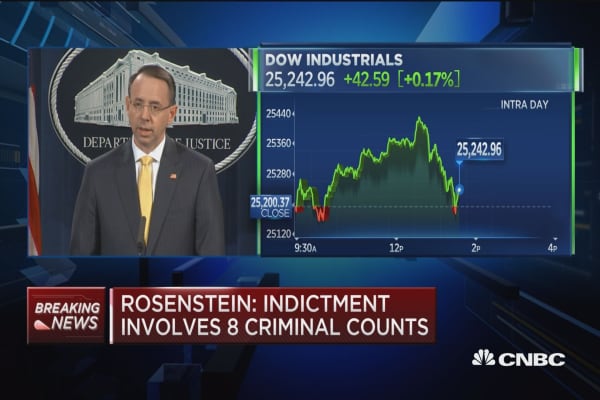
American intelligence has given fresh warning that Russia is once again preparing to reiterate in 2018 its interventions that took place in 2016; hacking, leaking, social media manipulation for starters. This was followed by the announcement by Robert Mueller, special counsel looking into the 2016 election interference, that thirteen Russians and three companies have been indicted for their roles in close Kremlin ties, for the three-year scheme using social media to attack Hillary Clinton while boosting Donald Trump.
In this, the C.I.A. is at a disadvantage in that Vladimir Putin has taken precautionary steps to neutralize challengers to his bid for another term at the Russian presidency. Laying questionable criminal charges against the most influential and popularly supported opposition leader Alexei Navalny, Putin went on to bar Navalny from entering the race based on criminal charges brought against him. The remaining opposition candidates simply haven't the support to make significant inroads in the election results that will result in Putin's re-election by a wiiide margin.
According to Loch K. Johnson whose career spanned the 1970s forward on a Senate committee as a staff member investigating the C.I.A., Russia's operation in 2016 quite simply represented the cyber-age version of standard American practices "We've used posters, pamphlets, mailers, banners -- you name it. We've planted false information in foreign newspapers", explained Mr. Johnson from his new perch at the University of Georgia.
The C.I.A. famously gave aid in the overthrow of elected leaders in Iran and Guatemala in the 1950s, backed violent coups in the 1960s, plotted assassinations and supported anti-Communist governments in Latin America, Africa and Asia, irrespective of how brutally they treated their populations. That kind of devious and morally unsupportable interventions, hasten Messrs. Hall and Johnson to assure, no longer reflect American policy which now focuses on strengthening democracy abroad. On the other hand, election meddling in other nations' sovereign affairs while certainly unethical, is accepted as -- albeit political as in Realpolitik -- meddling. Dov H. Levin, a Carnegie Mellon scholar, scoured the historical record to determine the extent and depth of election influence operations mounted by both the U.S. and Russia, to discover 81 such events conducted by the United States, and 36 by the Soviet Union or Russia between 1946 and 2000 which he could discern. The C.I.A.'s intervention in Chile in 1964 is clarified in a declassified report hat reads approvingly of the "hard work" done by the agency in supplying "large sums" to the candidate of its favour, portraying him as a "wise, sincere and high-minded statesman", while portraying his leftist opposition as a "calculating schemer." Over a prolonged period there were greater instances of American influence operations mounted by the State Department and affiliates. The U.S. funded an ultimately successful effort to defeat Slobodan Milosevic in Serbia's 2000 election. President Bill Clinton became involved in a drive to aid Boris Yeltsin's re-election in 1996 as president by dangling the carrot of an assured American support to achieve a $10-billion international Monetary Fund loan to Russia four months before voting day. Vladimir Putin views more recent American ventures in support of foreign groups, teaching basic campaign skills and how to build democratic institutions and the training of election monitors as a malign threat, not the benign good Americans feel it to be. Understandably, given that one group, the National Endowment for Democracy, rendered a $23,000 grant to an organization that employed Aleksei Navalny in 2006, years later to become Vladimir Putin's major political nemesis. "I assume they're [the U.S.] doing a lot of the old stuff, because, you know, it never changes. The technology may change, but the objectives don't", said William J. Daugherty, who worked from 1979 to 1996 for the C.I.A.
Declassified CIA files are replete with examples of agency interference in foreign elections, including state elections in India and West Germany and provincial elections in Australia, Canada, and Japan...
In the 1950s, the CIA provided massive support to the West German Christian Democrats,
which were led by Chancellor Konrad Adenauer. The CIA also did its best
to suppress supprt for the West German Social Democrats and the
far-right nationalist German Party in Berlin, Hesse, and Bavaria. In 1967, Indian Foreign Minister M. C. Chagla charged that the CIA "meddled" in India's election,
mainly through financial donations to parties in opposition to the
ruling Indian Congress party. The CIA particularly targeted Communist
parties in West Bengal and Kerala states. Former Canadian Prime Minister John Diefenbaker of the
Conservative Party charged in 1967 that CIA funds were used to bolster
the Liberal Party, which contributed to Diefenbaker's electoral
losses in two general elections held between May 1962 and June 1963.
Diefenbaker's successor, Prime Minister Lester Pearson of the Liberal
Party, discovered that the CIA funneled cash to the pro-Liberal Canadian
Union of Students in 1965 and 1966. The CIA did everything possible to defeat for re-election the New Zealand Labor Party government of Prime Minister David Lange. The
CIA provided propaganda support to the opposition National Party, which
was opposed to Lange’s policy of denying entry to New Zealand waters of
US nuclear-armed and nuclear-powered warships. The CIA ensured that
pro-American media in New Zealand harped on about New Zealand
record-high 6 percent unemployment, the nation’s foreign debt being half
of its gross domestic product, and $1 billion budget deficit. The CIA
also attempted to suppress traditional Maori support for Labor in the
August 15, 1987 election, a cynical use of race-based politics to alter
an election outcome. Between 1965 and 1967, the CIA station in Brazil, working in
conjunction with the AFL/CIO union in the United States and its
international arm, the American Institute of Free Labor Development
(AIFLD), were discovered to be interfering in union elections in Brazil.
The Sao Paulo office of the AIFLD, which was nothing more than
a CIA front, made cash payments to Brazilian officials to corrupt union
elections in the Brazilian petroleum sector. An itemized list of CIA
bribes to Brazilian officials was discovered by a Sao Paulo union
official: “Bonus to Jose Abud for collaboration – $156.25; Special
payment to Dt. Jorge M. Filho of Labor Ministry – $875.00; Trip for Mr.
Glaimbore Guimasaes, our informer at Fegundes St. – $56.25; Photocopies
of books and documents of Petroleum Federation – $100.00; Assistance to
Guedes and Eufrasio to defeat Luis Furtado of the Suzano Union –
$140.64.” Prior to the September 4, 1964 Chilean presidential election,
the leftist Popular Action Front opposition discovered that US chargé
d’affaires Joseph Jova was assisting the Christian Democratic Party
candidate. Christian Democrat Eduardo Frei Montalva, with the CIA’s help, defeated Allende. A CIA memo dated October 3, 1955, describes CIA support for
the pro-Western. Masjumi Party in the Indonesian election, the nation’s
first since independence. CIA director Allen Dulles appeared to
be hopeful about the chances of a Masjumi victory due to Indonesia’s
“large percentage of illiterates.”In the 1984 El
Salvador presidential election, the CIA supported Christian Democrat
Jose Napoleon Duarte over the more extreme-right winger, Roberto
d’Aubisson. Republican US Senator Jesse Helms of North Carolina charged
that the CIA “meddled” in the election on behalf of Duarte. It was even
discovered that the “invisible ink” used on the fingers of those who had
voted was supplied from the CIA.
"They should have said too close to call." "In Germany we wouldn't dare
to say on the basis of a survey what the distribution of seats in
parliament will look like. The polls [in the US] weren't bad, but how
they were translated into electoral delegates was faulty." Forsa Director of Political
Opinion Research Peter Matuschek
"It would be the first election in the history of humankind in which all
undecided voters ran to one party with flags flying." "Our most recent numbers show
no greater potential for the Social Democrats than for [Merkel's]
CDU-CSU." "We're assuming that the AfD is correctly reflected in our latest
numbers." "The difference between our final opinion surveys
and the actual AfD election results weren't very large." "As a pollster, it's impossible for me to consider any election boring. If I did, I'd be in the wrong job." Infratest dimap
Managing Director Nico A. Siegel
Martin Schultz and Angela Merkel
Germany is preparing for its 2017 election on September 24. Chancellor Merkel has prepared herself for yet another term. During her administration Germany has undergone monumental changes. It is, in some areas of the country, almost unrecognizable. But this hugely intelligent and talented woman has steered her country deliberately in the direction that has transformed it to such an unimaginable extent at the very same time that she headed the nation that bolstered the European Union as its most influential member and partial financier.
Frau Merkel is easily the equal in her tough demeanor, persistence and determination as Russia's President Vladimir Putin, whose tough-guy persona hasn't fazed her one bit. She has, in fact, called him to account for his east Ukraine interventions in support of ethnic Russian separatists and Moscow's grab of Crimea. Japan's Fukushima disaster when its nuclear plants went into meltdown after its powerful earthquake and tsunami persuaded the Chancellor that Germany would shutter its nuclear power plants.
Germans have placed their trust in this unflappable women whose strength of character has carried their country far from its early-and-mid-20th-Century position as international pariah. It's widely believed that she will carry the election, leaving her closest rivals in her wake. At the same time the Alternative fur Deutschland will gain enormously, because many Germans are hugely unsettled at what has become of their homeland with Frau Merkel's indomitable will insisting Germany would accept a million Muslims as refugees.
Germany had already absorbed five million Muslims. Turkey's Recep Tayyip Erdogan, not Germany's most enthusiastic fan after the government refused to allow his ministers to campaign among German Turks for the Turkish election that succeeded in elevating Erdogan to the position of the all-powerful caliph he so fervently sought, has warned Turks against the malevolence toward them of the German state. Which doesn't have their best interests at heart. Leading Erdogan to get on with his Islamization of Germany.
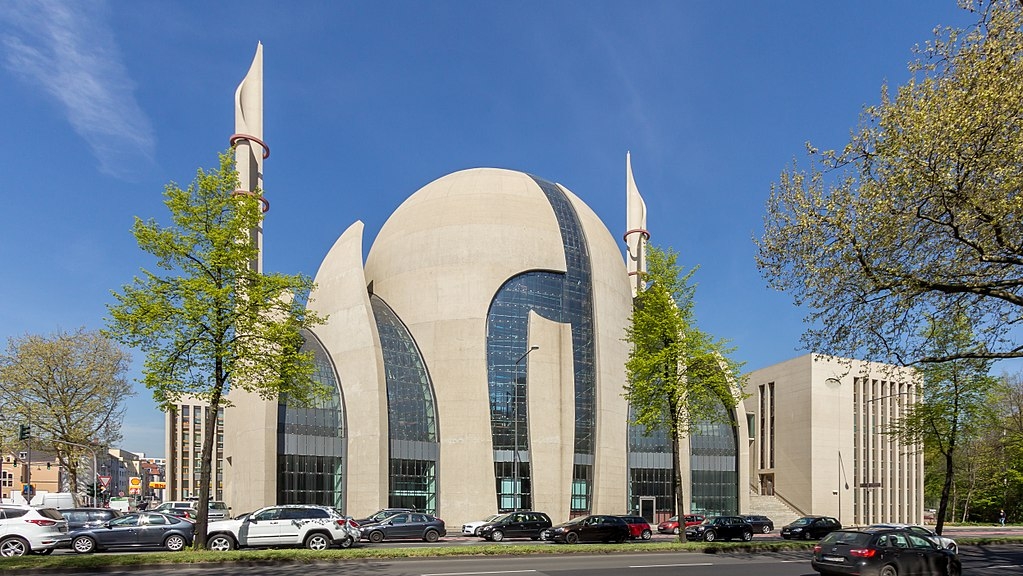
"The Turkish-Islamic Union for Religious Affairs (DITIB) just opened a
new mega-mosque for worship in the German city of Cologne. The new
German mega-mosque has a 1,200-person capacity and the tallest minaret of Europe. According to Deutsche Welle, 'Christian leaders bristled at the idea of Cologne's famed Dom
cathedral sharing the skyline with minarets.' When the mosque was
planned in 2007, a citizens' initiative was launched to say that "we want the cathedral here, not minarets". The Muslim authorities then announced the plan to 'double' the number of mosques."
The new mega-mosque in Cologne, Germany has a 1,200-person capacity and
the tallest minaret of Europe. (Image source: Raimond Spekking/Wikimedia
Commons)
"Since he took power in Turkey, Recep Tayyip Erdogan has built 17,000 Islamic prayer sites there. The Turkish president is committed to the construction of mosques in European capitals as well. Turkey controls 900 mosques in Germany and feels free to say that a "liberal mosque" in Germany is "incompatible" with Islam, according to the daily Frankfurter Allgemeine Zeitung. That is why the 57 percent of Germans fear the rise of Islam in their country." Giulio Meotti, German, The Rise of Islam, Gatestone Institute
So, is that 57 percent of Germans who fear Islam's rise in Germany, planning to vote nonetheless for the ethical, moral, dependable leader they know best or will they chose to support the 'right-wing' Alternative party? Current polls do give Frau Merkel a clear lead in the election. And despite Erdogan's dire warnings to his expatriates, given the current situation of Muslims dominating many towns and villages and the city of Cologne, they certainly will vote for the Christian Democrats.
Germany has been offered assistance by Saudi Arabia in usefully handling the needs of all those new immigrants, kindly proffering their assistance and to generously pay for 200 new mosques to service every 100 new Muslim entrants to Germany. It is no longer Deutchland Uber Alles, but Islam's peaceful conquest of yet another European country. Or, in Erdogan's unforgettable words: "Our minarets are our bayonets, our domes are our helmets, our mosques are our barracks."
"It's no question that people put their trust back into [Bill] Clinton because she stood behind her husband. At best she's all smiles and determination, but after Interngate her face hints at a variety of emotions: regret, confusion, anger, and bewilderment." "[Hillary] Clinton revels in the attention, demonstrating a perplexing sort of narcissism in which she believes she did nothing wrong." "But it's her tendency to lie that constituents and journalists are concerned about -- a fact she refuses to acknowledge in one interview after another." "Clinton luxuriates in the limelight, regardless of what she's being taken to task for. She loves describing her rise-and-fall-and-rise narrative to anyone who cares to listen, but never forgets to bring her politicking back to a cause; fighting for the middle and lower socioeconomic classes."
True, so true. Hillary Clinton as massively flawed Democratic candidate for the presidency of the United States of America. Women in America are themselves perplexed and polarized over the issue of the crowning of a woman for the first time as President of the United States and Commander in Chief. Pleased on the one hand that a woman is finally reaching the pinnacle of power, representing the capability of women to more than ably match men in management skills, lying and cheating.
The Democratic presidential
candidate explains her desire for Americans to see her as she is,
unmediated by “any veils of pretense, preconception, or concealing
cloth.” The Onion, March 2016
Oh, scrub that. Did I forget to attribute the quotes above? Sorry about that, an oversight. Well, actually not quite. It's more in the nature of a literary free-boost. Simply lifting something someone else (Tina Hassannia, Ottawa Citizen) has written and substituting names. This was, in actual fact, a review of a documentary on Anthony Weiner, the Democratic politician who ruined his career by sending a text-photo of his private business to a woman.
Not his wife, no. The selfie he sent of his spectacular appendage named appropriately after his surname, went off to an unnamed women. Oh dear, here's Hillary again, if only obliquely -- Huma Abedin, Hillary Clinton's senior aide and Weiner's wife was not the recipient. The candid and evidently often disturbing and most definitely unflattering cinematic documentation of Anthony Weiner and his aspirations reveal what the public was already aware of, a man whose personality is forged in the sweet potion of narcissism.
Eric Thayer / Reuters-- New York mayoral candidate Anthony Weiner and his wife Huma Abedin attend a news conference in New York, July 23, 2013
With all those additional attributes that reflect similar characteristics evidenced through the character of Hillary Clinton, so long in the public eye in the most exalted of public posts, from president's wife to state senator to presidential aspirant to Secretary of State, and back once again to presidential aspirant. They do have much in common, don't they? Both power couples, each at their level of competence/incompetence and moral incontinence.
The classic story of an ambitiously powerful man whose equally ambitious and doting wife manages to rise above her man's constant life-betrayals for the larger purpose of aiding him to reach his aspirational high points. Only in this instance Hillary Clinton is adamant that it's time she took her turn at the helm. And as circumstances have conspired to play out in the great U.S. of A., she will.
The choice is dire but avoidance of a Trump presidency takes precedence over dire. Good on ya, Hillary. Now that your pot of gold is within reach, what're you gonna do with it? The world, you know, unhappily awaits a response.
"Well, just so you understand, I don't know anything about David Duke, OK? I don't know anything about what you're even talking about with white supremacy or white supremacists." 2016 "I leave the Reform Party to David Duke, Pat Buchanan and Lenora Fulani. That is not company I wish to keep." 2000 Donald Trump, Republican presidential candidate in memory lapse
A fascist blackguard at heart, given to public displays of offensive and buffoonish expressions, the Republican Party of the U.S. of A. is suffering well-earned heart palpitations over the possibility, seemingly more real as time goes by in the theatre of American party politics reaching toward the fall general election that will see President Barack Obama vacate the White House, as the spectre of Donald Trump prevailing as president looms on the near horizon.
Americans have elected some peculiarly unlikely candidates for the presidency in the past. One, a born-again Georgia peanut farmer, Jimmy Carter, was a disaster as a president. Another, a grade B actor and Hollywood union leader, Ronald Regan, has become a beloved icon of Republican values, credited with helping to bring down the Berlin Wall leading to the eventual dissolution of the Soviet Union, the monolith he called the "Evil Empire".
Something about Democratic presidents; John F. Kennedy went to Berlin and declared himself a native son, while it was a Republican who called for the city to be reunited, and it was. It was another Democrat whose time in office coincided with the 1979 Iranian Islamist revolution that led to the storming of the U.S. Embassy in Tehran and its sacking, and the abduction and detaining of its staff in revenge against American meddling in Persian political affairs. They were released only with the election of a Republican president.
And it has taken a current Democratic president to give license to the Islamic Republic of Iran to get on with their nuclear program with an appropriate hiatus, through uranium enrichment on their way to a nuclear bomb to match their advanced long-range ballistic missiles, choosing to end sanctions that crippled the Iranian economy making it exceedingly more difficult to fund its proxy terrorist groups, and supporting the destructive war that the Syrian President Bashar al Assad wages against his Sunni civilians in Syria.
Candidates for each of America's political parties somehow fail to reflect the intelligence, resolution, and capabilities of its excellence in the sciences, in academia, in technology; in fact in mostly all indices of an advanced society (save racial bigotry). The branch of politics is a science separate and apart, and overwhelmingly staffed by egotistical charlatans anxious to make their impression on history with their legacies of 'to-war-or-not-to-war' in an increasingly unstable world.
Never before, however, of a certainty has a more problematical candidate for the presidency arisen to match the persona and character of Donald Trump. His utterances logically should make intelligent people wince in dismay at the very least, become frustrated and enraged that someone of his ilk could make such an unbelievable impact on the electorate, clamouring to hear his latest outrages and to applaud his 'honesty' and 'unaffected style'. They are enraptured by the whiff of his flamboyance and wealth in a culture obsessed by celebrity.
This is a man whom sources state keeps a publication of Adolf Hitler's admired speeches at his bedside. This is a man who admires and repeats Benito Mussolini's philosophical utterances. This is a man who finds it difficult to repudiate a leader of the infamous Ku Klux Klan since, for a man with a much-vaunted memory, he was incapable of recalling just who Duke and the Klan represented. Anyone who supports Trump for president is beyond reproach.
And anyone who brings up the matter of a class-action civil lawsuit revolving around the former Trump University is most discourteous. The matter of a one-year apprenticeship that Trump sold easy marks on paying tens of thousands for the privilege of hearing him briefly discourse on his success, turned out to be a seminar lasting three days where attendees were free to take privileged photographs of themselves beside a Trump cardboard cutout.