Politic?

This is a blog dedicated to a personal interpretation of political news of the day. I attempt to be as knowledgeable as possible before commenting and committing my thoughts to a day's communication.

Saturday, August 01, 2020

Rodrigo Duterte : Sage Advice : Rivalling Donald Trump
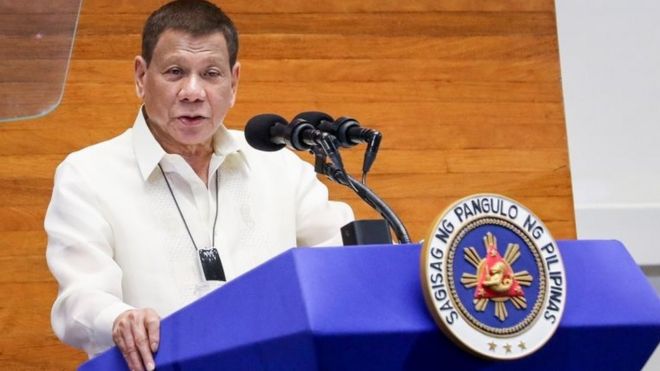
Mr Duterte gave a state of the nation address earlier this week, before his latest comments
Mr Duterte giving a state of the nation address    EPA
"Together, we shall fight this pandemic with the same fervour as our campaign against illegal drugs, criminality, insurgency and corruption in high places and entrenched parochial interests."
"What I said is true. Just go to the gasoline station, and then have some drops, that's disinfectant."
"I am not joking. That is true. You think I am just kidding."
"They [critics] said, 'Duterte's insane.' Stupid! If I'm insane, you should be the president, not me."
"What I've said was true. If alcohol isn't available, especially for the poor, just go to a gasoline station, and use [gas] to disinfect."
"I am not joking. I am not joking. You… you try to get inside my brain."
"At the end of the day, hang [the mask] somewhere and spray it with Lysol if you can afford it."
"For people who don't [have Lysol], drench it in gasoline or diesel... just find some gasoline [and] dip your hand [with the mask] in it."
President Rodrigo Duterte, Manila, Philippines
"You cannot use gasoline as disinfectant."
"Inhaling it may cause harm and could lead to more problems like respiratory disease."
Jose Santiago, president, Philippine Medical Association

"I can't believe that after four years of him as president, you still don't know [him]."                                                                                                                      "[It's only a] joke. Why would we use gasoline for washing?"                                                    Presidential spokesman Harry Roque

Thousands of people in the Philippines have been arrested by authorities for breaching curfew. Authorities have interrupted charity and relief operations and taken those suspected of violating quarantine rules to crowded facilities. Illogically those who flaunt the rules of mask-wearing and social distancing, are placed in crowded holding areas where social distancing is impossible to maintain. But the law is the law and it must be upheld

Police, the Philippine military and officials of neighbourhoods have all been authorized by President Duterte to shoot anyone defying lockdown restrictions. The Philippines, by order of the president, has enforced one of the globe's longest, most stringent lockdowns. Tactics in enforcement include mass arrests alongside threats of state violence. Methods well known to have been put in place in the president's war on drugs, methods deadly to drug dealers, users and innocents mistakenly taken for both.

Health professionals in the Philippines recommend soap and water to be used for cleansing reusable cloth masks. And that proper disinfection of surfaces require the use of 70 percent ethyl or isopropyl alcohol. The Philippine president has made the suggestion of using gasoline on masks on several occasions, eliciting shock from medical professionals as well as from some of his political opponents appalled at the dangerous advice he is propagating to a public that still awards him high approval ratings for his handling of the COVID-19 pandemic.

"DON'T TRY THIS AT HOME", tweeted Senator Risa Hontiveros. "FACT CHECK: Gasoline and diesel should not be used in disinfecting." President Duterte's response to his opponents is to defend his recommendations, emphasizing that his government's response had succeeded in preventing up to 3.5 million infections. The official government figure for the infection rate is 90,000, a figure generally held to be substantially under-counting cases.

No one in the Philippines may take the liberty of not wearing a mask; their use has been mandatory since March. Official figures admit to over 2,000 deaths caused by the SARS-CoV-2 virus causing COVID-19. For a second straight day on Friday, the country reported Southeast Asia's largest daily rise in new coronavirus cases. Restrictions meant to control the spread have been extended. The president has promised that by December the country would return to normal.

The second occasion on which Duterte repeated his singular advice for the use of gasoline or diesel to clean masks, medical experts were quick to override his comments, emphaszing that mask-cleaning tips by the president were not recommended. It's the kind of advice that places him in league with U.S. President Donald Trump's musing over whether injecting or drinking bleach might be effective in killing the virus. And his continued insistent recommendation of the use of a malarial drug as an effective vaccine for COVID.
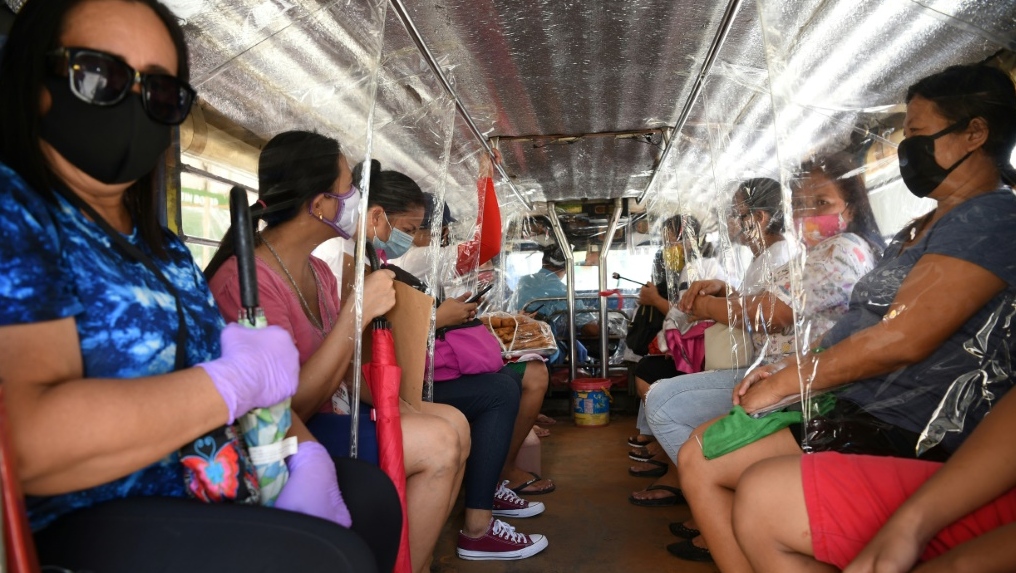
Philippines
Passengers travel on a jeepney with seat dividers to ensure social distancing in Manila. Residents of Navotas, one of the poorest areas of the capital, will go back into lockdown following a spike in new coronavirus cases. (AFP

Labels: , ,

Sunday, June 14, 2020

Where Tot-Hugging is Forbidden

"My mind is all over the map. One minute I'm like, yes, I absolutely need this, I need the time to work and focus. I'm just way too drained. And then the next minute, all these emotions start flooding in and I think, oh my gosh, we haven't even opened our bubble up to grandparents."
"There's so many questions. I think that's the biggest thing about daycares reopening so suddenly. It was a shock to hear daycares are opening Friday. Not a week, not two weeks, not July 1. There's no time to mentally prepare for that and you just have to make a decision."
"It's really hard to prepare yourself in terms of what the future is going to hold when it comes to kids going back into that environment, especially when you've been in such a closed bubble for so long."
Erica Williscroft, bank human resource officer, Ottawa
The Palotes preschool in Valladolid, Spain, on June 10, 2020. CESAR MANSO/AFP via Getty Images

"Parents are also worried about a shortage of available childcare spaces as many childcare programs are on the verge of financial devastation."
"Without any new provincial funding to the child care sector, either child care centres won't be able to reopen or parents will be expected to pay higher fees. That's not fair."
Ontario Coalition for Better Child Care

"After they declared the last emergency last week, we figured it would be weeks, not days. I think they were absolutely blindsided."
"There's less critical mass of parents to be paying the worker salaries. And the staff were mostly laid off and one of the reasons that they're not working in childcare, is because they're making more money on CERB [the temporary government financial support to people laid off from work due to COVID closure fallout]."
Martha Friendly, executive director, Childcare Resource and Research Unit

"There's a lot of families that are very nervous. Some families did take their children out for a period of time because they were nervous and then they started seeing a lot of families returning. They saw the fact that their children were really missing their friends and their teachers."
"What's the greater evil, keeping your child isolated, not interacting with their friends, and all of the positive things that go with that?"
"I don't know. I mean, it's a tough one."
Linda Starr, vice-president, sales and marketing, Kids & Company
A student has her hands sanitized in the schoolyard in Saint-Jean-sur-Richelieu, Que., on May 11. Christinne Muschi / Reuters

Well, after all, it's business. Operating day cares, some government sponsored at various levels, others for-profit represents an industry. As for parents, accustomed to freeing up their time from what full-time parenting would demand of them by discharging their traditional duties outward to ill-paid day-care workers who dedicate their services to providing emotional support and caring guidance to other peoples' children, while their parents get on with life pursuing their careers, they have been absolutely flummoxed by the new reality foisted upon them.

Two life-complicating changes have occurred in lock-step swiftness; most in the professions now work from home as a universal safety measure against the transmission of the highly infectious zoonotic that has locked the world community down in cowering fear of infection, severe illness and possibly death. The second, just as their employers have emptied their brick-and-mortar offices permitting employees who they consider essential to work from home, schools and daycare facilities have also been shuttered.

Effectively trapped at home, with their children. The familiarity of their days completely upended. No scurrying to drive the children to school or daycare, then off to the office to work alongside colleagues. Going out for lunch, socializing, attending meetings, and taking the reverse trip back home, picking up the children, preparing meals, putting the children to bed, tending to last-minute email, falling into bed exhausted but fulfilled.

All that traded in for sequestration, following government instructions based on best-case advice from health authorities. No more morning and evening commutes, no more hurrying children to have their breakfast and prepare to leave. Alarmingly, the responsibility of home-schooling abruptly arrived without a by-your-leave, and the house feels confining with children's loud voices, arguments, pleas and presence. There is no escape. And little opportunity to focus on work.

There is now housework to be done, since such paid services to continue are ill-advised for no one wants to voluntarily bring health risks into their home. How to survive when parents have chosen from day one to narrow down their responsibilities and give their all to the future of their careers and enhanced salaries to be enabled to live in the manner to which they have accustomed themselves. Having children no longer equates with raising them, emotionally nourishing them, entertaining them, instilling values.

In two-parent families shift work has been installed with one parent working the morning hours while the other looks after the children's needs, and then they reverse for an exhausting ritual of attempting to placate and enthuse and connect with one's own children -- a routine that simply hasn't been a vital part of past roles as part-time parents. These are the 'professional' employed, the middle and upper-middle class of society, not to be confused with those dependent on menial service employment.

Those who have mostly lost their employment when the companies or shops or restaurants or bars for which they worked have closed shop or entirely gone out of business, more casualties of the horrible SARS-CoV-2 dilemma. The people who have no recourse to aid other than food banks, who fear next month's rent, living in cramped apartments, with no green backyards for diversion and fresh air, even while area public parks are forbidden entry.

And then, suddenly, a solution to the dilemma. Daycares reopening by government decree. Leaving daycare operators to struggle with government-issued guidelines for safety that emphasizes social distancing for everyone and personal protective equipment for the workers, masks for children old enough not to tear them off, and fewer entries on the rostrum of children accepted to enable care workers to leap forward to separate three-year-olds who impulsively hug one another.

According to a survey undertaken by the Childcare Resource and Research Unit, 88 percent of childcare homes were concerned over reopening about health and safety issues and how they would manage to make ends meet in the light of lower enrollment, even while they require a larger staff to meet the new rules they must cope with. Both parents and daycare workers think of how safe the measures will make everyone.

Should outbreaks occur, how will they be handled? What will the children's reactions be like when confronted not by friendly, familiar faces and emotional hugs, but fully geared, masked and gloved care workers with a clear hands-off direction; hands busy for that matter continually cleansing hard surfaces with disinfectant. So busy in fact cleaning that children's most immediate needs and fears may be overlooked?

A child enjoying weather at Domino Park, Brooklyn (John Nacion/STAR MAX/IPx)

A maximum of ten people to a room, roughly representing a 30 percent reduction in ratios that childcare centres base their business plans on. Fewer children in a room means fewer revenues, means higher operating costs, means transferring some of those higher costs to parental fees hiked to make up at least some of the difference. And the rest will in all likelihood come from public subscription when municipalities and provincial governments decide to pitch in.

For-profit providers in daycare like Kids & Company operating centres across North America decided to keep their services in operation in British Columbia, maintaining operations to service essential workers elsewhere. No COVID incidents have cropped up so far with any of its centres. There will no longer be "family meals" with everyone eating in close proximity, naps will see cots spaced further apart, and disciplined cleaning will take place continually.

Hand washing will become a constant ritual. Any whisper of illness will automatically result in absence from the centres by both children and care-givers. Toys usually casually handled by everyone will be in short supply, leading to the need to distract children by offering a range of innovative and fun games in their stead. And it will be headache-inducing to monitor the under-fours to intervene when any feel a sudden urge to hug a friend.

The Palotes preschool in Valladolid, Spain, on June 10, 2020. CESAR MANSO/AFP via Getty Images

Labels: , , , ,

Tuesday, May 19, 2020

Governing On-The-Cuff By Remote Decree

"The Liberal government has presented social distancing measures as a stark choice -- either selflessly shut down the economy to save lives or selfishly worry about the economy and condemn thousands to a vicious illness."
"[That approach] is being pursued at an almost incalculably large cost to the well-being of Canadians."
"The rationale for the lockdown seems to have morphed subtly from managing the outbreak by 'flattening the curve' to preventing the illness from infecting Canadians at all, pushing the timeline for a return to some economic activity into the summer and a return to 'normal' a year or more into the distance."
Macdonald-Laurier Institute letter: 24 scientific and industry representative signatories

"What's happening now is they're convincing people to continue being afraid, when what we need is a message of reassurance and confidence from government."
"They're contributing to an atmosphere of fear and uncertainty that is completely unhelpful as we try to move toward a more measured response to the virus."
"It's becoming clearer and clearer that the fear we experienced at the beginning, when we knew so little about the virus, is exaggerated."
Brian Lee Crowley, managing director, Macdonald-Laurier Institute

"More people are taking the view that the risk-benefit calculation here, where you avert the risk of transmission in return for suppressing the economy, that it's not a worthwhile sacrifice."
"We spooked people so well into staying home, to avoid social contact, that it is extremely difficult now to reverse that message."
"[There is a] growing chorus [of medical professionals beginning to question strict lockdowns that have carried on for months]."
Dr.Neil Rau, infectious diseases specialist, medical microbiologist, Oakville, Ontario

According to critics who take umbrage at Prime Minister Justin Trudeau's penchant for slamming critics of his policies as illiberal, racist and selfish, when they question his decision-making and claim that with the shutdown of the economy due to the novel coronavirus threat, having gone on to 'shifting the goalposts' for opening the country back to normalcy, his wildly disparaging comments and unwillingness to listen to advice from the source of the criticism has motivated a coalition of health experts and business executives to sign a joint letter of discontent.

Debate surrounding the severity and length of economic shutdowns cross-country which has resulted in the majority of Canadian business being shuttered, millions of people being put out of work, and the corporate and government balance sheets having been effectively eviscerated. No one disputes the initial necessity to effect a lockdown as a measure to respond to the COVID outbreak, but at the present juncture people question why a more limited shutdown hadn't been considered, in its effectiveness to keep from overwhelming the health care system.

Economic restrictions enforced under provincial emergency orders were the responsibility of provincial governments, yet the provinces and the federal government have been at loggerheads, with Ottawa failing in its responsibility to guide the country as a whole toward returning the economy to full capacity. While fully realizing the real risks to the public from the pandemic, it is vital, the letter-signers indicate, to rescue the country from its current predicament.

To that end, economic concerns should not be dismissed by the federal government as callous in the face of evidence suggesting the economic shock has deprived millions of people of a sense of stability as they have undergone a sense of shock, the question of whether a more limited shutdown might have been equally effective to ensure the health-care system was not overwhelmed. A heavy psychological toll has been taken on people's mental and physical health, alongside forms of violence such as a rise in domestic abuse.

Close to eight million Canadians have applied for federal financial support, having lost employment. Stock markets and public pension funds have suffered a beating in recent months, with vast sums of wealth and savings lost. Hospitals across the country remain below capacity, the expected surge of COVID patients suffering respiratory distress failed to arise, thanks in large part to the population's having adhered to the social isolation policy to 'flatten the curve'.

Sweden, which had taken a relaxed view on social restrictions, allowing bars and restaurants to remain open for business, along with schools for younger children, has become a focal point in the debate regarding the degree of lockdown required for a successful outcome. Where at present, though COVID-related deaths are higher than that of its neighbours, health experts in Sweden anticipate mortality rates will even out.

Governing by casual remote.
Prime Minister Justin Trudeau holds his daily COVID-19 briefing at Rideau Cottage in Ottawa on May 15, 2020. Sean Kilpatrick/The Canadian Press

Labels: , , , , ,

Sunday, May 10, 2020

COVID-19 Measures : Lockdown or Common Sense?

"It seems like the lockdowns don't add a whole lot after you've done other social distancing measures."
"[On the other hand], the research on isolation and centralized quarantine is extensive and compelling. We know this works."
"As long as your life doesn't require you to be gathered in large groups, life here is pretty normal [where he lives and works, in Hong Kong]."
"Ideas go viral. When something works people imitate it and it appeared that the lockdown in Wuhan worked. If you follow the official guidance you never lose the lawsuit."
"Information is the most powerful tool we have. Getting good information out there is important."

Lyman Stone, researcher, American Enterprise Institute, Hong Kong

"By quickly implementing public health measures, Hong Kong has demonstrated that COVID-19 transmission can be effectively contained without resorting to the highly disruptive complete lockdown adopted by China, the United States, and Western European countries."
Benjamin Cowling, professor, School of Public Health, University of Hong Kong

"Simulations show that the overall burden is expected to be similar across countries, resulting in about 528 to 544 deaths per million."
"Unlike its peers, Sweden is likely to take the hit sooner and over a shorter period, with the majority of deaths occurring within weeks, rather than months."
Paul W.Franks, professor of genetic epidemiology, Lund University, Sweden
A study published on April 17 in The Lancet medical journal surveyed people on how they were adapting to the COVID-19 outbreak and found that 85 per cent were avoiding public places voluntarily and almost 99 per cent were wearing face masks outside.

The world looks toward Sweden for its approach to handling the country's response to the presence of a high contagious, vicious virus represented by COVID-19, ravaging populations in Europe, with Italy and Spain particularly hard hit with the number of cases and subsequent deaths among their populations, despite going into lockdown. Sweden, unlike its close neighbours, Denmark and Norway, decided to opt for a more open approach, closing most schools but otherwise ensuring that life would go on as normal, depending on the good sense and choices of Swedes to observe social distancing.

Sweden's high-risk experiment was a gamble the government decided on to see whether it could succeed in avoiding having its intensive care units overwhelmed. That outcome would serve as vindication of the government's decision-making. If matters turned out otherwise, "health care professionals in Sweden will face the fight of their lives", since it was at their scientific promptings the government was led to make the choice for a continued open society..

Sweden permitted bars and restaurants to remain open as well as schools for younger children. In Hong Kong, all schools were closed and everyone diligently wore face masks, taking personal responsibility for their health outcomes with the virus, but not shutting the city down as China did, and most Western societies as well. Lyman Stone, the American Enterprise researcher who lives in Hong Kong, is convinced that the world's response to the novel coronavirus by shutting down everything is unwarranted, that people should be trusted to observe physical distancing on their own.

"As long as  your life doesn't require you to be gathered in large groups, life here is pretty normal", he explained. Workers have been encouraged to work from home, and schools have closed, but restaurants remain open and shopping malls are full of shoppers. Hong Kong, with its population of 7.5 million, in close proximity to China has seen four people die from COVID-19. By the end of April there were almost 3,000 deaths in firmly locked-down, business-and-school-closed-down Canada.
A protester is interviewed as he demands the removal of the provincial coronavirus disease (COVID-19) restrictions outside the Ontario legislature in Toronto, Ontario, Canada April 25, 2020. Chris Helgren / Reuters

People in Hong Kong remember the 2003 SARS outbreak that hit really hard in Hong Kong. Masks are worn when colds or the flu appear imminent, and physical distancing becomes second nature every time a new outbreak is reported. The medical journal The Lancet published a study which surveyed how people were adapting to the COVID-19 outbreak, with the result that 85 percent avoided public places voluntarily, with close to 99 percent wearing face masks when out in public.

Before school closures and physical distancing in Hong Kong every person with the flu infected 1.28 people while after the automatic return to social distancing the infection number was reduced to 0.73. A similar effect is likely for COVID-19, according to researchers. The Hong Kong government believes the infection rate for COVID is somewhere below 0.5.

What defines a lockdown is people ordered to remain in their homes other than for essential trips. Disallowing people to mingle with others socially, with the exception of their own household and many businesses in a lockdown are ordered to close, with most social activities of any kind banned temporarily. The adoption of stay-at-home measures in most Western countries was based on world Health Organization guidelines, which in turn based its advice on China's reaction to the coronavirus.

Lyman Stone analyzed the imposition of protective measures in Spain, France and Italy, finding that deaths attributable to COVID-19 in Spain plateaued some ten to fifteen days following lockdown. Deaths were declining in Spain before the lockdowns even started, he found, since it takes about 20 days for death from the disease to occur, from the day of infection. People had adjusted their behaviour based on information about the virus even before government forced them to.

Trusted sources giving information appeared to have a large impact on people's behaviour in the United States, when for example celebrity figures confirmed they tested positive for COVID. Such revelations in tandem with a state of public alarm impacted on people's consciousness. One of the best methods to fight an epidemic, according to Mr. Stone, is the closure of schools and keeping children distant from one another, just as school closures are vital for influenza epidemics since children become the biggest spreaders.

Travel restrictions between states represent yet another important tactic in non-lockdown situations, a move readily taken in Asian countries in close proximity to the early coronavirus outbreak in China where Vietnam immediately imposed travel restrictions, giving them time to invest in other measures, the result being that no deaths were experienced in the country. A ban on large gatherings is another important measure, affecting 50 to 100 people. And still leaving restaurants open, where people maintain social distancing.

Centralized quarantine and generalized mask use have been commonplace in many Asian countries since the outbreak, whereas in Western countries a gradual approach was common. A sophisticated system to track, isolate and feed people in a centralized quarantine area in Taiwan, South Korea and Hong Kong could also have contributed hugely to their successful battle against the pandemic. People who tested positive or were in contact with positive-testers would ideally be isolated in a hotel or a custom-arranged space between seven to 21 days in quarantine. This requires widespread testing.

On the other hand, with Sweden's non-lockdown 'experiment' in trusting its population to self-monitor where the borders remain open, people can still gather in groups of up to 50 people and no one wears masks. One Swedish doctor has accused the government of playing "Russian roulette" with its population, with other experts  urging on stricter measures, in response to Sweden's death figures outdistancing those of its Scandinavian neighbours.

Sweden had about 256 deaths per million people in comparison to 38 per million in Norway and 75 per million in Denmark by the end of April. Sweden feels the number of deaths will even out eventually, accomplished with less strain on their economy and on people's mental health. Swedish professor Johan Giesecke's position is that few of the measures used to control COVID-19 in western countries "have a shred of evidence" in support of their choices, in high approval of his own government;'s decision to avoid full lockdown.

"How long in a democracy do you think you can keep a lockdown? After three or four weeks, people will say I want to go out. I want to go to the pub."

A person rides a bike with their dog past closed stores on April 29, 2020 in New York City. New York City has been on a lockdown of all non-essential businesses since March 23, 2020. Getty Images

Labels: , , , , , , , , ,

Wednesday, April 29, 2020

COVID-19? Re-Opening Quebec

"Our challenge is to gradually restart the economy without restarting the pandemic."
"The idea is to gradually add workers and analyze the effect on the contagion."
"But one thing is clear: If we want our plan to work, we need to continue our efforts of physical distancing, and we need to continue to protect the most vulnerable."
Quebec Premier Francois Legault

"Will I be sending my kids to school [in Montreal] on May 19? No. [There are costs to reopening that include risks to children and parents, teachers and staff with pre-existing conditions, and evidence of emerging complications for kids who get COVID-19]."
"[The province has not proven itself capable of doing widespread testing for the general population and has a dismal record of contract tracing, which means] we are basically flying blind."
"And reopening in Montreal of all places? Montreal has the highest number of cases in the country."
Claire Trottier, education specialist, professor, McGill University, Department of Microbiology and Immunity

“The best option here is to send the smallest kids back to school."
"We have lots of evidence that there are bad things that happen because the kids are stuck at home, like their parents can’t work, and kids who require special services are not getting those special services."
"We have a quarter million kids in Quebec who rely on school breakfasts and are not getting those."
Epidemiologist Jay Kaufman, department of epidemiology, biostatistics and occupational health, faculty of medicine, McGill University
A mobile hospital in partnership with the Canadian Red Cross is set up in the Jacques-Lemaire Arena to help care for patients with the coronavirus disease (COVID-19) from long-term centres (CHSLDs), in Montreal, Quebec, Canada April 26, 2020. Christinne Muschi / Reuter

Most Canadian provinces have fared well in their efforts to control the spread of COVID-19. British Columbia, where the epidemic first raised its ugly head, has seen declining rates of infection. Alberta appears to have SARS-CoV-2 under control but for a number of outbreaks in oil camps and poultry processing plants. Saskatchewan and Manitoba both of which have had very few numbers of COVID are preparing to reopen their economies. On Canada's Eastern shore, the COVID outbreaks have been well managed and relatively few in number.

The country's two most populous provinces -- Quebec and Ontario -- have borne the brunt of the COVID invasion, with Quebec accounting for far more cases and deaths than any other province, including Ontario. Yet it is Quebec that is preparing to reopen its schools on May 11, while Ontario takes a more cautious approach and has designated the end of May for its openings.

Canada's total number of confirmed cases of the novel coronavirus to date stands at 50,000 with 3,000 deaths. Quebec's numbers are daunting, with 26,594 confirmed cases and 1,761 deaths. The death figures for Canada overall and Quebec in particular are derived in large part from the elderly and health-compromised who live and are cared for in long-term care facilities and old-age homes.

Quebec's decision to move swiftly to reopen its economy have caught other provincial governments by surprise, although at some point in May most other governments have targeted their own re-openings; reasonable enough given their lower statistics of epidemic numbers. And all are cautioning that if matters turn awry with early opening, they will swiftly revert back to the status quo.

Premier François Legault has said the province will open elementary schools and daycares outside of Montreal as of May 11 and in Montreal, Laval and Longueuil on May 19 only if it felt it is in control of the coronavirus outbreak.
New Brunswick has had no new cases to report for the past ten days, yet it has decided to plan for a more gradual re-opening than Quebec whose latest report was 775 new cases and 83 new deaths on Tuesday alone. However, Premier Legault has announced that most retail stores will be clear to reopen on May 4. Only Montreal itself which has been hardest hit in the province, will wait another week for its re-openings on May 11.

Quebec accounts for half of the entire country's COVID-19 cases, and close to 60 percent of COVID-19 deaths, with 23 percent of the country's population base. Despite which officials have the impression that the peak of the initial wave of infections has arrived and they're now on the downward curve. Since lockdown measures were implemented, about 1.2 million Quebecers have been unemployed.

At Bombardier Inc., one of the province's largest manufacturers, manufacturing is to be gradually resumed from May 11, with its 22,000 employees expected to return to work in the next few weeks. The company is prepared to implement such precautions as daily employee temperature checks, tool disinfecting stations, installation of Plexiglas shields. "Are people concerned? It would be a lie if I said no. But the majority are happy to go back to work", said Serge Dupont, assistant to the Quebec director of Unifor.
Quebec has already allowed residential construction to resume. It plans to let the whole construction industry resume activities by the end of May. (Ivanoh Demers/Radio-Canada)

According to Jack Jedwab, president of the Association for Canadian Studies based in Montreal, part of the reason for Quebec decision-making might be accounted for given francophones appear less fearful of the virus. His organization worked with the polling firm Leger Marketing, tracking weekly public sentiment during the pandemic. The most recent round of polling found 47 percent of francophone responders fearful of acquiring the virus in comparison to 59 percent of anglophone respondents.

"I think there is also a cultural dimension to it, but you know, it's hard to measure that dimension", commented Jedwab. "Life goes on", said Premier Legault when he announced schools and nurseries would reopen. And with that re-opening, the rest of the country will be viewing what happens in Quebec over the next few weeks, and how it might pertain to their own more gradual plans for re-opening their economies.
Quebec plans to begin allowing some retail stores to open on May 4. (Ivanoh Demers/Radio-Canada )

Labels: , , , , , , ,

Saturday, April 11, 2020

Heading Back to Business as Usual

"I'm going to have to make a decision, and I only hope to God that it's the right decision. But I would say, without question, it's the biggest decision I've ever had to make."
"I call it the opening-our-country task force, or opening our country council. [The group will include] very, very great doctors and business people." 
"In the midst of grief and pain, we are seeing clear signs that our aggressive strategy is saving countless lives."
"I think we will be substantially under that number [of projects that the infectious outbreak could cause between 100,000 and 240,000 deaths]."
"There's something good going to happen. I really believe that. There's something very good going to happen. We have to get back." 
U.S. President Donald Trump

"There are places around the country that have seen consistently low levels."
"And as we ramp up testing and can feel more confident that these places actually can do surveillance and can do public health follow-up, some places will be able to think about opening on May 1." 
U.S. Surgeon General Jerome Adams 
Donald Trump and Jerome Adams
President Donald Trump and Surgeon General Jerome Adams at Friday's coronavirus briefing. | Evan Vucci/AP Photo
"[More than 600 CDC [Centers for Disease Control] employees are stationed around the country assisting with coronavirus response efforts, but the agency is] going to have to substantially amplify [that workforce to ramp up contact tracing]."
"Obviously, if we're going to try to get this nation back to work shortly after the end of this month, we're far along in those planning processes, as we speak."
Dr. Robert Redfield, director, Centers for Disease Control and Prevention

"[New York recorded 777 deaths Thursday, but the statewide headcount at intensive care units was down 17.] That means there are fewer people in the intensive care units statewide than there were." "And again, that's the first time we've seen a negative number, so that's good. The three-day average of that is down."
"A change in intubations is a tick higher than it's been the last few days, but it's overall down. The three-day average is also down."
New York Governor. Andrew Cuomo

"[While] we are starting to see the leveling off and the coming down [of coronvirus-related metrics], Americans must keep up their social-distancing practices."
"This is not the time to feel that since we have made such [an] important advance in the sense of success of the mitigation that we need to be pulling back at all."
"Now is no time to back off. The virus will decide [when the country can re-open]."
Dr.Anthony Fauci, infectious disease expert, White House advisor


Like a racehorse champing at the bit, the man who is president of the United States of America, a man whose experience is that of a high-powered business executive focused on getting ahead, on competition, on fixing the best deal and forging full steam ahead, envisions a swift end to America's novel coronavirus lockdown and a smooth return to business as usual, lifting his country back up by the bootstraps of financial duress.

Yet he also makes due reference to his version of consultation, that his bold strike against the economically ruinous constraints on business occasioned by the need to shut down the communication corridors of the sinister coronavirus striking at will, can only proceed when the health professionals advising him give clearance to the resumption of the open economy. He will be guided, he assured the public, by facts and recommendations from health experts and it is they who will ultimately determine when steps are to be taken to reopen the economy.

Clearly, he has paid little mind to his own top infectious disease expert, Dr.Fauci, who hasn't hesitated in the past, nor the present, to gently 'correct' his president. The U.S. is facing a forecasted loss of jobs of up to 20 million by the end of April. That, to be balanced against the potential of a 200,000 death count with the precipitous lifting of the shelter-in-place orders. Figures provided by the departments of Homeland Security and Health and Human Services. On the other hand, should social distancing continue, the projected death count would be reduced by 60,000.

As matters now stand, the U.S. has recorded the world's highest confirmed COVID cases, at over 485,000, resulting in over 18,100 deaths from the virus. Italy alone has a greater number of fatalities. The epicentre in the U.S. of COVID-19, New York, tallied 777 several days earlier, down from799 deaths daily, Governor Cuomo reported yesterday. Intensive care unit admissions had declined "for the first time since we started this journey".

Drone images show bodies being buried on New York's Hart Island on Thursday.
Contract labourers have been burying two dozen bodies of COVID victims daily -- their caskets lowered into freshly dug trenches on Hart Island, at the western end of Long Island Sound. Ordinarily weekly, roughly 25 bodies are buried on the island, a number that tripled in recent weeks. The caskets are lifted out of refrigerated trucks by Rikers Island jail inmates. 

With over 90 percent of the U.S. under stay-at-home orders, Easter weekend saw religious services livestreamed or broadcast, with most churches empty instead of typically overflowing with worshipers. "Satan and a virus will not stop us", declared Rev.Tony Spell, pastor of Life Tabernacle Church near Baton Rouge, Louisiana who expects over 2,000 people to gather at his evangelical megachurch on Sunday.

And that event may just turn out to be a wholesale new epicentre, spreading a new outbreak to scupper the president's May 1st cherished opening of the economy.

Trump coronavirus


Labels: , , , , ,

() Follow @rheytah Tweet