
Politic?

This is a blog dedicated to a personal interpretation of political news of the day. I attempt to be as knowledgeable as possible before commenting and committing my thoughts to a day's communication.

Wednesday, April 08, 2020

'Typical' COVID Presentation Symptom Giveaways

"We know that when patients with psychiatric diseases get sick, it kinds of mentally de-compensates. And we realized that the reason that her [emergency room patient] schizophrenia reaactivated was because of COVID-19."
"A few hours later she spiked a fever and then we realized, 'Oh gosh, there's more to this story than just atrial fibrillation."
"Theoretically, you know that this going on. And it's something we've been talking about. But to actually see that happen right in front of me was like, 'Oh my God'."
"I was fortunate that I had taken appropriate precautions with her. I was wearing a mask, I was wearing a gown. But I was just kind of going through the motions, just doing it because everybody else was doing it."
"And then when she spiked a fever, it really became much more internalized."
Dr.Gregg Miller, emergency room physician, Seattle

"We're just seeing so many strange presentations of this that basically we're in a state where almost anybody coming in with anything is a potential COVID case."
"We're taking precautions with everybody now. We're treating every single patient as a potential COVID patient."
"What's become very frightening is that, initially we had this very clear case diagnosis. It was travel and a cough and shortness of breath and fever."
"But what we've been finding is almost anything can be a presentation of COVID-19."
"We've seen patients whose only presenting symptom is headache or their only presenting symptom is abdominal pain and we swab them and they're positive."
Dr.Brett Belchetz, emergency medicine, Toronto
Commuters cross London Bridge with some wearing masks, as the spread of the coronavirus disease (COVID-19) continues, in London, Britain, March 23, 2020. REUTERS/Toby Melville - RC2MPF91KF6B
Covert cases could represent around 60% of coronavirus infections.
Image: REUTERS/Toby Melville
In his Montreal hospital emergency department, Dr.Zachary Levine by early this week had seen about 20 presumptive cases of COVID-19. then, a 37-year-old woman had come in. She qualified for testing because she had minor chills. But she had also suffered weeks of bloating and abdominal pain; those would never have qualified her for testing, without the presence of the chills of a minor nature. But you never can tell, and when her test came back, it told that she was indeed COVID-positive.

Most others he had seen had exhibited classic symptoms, and then there was another case that failed initially to qualify for testing, a women in her 70s who had recently returned from a trip to the Caribbean, with fatigue and malaise. No fever, no cough. "Luckily I wore a mask/visor/gown and gloves out of an abundance of caution", said Dr.Levine. An X-ray revealed chest abnormality, so he sent her for COVID testing; yet another positive.

Credit...Johnny Milano for The New York Times
In Dr.Miller's experience, a psychiatric patient entered the Emergency Room, delusional, hearing voices, she had a history of schizophrenia. She was asked to wait for a psych bed to become available. She waited a full day. This was a major hospital outside Seattle, in a busy ER, not unusual for specialized treatment. Then her fever spiked, alerting medical staff that something more than mental illness had presented.

Emergency Rooms and Intensive Care Units in hospitals across Canada and the United States have been separated; patients suspected or diagnosed with COVID-19 plugged into one side; those with no symptoms on the other. Then doctors increasingly realized the difficulties they were experiencing in ruling out anyone as a possible carrier of the COVID virus.

Trying to cope with an emergency in the pandemic, with the tension-filled expectation of sudden surges, hospitals have been faced with limited protective equipment along with backlogs for testing, exacerbating an already vexing situation. Dr.Belchetz was informed by one of his colleagues of a patient who arrived with a head laceration. "Everyone assumed it was nothing to worry about". Head wound? ERs are well accustomed to dealing with them.
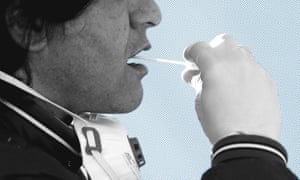
A patient does a coronavirus test swab
But in this particular instance after questioning the patient, it was revealed how the wound had occurred. The man had passed out and then had fallen, hitting his head on a hard surface, and sustaining the wound. There were no typical symptoms at presentation; no cough, no fever, but it was clear he wasn't getting enough oxygen. When the test came back, it revealed that he too, had COVID-19.

Despite all of this, Dr.Miller failed to fully realize the extent of the situation of unusual, atypical presentations, but when in the early weeks of the pandemic a woman came to his ER with an erratic heartbeat and a history of atrial fibrillation -- with her heart wildly beating at close to twice normal rate, he and his colleagues focused on that; getting her heart rate under control. Before realizing she was another COVID patient.

Recently, Dr.Miller along with a few colleagues published a paper on early lessons from the pandemic in the Seattle area. The message, he said, is not that it's useless to separate COVID from non-COVID. "You can do it, you just can't assume that because you've done that, the rest of your ER or your clinic is COVID-free". The virus is both sinister and insidiously diagnosis-tricky.

main article image

Labels: , , , , ,

Friday, April 03, 2020

Hospitals Gearing Up for COVID Rush, Emergency Admissions Decrease

"Before that trip [visit to New York] we were obviously all hearing about COVID, but everything was mostly business as usual. Now, going into the hospital, COVID is everywhere."
"I am hearing this is fairly similar across other emergency rooms in the Toronto area. We are seeing way, way, lower volumes of admissions overall."
"We're certainly hearing stories of people with abdominal pains and chest pains and all sorts of bad symptoms, like stroke symptoms, who are just not coming to the hospital because they're too afraid. It's actually somewhat of a tragedy."
Dr.Brett Belchetz, Emergency Room doctor, Scarborough, Ontario
An emergency department in Toronto prepared to screen patients who could be infected with COVID-19 earlier this month. (Craig Chivers/CBC)

"Emergency volumes have plummeted all over the country. People are so fearful of hospitals, understandably, they just aren't coming in."
"I'd be scared as a lay person to come in to the hospital with something unrelated to COVID. I'm very concerned that there are people who are having heart attacks and strokes and significant injuries at  home -- deep cuts that aren't getting sutured."
"I think this crisis is going to [cause] huge collateral damage to the medical system for non-COVID-positive patients."
"Very fortunately, we haven't seen this big surge in the super sick, which we were prepared for, and have been expecting. God willing, we'll never see it, but the next two weeks will tell."
Dr.Daniel Kalla, head, emergency department, St.Paul's Hospital, Vancouver

"There are less heart attacks coming to the emergency department now."
"And I don't know why, but I presume that some of the people who are having heart attacks are just not coming in."
"We can't help you with your heart attack if you stay home. Similarly, if you'r ehaving your severe abdominal pain, you're vomiting, you [have] shortness of breath, and you stay at home, we're not going to be able to help you."
Dr.Ari Greenwald, emergency medicine, Toronto and Hamilton
'We just know we have to be ready,' said Dr. Carolyn Snider, medical director of the emergency department at Toronto's St. Michael's Hospital. (Michael Wilson/CBC)

There is plenty of fallout and to spare, from the sudden emergency situation that hospitals and their medical staff are now facing. Although hospitals are any society's first line of defence against the onset of an epidemic, this global pandemic has proven an arduously, mysteriously difficult one to handle; too much is as yet unknown about it, and its indomitably sinister spread alongside the novel coronavirus's death rate has shaken both the confidence of the medical community and the trust of the public.

A disease of this virulent nature ensures a hospital setting will have an even greater teeming of communicable pathogens than usual. And where hospitals' vital role in diagnosing and treating calamitous maladies is acknowledged, entering one in a medically vulnerable condition, and thus exposing oneself to a potentially deadly infection on top of the medical condition that might have spurred a visit to a hospital emergency room becomes infinitely less palatable as a first choice, even at the cost of self-harm, the fear is that great.

The health community has made no secret of its trepidation and concern over a firestorm of emergency admissions with people suffering grievous consequences of having contracted COVID-19. and nor have their concerns over a shortfall of essential medical equipment such as ventilators and personal protection equipment for medical staff been kept from the public, much less the health communities' own fears respecting their personal safety, given that quite a number have now been diagnosed with the coronavirus.

Dr.Belchetz had been away to New York on a trip before COVID-19 had fully descended on the city to mark it out as the central point of infections in the U.S. He had gone into self-isolation at home following his two-week trip, and in the interim the hospital he works an emergency shift in had undergone a sea change, where reworked triage procedures had been designed, and his colleagues were in a state of deep anxiety. Yet, to his astonishment, he discovered that the emergency department itself was uncharacteristically quiet.
Quiet ERs could be a sign that social isolation is working. But doctors warn it could also foreshadow a significant problem to come. Getty Images

All over the country -- and this phenomenon could fairly be considered representative of hospitals globally, given similar conditions prevailing -- hospitals have been seeing a significant decrease in emergency admissions. Word of mouth between emergency room physicians appears to validate that startling new situation where, with the arrival of the pandemic, as in Seattle, Washington State, admissions to emergency rooms have fallen between ten and 20 percent at six large hospitals. In one there was a 40 percent drop while the pandemic savaged the region.

There could be several interpretations; the good-news optimistic one is that fewer admissions reflect people diligently practising social distancing, as required to stem the tide of infection. Fewer people out and about equates with fewer vehicle accidents, drunken fights and other social dysfunctions that often bring victims to a hospital ER. Most doctors, however, attribute the drop in admissions to stark fear of contracting the coronavirus; that in the current climate, the last thing anyone wants to do is go to a hospital.

With serious health collapses such as heart attack, stroke and appendicitis, early intervention is critical to a hoped-for outcome. Hospitals have done their best to separate COVID treatment areas from low-risk treatment areas, to lower chances of an opportunistic virus rampaging through hospital departments, infecting the already ill and vulnerable. On the other hand, quieter emergency rooms translates as a respite and the chance for medical personnel to breathe a little easier before the anticipated flood begins to overwhelm the system everyone depends upon.

A B.C. ambulance paramedic is seen outside the Lions Gate Hospital in North Vancouver on Monday. Contrary to what one might think, several emergency room doctors report relatively quiet ERs these days. (Jonathan Hayward/The Canadian Press)

Labels: , , , , ,

() Follow @rheytah Tweet