Politic?

This is a blog dedicated to a personal interpretation of political news of the day. I attempt to be as knowledgeable as possible before commenting and committing my thoughts to a day's communication.

Friday, January 09, 2026

Canada, Infiltrated by Foreign Agents

"Unlike some of its allies, Canada lacks a transparent mechanism to ensure the public is informed about attempts by foreign entities to influence Canadian political and governmental processes. As a result, foreign principals and their proxies can secretly seek to shape Canadian decisions and public opinion."
"Some activities by foreign entities are carried out secretly or in a non-transparent manner, often using proxies and tactics such as spreading misinformation."
"Non-transparent foreign influence activities that aim to affect political and governmental processes for the undisclosed benefit of a foreign power undermines Canada's sovereignty and democracy."
Federal government document on a Foreign Agent Registry
 
"If that's accurate, it means a scale of influence that's already significant."
"A registry of that size only matters if it leads to enforcement, and it raises real capacity concerns." 
"I worry about managed compliance rather than deterrence of a counter-intelligence threat."
Dennis Molinaro, intelligence analyst, author: Under Assault: Interference and Espionage in China's Secret War Against Canada 
https://i.cbc.ca/ais/d9e43f2a-5b13-4ff6-84c1-03248fee789f,1767535378911/full/max/0/default.jpg?im=Crop%2Crect%3D%281008%2C1379%2C6473%2C3641%29%3BResize%3D860
The Peace Tower is seen on Parliament Hill in Ottawa. (Sean Kilpatrick/The Canadian Press)
 
According to the federal government's own estimates close to 2,500 businesses or people are in Canada surreptitiously acting on behalf of foreign states for the purpose of directly influencing local politics and governments. They would all be required to register publicly under regulations linked to a long-awaited foreign agent registry. A tool that was expected to be fully operational a year ago, still awaiting the appointment of a Foreign Influence Transparency Commissioner who would be tasked with overseeing the registry.
 
Business and individuals would have to provide data describing the work they perform on behalf of and at the behest of a foreign government, meant to influence Canadian politics and governments. Penalties have been proposed ranging from $50 to $1 million imposed on foreign agents failing to respect registration rules. The document itself estimates that 1,550 businesses and 872 individuals will be required to declare foreign influence activities targeting Canada. 
 
Democratic allies such as the U.S., U.K., France and Australia set the standard in public registries for foreign agents; Canada has not yet recognized the absolute necessity to follow suit, the Liberal government taking its time to join them in this critical exercise. It is well known and has been proven that foreign agents abound in Canada representing the interests of China, Iran, Russia, and India. Members of Iran's IRGC are known to be resident in Canada, harassing Iranian-Canadians. Mainland Chinese agents in Canada track and threaten Chinese-Canadians hostile to the CCP. Russian agents are known to spread false and misleading new stories, among other issues.
 
May be an image of the Oval Office and text that says 'FOREIGN AGENTS FACE FINES AS LOW AS $50 UNDER RULES DRAFTED BY LIBERALS'
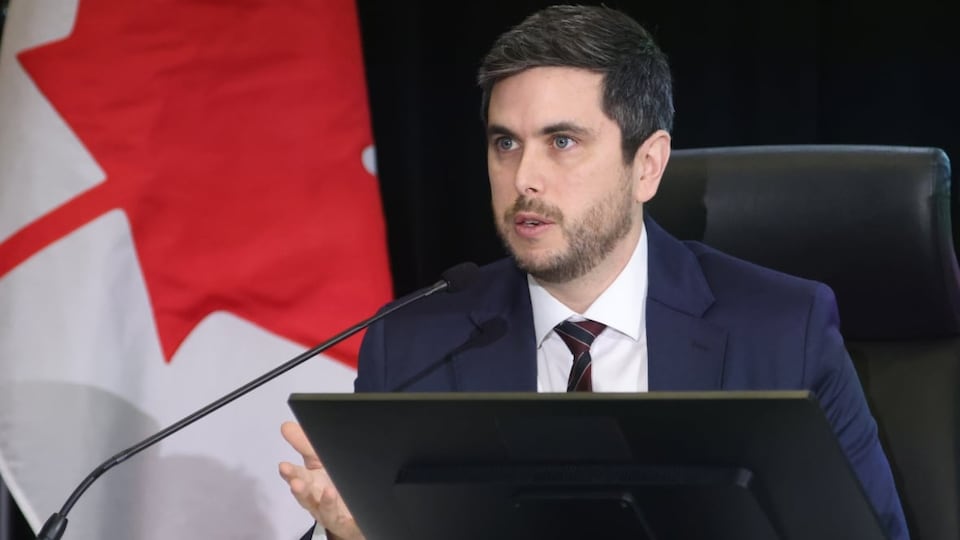
Canada's Minister of Public Safety Gary Anandasangaree  
 
Canada is also known as a conduit for money-laundering benefiting countries and groups hostile to Canada and its democratic values. In sum total, countries from everywhere on the globe, many falling under a non-hostile category, conduct foreign influence sorties in Canada. It is those countries who secretly seek influence among Canadians and the country's democratic institutions with the use of illegitimate means such as disinformation and misinformation that the registry will track. 
 
A year and a half ago Parliament passed a bill that promised the creation of a public registry of agents working for a foreign government. It is only in this new year that a 30-day consultation period will proceed to finalize a registry. And even then until a Foreign Influence Transparency Commissioner has been appointed, the registry cannot be implemented. An appointed commissioner would be responsible for hiring staff and implementing a secure IT protocol for the public registry. 
 
The truth of the matter is that Canada under the Liberal government fails to take the matter of foreign influence in the country seriously. The most challenging and threatening foreign predator in Canada is the Chinese Communist Party. Its influence within the Chinese community, manipulating the voting patterns of those loyal to Beijing is a direct interference in the sovereignty of the country. Yet the Liberal government itself is well infiltrated by Chinese influencers at every level. 
 
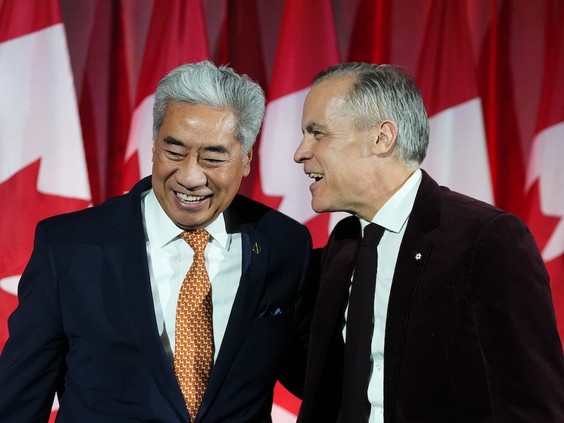
Prime Minister Mark Carney is set to travel to Beijing next week, accompanied by Liberal Member of Parliament Michael Ma, to meet with China's President Xi Jinping on outstanding trade issues. The issue of interference in Canadian affairs will certainly not be raised, nor would the harassment of Chinese-Canadians become an issue between the two premiers.
 
https://smartcdn.gprod.postmedia.digital/nationalpost/wp-content/uploads/2025/12/CP175471120-1.jpg?quality=90&strip=all&w=564&h=423&type=webp&sig=wKkPbGp-XogkED-5dYQnig
Prime Minister Mark Carney embraces Michael Ma, Member of Parliament for Markham-Unionville, who crossed the floor from the Conservatives to the Liberals hours earlier, at the Liberal caucus holiday party in Ottawa, on Thursday, Dec. 11, 2025.
 

Labels: , , , , ,

Wednesday, January 07, 2026

Venezuela's Military Alliances

"The things they said were plausible and they were consistent with more than 15 years of engagement with China, Russia and Iran. [But] not everything that they claimed by showing a satellite image was necessarily proven by that image... It's not nothing, but I don't regard it as a significant 'Ah-hah!"
"Venezuela now for literally more than two decades has been one of the biggest strategic challenges to the U.S. To me the drugs the U.S. is currently going after are only the tip of the iceberg of a broader, longtime, multi-dimensional threat."
Dr. Even Ellis, research professor, U.S. Army War College 
 
"There were several times when I was confounded by what he [Lee Wheelbarger, former U.S. army technology developer] presented to me, and then it  blew my mind when I validated it was accurate: 'Holy crap, OK, cool'."
"One thing I've learned is he's not going to put his word on the line unless he feels he can back it up. He will substantiate everything he has."
Michael Torres, retired U.S. air force colonel
Satellite photos show impact of Trump's strikes on Venezuelan  neighbourhoods | The Independent
Satellite show images of Trump's strike on Venezuelan neighbourhoods, The Independent 
 
According to Dr. Ellis of the Army War College, military ties that Venezuela has with Russia, China and Iran are of long standing. Venezuela purchased $12 billion in defence materiel from Russia starting in 2006 that was inclusive of a fleet of Sukhoi-30 fighter jets, helicopters, numerous S-300 anti-aircraft missiles and armed vehicles. A Russian fleet of war-vessels visited both Cuba and Venezuela last year. At least 27 of its K-8 fighters have been supplied to Venezuela by China, along with radars and associated equipment, while the Republic of Iran sourced Venezuela with a number of fast-attack boats, trained Venezuelan special forces members and collaborated on the production of drones. 
 
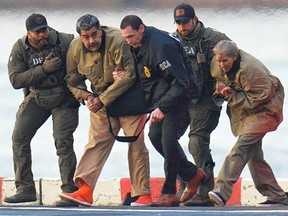
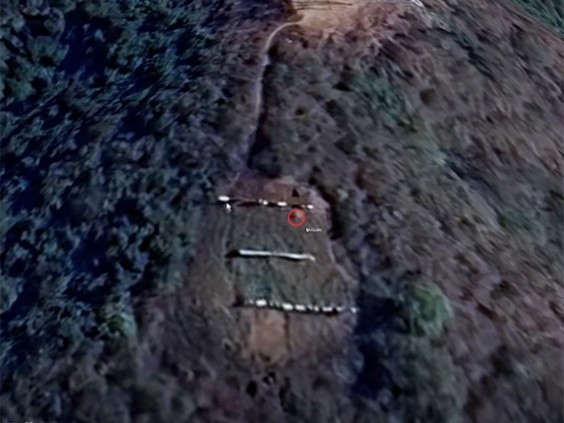
Intelligence experts are mulling over a report arguing that satellite images reveal a launch site in Venezuela that has the potential to aim ballistic missiles at Washington, D.C., produced by a group of amateur intelligence analysts. The report was released just prior to the dead-of-night surprise American military raid that captured Venezuela's president Nicolas Maduro and his wife Cilia Flores, taking them back to the United States to stand trial in New York for drugs and weapons charges deemed to be criminal offences in the United States, but not necessarily in Venezuela.
 
Five people walking along the a dock
 
According to the group's report, it was in fact, not drugs but military developments in Venezuela alongside Russian, Chinese and Iranian troops stationed nearby that persuaded the Trump administration to make their strike, despite that the U.S. military dismissed that contention as "speculative". "I don't think it [scooping up the Venezuelan president and his wife] has a damn thing to do with the drug boats. I think the drug boats are completely irrelevant. That's an excuse", stated Lee Wheelbarger, who led the group investigation whose findings, including a video compilation of satellite picture were presented to a defence-oriented think tank meeting, the Mackenzie Institute, in Toronto.
 
A spokesman for the U.S. Southern Command covering South America contended that the organization makes no comments on "speculative reporting or unverified premises. Our mission remains focused on supporting regional stability, combating illicit activities, and working with our partners to address shared security challenges". Yet according to a Russian lawmaker, Russia considered supplying its new Oreshnik ballistic missiles to Venezuela, requested by Nicolas Maduro along with other equipment from Russia, China and Iran.
 
It has been confirmed that Venezuela has close military ties with the three countries, as well as with Hezbollah out of Lebanon, the Iranian proxy militia. The images collected by Wheelbarger's group and the analyses produced led to conclusions explaining the sudden midnight action by the U.S. against Venezuela. Action culminated from the threatening appearance of American warships, including an aircraft carrier patrolling the region, even as the U.S. destroyed dozens of boats claiming they were carrying drugs to end up in the United States. Deadly incidents decried as extrajudicial executions by those purportedly involved in drug trafficking who would normally face arrest and trial.
 
Wheelbarger, for several years a senior technologist with the U.S. army -- was a contractor developing night-vision equipment, communications gear and an advanced technological protocol enabling battlefield medics to transmit images to military hospitals, and then receive instructions on a video display -- was lauded  with claims that "Wheelbarger's electronic creations have extended the eyes and ears of America's intelligence network", by the History Channel's Modern Marvels program, in 1999. 
 
According to the man himself, he engages in the collection of publicly available images from 28 satellites operated by Maxar Technologies, Planet Labs, Airbus Defence and Space, BlackSky, Capella Space,     ICEYE, SkyFi, European Space Imaging, Apollo Mapping, Satellite Imaging Corp., and L3 Harris Geospatial; also accessing images from ground cameras, along with another video method that remained unexplained, to glean information from global human sources. He possesses three-dimensional  renderings of military hardware that can be placed over satellite images to match shape and size aiding in identifying specific equipment. 
 
https://smartcdn.gprod.postmedia.digital/nationalpost/wp-content/uploads/2026/01/Venezuela-satellite-1.jpg?quality=90&strip=all&w=564&h=423&type=webp&sig=SzD5GWC_Qv_Um3aQQsO-Og
 
In his Toronto presentation video he identifies images close to Caracas including a Russian base complete with 94 T-72 and T-74 tanks. Impressively, he points to a mountain hollowed out in the creation of a subterranean military complex with openings cut into the hill surrounded by rebar suggesting creation of a massive concrete facade with "millions of cubic yards" of excavated dirt piled nearby. The mountainside features an area with three parallel, straight lines of holes which Wheelbarger and  his colleagues identify as tubes to fire intermediate-range ballistic missiles from, basing their theory on matching underground launch sites located in Iran.
 
Jeff Nyquist, writer and geopolitics blogger who collaborates with Wheelbarger, notes that intermediate-range missiles could reach north to the U.S. capital. The Cuban airfield images cigar-shaped objects at a runway's end, identified by the analysts as Kitchen missiles. Russian weapons travelling at almost five times the speed of sound that can destroy naval ships, usually fired from aircraft, generally the Tu-22 bomber, not seen in the images, but readily disassembled and smuggled into Cuba on larger cargo planes, according to Wheelbarger. 
 
Satellite images raise question about Venezuela's military ...
A stun­ning U.S. raid to cap­ture Venezuela’s pres­id­ent came after a group of ama­teur intel­li­gence ana­lysts argued that satel­lite images reveal a Venezuelan launch site that could send bal­listic mis­siles as far north as Wash­ing­ton, D.C.  National Post
 

Labels: , , , , , , ,

Sunday, December 07, 2025

U.S. National Security Strategy (NSS)

"[European allies risk] civilizational erasure [as a result of their migration and free speech policies]."
"[Economic stagnation in Europe] is eclipsed by the real and more stark prospect of civilizational erasure."
"[Ending the war in Ukraine is a core U.S. interest to] reestablish strategic stability with Russia." 
"[Europe is enfeebled by its immigration policies, declining birthrates], censorship of free speech and suppression of political opposition [along with a] loss of national identities and self-confidence."
"Should present trends continue, the continent will be unrecognizable in 20 years or less. As such, it is far from obvious whether certain European countries will have economies and militaries strong enough to remain reliable allies. Many of these nations are currently doubling down on their present path. We want Europe to remain European, to regain its civilizational self-confidence." 
"[As for the Middle East], America's misguided experiment with hectoring [countries in the Middle East, especially monarchies in the Gulf, about their traditions and forms of government]."
"[The Arab nations are] emerging as a place of partnership, friendship, and investment. We should encourage and applaud reform when and where it emerges organically, without trying to impose it."
"[The U..S. strategy] is motivated above all by what works for America -- or, in two words, 'America First'."
U.S. National Security Strategy 
A person speaks into a microphone.
U.S. President Donald Trump speaks at an event in Washington, D.C., on Saturday. Trump's new national security strategy was welcomed by Moscow, according to a Kremlin spokesperson on Sunday. (Julia Demaree Nikhinson/The Associated Press)
 
"The adjustments that we see correspond in many ways to our vision."
"[The current U.S. administration is] fundamentally different from the previous ones." 
"President Trump is currently strong in terms of domestic political positions. And this gives him the opportunity to adjust the concept to suit his vision."  
Dmitry Peskov, Kremlin Spokesman  
A person seated leans back to speak with someone standing who bends over to listen.
Kremlin spokesperson Dmitry Peskov, left, speaks with Russian President Vladimir Putin in Moscow.(Sergei Ilnitsky/The Associated Press)
 
"This NSS is a real, painful, shocking wake-up call for Europe. It is a moment of cavernous divergence between Europe’s view of itself and Trump’s vision for Europe."
"If Europe had any doubt that the Trump administration is fully committed to a tough love strategy, it now knows for sure. The administration is asking—demanding, really—that Europe polices its own part of the world and, most importantly, pays for it itself."
"The most worrying parts of the strategy are the ones that chastise Europe for losing its European character. The sentiment behind the words seems to stoke fear of migrants and an adherence to an idealized, old-world Europe that is questionable at best. Modern Europe is vibrant, evolving, and—largely—pretty happy."
"The majority of Europe’s reaction to this NSS is likely to be the same aghast shock as met Vice President JD Vance’s Munich speech."
Center for Strategic & International Studies (CSIS) 
Released on Friday, the Trump administration's new national security strategy will give no comfort whatever to its heretofore allies in Europe, while Russia has already expressed its cautious pleasure, and China will be satisfied to an extent; Latin America has more to puzzle over, and the Middle East will feel somewhat gratified and no little relieved, for the most part. America's erstwhile partners in Europe stand to wallow in discomfort and uncertainty, not quite recognizing its place in this new America First reality imposed upon the world.
 
A disconcerting pivot from the role of controlling, stabilization empire of the globe to a new hands-off policy which allows other nations the pleasure of going it alone when it comes to stability and self-defense. With the second election/administration of Donald J. Trump to the presidency of the United States of America a new world order came into effect. On the other hand, Mr. Trump remains dedicated to 'peace' and peace-making, still counting on the Nobel Committee to come to its senses in 2026 -- which hasn't given it pause in striking 'terrorist' boats in the Caribbean Sea trafficking drugs to the U.S.
 
This is a document required by law that the administration must release; and it presents a break from former president Joe Biden's Democratic administration's course of intent which implemented a campaign to reverse Mr. Trump's first administration's trajectories. In brokering an end to the four-year-stagnant conflict in Ukraine, the first shock was the virtual abandonment of Ukraine's sovereign rights and a surprise embrace of Moscow's territorial imperative. An end to the war is not designed to liberate Ukraine but rather to consolidate a rapprochement with Russia.
 
As for America's European allies, their intransigence in supporting Ukraine and expecting the United States to continue the previous administration's commitment to that end, has left those expectations adrift and discombobulated. Trump's position in a drive to "reestablish strategic stability with Russia", when Europe's concerns are the Kremlin's yearning to restore the Soviet bloc to its former glory and NATO is stuck in a position of unease when its member-states are forced to cope with mysterious drones flying over their airports and military bases, flounders with its most powerful ally scorning its utility.
 
Jewish population of Greater New York reaches 1.4 million - JNS.org
Jewish population of greater New York reaches 1.4 million. JNS
 
The United States, of course, faces no issues of immigration/migrant/refugee instability where Congress is faced with elected Representatives from Somalia and 'Palestine' backgrounds along with other Muslim Arab-Americans whose loyalties to the United States are not always evident. The U.S. 'melting pot' has installed imams in mosques whose Friday sermons don't exactly praise democracy and love of their fellow-man. New York electing an avowed Socialist, Muslim extremist whose contempt for America's ally in the Middle East has him broadcasting his intention to 'arrest' Prime Minister Benjamin Netanyahu should he come to New York City, the major home of Jewish-Americans.
 
The world at large is extremely well aware of the presence of Donald J. Trump in the White House. It is still reeling from the economic blows of trading with the United States where former free-trade agreements have been swept into the dust heap of the past as economy-crippling tariffs have taken their place. The sovereignty of nations called into question when U.S. national security under Mr. Trump eyes Greenland and Canada as potential extensions of the United States. It's Mr. Trump's very own version of How to Win Friends and Influence People.  
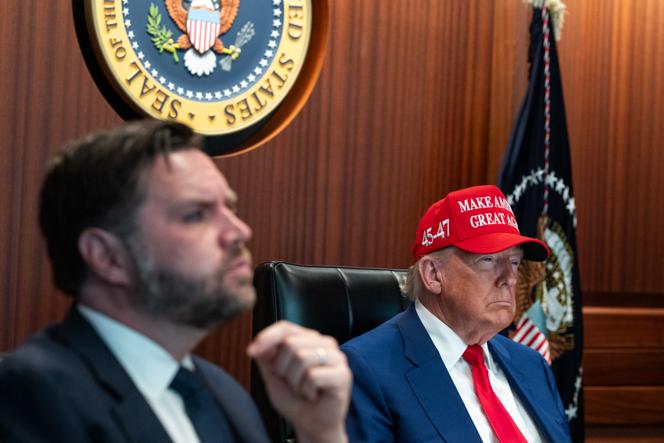
US Vice President JD Vance and Donald Trump at the White House, Washington, June 21, 2025.
J.D. Vance and Donald Trump   Getty Images
"That strategic clarity is entirely missing from the new NSS, which is more polemic than policy. The north star of great power competition with China and Russia—around which the first Trump administration built bipartisan consensus—is gone."
"Rather than describing the scope and scale of China’s systemic challenge to the United States and our allies and partners, the 2025 NSS makes clear that economics are “the ultimate stakes.” The new paramount objective of Washington’s China policy is a “mutually advantageous economic relationship with Beijing.” 
"The discussion of Russia is mealymouthed at best: The document declines to characterize the threat Moscow poses to U.S. interests. It instead opts for the bizarre formulation, “many Europeans regard Russia as an existential threat.” 
"And while the 2017 NSS highlighted Iran and North Korea as second-tier threats, the new NSS does not mention North Korea at all and downplays the danger posed by Iran after Operation Midnight Hammer."
"Vance’s speech in Munich could have been interpreted back in February as the ideological views of just the vice president and parts of the radical MAGA base. But now, these views have become the administration’s official policy, which will only accelerate Europe’s efforts to hedge against the United States and to build up its own autonomy."
Council on Foreign Relations  
https://time.com/redesign/_next/image/?url=https%3A%2F%2Fapi.time.com%2Fwp-content%2Fuploads%2F2025%2F10%2FGettyImages-2198761888.jpg%3Fquality%3D85%26w%3D1024&w=1920&q=75
 

Labels: , , , , , ,

Friday, November 14, 2025

Canadian Security Intelligence Service Report

"Worryingly, nearly one in ten terrorism investigations at CSIS [Canadian Security Intelligence Service] now includes at least one subject of investigation under the age of 18."
"Fortunately, only a small number of youth or adults with extreme views resort to violence. But when they do the consequences are devastating."
"[CSIS has helped to disrupt 24] violent extremist actions [that led to arrests of terrorism peace bond charges in just over three years]." 
"[Our agency is focusing more resources on] particularly alarming [cases involving plots by Iranian intelligence to repress -- and sometimes kill -- critics and dissidents of the regime in Canada]."
"In more than one case, this involved detecting, investigating and disrupting potentially lethal threats against individuals in Canada." 
CSIS Director Daniel Rogers 
https://images.radio-canada.ca/q_auto,w_960/v1/ici-info/16x9/foreign-interference-78942.png

Dan Rogers appears at the Public Inquiry into Foreign Interference in Federal Electoral Processes and Democratic Institutions hearings, in Ottawa. (Patrick Doyle/The Canadian Press)

Young people in Canada, warns the director of Canadian Security Intelligence Service, are increasingly radicalized online, resulting in rising violent extremism, markedly among those under 18 years of age. Motivated to extremism by a variety of ideologies among which are antisemitism, xenophobia, misogyny 'extreme interpretations' of religion or accelerationism [an inclination to accelerate the collapse of society], spreading with the momentum of social media's vast influence.
 
Teens and even children appear more susceptible to believing what they see and hear online; the allure and excitement of the socially forbidden; violent extremism seems like an adventure to their immature minds, drawing them into a never-ending cycle of the ever-increasing volume of viciously anti-social tropes. Speaking before an audience of government and police officials, academics and reporters in his first annual speech, Mr. Rogers attested to his increasing concern of the spread of extremism within the Canadian public.
 
A minor in Montreal was arrested, alleged to be planning an attack for Daesh (Islamic State); another, a 15-year-old in Edmonton suspected by police of planning to commit attacks on behalf of an online transnational violent group. 60 people have been injured, 29 killed in Canada in the past 11 years as a result of some attacks that were carried out before they could be apprehended. Many more were disrupted with the intelligence assistance CSIS provided. 
"Chinese spies have tried to recruit Canadians with access to government plans, intentions, information and military expertise, through social media and online job platforms."
"Both of those countries [China and Russia], and others, have a significant intelligence interest in our Arctic and those who influence or develop its economic or strategic potential."
"It's no surprise, then, that CSIS has observed both cyber and non-cyber intelligence collection efforts targeting both governments and the private sector in the region."
"CSIS will be challenged to adopt technology and use data in new and more significant ways to keep Canadians safe and to secure an advantage for Canada."
CSIS Director Daniel Rogers 
 CSIS assisted in the arrest of two 15-year-olds in Ottawa, plotting to commit a mass casualty attack against the Jewish community. Information leading to the arrest of a man planning a Daesh-inspired attack on the New York Jewish community saw CSIS contributing important information. China's reputation for spying on Canada to appropriate state, military and intellectual property continues unabated. Chinese agents entering Canada, he pointed out, increasingly target the private sector. While both China and Russia engage aggressively for more intelligence and influence in the Canadian Arctic. 
 
https://i.cbc.ca/ais/1.7632874,1757708951000/full/max/0/default.jpg?im=Crop%2Crect%3D%280%2C0%2C4032%2C2787%29%3BResize%3D805
Canadian soldiers prepare for a surveillance mission in Pond Inlet, Nunavut, as part of the annual Operation Nanook on Sept. 6. The exercise sees the small team inserted onto a remote mountain top with no additional support, honing their survival skills for multiple days. (David Common/CBC)
"Non-Arctic states, including the People’s Republic of China, seek to gain a strategic and economic foothold in the region. Russia, an Arctic state with a significant military presence in the region, remains unpredictable and aggressive." 
"National governments are still targeted for sensitive intelligence, military and economic secrets but so too are corporations and other levels of government whose data, technological innovations, influence and access to resources can shift the balance of advantage." 
"We benefit greatly from intelligence and security sharing by the United States, and we contribute back, So I think it’s still strong."
"Today, while the goals are similar, the targets are more varied. Some of the world’s most advanced and emergent technology is now held by private sector and academic institutions."
CSIS Director Daniel Rogers 
https://i.cbc.ca/ais/1.7632890,1757709018000/full/max/0/default.jpg?im=Crop%2Crect%3D%2874%2C53%2C2772%2C1529%29%3BResize%3D805
The Chinese vessel Xue Long, seen here in East Antarctica, is believed to be dual purpose, meaning it’s primary role is research but what it surveils can also be used for Chinese military purposes. (Andrew Peacock/Reuters)

Labels: , , , , , , , , ,

Sunday, November 02, 2025

That Eureka! Moment

"We are already in the midst of a three-way arms race among Russia the United States, and China."
"A resumption in testing of nuclear warheads would make this unstable situation worse, possibly far worse."
William Hartung, Quincy Institute for Responsible Statecraft
 
"By foolishly announcing his intention to resume nuclear testing, Trump will trigger strong international opposition that could unleash a chain reaction of nuclear testing y U.S. adversaries and blow apart the Nuclear Nonproliferation Treaty."
Daryl Kimball, Executive Director, Arms Control Association
 
"The only one who would benefit from nuclear warhead testing would be China, because they haven't done as many as Russia and the U.S."
"[As far as  nuclear weapons themselves], everything is done now through computational testing."
"The U.S. is far ahead of Russia and China on how much data it has from this, so it really doesn't need it at the moment [explosive testing]."
"None of them actually want to return to testing, but because they're thinking the other is preparing for testing, then that's how we end up testing."
"So that's the big risk involved at the moment."
Doreen Horschig, Center for Strategic and International Studies (CSIS)
https://media.cnn.com/api/v1/images/stellar/prod/ap25303261669814.jpg?c=original&q=w_1202,c_fill/f_avif
 
"First of all, every statement in that post [President Trump's musing statement on his social media site, Truth Social] is wrong."
"It’s not true the United States has the world’s most nuclear weapons. It’s not true that other states are carrying out nuclear tests."
"[Trump] seems to think it’s the Department of Defense that carries out nuclear tests. It’s not. It’s the Department of Energy."
Matthew Bunn, nuclear weapons expert, Harvard University 
 
"Neither China nor Russia has conducted a nuclear explosive test, so I’m not reading anything into it or reading anything out."
"[The Center for Arms Control and Non-Proliferation defines nuclear tests as] generally controlled explosions of [a] nuclear device, such as bombs or warheads [and Russia’s missile and torpedo tests do not meet that strict definition]."
U.S. Navy Vice Adm. Richard Correll 
https://csis-website-prod.s3.amazonaws.com/s3fs-public/styles/1400x600/s3/2025-10/GettyImages-615303604_cropped.jpg?VersionId=1V2AySX18xa6nYdV_6Va6qSzI8abDKjR&h=47ea0187&itok=BohgOkgj
Photo: CORBIS/Corbis/Getty Images

Once again, U.S. President Donald Trump's casual musing and extemporaneously-impulsive decision-making is turning incredulous heads in disbelief, shocking supporters and critics alike, and cutting like a buzzsaw through the corridors of international political diplomacy. This is a man who likes to keep people on their toes, a man who doesn't mind that what erupts from his mind and mouth is not particularly true, nor his decisions based on his warped perspectives creating blinding headaches for other world leaders; worth it all, and more, for the attention he garners. Attention that is proof-positive of the exalted political position he holds as the commanding, demanding most powerful man at the helm of the world's sole super-power.
 
What emerges from his mind and his mouth emits are his truths and if they're his truths then everyone must pay due attention and with it the homage he craves. Do otherwise and the wrath of this demi-God knows no bounds; his decisions can make and break the most carefully guarded quality of a nation's possessions; its economic health and security. While saying in one breath that he abhors conflicts and human death, he embarks on his own special eradication gambit, a 'war on terror' focusing on Venezuela and authorizing U.S. military assets to blow fishing boats out of the water in his measure of illustrating conflict/death.
 
U.S. testing, he announced, of nuclear warheads would commence "immediately", while on the other hand musing about the dire necessity of prolonging non-proliferation agreements for the good of humanity. It is not beyond reasonable to imagine the consequences that might ensue from his impulse of resuming nuclear tests; the risk of an expanded arms race becomes a huge potential. Nor that he announced his firm intention to proceed instanter comes at a time when internaional arms control has become wobbly.
 
If Washington's decision via its incendiary president was meant to match the positions taken by Beijing and Moscow, the president's decision would logically have been to remain wary in the realization that those he considers adversaries have the potential to resume nuclear testing, yet have chosen to refrain from so doing, in favour of continuing to honour the non-proliferation agreements they signed. Claiming that he authorized nuclear testing "on an equal basis" with Moscow and Beijing, is just Trump being Trump, take-it-or-leave-it. 
 
He has no realization that his 'immediate' decision itself cannot be implemented 'immediately'; it would take years of preparation before such resumption could take place, after a hiatus of decades. But it most certainly would spur Beijing and Moscow to rush to engage their own capabilities in a match with Washington's. All three of these world powers have in the interim engaged in testing delivery systems, not warheads; Russia's most recent of the platforms being tested appearing to have galvanized Mr. Trump's response, clearly demonstrating he cannot differentiate nuclear explosives from their delivery systems. 
 
Beijing responded politely indicating its hopes that Washington would reconsider and remain respectful ofits obligations to the Comprehensive Nuclear Test Ban Treaty and "take concrete actions to safeguard the global nuclear disarmament and nonproliferation system", while Moscow took pains to carefully describe to the American president that testing its nuclear-powered and -capable weapons did not constitute a direct test of atomic weaponry. (It's the delivery systems, stupid!)
 
The United States and Russia together represent the world's two leading nuclear powers; China is behind them in developing its nuclear arsenal but still remains far behind the other two. It was likely that last year's Pentagon warning that China is moving quickly on nuclear arms, particuraly in the development of operational warheads, that lodged itself firmly in Mr. Trump's mind; he doesn't like to be upstaged by anyone, nor that any other country reach for a position too close to that of the United States in superiority of numbers of anything.
 
The New Start arms control agreement between Washington and Mosow limits each to 1,550 deployed strategic offensive warheads, including a suspended verification mechanism, to expire in February2026, which Russia has proposed extending for another year. "Sounds like a good idea to me", Trump responded, without committing to anything that solid. "We are starting to work on that, a big problem for the world when you take off nuclear restrictions", he averred, in direct contradiction with the position he now takes. China's warhead total is one-third of that of Russia and the U.S.
 
And then there is the existential question, querulous but potently aware: How many warheads does it take to destroy this Earthly home we share? A minute proportion of the total, presumably. Which brings us to another question: How absurdly, dangerously pathetic can the powers that threaten our survival possibly be? Their actions, needless to say answer the second question, and until and unless a final solution is seriouisly entertained we won't know the answer to the first. And wouldn't know it in any event, since there woould be no one left to do the calculations of that Eureka! moment. 
 
https://www.politico.com/dims4/default/resize/630/quality/90/format/webp?url=https%3A%2F%2Fstatic.politico.com%2Fc9%2Fa1%2Ff6541d8044e8b7ff5d8ff9e2fc01%2Fsouth-korea-china-trump-asia-90340.jpg
President Donald Trump and Chinese President Xi Jinping look at each other after their summit meeting in Busan, South Korea, on Oct. 30, 2025. | Mark Schiefelbein/AP
"The post also comes just weeks after Putin offered to continue to observe the limits of the 2010 New Strategic Arms Reduction Treaty (New START) if the United States reciprocated. On October 28, Russian Foreign Minister Sergey Lavrov expressed his “hope” that Trump would positively respond to Putin’s offer and the principles discussed at the Anchorage Summit, saying, “President Trump has repeatedly spoken positively about this initiative put forward by President Putin, so we are actually hoping that these positive reactions will be translated into some kind of official announcement.” Other than an off-handed remark by Trump that it sounded “like a good idea,” there has been no official announcement from the White House on the future of New START, which expires in February 2026 and is the last remaining bilateral strategic arms control agreement of its kind. Trump’s post could also be an effort to generate negotiating leverage with Moscow."
"Finally, the administration should also take the opportunity to clarify Trump’s statements and recommit to nuclear agreements that are in U.S. interests. Washington would be worse off if states, particularly China, return to nuclear testing, which it likely would in response to U.S. test plans. This would undermine the norm against nuclear testing and could result in a reverse normative cascade, with implications for other rules of the road, such as nuclear nonproliferation."
Heather Williams, director, Project on Nuclear Issues, senior fellow, Defense and Security Department, Center for Strategic and International Studies, Washington, D.C. 
 

Labels: , , , , ,

Wednesday, August 06, 2025

Colonizing the Moon and Mars With Nuclear Power Generation

https://bigthink.com/wp-content/uploads/2022/09/Lunar_libration_with_phase_Oct_2007_continuous_loop.gif 
 
"Since March 2024, China and Russia have announced on at least three occasions a joint effort to place a [nuclear] reactor on the Moon by the mid-2030s."  
"The first country to do so could potentially declare a keep-out zone, which would significantly inhibit the United States from establishing a planned Artemis presence, if not there first."
NASA directive 
 
"The facility will be fully manufactured and assembled on Earth, then tested for safety and to make sure it operates correctly."
"Afterwards, it will be integrated with a lunar lander, and a launch vehicle will transport it to an orbit around the moon."
"A lander will lower it to the surface, and once it arrives, it will be ready for operation with no additional assembly or construction required."
CNBC  2020 report
 
"We're in a race to the moon, in a race with China to the moon. And to have a base on the moon, we need energy. And some of the key locations on the moon, we're going to get solar power."
"But this vision technology is critically important, and so we've spent hundreds of millions of dollars studying."
"Can we do it? We are now going to move beyond studying, and we are going.We have given direction to go."
"Let's start to deploy our technology, to move to actually make this a reality."
U.S.  Transportation Secretary and acting NASA Administrator Sean Duffy  
https://i.abcnewsfe.com/a/86022072-4779-4466-8560-fffdae264c2a/sean-duffy-epa-gmh-250708_1752002707642_hpMain.jpg?w=750
Secretary of Transportation Sean Duffy attends a cabinet meeting in the Cabinet Room of the White House in Washington, July 8, 2025.    Aaron Schwartz/Pool/EPA/Shutterstock

There was a sudden, surprise announcement out of Washington, that the United States is rushing to place nuclear power reactors on the moon and on the surface of Mars. Hopes by the Trump administration and by extension NASA, are that the first system would be launched by the end of the decade; 2029 at the earliest. First reported by Politico, a new NASA directive  calls for the appointment of a nuclear power czar for the selection of two commercial proposals within a six-month period. 

The Trump administration frames the push as a critical issue with a laser focus on outpacing a linked China-Russian effort to do the same.

Acting NASA chief Sean Duffy signed the directive in his dual capacity as U.S.  transportation secretary. The latest sign of the agency's shift in prioritizing human space exploration over scientific research under U.S. President Donald Trump, the July 31 memorandum makes it clear that this president sits atop a world that he has taken  unusual steps to dominate, so why not extend it to outer space? 

https://static.scientificamerican.com/dam/m/66ff3756785068bc/original/fission_surface_power_project_concept_illustration.jpg?m=1754408240.054&w=2000

A concept illustration showing NASA’s Fission Surface Power Project on the moon. Under a new directive, the space agency is seeking to develop bigger and more powerful nuclear reactors that could reach the lunar surface by 2030. NASA

NASA, since 2000, invested $200 million in the development of small, lightweight fission power systems. None has yet progressed toward flight readiness, but the urgency of the administration's wish to power ahead makes it clear that technological work will proceed apace to ensure those power systems will be ready in light-year time to ensure flight readiness without compromising the administration's and NASA's ambitions to beat Russia and China to the game.

In 2023, the completion of three $5-million industry study contracts represented the most recent effort to focus on generating 40 kilowatts of power, sufficient for the running of 30 conceivable households continuously for a ten-year period. Fission systems are operational around the clock, unlike solar power; an invaluable dependency during lunar nights that last for weeks, or in the case of Mars, interfering dust storms.
 
Technological advances have resulted in systems that are increasingly lightweight and compact. In December of 2024, NASA formally committed to the use of nuclear power on Mars, representing the first of seven specific decisions of primary functional requirements for human exploration of Mars. Elon Musk must be salivating in anticipation, while working on his diplomatic skills to inveigle himself back into the fond regard of President Donald Trump. 

https://bigthink.com/wp-content/uploads/2025/08/moonpower.jpg?lb=960,540
Humanity has long dreamed of establishing a robust and continuous presence on another world, such as the Moon or Mars. One of the keys to such a successful colony would be the continuous generation of power, with nuclear power plants remaining a prime, and arguably our best, option. But that may not be the true motive behind NASA administrator Sean Duffy's recent announcement. Credit: NASA; edited by E. Siegel

Surface power needs are expected to be at least 100 kilowatts, based on feedback by industry, to enable the support of "long-term human operations including in-situ resource utilization". Issues of such crucial matters as the provision of reliable life support measures, communications and mining equipment to be able to collect surface ice, in the absence of running water are being tended to.

Plans to proceed assume use of a "heavy class lander", capable of carrying up to 15 tonnes of mass, to target a "readiness to launch by the first quarter of FY30", aka late 2029. To the present, the sobering news that NASA's Artemis program -- the intention to return to the moon to establish a lasting presence near the south pole -- has faced repeated delays.  

https://bigthink.com/wp-content/uploads/2013/05/origin-505.jpg?resize=768,432
Humans have often dreamed of colonizing other worlds: both within our Solar System and beyond. While we may be a long way from a Martian colony involving skyscrapers, as illustrated here, many contend that a small, domed structure on another world, such as Mars or the Moon, could represent a key step toward that ultimate goal.  Credit: Corepics VOF/Shutterstock


Labels: , , , , , , ,

Monday, June 02, 2025

Dividing Up The World the Trump Way

"Commanding and extending spheres of influence appears to restore a fading sense of grandeur."
"[The leaders of the United States, Russia and China are all striving for] an imaginary past that was freer and more glorious."
Monica Duffy Toft, professor of International Politics, Tufts University 
 
"We don't talk about spheres of influence."
"The United States is an Indo-Pacific nation. We have relationships with Japan, South Korea, the Philippines."
"We're going to continue those relationships." 
"[Focusing on the Western Hemisphere is] critical to our national security and our national economic interests." 
U.S. Secretary of State Marco Rubio
https://foreignpolicy.com/wp-content/uploads/2025/05/3-sphere-of-influence-2ATFR3M-cropped.jpg?resize=1000,667&quality=90
An illustration depicts William Pitt and Napoleon carving the world into spheres of influence. GL Archive/Alamy Stock Photo
 
American President Donald Trump revealed in mid-May that it was his intention to normalize commerce with Russia, beginning with decreasing pressure on Moscow to wind down its war with Ukraine. He has now also given second thoughts to the fallout evident from his global trade war, urging the leader of China to call him directly. "We all want to make deals", he has stated.
 
Leading to speculation among political pundits eager to make sense of Mr. Trump's on-again-off-again trade threats and taunts of annexing other nations to realize the American Destiny. His actions have led some to suggest he might be in the throes of envisioning a world where three great powers -- the United States, China and Russia -- dominate each their portion of the globe. A throwback to 19th-century imperial rule. 
 
Having stated his intention to consume Greenland, part of Denmark; to annex Canada to unite most of North America under American rule; and take back control of the Panama Canal, for strategic and military-security purposes, his alienation of former allies and trade partners has taken the world by a storm of bombast and uncertainty. Actions taken by Trump-observers as consonant with a desire to create a sphere of influence.
 
Russia and China could conceivably benefit from President Trump's stated intention to withdraw American troops from positions around the globe, even as he has criticized traditional U.S. allies and mused about abandoning NATO.  He has left the impression that catering to strong leaders is more to his liking than preserving conventional alliances. And in the process by diminishing an American presence in Europe and Asia, opening the door to those he most admires.
 
His praise of President Vladimir Putin and Xi Jinping as strong, intelligent men with whom he is friendly has taken the world off guard. His attempts to formalize Russian control of portions of Ukrainian territory and in the process accessing Ukraine's mineral deposits for the United States comprise part of a potential peace agreement critics appraise as carving up Ukraine, with similarities to great powers in the age of empires. 
 
In 1884-85 at the Berlin Conference, European powers adopted a plan to carve up Africa, in their "spheres of influence". Bafflingly, with all this in the works, President Trump and his aides continue to exert greater U.S. influence from the Arctic Circle to South America's Patagonia region.  
 
There is ensuing confusion over intentions relating to regional alliances respecting the American president's warm relations with President Xi,leaving both Taiwanese and American officials musing whether Mr. Trump would choose to waver on U.S. arms support for Taiwan, mandated by a U.S. act of Congress.   
"China will not give up its stakes in the Western Hemisphere so easily."
"Beijing would love to have a grand bargain with the U.S. on spheres of influence."
"Its first and foremost focus will be on Taiwan." 
Yun Sun, analyst, Stimson Center, Washington  
https://foreignpolicy.com/wp-content/uploads/2025/05/Trump-America-spheres-of-influence-foreign-policy-illustration.jpg
Foreign Policy illustration/Getty Images
 

Labels: , , , , ,

Tuesday, March 04, 2025

Designed to Trap, Disabling Society's Vulnerable

"When I started my career, heroin was the opioid of choice -- the king of opioids."
"But I've seen a complete shift, to the point where I don't even see heroin anymore."
"It's all fentanyl, all the time."
Hamilton Police Det. Matt Dugdale 

"There's traffic going north to south and south to north and we don't want that."
"There's not a lot of intel to indicate that the substance is actually going down south."
"Even small amounts that are going south is too much; one single dose can kill someone." 
RCMP Commissioner Michael Duheme 

"Without the prescription opioid crisis and the excessive, long-term prescribing, without creating this demand in the population and all these problematic users ... we wouldn't have the fentanyl death crisis we've had over the last ten years."
"The overdoses go up, the deaths go up and we don't know what to do."
Benedikt Fischer, senior researcher, Simon Fraser University 

"People didn't know they were being switched over to fentanyl. [But] once  people became addicted to fentanyl, there was no turning back."
"Their brain  really is hijacked, their reward pathways are  hijacked."
"You have to look at the globe and ask why is it that fentanyl really came only to North America in as substantial a way as it did. [Why fentanyl and why was China the chief supplier? Leaving suspicions of] geographical considerations."
Dr. Alexander Caudarella, addiction-treatment specialist, Canadian Centre on Substance Abuse and Addiction
https://i.cbc.ca/1.7016679.1698953481!/fileImage/httpImage/image.jpg_gen/derivatives/original_1180/fentanyl-lab-bust.jpg?im=Resize%3D1180
A photo submitted by the RCMP shows a clandestine drug lab where Mounties say a large quantity of fentanyl was discovered in Mission, B.C. in November 2023. (submitted by Mission RCMP

Opioids were responsible for the deaths of 8,500 Canadians back in 2023, some 23 deaths daily, though numbers have descended slightly since. There are no areas that are immune: cities, towns, rural areas, and the Far North. Invented in 1960 by Belgian Paul Janssen as a type of anaesthetic considered safer than natural opioids, its molecular structure saw it cross the blood-brain barrier more efficiently than morphine-based drugs in swifter, more potent action.
 
Fentanyl is  up to 100 times more powerful than morphine; it is a central nervous system depressant which taken in excess can cause breathing to gradually stop. The heart deprived of oxygen will stop beating, leading to death. Sold as a pain treatment, doctors in Canada who withheld prescribing opioids as pain relief to avoid opium addiction viewed a new, slow-release opioid called OxyContin more favourably. When a cheaper, lab-produced alternative arrived, a more relaxed attitude prevailed and prescriptions soared.
 
Since 2016, opioid addiction and overdoses have taken the lives of 50,000 Canadians. A once-obscure prescription pain drug has caused havoc across North America in an era of liberal prescribing of morphine-related drugs and black-market fentanyl. Suspicions abound over China's role as chief exporter of the finished drug and its chemical antecedents. Canada is second to the U.S. in opioid prescription drugs consumption, dispensing more of the drugs per capita than any other country globally.
 
The realization finally set in that the prescribing of opioids had become too liberal, with governments and medical regulators prompted to take action through opioid monitoring programs, provincial drug plans to stop covering OxyContin and new generic versions. Consumption of legal opioids in Canada dropped by 50 percent from 2015 to 2021. And then fentanyl arrived, streaming into the country from producers in China. A drug so potent it allowed traffickers and smugglers an advantage with small quantities producing instant highs.
 
https://i.cbc.ca/1.6736808.1675481763!/cumulusImage/httpImage/image.jpg_gen/derivatives/original_1180/bc-decrim.jpg?im=Resize%3D1180
Health Canada says it can only take a few grains of fentanyl to kill someone. (Ben Nelms/CBC)
 
Anyone unaccustomed to opioids can die of just two milligrams, which meant that lucrative shipments could be more easily hidden. The Rand Drug Policy Research Centre estimates the annual underground supply of fentanyl weights less than 10 tons. "That literally means that any one of the over five million trucks that cross the U.S.-Mexico border each year could hold all the illegal fentanyl our nation consumes", stated Stanford professor Keith Humprheys. 
 
Last spring a U.S. congressional committee reported that Beijing provided tax rebates to companies exporting fentanyl copycat drugs and precursor chemicals, while not countenancing their being sold in China. "When it gets out into the public, you have a situation where you have a tremendous amount of resources to police it, stop its spread, try to deal with the health crisis. That plays into any adversary's hands", explained Dennis Molinaro, a former national security analyst.
 
Finally, China agreed under pressure from the United States, to classify finished fentanyl as a "listed drug", requiring a license to export it. Which led to a dwindling of the export of the finished drug, but chemical companies in China could still sell the chemical component precursors used to synthesize the drug. Now, laboratories have been established in rural out-of-the-way communities across the country in Canada where the manufacture of the completed drug is clandestinely and routinely carried on.
 
Canadian criminals began launching their own fentanyl in compounds concealed within rural landscapes. Other synthetic drugs such as methamphetamine and ecstasy are not ignored; labs turn them out along with the deadly opioid, fentanyl. A recent report by the Criminal Intelligence Service Canada, revealed that 235 organized crime groups in Canada are involved in producing or distributing fentanyl. Clandestine laboratory enforcement and response units with the RCMP are comprised of specially trained teams to hunt down, and dismantle the illicit facilities. 

Labels: , , , , , , ,

() Follow @rheytah Tweet