

Consigning Canada's Seniors to COVID-19
"With the onset of the pandemic it revved up that discussion [the issue of hospital emergency department avoidance on the part of long-term care homes]."
"There was very little that could be offered in the hospital that could not be offered in the nursing home [feeding assistance, oxygen, hydration, ever control]."
"It wasn't part of the planning to transfer individuals to emergency departments."
"Both the prime minister and the premier said they were going to target the more frail and vulnerable population around the end of March, but the reality was there wasn't a lot of help happening."
Dr.Fred Mather, president, Ontario Long-Term Care Clinicians
"I think residents that are sick with COVID-19 should be in the hospital."
"How we care for this age cohort is so tragically unsuccessful compared with how other countries dealt with the same problem it really demands a thorough investigation and it demands an adjustment in real time."
"The pandemic is not over. This is just the first wave and there is no need for us to continue to operate in the same way."
Michael Hurley, President, Ontario Council of Hospital Workers
"Many people died in situations that were very horrendous because they weren't sent to hospital."
"Long-term care, no matter what the government has said in the past, cannot give proper palliative care in these situations."
"We have heard of homes that had written policies not to send people to hospital without the doctor's OK. We have had many callers say that they had to force homes to call an ambulance for their loved ones."
Jane Meadus, staff lawyer, institutional advocate, Advocacy Centre for the Elderly
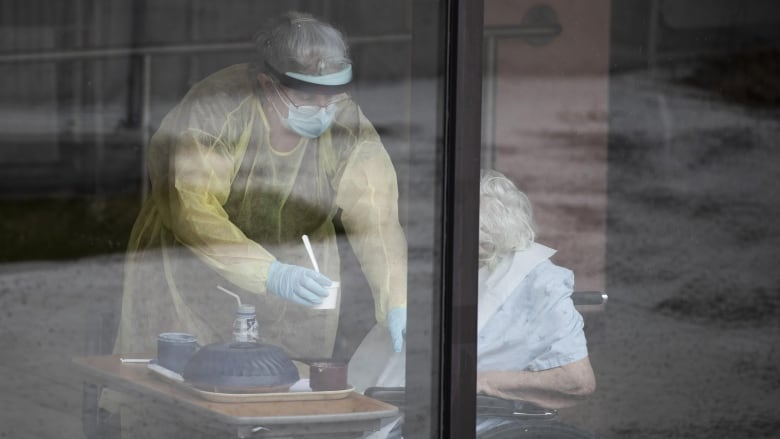 |
| An employee serves a resident at CHSLD Éloria Lepage in Montreal. As the pandemic continues to take lives in seniors' homes, the federal government is being pressed to fund the repair and construction of long-term care facilities. (Ivanoh Demers/Radio-Canada) |
Canadian authorities at all levels had long before the appearance of the global pandemic, been informed of the vulnerability of the health-impaired, the elderly, those with compromised immune systems, living in inadequately regulated long-term care institutions. Inadequate staff numbers, poorly paid, poorly trained and equipped staff, staff due to an inability to get enough working hours to make a decent living, working in a number of care centres making transmission of illness almost inevitable.
The result was that when COVID-19 arrived on the scene, government orders went out generally for social isolation and lockdown procedures to defend against wholesale transmission in t he face of a novel coronavirus with a raging appetite for infection, and for many people, a devastating impact on their health and longevity prospects. There was a fear that hospitals would be overwhelmed by the sheer crush of patients succumbing to the disease, requiring respirators and isolation. But evidently no thought wasted on the welfare of elderly people unable to self-isolate.
 |
| An elderly woman seen sitting in a room at the Lynn Valley Care Centre seniors facility in North Vancouver, B.C., on March 14. It was the first nursing home in Canada to experience an outbreak among its residents. (Darryl Dyck/The Canadian Press) |
That kind of 'difficult choice', appears to have permeated on a long-standing basis, the protocol at long-term care homes when an inmate became very ill, to refrain from sending them to hospital and just more or less muddle along; death was 'imminent' in any case, for elderly and frail individuals, why fight it? Except that this attitude led invariably to a horrific number of elderly and health-impaired dying painfully without adequate treatment and end-of-life comfort. The death count among the elderly in long-term care homes accounts for 80% of all deaths in Canada due to COVID-19.
When it was discovered weeks ago that such facilities in Quebec and Ontario were losing an astonishing number of patients to the novel coronavirus, that infection also afflicted long-term staff who may themselves have infected the elderly in their care, as they moved from home to home to home as workers, the home managers and the provincial governments in alarm, pleaded for aid from health workers from local hospitals.
That helped, but more assistance was badly needed, and the military was requested to deploy member of their health-care delivery system. Some nurses re-assigned from hospitals were aghast at the conditions they discovered at the homes -- in lapses in sanitary conditions, in responding to the needs of the patients, in drug management -- but little heed was taken. And then the Canadian military produced a report that shook the nation.
 |
| An Armed Forces member walks out of CHSLD Yvon-Brunet on April 18. About 125 military nursing officers, medical technicians and support personnel were sent to help after Quebec asked Ottawa for assistance. (Graham Hughes/The Canadian Press) |
By no means were all provincial long-term care homes in such a deplorable state, and many had no cases whatever of COVID-19, though others that did, were able to manage the situation fittingly, as opposed to those who were overwhelmed by the demands placed on them as home residents became ill in droves and many perished of the COVID effects.
Ms. Meadus points to alarming reports out of Italy in the early stages of the global pandemic, alerting health-care workers to the dire situation faced in Europe and the focus on ventilator use for patients. "The decision of whether to send long-term care residents who have COVID-19 to hospital is made on a case-by-case basis by a physician in consultation with the resident and their family", a Ministry of Long-Term Care spokesperson explained. "If residents who tested positive for COVID require medical attention that the long-term care home is unable to provide, these residents are transferred to hospital to meet their health-care needs."
 |
| A man wearing a protective suit and a mask is pictured at the Lynn Valley Care Centre in North Vancouver, B.C., on March 9. (Ben Nelms/CBC) |
A logical explanation which manages to sidestep the culture in nursing homes of retaining patients in the home, and refraining from sending them to hospital emergency rooms, under the belief that hospitals were there for intensive care and "heroic measures". There were, pointed out Dr.Fred Mather of the Ontario Long-Term Care Clinicians, no clear policy decisions on transferring long-term care residents to hospital even though emergency department avoidance was an active topic before the onset of the pandemic.
The confusion over the situation, where government inspections of the homes failed to detect problems, overlooked what problems they might identify of a minor nature, and seemed not to notice that some homes where up to 50 residents died, were inadequately staffed, the patients left on their own, wallowing in their own fecal matter, crying for help, dehydrated and unfed is one requiring deep and determined investigation -- both of the homes involved and of the inspection units' commitment to ensure safe and secure environments for the elderly prevailed.
At the federal, provincial and municipal levels, governments have been embarrassed at the very least, horrified and guilt-ridden as well perhaps, maintaining their intention to change the system completely from the dreadful mess the military report described -- to one that meets the minimal standards of dedication to care of the elderly. Typically of this Liberal federal government that promised a transparent, open government, the military has been ordered not to publicly air any further such reports of malfeasance and neglect on the part of the nursing homes.
/https://www.thestar.com/content/dam/thestar/news/canada/2020/04/17/management-at-three-nursing-homes-failed-to-protect-vulnerable-residents-and-staff-alleges-nurses-association-in-court-filing/_1_eatonville.jpg)
Labels: Crisis Management, Government of Canada, Long-Term Care Homes, Novel Coronavirus, Social Failures
posted by Pieface | 7:54 PM


0 Comments:
Post a Comment
<< Home