Politic?

This is a blog dedicated to a personal interpretation of political news of the day. I attempt to be as knowledgeable as possible before commenting and committing my thoughts to a day's communication.

Sunday, November 19, 2023

Beating Iran at its Terrorist-Enabling Game

"The Hamas battle is a relatively minor theatre in the larger war waged by Iran."
"Until you deal with the Iran question, Middle East peace and stability in the wider world will be increasingly disrupted by Hamas in Gaza, Hezbollah in the failed state of Lebanon, the Houthi war in Yemen and the ongoing mass murders carried out by the Assad regime in Syria."
"We already have a revolutionary movement in Iran that wants to topple the regime."
"What the west needs to do is help that revolutionary movement. What is needed is several lines of support to destabilize the situation inside the country. Funding, training, organizing the opposition so they can work together and topple the regime."
"If we're serious about solving all these problems, the answer is you need a change of regime in Tehran."
You have a population in the country that wants democracy and is open to the west and is open to Israel. Let's make use of this incredible resource that's at our disposal. The people in the streets of Iran are not equivocating. They want this regime gone."
Kave Shahrooz, Iranian-Canadian human rights jurist, democracy activist
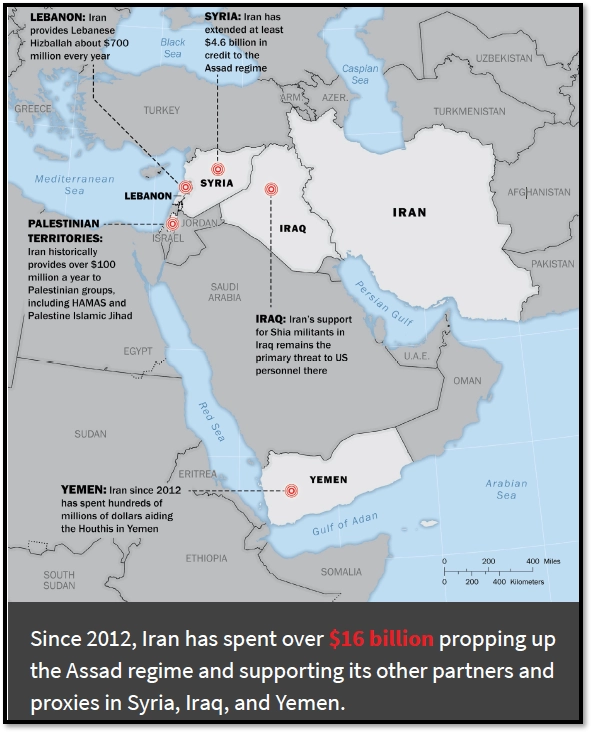
https://www.wilsoncenter.org/sites/default/files/styles/embed_text_block/public/media/uploads/images/State%20Department%20Iran%20Proxy%20Map%202020.webp
Hamas has fired thousands of rockets into Israel just within the six weeks since Hamas and Islamic Jihad invaded Israel. Only now that the Israel Defense Forces is destroying the capacity of the terrorist organization in Gaza, the rockets have diminished in number from the previous 100 daily to under 20 every day. But then, other rockets, far more sophisticated and powerful ones supplied by Iran to the Ansarullah Houthi regime in Sanaa, Yemen is sending its drones, rockets and missiles into Israel.
 
Yemen's Ansarullah group staged a military parade in late September to showcase several new types of Iranian cruise missiles and ballistic missiles recently acquired from the Islamic Republic of Iran to their protegees. Precision-guided liquid-propellant "Toufan" missiles with a range potential of up to 1,950 kilometres that brings the Red Sea port Israeli city of Eilat within striking range.

Israeli fighter jets and the country's Arrow air defence system intercepted several Ansurallah barrages of surface-to-surface missiles and drones; none of the attacks have yet managed to penetrate Israeli airspace. American warships in the Red Sea also have come under attack by drones launched from Yemen. Skirmishes with Iran's Hezbollah proxy terror group on Israel's northern border have been increasing. Airstrikes from Israel have responded to the Hezbollah rockets. 

Israel plans to maintain its focus on Gaza, but the prospect of a wider war initiated by Iran appears on the horizon. Hezbollah is in possession of a substantial arsenal, equal to that of a dozen UN member-states. In 2007 Hezbollah's weapons cache consisted of some 15,000 medium-range sophisticated missiles. At present, despite Israeli airstrikes on missile shipments going through from Syria to bases in Lebanon have allowed Hezbollah to stockpile 150,000 rockets and missiles; 400 long-range missiles.

Iran's Quds Force has been exerting influence in Syria in support of Bashar al Assad over the past three years, augmenting Iranian militias in Iraq, in a chain of command. Assad's military and security services now are supplemented by Shia militias faithful to Iran. Iran's armed groups in Iraq, Syria, Lebanon, Yemen and Bahrain, according to the Centre for Strategic and International Studies, have recruits from Afghanistan and Pakistan, numbering in total some 250,000 fighters.

A lot of manoeuvering and consolidation has taken place in the six weeks since Hamas invaded Israel with its barbaric terrorist slaughter of 1,200 civilians and abduction of some 239 Israeli children, women, the elderly and foreign agricultural workers into Gaza. Matters are proceeding precisely as the Islamic Republic has planned and there is obviously more, much more to come.
 
https://www.wilsoncenter.org/sites/default/files/styles/embed_text_block/public/media/uploads/images/Nujaba%20Iraq%20Tasnim.webp
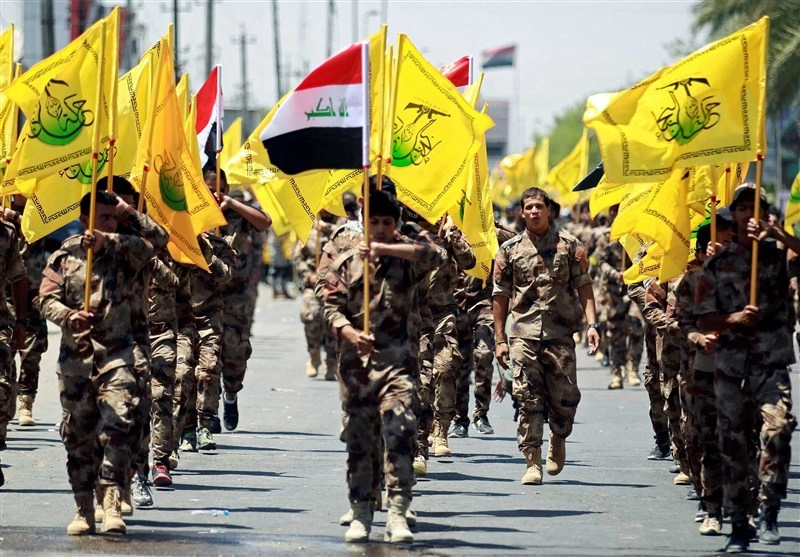
Harakat Hezbollah al Nujaba, an Iraqi militia trained by Iran's Revolutionary Guards  Tasnim News Agency
 
Iran is recognized internationally as the world's foremost sponsor of terrorist groups, ever since power was seized by Khomeini in 1979. Partially enabled by the policy approach of the Obama administration, then reconstituted with Joe Biden's inauguration; a policy viewing the Khomeinist regime's presence as a "balance" to the major Arab states in the Middle East. A geopolitical arrangement Barack Obama attempted to secure through a nuclear-weapons agreement.

Rapprochement, he was certain, would become his foreign policy legacy, moving him to allow Bashar al Assad to cross the "red line" with chemical weapons use in the Syrian Arab Spring uprising of Sunni Syrians against the Alawite-Shia-Baathist dictatorship. 1,400 civilians were slaughtered in 2013 in Eastern Ghouta and Moudamiyat al-Cham, by sarin gas. Obama failed to act, under Iran's threat to leave the nuclear talks.

Conflict-resolution specialist Robert Malley was the architect of the Obama strategy and he was reinstated by President Biden, to revive the Obama plan. Until Malley's security clearance was revoked pending an FBI probe into classified intelligence that was shared with Tehran. Then the eruption of a scandal when Tehran's "Iran Experts Initiative" infiltrated senior policy-making circles in Washington.

Long story short, the United States would do well to abandon the intention to have a partnership with the Khomeinist regime in nuclear containment, or indeed any issue whatever. According to Kaveh Shahroz, Iranian-Canadian human rights and democracy activist, a fortuitous alliance of helpfulness with Iran's dissidents should enable Iranians themselves to target Tehran to dispose of the terrorist-enabling regime.
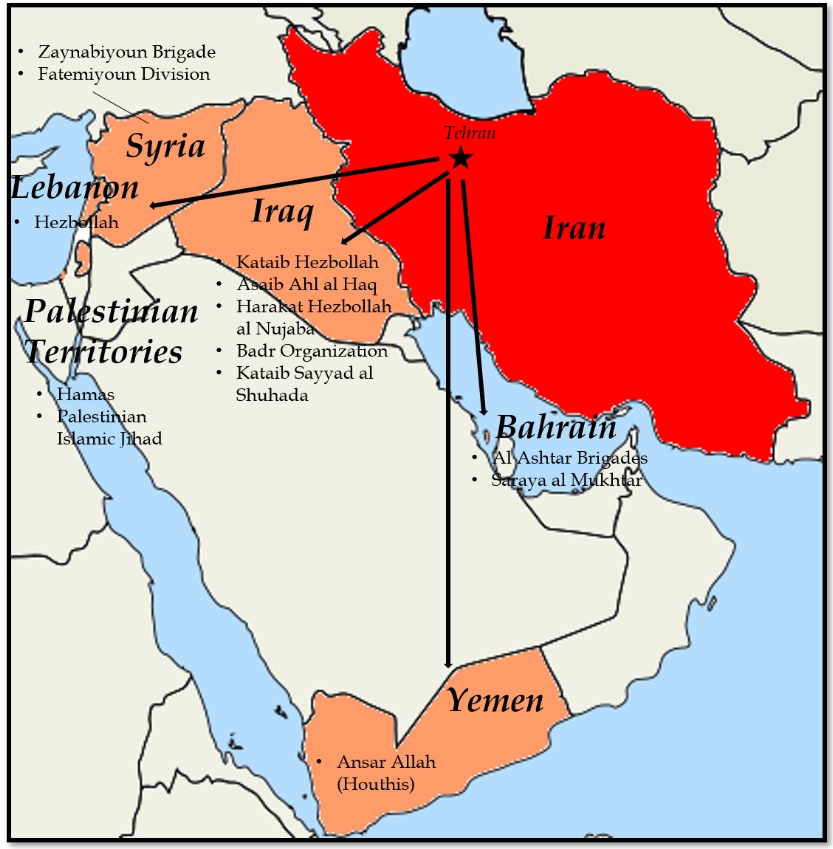
https://www.wilsoncenter.org/sites/default/files/styles/embed_text_block/public/media/uploads/images/Iran%20Proxy%20Map%20only%202020%20small.webp
U.S. Institute of Peace, Woodrow Wilson Center

"Hamas is backed by Iran. Hezbollah is backed by Iran. The Houthis are backed by Iran. All roads in this war lead back to Iran and the hundreds of millions of dollars they spend on these terror groups in the region to help them terrorize Israel and extend their hegemony throughout the region."
Iran's so-called supreme leader applauded Hamas for its horrifying October 7 attacks that targeted innocent Israeli civilians."
"Iran's shadow war with Israel is stepping into the sunlight, and Iran must be sanctioned. That starts with listing the IRGC as a terrorist entity and the total isolation of Iran within the international community."
Shimon Koffler Fogel, chairman, CEO, Centre for Israel and Jewish Affairs

Labels: , , , , , , , ,

Friday, September 29, 2023

Celebration Turned to Tragedy

"One door was blocked, so we opened it by force [in an outsider rescue attempt]. Massive flames came out of the hall. It was like Hell's doors opened."
"The temperature was unbearable. I cannot describe the extreme heat."
"I could not do anything but run away from the fire."
"After the firefighters arrived, I rushed inside to look for my friends. I saw 26 dead bodies in the bathroom. A 12-year-old girl was completely burnt and left in a corner."
"I cannot describe what I feel. I know families that lost almost everyone. At least three families have lost every single member in the fire."
"The whole community is sad, not only in Nineveh province, but all over Iraq. The whole country is sad." 
Nineteen-year-old Ghaly Nassim    
 
"What I saw was very difficult."   
"I have seen people with more than 90% of their bodies completely burnt [at least 50 children were pronounced dead as soon as they arrived at the hospital]."
Chief Nurse Israa Mohammed, Mosul's specialized medical centre for burns 
 
"We miraculously left the place. The groom and the bride were among the people who survived the accident. I was just with them, and their psychological condition was very difficult."
"I took some wounded to the hospital. What I saw in the hospital is difficult to describe. Many of the victims were burned and dead."
Wedding family member 
https://i.guim.co.uk/img/media/ae5a6b8fb213ea9003a8770866051b9f83691573/0_232_3500_2100/master/3500.jpg?width=700&quality=85&auto=format&fit=max&s=7e438ecc89640c87dce4b0a9bca9bde2
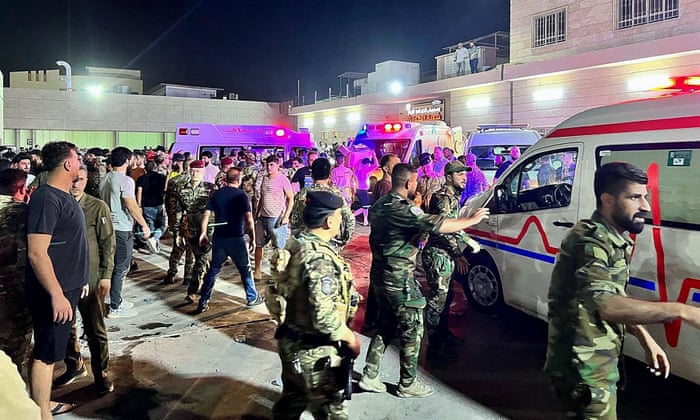
Chandelier catches alight in fire that killed more than 100 people at wedding in Iraq – still from video

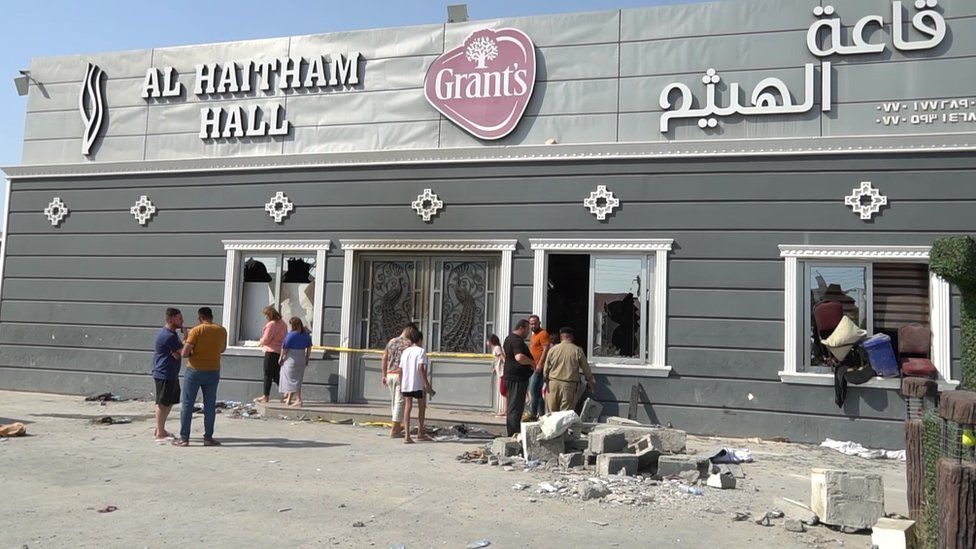
What could represent a more festive social occasion than a wedding? At this one, in the mostly Christian-occupied Hamdaniya area of Nineveh province, in Iraq, not far from Mosul the entertainment aftermath was a critical disaster. There were 250 guests. All invited to celebrate a wedding, the start of a new life together for a couple looking into the future. All too soon, as the celebratory dancing was initiated by the new bride and groom the 250 attendees panicked; guests in the Haitham Royal Wedding Hall stampeded toward the exits as flaming decorations and pieces of ceiling rained down on them.

Some cultures have strange and dangerous ideas about how they express jubilation, the joy of an event. As for example, shooting firearms into the air as an expression of excited happiness and power. What goes up will come down, and bullets can be lethal in their original forceful trajectory as well as their re-entry from a targetless shooting. And then there is the addiction to brilliant lights and explosive sounds inherent in fireworks displays, capturing attention, enrapturing the eyes, exciting the pulse.
 
Kurdish television news channel Rudaw showed footage of the event, of pyrotechnics blasting flames from the event's floor, hitting a chandelier and setting it afire. Authorities blamed flammable building materials that contributed to the blaze. An eruption of hellfire that killed 100 people and injured 150 more, accounting in total for the number of invited guests. 
 
Witnesses explained what they recall of the shocking events. Faten Youssef described the bride and groom initiating a ritualistic slow dance, when the fire began and raced through the plastic decorations that festooned the hall. And soon the ceiling began collapsing, the 50-year-old woman said. "Flames started falling on us. things were falling down and blocked the way to the exit".
 
Her family found a way through a kitchen exit, struggling through smoke and flames. A bystander shot video that showed a desperate attempt by people outside the hall to aid the escape of those trapped within. One man attempted to knock down a wall with an excavator. Soon, local hospitals were receiving victims conveyed by screeching fleets of ambulances. 
 
Bandaged survivors received oxygen. Workers at the hospital organized more oxygen cylinders, but then it was realized there was a shortage of oxygen; too many calls too suddenly exhausted hospital supplies, including burn bandages. Children were among those being treated for severe burns. Paramedics worked for hours after the fire was extinguished bringing out the injured.

It is customary in many countries in the Middle East for extravagant wedding ceremonies and entertainment planned for the hundreds of relatives and community members representing the wedding parties' close acquaintances and family members. Spectacularly elaborate decorations in the halls, with music and entertainers, and quite often pyrotechnics for the amusement and entertainment of all concerned.
 
Scene of blaze (27/09/23)
Highly flammable material is thought to have fuelled the blaze


Labels: , , ,

Friday, February 19, 2021

Don't Menace Israel: There To Stay

"The Arrow systems cover the highest altitudes of Israel’s missile defense arsenal, which also includes the Iron Dome and David’s Sling systems. The announcement of the Arrow’s latest system comes after the Israeli Defense Ministry hailed the success of the country’s first-ever multilayered missile defense test in December."
"Preliminary designs for the Arrow 4 originated in 2017 as the Missile Defense Organization sought to expand the capabilities of the Arrow 2. Israel Aerospace Industries was announced Thursday as the new system’s primary contractor. The unveiling comes just a day after US President Joe Biden spoke with Israeli Prime Minister Benjamin Netanyahu by phone."
"Iran possesses the largest ballistic missile arsenal in the Middle East. While Tehran initially relied on past technology from North Korea and China, it has continued to develop its own projectiles in recent years."
"Both US and UN officials have said there is evidence that Iran has transferred some of that technology to proxy forces in the region, such as the Houthis in Yemen and local militias in Iraq and Syria. Iran’s expanded arsenal has raised concerns over the past several years among officials in Israel and Washington about the Islamic Republic’s ability to strike targets across the Middle East."
Jared Sziba. Al-Monitor
 
"The Israeli army should be the one to be banned from acquiring weapons used to commit massacres against our Palestinian people,” he said, stressing the enormous ongoing efforts on the part of the Israeli army to 'prevent the resistance from exercising its right to obtain the necessary tools to defend its people'."
"But the resistance does not give in to such obstacles', Qasem [Hamas spokesman Hazem Qasem] said alluding to the local manufacturing of some military equipment."
Entsar Abu Jahal, Al Monitor
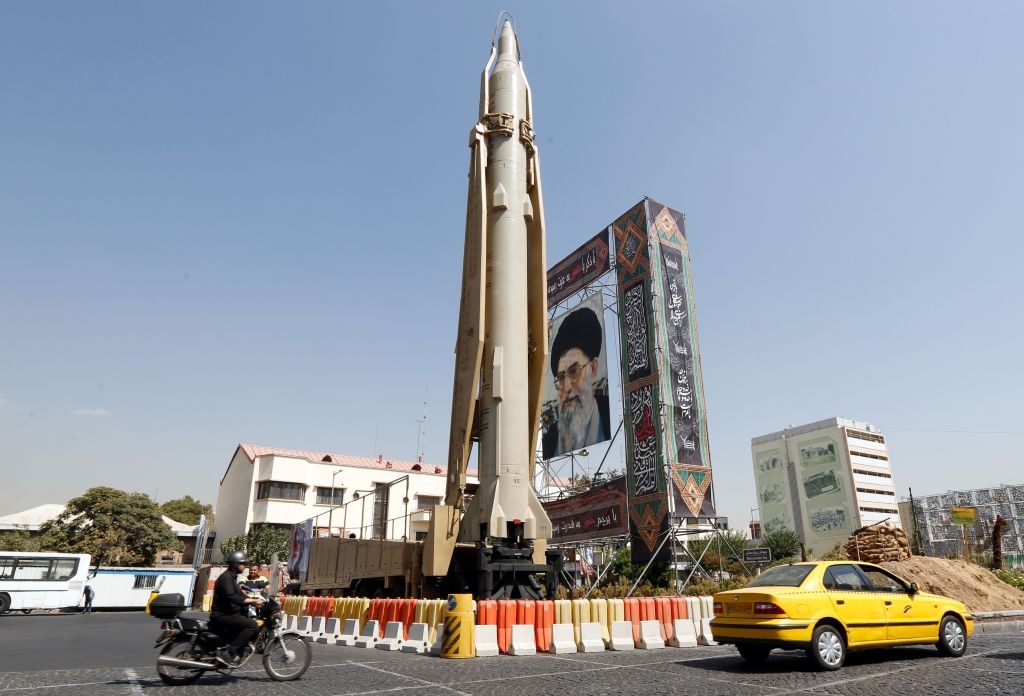
In spite of the Iranian leaders' claim that their nuclear program is for peaceful purposes, evidence reveals that the Iranian regime has long sought to acquire nuclear weapons. The regime's ballistic missile program to deliver nuclear warheads, a core pillar of its foreign policy, is closely linked to the nuclear program. Pictured: A Shahab-3 ballistic missile on display in Tehran, Iran on September 26, 2019. (Photo by STR/AFP via Getty Images)

What irony, the State of Israel came into being as a renaissance of its ancient heritage presence following Nazi Germany's horrendous 'Final Solution' success in methodically annihilating most of Europe's Jews. Now, the one country in the world that officially declares itself unimpressed that the Holocaust ever occurred, is diligently working toward accomplishing another genocide, this time against the Jewish state considered to be a haven for world Jewry. 

The Islamic Republic of Iran has made no secret of its intention to destroy the State of Israel; its clandestine but obvious search for nuclear weapons also threatens many other Middle East states.

Those Middle East states that can rest easy that they are not targets of the Iranian ambition to reassume a position it believes belongs to it by heritage in achieving preeminent power status are those fractured countries where Shiism predominates although the sect has minority status in comparison to Sunnis. Iranian proxies in Yemen, Lebanon, Syria and Iraq, and Iran-friendly nations like Qatar, Algeria and Turkey, support the Republic's antipathy toward Israel.

The Hezbollah Shiite militia that effectively rules Lebanon, Islamist Hamas (along with Palestinian Islamic Jihad and other terrorist groups) in Gaza, both of which have charters that distinctly express Israel's elimination as their goal, along with other terrorist Shia militias in Iraq all linked to Iran, form a cliquish threat to the predominance and security of the Arab Sunni states. Iran believes itself to be the true custodians of the two Muslim holy sites, Mecca and Medina, intent on replacing Saudi Arabia's eminent position as guardian of Islam's heritage.

The Middle East is nothing if not a roiling, unsettling cauldron of sectarian, political, tribal and clan enmities. And Israel is right in the middle of it all, but with the special status of its Judaic heritage, a square peg in a round hole which has no business squatting on Islamic geography as far as Iran is concerned. The leadership of the Palestinian Authority, Fatah and its sister organization Hamas agree without reservations. 

Iran, broadly acknowledged as the world's greatest terrorist-sponsoring nation, has been steadily supplying its proxies with weapons for years, and those weapons grow increasingly more sophisticated and powerful; Hamas has advanced from home-made rockets to semi-guided missiles, stockpiling more technologically advanced weapons which Israel's blockade of the Strip has attempted to stall. Hamas's dedication to its goal of destroying Israel leads it to spend inordinate sums the international community hands it to improve the lives of Gaza's population -- on building smuggling and offensive tunnels into Israel and Egypt.

Israel military strength 

For 2021, Israel is ranked 20 of 139 out of the countries considered for the annual GFP review. It holds a PwrIndx* rating of 0.3464 (0.0000 considered 'perfect'). 
Global FirePower

Israeli soldiers from the Golani Brigade take part in a military training exercise near the border with Syria (Jack Guez/AFP via Getty Images)

In efforts to both hinder Iran's transfer of weapons to Syria, Lebanon and Gaza, Israel conducts nighttime aerial strikes on weapons smuggling targets in Syria. Raids which continue to deliver the message that Israel will not tolerate these ongoing threats meant to embroil it in defensive wars where when it confronts its most direct enemies like Hezbollah and Hamas after lethal provocations, it faces an enemy that takes shelter behind civilian populations, inviting Israel's military to destroy non-militia lives as fodder for terrorist propaganda and international censure.

Iran has succeeded in building a hostile threatening ring to surround Israel from Syria, Lebanon and Gaza. Bases it has established in Syria and Lebanon where Hezbollah rules under Iranian auspices have their purpose. Not only to forestall direct attacks by Israel against Tehran's nuclear installations but to counter the threats its proxies mount against Israel's existence.

During the diaspora years it was Europe that surrendered its Jews that had lived there for a thousand years and more, to the agenda of Fascist Germany. Now that a Jewish homeland has been re-established it is the neighbourhood of Arab states and Aryan Persia that planned to rid its geography of a Judaic presence proclaiming itself to have a right of return to its origins. 

Currently, Sunni Arab states have recognized the futility of denying Israel's presence, a detente leading to recognition and conciliation by some moderate Islamic states toward Israel. Discovering, after all, that they have much in common and much to gain through cooperation with one another heading into the future of amicable engagement.

While Europe, which during World War II became a slaughterhouse for Jews, still finds common cause to criticize the Jewish nation for defending itself from terrorism and threats against its existence. Israel, however, has equipped itself with defences that will withstand all manner of threats. Extending first a hand of friendship to those who would return the embrace. And the fallback of ensuring it has a military second to none in motivation and equipment capable of formidable defence capabilities.

"Since the early 2000s, Iran has supplied cruise and ballistic missiles to its proxies in at least three countries -- Iraq, Lebanon and Yemen."
"[One of its primary goals is] the deployment of missiles under Iran's direct or indirect control would allow it to strike an adversary during a conflict from multiple directions."
Andrew Hanna, U.S. Institute of Peace
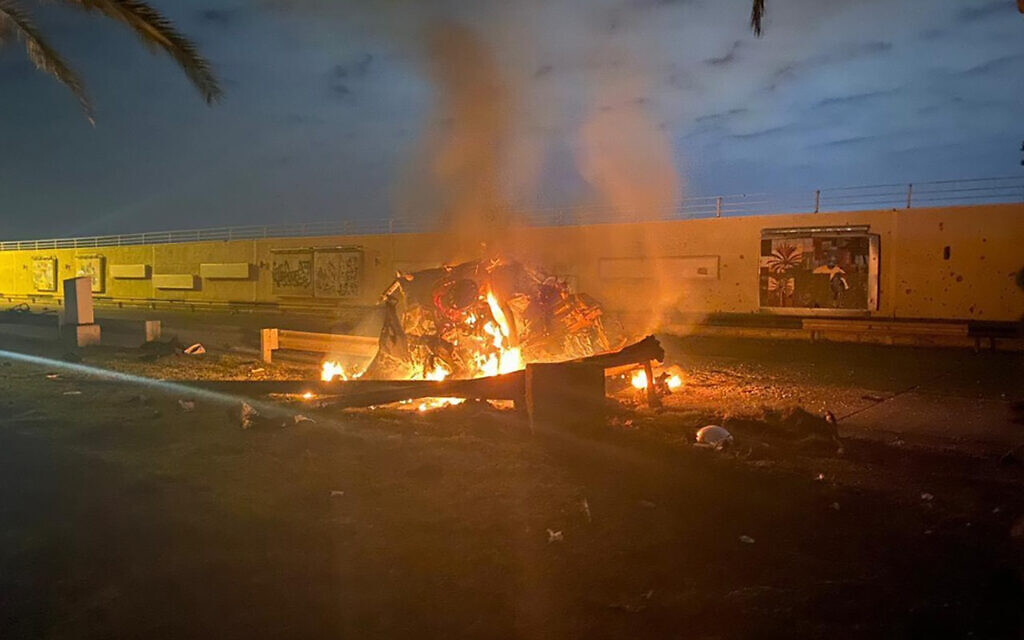
A burning vehicle at the Baghdad International Airport following an airstrike in Baghdad, Iraq, in which Iranian Gen. Qassem Soleimani was killed January 3, 2020. (Iraqi Prime Minister Press Office via AP)


Labels: , , , , , , , , ,

Thursday, January 16, 2020

The Chaotic Turmoil of the Medieval Middle East

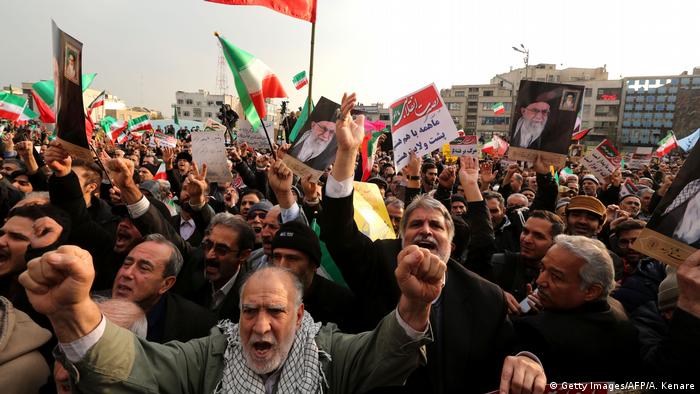
Protesters fill a street during an anti-government demonstration in Tehran, Iran.
An anti-government protest in Tehran on January 14, 2020. Demonstrations erupted after Iran admitted to unintentionally shooting down a passenger jet last week.
Fatemeh Bahrami/Anadolu Agency via Getty Images
"Aware of the anti-Iranian mood on the Iraqi streets—exemplified by protesters beating their shoes against portraits of Khamenei, just as they had done with former Iraqi President Saddam Hussein in 2003—an unnerved Khamenei did not hesitate to intervene."
"Referring to the unrest as a conspiracy orchestrated by the United States, Saudi Arabia, and the 'Zionist regime' [Israel], the ayatollah called on forces in Iraq to 'remedy the insecurity and turmoil'—a metaphor that served as a green light for Iranian-backed militias to quash demonstrations in Iraq." "But Suleimani’s fingerprints have been found in other parts of Iraq too. It recently emerged that the day after the protests started, the Iranian general secretly flew to Baghdad to meet with security officials. Suleimani called for a heavy-handed approach to deal with people on the streets, reportedly saying, 'we in Iran know how to deal with protests', an implicit reference to prior violent suppressions of peaceful demonstrations in Iran and, more aggressively, in Syria. The death toll in Iraq surpassed 100 the day after his departure, confirming the power of Iran’s word."
Kasra Aarabi, Foreign Policy
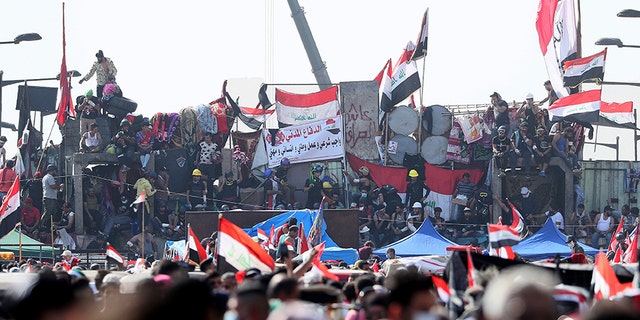
Protesters gather at Tahrir Square in Baghdad, Iraq, amid ongoing anti-government demonstrations.
Protesters gather in Baghdad, Iraq, amid anti-government demonstrations on Dec. 10, 2019. Sabah Arar/AFP/Getty Images
"If there was no escalation recently in the region, those Canadians would be right now home with their families."
Canadian Prime Minister Justin Trudeau

"In Iraq and in Lebanon, society is rebelling against an entire political class that, while ostensibly sharing power on a multi-sectarian basis, is actually looting state resources and failing to provide the most basic services. The protesters, furthermore, do not want to be part of a quasi-Iranian protectorate. Ominously for Iran, the Iraqi protests spread like wildfire from Baghdad — a mainly Shia city — throughout the Shia heartlands and holy cities of the south."
"In Lebanon, where demonstrations inside the capital have mixed Sunni and Shia, Christian and Druze, the Shia southern suburbs, and other Hizbollah strongholds in south Lebanon and the Bekaa Valley, have been a sea of Lebanese flags rather than the Party of God’s strident yellow banners. In Iraq, militia snipers as well as security forces have shot protesters, with more than 250 dead. In Lebanon, a tense peace has held — so far. Nobody has forgotten the sectarian bloodletting of the 1975-90 civil war. Thugs from Hizbollah and allied Shia militia Amal have attacked demonstrators."
David Gardner, Financial Times
Why Iran wants the Lebanon and Iraq uprisings to fade
Iraqi demonstrators take part in one of the ongoing anti-government protests in Baghdad, Iraq, (Reuters)
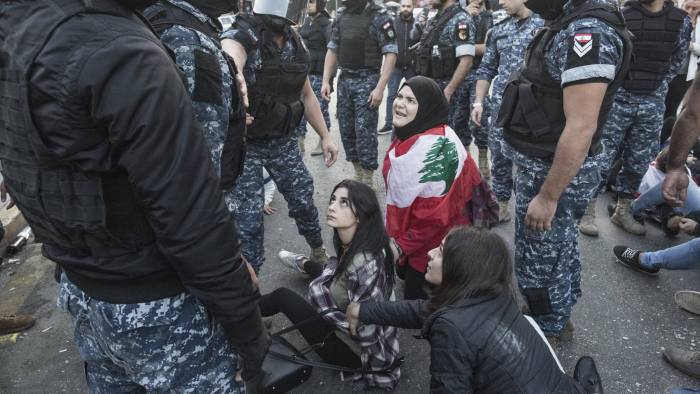
On Tuesday night, 59 people were arrested in Lebanon, protesting in cities like Tripoli, Sidon, Bekaa and Beirut. Serious injuries to protesters took place amidst riot police, broken windows, ambulances and tear gas. Hundreds of thousands of protesters  have come out since last October to pour through the streets, protesting the government's incompetence and Hezbollah's influence; most of all they raged against the presence of Iranian interference in the country.

BEIRUT, LEBANON - NOVEMBER 04: Riot police remove anti-government protesters occupying the
Riot police confront anti-government protesters blocking a main road in Beirut, Lebanon © Getty

There have been nothing like the violence of those riots in Iran, though the protests have been numerous and vehemently expressed in viral antipathy against the theocratic government, the Basij and the IRGC preoccupied with their interference in Syria, Lebanon, Iraq and Yemen, while the nation's economy is in freefall as a result of biting U.S. sanctions and Iranians are suffering privation. People on the streets of Iran's cities decry the dictatorship they suffer under and call for Supreme Leader Ali Khamenei's removal.

In Iraq, a wave of street demonstrations, strikes, marches and occupations begun last October has seen brutal violence causing the deaths of at least 500 protesters, and the injurious wounding suffered by another 19,000, all of which failed to put an end to the protests. Iraq has been coping with its most severe crisis since the 17 years of a U.S.-led invasion and occupation to remove the Butcher of Baghdad, Saddam Hussein which unleashed a sectarian backlash of slaughter.

And then there is Syria and the collapse of a former thriving country whose crumbling into chaotic destruction of its society and its heritage began with a quiet protest by Sunni Syrians over their second-rate status in a minority Shiite-Alawite-dominated regime whose president, Bashar Assad sneered at the 'terrorists' confronting his rule and unleashed chemical warfare, barrel bombs, the targeting of hospitals and schools and markets to convince Syrian Sunnis they have no future in Syria.

Discontent in Iraq and Lebanon is a way to expose Iran's corruption
Getty Images

The common denominator in these Shiite-led countries is their hegemonic relationship with the Islamic Republic of Iran which had set out to form a sectarian alliance of aggressive Islamist strength on its way to achieving power and influence over its Arab, Sunni-majority neighbours. Iranian tentacles throughout the Middle East, from Lebanon and Yemen, Syria and Iraq to Qatar and Turkey has served to roil the geography in an escalating hurricane of Islamist disequilibrium, long predating  the Hellfire missiles from a Reaper drone over Baghdad airport, targeting Qassem Soleimani.

Yet, despite this background of escalating dysfunction, hundreds of thousands of lives extinguished, millions of refugees created, amidst a high-boiling point of distrust and fear born of hatred and vengeance, Western leaders like Canada's Justin Trudeau quail at the prospect of holding Iran to sole and full account for the Quds Force malfunction causing the death of 176 passengers on Ukrainian Airlines Flight 752, killing 57 Canadians of Iranian origin, and countless more Iranian students heading to Canada on student visas.

From Damascus to Beirut, Baghdad to Sanaa, and Gaza included, the Khomeinist regime holds full sway, plaguing the region with its nefarious, violent agenda, exploiting sectarian divisions while continuing to defy injunctions and sanctions against uranium enrichment and technical advancements of the delivery systems in ICBMs. At the same time exhorting its proxies to wreak havoc in the oil fields of Saudi Arabia, while the IRGC speedboats hector and harass shipping in the Persian Gulf and Strait of Hormuz.

So, in fact, the 'escalation' of hostilities does not rest with the current White House administration which has finally departed in earnest from the folly of its previous resident's disastrous 'agreement' for nuclear deterrence of the JCPOA which Tehran endorsed but never intended to implement, succumbing instead to steeper sanctions imposed by the U.S. when it opted to have its satellite militias bomb U.S. bases in Iraq and Syria, never anticipating that this administration would commit to a 'disproportionate' response, which on reconsideration was entirely proportionately appropriate.

Labels: , , , , , , , , , , ,

Wednesday, January 08, 2020

The Islamic Republic of Iran -- Death by Misadventure

"[The missiles had 1,000 to 2,000-pound warheads on them, each with significant explosive power and] kill radius."
"I believe, based on what I saw and what I know, is that [the strikes] were intended to cause structural damage, destroy vehicles and equipment and aircraft and to kill personnel. That's my own personal assessment."
"But the analytics is in the hands of professional intelligence analysts. So they're looking at that."
U.S. Army General Mark Milley, chairman, Joint Chiefs of Staff

"It is clear these missiles were launched from Iran and targeted at least two Iraqi military and coalition personnel."
"As we evaluate the situation and our response, we will take all necessary measures to protect and defend U.S. personnel, partners, and allies in the region."
Pentagon statement

"Lacking a modern airforce, Iran  has embraced ballistic missiles as a long-range strike capability to dissuade its adversaries from attacking Iran."
"Iran also has the largest missile force in the Middle East, with substantial inventory of close-range ballistic missiles, short-range ballistic missiles and medium-range ballistic missiles that can strike targets throughout the region as far as 2,000 kilometres away."
Christian Saunders, senior defence analyst, Pentagon

And so, in retaliation for a U.S. drone striking four missiles at a two-vehicle convey setting out from Baghdad International Airport last Thursday to target and destroy Iran's commander of the IRGC Quds Force, Qassam Soleimani who was accompanied by the leader of the Iranian-sponsored militia Kataib Hezbollah and five other Iraqi militia terrorists, Iranian forces launched over a dozen ballistic missiles against two military bases in Iraq with the intention of striking American forces.

Iran has been fuming at the assassination of Soleimani, revered in the country as a national treasure, a warrior for Shiite Islam, and mastermind behind countless bloody attacks by Hezbollah in Lebanon, Hamas in Gaza, extending attack blueprints into Afghanistan, and Yemen, and above all, enabling Syria's murderous President Bashar al-Assad to slaughter a half-million Sunni Syrians. Second in esteem and power only to Supreme Leader Ali Khamenei, Soleimani boasted he would erase Israel and drive the U.S. from the Middle East.

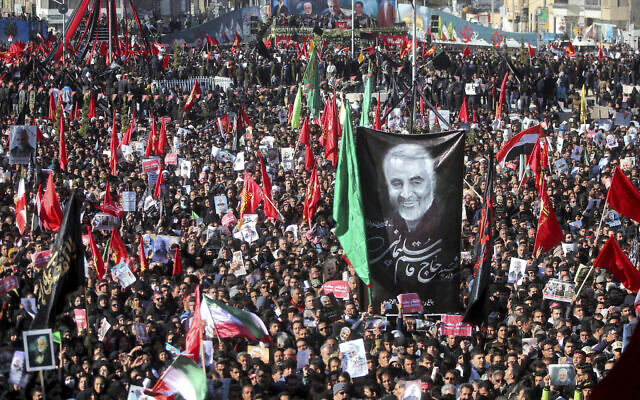
The funeral for Brig.Gen. Qassam Soleimani was attended by hundreds of thousands of Iranians, mourning their martyred champion. When his casket procession travelled to Kerman, the town of his birth, the route followed a narrowing passage insufficient for a fluid advance of the crowds, and panic ensued, people were trampled, and many more Iranians joined Soleimani in martyrdom; over 50 funeral attendees died, and hundreds were injured, delaying his burial.


The Islamic Revolutionary Guard Corps proudly took responsibility for the barrage of missiles that targeted two bases, one in Western Iraq, the other facility in Kurdistan's Erbil, both hosting U.S. servicemen. According to initial estimates, damage to the facilities appears minimal. And while Tehran claims that over 200 American soldiers were killed in the attacks, the White House scathingly gave the number of American casualties as zero; no deaths whatever. As the Pentagon continues to take stock that will be either verified or rebutted.

"They're still in bunker mode", one U.S. official stated, speaking of ongoing assessment of possible damage resulting from the strikes. The Pentagon had anticipated that Iran was prepared to deploy a rising number of "more accurate and lethal ballistic missiles" as its technology evolves. It has supplied quite a stock of missiles to Lebanon's Hezbollah and the other terrorist group, Hamas in Gaza. Both their targets are known to be Israel; threats to Israel's existence by the Islamic Republic of Iran, and by its proxy terrorist groups are well known.

The Anbar base houses part of the five thousand American troops stationed in Iraq, training local forces in conflict practise against the Islamic State, considered to be the ultimate Islamist jihadi terrorist group, on the Sunni divide in Islam. This is as much a sectarian war, rife throughout the Middle East and beyond as the the conflict in Syria reflects. Heretofore, Iran's Quds Force and their militias have targeted its Saudi Sunni regional counterpart's oil interests on land and by sea.

The increasing attacks by the Shiite proxies against U.S. installations notched the situation up substantially, when Kataib Hezbollah launched 31 rockets at a base near Kirkuk killing a contractor and wounding a few U.S. troops. An action following on others that finally persuaded the U.S. military to return airstrikes on targets linked to Iranian-backed forces. When Kataib Hezbollah engineered an attack on the U.S. embassy in Baghdad, triumphantly teaching the U.S. a lesson, it backfired.

The American response was to target Brig.Gen Soleimani and the leader of Kataib Hezbollah. And Tehran, in its disbelief and its grief at the loss of one of its most competent of terrorist strategists became somewhat careless when it allowed missiles to continue crowding the skies over Tehran, even while a Ukrainian Airlines passenger jet with 175 aboard took off and moments later, exploded in the air, falling in pieces to the ground below. Like Malaysia Airlines Flight 17 shot down over rebel eastern Ukraine by a Russian Buk missile in 2014.  Leading to the deaths of all aboard then, and this time around as well.

Unsurprisingly, Tehran is firm in its intention to withhold the black boxes retrieved from the wreckage from scrutiny by Ukrainian or American investigators. Just notch up more deaths resulting from the nefariously deadly schemes of the Islamic Republic of Iran intent on its commanding imperialist agenda of Shia conquest in a Sunni Arab landscape.


Labels: , , , , , ,

Tuesday, January 07, 2020

The Middle East in Chaos, The World on Tenterhooks

"Thirty-five vital American positions in the region are within the reach of the Islamic Republic, and Tel Aviv."
"The Strait of Hormuz is a vital thoroughfare for the West, and a large number of American destroyers and warships cross the Strait of Hormuz, the Sea of Oman and the Persian Gulf."
Brig.Gen Golamali Abuhamzeh, Iran

"Iran has been nothing but a problem for many years."
"Let this serve as a warning that if Iran strikes any Americans, or American assets, we have targeted 52 Iranian sites [reflecting the 52 American hostages taken by Iran during the storming, siege and takeover of the U.S. Embassy in Tehran in 1979], some at a very high level & important to Iran & the Iranian culture, and those targets, and Iran itself, will be hit very fast and very hard. The USA wants no more threats."
American President Donald Trump

"We have increased security and defensive measures at the Iraqi bases that host anti-ISIS coalition troops."
"Our command places protection of U.S. forces, as well as our allies and security partners in the coalition, as the top priority; we remain vigilant and resolute."
U.S.-led military coalition against the Islamic State group
us embassy
Iraqi forces taking security measures last Tuesday after an assault on the US Embassy in Baghdad.
Murtadha Sudani/Anadolu Agency via Getty Images

Members of Iraqi security forces were warned by Kataib Hezbollah, one of a number of Iraqi militias acting as Iranian terrorism proxies, to keep their distance from American military bases in Iraq. This was the militia that had planned and led supporters in a violent siege of the U.S. Embassy in Baghdad after Iraqi security had allowed them to enter the confines of the heavily guarded and hardened Green Zone where foreign embassies, aid groups and government offices are located.

In Baghdad itself thousands of Iraqis marched in a mourning procession memorializing Iran's powerful Quds Branch of the Iranian Republican Guard Corps Qassem Soleimani's assassination when missiles fired from a U.S. drone hit a vehicle convoy in which he was travelling from Baghdad Airport, with a number of Iraqi Shiite militia members, among them the leader of Kataib Hezbollah. "Death to America, death to Israel", they chanted. "We will take our revenge!"
Mourners attend a funeral ceremony for Iranian Gen. Qassem Soleimani and his comrades, who were killed in Iraq in a US drone strike, in the city of Kerman, Iran, January 7, 2020 (Erfan Kouchari/Tasnim News Agency via AP)

Qassem Soleimani and Abu Mahdi al-Muhandis, the Shiite militia leader, both of whom were buried on Tuesday, were not the only martyrs, aside from the other five militia members hit by the drone's missiles last Thursday. There was a stampede during the Soleimani funeral procession, along the route to Soleimani's hometown Kerman burial destination. Hundreds of thousands filled the streets to mourn the terrorist kingpin, now a martyr. And joining him in martyrdom were 56 mourners , victims of the crush of people, with another 212 injured.

Thousands of people were crammed within a single street, along the poorly planned funeral route.
"The route that they chose was too narrow for this crowd. This is something that could have been prevented", an unnamed Kerman resident, said. "The surrounding alleyways were also blocked for different reasons. There was no way to go back or turn around." This too is what the U.S. and Israel are responsible for, earning further shouts of "Death to the U.S.", "Death to Israel", as civilized nations everywhere are wont to declare.

Iranians, however, have god on their side.
"God the almighty has promised to get his revenge, and God is the main avenger. Certainly, actions will be taken."
"We promise to continue down martyr Soleimani's path as firmly as before with help of God. [The aim is] to get rid of America from the region."
Esmail Ghaani, Soleimani's replacement as head of the IRGC's Quds Brigade
And nor is Ghaani's and Grand Ayatollah Ali Khamenei's promises of vengeance the only ones to generate news after the timely death of the venerated Soleimani, for his daughter Zanab, 28, who happens, quite amazingly, to have American citizenship has announced her own promises of revenge for her sainted father's death. "Families of the American soldiers ... will spend their days waiting for the death of their children. Crazy Trump, don't think that everything is over with my father's martyrdom."

But wait; there's more. A $80-million bounty on the head of Donald Trump. "We are 80 million Iranians", stated a eulogist at the Soleimani funeral. "If each one of us puts aside one American dollar, we will have 80 million American dollars, and we will reward anyone who brings us [Trump's] head with that amount."
Mourners holding posters of Iranian Gen. Qassem Soleimani attend a funeral ceremony for him and his comrades, who were killed in Iraq in a U.S. drone strike on Friday, at the Enqelab-e-Eslami (Islamic Revolution) Square in Tehran, Iran, Monday, Jan. 6, 2020. The processions mark the first time Iran honored a single man with a multi-city ceremony. Not even Ayatollah Ruhollah Khomeini, who founded the Islamic Republic, received such a processional with his death in 1989. Soleimani on Monday will lie in state at Tehran's famed Musalla mosque as the revolutionary leader did before him. (AP Photo/Ebrahim Noroozi)
Mourners holding posters of Iranian Maj. Gen. Qassem Soleimani at a funeral in Tehran on Monday.
Associated Press

Labels: , , ,

Monday, December 30, 2019

Iraq, Increasingly Indistinguishable from Iran

"[The American operations will] degrade KH's ability to conduct future attacks [against coalition forces]."
"Iran and their KH [Kataib Hezbollah] proxy forces must cease their attacks on U.S. and coalition forces, and respect Iraq's sovereignty, to prevent additional defensive actions by U.S. forces."
"KH has a strong linkage with Iran's Quds Force and has repeatedly received lethal aid and other support from Iran that it has used to attack OIR coalition forces."
Jonathan Hoffman, chief Pentagon spokesman

"The Iraqi Prime Minister expressed his strong objection to this unilateral decision and his concern that it would lead to further escalation and demanded that he [Defense Secretary Mark Esper] stop it [airstrikes] immediately."
"These strikes represent a treacherous stab in the back."
Abdelkarim Khalaf, spokesman of the commander of Iraq's Armed Forces

"[The Baghdad government rejects] unilateral action [by coalition forces inside his country]." 
"We have already confirmed our rejection of any unilateral action by coalition forces or any other forces inside Iraq. We consider it a violation of Iraq's sovereignty and a dangerous escalation that threatens the security of Iraq and the region."
Iraqi Prime Minister Adil Abdul Mahdi
Iraqi people walk on a United States flag in a protest after an air attack at the headquarters of Kataib Hezbollah militia group in al-Qaim, Iraq [Alaa al-Marjani/Reuters]
To Iraqis and their leaders it is reprehensible that the U.S. gave warning to its Iraqi hosts that it intended to respond to the attack on U.S. positions in Iraq, then carried out a government-unauthorized mission delivering a compelling message that any militias with plans to bomb Americans should consider themselves placed on notice that repercussions would be swift and deadly. How Iraqi authorities garnered the impression that Washington and the U.S. military are at their beck and call and will act only with their express permission remains a mystery.

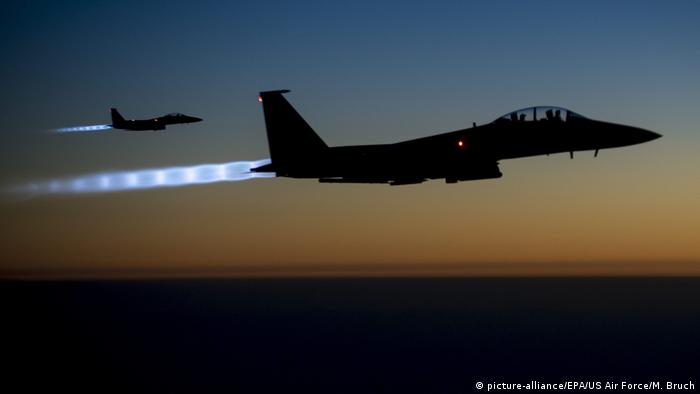
Repeated attacks on U.S. installations on Iraqi bases by Kataib Hezbollah spurred the U.S. to action, as simple as that. Five facilities in Iraq and Syria with ownership of the Shiite militia with its Iranian backing were bombed by U.S. F-15 Strike Eagle fighter planes on order from the Pentagon and the U.S. administration after an American contractor was killed when an Iraqi base was hit. That the Iraqis feel Iran-linked militias have impunity to act as they will targeting the U.S. may very well reflect the fear the Iraqi administration feels that Iran might hold them accountable.

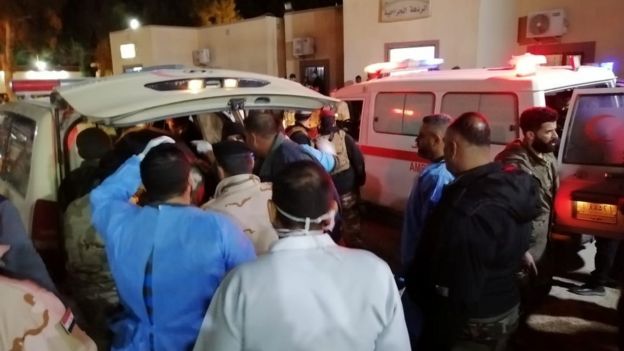
An ambulance transporting wounded Iraqi paramilitary fighters arrives at a hospital in al-Qaim, Iraq (29 December 2019)
Paramilitary Popular Mobilisation: dozens of people killed or injured  Reuters

Pulling the strings on a puppet government cautious lest it give offence to its powerful terrorist neighbour seems appropriate for the Byzantine intrigues and violence of the Middle East. The targeted militia has given its own due warning that it is prepared to draw on its resources to inflict further casualties on U.S. interests. Which will have the effect of drawing the U.S. back into an endless conflict it would prefer to vacate.

The Pentagon knows the militia's links to Iran's Quds Force, the special operating forces of the Iranian Republican Guard Corps tasked to guide their external proxy militias outside Iran. Since Iran controls the militias and they feel secure enough to attack U.S. interests, the provocation is coming from Iran, the response from the U.S. So if any entity is responsible for the potential of heightened hostilities and linked violence it is the Islamic Republic which feels itself indomitable.

It is long past time for a comeuppance and for events to take place to determine whether or not the regime can survive the restive efforts of Iranian protests and the linked Iraqi protests at the involvement of Iran in the affairs of its neighbours to fulfill its viciously nefarious plans of conquest. Those protests are concerning enough to both regimes to elicit deadly means to stifle dissent.

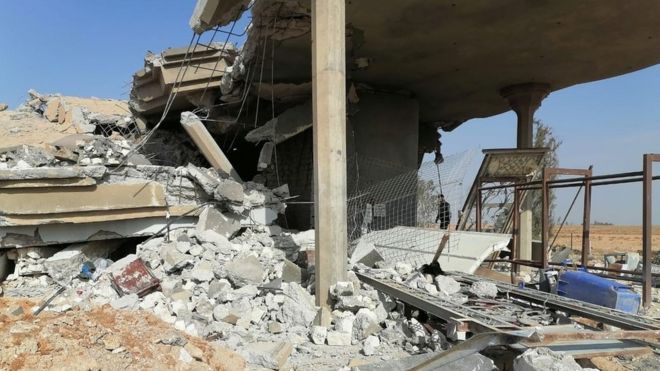
The militia's holdings that were targeted in both Iraq and Syria included facilities for weapons storage, and areas used by the militia in planning attacks against coalition forces.

Syrien US F-15 Kampfflugzeug (picture-alliance/EPA/US Air Force/M. Bruch)

In Iraq about 25 of their fighters were killed and 55 wounded. Among the dead were four local Kataib Hezbollah commanders, the result of one of the strikes targeting the group's headquarters near the border with Syria. Intelligence had alerted Pentagon officials that Iranian backed groups were planning to attack U.S. forces in Iraq. And then, it happened; over 30 rockets had been launched on an Iraqi base near Kirkuk on Friday, killing the contractor and wounding another few U.S. service members.

Concern related to tensions between the U.S and the Popular Mobilization Units, Shiite militias supported and armed by Iran of which Kataib Hezbollah is but one group among many paramilitary groups under the umbrella of the 'popular mobilization units', will lead to further violence within Iraq. "If something happened then we'll be in the middle and it will be chaos", observed Lt.Col.Hassan Kadhim, an officer with the Iraqi army's 8th Division. "It's being done by Iran proxies. Iran wants to have their war in our land."

Iraqi officials failed to effectively respond to a request by U.S. Defense Secretary Mark Esper when he had conveyed his concerns about recent attacks on U.S. bases, with the knowledge it was not the Islamic State that was involved, but rather Iranian proxies. Iraq's co-operation was sought to itself respond to an increase in those U.S. base attacks; an appropriate action since they care so much about their sovereignty. Their previous inaction has led directly to the U.S. defending its own interests.
"My suspicion would be that Iran is behind these attacks, much like they're behind a lot of malign behaviour throughout the region, but it's hard to pin down."
"So again, we need their help [Iraqi military] in terms of getting the security situation under control and stabilized, but we also still retain our right of self-defence."
U.S. Defense Secretary Mark Esper
Destroyed facility linked to Kataib Hezbollah in al-Qaim, Iraq (30 December 2019)
Kataib Hezbollah said its headquarters in the western Iraqi town of al-Qaim was hit  Reuters

Labels: , , , , ,

Thursday, November 28, 2019

France, Eager to Fill a Vacuum

"We've seen deliberate, gradual US disengagement [in the Middle East]."
"When the mining of ships went unanswered, a [U.S.] drone got shot. When that in turn went unanswered, major oil facilities were bombed [in Saudi Arabia]. This is dangerous even for those who think they gain – because bold is never far from daring, and daring never far from reckless."
"The edifice has started shaking and opportunists rush in/"
"[The signs in the region] hint at the severe weakening of an order based on cooperation; that mix of US presence, norms, a degree of multilateralism, some stability of governance and a great deal of deterrence."
"I have sent a robust package of advance warning, including sophisticated radar and tens of operators to deter drone and cruise missile attacks."
French Defense Minister Florence Parly
Iraqi demonstrators gather as flames start consuming Iran's consulate in the southern Iraqi holy city of Najaf on November 27, 2019, two months into the country's most serious social crisis in decades.

During the Green Revolution when Iranians finally got fed up with their theocratic government ordering every facet of their lives, demeaning their human rights, oppressing the population, discriminating against minorities, imprisoning dissenters, forcing women to cover themselves, resurrecting capital punishment to a degree reflective of the medieval era, supporting and arming terrorist groups to mount atrocities in the region and abroad, the outside world looked in with fascination while the major Western influencer and dominant authority in the U.S. did nothing to support Iranians.

Now another, larger, more widespread series of protests has been taking place in the Islamic Republic with hundreds of thousands of people mustering the courage to confront their brutally oppressive government, demanding the ouster of the Ayatollahs, a stop to interference in neighbouring countries like Iraq, Lebanon and Syria, and relief for impoverished Iranians whom reimposed sanctions related to Iran's nuclear program, have increased economic hardships for -- an already-hard-pressed population.
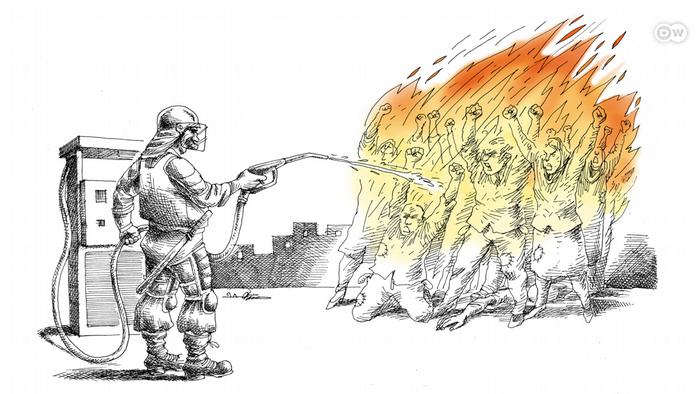
Cartoon on the Iran protests showing a security official spraying fuel on a burning crowd
The government's response to the protests has been much the same as their Syrian puppet Bashar al-Assad's was, though they have not yet employed barrel bombs and chemical weapons in hopes of disrupting the protests. They have in the process of damping down dissent, seen to the deaths of several hundred Iranians, and have wounded thousands in the government's response. Thousands of Iranians have been arrested. Although news has been hard to come by in the wake of a complete Internet shut-down by the government, credible claims of torture and murder have arisen.

According to Supreme Leader Ayatollah Ali Khamenei, the past two weeks of violence represents the work of a "very dangerous conspiracy". Originally caused by an increase in fuel prices for Iranians reflecting the dire state of the nation's finances (which could be addressed by no longer funding terror and by Iranian government elites restoring to state treasury the funds they have spirited into their own Swiss bank accounts), Khamenei has announced that the rioting has been quelled. Strangely enough, they have continued....

Mobile Internet was restored in Tehran and a number of other areas in mid-week. Eight people whom Iran's Intelligence Ministry has linked to the American Central Intelligence Agency were arrested during the protests. "These elements had received CIA-funded training in various countries under the cover of becoming citizen-journalists", claimed state news agency IRNA, quoting the ministry. If true, which is doubtful, that describes precisely the Republic's modus operandi; funding, training, inspiring terrorism abroad.

Concurrently with and pre-dating the Iranian protests were similar protests taking place in Iraq and Lebanon, where people there have demanded their governments disassociate themselves with Iran, and stop permitting the Republic the large and commanding voice it has in their internal affairs. That would be quite the trick in Lebanon where Iran's proxy Hezbollah militias have fully infiltrated the Lebanese government, taking their orders from Iran.

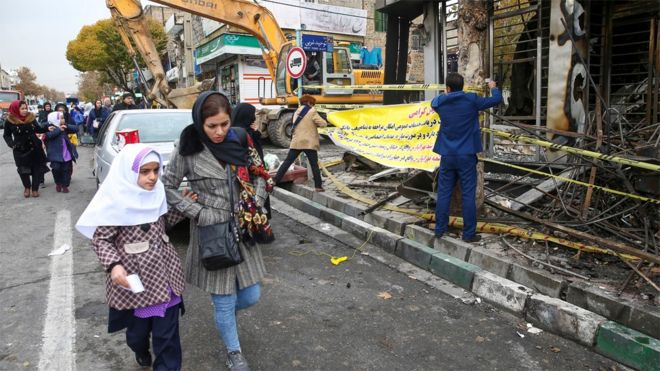
Women and girls walk past a burned out bank in Tehran, Iran (20 November 2019
President Rouhani blamed the protests on "subversive elements" backed by foreign enemies  Reuters

Tehran has made it abundantly clear that "thugs" (ordinary Iranians protesting their leaders) with links to regime opponents in exile in lock-step with the  United States, Israel and Saudi Arabia are the devils in residence, supporting and inciting the villains rioting in the streets of Iranian cities. "A deep, vast and very dangerous conspiracy that a lot of money had been spent on ... was destroyed by the people", stated Khamenei.

The paramilitary Basij force, a civilian volunteer offshoot of the Iranian Revolutionary Guard Corps, aiding in the crackdown on protests did their work well, beating and flogging protesters whom the Interior Minister Abdolreza Rahmani Fazli claimed destroyed 731 banks, 70 gas stations and 140 government sites by putting them to the torch. Over 50 security forces bases were 'attacked'. But the situation is now well in hand, assured Iranian authorities.

A tear and a thought for the Iranian people whose courage in the face of a government intent on enslaving them to their vision of fundamentalist, venomous Islam has not yet succeeded in delivering them from their cruel dilemma.

Pro-government demonstrators in Tehran
I recommend [foreign countries] look at the marches ... to see who the real people in Iran are': Foreign Ministry spokesman

Labels: , , , , , ,

Monday, November 04, 2019

Baghdad's Massive Riots

"[The unrest is costing the economy] billions of dollars."
"[The protests  that] shook the political system [have achieved their purpose and must stop affecting the country's trade and economic activities]."
"Threatening the oil interests and blocking roads leading to Iraq's ports is causing big losses exceeding billions of dollars."
Abdul-Mahdi, Iraqi Prime Minister
"A witness told us [Monday] that the police responded with live ammunition, not tear gas, and that at least five people may have been killed."
"A medical source told us about 30 people have been injured and these injuries are gunshot wounds to the head and face. The injured include security forces as well as protesters."
Natasha Ghoneim, reporting from Baghdad
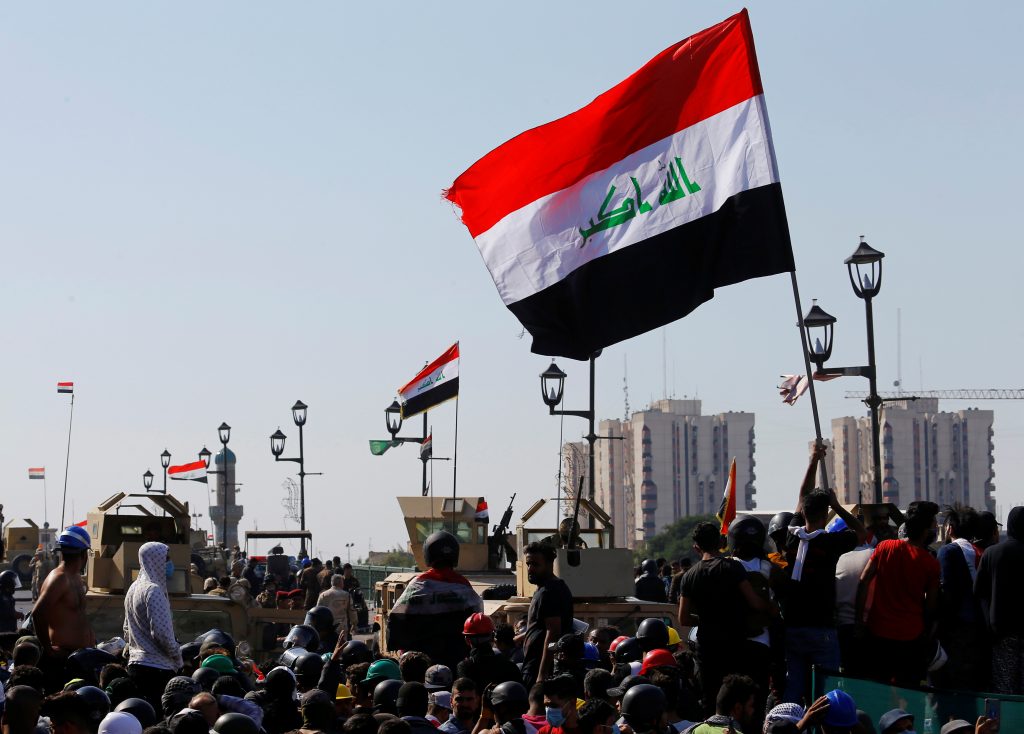
Anti-government protesters stand on barriers set by Iraqi security forces to close a bridge leading to the Green Zone government areas during ongoing protests in Baghdad, Iraq, on Monday.
Anti-government protesters stand on barriers set by Iraqi security forces to close a bridge leading to the Green Zone government areas during ongoing protests in Baghdad, Iraq, on Monday. (AP)

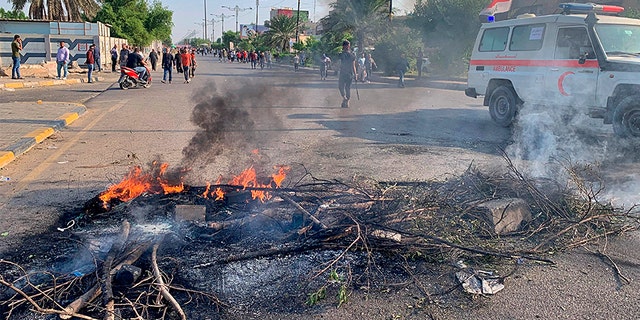
On Sunday, the appeal from Iraqi government authority was for protesters to cease and desist; the economy was faltering. Thousands of demonstrators burned tires and blocked major roads in the capital, Baghdad. Anti-government protests have been steadily mobilizing and their actions increased. Roads were obstructed with wooden pallets, barbed wire and the torching of furniture dragged into the thoroughfares. Central Tahrir Square has hosted huge numbers of people calling for the resignation of the government.

Undeterred by the latest violence, protesters pushed on Monday with civil disobedience tactics they have increasingly adopted over the past week [Ahmad al-Rubaye/AFP]
Protesters pushed on Monday with civil disobedience  [Ahmad al-Rubaye/AFP]

Banners reading "Roads closed by order of the people" were held aloft, and calls for ending the political system that came out of the 2003 U.S.-led invasion of Iraq were rife. In the past month since the demonstrations began, over 250 people have died.

 Security forces firing live rounds at protesters along with rubber bullets and tear gas canisters have increased the death toll. An inquiry launched by the government itself claimed security forces have used excessive force against protesters.

Despite that revelation and its release a hundred more people have been killed. At Iraq's main Gulf port, Umm Qasr close to Basra, there is a complete standstill where the bulk of the country's imports of grain, vegetable oils and sugar is normally received. An activist physician who had offered medical care to protesters was abducted on Saturday by unknown assailants. Physician Siba al-Mahdawi's whereabouts is unknown, yet the sinister abduction has not deterred protesters.

A protester kneels on next to body of a fellow protester covered in an Iraqi flag. He is surrounded by other protesters.
At least 250 people have been killed in the anti-government protesters since they began at the start of October.
Increasing violence has simply spurred demonstrators to become bolder, and aside from critical rage at their own government, the protests have turned to targeting the presence of Iranian forces in Iraq. Even while the prime minister has warned protesters that the price of goods will rise as a result of their actions, the mostly young demonstrators with their bleak future prospects in a country where they cannot find employment, has not convinced them to cease.

On Sunday, Iraqi security forces shot three protesters outside the Iranian Consulate in the holy city of Karbala. That led to Monday's demonstration where dozens of Iraqis fired up tires and attacked the consulate, scaling the concrete barriers surrounding the consulate, lobbing firebombs over the walls, chanting "the people want the fall of the regime", echoing the slogans of the 2011 Arab Spring. The goal was to haul down the Iranian flag over the consulate to replace it with an Iraqi flag. Ultimately the Iraqi flag was placed on the wall in front of the consulate, its message clear.


The lavish lifestyles of the country's political elite at a time when young Iraqis know their future holds a one-in-five potential of living below the poverty line, simply infuriates them even more, given that one in four among them is unemployed. "The protesters want radical change, but the ruling class would lose everything if such change came to pass", commented Abdulla Hawez, a regional researcher.

Protesters set fire to close a street in Sadr City during the ongoing anti-government protests in Baghdad, Iraq, on Monday. (AP)


Labels: , , , ,

Sunday, October 20, 2019

It's The Liberal Way

"We, under the Conservatives, shipped about 2,000 rifles over there [to Kurdish fighters in Syria]."
"We used to brag to the Americans and the British about how great Canada was to do business in."
"We were going to make them [order for 30,000 rifles and 150,000 pistols for the Peoples Protection Units [YPG] in Canada, but it's just not worth the risk."
"I'm not SNC-Lavalin."
Jeff Hussey, former president, NorthEastern Arms
Canadian special forces soldiers speak with Peshmerga fighters at an observation post, Feb. 20, 2017. Ryan Remiorz/The Canadian Press

Military weapons manufacturing is big business everywhere; all manufacturing nations work hard to increase their sales to other ordering nations to increase their own GDP. The manufacture of weapons of war is not quite the same in terms of civil odour as, for example, manufacturing bathroom tissues; most ordinary civilians think of the trade in weapons with no little amount of distaste. When they're produced and sold to nations at war or pursuing conflict in territorial disputes, it's hard to get beyond the reality that in so doing, the selling party is an accomplice to war, destruction and death.

When, on the other hand, weapons are transferred to another country or to a military entity that is engaged in self-defence, the issue is somewhat altered; becoming one nation aiding and assisting another one against the destructive belligerence of an adversary set on conquest. Canada had a fairly long-standing support arrangement with the Kurdish military in Syria and Iraq, supplying their militias not only with the sage strategic advice of Canadian military trainers, but giving them badly-needed weapons with which to defend themselves against Islamic State, under the former Conservative government of Prime Minister Stephen Harper.

Over the past four years of government in Canada with Justin Trudeau as prime minister under the Liberal Party of Canada, there has been a pull-back; no more military trainers intervening on behalf of the Kurds, and a stop to the sale of weapons to erstwhile Kurdish allies. Long-promised military aid meant to be delivered to the Kurds, negotiated under the Harper government was set aside by the Trudeau government. No more training and equipping the Iraqi Peshmerga.
Then-Prime Minister Stephen Harper meets with Kurdish Peshmerga forces, May 2, 2015. Safin Hamed/AFP/Getty Images

Canadian military aircraft gave the Peshmerga cover in Iraq, and private companies exported arms to the Peshmerga in 2015 and 2016. Until it all gradually dried up. The Kurds continued to fight against ISIL strongholds, but Canada's bombing campaign in Syria was abruptly halted, the special forces training Kurdish fighters in Erbil halted in 2018, military resources diverted toward Baghdad's central government.

According to Mr. Hussey, the Kurdish Regional Government placed orders for 18,000 additional rifles which the new Liberal government required they first have approval from Kurdistan and Iraq for. Despite which though both Erbil and Baghdad signed off, Ottawa did not. "They basically slow-played us", he said of the Canadian government choosing not to deny the request for export permits, but failing to approve them.

Aid promised by the Canadian government in 2016 failed to arrive as promised in Kurdistan, despite that Defence Minister Harjit Singh Sajjan having ordered rifles and mortars, then leaving them in a warehouse in Montreal, failing to authorize their shipment to the Kurds. President Recep Tayyip Erdogan of Turkey considers all Kurds his enemies, calling them 'terrorists', and as a member of NATO lobbied for the West to end military aid and weapons sales to Kurds.

While taking steps to halt new military exports to the Kurds in Iraq, the Trudeua government expanded sales to Turkey of military exports. Since the Turkish invasion of northeast Syria to drive out the Syrian Defense Forces, Canada followed the lead of censuring Western countries in suspending new export permits of weapons to Turkey, even as existing permits for weapons transfers would not be affected.

And then there is the issue of Canadian arms sales to Saudi Arabia. In 2018 alone, Canada sold 1.2 billion of military weapons to Saudi Arabia, engaged in a no-holds-barred conflict in Yemen, one of the world's poorest nations, roiled by sectarian violence and attempting to cope with a proxy war between the Islamic Republic of Iran and the Kingdom of Saudi Arabia.

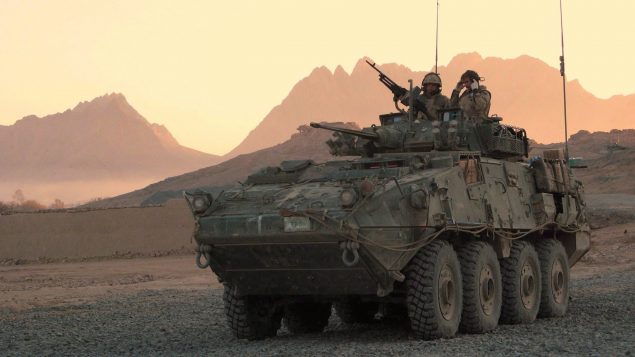
A Canadian LAV (light armoured vehicle   (Bill Graveland/The Canadian Press)

"This morning I sent a formal notice to the minister of foreign affairs [Chrystia Freeland] asking her to annul the export permits that have already been issued and that would allow the export of these LAVs that continue to be produced in London by General Dynamics Land Systems – Canada."
"And I have mentioned in that formal notice that if on Sept. 30 there is no positive answer, I will bring a case and ask courts to order the government to annul these export permits."
University of Montreal law professor Daniel Turp

Labels: , , , , , , , , , ,

() Follow @rheytah Tweet