Politic?

This is a blog dedicated to a personal interpretation of political news of the day. I attempt to be as knowledgeable as possible before commenting and committing my thoughts to a day's communication.

Monday, October 25, 2021

Imprisoning the Enablers of Islamist Death and Destruction

"I stopped eating almost a week ago. My body just can’t take this anymore…this place guarantees you lose your sanity, your dignity, your humanity one way or another…"
"It’s exhausting trying to protect myself all day, all night. I can’t do it anymore."
"I am continually bleeding My teeth are all broken ... my legs cannot walk or stand. I am dying a slow death here and I have done everything I can think of to get help."
"Nothing has worked."
Canadian Kimberly Polman, 42, convert to Islam, ISIS wife, Al-Hol prison camp, Syria
 
"She was hoping she could go home, she was given reason to believe that that might be the case from someone high up in the camp, especially because of the snap election [in Canada]."
"She’s really devastated [that she can’t come home], she’s been sick for a while, she has broken teeth, she has kidney infections…she’s distraught and says she doesn’t want to live anymore….it’s the last thing she has control over."
"I am all for justice, and the choice she made has consequences beyond anything that she could have ever imagined. But we don’t have our Canadian citizenship on merit…even the most hardened criminals and murderers are granted the rights of a Canadian citizen….they are still human beings, they are still Canadians."
Kimberley Polman's sister, Canada
al-Hol
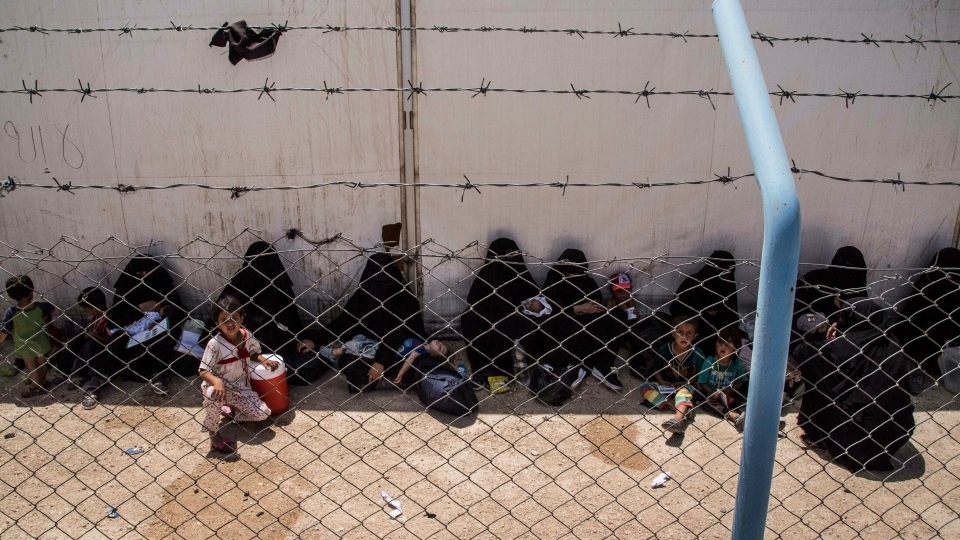
Women and children related to fighters of the Islamic State group wait to board buses and trucks, leaving the overcrowded al-Hol camp to return to their homes on June 3, 2019, in Hasakeh province, Syria. THE CANADIAN PRESS/AP, Baderkhan Ahmad

The families of Canadians who left the country to join the Islamic State of Iraq and the Levant during the time of its growing 'Caliphate', happy to be part of the revolutionary new sharia-led Islamist scourge that marched into Syria and Iraq, invading towns and cities, confronting the military in each country uniformly fearful of the terrorists' well-earned reputation for committing atrocities purposefully, to inspire horror and gaining that reputation for sadistic brutality that worked in their favour to inspire fear and ensure that opposition would melt away, have launched a lawsuit against the government of Canada.

For its inaction in committing to bring back their citizens now festering in a prison camp specifically meant to hold the wives and families of Islamic State fighter-terrorists. Separate from the Islamist women who dedicated themselves to serving the interests of the men, there is another, secure prison that holds the men in confinement. Among them are tens of thousands of ISIL diehards who arrived in Syria to become part of ISIL's purge of minorities and persecution of civilian populations from abroad; North Africa, other areas of the Middle East, countries in Europe and North America.

Not all ISIL terrorists were captured by the Kurdish armed forces, the only real opposition to the menace of the Islamic State. Many managed to evade capture and to leave the area where they were vulnerable to arrest and detention, to return to their countries of residence, covertly or under the watchful eye of policing authorities there. Some countries imprisoned their returnees, others allowed them to remain at large, under investigative watch. And while the Kurdish forces that police the camps appealed to foreign nations to repatriate their citizens, some have, most have not.

For the women and children, humanitarian groups argue that they cannot be held accountable for the crimes committed by their husbands, that they are innocent, and most certainly the children born to them as 'caliphate' offspring are innocent of any wrongdoing, and should be returned to their real home, not left to fester in the crime-infested, dangerous, inhumane and putrid confines of the Al-Hol detention camp. Where the frustrated guards hardly know where to turn next, amidst the confusion, the violence, the attacks against them, and the murders that take place within the camp.

Of the foreign women who recruited themselves to become ISIL 'wives' at part of an exciting new venture as partners in the future with Islamist terrorists who commonly executed their prisoners in the most lurid, despicable displays of inhumanity, protestations of innocence ring hollow. They knew and they approved of everything that the men they supported were inflicting on helpless unfortunates who were captured by the terrorists. In some instances pre-adolescents were taught to emulate their elders in handling weapons, in beating prisoners, in pulling triggers to cause death.

The Kurdish Autonomous Administration is doing all it can to protect the wider global public from future depredations of these criminals. Who continue to flourish elsewhere, in parts of Africa, in Afghanistan, and who  still inspire acts of terrorism by their adherents in the West. The Kurdish forces that took on that responsibility of protecting the wider world from the vicious brutality of the Islamist horde have had no assistance from any other source in managing the camps where human rights groups speak of squalid hygienic conditions and lack of security. 

It is typical of people to feel themselves to be unfairly judged and treated for merely following their goals in life, abandoning what they have in secure citizenship and a way of life that is far removed from that of hate-festering ideologies of death and destruction. They make the choice to leave the familiar and launch themselves into a brave new world of fascinating adventure. An adventure that is deadly to others, a fact they appear willingly oblivious to, yet feel entitled after the fact, to expect their transgressions to be overlooked.
al-Hol camp
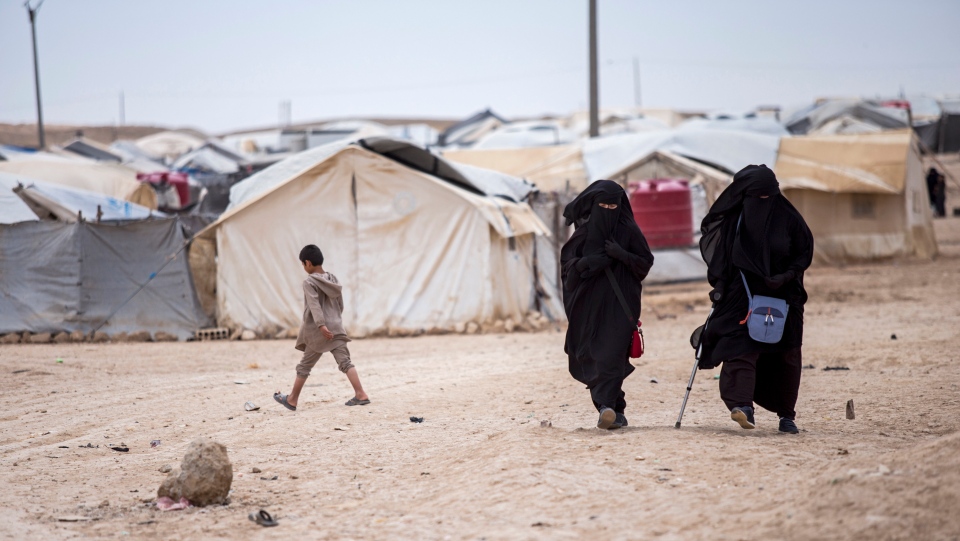
In this May 1, 2021 file photo, women walk in the al-Hol camp that houses some 60,000 refugees, including families and supporters of the Islamic State group, many of them foreign nationals, in Hasakeh province, Syria.   (AP Photo/Baderkhan Ahmad)
 

Labels: , , ,

Sunday, October 20, 2019

It's The Liberal Way

"We, under the Conservatives, shipped about 2,000 rifles over there [to Kurdish fighters in Syria]."
"We used to brag to the Americans and the British about how great Canada was to do business in."
"We were going to make them [order for 30,000 rifles and 150,000 pistols for the Peoples Protection Units [YPG] in Canada, but it's just not worth the risk."
"I'm not SNC-Lavalin."
Jeff Hussey, former president, NorthEastern Arms
Canadian special forces soldiers speak with Peshmerga fighters at an observation post, Feb. 20, 2017. Ryan Remiorz/The Canadian Press

Military weapons manufacturing is big business everywhere; all manufacturing nations work hard to increase their sales to other ordering nations to increase their own GDP. The manufacture of weapons of war is not quite the same in terms of civil odour as, for example, manufacturing bathroom tissues; most ordinary civilians think of the trade in weapons with no little amount of distaste. When they're produced and sold to nations at war or pursuing conflict in territorial disputes, it's hard to get beyond the reality that in so doing, the selling party is an accomplice to war, destruction and death.

When, on the other hand, weapons are transferred to another country or to a military entity that is engaged in self-defence, the issue is somewhat altered; becoming one nation aiding and assisting another one against the destructive belligerence of an adversary set on conquest. Canada had a fairly long-standing support arrangement with the Kurdish military in Syria and Iraq, supplying their militias not only with the sage strategic advice of Canadian military trainers, but giving them badly-needed weapons with which to defend themselves against Islamic State, under the former Conservative government of Prime Minister Stephen Harper.

Over the past four years of government in Canada with Justin Trudeau as prime minister under the Liberal Party of Canada, there has been a pull-back; no more military trainers intervening on behalf of the Kurds, and a stop to the sale of weapons to erstwhile Kurdish allies. Long-promised military aid meant to be delivered to the Kurds, negotiated under the Harper government was set aside by the Trudeau government. No more training and equipping the Iraqi Peshmerga.
Then-Prime Minister Stephen Harper meets with Kurdish Peshmerga forces, May 2, 2015. Safin Hamed/AFP/Getty Images

Canadian military aircraft gave the Peshmerga cover in Iraq, and private companies exported arms to the Peshmerga in 2015 and 2016. Until it all gradually dried up. The Kurds continued to fight against ISIL strongholds, but Canada's bombing campaign in Syria was abruptly halted, the special forces training Kurdish fighters in Erbil halted in 2018, military resources diverted toward Baghdad's central government.

According to Mr. Hussey, the Kurdish Regional Government placed orders for 18,000 additional rifles which the new Liberal government required they first have approval from Kurdistan and Iraq for. Despite which though both Erbil and Baghdad signed off, Ottawa did not. "They basically slow-played us", he said of the Canadian government choosing not to deny the request for export permits, but failing to approve them.

Aid promised by the Canadian government in 2016 failed to arrive as promised in Kurdistan, despite that Defence Minister Harjit Singh Sajjan having ordered rifles and mortars, then leaving them in a warehouse in Montreal, failing to authorize their shipment to the Kurds. President Recep Tayyip Erdogan of Turkey considers all Kurds his enemies, calling them 'terrorists', and as a member of NATO lobbied for the West to end military aid and weapons sales to Kurds.

While taking steps to halt new military exports to the Kurds in Iraq, the Trudeua government expanded sales to Turkey of military exports. Since the Turkish invasion of northeast Syria to drive out the Syrian Defense Forces, Canada followed the lead of censuring Western countries in suspending new export permits of weapons to Turkey, even as existing permits for weapons transfers would not be affected.

And then there is the issue of Canadian arms sales to Saudi Arabia. In 2018 alone, Canada sold 1.2 billion of military weapons to Saudi Arabia, engaged in a no-holds-barred conflict in Yemen, one of the world's poorest nations, roiled by sectarian violence and attempting to cope with a proxy war between the Islamic Republic of Iran and the Kingdom of Saudi Arabia.

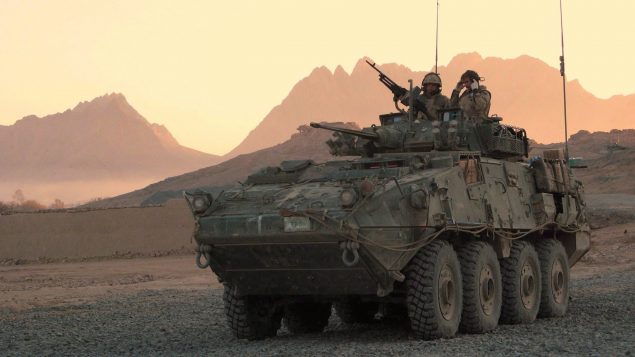
A Canadian LAV (light armoured vehicle   (Bill Graveland/The Canadian Press)

"This morning I sent a formal notice to the minister of foreign affairs [Chrystia Freeland] asking her to annul the export permits that have already been issued and that would allow the export of these LAVs that continue to be produced in London by General Dynamics Land Systems – Canada."
"And I have mentioned in that formal notice that if on Sept. 30 there is no positive answer, I will bring a case and ask courts to order the government to annul these export permits."
University of Montreal law professor Daniel Turp

Labels: , , , , , , , , , ,

Thursday, February 15, 2018

Double Standards on Canada's Conscience

"I believe there is a long way to go in terms of being able to say there's a Colt Canada opportunity in the Ukraine."
"We have as equal a chance as anybody, but I think there's a long process to go through in terms of them (Ukraine authorities) finding the best weapon for the best price."
"So, we've got as good a chance as anybody [in eventually selling weapons to Ukraine]."
Alex Payne, manager, Colt Canada

"We are planning to work out some positions, including with Canada, on military and technical co-operation, such as procurement of weapons and equipment from our partners."
Stepan Poltorak, Ukraine Defence Minister

"This is about building the capacity. This is about increasing the effectiveness of the Ukrainian armed forces, which is happening, and then actually providing the necessary equipment for them to sustain that as well."
Harjit Sajjan, Canadian Minister of Defence


Ukrainian soldiers are involved in an ongoing conflict against Russian-backed separatists. More than 10,000 people have died in the fighting. Anatolii Stepanov/AFP/Getty Images     
"It's a very practical thing that Ukraine would be able to get — or to buy — firearms which we badly need to defend ourselves."
"While we reform our armed forces and we achieved a lot on this path in the last year, we need also to arm our guys and to make further aggressive actions of Russia and Russia-supported gangs in [the east] harder. We defend our territory."
"This is a very strong signal to the Russian Federation from Canada."
Oleksil Makeiev, political director, Ukraine Foreign Ministry
So Kitchener, Ontario-based Colt Canada is looking to seal a business deal to re-equip the Ukrainian military with new assault rifles after their "exploratory type meeting" in January with Ukraine government officials, while Ukraine decides exactly what equipment it needs that can be provided by Canadian arms manufacturers. The previous Conservative-led government, while making clear its support for Ukraine and its denunciation of Moscow's interference in supporting ethnic Russian Ukrainian rebels in East Ukraine along with its illegal takeover of Crimea, hesitated to provide Ukraine with offensive weaponry.

The Liberal-led Canadian Government headed by Justin Trudeau, however, altered Canada's arms export rules to enable the sale of machine guns and allied small arms to Ukraine. So while the previous government provided Ukraine's military with non-lethal military supplies and Canadian trainers, Canada will now be changing course with the altered export rules in place to aid Ukraine in its defence and to upgrade and modernize its forces in line with NATO standards preparatory to joining the alliance.

It is not just the 100,000 rifles that Colt Canada anticipates being able to sell to Ukraine. Ukraine has expressed its interest in other military equipment, like anti-tank weapons, from Canada and the United States. In line with the U.S. President having announced his intention to send anti-tank missiles to Ukraine. A statement that aroused protests from Russia, warning that move would set the stage for further regional conflict. As though to suggest that Ukraine is the aggressor, and Russia the hapless bystander.

The main supplier of small arms to the Canadian Forces, Colt Canada is eager to sign on the dotted line with Ukraine. Canada altogether is anticipating a greatly expanded role in Ukraine after discussions between the two countries' defence ministers where Canadian involvement in the building of a Ukrainian ammunition plant appears to have been agreed upon. Greater Canadian support is being envisaged toward the Ukrainian military beyond the construction of such a factory. All to the good; Canada giving aid to its allies.

Sometimes. Its recent re-think on the sale of military helicopters to the Philippines in recognition that Philippine President Duterte has been waging a violent campaign against the drug trade in that country resulted in the cancellation of the sales agreement. But how to explain Canada withdrawing its promise to Iraqi Kurds for the supply of military weapons updated to aid them in combating Islamic State? Canada cites clashes between Iraqi and Kurdish forces mandating that reversal.

A picture taken on October 17, 2017 shows Iraqi government forces gesturing as the enter the Havana oil field, west of the multi-ethnic northern Iraqi city of Kirkuk. Iraqi forces took control of the two largest oil fields in the disputed northern province of Kirkuk demolishing Kurdish hopes of creating a viable independent state.AHMAD AL-RUBAYE/AFP/Getty Images

The clashes were born of the results of a referendum in Kurdistan for sovereignty in overwhelming agreement of Kurdish voters, and the Government of Iraq's reaction. That it is past time for the world to acknowledge that the Kurds with their multiple tens of millions of people represent the largest ethnic group in the world without recognized borders of their own on their ancient heritage land. The promise of that recognition by Western powers was reneged upon, Kurdish land divided between Iraq, Iran, Turkey and Syria.

Canada had promised the delivery of $10-million-worth of .50-calibre sniper rifles equipped with silencers, 60mm mortars, Carl Gustav anti-tank systems, grenade launchers, pistols, carbines, thermal binoculars, cameras, scopes and medical supplies. None of which is now destined to reach the people who require those promised supplies. With plans to deliver the weapons scuttled, it is unknown how the stockpile will be disposed of. Whatever else happens, this is a clear picture of Canada abandoning its support of a people in need.

Russia's aggression toward Ukraine has seen Canada making ethical decisions in support of a country's threatened sovereignty. Iraqi aggression toward a sizeable minority seeking the legitimization of their sovereign territory provides a counter-picture of a nation denied its national heritage, another moral and ethical dilemma, one which the Government of Canada chose to fail, preferring to support a government that delegitimizes the rights of two of its minorities, one sectarian the other ethnic.

It was the Kurdish Peshmerga that was effective in countering the spread of Islamic State; the Iraqi military had chosen to vanish in panic at the ISIL advance on Mosul. The Kurds gave safe haven to all the ethnic and religious minorities fleeing Islamic State from their punishing war on Yazidis and Christians. For all their sacrifices, recognized by Canadian and U.S. forces that helped train and arm the Peshmerga, they have been abandoned in the wake of their aborted efforts at sovereignty.

Iraqi forces fire mortars against Kurdish Peshmerga positions near Faysh Khabur, on the Turkish and Syrian border. Ahmad Al-Rubaye/AFP/Getty Images

Labels: , , , , , ,

() Follow @rheytah Tweet