
Politic?

This is a blog dedicated to a personal interpretation of political news of the day. I attempt to be as knowledgeable as possible before commenting and committing my thoughts to a day's communication.

Monday, December 30, 2019

Iraq, Increasingly Indistinguishable from Iran

"[The American operations will] degrade KH's ability to conduct future attacks [against coalition forces]."
"Iran and their KH [Kataib Hezbollah] proxy forces must cease their attacks on U.S. and coalition forces, and respect Iraq's sovereignty, to prevent additional defensive actions by U.S. forces."
"KH has a strong linkage with Iran's Quds Force and has repeatedly received lethal aid and other support from Iran that it has used to attack OIR coalition forces."
Jonathan Hoffman, chief Pentagon spokesman

"The Iraqi Prime Minister expressed his strong objection to this unilateral decision and his concern that it would lead to further escalation and demanded that he [Defense Secretary Mark Esper] stop it [airstrikes] immediately."
"These strikes represent a treacherous stab in the back."
Abdelkarim Khalaf, spokesman of the commander of Iraq's Armed Forces

"[The Baghdad government rejects] unilateral action [by coalition forces inside his country]." 
"We have already confirmed our rejection of any unilateral action by coalition forces or any other forces inside Iraq. We consider it a violation of Iraq's sovereignty and a dangerous escalation that threatens the security of Iraq and the region."
Iraqi Prime Minister Adil Abdul Mahdi
Iraqi people walk on a United States flag in a protest after an air attack at the headquarters of Kataib Hezbollah militia group in al-Qaim, Iraq [Alaa al-Marjani/Reuters]
To Iraqis and their leaders it is reprehensible that the U.S. gave warning to its Iraqi hosts that it intended to respond to the attack on U.S. positions in Iraq, then carried out a government-unauthorized mission delivering a compelling message that any militias with plans to bomb Americans should consider themselves placed on notice that repercussions would be swift and deadly. How Iraqi authorities garnered the impression that Washington and the U.S. military are at their beck and call and will act only with their express permission remains a mystery.

Repeated attacks on U.S. installations on Iraqi bases by Kataib Hezbollah spurred the U.S. to action, as simple as that. Five facilities in Iraq and Syria with ownership of the Shiite militia with its Iranian backing were bombed by U.S. F-15 Strike Eagle fighter planes on order from the Pentagon and the U.S. administration after an American contractor was killed when an Iraqi base was hit. That the Iraqis feel Iran-linked militias have impunity to act as they will targeting the U.S. may very well reflect the fear the Iraqi administration feels that Iran might hold them accountable.
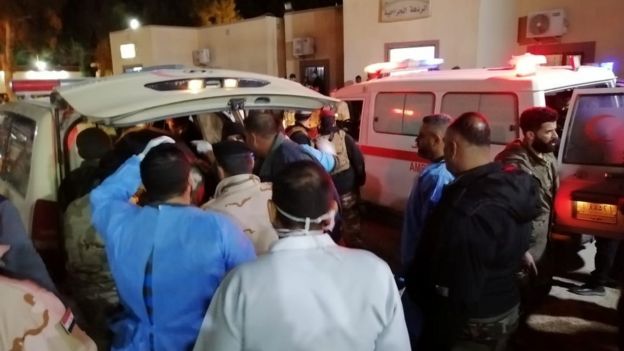
An ambulance transporting wounded Iraqi paramilitary fighters arrives at a hospital in al-Qaim, Iraq (29 December 2019)
Paramilitary Popular Mobilisation: dozens of people killed or injured  Reuters

Pulling the strings on a puppet government cautious lest it give offence to its powerful terrorist neighbour seems appropriate for the Byzantine intrigues and violence of the Middle East. The targeted militia has given its own due warning that it is prepared to draw on its resources to inflict further casualties on U.S. interests. Which will have the effect of drawing the U.S. back into an endless conflict it would prefer to vacate.

The Pentagon knows the militia's links to Iran's Quds Force, the special operating forces of the Iranian Republican Guard Corps tasked to guide their external proxy militias outside Iran. Since Iran controls the militias and they feel secure enough to attack U.S. interests, the provocation is coming from Iran, the response from the U.S. So if any entity is responsible for the potential of heightened hostilities and linked violence it is the Islamic Republic which feels itself indomitable.

It is long past time for a comeuppance and for events to take place to determine whether or not the regime can survive the restive efforts of Iranian protests and the linked Iraqi protests at the involvement of Iran in the affairs of its neighbours to fulfill its viciously nefarious plans of conquest. Those protests are concerning enough to both regimes to elicit deadly means to stifle dissent.

The militia's holdings that were targeted in both Iraq and Syria included facilities for weapons storage, and areas used by the militia in planning attacks against coalition forces.
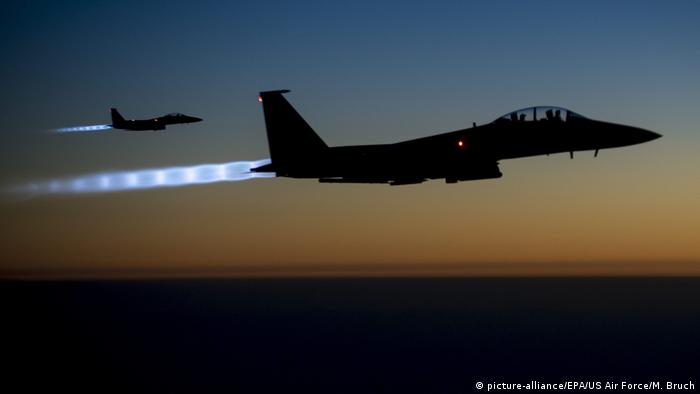
Syrien US F-15 Kampfflugzeug (picture-alliance/EPA/US Air Force/M. Bruch)

In Iraq about 25 of their fighters were killed and 55 wounded. Among the dead were four local Kataib Hezbollah commanders, the result of one of the strikes targeting the group's headquarters near the border with Syria. Intelligence had alerted Pentagon officials that Iranian backed groups were planning to attack U.S. forces in Iraq. And then, it happened; over 30 rockets had been launched on an Iraqi base near Kirkuk on Friday, killing the contractor and wounding another few U.S. service members.

Concern related to tensions between the U.S and the Popular Mobilization Units, Shiite militias supported and armed by Iran of which Kataib Hezbollah is but one group among many paramilitary groups under the umbrella of the 'popular mobilization units', will lead to further violence within Iraq. "If something happened then we'll be in the middle and it will be chaos", observed Lt.Col.Hassan Kadhim, an officer with the Iraqi army's 8th Division. "It's being done by Iran proxies. Iran wants to have their war in our land."

Iraqi officials failed to effectively respond to a request by U.S. Defense Secretary Mark Esper when he had conveyed his concerns about recent attacks on U.S. bases, with the knowledge it was not the Islamic State that was involved, but rather Iranian proxies. Iraq's co-operation was sought to itself respond to an increase in those U.S. base attacks; an appropriate action since they care so much about their sovereignty. Their previous inaction has led directly to the U.S. defending its own interests.
"My suspicion would be that Iran is behind these attacks, much like they're behind a lot of malign behaviour throughout the region, but it's hard to pin down."
"So again, we need their help [Iraqi military] in terms of getting the security situation under control and stabilized, but we also still retain our right of self-defence."
U.S. Defense Secretary Mark Esper
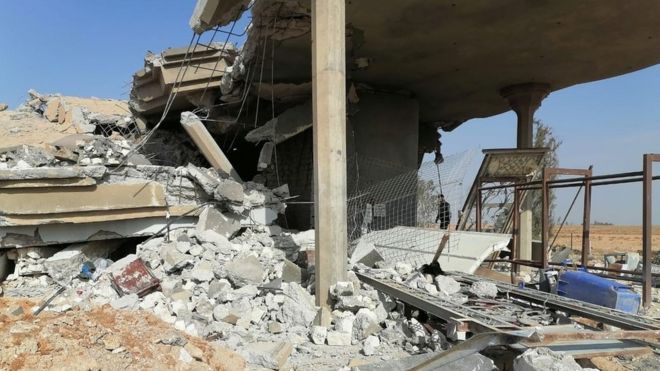
Destroyed facility linked to Kataib Hezbollah in al-Qaim, Iraq (30 December 2019)
Kataib Hezbollah said its headquarters in the western Iraqi town of al-Qaim was hit  Reuters

Labels: , , , , ,

Tuesday, July 25, 2017

From Mosul to Raqqa

"[Canada's All-Source Intelligence Centre, gathers and analyzes data with the U.S.-led coalition] so we can develop legitimate military targets that need to be defeated."
"[Since ISIL] does not respect international borders, our assessments consider Daesh activity in Iraq and Syria."
"They used small drones -- ones that we would buy commercially -- and know how to drop munitions from those drones. They would use drones for surveillance and monitor the Iraqis and our tactics and strategies."
"[ISIL has] lost more than 65 percent of the land [it had dominated for its caliphate in Iraq and Syria, which had] resulted in the freeing of millions of people and significant reductions in their revenues."
"The key part is that Daesh is on the defensive. [But despite their defeats ISIL forces] are not surrendering in great numbers. That is not the way they operate."
Brig.-Gen.Daniel MacIsaac, Kuwait


How then, do they operate? As jihadists whose end goal really is the end in the sense that they court the status of shaheeds, for that equates with honour, jubilation and adulation in Islam; to become a martyr is the status they seek. Their initial goal when cornered is to escape so they can continue being feared and celebrated warriors of Islam, if at all possible. When that is not feasible, reflecting a situation inimical to survival, they fight to their honourable deaths.

This is the barbaric ideology that celebrates its gloating penchant for gruesome atrocities that make for such eye-capturing, heart-thumping attention in gory theatre that they excel in; videos of terror-in-action atrocities that gained them their notoriety and fear-factor so irresistible to the recruits their mastery of social media has gained them over the years.

With their defeat on the battlefield, outnumbered but not outfoxed, their public relations machinery has undergone an expert turn in convincing recruits to remain where they are; simply operate from wherever they happen to be. Use any weapons at hand. Any action, any attempts serve to strike fear into the minds of their targets, irrespective of meeting with success or failure.

Their proficiency both in the geographic field, mining territory to slow down the advance of their enemies, holding civilian populations hostage, killing those no longer of any practical use, or suspected of abandoning the sinking ship, and ensconcing their fighters and sharpshooters underground in expansive tunnelworks used to cache weaponry, reflects sharp minds at work, skilled in the tactics of underground guerrilla warfare.

A car bomb exploding next to Iraqi army vehicles during fighting to liberate Mosul
A car bomb exploding next to Iraqi army vehicles during fighting to liberate Mosul Credit:  Felipe Dana/AP
Threat assessments and targeting information for Islamic State targets are now turning from Iraq to Syria where the focus is being transferred. The future of Raqqa and of Islamic State hang in the balance. Even with the certainty that defeat on the battlefield will represent only a hurdle, not the end of the practised killing machine that ISIL represents. As a Sunni militia it can still learn a few techniques from a Shiite counterpart, in the Syrian regime.

The nine-month battle in Mosul close to completion, Raqqa, the ostensible ISIL headquarters, beckons.

As for the All-Source Intelligence Centre, different branches of the Canadian military are represented from intelligence, artillery and communications systems experts to geomatic engineers capturing and interpreting data from cameras, remote sensors and global navigation satellites. The maps they create from those data sources are analyzed by the coalition to identify potential threats and to select attack targets.

"Daesh command and control centres as well as combatants, installations or anything else that is essential to Daesh operations", represent the typical targets the units identify, according to Brig.-Gen. McIsaac. "Fairly routinely" the Royal Canadian Air Force operates reconnaissance and refuelling flights over Syria where the airspace is complicated with the presence of Russian and Syrian fighter jets, along with the threat from Moscow that U.S.-led coalition aircraft may be targeted.

Crews on the RCAF CP-140 reconnaissance aircraft were "significantly involved" identifying targets for allied warplanes striking Mosul "until a few months back, when we shifted to another area", that area unspecified for obvious reasons. Canada's propeller spy plane has flown ten-hour missions, equipped with cameras and sensor arrays where on-board analysts at consoles behind the cockpit search for places where enemy fighters may establish themselves in a compound, a neighbourhood, an industrial area, making bombs.

Under Brig.-Gen. McIsaac's command is also a military surgical hospital in Erbil, Iraq, treating coalition troops and civilian workers, and a small helicopter detachment, along with a recently added RCAF C-130J Hercules aircraft to transport cargo and personnel between coalition bases. Brig.-Gen. McIsaac emphasizes that ISIL is "not only brutal. It is intelligent and creative", citing vast quantities of rockets, mortars and improvised explosive devices it produces, as well as armoured cars turned into vehicular IEDs.

Worse, its adoption of unmanned aerial devices in the hands of a terrorist organization. An estimated 4,000 ISIL fighters remain in Iraq, so along with the 20,000 estimated ISIL fighters in Syria, it may take quite a while to wrap up the conflict with Islamic State.

Labels: , , , , , , ,

() Follow @rheytah Tweet