Politic?

This is a blog dedicated to a personal interpretation of political news of the day. I attempt to be as knowledgeable as possible before commenting and committing my thoughts to a day's communication.

Thursday, January 16, 2020

The Chaotic Turmoil of the Medieval Middle East

Protesters fill a street during an anti-government demonstration in Tehran, Iran.
An anti-government protest in Tehran on January 14, 2020. Demonstrations erupted after Iran admitted to unintentionally shooting down a passenger jet last week.
Fatemeh Bahrami/Anadolu Agency via Getty Images
"Aware of the anti-Iranian mood on the Iraqi streets—exemplified by protesters beating their shoes against portraits of Khamenei, just as they had done with former Iraqi President Saddam Hussein in 2003—an unnerved Khamenei did not hesitate to intervene."
"Referring to the unrest as a conspiracy orchestrated by the United States, Saudi Arabia, and the 'Zionist regime' [Israel], the ayatollah called on forces in Iraq to 'remedy the insecurity and turmoil'—a metaphor that served as a green light for Iranian-backed militias to quash demonstrations in Iraq." "But Suleimani’s fingerprints have been found in other parts of Iraq too. It recently emerged that the day after the protests started, the Iranian general secretly flew to Baghdad to meet with security officials. Suleimani called for a heavy-handed approach to deal with people on the streets, reportedly saying, 'we in Iran know how to deal with protests', an implicit reference to prior violent suppressions of peaceful demonstrations in Iran and, more aggressively, in Syria. The death toll in Iraq surpassed 100 the day after his departure, confirming the power of Iran’s word."
Kasra Aarabi, Foreign Policy
Protesters gather at Tahrir Square in Baghdad, Iraq, amid ongoing anti-government demonstrations.
Protesters gather in Baghdad, Iraq, amid anti-government demonstrations on Dec. 10, 2019. Sabah Arar/AFP/Getty Images
"If there was no escalation recently in the region, those Canadians would be right now home with their families."
Canadian Prime Minister Justin Trudeau

"In Iraq and in Lebanon, society is rebelling against an entire political class that, while ostensibly sharing power on a multi-sectarian basis, is actually looting state resources and failing to provide the most basic services. The protesters, furthermore, do not want to be part of a quasi-Iranian protectorate. Ominously for Iran, the Iraqi protests spread like wildfire from Baghdad — a mainly Shia city — throughout the Shia heartlands and holy cities of the south."
"In Lebanon, where demonstrations inside the capital have mixed Sunni and Shia, Christian and Druze, the Shia southern suburbs, and other Hizbollah strongholds in south Lebanon and the Bekaa Valley, have been a sea of Lebanese flags rather than the Party of God’s strident yellow banners. In Iraq, militia snipers as well as security forces have shot protesters, with more than 250 dead. In Lebanon, a tense peace has held — so far. Nobody has forgotten the sectarian bloodletting of the 1975-90 civil war. Thugs from Hizbollah and allied Shia militia Amal have attacked demonstrators."
David Gardner, Financial Times
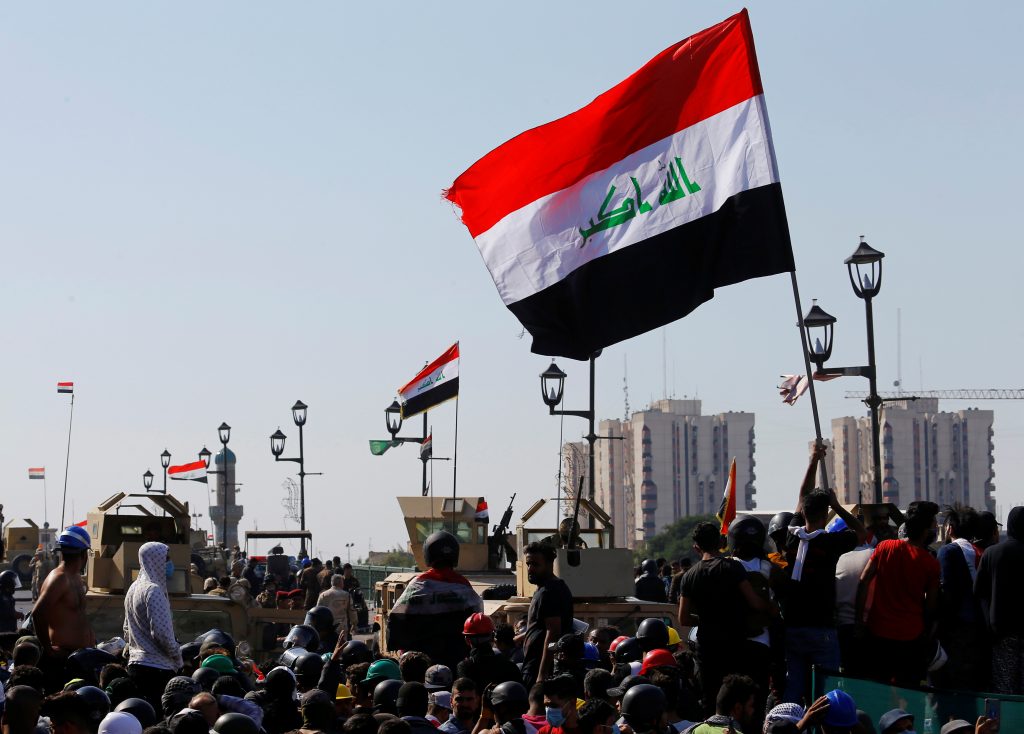
Why Iran wants the Lebanon and Iraq uprisings to fade
Iraqi demonstrators take part in one of the ongoing anti-government protests in Baghdad, Iraq, (Reuters)
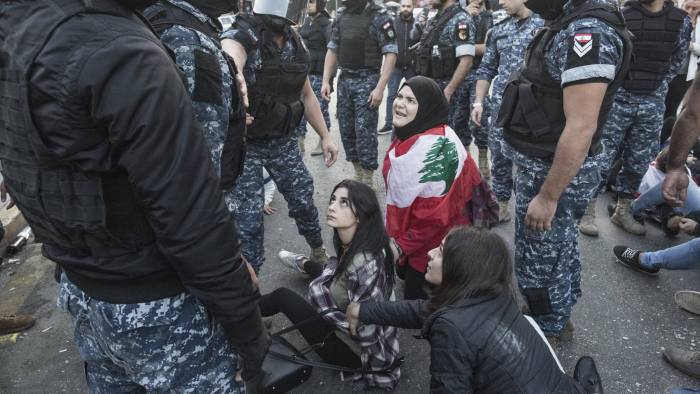
On Tuesday night, 59 people were arrested in Lebanon, protesting in cities like Tripoli, Sidon, Bekaa and Beirut. Serious injuries to protesters took place amidst riot police, broken windows, ambulances and tear gas. Hundreds of thousands of protesters  have come out since last October to pour through the streets, protesting the government's incompetence and Hezbollah's influence; most of all they raged against the presence of Iranian interference in the country.

BEIRUT, LEBANON - NOVEMBER 04: Riot police remove anti-government protesters occupying the
Riot police confront anti-government protesters blocking a main road in Beirut, Lebanon © Getty

There have been nothing like the violence of those riots in Iran, though the protests have been numerous and vehemently expressed in viral antipathy against the theocratic government, the Basij and the IRGC preoccupied with their interference in Syria, Lebanon, Iraq and Yemen, while the nation's economy is in freefall as a result of biting U.S. sanctions and Iranians are suffering privation. People on the streets of Iran's cities decry the dictatorship they suffer under and call for Supreme Leader Ali Khamenei's removal.

In Iraq, a wave of street demonstrations, strikes, marches and occupations begun last October has seen brutal violence causing the deaths of at least 500 protesters, and the injurious wounding suffered by another 19,000, all of which failed to put an end to the protests. Iraq has been coping with its most severe crisis since the 17 years of a U.S.-led invasion and occupation to remove the Butcher of Baghdad, Saddam Hussein which unleashed a sectarian backlash of slaughter.

And then there is Syria and the collapse of a former thriving country whose crumbling into chaotic destruction of its society and its heritage began with a quiet protest by Sunni Syrians over their second-rate status in a minority Shiite-Alawite-dominated regime whose president, Bashar Assad sneered at the 'terrorists' confronting his rule and unleashed chemical warfare, barrel bombs, the targeting of hospitals and schools and markets to convince Syrian Sunnis they have no future in Syria.

Discontent in Iraq and Lebanon is a way to expose Iran's corruption
Getty Images

The common denominator in these Shiite-led countries is their hegemonic relationship with the Islamic Republic of Iran which had set out to form a sectarian alliance of aggressive Islamist strength on its way to achieving power and influence over its Arab, Sunni-majority neighbours. Iranian tentacles throughout the Middle East, from Lebanon and Yemen, Syria and Iraq to Qatar and Turkey has served to roil the geography in an escalating hurricane of Islamist disequilibrium, long predating  the Hellfire missiles from a Reaper drone over Baghdad airport, targeting Qassem Soleimani.

Yet, despite this background of escalating dysfunction, hundreds of thousands of lives extinguished, millions of refugees created, amidst a high-boiling point of distrust and fear born of hatred and vengeance, Western leaders like Canada's Justin Trudeau quail at the prospect of holding Iran to sole and full account for the Quds Force malfunction causing the death of 176 passengers on Ukrainian Airlines Flight 752, killing 57 Canadians of Iranian origin, and countless more Iranian students heading to Canada on student visas.

From Damascus to Beirut, Baghdad to Sanaa, and Gaza included, the Khomeinist regime holds full sway, plaguing the region with its nefarious, violent agenda, exploiting sectarian divisions while continuing to defy injunctions and sanctions against uranium enrichment and technical advancements of the delivery systems in ICBMs. At the same time exhorting its proxies to wreak havoc in the oil fields of Saudi Arabia, while the IRGC speedboats hector and harass shipping in the Persian Gulf and Strait of Hormuz.

So, in fact, the 'escalation' of hostilities does not rest with the current White House administration which has finally departed in earnest from the folly of its previous resident's disastrous 'agreement' for nuclear deterrence of the JCPOA which Tehran endorsed but never intended to implement, succumbing instead to steeper sanctions imposed by the U.S. when it opted to have its satellite militias bomb U.S. bases in Iraq and Syria, never anticipating that this administration would commit to a 'disproportionate' response, which on reconsideration was entirely proportionately appropriate.

Labels: , , , , , , , , , , ,

Friday, January 10, 2020

Canada's Dilemma, The World's Problem

"If the allies are too harsh with Iran there is a risk they could abandon the deal [the Joint Comprehensive Plan of Action nuclear deal] altogether."
"At the same time, Trump can point to this incident [the shooting down of Ukrainian Airlines Flight 752 killing all 176 aboard] and say the Iranians can't be trusted with any weapons. So these three power [Germany, the U.K. and France] really are between a rock and a hard place [trying to convince Iran to honour the JCPOA]."
"[With no diplomatic presence in Iran, Canada finds itself without the capacity] to send a signal by closing an embassy or pulling diplomats."
"This is truly a dilemma in the philosophical sense. There are no good options."
Christian Leuprecht, political science professor, Royal Military College of Canada, Kingston, Ontario

"Trudeau was careful not to call this an act of war or to denounce the Iranians."
"He wants an investigation. But what if dialogue and engagement bears no fruit and Iran stonewalls him?"
"Then the question is how does Trudeau play it?"
Peter Rough, senior fellow, Hudson Institute, Washington, D.C.
Canadian Prime Minister Justin Trudeau arrives for a news conference on January 9, 2020 in Ottawa, Canada. - Prime Minister Justin Trudeau said Thursday that Canada had intelligence from multiple sources indicating that a Ukrainian airliner which crashed outside Tehran was mistakenly shot down by Iran.  Dave Chan / AFP

When the U.S., U.K., France, Germany, Russia and China, with European Union prompting, signed the JCPOA nuclear deal with the Islamic Republic of Iran, it was with the expectation not that Iran would surrender its ambitions for nuclear weaponry, but that its ongoing research would be stalled for a defined period of time before it would once again resume refining uranium to nuclear dimension potential. The agreement stipulated nothing whatever of the regime's technological refinement of ballistic missiles that nuclear warheads would neatly fit on.

Iran's neighbours, well familiar with the Republic's ambitions to declare itself regional hegemon, with primary influence and command, an Aryan Persian Shiite theocracy firmly in control of a majority Sunni Arab neighbourhood, have good reason to fear Iran's aspirations. They have been largely achieved through threat and the spread of terrorism. Its Republican Guard Corps and in specific the Al Quds Force of the IRGC, has sponsored, weaponized and directed proxy terror groups like Hezbollah, Hamas and Islamic Jihad along with Yemen's Houthis.

Its alliance with and support for the Syrian Alawite (Shiite) regime of Bashar al-Assad enabled the Syrian president to massacre over a half million Sunni Syrians, internally displace millions of Syrians and create millions of refugees scattering to neighbouring countries for refuge, with millions finding their way to Europe for haven. Iran's infamous public declarations of its intention to destroy the State of Israel hasn't deterred it from taking a place on committees of the United Nations.

 Ukrainian Embassy, Ottawa, Jan. 9, 2020.  Sean Kilpatrick/The Canadian Press

The volatile, destructive nature of Iran's ruling Ayatollahs, mullahs and imams have created hellish living conditions for Iranians, all the more so that sanctions have been reimposed on the country by the United States, the 'Great Satan', with the current administration determined to ensure that Iran does not acquire nuclear weapons. So, that the Iranian military used a Russian-acquired land-to-air missile to shoot down a passenger jet, deliberately or by misadventure gives a fairly good clue to how dangerous it would be for the world for it to acquire nuclear weapons.

Yet, despite all of this, the West is apprehensive about holding Iran to the same standards of civil behaviour and human rights entitlements as is expected of the rest of the world. How to 'punish' Iran for its vicious transgressions, much less its internal and external terrorism, its ongoing threats to world order, when it already occupies the position of an ostracized, dysfunctional state? Much of the problem lies in the approach of Western countries to the issue of Iran as a violent, threatening misfit of a nation.

Which 'progressive' elements of Western government feel that appeasement and reassurance to the regime is entirely appropriate, failing the most rational test of observers and psychological MidEast interpretation of bully states who view acquiescence to their demands is a sign of weakness, emboldening them to ever greater acts of defiance of civil norms in the belief that their religious beliefs shield them from reprisals and demands to conform to broad social norms and decency.


This satellite photo provided by Maxar Technologies on Jan. 9, 2020, shows the site where a Ukrainian jetliner crashed late Tuesday near the town of Shahedshahr, Iran, southwest of the capital Tehran.
The Canadian Press

Labels: , , , ,

Wednesday, January 08, 2020

The Islamic Republic of Iran -- Death by Misadventure

"[The missiles had 1,000 to 2,000-pound warheads on them, each with significant explosive power and] kill radius."
"I believe, based on what I saw and what I know, is that [the strikes] were intended to cause structural damage, destroy vehicles and equipment and aircraft and to kill personnel. That's my own personal assessment."
"But the analytics is in the hands of professional intelligence analysts. So they're looking at that."
U.S. Army General Mark Milley, chairman, Joint Chiefs of Staff

"It is clear these missiles were launched from Iran and targeted at least two Iraqi military and coalition personnel."
"As we evaluate the situation and our response, we will take all necessary measures to protect and defend U.S. personnel, partners, and allies in the region."
Pentagon statement

"Lacking a modern airforce, Iran  has embraced ballistic missiles as a long-range strike capability to dissuade its adversaries from attacking Iran."
"Iran also has the largest missile force in the Middle East, with substantial inventory of close-range ballistic missiles, short-range ballistic missiles and medium-range ballistic missiles that can strike targets throughout the region as far as 2,000 kilometres away."
Christian Saunders, senior defence analyst, Pentagon

And so, in retaliation for a U.S. drone striking four missiles at a two-vehicle convey setting out from Baghdad International Airport last Thursday to target and destroy Iran's commander of the IRGC Quds Force, Qassam Soleimani who was accompanied by the leader of the Iranian-sponsored militia Kataib Hezbollah and five other Iraqi militia terrorists, Iranian forces launched over a dozen ballistic missiles against two military bases in Iraq with the intention of striking American forces.

Iran has been fuming at the assassination of Soleimani, revered in the country as a national treasure, a warrior for Shiite Islam, and mastermind behind countless bloody attacks by Hezbollah in Lebanon, Hamas in Gaza, extending attack blueprints into Afghanistan, and Yemen, and above all, enabling Syria's murderous President Bashar al-Assad to slaughter a half-million Sunni Syrians. Second in esteem and power only to Supreme Leader Ali Khamenei, Soleimani boasted he would erase Israel and drive the U.S. from the Middle East.

The funeral for Brig.Gen. Qassam Soleimani was attended by hundreds of thousands of Iranians, mourning their martyred champion. When his casket procession travelled to Kerman, the town of his birth, the route followed a narrowing passage insufficient for a fluid advance of the crowds, and panic ensued, people were trampled, and many more Iranians joined Soleimani in martyrdom; over 50 funeral attendees died, and hundreds were injured, delaying his burial.


The Islamic Revolutionary Guard Corps proudly took responsibility for the barrage of missiles that targeted two bases, one in Western Iraq, the other facility in Kurdistan's Erbil, both hosting U.S. servicemen. According to initial estimates, damage to the facilities appears minimal. And while Tehran claims that over 200 American soldiers were killed in the attacks, the White House scathingly gave the number of American casualties as zero; no deaths whatever. As the Pentagon continues to take stock that will be either verified or rebutted.

"They're still in bunker mode", one U.S. official stated, speaking of ongoing assessment of possible damage resulting from the strikes. The Pentagon had anticipated that Iran was prepared to deploy a rising number of "more accurate and lethal ballistic missiles" as its technology evolves. It has supplied quite a stock of missiles to Lebanon's Hezbollah and the other terrorist group, Hamas in Gaza. Both their targets are known to be Israel; threats to Israel's existence by the Islamic Republic of Iran, and by its proxy terrorist groups are well known.

The Anbar base houses part of the five thousand American troops stationed in Iraq, training local forces in conflict practise against the Islamic State, considered to be the ultimate Islamist jihadi terrorist group, on the Sunni divide in Islam. This is as much a sectarian war, rife throughout the Middle East and beyond as the the conflict in Syria reflects. Heretofore, Iran's Quds Force and their militias have targeted its Saudi Sunni regional counterpart's oil interests on land and by sea.

The increasing attacks by the Shiite proxies against U.S. installations notched the situation up substantially, when Kataib Hezbollah launched 31 rockets at a base near Kirkuk killing a contractor and wounding a few U.S. troops. An action following on others that finally persuaded the U.S. military to return airstrikes on targets linked to Iranian-backed forces. When Kataib Hezbollah engineered an attack on the U.S. embassy in Baghdad, triumphantly teaching the U.S. a lesson, it backfired.

The American response was to target Brig.Gen Soleimani and the leader of Kataib Hezbollah. And Tehran, in its disbelief and its grief at the loss of one of its most competent of terrorist strategists became somewhat careless when it allowed missiles to continue crowding the skies over Tehran, even while a Ukrainian Airlines passenger jet with 175 aboard took off and moments later, exploded in the air, falling in pieces to the ground below. Like Malaysia Airlines Flight 17 shot down over rebel eastern Ukraine by a Russian Buk missile in 2014.  Leading to the deaths of all aboard then, and this time around as well.

Unsurprisingly, Tehran is firm in its intention to withhold the black boxes retrieved from the wreckage from scrutiny by Ukrainian or American investigators. Just notch up more deaths resulting from the nefariously deadly schemes of the Islamic Republic of Iran intent on its commanding imperialist agenda of Shia conquest in a Sunni Arab landscape.


Labels: , , , , , ,

() Follow @rheytah Tweet