Politic?

This is a blog dedicated to a personal interpretation of political news of the day. I attempt to be as knowledgeable as possible before commenting and committing my thoughts to a day's communication.

Friday, October 22, 2021

Our World is an Unsafe Place

"NATO faces the most complex security environment since the end of the Cold War. Russia's behaviour remains assertive and destabilising, and terrorism continues to represent a global security challenge and a threat to stability. At the same time, the rise of China is shifting the global balance of power, with implications for the Alliance's security, values and way of life. Growing global uncertainty, more sophisticated and disruptive cyber and hybrid threats, and exponential technological change are having a substantial impact on the Alliance."
"Russia's aggressive actions, including the threat and use of force to attain political goals, challenge the Alliance and undermine Euro-Atlantic security and the rules-based international order. Russia has become more assertive with its illegal and illegitimate annexation of Crimea (2014), the destabilisation of eastern Ukraine, its military build-up close to NATO's borders, its hybrid actions, including disinformation campaigns, and its malicious cyber activities."
North Atlantic Treaty Organization

 
"It has not been more difficult since the end of the Cold War."
"We still have avenues and channels for communications with Russia, but we regret the Russian decision to close the two NATO offices in Moscow, and to also stop their activity at that NATO mission here at NATO."
"NATO's approach to Russia remains the same as before, meaning credible deterrence and defense, combined with efforts to have a meaningful dialogue with Russia."
Jens Stoltenberg, Secretary-General, NATO
 
"This isn't new behavior [on Moscow's part]."
"This is the way of deterrence [the 30-member NATO agreed-upon plan].".
"And this is being adapted to the current behavior of Russia -- and we are seeing violations particularly of the air space over the Baltic states, but also increasing incursions over the Black Sea."
German Defense Minister Annegret Kramp-Karrenbauer
The Kremlin and Russian President Vladimir Putin have long been placed on notice. That occurred when Russian troops violated Georgia's sovereign border and facilitated two breakaway provinces to declare their intentions and re-occurred when ethnic Russian Ukrainians in eastern Ukraine declared their independence from Kyiv and the reassignment of allegiance to the Russian Federation. 'Invisible' Russian troops were there to help and encourage them.
 
And when Russia appropriated the Crimean Peninsula, annexing it as an integral, traditional, historical part of Russia's beating heart, NATO called on its members to pledge their participation -- more symbolic than conflict-ready -- in troops to be stationed in the near-abroad of former Soviet satellites to ensure the Kremlin understood the message, loud and clear. NATO on the periphery of Russian geography, giving assurances to concerned Baltic states.
 
And now a new master plan to defend eastern Europe against potential attacks on presumed multiple fronts. Moscow issuing territorial threats on land, sea and air, a repetition of Beijing's behaviour in the South China Sea, the Himalaya, its contesting of disputed geographic claims with its neighbours. One focus at a time. The strategy's purpose is in preparation for a presumed attack, simultaneously in the Baltic and Black Sea regions by a nuclear-armed, belligerent, former world power.
 
"We continue to strengthen our alliance with better and modernized plans", NATO's Jens Stoltenberg assured Europe, with an added approval of a fund for the development of new digital technologies, in a world where cyber attacks are increasingly becoming the new and preferred mode of intimidation, threat and cyber-war. (Think Estonia) Strictly proactive, preventive, not in reaction necessarily to a presumed near-pending conflict by a Russia which denies intentions of any aggression, accusing NATO itself of fomenting a destabilizing atmosphere.
Uran-9 robot tank
Uran-9 combat unmanned ground vehicle. Image: Vitaly V. Kuzmin/vitalykuzmin.net

The Concept for Deterrence and Defence in the Euro-Atlantic Area, the new strategic master plan, has the approval of European diplomats to NATO who agree that its strategic implementation is a requirement in the face of Russian development of advanced weapons systems, while deploying troops closer to the borders of NATO's allies.  A nervous-making gesture if any were needed, to validate the necessity of such a deterrent plan-of-action. 

More detailed regional plans will be formulated by the final days of 2022, according to an American official, where NATO will determine what further weapons are required and how best its forces are to be positioned. Russia amassed a staggering 100,000 troops on Ukraine's border in May, simulating an invasion scenario, a theatrical tease with sinister overtones. New combat robots were deployed in military drills in September with Belarus, further alarming the Baltic states.

The Kremlin's determination in advancing Soviet military space systems could have the potential to attack orbiting satellites as it develops artificial intelligence technologies that could disrupt allied command systems. In 2018 "super weapons" were unveiled, including nuclear-capable hypersonic cruise missiles capable of evading early-warning systems. Provocative, intimidating, assertive and needful of responsive recognition.
"Russia is pursuing the incremental integration of asymmetric force-multiplier technologies into its established and legacy weapons systems. Meanwhile, the defence industry is developing new systems and capabilities in military robotics and has successfully integrated unmanned vehicles, particularly aerial drones, into its military operations. In the space sector, Russia is pursuing the development of capabilities able to potentially counter and disrupt an adversary’s satellite operations. Finally, AI technologies are being developed with a view to the disruption of Western command and control systems and communication facilities, as well as the establishment of information superiority."
Chatham House
210426-det-def-map-thumb.jpg


Labels: , , , ,

Tuesday, June 15, 2021

NATO, Viewing Beijing Challenges

"China's stated ambitions and assertive behaviour present systemic  challenges to the rules-based international order and to areas relevant to alliance security." 
NATO
 
"I want all Europe to know that the United States is there. NATO is critically important to us." 
"[Russia and China are not behaving] in a way that is consistent with what we had hoped."
U.S.President Joe Biden

"If  you look at the cyber threats and the hybrid threats, if you look at the co-operation between Russia and China, you cannot simply ignore China."
"But one must not overrate it, either ... we need to find the right balance."
German Chancellor Angela Merkel

"China is coming closer to us. We see them in cyberspace, we see China in Africa, but we also see China investing heavily in our own critical infrastructure [ports and telecom networks]"
"We need to respond together as an alliance."
NATO Secretary-General Jens Stoltenberg
 
China's steadily increasing military presence stretching from the Baltics to Africa, alarms NATO. It is presenting "systemic challenges", it announced at the recently-concluded summit with member-nations. The alliance, originally created as a force to defend Europe during the days of the Soviet Union and the Cold War, while still having Russia in its sights, has swerved its attention as well to the actions of the Chinese Communist Party in Beijing.

China is outraged at its global reputation being besmirched by false allegations it claims, emanating out of the G7 and NATO. China, to be sure, finds itself in an awkward position. While it is aggressive and provocative, it also attempts to be ingratiating, helpful, interested in amity and harmony among itself and other nations of the world. The mystery is how it expects to be viewed favourably by democratic
countries when it provokes India over territorial rights in dispute, and does the same with territory in dispute over its claims in the South and East China seas.

There is the Belt and Road initiative whereby China has set out to substantially 'help' poorer countries gain entry to its new 'silk road' economy by handing out loans in generous payback conditions for the building of critical infrastructure; roads, bridges, seaports and the like. Gargantuan sums of financing arranged, which poor countries are eager to take advantage of until they realize they will face enormous difficulties paying back the loans.

China's generosity evokes gratefulness in those it assists, even as it creates conditions of loyalty to its agenda with a frisson of resentment at both the dependency on China's largesse and a burden of unaffordable repayment. One of the issues at the G7 summit was the announcement of a global infrastructure plan meant to counter China's Belt and Road Initiative by a more generous plan the G7 collective would design and initiate without crippling recipient nations' fragile economies.
 
 
China's soft power and its hard power, both on full display, has earned a lash-back from the influential, wealthy democracies that once harboured the hope and expectation that China would join the world of orderly, restrained, cooperative world politics. Instead, its insatiable hunger for resources, territory, influence, control and respect while marauding other nations' secret military, industrial, scientific and social secrets and indulging in cyberintelligence theft has aroused suspicion and push-back.

China's soft power seen in its vaccine diplomacy with the potential to raise its reputation worldwide, has boomeranged. Sinovac and Sinopharm shipped COVID-19 vaccines to Africa, Asia and the Middle East, occasionally cost-free as a gift, to mollify global opinion over suspicions that the virus that appeared in Wuhan was poorly handled to prevent it becoming a pandemic. Apart from the fact that China's generosity with its vaccines failed to gain it acclaim, partially on the basis of their low efficacy, that impact fizzled even as the world demands more clarification over SARS-CoV-2 origins.

The origins secrecy and deceptions succeeded in renewing calls for deeper investigations, and for China to hand over documents it refused to release to the World Health Organization investigators when they travelled to Wuhan for their initial report which ended up being inconclusive in reflection of that lack of cooperation, while keeping the investigators under their watchful eye and pressing thumb. China remains obdurately obstructionist.

A round of sanctions developed based on a number of glaring issues that Beijing declares to be of no outside interest to anyone or any nation other than China. They include the 're-education' and slave labour imposed upon the Xinjiang Uhghurs and other minority Turkic Muslim populations whom China is committed to de-Islamizing, and re-Communizing for full integration into Chinese CCP culture and social-political expectations of all populations within China. 
 
Courtesy Reuters
 
Beijing's unification threats to Taiwan, its bulldozing of Hong Kong's move toward full democritization, its provocations against its neighbours in disputed territorial ownership, its aggression over international G5 telecommunications and Internet servicing by Huawei and its grudge-fights against countries like Australia and New Zealand, its aggressive interest in the Arctic for navigable trade routes, all arouse suspicion over its ultimate goals. Its micro-military skirmishes with India over Himalayan-area border issues, its strengthened alliance with Russia, altogether paint an unsavoury picture of entitlements.

And then there is the massive expenditure on military infrastructure, modernizing and ultra-equipping its military, on land, sea and air. Western democracies have painted themselves into a troublingly unpalatable position. On one hand, trade and manufacturing and services alongside political infiltration have woven a web of interdependence. Wealthy countries are indebted to China for its production capabilities, even while they welcomed Chinese investment in critical national enterprises and natural resources.

If and when they 'cut off their nose' it will be to spite their face.

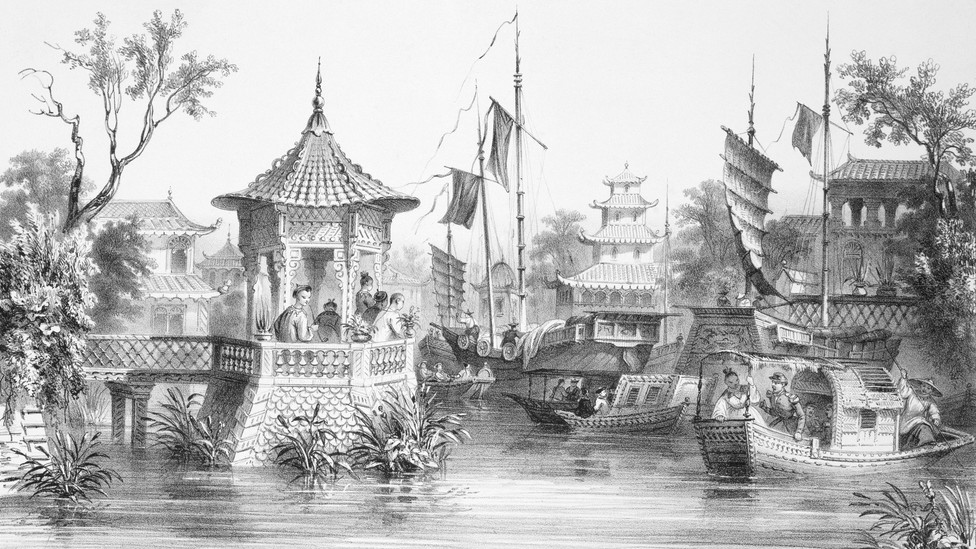
Lithograph View of Canton or Guangzhou
The arrival of the Portuguese in Guangzhou, pictured here, in the early 16th century. (Corbis Historical / Getty)

Labels: , , , , , , , ,

() Follow @rheytah Tweet