Politic?

This is a blog dedicated to a personal interpretation of political news of the day. I attempt to be as knowledgeable as possible before commenting and committing my thoughts to a day's communication.

Thursday, October 08, 2026

So, Mr. Putin, How's Your 'Special Military Operation' Faring?

"Putin has the view that by summer the situation in Europe will change and support for Ukraine will fall away."
"This gives the Kremlin the motivation to continue its brazen attacks."
Mikhail Khodorkovsky, exiled London opposition figure
 
"We will take the path of escalation [to deter Europe]. As well as strikes on Ukraine to take full advantage of the lack of missile defence." 
"[Efforts to restart peace talks were going] nowhere." 
Unnamed Russian official
 
"[Moscow was stepping up an aggressive] shadow war [against Germany to undermine its support for Kyiv]."
"Russia is putting us to the test and closely watching how we handle this situation."
"From the perspective of the Kremlin leadership, any sign of wavering invites them to further increase the pressure on Germany."
"We have to stand up to that."
German Federal Intelligence Service chief Martin Jaeger 
 
"Look at what's happening with the economy."
"Look at what's happening to social policy, with the living standards of citizens of the biggest European states."
"In these conditions they have to ... switch the attention of their citizens from internal problems to problems of an external nature."
Russian President Vladimir Putin
https://i0.wp.com/cepa.org/wp-content/uploads/2025/11/3D1W3PY-1-scaled.jpg?resize=1512%2C933&ssl=1
The Russian leader has set out his demands: Europe must bend the knee, or the war will go on and on and on. Center for European Policy Analysis

Europe has its growing problems that must be dealt with. That's the Europe that has been solidly behind Ukraine in its existential counteroffensive against Vladimir Putin's aspirational territorial goals. There is political upheaval in Germany, and France is faced with escalating violent student riots, and Britain seems increasingly politically unstable to name but a few. All of which lead the Russian president to believe that playing his cards right will result in the fatigue that is growing among Kyiv's supporters coming to a crisis level where they can no longer offer the munitions and the funding they've been doling out as generously as they can, over the past four years.
 
Waging war is never cheap, and Russia's own economy is struggling with the international sanctions that have dampened its economy; a yawning budget deficit must be met with some manner of solution; war funding on borrowed time and burdening future generations call for a scheme that can undermine the solidarity that Europe has shown toward Ukraine allowing it to fend off Russian attacks and to successfully mount their own within Russia. 
 
With the Russian military striking at Ukraine's civilian infrastructure; schools, power plants and bridges with their jet-powered drones and ballistic missiles, Mr. Putin feels in striking distance of his goal -- if he can only demoralize the Ukrainian public sufficiently, and with them the European public wearying of supporting beleaguered Ukraine. Russia's war-weary citizens, insecure themselves never knowing when a Ukrainian drone will strike even in Moscow, and the waning economy does not so much perturb Putin that he feels any need to curtail his ambitions, certain as he is that he is within striking distance of his goal.
 
Irritatingly, despite the Trump administration's lack of interest in supporting Ukraine, bolstering Moscow's own determination to proceed as charted, German Chancellor Friedrich Merez, visiting Kyiv unexpectedly, announced another $1.5 billion in funding aid to Ukraine. With the far-right Alternative for Germany opposing aid for Ukraine breathing down his neck, his own political future is uncertain.  "Promising further billions in German taxpayer money that is missing from the pension and health insurance funds, while Germany is mired in its worst energy crisis. It's all too much to fathom", wrote Alternative for Germany's co-leader Alice Weidel, in her criticism of Germany's leader.  
"Meanwhile, there is little for Moscow to celebrate on the battlefield. Ukraine has regained the upper hand in drone warfare, inflicting more fatalities on Russian forces. At the same time, recruitment of new soldiers is likely slowing, as even rising contract-signing bonuses may no longer tempt the shrinking pool of po    tential volunteers. As a result, Russia is beginning to struggle to replace its battlefield losses." 
"Ukraine also faces personnel shortages but has nonetheless managed to stabilise the front line, seize the initiative in some areas (such as around Huliaipole in the Zaporizhzhia region) and will now have the resources to strengthen its defences thanks to major new financial assistance from the EU."
Ondrej Ditrych, European Union Institute for Defence Studies  
Now, post-'election' and firmly back in his throne for another 30-or-some-odd years, Putin having spoken of returning to talks post-election, now claims that during the election, Ukraine's drone attacks were responsible for cancelling prospects for any new ceasefire talks. Moscow's actions, said Merz, signalled "Russia's desperation in the face of its unsuccessful war in Ukraine". Once again threatening attacks on Europe and nuclear warnings according to some analysts, signals Moscow's desperation, with its finances under strain. 
 
Claiming a week ago, spurred by a British documentary series that depicts a fictional war game exercise, that it had information that NATO was preparing an "air and naval blockade" of Kaliningrad, the Russian Foreign Ministry gave warning to the western alliance that his country was "prepared to respond to any efforts to isolate its Baltic enclave with all its arsenal, including nuclear weapons". In response, NATO accused Moscow of "irresponsible nuclear rhetoric". 
 
The Belgian Defence Minister predicted "a dark winter ahead", while Denmark's defence intelligence service gave warning of "a low but growing risk that Russia will launch a limited military attack against one or several NATO countries on its border in the coming months". Russia's hybrid attacks in its low-decibel shadow war against Ukraine's European friends and neighbours have made them all nervous, particularly the Baltics. 
"[Putin is counting on] crises mounting."
"And that the current leaders who are seen as anti-Russian and inadequate just won't be able to cope."
"[The Kremlin is operating on] the understanding that there are different forces in Europe, and that there are those who don't want the situation to escalate to nuclear confrontation."
"[Moscow's policy on Europe has become] schizophrenic. Putin is signalling that there is an official and unofficial line that we don't want to go to war with Europe [while warning that] we have nuclear weapons if you will continue arming Ukraine and build around us all kinds of military infrastructure and threaten Kaliningrd and so on." 
"[But all Putin really wants, is for Europe to become] more pragmatic [and follow the path taken by U.S. President Donald Trump]."
Tatiana Stanovaya, senior fellow, Carnegie Eurasia Russia Center 

https://www.iss.europa.eu/sites/default/files/styles/extra_large_focal/public/2026-04/Putin.jpg?h=ec041e41&itok=ctnCgjNy
Russia’s economy is not yet collapsing. Nor is its military campaign against Ukraine. But the Kremlin is mortgaging the country’s future as underlying structural weaknesses in the economy begin to emerge. European Union Institute for Security Studies


Labels: , , , ,

Saturday, October 03, 2026

"No Rules Now" Putin's Latest Assaults on Human Rights

"The capital is in a very dramatic situation."
"It's no longer possible to pretend that we can live now as we lived in peacetime."
"The enemy is tearing Kyiv apart."
Kyiv Mayor Vitali Klitschko 
 
"The Russians couldn't occupy us. So now they are doing massive attacks and massive killings."
"They are increasing the number of people they recruit through various methods. It is important that the governments of countries from which Russia recruits people for its army take action against this." 
"New interceptors are being actively tested. Some combat groups are using them, but, of course, some details still need to be refined to achieve enough effectiveness and scale. "
"We are speeding up the developers." 
Ukrainian President Volodymyr Zelenskyy 
https://i.cbc.ca/ais/8f3ef6b9-ebaf-4567-8ade-8b8bd427037d,1790628504705/full/max/0/default.jpg?im=Crop%2Crect%3D%280%2C873%2C8576%2C4824%29%3BResize%3D860
Flames are seen at Kyiv's Dobrobut Hospital on Monday in the aftermath of a Russian drone strike. (Evgeniy Maloletka/The Associated Press)
 
What is left of the 8,000 North Korea soldiers sent over to fight with Russia against Ukraine, is being fortified with the arrival of another 10,000 North Korean military operatives, as Russia ramps up its recruitment efforts for its ongoing offensive. The plan is to strike civilian infrastructure as the Russian military has always done, but now the focus has turned to Kyiv, which up until a short while ago managed to escape most of the missiles and drones targeting other parts of Ukraine.
 
Residents of Kyiv, while becoming accustomed to energy infrastructure hits, particularly in the winter months -- meant to demoralize them, suffering from unheated interiors and difficulties with food preparation in freezing weather -- were mostly able to go about their business as usual, as soon as energy was restored. During aerial attacks, people flooded into shelters, where the subway system tunnels proved a great asset. More latterly, however, transportation systems have been targeted to fully interrupt illusions of normalcy.
 
More recent aerial strikes have brought a standstill to traffic with a bridge linking Kyiv's east and west put out of commission. A fuming Volodymyr Zelenskyy once again ripped Vladimir Putin for his savage attacks on civilian areas in Ukrainian cities. The grinding conflict reaching into its fifth year with Moscow ordering massive nighttime raids whose effects are the destruction of municipal infrastructure, apartment buildings, government offices have reached a new low in violations of international rules of war. President Zelenskyy revealed Putin having declared "no rules now", gained through intelligence.
 
The ground combat in the east has morphed into a focus on massive aerial attacks, which until latterly Ukraine managed to mostly intercept, with most damage on the ground caused by pieces of shrapnel, from exploded missiles and drones. Russia's production of a new type of drone based on the Iranian Shahed, have been proven all too difficult to intercept. Their speed and deadly impacts allow them to evade interception and strike their targets with efficient violence.
 
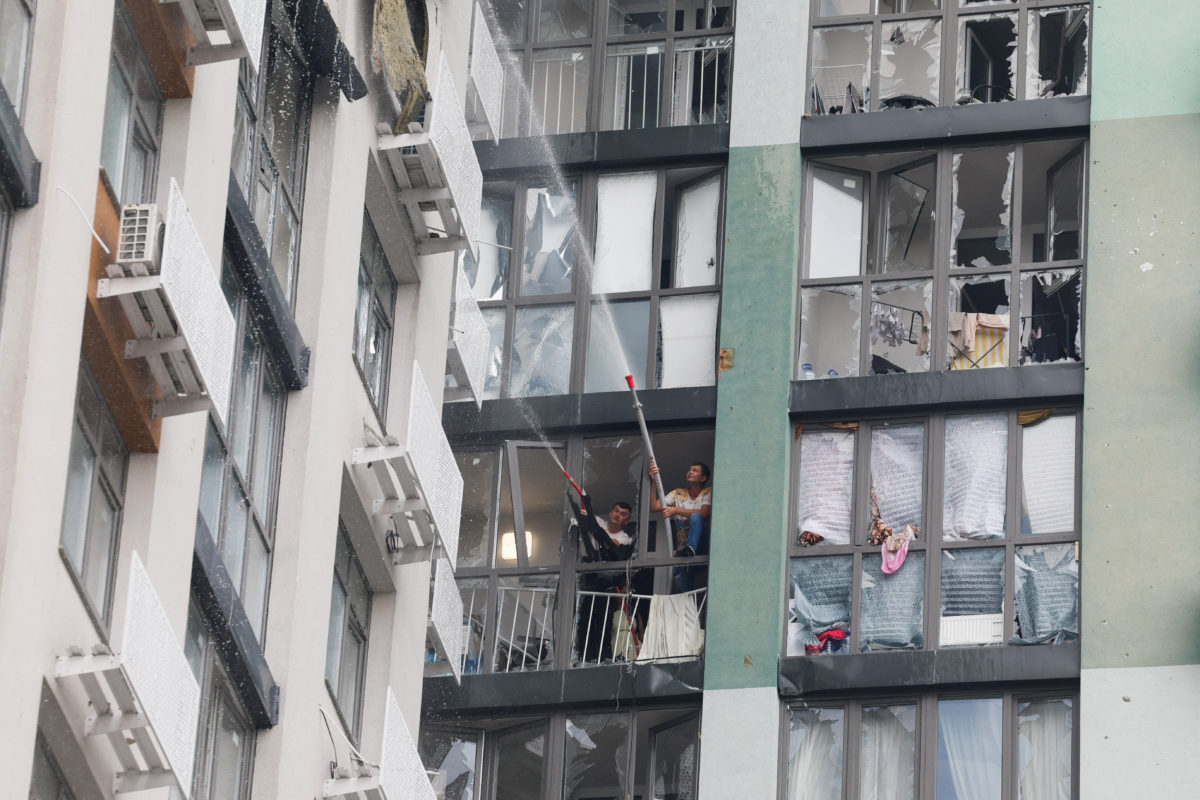
In Kyiv the closure of its main bridges and restricted movements follow yet another wave of deadly strikes by fast-moving, jet-powered drones. Main roads are gridlocked while commuters seek out alternative routes or simply abandon their vehicles and attempt to walk to their destinations. Of eight bridges connecting Kyiv east and west over the Dnipro River, because of those damaged, vehicles going in both directions can move neither backward nor forward.  
 
https://i.cbc.ca/ais/57786ae6-6ce1-4962-bd25-941426820d2c,1790628816379/full/max/0/default.jpg?im=Crop%2Crect%3D%280%2C0%2C5500%2C3668%29%3BResize%3D796
A man escapes from an administrative building in Kyiv which caught fire after being hit by a Russian jet-powered drone. (Thomas Peter/Reuters)
 
The aerial bombardments of recent months have placed Ukraine's capital city on constant alert, daily life completely disrupted. Approaching aerial threats cause air raid sirens to sound close to constantly throughout the course of a day, allowing an estimated three minutes for residents to seek shelter. Trains and gas stations have suffered repeated strikes. Rail and road networks have been hit, and attacks on energy facilities constantly threaten power and heating outages with the approach of a Ukrainian winter.
 
Some city residents, given the continual raids, have been forced to spend overnight in subway stations. People face air raid obstacles to reaching their work sites during the day, the loss of earnings added to the trauma faced now on a daily basis. "You just spend the whole day feeling completely beaten down", remarked one woman who spent fruitless hours attempting to reach her place of employment. This, as a 24-storey residential building was hit in southeast Kyiv, killing several and injuring many.
 
https://img.i-scmp.com/cdn-cgi/image/fit=contain,width=1024,format=auto/sites/default/files/d8/images/canvas/2026/10/01/d5cc5f60-3a73-4aab-bc8b-e7621422e5ad_a2821129.jpg
Intercepted jet drone, Kyiv.
President Zelenskyy calls for urgent measure to be taken for tougher sanctions to prevent Russia from its manufacture of the jet-powered drones, so difficult for Ukraine to intercept. Just days ago, the Ukraine military was able to use its own FP-7 tactical ballistic missile for the first time in combat. A small hint of future manufacturing success to come, but in the meanwhile, pleading with  Ukraine's western allies for greater military support, in particular for U.S.-manufactured Patriot missile interceptors.
 
Even as Ukraine buckles, but does not collapse under the newer and more powerful Russian attacks, Ukraine's military struck an oil refinery in Volgograd, and another in Samar, in southwest Russia. Disabling their capacity to supply fuel to Russian forces.   
"[Russia's production of jet-powered drones are] critically dependent [on foreign components."
"Every Russian drone can actually be stopped right at the production line. What is needed is the political will of these countries." 
Ukrainian President Volodymyr Zelenskyy  
https://i.cbc.ca/ais/6c31f57e-9fc4-48f7-8153-71c58582b21a,1790629183530/full/max/0/default.jpg?im=Crop%2Crect%3D%280%2C0%2C7197%2C4793%29%3BResize%3D796
Ukraine's National Academy of Science building burns in Kyiv after a Russian drone strike. (Dan Bashakov/The Associated Press)


Labels: , , ,

Thursday, October 01, 2026

Putin's Costly 'Special Military Operation'

"[The rise in spending] comes as no surprise."
"It's not just about 'retaliatory strikes'. Simply put, more munitions are needed if the goals of the Special Military Operation are to be achieved."
Evgeny Suvorov, chief economist, CentroCredit Bank, Moscow
 
"[The ministry revealed last week that the budget plan would] ensure the provision of necessary weaponry and military hardware to the armed forces, the payment of allowances to military personnel and support for their families, and the modernization of defence industry enterprises."
Finance Ministry press service
https://www.reuters.com/resizer/v2/SC6NGCYJDJN25PWZ76F6BLLRJM.jpg?auth=3b735659d834194a01e158241c97ba46b73bbade27cee55b79d65ea2e76f6127&width=640&quality=80
A Russian MiG-31 fighter jet flies in the international airspace over the Gulf of Finland, September 24, 2026. Swedish Air Force/Finnish Air Force/Handout via REUTERS/
 
"Russia continues its reckless campaign of hostile actions against NATO allies. It is trying to weaken our resolve and stop our support for Ukraine."
"But Russia is failing. It is failing on the battlefield in Ukraine and it is failing to undermine our unity and support for Ukraine."
NATO Secretary-General Mark Rutte  
On the sidelines of Moscow's invasion of Ukraine, Russia has been teasing and testing NATO member countries, particularly its close East European neighbours in the Baltic region. Estonia has concluded an investigation into an arson attack on August 15 against Milrem Robotics, an Estonian defence manufacturer producing ground drones used by Ukraine. "We can conclude with certainty" stated Estonian Foreign Minister Margus Tsahkna, "that the arson attack ... was an act of sabotage ordered by the special services of the Russian Federation".
 
Milrem Robotics located in the Estonian capital Tallinn, had a fire break out in a building for which it has concluded Moscow's responsibility. "Baseless, absolutely no relation to reality. We cannot and will not take such statements seriously", responded Kremlin spokesman Dmitry Peskov in response. Russia has been repeatedly accused of hybrid provocations since its 2022 invasion of Ukraine. Latvia, Lithuania and Estonia have increased their defence investment as a result. "Moscow is trying to scare Europe into winding down its support for Ukraine. This will not happen", stated Christian Wigand, European Commission spokesman. 
https://s.yimg.com/lo/mysterio/api/17fd953a9de7a75327dcda815eddf57fe48da451d5aa7f7afcf6d293c11f39ca/lightyear_networkapi/resizefit_w960%3Bquality_80%3Bformat_webp/https%3A%2F%2Fmedia.zenfs.com%2Fen%2Fnewsmax_809%2Fa5e1cebd932a59d7ea325d2f7f506821.jpg
(DMITRY KOSTYUKOV/Getty Images)
 
War is a costly business on all sides. Vladimir Putin is so engrossed in saving Ukrainians from the grip of their 'neo-Nazi' government that despite Ukraine's courageous and effective counteroffensive to the conflict reaching into its fifth year -- discounting Moscow's 2014 annexation of Crimea and much of the Donbas, and the loss on both sides of tens of thousands of military personnel -- he grinds on with his goal. It is Ukraine's vast territory, its agricultural land and natural resources that Putin slavers over.
 
A scarcity of fighting manpower, the cost attendant on firing countless missiles and drones to defeat Ukraine's resolve to meet the challenge its neighbour poses and exit the war intact, has cost Russia dearly. Nothing deters Putin's territorial ambitions. He is prepared to continue pouring more resources -- both manpower and financial -- into the war he has inflicted on Ukraine. Plans are underway at the Kremlin to boost military spending by over 25 percent, even as Ukraine has succeeded in penetrating deeper into Russian territory.
 
Military spending reflecting Putin's new draft budget now stands at 17.1 trillion rubles (some $288 billion) for the coming year. War spending will sit at roughly 35 percent of the country's 48.8 trillion rubles in total expenditures. Moscow has been forced to spend greater sums just on protecting itself even as it relentlessly continues to attack Ukraine's cities, aiming for its electrical grids as winter approaches to once again demoralize Ukrainian citizens left without heat and cooking facilities during its long cold winter.
 
For its part, Kyiv continues its winning strategy of sending missiles and drones further within Russia, targeting oil refineries, logistics hubs and warehouses. Russia must respond to increase costly air defences, and stepped up its attacks on crucial Black Sea ports for Ukraine, and hitting urban centres which it claims are really military depots. Ukraine's targets of Russian oil facilities have caused pain in a gasoline shortage across the country.
 
Russia's air defences, the advanced systems protecting Moscow included, have been tested by large scale drone attacks, courtesy of Ukraine. The massive military casualties that Russia has suffered have failed to translate to progress on the battlefield. Russians now spend sleepless nights in worrying over a new mobilization, with the new parliament back in session, when an overwhelming 'democratic process' voted Vladimir Putin back in power. 
 
https://static.themoscowtimes.com/image/article_1360/0c/putin23p974129736.jpg
Russia plans to spend 17.1 trillion rubles ($202.58 billion) on defense in 2027, around 27% more than the 13.5 trillion rubles originally budgeted and the highest figure since the start of the war in Ukraine in 2022, government documents seen by Reuters showed on Monday.  Reuters
 

Labels: , , , , , ,

Monday, September 14, 2026

Unending Air Raid Alerts in Ukraine

"In many cities and communities, air raid alerts practically do not stop because of the threat of Russian jet-powered drone attacks."
"The Russians have found a new way to escalate, and they have no intention of slowing down."
Ukrainian President Volodymyr Zelenskyy 
 
"Countermeasures against jet drones are ongoing."
"New drones have passed field tests The task is to scale production as quickly as possible."
Ukrainian Defence Minister Yevhenii Khmara
 
"There are no suburban trains, no metro."
"But it is much worse for patients, for whom medical care will become less accessible due to the inability to get to a doctor."
Kostyantyn Kuts, 39, neurologist, Boryspil  
https://i.cbc.ca/ais/5fcd7100-467d-4955-a18f-5c67b1348ddf,1788179140679/full/max/0/default.jpg?im=Crop%2Crect%3D%280%2C388%2C5549%2C3121%29%3BResize%3D860
Smoke rises in Kyiv, Ukraine, during a Russian drone strike on Aug. 31, 2026. (Gleb Garanich/Reuters)
 
The Kremlin's bombing strategy has been altered. Where at one time Moscow focused on night-time attacks, its decision to swarm  Kyiv with relentless barrages of drones throughout the day has resulted in no relief for residents of the capital at all. No longer are they able to go about normal daytime activities; school, work, shopping. The around-the-clock barrages has hampered 'normal' life for the three million people who reside in Kyiv.  
 
Public services have been interrupted, even as the risk of civilian casualties rises. Public morale is plummeting in anticipation of oncoming winter and the thought turns to Russia once again targeting the public energy grids making for an impossibly long winter of freezing interiors, dark rooms and crude cooking conditions. Moscow claims it is interested only in striking military facilities, and weapons depots while continuing to target apartment buildings and civil infrastructure.
 
Ukrainian authorities are fully expectant that Russia will increase the use of jet-powered drones. "We will certainly need to adapt. This will take time", admitted Pavlo Palisa, deputy chief of President Zelenskyy's office, acknowledging the fact that Ukraine has not yet reached the point of competence in countering those deadly drones. Entering its fifth year of conflict, Ukrainians can be forgiven for succumbing to war-mandated deprivation fatigue.
 
The situation has stagnated, with neither side making any progress on the battlefield, turning instead to striking deeper into the other's territory, for citizen demoralization and exacting a war toll of scarcity, in hopes of forcing the other side into negotiations. Businesses and warehouses on both sides have become targets in the latest air war tactics. The aim is to cripple the economy, fuel public discord and cause panic buying. 
 
While Ukraine has targeted Russian e-commerce giant Wildberries facilities and that of its competitor Ozon, following air strikes on oil refineries causing gasoline shortages, Russia has returned the compliment with attacks on the largest retailers in Ukraine where shortages of some products have resulted. Now, Russia has turned to jet-powered Shahed drones, faster than propeller-drive versions. 
 
https://www.thetimesunion.com/wp-content/uploads/2026/08/4745729-691087353.jpg
The growing use of daytime drone waves has created a different kind of disruption for Kyiv residents, Times Union
 
The routine that had developed in Ukraine's cities during the times of nighttime attacks where the population emerged during the day to resume their lives has been completely upended. People are now forced to adapt to their new reality, living from one alert to the other, second-guessing walks and spending nights in subway stations deep underground, recalling the early days of the war. Even as regular attacks on Ukraine's energy infrastructure continue when water and electricity are cut off. 
 
Additional concerns have arisen over Russia's new tactic of hoarding ballistic missiles, switching over to jet-powered drones. That Moscow now stockpiles ballistic missiles to be unleashed in the winter months to destroy energy and heating infrastructure to make for fewer critical amenities available to residents once again this coming winter, is everyone's nightmare. Particularly in the face of Ukraine's interceptors shortage to stop ballistic missiles hitting their targets.
 
https://images.firstpost.com/uploads/2026/09/blobhttpsweb.whatsapp.comb4bdd32e-b2c6-44aa-998b-ebdae9810f7e-2026-09-09T112702.466-2026-09-7ad363868e14947c65954088b396a55f.jpg?im=Resize,width=720,aspect=fit,type=normal
A man carries his bicycle as he past firefighters pushing out a fire following Russian missiles strikes in Kyiv early on September 8, 2026, amid the Russian invasion in Ukraine. (AFP)
  
"Every day now resembles the movie 'Groundhog Day', due to the number of alarms, explosions and descents into the basement."
"I, my mother and sister are fourth- and fifth-generation Kyiv residents."
"We will be in our land until the end."
Lika Modebadze, 18, high school student, Kyiv 

Labels: , , , , ,

Thursday, September 10, 2026

Russia Killing Ukrainians From The Skies

"[Putin presented an] objective and detailed analysis [of the frontline situation]."
"[Putin] pointed out what the Americans could realistically do to bring the hostilities to a swift conclusion [and stressed that Russia had] no aggressive plans [toward Europe]."
Kremlin aide Yuri Ushakov
 
"The moment the U.S. president's peace envoys left, Putin launched another massive, horrific attack against Kyiv."
"His ballistic missiles speak louder than his words on diplomacy."
Ukrainian Foreign Minister Andriy Syubiga
 
"It was very terrifying, we barely managed to run into the parking lot."
"The parking lot was shaking all over."
"[My car was] burnt to ashes."
Nina Kimova, 55, Kyiv 

https://images.euronews.com/articles/stories/09/90/66/56/750x500_cmsv2_7b1f15fc-b977-5ddf-8b7b-fb819fc00400-9906656.jpg

Firefighters work to extinguish a fire in a destroyed household chemical warehouse following a Russian missile and drone attack in Kyiv, 8 September, 2026 AP Photo 

According to the Kremlin, the Ukraine conflict was discussed between Russian President Vladimir Putin and U.S. President Donald Trump in an hour-long telephone conversation that was "extremely frank" and constructive. A Kremlin spokesperson described Mr. Putin's part of the conversation describing the frontline in his determined effort to subjugate Ukraine to his territorial aspirations of annexing as much of his sovereign neighbour's geography as possible, as 'objective'. The two countries -- the attacker and the defender, appear at this juncture to be in a stalemate, but the Russian aggressor holds to the fiction of reaching his objective.

Hoping to kick-start a fresh opportunity for talks between Moscow and Kyiv, negotiators Steve Witkoff and Jared Kushner left Moscow, their mission for the Trump administration at its own stalemate. Moscow will stick with its president's demands that Ukraine agree to Putin's annexation of all of the eastern Donbas, even those parts that continue to be held in the Ukrainian counteroffensive, and that Ukraine surrender its ambitions to join NATO. Understandably, Ukraine will have none of it.
 
Yet Kyiv is willing enough to resume the talks even while the Kremlin states it is "too early",  holding out as long as possible, while under U.S. pressure, to gain more of the ascendancy in grasping Ukrainian territory to fulfill Putin's ambition. According to Putin, Russian troops are steadily advancing across the entire front; it is a mere matter of time before all of the eastern Donbas falls to Russia. Giving assurances to the U.S. negotiators that beyond Russia's need to rescue Ukraine from its neo-Nazi leaders, there is no intention to pose a threat to any other European country.
 
https://d3i6fh83elv35t.cloudfront.net/static/2026/09/2026-09-01T084233Z_384486850_RC28ANAG6OZR_RTRMADP_3_UKRAINE-CRISIS-ATTACK-KYIV-1200x800.jpg
Samya Kullab, Associated Press
 
Ukrainian President Volodymyr Zelenskyy makes no secret of his wish to resume face-to-face talks with the critical aim of ending the conflict, despite Putin's reluctance. "If all sides agree, we also want to hold it (negotiations) in the autumn. If September works out, then it would be great. The earlier, the better", he enthused hopefully, despite the abysmal failure of earlier negotiation rounds.
 
As soon as the U.S. negotiators left, Russia lost no time in carrying out what it termed a 'massive strike' on what it described as military-industrial sites, logistics hubs and storage centres located both in Kyiv and its near suburbs. The result of these unending strikes at civilian areas by Moscow has been unprecedented carnage with civilian deaths at their highest since the first months of the Russian 2022 offensive, according to the United Nations.
 
What Ukraine hopes for, and has the U.S. on board with, is to convince Moscow/Putin to reach for peace before winter sets in. Memories are raw for Ukraine of Russia's predictable attacks on the country's civilian energy grid, cutting power and heating to millions of Ukrainians at a time when temperatures sink as low as -20 Celsius. Kyiv has stated time and again it has no intention of capitulating to Moscow's demands to cede its  territory to Russia. Back to square one. 

https://www.aljazeera.com/wp-content/uploads/2026/07/afp_6a45c2dd7b60-1782956765.jpg?resize=770%2C513&quality=80
At least 18 dead as Russia launches massive drone and missile attack on Kyiv The Guardian

"Russia's war is becoming more ruthless and destructive, but it's unfortunately not closer to ending." "Russia's army is bogged down on the ground, and that is why they are killing civilians from the skies."
EU foreign policy chief Kaja Kallas

Labels: , , , ,

Friday, September 04, 2026

Russia's Jet-Powered Drones

"Last month, according to our statistics, there were 1,500 jet UAV attacks. This month, we've already counted 3,000 jet drones."
"Based on our intelligence data, the Russians have plans to produce 36,000 to 40,000 UAVs per yer -- that is, more than 3 ,000 per month."
"It's safe to say they have already reached that production capacity."
Serhiy Beskrestnov, adviser to President Volodymyr Zelenskyy 
 
"[Such strikes have] once again highlighted a critical issue facing Ukraine: The Armed Forces of Ukraine have reached a breaking point regarding their shortage of surface-to-air missiles."
"Missiles are more expensive and complex to manufacture, making their daily use unfeasible. Geran drones, however, offer an immediate operational advantage."
"Looking long term, with the potential for production and launch capacities up to 5,000 units per month, they can be used to exacerbate the air defence shortages and intensify strikes on Ukrainian territory."
Mikhail Zvinchuk, Russian military blogger 
https://csis-website-prod.s3.amazonaws.com/s3fs-public/styles/1400x600/s3/2026-09/AdobeStock_784602357_cropped.jpg?VersionId=2ykd4HGx8c2t2W_CH5b2mWVmSOYrj1md&h=266da715&itok=Dq2IBgTn
From Shahed to Geran: Russia reinvents the One-Way Attack Drone  Photo: Anelo/Adobe Stock

"We'll give them the right to make Patriots. We'll show them how to do it", said U.S. President Donald Trump, pressed by Ukrainian President Volodymyr Zelenskyy to do more to help Ukraine defend itself from Russian attacks on its civil infrastructure, missiles and drones hurled in great numbers at Ukrainian cities throughout the vast geography of the nation. Then came the qualifier: "advanced technology is a hard thing to give  away". 
 
Over 2,800 jet-propelled drones that fly twice as fast as less advanced ones, were launched in numbers meant to overwhelm Ukraine's defences, to force Kyiv to resort to more high-tech methods for self-defence. More than half of the unmanned aerial vehicles (UAVs) that Russia launches now to "wear down" Ukraine are jet-propelled. "There were almost 1,500 drones of all types in these four days alone, about 800 of them jet powered", stated President Zelenskyy. 
 
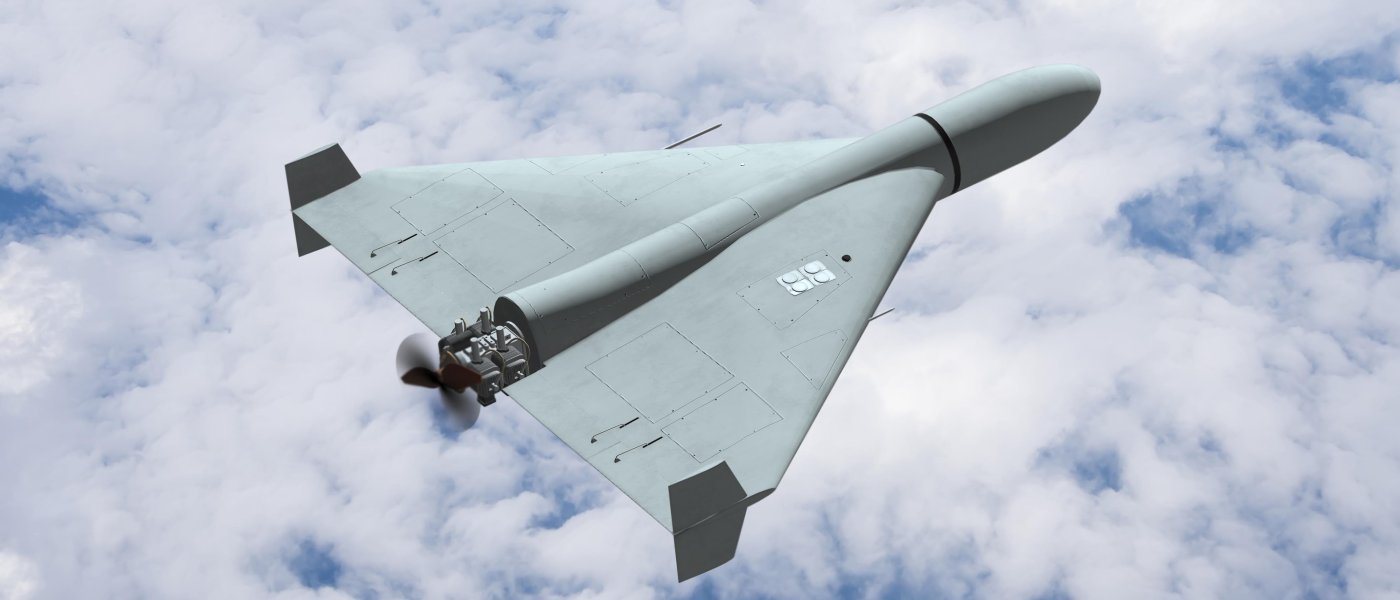
Developed from basic Iranian Shahed drones, the Geran-4 and Geran-5 models are capable of speeds of up to 400 kilometres per hour. Ukrainian forces scrambled combat aircraft at times in an effort to repel them. The role of these drones underlines Russia's alliance with Iran; emphasized when Russian President Vladimir Putin met with Iranian President Masoud Pezeshkian earlier this week.  A Russian Geran-4 drone struck a munitions warehouse in a village outside Kyiv over a period of several hours, killing 38 people, this past week.
 
https://gdb.rferl.org/e43e7b9c-5de2-4c7d-a5b5-08debadd8a36_cx0_cy7_cw0_w1023_r1_s.jpg
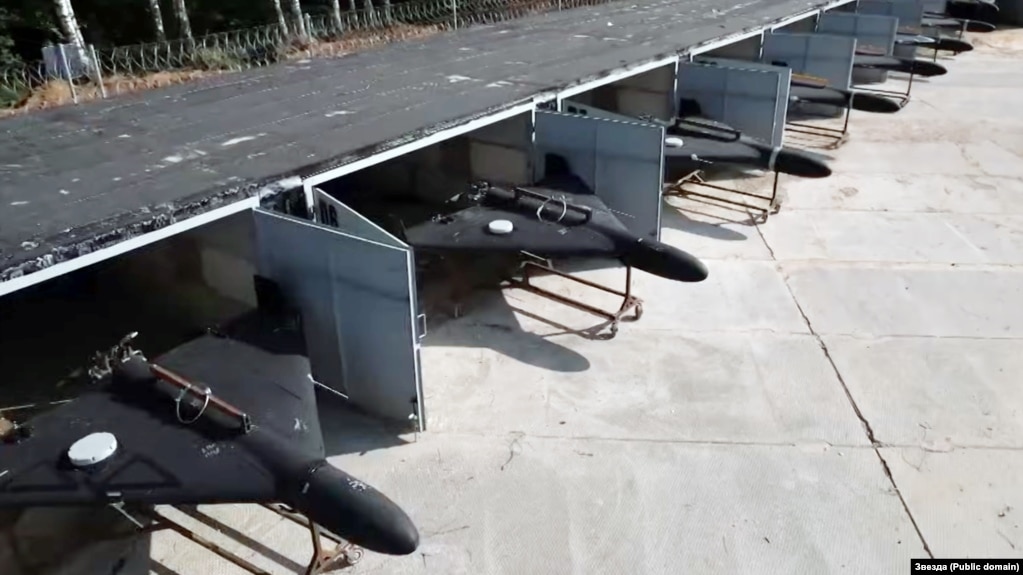
The image shows Geran drones stored near Tsymbulova in Russia's Oryol region.
 
Russia, predicted Beskrestnov, would go on producing gasoline-powered drones, with Jet-propelled models representing about 60 percent of output. Older types like the Shahed-136 and Geran-2 will make up the rest of the arsenal. But Russia is not the only protagonist in this conflict using powerful drones to their advantage; Ukraine has shown itself adept at producing its own weaponized drones to good effect within the Russian geography.
 
Aerial strikes used by each side penetrated deep into one another's territory, with the ground war stalled. Russian oil refineries continue to be hit by Ukraine. Ukraine has extended its campaign against major Russian online retailers, striking Ozon warehouses, quite apart from its hits on Russian oil refineries. An estimated six percent of the warehouse capacity of the online retailer was obliterated. 
 
For their part, a mix of drones and ballistic missiles are fired by Russia, striking warehouses around Kyiv, and in so doing threatening food shortages, seen as some grocery stores now have empty shelves. Ukraine has improved its capacity significantly to shoot down drones, ramping up its own long-range drone production. Even so, the shortage of air defence missiles represents a persistent vulnerability, an advantage for Russia.
 
Ballistic missiles can inflict much more damage, penetrating heavily defended or underground sites, but they are infinitely more expensive to produce than drones. President Zelenskyy aspires to acquire additional interceptors, pressing President Trump and the U.S. Congress to make more supplies available to Ukraine. He estimates that Ukraine requires at least five percent of U.S. Patriot production in its defence against Russian onslaughts, not merely the one percent it now relies upon. 
 
https://media.cnn.com/api/v1/images/stellar/prod/gettyimages-2291962465-20260831161106591.jpg?c=original&q=w_1202,c_fill/f_avif
Russian air attack on Kiev, August 29, triggering major explosion and fire on warehouse. AP/Getty
 

Labels: , , , ,

Wednesday, August 05, 2026

The Expanding Use of Armed Robots and Unmanned Ground Vehicles in Ukraine

"It is already impossible to imagine defence without drones, and the same applies to UGVs [unmanned ground vehicles]."
"Logistics on the front line, evacuation of the wounded, combat missions -- the use of UGVs is now expanding at the fastest pace."
"The future is already on the front lines and Ukraine is creating it."
Ukrainian President Volodymyr Zelenskyy 
 
"At least 25 kilometres from the line of contact is effectively a 'kill zone', where the risks of casualties are extremely high due to the density of drones."
"So replacing human involvement with drones significantly reduces losses."
"[Some of these Unmanned Systems Forces are used in the delivery of mines or to conduct] kamikaze [attacks]." 
Robert Brovdi, commander, Ukraine's Unmanned Systems Forces
 
"Replacing the infantryman is totally impossible."
"We are talking about helping the infantryman."
Taras Ostapchuk, CEO, Ratel Robotics 
https://spectrum.ieee.org/media-library/an-ukrainian-soldier-adjusting-an-unmanned-ground-vehicle-u2019s-machine-gun.jpg?id=67114858&width=900&quality=100
The Droid TW 12.7, by DevDroid, is shown here outfitted with a 0.50-caliber M2 Browning machine gun that can be aimed and fired by a remote operator using a tablet and an encrypted communications link.  DevDroid
 
In the early years of the conflict imposed on Ukraine by the full invasion of the country by Russian forces it was tank formations and large-scale troop movements, the conventional mechanisms in the pursuit of offensive dominance and defensive responses that typified the war. Now approaching the second-half of its fourth year, not taking into account Russia's military annexation of the Crimean peninsula, the eastern and southern front line is at a stalemate, monitored by drones set to strike moving targets. 
 
Ukraine's surprise counteroffensive took Russia's Vladimir Putin off guard; despite its much smaller population, military, arms, and economy. Ukraine stopped the Russian military dead in its tracks, even recovering some of its territory. Ukraine steadily advanced from desperately attempting to down Russian missiles and drones to protect its civilian infrastructure targeted by Moscow, to striking back across the border into Russia, first hitting only border targets then moving on to strike as far as Moscow and beyond.
 
Now, Ukrainian infantry units are using robot vehicles on combat missions as Ukraine has out-innovated Russia. The asymmetric technological approach with the use of drones and robots is Ukraine's winning ticket to defeating the Russian military. Like Mykhailo Fedorov the Ukrainian Defence Minister recently removed, Ukraine's new Commander-in-Chief Mykhailo Drapatryi advocates leveraging drone and robotics know-how for advantage on the battlefield. 
 
Recently a battle robot armed with a flame thrower approached a group of Russian assault troops planning to challenge Ukrainian defences on a section of the eastern Donetsk front lines. The robot turned the area where the Russians were positioned near a tree line to into a flaming cauldron, followed up by a machine gun crew to clean up the surviving attackers. A new battlefield technique employed by Ukraine's 93rd Separate Mechanized Brigade.
 
https://imageio.forbes.com/specials-images/imageserve/6a70886d457ae098dd605309/Heavy-list-with-UGVd/0x0.jpg?width=960&dpr=1
 
That robot represents an expanding Ukrainian corps of unmanned ground vehicles equipped with such offensive devices as rifles, to rocket-propelled grenade launchers. At least 50,000 of these UGVs are set to be produced for the battlefield to reinforce human troops tasked to confront Russian servicemen. A remote-controlled combat robot was landed using an unmanned naval drone reaching the shore 11 kilometres away at the occupied Kinburn Spit in southern Ukraine. 
 
The  ground robot, a Wolly 7.62, carried an ammunition-loaded machine gun firing on Russian troop positions, who were forced to pull back, then self-destructed.
 
The $11,000 robot was made use of by the 123rd Separate Territorial Defence Brigade with four Ukrainian operators conducting the assault. "We are already fighting with drones in many areas, and we are very polite to our robots in advance", laughingly explained a solder with the call sign "House Goblin" archly referring to the Terminator movie series. According to Ukrainian officials, unmanned systems help manage the manpower gap with Russia, freeing up soldiers, saving lives on tasks with dangerous logistics in supporting front-line troops and evacuating the wounded. 
 
While Ukraine's wish to join the North Atlantic Treaty Organization remains endlessly deferred, NATO members are eager to learn from Ukraine's tactical innovations with the use of its advanced technology in the production of drones and robots. Some European states have signed defence production partnerships with Ukraine as Kyiv strives to become central to the security structures of the continent. 
 
https://s.yimg.com/lo/mysterio/api/0f3e4562ff6a4b8790b2f363f344c9fa5a38908e172d371f472512c171ac5bf2/lightyear_networkapi/resizefill_w780_h438%3Bquality_80%3Bformat_webp/https%3A%2F%2Fmedia.zenfs.com%2Fen%2Fbgr_ecomm_183%2F743896408fb3f4348637860fc46a2985
Zysko Sergii/Shutterstock
 
"Absolutely incredible,  [Ukraine] fully integrates every single drone every sensor, and every shooting platform into just one single network", the U.S. Senate Armed Services Committee was advised by U.S. army secretary Dan Driscoll. "Ours does not." Ukraine has signed drone deals with countries as disparate as Saudi Arabia and the Netherlands, with an increasing number of partnerships being floated, including with the United States.  
"They accomplished something never done in warfare."
"They pushed Russians off a position that was being defended by humans and they pushed them off the position with no humans in the fight."
Former U.S. army vice-chief of staff Jack Keane  
https://spectrum.ieee.org/media-library/an-unmanned-ground-vehicle-moving-through-a-sparse-forest-landscape.jpg?id=67114838&width=1200&height=750

RoverTech’s Zmiy uncrewed ground vehicle moved through a forest during a demonstration. RoverTech  


Labels: , , , , , ,

Sunday, July 26, 2026

Ukraine Alerting Russians to Pain Caused by Putin's War

Article image
Smoke rises from a fire at Wildberries' logistics complex in Elektrostal, outside Moscow, Russia, following a Ukrainian drone attack on July 18, 2026. (Tatyana Makeyeva / AFP / Getty Images)
 
"Well, starting last Saturday and just about every day since, Ukrainian drones have struck these giant warehouses belonging to Wildberries, causing massive fires to facilities outside of Moscow, outside of St. Petersburg and several cities in the south of Russia."
"The costs have come in lives. At least nine workers are dead, dozens more injured, several of whom were migrant workers from Central Asia. But of course, there's also material costs."
"Wildberries is Russia's largest online retailer. And its warehouses are full of goods from small and mid-size Russian businesses, who have taken to social media to say these attacks have caused their financial ruin."
Charles Maynes, NPR, Moscow  
"Yet another flood of videos from Russians weeping over the ‘shock’ and ‘unfairness’ of strikes on a Wildberries warehouse."
"​It doesn’t cross their minds how unfair it felt when we were just living our lives, bothering no one, in our own country and our own homes, right up until their missiles started tearing our cities apart on a chilly winter morning."
Kateryna Bohuslavska – who posts on X as “Kate from Kharkiv”  
 
"In Russia, official procedures mostly only cover arms procurement."
"So military units and individual soldiers need to buy a lot of things themselves: uniforms, food, gasoline, electric power generators, drones, cars, motorcycles, spare parts… that’s why it is possible to buy goods necessary for warfare on Wildberries." 
Pavel Luzin, senior fellow, Center for European Policy Analysis 
https://i.cbc.ca/ais/9454350d-6b32-4d16-83f2-a0b2316eac22,1784917404941/full/max/0/default.jpg?im=Crop%2Crect%3D%280%2C799%2C1450%2C815%29%3BResize%3D860
Smoke rises from a Wildberries facility in St. Petersburg, Russia, on July 24 after a Ukrainian drone attack. Reuters verified this social media image by matching building and other details with satellite imagery. The founder of Wildberries also confirmed there was an attack on the facility. (Social media/Reuters)
 
  A fire sending smoke pouring over St. Petersburg early Friday was caused by Ukrainian drones hitting a warehouse for a Russian e-commerce giant. St. Petersburg has been targeted by Kyiv stepping up its long-range drone strikes on Russian energy, military and logistic sites in recent weeks. Retribution for Moscow's nightly drone and missile barrages aimed at Ukrainian cities. Russian strikes at civilian targets throughout Ukraine have aimed at depressing morale of the Ukrainian population, a war crime in and of itself. Russians have never, until recently, had to face the reality that Ukrainians have lived with for over four years.
 
This was not supposed to happen. Russian President Vladimir Putin imagined a swift and easy invasion of a country incapable of defending itself. The Ukrainian response proved otherwise, rising from an initial determination to defend itself against superior numbers and weaponry, to the present where necessity drove Ukraine to invent its own military hardware capable of withstanding Russia's aerial attacks and in good time a counteroffensive to knock Russia's military back from its steady advances, to the point where Ukraine not only held its own, but retook some of its sovereign territory from rapacious Russian occupation.
 
Most recently, Russian forces were put to the test of shooting down 571 Ukrainian drones over a dozen regions, including Crimea, the Black Sea peninsula that Russian annexed in 2014 when it began its revanchist Greater Russia enterprise. More latterly, grey smoke rose into the morning sky over highrise residential buildings in St. Petersburg, Vladimir Putin's hometown, located over 800 kilometres from the Ukrainian border. 
 
A Wildberries warehouse, for Russia's largest online retailer referred to as 'Russia's Amazon" was set on fire following the strike. The third such overnight strike on a Wildberries installation by Ukraine forces over the course of a single week. Eight night shift workers last week were killed at Wildberries sites when one of the company's main warehouses came under attack and burned to the ground, just outside Moscow. 
 
https://i.guim.co.uk/img/media/8da4bbc01606451f97cb9a1781d0033689266536/522_0_6439_5152/master/6439.jpg?width=1900&dpr=1&s=none&crop=none
A Wildberries collection point in Moscow. The platform is popular among lower-income Russians and its network of collection points extends into small towns and villages. Photograph: Anastasia Barashkova/Reuters
 
According to Ukrainian President Volodymyr Zelenskyy, the facilities were used to "supply sanctioned components for drone production and navigation equipment". This bombing campaign is one of "long-range sanctions"; Kyiv adding that the attacks are justified retribution for nightly drones Russia sends along with missile barrages everywhere in Ukraine, targeting its cities since February of 2022 when the ground invasion of Ukraine began.
 
Nationwide fuel shortages have arisen thanks to the campaign, undeniably taking its toll on Russia's financial war account. Pulkovo airport in St. Petersburg was forced to suspend flights throughout the attack, disrupting 50 departures. Two of Wildberries warehouses in the city temporarily halted their business operations.  
 
Recent months have seen escalations of long-range strikes by both Russia and Ukraine. Increasing ballistic missile numbers have been fired at Kyiv, killing dozens of residents, while ripping open apartment blocks and destroying neighbourhoods. Leading perhaps to a turnabout in attitude, when U.S. President Donald Trump seemed to back Ukraine's counterattacks on Russia; naming the strikes "an escalation that can lead to an end".
 
June of 2026, according to the United Nations, has seen a surge in civilian deaths; the deadliest month since mid-2022.  
"Russians found out their country is waging a war. The next step is for them to realize who is responsible for all the damage caused to Russia (Putin)."
"Wildberries is no longer just an online marketplace for clothing and household goods. The platform sells weapons, body armor, drones, drone components, and fiber-optics used for drones."
"All of these items are used in the war against Ukraine and help kill Ukrainians. That is why such facilities are legitimate military targets for Ukraine’s Armed Forces."
Anton Gerashchenko, Ukrainian social media influencer  
https://d3i6fh83elv35t.cloudfront.net/static/2026/07/2026-07-23T161018Z_1048657861_RC2MJMAPB5X2_RTRMADP_3_UKRAINE-CRISIS-RUSSIA-WILDBERRIES-SITE-1200x776.jpg
Remains of the Wildberries warehouse that burned down after a recent Ukrainian drone attack in the course of the Russia-Ukraine conflict, in the city of Elektrostal in the Moscow region, Russia July 23, 2026. Photo by Stringer TPX Reuters
 
"[The warehouse attacks added to the pain of small businesses, which in recent years have been] struggling very badly, [while probably causing only] relatively slight [damage to the industry and the economy in general; effectively stagnant, but stable]."
"[It's about] undermining public morale, and getting people to talk much more [about the war and question the Kremlin's actions]."
"[For years after Russia's full-scale invasion of Ukraine in 2022, people largely appeared complacent about the fighting.] It was something that was happening a long way off. [But that has changed this year, with regular strikes on oil refineries in parts of Russia leading to the massive fires, and now Wildberries]."
"There is now much more awareness, but there's also much more discussion, and more people are questioning what's going on and why is it happening and the conflict lasting so long. It brings it home."
Chris Weafer, CEO, Macro-Advisory Ltd. Consultancy 

Labels: , , , ,

Thursday, July 23, 2026

Success Breeds Resentment in Kyiv

"This [appointing Mykhailo Drapatyi, a popular and innovative general, as the new head of Ukraine’s armed forces], brings a breath of fresh air and new hope to the struggle of free people for freedom and justice. It is a voice for change that could not be ignored."
"The high expectations of the Ukrainian people must be met with a clear vision for ending the war for independence, a strong team and decisive actions aimed at saving the lives of our soldiers, automating the frontline, delivering asymmetric strikes and crippling the Russian economy."
Mykhailo Fedorov, former Ukraine defence minister 
 
"I offered Mykhailo a prominent position within the government that would enable him to unify the technological sector of our state and ensure its development."
"Our shared wish is one – victory over the enemy and conditions at the front and in pressure on Russia that would force Russia toward peace."
"A significant path has been travelled, the defence of Ukraine continues, and every warrior deserves dignified treatment."
"We have come a long way. The defence of Ukraine continues. And every soldier deserves to be treated with respect."
"I am grateful to Syrskyi and to] every one of our soldiers [fighting on the frontline]." 
Ukrainian President Volodymyr Zelenskyy  
https://media-cldnry.s-nbcnews.com/image/upload/t_fit-1000w,f_auto,q_auto:best/rockcms/2026-07/260718-Oleksandr-Syrskyi-ch-1046-ae0aff.jpg
Oleksandr Syrskyi and Volodymyr Zelenskyy in Kharkiv, Ukraine, in 2022.  Metin Aktaş / Anadolu Agency via Getty Images file
 
In a sudden move a week ago President Volodymyr Zelenskyy decided to remove his popular defence minister, his prime minister and several days later the commander-in-chief of his armed forces. Puzzlingly, this at a time when Ukrainian drones are hitting Russian refineries, while Moscow's summer offensive has stalled on most front areas and Ukraine has been restoring some of its sovereign territories.  Relations with Trump have settled down, and Ukraine has been given permission to manufacture its own U.S.-style interceptor missiles.
 
Yet at this signal time in Ukraine's history its president has announced a new "political strategy" through the reshuffling of its major war figures responsible for these successes. Thousand of Ukrainians poured into the streets across the country to protest the removal of  the popular Mykhailo Fedorov, credited as a key architect of Ukraine's advances in a drone warfare breakthrough. With no satisfactory explanation for the removal, Ukrainians fed up with corruption and alert to malfeasance, have campaigned for his reinstatement as minister of defence.
 
On the surface it appears that a generational conflict over how best to wage a modern war should proceed, as well as conflicts over corruption, inclusive of turf battles between the Defence Ministry and the generals, plus a president with a reputed tendency to remove subordinates who become too popular in the public regard, lest they become competitors for his alpha-executive governing position. 
 
With the acute realization that he may have made some awkward decisions that would not be well received not only by the Ukrainian public, but by the White House and Ukraine's NATO allies, Mr. Zelenskyy has been left to scramble in hopes of containing the fallout. It has become clear that deep institutional tensions on command structures in Ukraine which were brewing for months, have led to this crisis in confidence.  
"Probably [Zelensyy] didn't grasp fully how Fedorov has become so closely associated with positive changes."
"And the overall protest morphed into broad debate on war strategy and battlefield management."
Mykola Bielieskov, Kyiv defence analyst  
https://media-cldnry.s-nbcnews.com/image/upload/t_fit-560w,f_auto,q_auto:best/rockcms/2026-07/260718-Mykhailo-Fedorov-ch-1049-0f39b9.jpg
Former Ukrainian Defense Minister Mykhailo Fedorov holds a briefing in Kyiv on Thursday.  Danylo Antoniuk / Future Publishing via Getty Images
 
The disrupter-style hacks that were championed by younger officials tended to raise the hackles of old-guard battlefield tacticians, Mykhailo Fedorov first among them. Fedorov's innovative approach to the battlefield had won the approval of many officials in NATO, who privately expressed disappointment that Mr. Zelenskyy moved against his continuing in the role of Minister of Defence. 
 
Five consecutive nights saw thousands of noisy protesters outside the president's Kyiv office following Fedorov's dismissal as Minister of Defence, as rallies took place in over a dozen cities.  The public pressure succeeded in having the president reverse course, to fire Ukraine's commander-in-chief, Oleksander Syrsky and to replace him with another reform-minded commander, while offering Fedorov a new high-level government role. 
 
It had been widely rumoured that bad blood in battlefield disagreements between Fedorov and Syrsky led the commander-in-chief to demand that a choice had to be made by Zelenskyy; either Fedorov had to leave or he would. That choice was made, and then reversed under the weight of public censure. 
 
Syrsky's appointment to lead Ukraine's military arrived two years ago, replacing another poplar head of the armed forces, General Valery Zaluzhny, top commander during the February 2022 Russian invasion. A number of military issues led Zaluzhny to clash with Zelenskyy; the latter's request to mobilize 500,000 new soldiers one of those irritants.  It was likely that political ambitions on Zaluzhny's part finally poisoned their relations.
 
Disagreement between those who believe that drones and robots should drive the war to its winning conclusion as opposed to those who place their trust in conventional infantry and artillery to win the war has the former now feeling vindicated. The military tactics with the use of drones have unquestionably turned the tide of the war in Ukraine's favour. 
 
According to an interpretation by a European diplomat stationed in Kyiv, the turbulence between generational factions, corruption currents and personal egos are all involved. "All three of those reasons are  true. But also Fedorov is a political threat to Zelenskyy; many groups wanted to take him down." 
 
https://i.guim.co.uk/img/media/aebe792ee0f3f3fb034ebe938e9652e5885c5128/906_513_3398_1884/master/3398.jpg?width=1900&dpr=1&s=none&crop=none
Volodymyr Zelenskyy with Oleksandr Syrskyi at the handover of drone missiles to the Ukrainian army in Kyiv in December 2024. Photograph: Sergey Dolzhenko/EPA
  

Labels: , , , , ,

Monday, June 15, 2026

Have Turkey's Erdogan and Russia's Putin Kissed-and-Made-up for the Very Last Time?

"This is a person [Recep Tayyip Erdogan] who keeps his word — a man."
"He does not follow his tail. If he believes it is advantageous for his country, he goes to the end"
"There is an element of predictability, and it is very important to understand who you are dealing with."
Vladimir Putin, 2021
 
"[Putin’s words are] exactly how I have known Mr. Putin since I first met him."
"He is straightforward and keeps his word."
"It is rare to have such strong relations with any state."
Recep Tayyip Erdogan
The Uneasy Alliance Between Putin and Erdogan
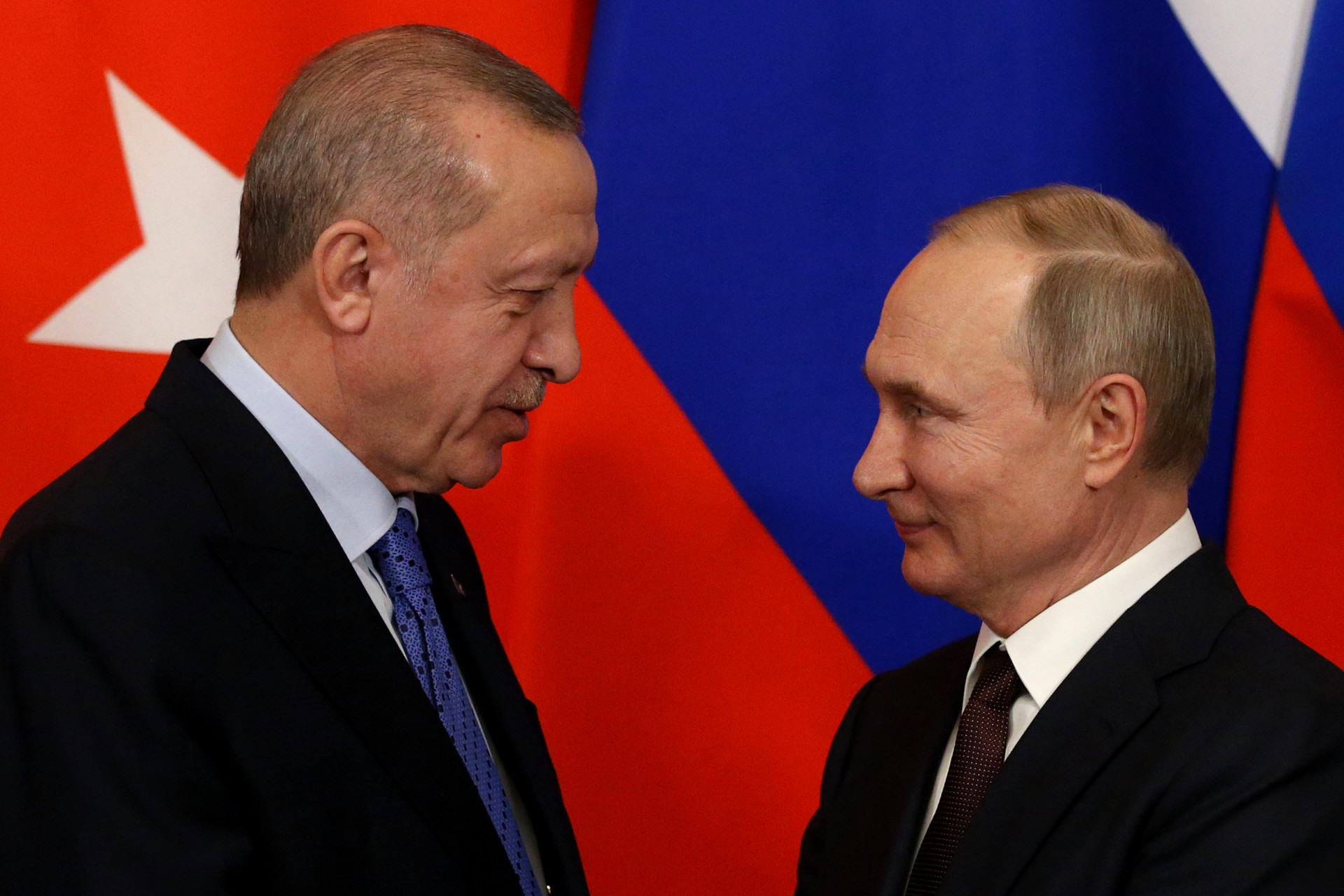
Russian President Vladimir Putin and Turkish President Recep Tayyip Erdogan at the Kremlin on March 5, 2020 in Moscow, Russia/ Mikhail Svetlov/Getty Images
  
"On Nov. 24, 2015, Turkey shot down a Russian fighter jet over Syria, resulting in the deaths of two Russian soldiers and prompting a sometimes spine-chilling war of words. At his annual press conference in December that year, Putin’s description of Erdoğan was quite different from the one he gave five years later. He said he did not “see any prospect of improving relations with the Turkish leadership,” whom he accused of trying to “lick the Americans in a certain place”."
"Sinking the knife in even deeper, Putin accused Erdoğan of betraying the secular system put in place by Turkey’s national hero, Mustafa Kemal Atatürk. “The creeping Islamization would probably cause Atatürk to turn in his grave,” he said. Erdoğan, for his part, lambasted Russian “war crimes” in Syria. Russia imposed sanctions, with the package holidays that brought hundreds of thousands of tourists to Turkey’s Mediterranean coast halted and goods like Turkish tomatoes no longer welcome in the other direction."
Stuart Williams, New Lines Magazine  
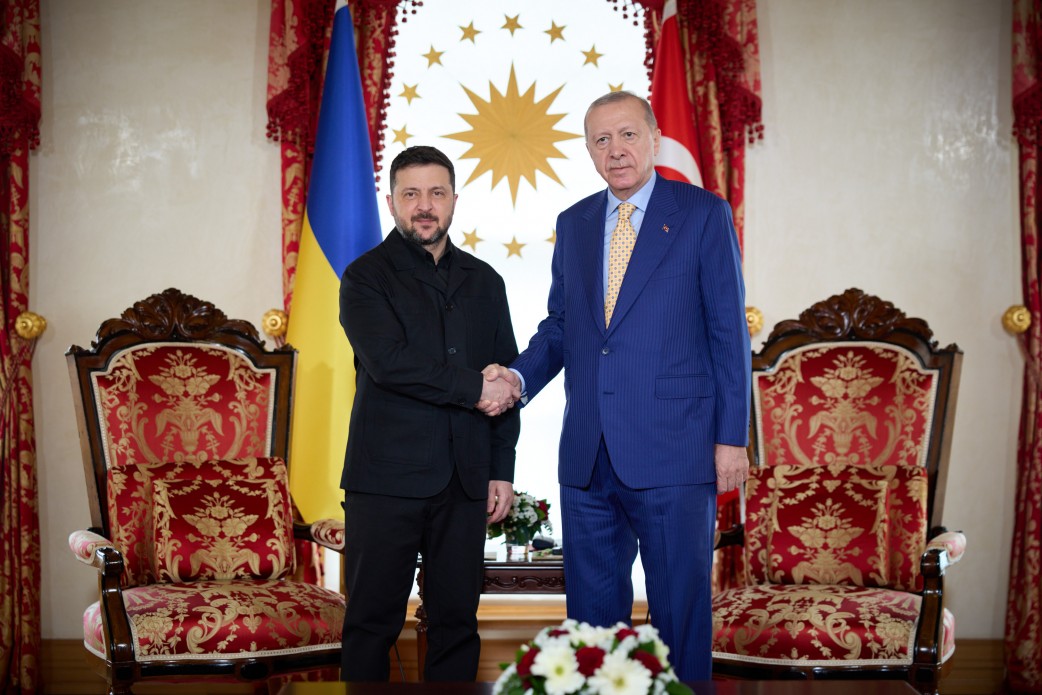
Suddenly Turkey is Ukraine's best friend -- no, really. With Erdogan's courteous assistance, Ukrainian President Volodymyr Zelenskyy now has cordial ingress to the movers-and-shakers of the Middle East. Many of whom have been under extreme violent duress, with the Islamic Republic of Iran punishing the Gulf states for their friendliness with the United States, not to mention Israel. U.S. military bases in Saudi Arabia, the UAE, Bahrain, Qatar and Kuwait, all of whom have been, to some degree targeted by the IRGC; above all, the United Arab Emirates.
 
If any leader of any country currently knows anything about counteroffensives and self-preservation, it is the Ukrainian President, and he is more than pleased to be able to demonstrate what the Ukrainian military has learned while it has been under massive bombardment by an aggressive, much larger conventionally armed neighbour. The Iran war has enabled Mr. Zelenskyy to cultivate closer ties with Gulf states. The Shahed-136 kamikaze drones that Russia uses in Ukraine have been supplied to Iran by Russia and China.
 
https://www.president.gov.ua/storage/j-image-storage/57/22/45/04cea6a977c8fa00116ae17bf3ba8d4c_1775321832_extra_large.jpeg
At the Dolmabahçe Palace in Istanbul, President of Ukraine Volodymyr Zelenskyy held a meeting with President of Türkiye Recep Tayyip Erdoğan.  President of Ukraine
 
Ukraine's answer to the devastating attacks on its cities and civil infrastructure was almost-instant devising, production and use of surprisingly simple advance drone technology which has given it longer reach into Russia itself, demonstrating what's good for the goose is fine for the gander in blowing up Russian military bases, bridges, ships, weapons storage, and oil depots. Ukrainian resistance has resulted in the deaths of tens of thousands Russian servicemen monthly, dealing severe blows to Russia's troop numbers and recruitment.
 
With all that experience behind them, Ukraine was pleased to dispatch air defense teams to Qatar, Saudi Arabia and the United Arab Emirates. Turkey, in ushering Ukraine into the comfort zone of making new contacts in the Middle East, has a new partner, as it leaves behind the old one with which its own agenda was never quite a perfect fit. After all, during the drawn-out civil war in Syria, Turkey armed the Sunni groups trying to break Bashar al-Assad's Alawite grip on the country, even as Erdogan targeted Kurds whose fighting prowess was superior to all of the regime's opponents.
 
And it was Russian warplanes out of the Russian air base in Syria that constantly flew over Sunni strongholds bombing them mercilessly. Just incidentally the very same Sunni fighting groups that Mr. Putin has attempted after the fall of President Assad, (domiciled now in Russia), to ingratiate himself with, hoping to be able to maintain both his remaining naval and air bases in the new Sunni-led government of Ahmed al-Sharaa. 
 
https://www.newarab.com/sites/default/files/media/images/0A76B1EF-A62A-44EC-89A0-0F4D6392318C.jpg
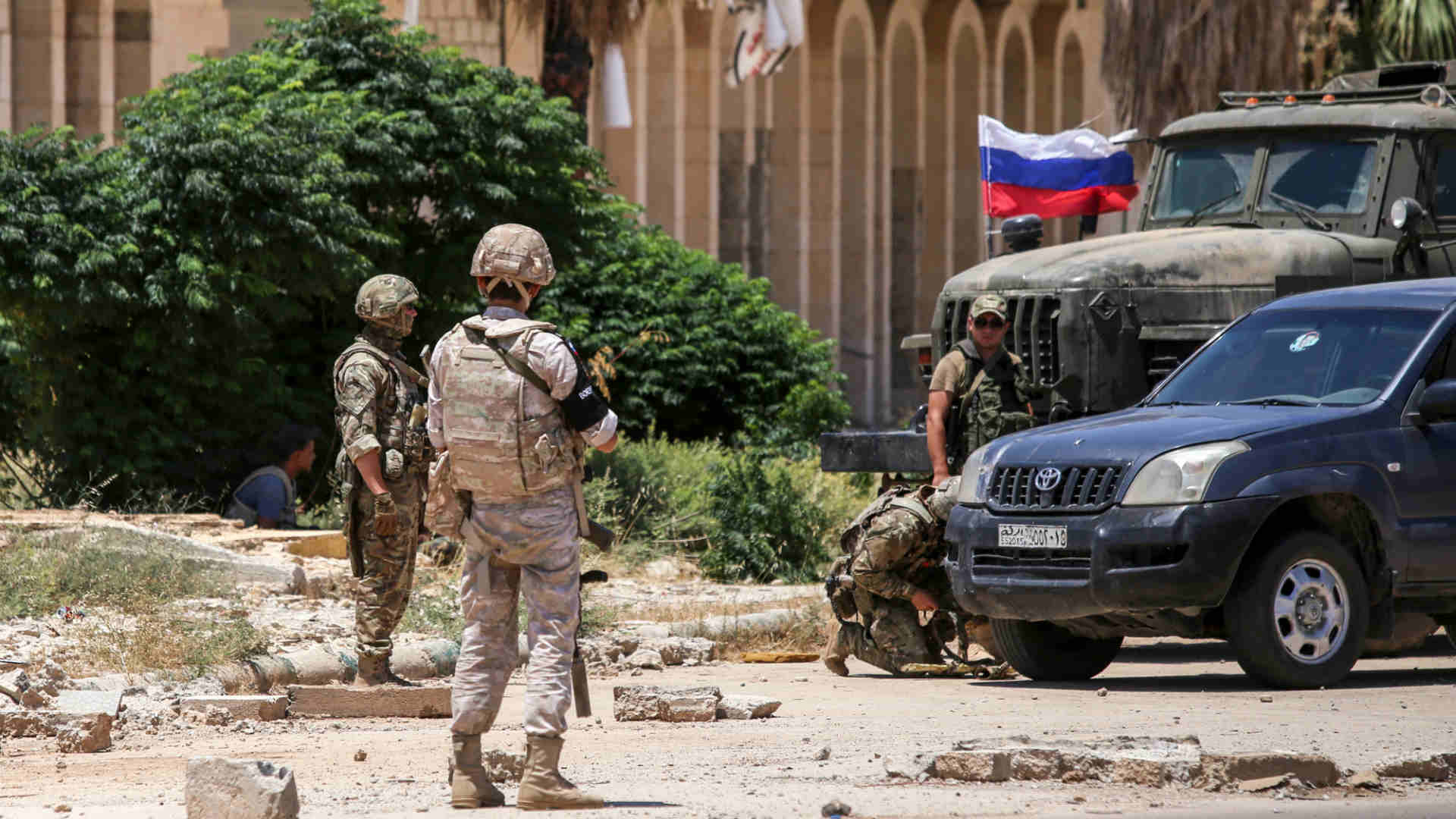
The Russian military presence in Syria has declined significantly over the past two years, from 114 military sites to only two bases today. [Getty]
 
In the early years of Russia's conflict in Ukraine when Moscow was isolated by the West, Turkey, though a standing member of the NATO alliance, spurned the sanctions. In the process becoming a link for Russian trade, investment and energy flows. A situation that gave Ankara greater leverage over Moscow. Russia, before the ouster of the Syrian Alawite regime, could do anything it wanted there and had hundreds of military bases; now under the new Sunni-led regime, reduced to two, albeit its major bases. 
 
It is Turkey that is now the power lever in Syria, helping its interim president al-Sharaa to be presented to the EU, the U.S. as the new, kinder, 'democratic' face of Syria with whom they could all do business with confidence. And in the process, Turkey has become the king-maker, which suits its future plans of greater dominance in the Middle East very well. A role that as a junior partner to Russia for so many years, Russia cultivated for itself, while it is Turkey now that has inserted itself in helping to rebuild the Syrian Army.
 
By openly giving assistance to Ukraine's President Zelenskyy, Mr. Erdogan is amply demonstrating that once again Turkey has spurned its sometimes-tenuous, but generally past-useful allyship with Russia, moreover a Russia that has, by its territorial aggression served to isolate itself, while continuing to aggravate and threaten his eastern European neighbours and needling NATO, of which Turkey is a member. Vladimir Putin and his war-wearied economy has lost the projection of global power, and Turkey for the time being has no further use of his allyship with Russia. 
 
https://cdn-live.foreignaffairs.com/sites/default/files/styles/_webp_medium_2x/public/images/2026/06/09/2025-09-01T101030Z_1521986028_RC2YIGAOA3UO_RTRMADP_3_CHINA-SCO-PUTIN-ERDOGAN.JPG.webp?itok=fDEDQRY6
Russian and Turkish delegations at a summit in Tianjin, China, September 2025 Vladimir Smirnov / Reuters


Labels: , , , , , , ,

() Follow @rheytah Tweet