Politic?

This is a blog dedicated to a personal interpretation of political news of the day. I attempt to be as knowledgeable as possible before commenting and committing my thoughts to a day's communication.

Saturday, January 18, 2020

UN Committees Hot on the Heels of Human Rights Abusers

"[The committee failed to study First Nations views toward the project; I] did not know [that most First Nations committees supported the Coastal GasLink natural gas pipeline]."
"I did not know that most First Nations agree on that. This is something new that comes to my understanding."
Noureddine Amir, Chair, United Nations Committee on the Elimination of Racial Discrimination (CERD)

"I frankly find it condescending to the work the 20 nations have done in the past six or seven years to get the project to where it is today."
"I think it speaks volumes in terms of the sensationalism [around] a topic that is getting so much attention."
"There are sides to the story that are not being reflected and frankly there are not many voices in the media in support of the project [to bring natural gas via a pipeline to an export facility along the West coast of British Columbia]."
"They [TC Energy based in Calgary] offer the solution to social issues that no other entity, no other political body, no other government has been able to do for our people."
Naisla Nation Chief Crystal Smith

"[CERD was] disturbed by the forced removal, disproportionate use of force, harassment and intimidation by law enforcement officials against Indigenous peoples who peacefully oppose large-scale development projects on their traditional territories."
CERD directive

"Of all people, someone in his position, you would think the very first thing he would do is at least to gather information on both sides of the story. It's unfortunate he never did his homework."
"He could have looked it up online and found out in seconds."
"I nearly spat out my coffee [reading the CERD directive]."
Chris Sankey, former elected band councillor, Lax Kw'alaams First Nation, Prince Rupert, B.C.
Wet'suwet'en Hereditary chiefs after issuing their eviction notice to the Coastal GasLink Pipeline. - Facebook

According to Haisla Chief Smith, the agreement in question that her community signed with TC Energy to build the pipeline in question represents their best opportunity to attain autonomy and to become financially independent. Proceeds that accrue to the First Nation, as it will to others signing the agreement, are set to be used in broad poverty-reduction programs along with associated social tools leading to efforts to "revitalize" the local culture.

A directive had been issued in December by the UN Committee on the Elimination of Racial Discrimination that called for three large-scale natural-resource projects in British Columbia to "immediately" be shut down. Those projects include the Coastal GasLink natural gas pipeline projected to feed into a massive export facility along the West coast, a project with signed benefit agreements linking 20 Indigenous communities along the 670 kilometre route cutting across their territory.

Ellis Ross
Chief Ellis Ross: “the UN has no frickin’ business talking about what’s happening here.”

Mr. Noureddine, chief of CERD had no real idea of what his committee based its conclusions on other than that they were defending the rights of Indigenous communities. No information had been sought to explain the issues involved because investigative work is not included in the committee's mandate. Which seems rather typical of any United Nations arm mandated to express opinion on issues based on surface circumstances when without a full understanding of issues and history they should neither condone nor condemn.

Major resource projects in Canada evolving around extraction, refining and use and shipping of fossil fuels have engendered great discussions and protests from environmental groups determined to halt any possible progression in the industry to the point where Canada, with its vast proven resources is unable to proceed with extraction, with pipelines sending product to other parts of Canada, instead shipping oil the vast distance from the Gulf States to North America. With the focus on the issue comes the erroneous impression that all First Nations are opposed to the industry.

The CERD directive called as well for an immediate stop to the Trans Mountain pipeline construction and the Site C dam in British Columbia. When Mr. Noureddine made it clear he had made no effort to investigate before condemning, First Nations representatives for whom the pipeline construction represents an opportunity to prosper from their territorial geology, responded with disbelief and anger. The Pacific North West LNG project since scrapped was a matter of negotiations for the Lax Kw'alaama First Nation as well.

"It is unbelievable that a  United Nations Committee who [s8c] attempted to single out Canada didn't even realize that many major Canadian projects have earned First Nations and community support", Sonya Savage, Alberta Energy Minister expressed in disgust, in a written statement. "With all the injustice in the world, it’s beyond rich that the unelected, unaccountable United Nations would seemingly single out Canada — one of the greatest champions of human rights, democracy and the rule of law. Canada’s duly elected representatives — not unaccountable international committees — are responsible for governing decisions in this country."

Part of the broader $40 billion LNG Canada project under construction near Kitimat, British Columbia, the Coastal pipeline will eventually ship supercooled gas to Asian markets, the first major LNG project at the construction phase after years of regulatory delays and political disputes delaying such large-scale developments in Canada. And while there are some First Nations bands that protest the pipeline construction, there are others who fully support development.
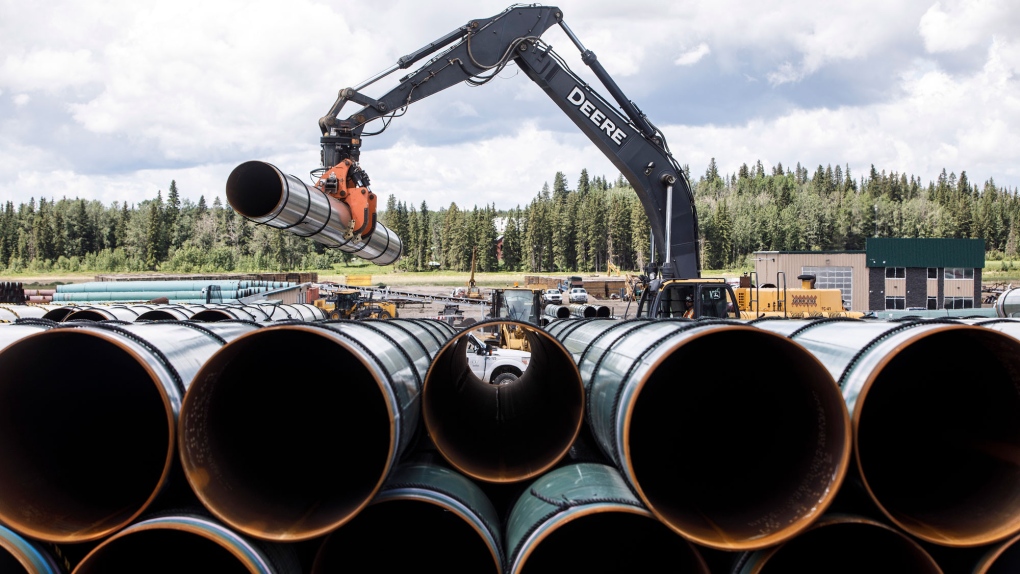
Pipeline
Pipe for the Trans Mountain pipeline is unloaded in Edson, Alta. on June 18, 2019. (THE CANADIAN PRESS/Jason Franson)

Labels: , , , , , ,

Monday, December 17, 2018

Self-Righteous Hypocrisy

"Among the 3.7 million Quebecers who had a job in 2016 and who worked away from home, 78 percent said they primarily used a personal vehicle to get there [to place of employment]."
Universite de Montreal report on energy use in Quebec

"Yes, there is a certain degree of hypocrisy in all humans, and obviously, with regards to certain positions that Quebecers take [on energy], there is some hypocrisy there."
"One hundred percent of electricity in Quebec is from renewal resources [resulting from Quebec's hydroelectric James Bay source of renewable, non-carbon-producing energy production; a circumstance of geology]."
"Also, Quebecers are less rich than other Canadians, meaning they consume less energy, have less cars [traditionally]."
Professor Pierre-Olivier Pineau, co-author, report on Quebec energy use
Related image
Hydro Quebec, Valtech    James Bay hydroelectricity project

Quebec prides itself on its use of 'clean energy'. The province has been gifted by nature with 40 percent of Canada's freshwater resources. It has the monumental James Bay project and Churchill Falls which Hydro Quebec uses internally for energy use at the cheapest rates in North America, and which it also uses as a salable natural resource at prevailing market rates from its 63 power stations to customers in New England, U.S.A. To say that Quebec is smug about its clean energy policies is to understate the situation. Energy from wind farms also play a significant role in energy production.

The general portrait of Quebec and Quebecers is that of environmentally conscious citizens of the world, loyal to the government's vision of green energy, conservation and environmental awareness of the highest order. So much so, that its new Premier Francois Legault spoke publicly of his contempt for western Canadian oil, stating there was "no social acceptability" in Quebec for a "dirty energy" pipeline to be built from Alberta to eastern Canada.

This assertion did not go down very well with the premiers of Alberta and Saskatchewan who in the best interests of those oil-and-gas-producing provinces and Canada as a whole are in dire need of pipelines to move their products to tidewater to ship to markets abroad, much less to Canadians living in the east who would far prefer Canadian oil and gas to imports from the Middle East. Alberta is forced to sell its oil well below market place for want of a reliable, efficient transportation system.
Luxury vehicles

Quebecers enjoy scorning 'dirty oil' as they will have it, from Alberta. Lauding themselves for their 'green' credentials, and paying for their social programs with equalization payments doled out by the federal government from taxes levied against the provinces then re-distributed to the 'have-not' provinces which Quebec has always portrayed itself as, needful of a hand up from other provinces deemed wealthier, among which Alberta is the foremost. So while Alberta struggles with a deficit this fiscal year and Quebec has balanced its books, the facade of green superiority sizzles.

The BMW X7 in the three-quarter front view in front of the desert background

Quebecers, however, represent some of the highest energy consumers in the world. This, according to a newly issued report prepared by researchers at Universite de Montreal's school of business. Quebecers, new data indicate, are purchasing record amounts of gasoline, purchasing gas-guzzling trucks and larger homes. While per capita carbon emissions in the province remain the country's lowest as the province has decreased its overall emissions by 11 percent since 1990, it is mostly attributable to their hydroelectric energy source.

Vehicle sales of trucks, SUVs and pickups in Quebec between 1990 and 2017 increased by 246 percent, while gasoline sales leaped 33 percent in that same time period. Since 2015, yearly sales of larger vehicles requiring more gas have vastly overtaken the sale of cars. Moreover, between 1990 and 2015 the average surface area of a home in Quebec has increased by 17 percent.

The conclusion is that, on a per-capita basis, people living in Quebec consume far more energy than the global average, similar to the consumption seen in countries like China and Germany, almost as much as people living in the United States. Sleight of mind?

Single Family Home for Sale at Ville-Marie, Montréal 1245 Rue Redpath-Crescent, Ville-Marie, Quebec, H3G1A1 Canada
Ville Marie, Montreal, Quebec

Labels: , , , ,

Sunday, September 09, 2018

Trudeau & Company

"Canada is leading by example to address the issue of gender equality in the G7 energy agenda. We will continue to engage key private sector and public sector leaders on this important issue and take actions to improve gender equality, particularly in the energy sector."
"We want to influence current and future leaders of Canadian industry to commit to meaningful action in the area of gender equality."
Minister of Natural Resources Amarjeet Sohi

"Canada's energy industry is gender-imbalanced. [The Right Honourable Justin Trudeau] has made gender a equality a priority for Canada's G7 Presidency."
Natural Resources Canada
Alberta mayors hold “Go East” signs in support of the East Energy pipeline project while Lisa Holmes, president of Alberta Urban Municipalities Association, left, takes a selfie with Alberta Premier Rachel Notley at a mayors’ caucus in Edmonton on March 9, 2016. Postmedia News

The current Liberal-led government identifying the most critical area of concern at the moment for the G7 to be energy is rather amusing, given that this Liberal government has been incapable of leading Canada to the point where its vast natural resources in energy have been so ill-managed that the one province that had always been depended upon for its wealth lifting other provinces into the great Canadian net of 'haves' now teeters in uncertainty.

A teeter-totter of inequity solved by confederation evoking a responsibility from the wealthy to even out social advantages for the entire population.

'Wealthy' Calgarians agreeing to ensure that Montrealers have equal access to social welfare as anyone living in Alberta, thanks to that province's oil bounty. Quebec spurns oil, its energy needs served by water power for electricity, but it still needs gas to operate vehicles and heat homes. Yet Quebec finds it offensive that a pipeline should convey oil as well as gas from one geographic area of the country to the other; better to rely on imported oil from unstable, human-rights-abusing Middle East countries.

Canada is open for business, Trudeau smiled ingratiatingly at international investors. And then he set about beefing up his environmental agenda, and his gender equity agenda, making doing business all the more complex to meet environmental standards and human rights' employment hurdles for potential investors for whom the red tape and the stalling became too fraught with risk. But Canada is special and under Trudeau has a mission, to bring the rest of the world around to his views on solving all social ills through manipulating safeguards for the vulnerable into trade and investment and energy development.

And that's kind of amusing, too. Since Canada has a global reputation through its expertise and wide investments in developing nations in mining, as a predator and a human-rights abuser of other nations' aboriginal populations whose heritage traditional villages happen inconveniently to be located just where those Canadian mining vultures are poised and set to begin their operations in contracts signed by the various governments with which they do business and share profits. Not too concerned over the environmental and human rights impacts abroad.

Now that the revolving presidency of the G7 has fallen into Justin Trudeau's ever-so-capable hands, he plans to guide his G7 counterparts toward accepting and implementing his very own virtuous gender-equality insights and programs having chosen "Climate Change, Oceans and Clean Energy" as his major theme for the Halifax G7 meeting in September. Climate change, oceans and clean energy cannot be addressed in the absence of gender equality, just as international free trade is a non-starter without gender equality and recognition of LGBTQ-2 rights.

Canada is leading the pack. This is the Canada incapable of bringing its oil and gas resources to world markets, safely and efficiently conveying those energy resources from Alberta to the B.C. coast, much less pipelining it to the rest of Canada in the east and efficiently to the U.S. to enable it to start charging the going price rather than the marked-down price to American refineries. Venezuela's vast oil resources haven't kept pace with the need to upgrade its infrastructure and refining capabilities and the country is imploding in poverty and social welfare backwardness. See any resemblance?

But the issue of Canada's clumsy inability to govern itself takes second place to Advancing Gender Equality and Women's Empowerment in the energy industry. At the present time, women's representation in the Canadian energy industry stands at 24 percent. Rather than view that number as a voluntary representation in that women by and large are not represented in as great numbers as men because they don't naturally gravitate to the industry, Trudeau insists it is because they are deliberately shut out of the industry.

Which brings us to a summit of "gender equity in the energy industry" led by a government incapable of rising above its level of incompetence to solve the issue of opening up two pipelines summarily dismissed and paving the way for the TransCanada to finally get built, but that doesn't square with Trudeau's dedication to the "Path forward".

Canadian Prime Minister Justin Trudeau speaks as the seat of US President Donald Trump sits empty during the Gender Equality Advisory Council working breakfast on the second day of the G7 Summit on June 9, 2018 in Quebec City, Canada.Leon Neal/Getty Images

Labels: , , , , , ,

Monday, November 07, 2016

Environmentalist Standards: Pipelines Bad, Frakking Fine

The United States Geological Survey just produced a seismic hazard forecast for 2016 for the central and eastern United States that includes both induced and natural earthquakes. While almost all of the fracking-induced or triggered earthquakes are small — less than magnitude 3, which can’t be felt by most people — enough are above 3 that the USGS predicted a 5% to 17% chance of significant damage to homes and structures in just the year 2016 for areas of north-central Oklahoma and southern Kansas where fracking occurs. Presumably, this will continue each year as long as fracking continues close to the present rate.
In cases when injection of water induces earthquakes of larger magnitudes, the earthquakes are most likely the result of reactivation of nearby pre-existing faults by upsetting the subsurface pressure regimes that keep the fault closed.
Forbes online

Figure 1. Earthquakes greater than magnitude 3 in the central and eastern United States from 1973 to April 2015. Two abrupt increases in the earthquake rate occurred in 2009 and 2013, coinciding with dramatic increases in fracking for gas and oil. Blue dots represent earthquakes that occurred between 1973 and 2008, and red dots represent earthquakes that occurred between 2009 and April 2015. Prior to 2009, earthquakes were spread across the United States. Beginning in 2009 the earthquakes are tightly clustered in a few areas including central Oklahoma, southern Kansas, central Arkansas, southeastern Colorado and northeastern New Mexico, and multiple parts of Texas. Source: USGS

The industry says nonsense, fracking has nothing to do with earthquakes, they are simply coincidental. On the other hand, scientists with the U.S. Geological Survey appear to believe on the basis of their research that it is indeed fracking that has been causing a notable uptick in seismic activity, causing understandable concern to citizens who feel themselves and their properties threatened.

Central Oklahoma has now experienced a magnitude 5.0 earthquake which has caused considerable damage to buildings in Cushing, known as the Tank Farm Capital of the World. The quake epicentre was less than two kilometres west of Cushing, itself about 80 km northeast of Oklahoma City, and felt as far away as Kansas City, Missouri, and Little Rock Arkansas. That's a quake of considerable power, unlike the many others that have shaken the earth, attributable to fracking.

The town's population of eight thousand people certainly has cause for concern given that its police department has reported "quite a bit of damage" without being too specific. A documented 19 earthquakes have occurred in the past week alone in Oklahoma, according to USGS data. And scientists have been unequivocal; there are undisputed links with the underground disposal of waste water from oil and gas fracking production.

It is interesting that fracking has made the United States independent of the need to continue accessing Middle East-derived oil and gas. Through fracking the country now has sufficient petroleum resources to respond to all its needs, available through that medium which is now causing such concern.

Oil pipelines, on the other hand, like the Keystone XL pipeline project, Canada based, meant to move Alberta oil to refineries on the American west coast, occasioned huge protests by American environmental groups which killed the project, despite the State Department having given it a clean environmental impact bill of health.

Because the XL pipeline was put to rest, Canadian-sourced oil and gas is railroaded and trucked into the U.S., a seemingly acceptable mode of transport which has proven otherwise in the past, when rail accidents have occurred, whereas it is generally acknowledged that pipelines transporting fossil fuels have far fewer incidents of spillage and consequential damage.

The U.S. is still heavily dependent on coal-fired furnaces for energy needs, an environmental contaminant of the first order.


Odd that dirty coal and dangerous fracking aren't the major focal point of American environmentalists, but the savage denunciation of Canadian oil pipelines brought out the protests in vociferous and huge numbers, to which the Obama administration bent.

Labels: , , , , , ,

Friday, May 20, 2016

Ferociously Unstoppable Alberta Wildfire

"The government of Alberta has been discussing a re-entry plan with the Municipality of Wood Buffalo. Obviously, yesterday's events have caused us to take a second look at those plans [to allow early return of residents to Fort McMurray after the evacuation in the face of a gigantic wildfire]."
"It's still a bit of a moving target, but those numbers are in the range of things that we've seen. The actual numbers? It's too early to tell."
Alberta Premier Rachel Notley
CTV -- Alberta wildfire crossing into Saskatchewan, May 19, 2016

Already the wildfire of such gigantic, unstoppable proportions that led to the evacuation of almost 90,000 residents of Fort McMurray in the space of hours when a wildfire unexpectedly veered directly toward the suburbs of the city, has knocked 1.2 million barrels of oil production off-line for a two-week period, representing $985 million in real gross domestic product, lost. This, in a province struggling with a deficit and a stumbling economy after years of robust oil wealth.

The fire has caused regional shutdowns, placing millions of barrels of oil off-line, with energy corporations forfeiting $70 million daily in lost revenues. Production had been set to get underway until a renewed threat of the fire spread forced a delay, affecting Suncor, Syncrude and Husky Energy Inc., all forced to shut down, and all recently lending their facilities, expertise and professionals in the bid to protect Fort McMurray and to host evacuees.

Executives from those oilsands companies had met last week with Premier Notley to discuss timelines for facilities to re-start. But the volatility of the situation has further hampered the expectation that work could re-start, and residents of Fort McMurray could begin to contemplate returning at the first word from the government of assured safety to do so. The fire's rapid growth and its sheer volatility has made predictions for both of these, impossible.

"We do have plans in place to move people out of the area [if the situation worsens]", said Cameron Yost, Shell Canada spokesman of his facilities located further north from the fire which had ramped up production but operating at reduced rates in preparation for evacuation should the fire approach, or if air quality deteriorates further.


The fire this week reached in its eastward move, into and across the border with Saskatchewan. The hot, dry conditions and winds ensured that 8,000 workers were evacuated from camps between Fort McMurray and Fort McKay early in the week. One of the camps was destroyed by the fire. "My expectation is there is very little there to be salvaged", Horizon North president Rod Graham said, though the company already has plans to rebuild the camp.

Fort McMurray wildfire
The wildfire in Fort McMurray continues to grow, Thursday, May 19, 2016. (Bill Fortier / CTV News)

Labels: , ,

Wednesday, February 03, 2016

Yearning for Better Days

"I do not know what they will cut, but I know it will affect us. It is clear that the government lacks the necessary resources to give us a normal life."
"Russia always lived with some manner of national idea, a goal: We were building socialism and communism. But there is no national idea. Now, we just go with the flow and it is not clear in what direction."
"The Russian people got what they wanted, a czar ruling the country."
"What we need is an effective manager, but what we got is the Olympics, soccer and war."
"The state, if it suspects you of something, can get access to wiretapping through [a] court even now. No one is arguing — there will still be problems. But the position is clear: The state has the right to listen in."
Sergei Titov, 64, Krasnodar, Russia

"People are more alarmed and more tense, because now we are speaking not only about their well-being, but their lives in general."
Valery Fedorov, Russia Public Opinion Research Center

"The world is drowning in oil. Saudi Arabia is pumping at almost full tilt. It is widely thought that the Saudis want to drive out higher-cost producers from the industry, including some of the fracking firms that have boosted oil output in the United States from 5m barrels a day (b/d) in 2008 to over 9m b/d now. Saudi Arabia will also be prepared to suffer a lot of pain to thwart Iran, its bitter rival, which this week was poised to rejoin oil markets as nuclear sanctions were lifted, with potential output of 3m-4m b/d."
"With GDP in Russia falling, the government could well face a budgetary crisis within months."
The Economist
Russia Economy
Men walk past a board showing currency exchange rates of the U.S. dollar and euro against the ruble in Moscow, Jan. 20, 2016. Photo: Reuters/Sergei Karpukhin
Russia, only a few short years ago, resplendent in its oil and gas reserves plumping up the economy, giving Vladimir Putin that flush feeling that stimulated him to build his immense new palace, to splurge on the Sochi winter Olympics to show the world that Russians know how to party and celebrate, even while waging an underhanded conflict in Ukraine, is now in financial doldrums and nowhere to look to distract the populace, not quite certain they want to be involved in a Syrian conflict.

The world is turning as it must, ordained by nature and the nature of all things, and as it turns events take us by surprise. Conflicts and national umbrage over neighbours' entitlements and imperial designs serve to upset the order of things, not natural necessarily, but man-made of necessity. Falling oil prices going from a high of over $100 a barrel a mere year and a half ago triggered by China's diminishing demand and OPEC's Saudi Arabia war on Iran, to $30 a barrel today.

A worldwide oil glut has impacted investment on extraction and sales from Venezuela to Canada, and Russia's falling income from oil sales packed onto its losses from years of very effective sanctions have placed the country into a financial bind. The sudden transition from big spender to big-time thrift doesn't sit well with ordinary Russians since it's not the Kremlin elites who suffer but those who work for what they earn.

And now the Kremlin is faced with little choice but to state that government spending must now be amended for the greater purpose of keeping deficit numbers under three percent of the gross domestic product. The Russian economy has been given an additional downward jolt by the International Monetary Fund downgrading its 2016 economic forecast. When the mighty fall they fall hard. And now Vladimir Putin can muse on what will happen to his popularity level under the burden of failing public expectations.

The required belt-tightening resulting from a downgrade from a 0.6 contraction to a full one percent will result in an anti-crisis concern put into action that will cost $5.1 billion to impact the weakest economic sectors, including the possible cut of the five-year-old social security program. When you think back to 2014 and the expenditure in preparation for the Socchi Winter Olympics, $5.1 billion is a pittance compared to the Olympics total cost of $51 billion.

The games themselves accounted for $6.5 billion, but it was the infrastructure projects, roads, railroads, power plants and other infrastructure that raised the total to an estimated $51 billion. True, Moscow felt it did itself proud, and Vladimir Putin strutted the world stage as a gracious host to those turning out for the event, but how now does that investment help Russia? Best not to ask. Not even those who were thrilled over Moscow's turn to play hospitable world host at the time.


People whose public service employment wages have been sharply cut back as emergency measures against the drooping economy would doubtless prefer not to linger on the recent past and its exuberant profligate spending. Regional governments are being squeezed to reduce all manner of subsidies for older Russians. Unauthorized demonstrations are being held by disgruntled older Russians to chant "Return our benefits!"

Across the vast country illegal protests and wildcat strikes are cropping up by truckers, teachers, factory workers and all manner of Russians whose steep government cutbacks as a result of falling revenue from oil and gas are being seriously affected. Russia, so hugely reliant on energy exports for a whopping 50 percent of its federal budget is in big trouble. Will that mean that Mr. Putin will decide to pull back from the Syria conflict?

By December of 2015 the economy had shrunk 3.9 percent while inflation hit 12.9 percent. But Mr. Putin interpreted that in a kind of wonky way, using it as an opportunity to regale the population in a new year's speech with the glad tidings that the worst of the recession was behind them, over, done with; to prepare now for growth throughout 2016. Russia has been taught a lesson; it must diversify its economy, and in that sense the oil collapse presented an "opportunity".

How will Russia diversify? Renting out their military to any countries embroiled in civil war who can see the benefits of a mercenary force of skilled fighting men equipped with all the latest that technology and oil money can provide them with? The revenues to help bring food prices back to an affordable level, perhaps, strained by Mr. Putin's sanctions on Western food imports to retaliate for the West's sanctions over Ukraine. Rather circular, isn't it?

As matters now stand, Russian companies and state-operated corporations will revert to Soviet times by cutting working hours or holding back salaries, while keeping the working force intact to forestall social unrest. It can't much help workers grousing about the penalties imposed upon them resulting from the faulty administration by their government, particularly when they can see wealth all around them in the streets reflected by Rolls Royce reporting a 5 percent leap in sales.

And Moscow's City Hall advertising for banquet tenders with the notation that menu items are expected to include foie gras and Parma ham. On the other  hand, Russians are culturally and socially accustomed to hard times, to hunkering down and waiting out the bad times to pass, prepared to welcome a new order in its eventuality when all will once again be returned to a new normalcy of plenty.

Plenty of vodka, plenty of health problems leading off from excessive alcohol consumption, and early deaths. Something else that Russians do, often too well.

Labels: , ,

Monday, November 23, 2015

The New Islamic Republic of Iran

'We consider Iran a big country with huge natural gas reserves and high technical capabilities."
"Iran is a major country in supplying natural gas and we are seeking to buy gas from Tehran under suitable conditions."
"We will continue negotiations until the conditions for Engie presence in Iran are prepared for the company and will start activities as soon as international restrictions are removed from Iran."

French multinational Engie Company spokesman
Islamic Republic News Agency

Europe and Asia are champing at the bit to enter into business deals and investment with Tehran, now that the nuisance of the nuclear agreement has been formalized and the international community has conveniently set aside any nigglingly-inconvenient thought that the world's foremost supporter of terrorism might be setting a course for the manufacture of a nuclear weapons arsenal. Iran, so formidably skilled in denials if ill intent and feinting innocence has managed to manipulate events to its purpose.
news.yahoo.com
French President Francois Hollande (L) welcomes his Iranian counterpart Hassan Rouhani for a meeting

The world wanted to believe that with the departure of Iran's sinister Mahmoud Ahmadinejad, the country was prepared to abandon its embrace of state-sponsored terrorism and its destabilization of the Middle East, its frequently stated intention of destroying Israel, its stark domestic oppression of its population, and above all, the threat posed by the Islamic Republic of Iran's insistence that it had a right to become a nuclear power, despite its violent Islamist threats.

This wishful thinking served to consider the incoming president -- Hassan Rouhani, who was the leading candidate for the presidential election approved by the ruling Ayatollahs, and himself a former nuclear negotiator of high ranking who had boasted that he had succeeded in putting Iran's adversaries off scent in earlier negotiations -- as a 'moderate', whose ascension would bring a newer, more cordial and human-rights-observing Iran to the fore.

But while President Rouhani's name is always elaborated in the news with the appendage "moderate", during his time in power state executions have increased markedly. In any event, it is not the president of Iran who has the ultimate power, but rather Grand Ayatollah and Supreme Leader Ali Khamenei. And along with him, the Republican Guard Corps' hierarchy. Yet world leaders have expressed a sigh of relief that the nation that has gulled them on previous occasions has done so again.

And those same world leaders, eager to take advantage of another source of energy, from the world's fourth-leading source of oil and leading gas reserves, are eager to do business and in so doing enhance the ability of Iran to emerge stronger than ever, an influential power-broker in the Middle East and beyond. China has recently stated through its foreign ministry spokesman that the admission of Iran to the BRICS group of emerging economies that include Brazil, Russia, India, China and South Africa is imminent.

Economic cooperation with Iran is of great attraction to so many countries, heedless with a reckless determination of what exactly they are dealing with. A country that has supported a vicious civil war in Syria, prolonging it with its al Quds Republican Guards and Hezbollah terrorist militia and Shiite militias aligned with Iran helping Bashar al-Assad to butcher his own people, and create a mass migration of Syrians frantic to escape into neighbouring countries and to Europe.

As the global petrochemicals market opens its door wide in welcome for Tehran, its export targets will go to the Asia-Pacific, to China, India, Japan and South Korea, and countries like France are confident that their business leaders will be investing in Iran to make the most of the new opportunities opening up at huge benefit for all. A conference is set to take place in London in February where Tehran is set to provide details of new oil and gas schemes.

But nothing has changed in the political/ideological sphere for Iran. Its opposition to the Arab countries in the Middle East, and relations with Israel, the United States and Saudi Arabia remain fixed in amber. Iranian financial and military support for militant terrorist forces like Hamas, Hezbollah, Yemen's Houthi rebels and Iraqi Shia militias remains a constant.

Iran remains what it has always been since the Iranian Revolution, a Persian-power-in-waiting. And nothing will dissuade it from its goals.

Labels: , , , , , , ,

Friday, September 04, 2015

The Environmentalist President

"Arctic ecosystems are among the most pristine and understudied in the world, meaning increased commercial activity comes with significant risks to the environment."
"The growth of human activity in the Arctic region will require highly engaged stewardship to maintain the open seas necessary for global commerce and scientific research, allow for search-and-rescue activities, and provide for regional peace and stability."
Obama White House
Shell: Giant oil rig to be towed to Seattle this weekAn oil drilling rig arrives aboard a transport ship, following a journey across the Pacific, Friday, April 17, 2015, in view of the Olympic Mountains in Port Angeles, Wash. (Daniella Beccaria/seattlepi.com via AP)
"It's the biggest buildup of the Russian military since the Cold War. They're reopening ten bases and building four more, and they're all in the Arctic, so here we are in the middle of the pond, feeling a little bit uncomfortable."
Alaska Governor Bill Walker, Anchorage
Rumour is that U.S. President Obama is on the cusp of ruling finally on Canada's Keystone XL oil pipeline. All the previous State Department clearances aside, the country whose carbon record for burning dirty coal remains concerned over Alberta's 'oilsands'. The seven-year delay has resulted from his determination to look good to the environmentalists who support his vision of the climate Apocalypse, and his intention to leave an enviable legacy as the world's premier environmental visionary.

So, what gives, with the announcement that it's perfectly all right to enter the pristine environment of the Arctic with oil drilling equipment...? Shell to be permitted to drill for oil 8,000 feet below the Arctic seabed off the coast of Alaska. While feting Mr. Obama over his hostility to Keystone, environmental groups are puzzling over this unanticipated turn of events.

"It sends a terrible signal to the rest of the world for the United States to be using public resources to promote that development", stated Niel Lawrence of the Natural Resources Defense Council. Mr. Obama's justification to proceed with oil exploration in the Arctic, that the U.S. will require the oil "is rooted in the assumption that next to nothing will be done to tackle the global climate crisis", observes Hannah McKinnon of Oil Change International.

The construction of a pipeline across a few Midwestern states which already have similar lines in place, and with years of building experience dealing with such pipelines is considered a greater threat than a drilling rig thousands of miles in the Chukchi Sea, navigable about four months of the year, where some of the world's harshest weather is experienced. U.S. Coast Guard rescued 18 oil workers in 2012 when a giant Shell rig broke free and ran aground in stormy seas.

"I would rather us, with all the safeguards and standards that we have, be producing our oil and gas, rather than importing it, which is bad for our people, but is also potentially purchased from places that have much lower environmental standards than we do", Mr. Obama asserted, as though the Deepwater Horizon disaster only five years ago had never happened, killing 11 workers, taking 87 days to control.

The American Coast Guard fleet is an aging one, and there are only two ice breakers at the disposal of the Coast Guard. Russia has 41 icebreakers and plans to add another 11. Canada has two heavy icebreakers for the Arctic coast, with another on the way. Obama's grandiose vision of environmental stability under his watch is a grand lesson in hypocrisy.

Labels: , , , ,

Sunday, July 05, 2015

Popularity Contest: Canada vs Cuba

Canada may be the next-door neighbour sharing a contiguous border, largely undefended since there is no need for the United States to fear its friendly North American cousin, but it has been playing second fiddle to a country whose ideology is anathema to the U.S. government and which America has had no diplomatic relations with for decades. Still, that hasn't stopped the Obama administration from giving high priority in re-establishing relations with Cuba, while trampling on the historical close relations with Canada.

Canada is the closest trading partner along with Mexico, of the United States. The economies of all three countries are intertwined, and the Canada-U.S. relationship is complex and closely aligned to the economic resourcefulness and well-being and stability of both countries. The United States imports more gas and oil from Canada than from any other single source. The two countries celebrate shared values and a fairly common heritage.

But it seems that President Barack Obama has identified closer relations with Cuba as a potential legacy project, even while he cavalierly spurns the demonstrated need to repair his wilting relationship with Canada. Under his administration, the relations between the two countries have been steadily declining. Canada currently has a Conservative government, while that of the United States is a Democratic administration; but Canada's conservatism is more liberal generally than that of American democratic politics.

Where the disagreement comes in largely is President Obama's investment in another legacy project; the environment. In a country hugely dependent on the use of coal-fired energy which is the dirtiest of all environmental pollutants, and which has invested hugely in extracting oil and gas by fracking methods potentially imperilling groundwater resources at a time when parts of the country are undergoing serious drought threatening those underground water resources, the United States wagging an admonitory finger at Canada for environmental pollution through the Alberta oilsands smacks of ardent hypocrisy.

TransCanada, which is behind the proposed oil pipeline to send both Canadian and American oil to Texas refineries has implored the administration to reconsider its unstated but obvious refusal to give that go-ahead to the XL project. Even though 40,000 jobs would be guaranteed in the U.S. through the implementation of Keystone XL which would also replace oil from Venezuela and the Middle East as questionable providers.

Ottawa has made a commitment to cut greenhouse gas emissions by 30 percent below 2005 levels by 2030, the new Alberta government has doubled the carbon levy, and corporate innovation has gone to great lengths to ensure that pollution levels will be at a minimum. The U.S. State Department's Final Supplemental Environmental Impact Statement concludes the pipeline would not "significantly exacerbate" emissions.

Canada produces a mere 1.6 percent of global man-made emissions, with oil sands production producing one-thousandth of the total. Contrast that to the effect of American emissions impacting the global environment. Alas, to no avail, no one in the Obama administration is listening because President Obama has closed his listening devices, going hell-bent for legacy.

Line graph that shows the U.S. carbon dioxide emissions from 1990 to 2013. In 1990 carbon dioxide emissions started around 5,000 million metric tons. The emissions rose to about 6,000 million metric tons in 2000 where it remained until about 2008 when it began to decline. By 2009, the carbon dioxide emissions were at about 5,500 million metric tons, followed by a slight recovering in 2010 to about 5,700 million metric tons and a decrease in 2013 to about 5,500 million metric tons.

Labels: , ,

Saturday, May 09, 2015

Neighbourly Relations

"Unfortunately, of modern presidents, Barack Obama appears to have the least appreciation of the strategic importance of Canada to the U.S. He has not put the necessary effort into the neighbourhood, including Mexico, that it deserves."
Former Canadian diplomat
A 2012 photo shows U.S. President Barack Obama arriving at the TransCanada Stillwater Pipe Yard in Cushing, Okla. With renewed momentum in Congress to approve construction of the northern leg of the Keystone XL pipeline, Obama may soon be faced with making a final decision on whether to approve the project.
A 2012 photo shows U.S. President Barack Obama arriving at the TransCanada Stillwater Pipe Yard in Cushing, Okla. (Pablo Martinez Monsivais/Associated Press)

In six years of administering the executive affairs of the United States, President Obama has visited Saudi Arabia more often than he has gone next door to Canada. Still-influential former Canadian Ambassador to the U.S. Allan Gotlieb who helped negotiate the original Free Trade Agreement between Canada and the U.S. spoke of a "striking lack of sensitivity" by President Obama to "the impact of their (Keystone XL) position on our historic joint energy relationship, our joint economic security interests and the uniquely integrated economic ties with the country with which they share a continent."

As the world's second-largest producer of oil and natural gas and with the fourth-largest proved gas reserves located directly within the United States, Canada is right behind, rating as the fifth-largest energy producer controlling the third-largest proven oil reserves in the world. Mexico as well  stands as the tenth-largest oil producer on the globe. Which means that North America is fairly well energy-sufficient.

It would make sense for the three countries to coalesce their natural resources, to ensure all three are free of the need to obtain energy from problematical sources. Tracing Saudi Arabia's transition from a dustily arid kingdom to one awash with oil riches enabling it to establish Wahhabist madrassas worldwide which spawned a vibrantly vicious Salafist brand of Islam now challenging the world order with its terrorist jihadi agenda, it makes sense to leave that source adrift.

Yet Barack Obama, whose reign has been arguably a surprisingly large disappointment in inept management and alienation of America's allies resulting from poor decision making in the face of world events that required cool reasoning and decisions to match, has decided, since he has failed in all other indices, to make the environment his legacy project. He has the support of environmentalists to spurn with contempt Canada's oil, labelling it "dirty".

Yet there are many unknowns related to the fracking that the U.S. is fully engaged with to extract gas and oil, and the long-term effects. The waste of water used in the fracking process when there are water shortages worldwide, let alone in the U.S., the pumping deep into the earth of chemicals, some of which surge back to the surface with unhappy results, the fracking that causes small earthquakes, all of distinctly environmentally unfriendly.

American use of low-grade coal alone produces far more carbon emissions blighting the environment than all of Canada's energy expenditure on freeing up Alberta oilsands. But a truly troubling dilemma is that of the growing incidence of hospital superbugs and the disabling of once-effective antibiotics, placing peoples' lives at real peril, forcing medical science to scramble in the search for more effective antibiotics; a seemingly scarce-success field of endeavour.

The United States uses more antibiotics in animal feed to force upward-scale production of mature ready-to-slaughter animals than it does for human medical use. That antibiotic swell on the medical environment is responsible in huge part for the dilemma facing medicine today; the inability to cope with increasingly potent threats to human health. So much for sanctimonious assertions that the environment and nature are top of the agenda of the Obama administration.

Labels: , , , , ,

Wednesday, February 25, 2015

Let Us Count The Ways

"[The State Department's assessment is] a proven process for determining whether or not building and operating a cross-border pipeline serves the national interest. My responsibility [in veto power is] to the American people."
"Because this act of Congress [Congressional legislation to force approval of Keystone XL] conflicts with established executive branch procedures and cuts short thorough consideration of issues that could bear on our national interest -- including our security, safety and environment -- it has earned my veto."
U.S. President Barack Obama
A depot used to store pipes for Transcanada Corp's planned Keystone XL oil pipeline is seen in Gascoyne, North Dakota November 14, 2014.  REUTERS/Andrew Cullen
A depot used to store pipes for Transcanada Corp's planned Keystone XL oil pipeline is seen in Gascoyne, North Dakota November 14, 2014.    Credit: Reuters/Andrew Cullen
"TransCanada remains fully committed to Keystone XL despite today's veto of bipartisan legislation in support of the project."
"Keystone XL clearly satisfies all of the stated National Interest Determination criteria, it passes the environmental test ... will enhance U.S. energy security and provides economic benefits to the nation through privately funded job creation and economic stimulus."
"Keystone XL will be the safest pipeline ever built in America and be an important part of a modern energy infrastructure system that helps minimize impacts to the environment The State Department's exhaustive six years of scientific study has consistently confirmed that Keystone XL will operate at a  higher level of safety than any other pipeline currently in operation and will have a minimal impact on the environment." 
Russ Girling, president, CEO, TransCanada Corporation

"This veto is conclusive proof that activism works. After four years of rallies, marches, sit-ins, and civil disobedience, we're thrilled to see President Obama take an important first step by vetoing this love letter to Big Oil. As the president himself has argued, Keystone XL would worsen climate change, threaten the safety of farmers and landowners in America's heartland, and create essentially no long-term jobs -- all so a Canadian oil company gets to ship dirty tarsands to the rest of the world."
May Boeve, executive director, 350.org

"I think you should take this personally."
"We have had a long relationship with your country as far as trade, been key allies for decades or centuries, and we have tried to highlight the importance of the relationship at the U.S. Chamber. Some of it has been caught up in U.S. politics. But we think that Canada is being singled out."
Matt Koch, vice-president, U.S. Chamber of Commerce Institute for 21st Century Energy

The American President spoke with undisguised contempt of the plan to ship oil from Alberta across the U.S. to west coast refining plants. As though Canada is an interloper in American affairs, having no entitlement to access that will not benefit Americans, totally ignoring the reality that American labour unions and the U.S. public at large see huge benefit in the pipeline. In employment opportunities and in aiding their country in sourcing sufficient energy to ensure it will no longer be reliant on oil from antagonistic sources like Venezuela, and from U.S.-hostile sources in the Middle East.

That oil, with or without the pipeline in place, is destined to be moved into and through the United States. It will be moved through means that are fraught with their own dangers; an increasing amount of rail traffic moving oil and oil products has in the past few years caused considerable problems in both countries. Moving oil by rail has its hazards; it is clearly not as safe as transporting the product by pipeline. The U.S. environmental movement is aware that targeting American oil business will be harmful to their economy; they have realized great success in making Canadian oil a target.

The Government of Canada, along with that of the Province of Alberta has jumped through hoops for years in attempting to persuade the Obama administration that building the Keystone pipeline would represent an economic boost for both countries. At the present time, the U.S. imports more oil from Canada than from any other external or international source. And it does so at a rate that benefits the U.S. and penalizes Canada by its return, lower than market rate. The pipeline's installation would remedy that.

The State Department review of the environmental impacts of the pipeline installation has been in he works for the past six years. Previous environmental reviews have given the enterprise a green light. The environmental impact would be relatively minimal, was the general consensus. Canada and the U.S. have always enjoyed a trade relationship that has been robust and useful to both countries' advancing economies. In many ways key areas of the economy in both countries are intertwined; no less so the oil industry. President Obama's obvious hostility to Canada has turned that relationship on its head.

So there is Canada down but not out completely, since it will forge on with its determination regardless, given the reality that President Obama will not be president forever, and the trade partnership with Canada although diminished by his tenure, will survive to see itself eventually re-evaluated and refurbished. President Obama insists that any bill that would force approval of Keystone XL would undercut protocol. Protocol is the escape he uses as an excuse that comes in handy in other situations as well.

Insisting that inviting Israeli President Benjamin Netanyahu without his knowledge and specific approval to address a joint session of Congress, as per the invitation extended him by the Republicans, demeans the executive branch in the White House. The White House is where the Muslim Brotherhood has entry to American political action at the premier level, undermining the government of Egyptian President al-Sisi who did the bidding of the Egyptian people in removing Mohammad Morsi from the post-Arab spring presidency.

Under this president the United States has left its traditional former allies confused and bitter, from Israel to Egypt, Saudi Arabia to Ukraine, Jordan, Yemen, Libya, and Italy. France, Britain and Germany seem not quite to know what to make of this new America that appears to have withdrawn as the world's superpower, handing opportunity to Russia and to Iran where Mr. Obama's focus appears to have shifted from American support of Sunni states to those of the Shia states, predominately Iran.

Canada has plenty of company.

Labels: , , , ,

Sunday, December 21, 2014

On The Record

"It's very good for Canadian oil companies and it's good for the Canadian oil industry [Keystone XL pipeline], but it's not going to be a huge benefit to U.S. consumers."
"Those are temporary jobs. There is probably some additional jobs that can be created in the refining process down in the Gulf (area). Those aren't completely insignificant, but when you consider what we could be doing rebuilding our roads and bridges around the country, something the congress could authorize, we could probably create hundreds of thousands of jobs or a million jobs."
"[If the project proceeds it should not add to the problem of climate change] which I think is very serious and does impose serious costs on people, some of them long term. If we got more flooding, more wildfires, more drought, there are direct economic impacts on that."
U.S. President Barack Obama
take action
"It makes no business sense for our customers to have us build this infrastructure to reduce their transportation costs and improve the efficiency for delivering this oil to their refineries and then turn around and pay to export it overseas."
"[Keystone  is] not an export pipeline system -- period."
TransCanada Corp. statement


It has been known for quite some time now that President Obama has no wish to sign off on the $8-billion US Keystone XL project, which just happens to be the pet project of American environmental groups. Better to assign blame for carbon greenhouse gases emissions emanating from some source outside the U.S. than those within.

So all the fracking that's going on to release shale oil and gas in the U.S. isn't in their crosshairs so much even though it remains unknown what the long term effects, much less accidents of geology could manifest through the high-pressure water, sand and chemicals finding their way into aquifers and abandoned well sites could develop into.

Much less the emissions from all those coal-fired plants in the United States spewing carbon and particulates into the atmosphere. China's infamous atmospheric fog of carbon-emitted smog violating the quality of life for urban Chinese living in their megacities where huge coal-firing chimney stacks belch their black fumes and dirt into the atmosphere creates a picture of a nation wedded to energy at any cost, but the United States isn't far behind; it is, after all, the world's second-largest source of carbon emissions.

All those roads and bridges that President Obama waxes enthusiastic about rebuilding are there because of a vehicle-based economy, where transportation of people, goods, resource extraction, manufacturing and any number of activities related to a thriving economy are themselves based on energy production; they run on fossil fuels, and without availability of those fossil fuels those productive transportation routes are unfeasible.

The electric cars so beloved of environmentalists whom President Obama champions may present as an alternative to smog-causing gasoline-consuming vehicles, but that too is an illusion; the energy that those electric cars operate on comes from energy produced by coal-firing sources. President Obama insists it is his wish that should the Keystone project proceed (should he be unable to stop it if Congress pulls its weight), that it not add to the critical climate change problem.

Mostly, he's referring to the oft-repeated claims that Alberta-based oil extraction is not 'clean', costly to extract, and more injurious to the atmosphere, completely ignoring new techniques that make all those concerns moot, and at the same time overlooking the relatively small impact that the extraction claims on the atmosphere. The world's largest emitter of carbon is China, accounting for a whipping 25% of global emissions, but the U.S. is right behind at 16%, with Canada at 1.48%.

The President is very well aware that the U.S. buys more Canadian oil and gas than from any other exterior source, and it does so at a bargain price, denying the Government of Canada its full share of global pricing, a situation that would no longer prevail with the pipeline in place. And, as TransCanada Corp. points out in its rejoinder to the President's contentious statements, the pipeline as an investment is not only one meant to profit Canada, but the United States, its largest trading partner, as well.

While the pipeline was designed for the transport of Canadian oil, it also was designed with U.S. oil transport in mind. Oil from the Bakken fields in North Dakota. Moreover, what President Obama calculatedly chooses not to acknowledge is that the U.S. State Department calculates the pipeline will have the effect of creating 42,100 direct and indirect jobs in the United States.

In playing to the environmental lobby in the United States, the president is crafting his legacy as a champion of the environment, and that's not a bad thing. In so doing, however, he has deliberately overlooked American extraction processes and energy sources rather than focus on them since to do so might harm the U.S. economy.

It's just so much simpler to appear to focus on environmental issues through blaming another country and that is a bad thing. Particularly when reality must be contorted to achieve the end.

Countries by carbon dioxide emissions in thousands of tonnes per annum, via the burning of fossil fuels (blue the highest).

Labels: , , , , , ,

Thursday, November 20, 2014

Canada/U.S. Trade Relations

"Understand what this project is: It is providing the ability of Canada to pump their oil, send it through our land down to the Gulf where it will be sold everywhere else. It doesn't have an impact on U.S. gas prices." 2014
"Allowing the Keystone pipeline to be built requires a finding that doing so would be in our nation's interest And our national interest will be served only if this project does not significantly exacerbate the problem of carbon pollution. The net effects of the pipeline's impact on our climate will be absolutely critical to determining whether this project is allowed to go forward." [2013]
"Republicans have said that this would be a big jobs generator. There is no evidence that that's true. The most realistic estimates are this might create maybe 2,000 jobs during the construction of the pipeline, which might take a year or two, and then after that we're talking about somewhere between 50 and 100 jobs in an economy of 150 million working people. A blip relative to the need." [2013]
"I have to constantly push back against this idea that somehow the Keystone pipeline is either this massive jobs bill for the United States or is something lowering gas prices."
President Barack Obama
Seems the American public no longer hangs on the words of their president. He has stated some assurances so confidently in the past only to have them flap against his face when they've been proven wrong, wrong, wrong. American unions in the industry are all for giving approval to the pipeline. The majority of American citizens are clearly in favour of the pipeline proceeding. He isn't listening to them.

The U.S. House of Representatives voted for the ninth time to approve the Keystone XL pipeline last Friday, and the vote to approve was lost by one vote. Another bill will surface in favour of approval at the turn of the year in 2015 when the new Republican House members will be sworn in, after the recent election that saw the Republican candidates sweep the polls, making no secret that this issue is of top importance to them and to their economy.

This is President Obama's courting of the environmental groups that have given him huge support and continue to invest their interests in his ongoing reciprocation in his quest to cement his legacy as he prepares to leave office. It seems so strange that a Democratic President and a Democratic cohort is averse to approving a project that will, regardless of statements to the contrary, materially benefit the U.S. Whereas a Republican Congress and Senate would react differently.

Canada's politics and values, sometimes appearing close to those of the U.S., are more in tune with Democratic rather than Republican values, so there's a strange disconnect there; Democrats tend to be more protectionist, contrary to conventional wisdom and when it comes to trade matters between each others' largest trading partners and continental neighbours, it seems the Republicans are more friendly to Canada's needs and aspirations.

"What's in it for us? The dirtiest oil in the world, so Canadians can make more money?" Massachusetts Democratic Senator Ed Markey claims KXL would profit Canada sending oil through the U.S. to the Gulf Coast to be shipped to Europe, Latin America and China since "they will pay more for this oil than the United States." But it's been really swell for the U.S. to pay an artificially low price for Canadian Oil per barrel up to now, since they've had Canada over a barrel.

Canadian oil will be shipped out, primarily to its U.S. market, but by rail until a pipeline is built.

Rail conveyance of crude and other oil products is not as safe as pipeline delivery. And the claims of carbon pollution coming out of the oilsands in Alberta have been reduced in impact by the U.S.'s own investigative conclusions. Canada's portion of air pollution comes nowhere near that of the United States, the world's greatest environmental polluter; the impact of carbon emissions from the oilsands is comparable to 300,000 vehicles on the road in the U.S.

"Misery follows the tar sands. We have seen a tremendous rise in domestic production. It is not tar sands oil. It is not filthy oil. Conventional crude oil is different than the tar sands. The tar sands have eleven times more sulphur and nickel, six times more nitrogen, and five times more lead. Before we invite a 45% increase in this filthy, dirty oil, let's take a look at what this tar sands is", fulminated Barbara Boxer, Democratic Senator for California.

More or less overlooking the fact that crude oil derived from Venezuela is just about exactly the same in its 'yuck' content. And forgetting that the widely-used coal burned in the United States is overwhelmingly far more injurious to the environment from its sulphur dioxide emissions than the oil product that Democrats are so contemptuously dismissive of, because it's Canadian 'tarsands' oil.
Because, in point of fact, it's Canadian.

Labels: , , , ,

Monday, November 17, 2014

Oil Revenue War

The Middle East has long relied on the United States to maintain a balance of what passes for moderation in that highly volatile area. That oversight by the most powerful and persuasive nation on Earth has latterly undergone a tectonic power shift. Under the Obama administration the United States has gradually shifted away from its conventional role and its traditional allies in the Middle East. When Barack Obama visited Egypt shortly after his presidential inauguration he spoke to the Muslim world that a new day was dawning between America and the world of Islam.
President Barack Obama with President Hosni Mubarak, Cairo, Egypt, June 2009  Photo: Stephen Crowley/The New York Times

He was speaking of course of Arab/Muslim resentment over perceived and actual interference in the Middle East by the United States. There have always been polarizing views over the position of the U.S. in the Mideast; resentment that Israel has always seemed a protectorate of the U.S. Yet relief when the U.S. assembled allies to free Kuwait from Saddam Hussein's belief that it should be part of Iraq. And anger at the manipulations between oil-producing sheikdoms and kingdoms and the U.S.

Where once the United States of America was the champion of Israeli existence in a swamp of Islamic fury, and where the U.S. cultivated Saudi Arabia and managed Egypt, that has all undergone a change of sudden and stunning proportions. The terrorists representing al-Qaeda who destroyed the World Trade Centre in New York and took the lives of almost three thousand people, were mostly of Saudi origin. Their leader, a Saudi of Yemeni origin, set out to destroy the Saudi regime and set its sights on the U.S. as well.

Even so, the bonds between Saudi Arabia and the U.S. remained tightly oil-obsessed. But the United States electorate is tired of fighting Middle East/Muslim wars; Iraq and Afghanistan, and the U.S. administration set itself the goal of becoming energy-independent of Mideast oil; it can be said with confidence that the U.S. funded the rise of fanatical Islam through Saudi Wahhabism generating jihad, a central duty of pious Muslims. Wealthy Saudis financed al-Qaeda just as they finance the Islamic State of Syria and Al-Sham.

The predicament now for the Middle East is an implosion of violent jihad-borne Islamofascism with the rise of a totalitarian Sunni caliphate, ISIS, in competition with Shiite Iran and its proxy Shia militias, fundamentalist Islamists whose threat is more than equal to that of ISIS. And Saudi Arabia, with the U.S. poised to become completely oil-sufficient no longer requiring oil from the Middle East has found itself cast adrift. With ISIS threatening invasion on one flank, Iran threatening on the other.

The Saudis viewed with no little degree of alarm the offhand manner in which the U.S. divested itself of interest in Egypt after having supported a Muslim Brotherhood government once they abandoned Hosni Mubarak; reacting unfavourably to seeing the Brotherhood deposed. Under the Obama administration the Brotherhood had legitimacy and Egypt now finds itself partially divorced from the good graces of the U.S. In this, Egypt has a counterpart in where Israel finds itself, in the bad books of the Obama administration.

U.S. policy has seen a 90-degree turnabout under President Obama. The shift has left doubts that the U.S. will push too hard over Iran's nuclear aspirations. That being the case, Saudi Arabia now has more in common with Israel than would be otherwise, with both countries in dread of the Islamic Republic of Iran acquiring nuclear weapons. While Saudi Arabia is in a political-religious war with Iran, Israel is in Iran's sights as a blot on Islamic geography waiting to be destroyed.

Where Saudi Arabia might have fondled the thought that at some point the U.S. would honour its threat to destroy Iranian nuclear installations for fear of its acquiring nuclear warheads, that is no longer the case. The power that could destroy Iran's installations will not, Israel that wishes to, cannot. Iran suffered under the U.S.-led sanctions, yet now the sanctions have been partially lifted and negotiations appear stalled at the point where it seems the U.S. is prepared to surrender key demands to Iran's ambitions.

The result of which has been a sudden glut of Mideast oil on the international market at bargain-basement prices that might go lower yet. Saudi Arabia has led the way to lower per barrel prices, taking a hit it is prepared to weather leaving it reliant on its vast currency reserves. Whereas Iran, with its much slimmer currency reserve, and ailing from the effect of the sanctions, needs higher per barrel oil prices to lift it from its economic slump.

Saudi Arabia has no intention to going to war with Iran to preserve itself, not in the conventional sense. But it can and will continue to lower oil prices a little more, leaving Iran to struggle with a critically leaner revenue source. A situation that, just coincidentally, impacts Russia, Syria and ISIS as well, all dependent on sustained high oil per-barrel prices to keep them ticking along. Russia, already in recession, and Syria in parlous straits, getting their just desserts, courtesy of Saudi Arabia.

Labels: , , , , , , ,

Sunday, September 07, 2014

Supporting Terror: EU States Buying Islamic State Oil

Supporting Terror: EU States Buying Islamic State Oil

EU Ambassador to Iraq reveals EU states purchasing oil from jihadist terror group, refuses to divulge names of states.    
By Ari Yashar
First Publish: 9/7/2014, 11:33 AM

EU states helping to fund ISIS?
Reuters

The Ambassador for the European Union (EU) in Iraq, Jana Hybaskova, admitted last week that several EU member states have bought oil from the Islamic State (IS, formerly ISIS) terrorist organization that has been brutally conquering large portions of Iraq and Syria.
Hybaskova made the revelation at the European Parliament Foreign Affairs Committee, but refused to divulge the names of the countries despite being asked numerous times, reports the Turkish Daily Sabah.

In addition to its implementation of brutal Islamic law, including numerous public executions, IS in late June captured Iraq's largest oil refinery factory, days later in early July capturing the largest oil field in Syria, and another Syrian oil field a few days after that.

The US is leading a western effort to aid Iraqi government and Kurdish forces in rolling back IS's gains - with some effect - but the various seizures of infrastructure and resources have led IS to be assessed as the "world's richest terrorist organization," and with EU states aiding it by buying IS oil, that economic power fueling the jihadist group seems only likely to grow further.

Regarding IS's ability to export its captured oil stores, Turkish Minister of Energy and Natural Sources Taner Yildiz rejected claims his state was importing IS oil on July 31, shortly after the UN threatened sanctions on states purchasing or transporting IS oil.

According to security estimates IS has hundreds of foreign jihadists in its ranks, including many from Western nations. The terror group has been actively recruiting from the West, through such means as flashy propaganda videos in German and English - a phenomenon that has western government nervous over the possibility that recruits could return home to carry out terrorist attacks.

Labels: , , , , , , , , ,

() Follow @rheytah Tweet