Politic?

This is a blog dedicated to a personal interpretation of political news of the day. I attempt to be as knowledgeable as possible before commenting and committing my thoughts to a day's communication.

Monday, July 10, 2017

Tight Little Island(s)

"Japanese funerals were based on showing off to other people, and people cared how they were viewed by others."
"But fewer and fewer people talk to their neighbours, so they don't have to show off or think about how they are viewed by them."
Midori Kotani, executive researcher, Daiichi Life Research Institute
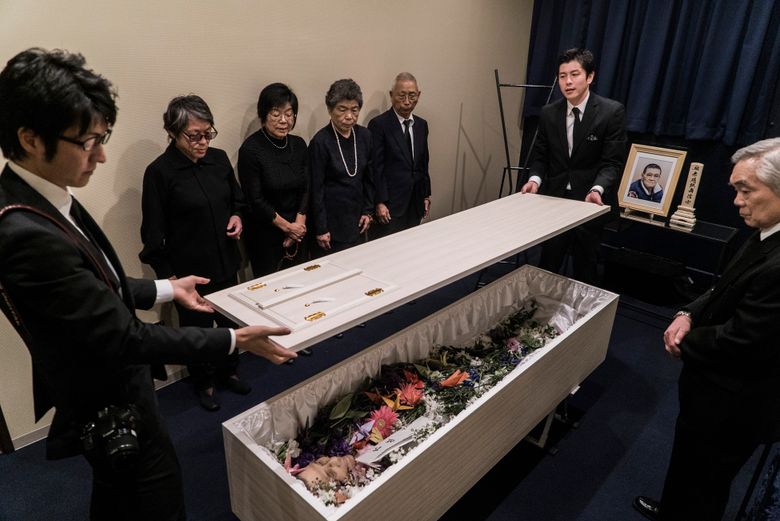
The funeral for Hajime Iguchi at Sousou, a so-called corpse hotel in the Tokyo suburb of Kawasaki City, Japan. (BEN C. SOLOMON/NYT)

Japan is the quintessential society or orderly politeness and cohesion, and its people take care never to seem to be different, because homogeneity is of supreme importance to the culture that values harmony, neatness, orderliness and good behaviour. But above all, being Japanese. After all, the islands that comprise Japan accommodate the living needs of 127-million people, living in fairly close proximity to one another in a geography that is mountainous, making for a crowded urban environment in its cities.

The Japanese are consummate consumers, demanding quality control and excellence, whether it be in the vehicles they produce (and typically discard when several years old for new ones because of 'safety' rules, exporting the old to other Asian nations) or the food they eat both local and imported. They are fastidious people with a genuine love of nature; when exploring the natural landscapes Japanese enjoy dressing for the occasion lederhosen, walking sticks and all.

And they certainly love thematic drama to accommodate their sense of orderliness, along with a social contract that abhors unseemly behaviour bringing public attention to oneself, behaving with public circumspection to a degree not seen elsewhere. The very essence of being Japanese is a state of being to be both cherished and protected; those who exit the country to go abroad temporarily are viewed as less than authentic Japanese on their return.

Japanese in Tokyo typically live in building complexes where apartments are very small, so they do their entertaining at hotels and restaurants. Urban building areas are so tight that amazingly narrow buildings are shoehorned in wherever possible between existing buildings. And because homes are so tight there is little opportunity for a couple to get intimate while courting. Japan looks after that through Love Hotels, temporary and elegant surroundings for a few hours or an evening of togetherness.

There are hotels whose architecture has been designed to appear like a wedding cake. Famously, there are specialized hotels in Japan whose rooms are actually sleeping pods, narrow platforms meant simply for sleep. They are called capsule hotels and resemble what might be sleeping arrangements on a space ship, utilizing all available room in a space-tight environment. In Japan, with its large population and small geography, it makes sense.

Categorization as well as themes also play a significant role in merchandising and marketing, where streets and specific neighbourhoods are dedicated to a single theme. To highlight electronics, or a focus on shoes only, on motorcycles, or on fish so that on that street, shop after shop exclusively features products that fit that specific category. Another quaint and perhaps sensible custom is the featuring of plastic models of the food that can be ordered at restaurants, colourful and obvious, in cafe or shop windows.

The latest, it would seem, is the inauguration of Corpse Hotels, where family and friends are able to  grieve for their loved ones who have passed through life and death has embraced them. They are called "itai hoteru". One half of the rooms in the hotel are meant to hold coffins on platforms built into the room alongside small altars. Some of the coffins come with transparent lids to aid the mourners' view of the departed. The other rooms are meant for mourners to stay over.
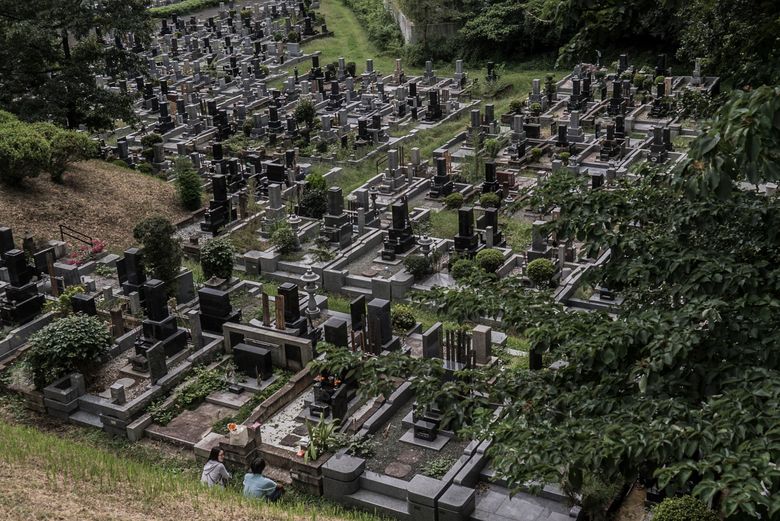
A cemetery outside Tokyo. Nearly all people who die in Japan are cremated. Crematories cannot keep up with demand, so businesses are combining hospitality for families and temporary storage for bodies. (BEN C. SOLOMON/NYT)

Instead of the large funerals that were once traditional, these "itai hoteru" are being popularized. In 2015 alone, 1.3 million people died in Japan, representing an increase of 35 percent from 2001, and increasing. The death rate is expected to peak in 2040 at 1.7 million people expiring. Last year, 37 percent of Japanese women were over 90 when they died, with few to mourn them. Almost one-fifth of Japanese men never marry or have children, so there are few relatives.

In Tokyo, with its population of 13 million people, there are 25 crematoriums even though there are 5,100 crematoria throughout the entire country.The number of people over age 65 who died alone at home in Tokyo doubled between 2003 and 2015. The appearance and usefulness of Corpse Hotels reflect a solution to a social conundrum for a practical people.

Labels: , , , ,

Thursday, January 26, 2017

Modernizing Egypt, Slowly Empowering Egyptian Women

"Why cannot we, as a state concerned with the safeguarding of society ... issue a law that only legalizes divorce when done in the presence of a Maazoun [cleric authorized by government to officiate marriage and divorce] so we can give the couple a chance to reconsider?"
"It cannot be just a word that is casually uttered. [Children would be protected under a proposed law, preventing 'inappropriate behaviour'."
Egyptian President Abdel Fatah el-Sissi
(File : AFP)
Egyptian President Fatah el-Sissi, AP

President el-Sissi, with much on his agenda, not the least of which is Egypt's economy, its domestic crime rate, sectarian hostilities, the pressures of Islamists loyal to the now-outlawed Muslim Brotherhood, and the violent attacks taking place in the Sinai by Salafist Bedouin, Islamic State and el-Qaeda militias and Brotherhood-linked Hamas on Egyptian police and military, still obviously uses his nimble brain to ruminate on how Egyptian society could benefit by setting aside some of the Islamist-inspired cultural traditions such as a man's prerogative to end a marriage simply by stating "I divorce you" three times in succession. 

As a devout Muslim himself, President el-Sissi is aware of creeping fundamentalist Islamism and the violence that ensues, and has expressed his frustration in the past over ancient Islamic scripture being revived that reflects the mores of its medieval past, rather than moving forward into the 21st Century. In particular, he has spoken of Islamic exceptionalism and jihad, rejecting both as inappropriate for a world religion and deploring the existence of terrorist groups patterning themselves on the Islam of its early years of bloody conquest.

Now he has addressed himself to his nation's high divorce rate. He feels that legislation that would outlaw the verbally valid divorce in Sharia law -- to make it mandatory for Muslim men and their spouses to seek out alternatives to spur-of-the-moment sundering of a marriage contract -- would represent a step forward. President el-Sissi spoke recently during a televised address of his alarm on hearing from the head of the nation's Statistics Bureau that some 40 percent of Egypt's annual 900,000 marriages last a mere five years.

Legislation was required -- he suggested to the Grand Imam of Al-Azhar, the international authority of the Muslim world and of religious learning and jurisprudence -- that would de-legalize the too-simple social convention of three-times-repeated "I divorce you", which could be initiated only by a man. Divorce should ideally be legal only when announced in the presence of an officially authorized cleric, he sressed. The idea being to avert emotional arguments between husband and wife, descending to a splintering of the marriage.

The Religion of Peace

The old verbal protocol, announcing the dissolution of a marriage, satisfies the traditional patriarchy in Egypt which considers that kind of decision the prerogative of the male. President el-Sissi's foray into reforming such outdated cultural traditions is not popularly embraced by either conservative militants or fundamentalist clerics. President el-Sissi understands these dynamics well, that he requires the cooperation of Al Azhar's grand imam, sheik Ahmed al-Tayeb, for success in overturning the male-centric privilege.

But the Egyptian president is firm in his belief that Islam is badly in need of a new image, and to do so would require expunging the interpretation of the radical readings of the Koran, popularized by militant groups such as the Islamic State. "It's a harsh war and the entire world knows that we are fighting it alone", said President el-Sissi in contradiction of pro-government media asserting that the militants were on the verge of destruction, successfully challenged by the Egyptian military.

The President's views on sexual harassment in Egyptian society as a chronic social ill, has him speaking forcefully in condemning the practise. He guided his 596 seat parliament last year on producing tougher penalties for female genital mutilation, where amendments to punish perpetrators with up to 15 years in prison should a child die as a result of the medieval practise, and up to seven years for performing the procedure.

Egypt is well served under his tutelage and guidance.

Labels: , , , , , ,

Saturday, December 12, 2015

Life In The West Bank

"I live a social life that is probably as good as any European country. My wife and I live in a nice flat, we have good jobs, we go out often to pubs and restaurants with friends or alone. We have one or two vacations a year during which we almost always go to Europe."
"We are not rich. But our lifestyle is not the way most Palestinians live, we have significantly higher disposable that allows us to live this life style."
"As in every country, there are people who are filthy rich, and those living in extreme poverty and those at different points between the two ends of the spectrum."
"You can say the we are, generally, no different from the neighbouring countries like Jordan, but much better off than Egypt due to less skewed distribution of wealth."

"You can lead a good living standards in the West Bank. But you will always be living day to day, no matter how rich or poor you are. I, like almost everyone else, feel suffocated by the level of control Israel has on us and the extent to which they exercise this control, ultimately affecting every aspect of our lives."
Nedal Zahran, Palestinian resident, writer, West Bank 

The Palestine Trade Tower in RamallahThe Palestine Trade Tower in Ramallah is claimed to be the tallest building in the Palestinian Authority

In the West Bank, as in every other community in the world there is a mixed population, those living moderately, those living in poverty and those living with sumptuous wealth. There are dank streets and humble dwellings and within there is bitterness at the lean life and the questionable future its inhabitants visualize. On the other hand, there are areas with 5-star hotels and restaurants whose chefs hail from Paris and Florence. There are multi-story shopping malls, cafes and nightclubs.

Movenpick Hotel in RamallahMovenpick Hotel in Ramallah

If you had your pick, which would you choose? Well, life does not always give us options and we live where we do because we have few other choices. Where luxury suites of hotels cost $400 nightly with breakfast at a Movenpick Ramallah Hotel with its seven banquet halls and modern amenities "overlooking the suburbs of Jerusalem", the privileged take full advantage, as why would they not? Those not privileged can only look on in envy; they might be impoverished residents of Ramallah or equally poverty-stricken Israeli Jews.

House of Palestinian businessman Mohamed Abdel-Hadi

Looking for luxury car dealerships? They can be found there. And cars that fit that description can be found on the streets as well, but they're associated with streets upon which stand palatial mansions, for there is wealth aplenty. Aside from the wealth there is a rich vein of history, special to Jews, Christians and Muslims. In fact, Islam lays claim to much of which is sacred to Judaism and Christianity, since Isa, whom Jews and Christians better know as Christ was born a Muslim Palestinian.

Just ask Palestinian Authority President Mahmoud Abbas. It's one of many historical factoids he is particularly proud of. Then there is the Cave of the Patriarchs the most ancient of Jewish sites venerated by Jews, of course. Imagine: 3700 years ago Abraham, Isaac, Jacob, Sarah, Rebecca and Leah of the Old Testament were buried in that sacred tomb. It is a place revered by Muslims since Ibrahim as they know him, was a Muslim prophet.

Jawwal cell phone company in el-Bireh, next to RamallahJawwal cell phone company in el-Bireh, next to Ramallah

The human-misery index of the West Bank is undeniable; the poverty rate stands at 18 percent. Wait: the poverty rate for the United States is 15 percent. And Israel's? How about 21 percent. There is a high literacy rate among Palestinians; 96.5%, something to be justly proud of. Palestinians view their education system with high approval. According to the United Nations' Human Development Report, Palestinians outlive their Arab neighbours by five years.

Palestinian infant mortality rate is less than half of other Arabs. The New Economics Foundation's Happy Planet Index reports that Palestinians are among the happiest of Arabs, ranking 30th happiest in the world. Imagine, if you will; Palestinians are happier than Canadians, Americans, Australians and Britons. BMWs and Mercedes abound, since there are local dealerships aplenty. 

Of the world's longest-lived refugee camps, 19 exist teeming with Palestinians. The Palestinian refugees of the current era include the children, grandchildren and great-grandchildren of the original 1948 refugees.

Kerish Motor Mall in Beitunia, 3 km. west of RamallahKerish Motor Mall in Beitunia, 3 km. west of Ramallah

They are, of course, refugees of such long standing because having fled the territory that Israel claimed after the UN declaration of Partition which the Palestinians flatly rejected, no Arab countries would give them status as citizens, though they allowed the United Nations to erect refugee camps for them, to fester with resentment within; a sore become a scab that everyone picks at and when it bleeds the world responds with compassion.

Arab Mansion in RamallahArab Mansion in Ramallah

The camps of course are no longer tent cities, if they ever were. They are cities of four- and five-story apartment buildings, the units owned by the residents. There is no shortage of electricity, satellite television, water and sewage systems, and municipal garbage collection. All paid for by the United Nations and Western aid agencies. In the last two decades an estimated $30 billion has gone to the aid of the Palestinians.

Labels: , , ,

Monday, April 15, 2013

Our Very Own Camelot

Wait for it - it's on its way, took time coming, but chugging along. The polls instruct that a majority of Canadians conceive of Justin Trudeau as prime ministerial material, just what Canada needs, they think. Prime Minister Stephen Harper has become too predictable, too boring, and Canada needs an infusion of excitement. Justin Trudeau promises to deliver that, a knock-off in part of his heritage. His mother certainly lent herself to excitement; Rolling Stones concerts were her metier.

His father was capable of indulging the inner fancy of his faery muse from time to time, but his was a complex personality that also combined intellect and philosophy to really confuse those who attempted to pin him down. With Justin Trudeau it becomes a little easier; he is what you see, and not what you perceive, and this is the measure of that fellow, who is physically attractive and casually assured - appealing traits to those who look for these important attributes in a leader.

No experience? No problem. No perceptible plans for the Liberal Party, much less the country itself? No problem. Inviting the votes of an adoring Twitter-Facebook generation to casually vote online without the irritating necessity to register in acknowledgement of their disdain of commitment? No problem. It's a mutual admiration society. And it's our society.

A first-ballot win. Unheard of. A first-ballot registering 80% of the easy-eligible voting contingent? Breaking new ground. This will be his speciality. "Canadians will not suffer fools gladly", he claimed in his 'acceptance' speech, and it's difficult not to snigger. Canadians not suffering fools gladly? Why Justin, what just happened?

Focusing in his 'victory' coronation speech on the Conservative-led Stephen Harper government's "unambitious agenda", is rather priceless. He, on the other hand, is a political leader dedicated to the good fight. He will lead the country on a pilgrimage to new, unexplored territory of aspirational involvement in finding ourselves in a finer place. That's an ambitious agenda.

"(Canadians) want something better. They refuse to believe that better is not possible." What some of them refuse to believe, find it painful to come to terms with, attempt desperately to understand, is how someone so callow, inexperienced, egocentric and placidly convinced he is adored to the point of anointment could take the leadership of a political party that once held a storied place in Canada.

It is, granted, a party that has become rather defunct in purpose and design. So perhaps it is only fitting that it be led by one who is groping his way to discovering what can be done to unite the country in a Castro-Chavez type of personality cult that is oblivious to the practicality of good governance and addicted to saluting posters.

Lovely family photograph, though.
Justin Trudeau, his wife Sophie Gregoire and their children Xavier and Ella-Grace celebrate after he won the Federal Liberal leadership Sunday April 14, 2013 in Ottawa. THE CANADIAN PRESS/Adrian Wyld

Labels: , , ,

Friday, March 15, 2013

Canada slips out of UN’s list of 10 most developed countries

Canadian Press | 13/03/14 | Last Updated: 13/03/14 2:43 PM ET
More from Canadian Press
PAT McGRATH/Ottawa Citizen files

The top countries on the UN Human Development Rankings for 2013

  1. Norway
  2. Australia
  3. United States
  4. Netherlands
  5. Germany
  6. New Zealand
  7. Ireland
  8. Sweden
  9. Switzerland
  10. Japan
  11. Canada
Canada has fallen five places since 2007. It is still experiencing Human-development growth as tracked by the UN, but that growth is not happening as quickly as other countries higher on the list.

OTTAWA — Canada has slipped out of the top 10 countries listed in the annual United Nation’s human development index — a far cry from the 1990s when it held the first place for most of the decade.

The 2013 report, which reviews a country’s performance in health, education and income, places Canada in 11th place versus 10th last year.

A closer look at the trends shows Canada actually did better than last year, but other countries such as Japan and Australia improved at a greater rate.

The main finding of the report is positive, that some of the world’s poorest countries are consistently improving areas such as life expectancy, school attendance and per capita income.

Even the countries at the bottom of the list, Niger and the Democratic Republic of Congo, are among those who showed the greatest improvement.

Meanwhile, another report released today shows Canada has moved up its economic ranking to sixth out of 16 countries — but it’s mostly due to the weakness of other countries.

The Conference Board of Canada says the country has retained its “B” grade and improved its ranking from 11th since its last report card in pre-recession 2008, adding that part of the reason the surge is because some European countries going through tough times.
The board says with the exception of inflation and employment growth, Canada ranks far below the highest-ranked countries on other economic indicators such as productivity and attracting global investment.

Despite its economic challenges, the United States ranks fourth, two places ahead of Canada with slightly better productivity and a higher standard of living. While Norway and Australia are the top economic performers with both countries scoring “A” grades.

National Post Graphics
National Post GraphicsCanadian debt by province (click to enlarge)
 
Canada’s improved ranking doesn’t completely reflect its performance, said the report released on Thursday.

“We have moved up, but some of it is because others have gotten a lot worse,” said Kip Beckman, principal economist at the independent research organization.

“The Canadian economy may only be growing at two per cent now, but people in Europe would love to have two per cent growth.”

Beckman said partly to blame is a labour productivity gap with the United States that has been around for decades.

Labour productivity refers not to employees working longer and harder, but working smarter.
“For example, if a company brings in a robot on a car assembly line and they can produce with the same workers more cars — that’s an improvement in productivity and that leads to a higher standard of living,” he said.

Investments in machinery, equipment and technology can improve productivity as well as encouraging innovation, Beckman added.

Income per capita and foreign investment in the country and by Canadian companies outside the country also held Canada back.

Beckman noted that Canada is behind the United States’ standard of living rating by about 15 per cent, attributed mostly to lower productivity.

Human Development Report 2013 from UNDP on Vimeo.

Norway was the top performer with income per capita, which is gross domestic product divided by population, of about US$48,000. Canada had income per capita of US$36,138, which earned it a “C” grade, the report said.

Canada got a “D” grade on attracting foreign investment while Belgium was the “runaway” leader on this kind of investment, the report said.

The country’s low grade could be due to productivity, taxes and regulatory concerns, Beckman said.
Canada got a “C” for the country’s firms investing globally but lagged far behind the top performers, Belgium and Switzerland, the report said.

Beckman noted that Australia has fared well because of its close trade ties with the Pacific-Asia region, which is the fastest growing region in the world.

“Whereas we’re tied with the United States, which is growing at two per cent,” he said.

The report, called How Canada Performs, is to help identify strengths and weaknesses in Canada’s socio-economic performance by examining the economy, innovation, environment, education, skills, health and society.

Labels: , , , , , ,

Monday, February 11, 2013

Pope Benedict XVI in shock resignation

BBC News online - 11 February 2013
Pope Benedict XVI announces his resignation in a surprise statement
Pope Benedict XVI is to resign at the end of this month after nearly eight years as the head of the Catholic Church, saying he is too old to continue at the age of 85.

The unexpected development - the first papal resignation in nearly 600 years - surprised governments, Vatican-watchers and even his closest aides.

The Vatican says it expects a new Pope to be elected before Easter.
Cardinal Joseph Ratzinger became Pope in 2005 after John Paul II's death.
The BBC's David Willey in Rome says the move has come as a shock - but adds that in theory there has never been anything stopping Pope Benedict or any of his predecessors from stepping aside.
Under the Catholic Church's governing code, Canon Law, the only conditions for the validity of such a resignation are that it be made freely and be properly published.

But resignation is extremely rare: the last Pope to step aside was Pope Gregory XII, who resigned in 1415 amid a schism within the Church.

A Vatican spokesman, Father Federico Lombardi, said that even Pope Benedict's closest aides did not know what he was planning to do and were left "incredulous". He added that the decision showed "great courage" and "determination".

Pope Benedict XVI

  • At 78, one of the oldest new popes in history when elected in 2005
  • Born in Germany in 1927, joined Hitler Youth during WWII and was conscripted as an anti-aircraft gunner but deserted
  • As Cardinal Joseph Ratzinger spent 24 years in charge of Congregation for the Doctrine of the Faith - once known as the Holy Office of the Inquisition
  • A theological conservative, with uncompromising views on homosexuality and women priests
Italian Prime Minister Mario Monti is quoted as saying he was "greatly shaken by this unexpected news".

The brother of the German-born Pope said the pontiff had been advised by his doctor not to take any more transatlantic trips and had been considering stepping down for months.

Talking from his home in Regensburg in Germany, Georg Ratzinger said his brother was having increasing difficulty walking and that his resignation was part of a "natural process".
He added: "His age is weighing on him. At this age my brother wants more rest."

The Pope is not expected to take part in the conclave that will choose his successor, and will then retire to the papal residence at Castel Gandolfo when he leaves office.

Father Lombardi said the Pope would then move into a renovated monastery used by cloistered nuns inside the Vatican, for "a period of prayer and reflection".

Damian Thompson, former editor of the Catholic Herald, says the Pope has made a "brave move"

At 78, Cardinal Joseph Ratzinger was one of the oldest new popes in history when elected.
He took the helm as one of the fiercest storms the Catholic Church has faced in decades - the scandal of child sex abuse by priests - was breaking.

In a statement, the pontiff said: "After having repeatedly examined my conscience before God, I have come to the certainty that my strengths, due to an advanced age, are no longer suited to an adequate exercise of the Petrine ministry.

"I am well aware that this ministry, due to its essential spiritual nature, must be carried out not only with words and deeds, but no less with prayer and suffering.

The Pope's shock resignation on health grounds is an "eruption of modernity" into the Vatican, according to Ezio Mauro, chief editor of Italy's La Repubblica daily.

The Spanish daily El Mundo says Benedict XVI will be remembered as "God's sweeper" - the man who tried to resolve the "numerous problems of the Church that did so much harm to its image".

In a video commentary, the chief editor of Poland's Rzeczpospolita daily, Boguslaw Chrabota, said: "I'm shocked, just like the whole world is... For a long time we have known about his health problems, but we never knew the details, of course. We thought that he would cope, that he would overcome his illness."

The editor of German broadcaster Deutsche Welle, Bernd Riegert, calls the Pope's move "a courageous step, a revolutionary step". "He has helped himself to freedom, he is setting boundaries. No longer will successors be able to cling onto their office."

"However, in today's world, subject to so many rapid changes and shaken by questions of deep relevance for the life of faith, in order to steer the ship of Saint Peter and proclaim the Gospel, both strength of mind and body are necessary, strength which in the last few months, has deteriorated in me to the extent that I have had to recognise my incapacity to adequately fulfil the ministry entrusted to me. 

"For this reason, and well aware of the seriousness of this act, with full freedom I declare that I renounce the ministry of Bishop of Rome, Successor of Saint Peter, entrusted to me by the cardinals on 19 April 2005, in such a way, that as from 28 February 2013, at 20:00 hours, the See of Rome, the See of Saint Peter, will be vacant and a conclave to elect the new Supreme Pontiff will have to be convoked by those whose competence it is."

A theological conservative before and during his time as Pope, he has taken traditional positions on homosexuality and women priests, while urging abstinence instead of blessing the use of contraceptives.

His attempts at inter-faith relations were mixed, with Muslims, Jews and Protestants all taking offence at various times, despite ongoing efforts to reach out and visits to key holy sites, including those in Jerusalem.

A German government spokesman said he was "moved and touched" by the surprise resignation of the pontiff.

"The German government has the highest respect for the Holy Father, for what he has done, for his contributions over the course of his life to the Catholic Church.

"He has left a very personal signature as a thinker at the head of the Church, and also as a shepherd."

Labels: , ,

Friday, January 18, 2013

Alarabiya.net English‘Jew’ is the new ‘cool’ for Dutch youths

Dutch teens are now using the term “Jew” to mean “cool.” (Reuters)
 
“Cool,” “awesome,” and even “sick” are words that have been used by teenagers to define what is “cool.” But recently, a new word, “Jew,” has been added by young Dutch teenagers to mean “cool.”

The word ‘Jew’ has long been used for anti-Semitic invective that implied a negative connotation or associated with avarice, according to Leiden University’s Linguist Professor Marc van Oostendorp. Recently, however, the use of the word ‘Jew’ indicates something “beautiful and very pleasant,” the Dutch website Pow Ned reported.

“Apparently the time has come for the Jew-generation,” said the language professor in the report.

Oostendorp wrote on his blog that in Netherland’s city of Leiden, high schools students have been using the Dutch word “jood,” with a positive undertone, which confirmed what the professor had earlier read on a Dutch-language based Internet forum.

The Urban Dictionary site, which is known for its ability to record the coined words and phrases, defined the term “jood” as meaning “cool.”

But according to the dictionary’s statistics, “jood” has received a mixed reaction, with nine people identifying the phrase as accurate, while 22 others expressed doubt over the definition.

The use of the word ‘Jew’ hails a controversial debate in any context even when pro-Jewish Ajax Amsterdam football fans chanted “we are the super Jews” during the match.

A Dutch anti-racism campaign group, BAN, has sued the sports club for using the pro-Jewish chant.

Labels: , ,

Friday, January 04, 2013

Walking may lower women’s risk of stroke, Spain study finds

Kathleen Raven, Reuters | Jan 4, 2013 10:55 AM ET
Getty Images
Getty Images Women who who walked briskly for 210 minutes or more per week had a lower stroke risk than inactive women in a recent study, but also a lower risk than those who cycled and did other higher-intensity workouts for a shorter amount of time.
 
Women who walk at least three hours every week are less likely to suffer a stroke than women who walk less or not at all, according to new research from Spain.

“The message for the general population remains similar: regularly engaging in moderate recreational activity is good for your health,” said lead author José María Huerta of the Murcia Regional Health Authority in Spain.

Even after chronic disease diagnosis, older Canadians persist in bad lifestyle choices

Even after Canadians aged 50 and older are diagnosed with a chronic condition like heart disease or diabetes, they rarely make lifestyle changes that could improve quality of life or prolong their lives, a report suggests.

In a Statistics Canada study released Wednesday, researchers found that quitting smoking or cutting back on the number of daily cigarettes were the changes most commonly reported, although most smokers continued the habit after their diagnosis.

“Studies have shown that there are positive benefits in terms of longevity, quality of life and reducing recurrence or progression of a disease,” said Pamela Ramage-Morin, a senior analyst at Statistics Canada and a study co-author.

Past studies have also linked physical activity to fewer strokes, which can be caused by built-up plaque in arteries or ruptured blood vessels in the brain.

While the current study cannot prove that regular walking caused fewer strokes to occur in the women who participated, it contributes to a small body of evidence for potential relationships between specific kinds of exercise and risk for specific diseases.

Women who walked briskly for 210 minutes or more per week had a lower stroke risk than inactive women but also lower than those who cycled and did other higher-intensity workouts for a shorter amount of time.

In all, nearly 33,000 men and women answered a physical activity questionnaire given once in the mid-1990s as part of a larger European cancer project. For their study, Huerta and his team divided participants by gender, exercise type and total time spent exercising each week.

The authors, who published their findings in the journal Stroke, checked in with participants periodically to record any strokes. During the 12-year follow-up period, a total of 442 strokes occurred among the men and women.

The results for women who were regular walkers translated to a 43% reduction in stroke risk compared to the inactive group, Huerta said.

There was no reduction seen for men based on exercise type or frequency, however.

“We have no clear explanation for this,” Huerta wrote in an email. He hypothesized that the men may have entered the study in better physical condition than the women, but there was no evidence to support that guess.

Huerta also declined to compare the study participants’ risk levels to those of the general population, citing the subjects’ unusual characteristics: a majority of men and women in the study were blood donors, who tend to be in good health in order to give blood.

“I wouldn’t make much of the results because they are for a very specific population,” Dr. Wilson Cueva of the University of Chicago in Illinois said.

Cueva, who was not involved with the research, pointed out that the study relied too heavily on subjective measurements, like the participants’ memory of exercise routines.

“There is no objective way to measure how much exercise they actually did,” he said.
Each year in the U.S., about 795,000 people suffer a stroke, according to the American Heart Association. Put another way, one American has a stroke every 40 seconds and dies from one every four minutes.

Despite a recent dip in strokes attributed to better blood pressure control and anti-smoking campaigns, the World Health Organization (WHO) predicts that stroke cases will increase as the global population continues to grow older.

Guidelines set by the WHO and U.S. Centers for Disease Control and Prevention recommend at least 150 minutes — or two-and-a-half hours — of moderate exercise such as brisk walking each week.

Cueva urged health consumers to heed those guidelines for now. The way the Spanish study was designed, it’s difficult to draw any conclusions he said. But, “We know that exercise is related to reduced risk of stroke and other diseases.”
© Thomson Reuters 2013

Labels: , ,

Thursday, January 03, 2013

Op-Ed: Exposé: England is Marching to Islam

Published: Thursday, January 03, 2013 7:47 PM   Arutz Sheva 7

Islamification is a phenomenon epitomized by a sign on the walls of London University: “Peace with Israel is a crime”.


According to a new study of the Henry Jackson Society, the Muslim Council of Britain, which calls itself the “representative body” of UK Muslims, already has a more prominent role in public debate today than the Church of England.

“2030: the year in which England ceased to be a Christian nation”, said the Daily Mail. The title might be too optimistic. The Church of England is already dying and the UK is experiencing a process of “Islamification”, as a leftwing publication such as The Independent recently titled a report.
In his new bestselling book “Civilization,” renowned Harvard historian Niall Ferguson writes: “If the Muslim population of the UK were to continue growing at an annual rate of 6.7% (as it did between 2004 and 2008,) its share of the total UK population would rise from just under 4% in 2008 to 8% in 2020, to 15% in 2030 and to 28% in 2040, finally passing 50%in 2050.”

At the recent Anglican Synod, the Bishop of Southwell and Nottingham, Paul Butler, declared that the Church of England “will no longer exist in twenty years”. The Economist, a weekly magazine always insightful about the internal upheaval of the British society, predicts that in 2020 the members of the Church of England will be no more than 680,000, compared to the current 800,000 and one million a decade ago. In 1979 there were 5 million.

The recent national census for England and Wales shows that in the capital, London, people identifying themselves as “white British” have for the first time become a minority. But most strikingly, the national Muslim population has doubled.

It is now official: between 2001 and 2011 the Muslim population of the UK rose from 1.5 million to 2.7 million. Otherwise put, it is an increase from 3 percent to 4.8 percent of the overall population.
Islam is the fastest-growing religion in England and Wales, according to new census data.

Another recent survey, conducted by the inter-faith group Faith Matters, shows that the number of British converts to Islam just passed the 100,000 mark, and there are as many as 5,000 new conversions each year. The Channel 4 programme “The Last White Kids” shows two British children living in an entirely Muslim district and becoming enthusiastic attenders at the local mosque.
Since the last census in 2001, the number of Britons identifying themselves, however loosely, as “Christians”, is down 13 percentage points to 59 per cent.

The study named English Church Census also predicts that the number of Christians attending Sunday services in the UK will fall by two-thirds over the next three decades. The study expects that poor attendance will force 18,000 churches to close.

Islamification is spreading in the universities as well.

Eight British universities, including Oxford and Cambridge, have accepted more than 233.5 million pounds sterling from Saudi and Muslim sources since 1995. The total sum, revealed by Anthony Glees, the director of Brunel University's Centre for Intelligence and Security Studies, amounts to the largest source of external funding to UK universities.

Universities that have accepted donations from Saudi royals and other Arab sources include Oxford, Cambridge, Durham, University College London, the London School of Economics, Exeter, Dundee and City.

The consequences of the funding have been very clear. 70 per cent of political science lectures at the Middle Eastern Centre at St Antony’s College, Oxford, were “implacably hostile” to the West and Israel. It’s a phenomenon epitomized by a sign on the walls of London University: “Peace with Israel is a crime”.

Meanwhile, the great British ideal stretching back centuries to the Magna Carta, requiring that everyone should be treated equally under the law, has been eroded by the Sharia courts.

The UK imported imported Islamic law from theocracies like Iran, Afghanistan and Saudi Arabia: an estimated 85 Sharia councils are already operating in the UK, according to a 2009 report by the think tank Civitas. There is also a large network of informal Islamic “councils”, often operating out of mosques, dealing with religious divorces and even child custody matters in line with Koranic teaching. These courts are based on the rejection of the principle of inviolability of human rights. The courts formalize the “talaq,” the repudiation of the wife by the husband, polygamy, the right to “rebuke” the wives and genital mutilation.

The Islamists have also been able to destroy another British treasure: freedom of expression.

Historian Tom Holland’s Channel 4 film “Islam: The Untold Story” has been cancelled due to a flow of menaces and death threats. Grayson Perry, the Turner Prize-winning artist,  then admitted that he censors himself when it comes to matters relating to Islam. “I don’t want my throat cut”, he said.
In the “Decline and Fall of the Roman Empire”, the great historian Edward Gibbon speculated that if the French had failed to defeat an invading Muslim army at the Battle of Poitiers in 732C.E., “perhaps the interpretation of the Koran would now be taught in the schools of Oxford”. When those words were published in 1788, the idea was a fantasy. Today, Oxford debates “Israel’s right to exist” and preaches Islam.

Gibbon was right, but before his time. The British march toward Islam looks inexorable. This is Aldoux Huxley’s “Brave New World”. The imams’ call to prayer will rise across the slate roofs of the British industrial slums and medieval “emirates” will operate outside British law but inside the cities. Churches will be used as night clubs or mosques. Jews will be forced to live in new ghettos for “security reasons” or to pack and leave.

Britain as we knew is going to disappear. History tells us that entire countries have adopted a new religion.in the past.  Why it can’t happen again in the UK?

Labels: , , , ,

Thursday, December 27, 2012

Inheriting Injustice

Written by Diana Atallah  The Media Line
Published Thursday, December 27, 2012


Palestinian Women Face Discrimination In Inheritance
  
Ramallah – They may argue they enjoy better conditions than their peers in Arab countries, but Palestinian women share a similar problem with them: being forcibly denied their legitimate inheritance.

Women are usually shy about making such demands or fear social pressure such as being ostracized by their family. Others simply believe their male relatives are more entitled to the inheritance because they are the family's bread-winners, and give up their rights to inherit intentionally.

Social workers and lawyers familiar who work on such cases blame Arab society's culture and norms, since women's right of inheritance is granted by Islam's Sharia law and the Palestinian laws derived from it.

The Sharia law implemented in this area clearly classifies who gets what. Christians refers to their churches' courts which also give women the right of inheritance.

Jwana Rafeedie, Coordinator of the YMCA's Inheritance Denied Project, told The Media Line that the YMCA started their lobbying and awareness project after 2004 statistics showed only four percent of Palestinian lands and properties were owned by women. "We believe if women acquired their rights [to inherit], the figures would go up to 33%," she added.

The tribal and family unit still plays an important part in Palestinian society, making women less willing to challenge traditions regarding inheritance. In an attempt to try to keep the wealth within the family, the inheritance is split solely among the males. Rules are even stronger regarding property because granting a piece of land to a woman is seen as tantamount to giving it to her husband, often labeled a "stranger" if he is from a different clan.

Keeping the money in the family is what often leads to a preference for young Palestinians to marry close relatives, such as first cousins.

Of the 10,000 men and women the YMCA and their partners targeted in inheritance rights awareness campaigns in the middle and southern West Bank, only 50 women utilized the free legal consultation offered, and just two went to court.

Social pressure in particular discourages women from demanding their rights. "One woman couldn't find witnesses to prove the date of her grandfather's death. No one from the village agreed to stand by her," Rafeedie told The Media Line.

The relatively long and costly court procedures also make women reluctant to seek justice.

Women are often asked to waive their right to inherit a deceased relative’s land in exchange for a sum of money, Sheikh Youssef Idees, Chairman of the Supreme Council for the Islamic Courts, told The Media Line.

Since it is often unclear exactly how much land the deceased had, and women are often unable to have the land properly appraised, they frequently waive their inheritance claims for a fraction of its true value.

Idees told The Media Line that he is working on issuing a decree that women who agree to the money instead of the land must sign the waiver in front of a judge to ensure they are given their full rights. However, he said he expects to encounter social resistance to the idea.

Sahar Ahmed (not her real name) fought for her sister-in-law’s right to inherit her father, who died five years ago. "My mother-in-law didn't want to give any of the land even to her own daughter, saying that she was living a good life already," Ahmed told The Media Line. 

She said that her eldest brother-in-law agreed with his mother, saying that he also didn't want his daughters to inherit him in the future," she added.

After years of discussion, Ahmed succeeded in convincing her mother-in-law that Islam gives Palestinian women the right to inherit even when they are wealthy.

"It's strange when people try to impose religious views on women, like wearing the hijab [head covering] and so on, but when it comes to their rights in inheritance, they just turn their backs," she added.

The Ahmed family members plant their land with olive trees, sell the olives, and share the yearly revenue.

Sa'eda, who finished secondary school, is a housewife and received her first share of the land's crop of olives this year.

"You can't imagine how happy she was. I believe I did a good thing because her husband is not doing well now, and this year's crop helped sustain the family," Ahmed said.

Over the last three years of the YMCA project, Rafeedie noted that she didn't find any major differences between women and the inheritance issue in terms of their social and academic status, location or religion.

Rafeedie believes changing this long-held tradition will not be an easy task. "A man killed his sister last April because of an inheritance dispute, and then the killer claimed it was an 'honor killing' incident, she said, adding that the idea of women having financial independence is still unacceptable in Palestinian society.

Honor killings refer to a family member who kills a woman suspected of adultery to preserve the family’s honor.

Salman Jabareen, 48, keeps asking her brothers  for her share in her father's lands but to no avail. "My husband and sons won't allow me to file a law suit against my brothers. They think it's unacceptable that we go to court over this," she said. Jabareen, a housewife and mother of four, told The Media Line she believes her brothers will eventually give her and her sisters their share.

Conversely, Rabab Mousa's family not only gave her the inheritance, but also split the money equally. "Islam says that the son inherits double the daughter, but my brothers said they wanted us to be equal," she told The Media Line. Mouse, a 38-year-old government employee, said that her family is not highly educated or very religious, but behaved ethically in this matter.

As Islam doesn't acknowledge wills of the deceased, some men still get their way by convincing relatives close to death to legally transfer the lands to male relatives, making it impossible for the women to inherit this land.

Labels: , , , , , , ,

Tuesday, December 25, 2012

Which Hooligans?

Protesters shield themselves as Indian police prepare to beat them with sticks (23 December 2012)

Protesters against a society in which denigration of women in a contemptible dystopian view of women and girls as ready pickings for predatory men were subjected to tear gas, water cannon and batons in Delhi.  The government banned demonstrations but doing so failed to impress the thousands of young people outraged by the perilous security of women in that patriarchal society which has failed to protect women from atrocious male conduct.

The government has sought to close off all venues of potential protest sites.  Effectively shutting down transportation routes as metro stations were closed and roads into the administrative centre of the city were barricaded.  The violent protests against government inaction in the face of dreadful insecurity of Indian women commonly assaulted on public buses, girls abducted, gang raped and left for dead or just killed outright and left to be discovered, continues.


 An Indian policeman beats women protesters with sticks, during a violent demonstration near the India Gate against a gang rape and brutal beating of a 23-year-old student on a bus last week, in New Delhi, India, Sunday, Dec. 23, 2012. The attack last Sunday has sparked days of protests across the country. (AP Photo/ Saurabh Das) 

India proudly boasts of itself as the largest democracy in the world.  Most democracies pride themselves on public safety and security.  Most democracies are not venues for their female populations continually being assaulted by criminally violent rapists and murderers. For that matter, most democracies would resist the police temptation to harass and unmercifully beat protesters whose only crime is to decry the gang rape and murder of women and girls.

Scores of people required medical treatment as a result of these violent exchanges with the police.  Little wonder that protesters respond by tossing bottles and rocks at the police, in their turn.  The latest outrage over the gang rape and attempted murder of a 23-year-old female university student and the brutal beating of her male companion who attempted to protect her has activated public rage.  Less is heard about the dreadful atrocities committed on women and girls living in poor jurisdictions.

In a country that has made attempts to turn around long-held traditions that socially isolated and subjugated minorities and women, from the plight of the Dalit (untouchables), to the subservience and sacrifice of women who are widowed (purdah or familial abandonment), the acid attacks on young women, the violent maltreatment of women through intimate violence and honour killings, India has much on its hands.


Those covering the scenes of mayhem and outrage are themselves vulnerable to harm.  A 36-year-old Indian journalist was killed during a protest over yet another, separate sex attack in north-eastern India that took place in Imphal, Nanipur, where an actress/model reported an attempted rape.  Would-be rapists feel impervious to criminal justice, in a society which has traditionally treated rape as an inconvenience to women.

During the protest over the attempted rape when the actress appeared on television to demand justice because a local militant attempted to rape her, the journalist who was in attendance was shot in the chest once the protest turned violent and the police opened fire.  The police firing on protesters.  This is India's answer to its people whose human rights to security and safety are being violated.  The violators escape justice and the protesters are fired upon.

Police are claiming that what begins as peaceful protests degenerate into violence once they have been hijacked by hooligans.  One wonders at the definition of hooligans.  Those who throw stones in frustration at the inactivity and lack of adequate attention by the authorities to the viral assaults against the most vulnerable in society.  While the police, responding to the 'hooligans', use tear gas, water cannon, batons and guns to restore order.

Labels: , , , , , , ,

Thursday, December 20, 2012

 Interpreting Custom

There is a kind of dreadful irony in the fact that a woman insists she must wear a niqab in deference to her religious traditions, even when appearing in a court of justice accusing two members of her extended family of having sexually abused her and violating her childhood innocence and trust.  The niqab, and indeed all bodily coverings worn by pious Muslim women has a distinct purpose; to keep the eyes of strangers away. 

To ensure that womanly virtue is maintained. 

To ensure that lustful men cannot appraise her feminine attributes, and in this way ensure the woman's anonymity and public safety.  But, in fact, it was her uncle and her cousin, those forsworn by custom and tradition to observe the best interests of the females in a family, who abused her when she was a child.  Bad enough when young women are sexually exploited by family members; intolerable and cruel when girls are violated.

The niqab has not worked for a Canadian Muslim woman who is only identified by the initials "N.S.".  She has anonymity.  She could, if she opted, ask to be permitted to testify at trial behind a screen to further protect her identity from public scrutiny.  She has chosen instead to plead that her religious/cultural tradition of revealing eyes only, and veiling all other parts of her recognizable visage, along with her body be permitted in a court of law.

It defies reason that a woman who has allowed a tradition born of patriarchal misogyny to convince her that a hijab and a niqab  are required for the sake of female decency, cannot identify the hypocrisy involved.  A hypocrisy that keeps her enslaved to a tradition that results in her personal identity, her gender femininity to be hidden as though they were shameful and not natural attributes endowed her by her maker.

Through submission to this tradition, imposed upon women by a backward culture that relies upon quoting religious devotion to impress upon women the need to surrender their individuality to obscurity to deflect notice of herself as a woman, she also denies her native intelligence.  Intervenors have explained time and again that nowhere in the Koran is there a demand for women to wear burqas or any other coverings; the requirement is to be modest in demeanor and appearance.

Lower courts have denied the request of N.S. to permit her to testify while wearing her niqab.  The Supreme Court of Canada to whom the matter was finally deferred, brought down their divided ruling today.  Another one of those Solomonic decisions.  The majority opinion defended Muslim women wishing to wear a niqab in court, as a religiously sensitive issue. 

On the other hand, and tellingly, they also left it to the discretion of any lower court to rule individually on the issue - in a culturally sensitive case-by-case manner.

On the one hand, the ruling may encourage women to come forward who might otherwise be loathe to lodge an official complaint of wrong-doing under the law for fear of having to testify without a face-covering.  On the other hand, the issue of the right of a defendant to be able to face his/her accuser can be compromised in acceding to the request of the accuser in this regard.

This kind of complex issue can never be solved to everyone's satisfaction.  But that old saying of 'when in Rome' is as meaningful in this context as it is in most others when societal values are opposed by traditional conventions and meet in a court of law.  The prevailing social/legal covenant should be the accepted one.

Labels: , , , , , , , , , , ,

Monday, December 10, 2012

 Japan Transformed

Japan is an orderly, quiescent society, where public outbursts are unknown, where civil propriety is the order of the day, every hour of every day, where people are unfailingly polite and considerate and authority and tradition and heritage are profoundly respected.  Public spectacles are simply not seen.  People are private, yet they are curious about others and quietly observant. 

A place for everything and everything in its place.  Social coherence and indivisibility of values, a soft zen Buddhism overlays everything.  A place where taxi drivers wear white gloves and at down times withdraw a feather duster to ensure the interior of their vehicle is immaculate.  Where drivers, coming to a red light and a stop, automatically shut down their ignition, to turn it on again when the light changes.

Where out of tall apartments, windows are festooned daily with airing futons.  Where in rental dwellings one must supply one's own utilities.  Where people can still be see in the streets at dawn or at dusk walking to a local bath, wearing cotton yukata and sandals.  Where, using a public washroom, one removes shoes in exchange for elevated sandals relieving oneself by squatting over a aperture set into the floor.

Where anyone moving to a new neighbourhood will expect the appearance of local police making background enquiries and taking note of the new residents, to record and return to the street-corner koh-ban (police box-station) nearest the area concerned.  Where in response to fire alarms, firemen pull fire wagons through the narrow streets unable to accommodate a fire truck.  Where two vehicles may not pass one another on those narrow streets.

Where side streets are unnamed and prefecture numbers identify locations, and somehow mail is miraculously delivered.  Where the subways run on time, as do the trains rumbling through Tokyo, and buses have wood slat floors and no air conditioning in a broad network of interconnecting public transportation routes, train stations, bus stops and subway stations.


Where outdoor fresh-food markets like Ueno, an immense fish market at Tsukiji and a world-class electronics experience at Akihabara tempt and entertain and fulfill the expectations of perfection-obsessed Tokyoites.  Where temples and shrines and their fabulous gardens and huge, gleaming silver, orange and gold koi swim the ponds, and where Mount Fuji can be seen beyond the skyscrapers in Shinjuku.

And where, unfailingly, the quiet of a main street will suddenly be ear-shatteringly infused with a startling racket emitted from loudspeakers clamped on a garishly painted bus identifying it in huge hiragana lettering as that of a right-wing political group, blaring its rightist nationalist message through the quiet ambiance suddenly made grim with the ugliness of noise and embarrassment.

The Japanese far-right, once considered a noisy fringe of establishment politics in Japan, appears to be gaining momentum.  Quiet Japan is turning into bumptiously right-wing Japan with the Liberal Democratic Party poised to return to power under Shinzo Abe who had in a previous prime ministerial incarnation improved relations with Beijing, and desisted from controversially visiting the Yasukuni Shrine identified with war-time Japan.

The Shinzo Abe whose party is set to capture 300 of the 480 parliamentary seats, beating out Yoshihiko Noda's currently ruling Democratic Party which may now only hope to retain a mere 70 of the 230 seats it currently holds in the lower house, is currently a far different politician than he was back in 1993 when Japan admitted and apologized for its use of Korean "comfort women" during WWII.  Abe is set to rescind that admission.

He and his party plan to re-write Japan's post-war constitution, to turn Japan's Self-Defence Force into an active army.  Where until fairly recently the Japanese military hesitated to dress in uniform outside the confines of defence headquarters because of the memory among ordinary Japanese of its role in WWII, its provocation at Pearl Harbour that brought atomic destruction to Hiroshima and Nagasaki, momentum for an unambiguous presence of the military is proceeding.

"I find it very troubling that Abe is trying to insert his revisionist agenda into the electoral program of the LDP.  Not only in calling for revision of the constitution but also in demanding significant changes to education policy regarding the wartime past", explained Daniel Sneider, director of the nationalism and regionalism project at Stanford University.

This is a new, belligerent Japan, responding to the new militarism of China, and the concern over a nuclear-armed North Korea, and the not-too muted threats by China toward its regional neighbours' insistence on their traditional offshore territorial rights in the South China Sea, along with Japan's recent face-off with China over their disputed Sankaku/Diaoyu island squabble.

"I'm saying 'show us the proof'.  This is where Japanese nationals need to be aware.  Confront (South) Korea, and argue back, fight it out verbally until you foam at the mouth", wrote ultra right-wing mayor of Osaka Toru Hashimoto who formed the Restoration Party, now calling on nations invaded by militaristic early-to-mid 20th Century Japan to "prove their claims of abuses".

Labels: , , , , , , , , , ,

Wednesday, December 05, 2012

War Crimes and the International Criminal Court

It is the 'they can', and 'they can't' syndrome.  Low expectations and slovenly-minded acceptance of those held to have different values and standards, and high expectations of those known to practise a high level of principled, honest and fair standards.  Those who can be anticipated to behave on the lowest order of human intolerance, and those who consistently comport themselves by conviction and honour to the highest level of human aspiration.

Take, for example, the International Criminal Court in 2009 taking it upon themselves on ample evidence to issue a warrant for the arrest of Sudanese President Omar Al-Bashir, the first sitting Head of State to be indicted by the Court, for war crimes and crimes against humanity committed in Darfur with the help of his military and the Arab janjaweed "devils on horseback", committing mass rapes, slaughter, and the mass evacuation of hundreds of thousands refugees from their homes.

As far as the Arab League is concerned this is an insignificant occurrence; those victims were not Arabs, they were black Sudanese, and not practising Muslims.  President Al-Bashir may travel with impunity wherever he wishes without fear of being apprehended for he is among friends and colleagues.  And his fearsome reputation for brutal repression and genocide hasn't stopped China from doing oil business with Khartoum.

China too is known to be abusive of human rights.  Tibet is a prime example.  China has a difficult task maintaining balance and order among its babel of languages, ethnicities, cultures and religions.  Civil disobedience is not honoured and it is not taken lightly.  Harmony above all.  Is it a breach of human rights to remove thousands upon thousands of peasants without recompense from their birthright so their farms can be flooded for a giant dam?

Can the deliberate destruction of a historical culture as in Tibet be considered a war crime, a genocidal attempt at extinguishing something irreplaceable?  Might the International Criminal Court be convinced to bring China to heel over its series of human rights omissions and commissions?  We think not; immeasurable size, influence, power and rigidity of purpose and a mighty military go far to influencing caution.

Take, for example, the Palestine Liberation Organization, it has a political and a military wing, just like Hamas.  Of course the PLO is now more familiarly called Fatah, and it heads the Palestinian Authority.  The PLO under Yasser Arafat was a terrorist organization, and it was organized specifically for that purpose.  For the single-minded purpose of restoring "Palestine" to the Palestinians. 

Palestine, the real Palestine, was a geography peopled by Jews within this century and long before.  It was appropriated, like so many other vestiges of Jewish heritage, from sacred sites like the Temple Mount and the name Palestine itself, to represent Arab heritage and rightful aspirations which painted the Jewish presence as that of latecomers, foreign invaders, not a people returning to its roots, rejoining those who had never left.

And in its zeal to demonstrate it meant business, the PLO recruited from among the virally disaffected Arab Palestinians its members pledged to uphold the PLO constitution riveted on the destruction of the State of Israel.  It embarked on an orgy of abductions, assassinations, bombing, and slaughter that horrified the world to a degree, but not so deeply that all would be later forgiven and the 'cause' of the Palestinians taken up with great gusto by the international community.

Those horrific crimes against humanity were directed at Jews so they can be taken fairly lightly.  Jews vow to look after themselves.  And every time Jews take it upon themselves to defend their own they are held to a far different criteria of justice and fairness and proportionality to sit easily with the principles and consciences of those looking on from afar with jaundiced eyeglasses that miraculously become pale pink turned in the direction of the Palestinian Territories.

Israel considers that it responds in a measured manner to the vicious provocations of the Palestinians.  Is there another country on the Globe that sustains regular rocket assaults on its territory?  Is there another country anywhere in the world that takes meticulous care not to harm ordinary citizens of a government that encourages its populations to "resist" the "Occupation", a situation that the resisters through their agenda of avenging their state of everlasting refugeedom visit slaughter on those who are then forced to defend themselves at the cost of being labelled "occupiers"?

The State of Israel was forced to defend itself from a series of collective military onslaughts by combined Arab armies determined to destroy the Jewish presence in the Middle East.  Having failed at that objective, an uneasy truce resulted.  But each time another assault occurred Israel was able to strike back in its defence even more strenuously, in the final analysis gaining territory including finally entry to its own sacred precincts in its historical homeland and its heritage capital, Jerusalem.

Arab-come-latelies claim the Old City containing Israel's biblical-era-and-beyond heritage as the site of their own capital.  The Palestinian Authority has always, and continues to applaud and honour those of their own who have successfully engaged in the murder of Jews; it pays them a regular honorarium, names streets, buildings and squares in their honour.  It teachers children through school curricula that their future duty is to oppose the Israeli presence to reclaim Palestine.

And the Palestinian Authority, lauded by the international community for its courage in resisting the occupation has been granted emerging state status in the hallowed halls of the United Nations.  Giving the PA the courage of its convictions to appeal to the ICC to convict Israel of war crimes in its pursuit of building homes on land the PA insists is their own.  Building homes within Israeli settlements represents a war crime. 

Sending countless deadly rockets into civilian enclaves is not a war crime, it is an expression of resistance.  Sending suicide bombers on missions to blow up city buses, restaurants, municipal squares crowded with people, is yet another expression of resistance, not qualifying as a war crime.  Murdering elite Olympic athletes is an unfortunate misunderstanding between opponents, not a war crime.

And there's the different in a nutshell between Jews and Arabs; perspective and proportionality, humanity and hatred.  And isn't it absolutely amazing that the civilized world has joined the still-tribal, semi-civilized world of barbarism and revenge in hailing the justice of rewarding the barbarians while denouncing and threatening the civilized?

Labels: , , , , , , , , , , ,

() Follow @rheytah Tweet