Politic?

This is a blog dedicated to a personal interpretation of political news of the day. I attempt to be as knowledgeable as possible before commenting and committing my thoughts to a day's communication.

Friday, February 27, 2026

The Incomparable Israel-India Alliance

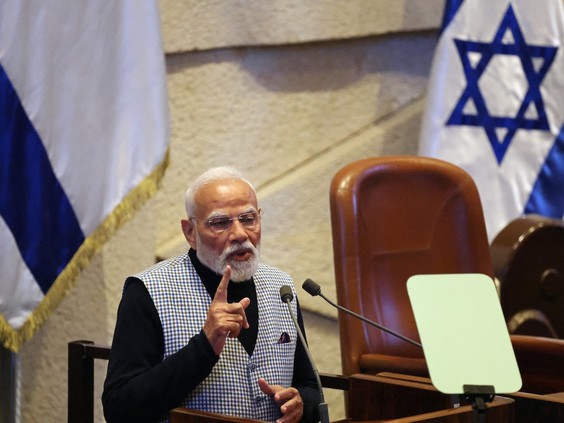
"It is a privilege and an honour for me to stand before this distinguished House. I do so as the Prime Minister of India, and as a representative of one ancient civilization addressing another."
"I bring with me the greetings of 1.4 billion Indians, and a message of friendship, respect, and partnership."
"India has also endured the pain of terrorism. We feel your pain. We share your grief. India stands with Israel, firmly with full conviction, in this moment and beyond."
"Like you, we have a consistent and uncompromising policy of zero tolerance for terrorism, with no double standards."
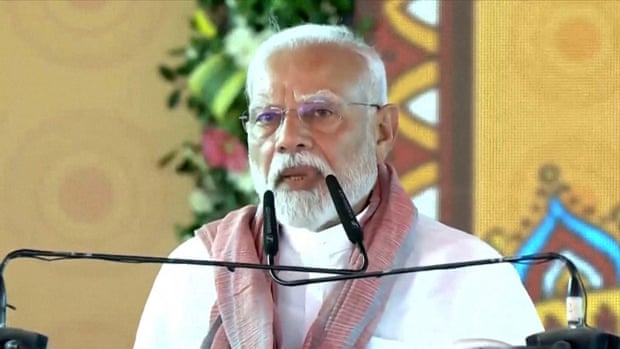
Indian Prime Minister Narendra Modi 
https://smartcdn.gprod.postmedia.digital/nationalpost/wp-content/uploads/2026/02/2262969052-1.jpg?quality=90&strip=all&w=564&h=423&type=webp&sig=ifV2QJ1n3e5TV3S9nYtI_w
India's Prime Minister Narendra Modi addresses the Israeli parliament, the Knesset, in Jerusalem on February 25, 2026. (Photo by ilia YEFIMOVICH / AFP via Getty Images)
 
Indian Prime Minister Narendra Modi just concluded his second visit to Israel. His first took place in 2017, becoming the first prime minister of India to visit Israel. He spoke of the acknowledgement of much in common, historically, culturally and politically between the two nations. In speaking of India's high alert over terrorism, addressing the Knesset, it is clear that Islamist terrorism that has kept Israel on guard since 1948, is the very menace that India too has faced, and from that very same year-before, when Pakistan divided from India and a mass exchange of population took place through partition.
 
The Partition offer made by the United Nations between Israel and those calling themselves Palestinians failed to conclude with two states side-by-side, when Israel gratefully and ebulliently took up the offer and the Arab Palestinians rejected it. That rejection has continued with each offer Israel has made through negotiations where concessions were never enough for the Palestinians demanding the ultimate concession of  Israel's dissolution and the land 'from the river to the sea' turned over to the Palestinians; land historically and ancestrally Judean. 
 
India and Pakistan continue to confront one another over the disputed border of Kashmir. India aspires to live in peace with its combative neighbour, while knowing that there will be eruptions of violence emanating from Pakistan into India. Internally, India hosts the third largest Muslim population globally as citizens, about 14 percent of its population. Distrust between the fractious nature of Muslim vs Hindu can flare at any time. India with its vast population base and huge ethnic/religious/ideological groups must also grapple with threats from its Sikh population that promotes a geographic schism in the Punjab called Kalistan. 
 
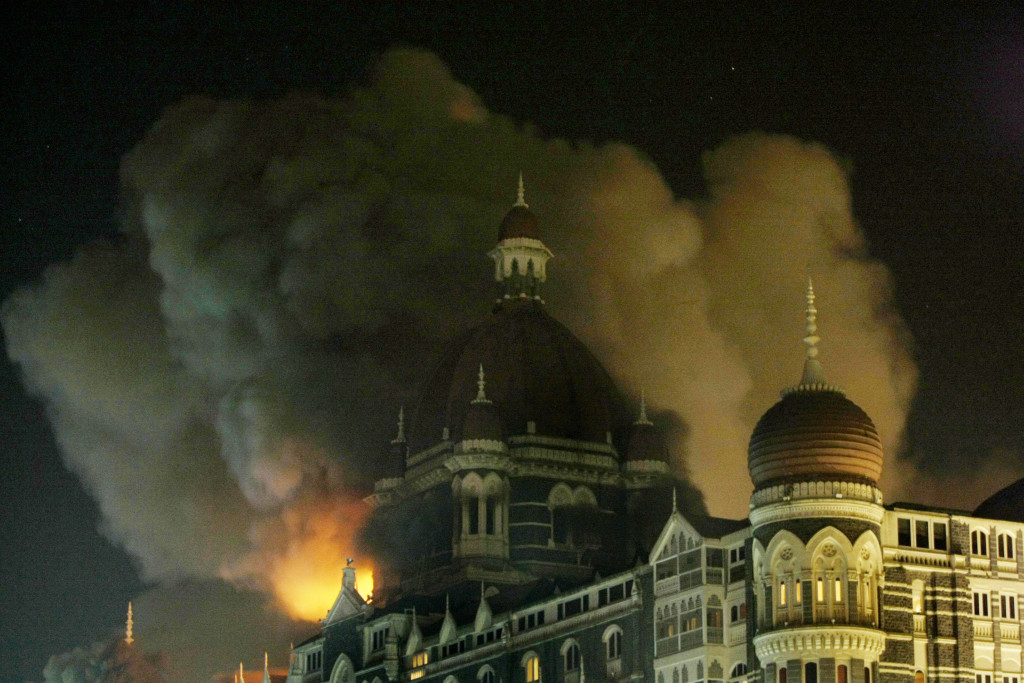
But it was a fundamentalist Islamist Pakistani group that launched a massive attack on India's financial hub in south Mumbai that brought home the extremist hatred of religious domination through jihad when a dozen coordinated attacks in 2008 shut the city down for three days while Indian security forces battled with murderous armed terrorists shooting and setting off explosives in a catastrophic scene of pandemonium and bloodshed, where in total 175 civilians, security personnel, and nine attackers, were killed. Bodies of many of the dead hostages showed signs of torture or disfigurement. 
 
https://www.pbs.org/wgbh/frontline/media/uploads/2015/11/1419184054_AP081127029528-1024x683.jpg
Thursday, Nov. 27, 2008, fire engulfs a part of the Taj Hotel in Mumbai, India. Teams of gunmen stormed luxury hotels, a popular restaurant, hospitals and a crowded train station in coordinated attacks across India’s financial capital,taking Westerners hostage and leaving parts of the city under siege. The terror lasted for three day which killed 195 people. (AP Photo/Gautam Singh)
"[India honours the ancient Jewish communities of India]: the Bene Israel of Maharashtra, the Cochini Jews of Keralam, The Baghdadi Jews of Kolkata and Mumbai, and the Bnei Menashe of the North East have enriched India."
"In my home state, Gujarat, there is a school set up by a Bene Israeli family -- Mister and Missus Best. It is an excellent school, and of course, it is called the Best School!"
Prime Minister Modi  
https://w2.chabad.org/media/images/1323/aQnL13232866.jpg?_i=_nF2BB495DED96754E4660F69A3A9F4712
Cochin Jews, c. 1900.
 
India is forced to arm itself in readiness for the prospect of defending itself against further violence from Pakistan. Like Israel, India is also a nuclear power ... as is Pakistan. Pakistan battles its own insurgent Islamists as it happens, as well as preparing itself for conflict with Afghanistan where skirmishes have already taken place between the two through accusations by Pakistan that Afghanistan is giving haven to Pakistan's Taliban that threaten Islamabad. The irony being that Pakistan had sheltered and its Intelligence Services had trained the Afghanistan Taliban.
 
According to the Stockholm International Research Institute, 34 percent of Israel's total arms exports between 2020 and 2024, valued at roughly $20.5 billion have gone to India. Israel supplies India with "missiles, seekers, radars, sensors, electronic warfare suites, UAV technologies, and a host of force multipliers." 
 
India represents one of the few geographies where persistent antisemitism has not made its way into the culture; Jews have lived safely in India for centuries; unlike the Jewish experience throughout Europe where diaspora Jews have lived for millennia. In India no pogroms threatened the security of Jews living there, no expulsions took place, nor state-institutionalized persecution. Much less ghettos imposed upon Jewish-Indian enclaves.  
 
Times of Israel
"Israel is often called the 'startup nation'." 
"Our aspirational spirit aligns naturally with Israel's innovation ecosystem. I see a lot of synergies in areas such as quantum technologies, semiconductors, and artificial intelligence."
"We are also working with Israel on creating cross-border financial linkages using our Digital Public Infrastructure." 
Prime Minister Modi 

Labels: , , , , , ,

Thursday, September 04, 2025

China Welcoming Friends Old and New

"This parade showcases the ascendancy of China propelled by Trump's inept diplomacy and President Xi's astute statecraft."
"The Washington consensus has unravelled, and Xi is rallying support for an alternative."
Jeff Kingston, professor of Asian studies, Temple University, Japan 
 
"Though the Russia-North Korea tie has resumed to a military alliance, China refuses to return to the year of 1950 [when Beijing sent soldiers to support North Korea's invasion of the South and the USSR provided critical military aid]."
"It is wrong to believe that China, Russia and North Korea are reinforcing bloc-building."
Zhu Feng, dean, School of International Relations, Nanjing University 
 
"I want to say that no one has been plotting anything, no one was weaving any conspiracies."
"None of the three leaders had even thought about such a thing."
Yuri Ushakov, Putin foreign affairs adviser
 
"Kim can also claim a diplomatic victory as North Korea has gone from unanimously sanctioned by the U.N. Security Council for its illegal nuclear and missile programs to being embraced by the UNSC permanent members Russia and China."
Leif-Eric Easley, professor of International Studies, Ewha Womans University, Seoul
https://i.cbc.ca/ais/552f024e-90ef-4171-8f43-c1e2531c2f89,1756924653455/full/max/0/default.jpg?im=Crop%2Crect%3D%280%2C0%2C1920%2C1080%29%3BResize%3D620
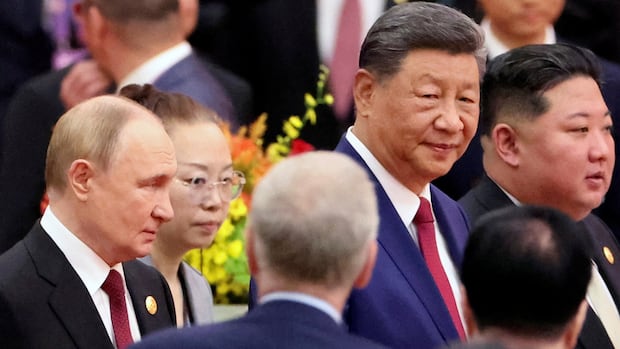
China put its military might on display Wednesday with a large parade. Also on display was China’s Xi Jinping flanked by Russia’s Vladimir Putin and North Korea’s Kim Jong-un, a group of leaders united in a desire to challenge the dominance of the United States.  Still from video/CBC
 
Standing shoulder to shoulder, leaders of China, North Korea and Russia watched high-tech military hardware moving impressively along with thousands of soldiers marching the streets of Beijing in an massive show of strength and power. Indian Prime Minister Narendra Modi, Russian President Vladimir Putin and Chinese President Xi Jinping spoke with private confidence, smiling, clasping hands at a meeting several days before the military parade, at a meeting of the Shanghai Cooperation Organization.
 
The meetings represented living proof of a message being sent to the United States of America and its allies through a shift from the U.S.-dominated world order led by the West with American President Donald Trump withdrawing from his nation's historic alliances, while imposing trade tariffs on friend and foe alike, shaking the world economy, puzzling allies and placing them on the defensive, looking elsewhere for validation of their right to aspire to economic and political stability, left adrift by the one guiding-light nation that has turned inward.
 
"Please give my warmest regards to Vladimir Putin and (North Korean leader) Kim Jong Jun, as you conspire against The United States of America" was President Trump's message to his Chinese counterpart, while congratulating China on its celebration of emergence from the Second World War, free from Japanese occupation. A freedom from occupation not due to China's own defences, but owing to the offensive offered by the United States in humbling and defeating Japan through the persuasive power of its then-emerging nuclear capabilities.
https://i.cbc.ca/1.7624014.1756913585!/cpImage/httpImage/image.jpg_gen/derivatives/4x3_1180/china-parade.jpg?im=Resize%3D1180
The latest drones, missiles and other weapons were on display during a military parade to commemorate the 80th anniversary of the end of the Second World War, in front of Tiananmen Gate in Beijing on Wednesday. Chinese President Xi Jinping invited dozens of leaders, including Russian President Vladimir Putin and North Korean leader Kim Jong-un to his nation's largest-ever military parade. (Liu Xu/Xinhua/The Associated Press)
 
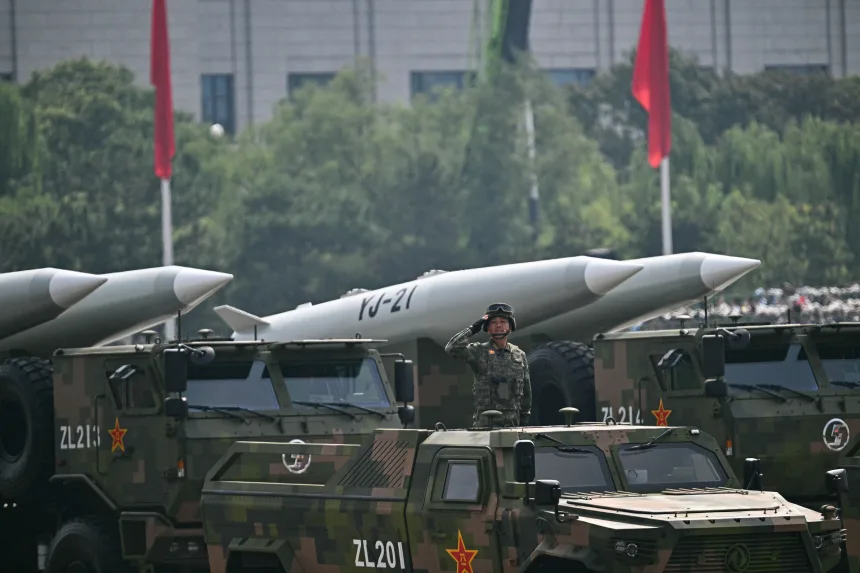
The 80th anniversary in Beijing commemorating the end of the Second World War was the annual showcasing of Beijing's dedication to its own burgeoning nuclear arsenals on land, in the air and at sea. China's assertiveness, its expansionist imperatives and economic/manufacturing/infrastructure/trade and foreign investment through its ambitious Belt and Road initiative signal it as the emerging counterpart of the powerful United States of America.
 
The leaders invited to share China's celebratory commemoration, from Russia to North Korea, India to Turkey, Iran and to Cuba, share one issue in common between them, isolation and sanctions from the United States and its Western bloc of allies. Beyond that shared connection is the fact that each of those nations is fully focused on their own aspirational futures, some in direct contradiction to China's. Even while isolation drives their friendship, it is a facade, since they all aspire to achieve their goals, while gravitating around China's lead.
 
https://media.cnn.com/api/v1/images/stellar/prod/gettyimages-2232840989.jpg?c=original&q=w_860,c_fill/f_webp
YJ-21 hypersonic anti-ship ballistic missiles are seen during a military parade marking the 80th anniversary of victory over Japan and the end of World War II, in Beijing's Tiananmen Square on September 3, 2025.   Pedro Pardo/AFP/Getty Images
 
China remains concerned with North Korea's nuclear power which has softened its support for Kim. Making common cause with Putin, both deeply isolated from the West, belies the reality that though both have signed a military pact strengthening their overt ties, they still and will always have territorial disagreements in a silent infiltration of Chinese in Russia's far east, scantly populated by Russians and increasingly taken possession of by Chinese settlers.
 
The free trade agreement that India and Washington were negotiating fell apart when Trump imposed a 25 percent tariff across the board as punishment for the Russian oil New Delhi has signed on to; with combined tariffs at 50 percent taking Modi aback at a time when relations with the U.S. were on rocky ground of late, forcing India to look elsewhere for support and for the time being, moving closer to China and Russia.  
"India is carefully walking this tightrope between the West and the rest, especially when it comes to the U.S., Russia and China."
"[Modi did not participate in Beijing's military parade since] distrust with China still exists."
"Because India does not believe in formal alliances, its approach has been to strengthen its relationship with the United States, maintain it with Russia, and manage it with China."
Praveen Donthi, senior analyst, International Crisis Group 
https://dims.apnews.com/dims4/default/796f953/2147483647/strip/true/crop/7678x5119+0+0/resize/800x533!/format/webp/quality/90/?url=https%3A%2F%2Fassets.apnews.com%2F44%2Fe5%2F1a0a7b0fc4db71a4dbfc641fbce1%2Fc65e8e2bc0484baa9a56169f2f4f64db
Military personnel take part in a military parade to commemorate the 80th anniversary of Japan’s World War II surrender held in front of Tiananmen Gate in Beijing, Wednesday, Sept. 3, 2025. (AP Photo/Ng Han Guan)

Labels: , , , , , , , ,

Friday, May 09, 2025

India's Operation Sindoor Against Pakistani Terrorists

"Pakistan and India have enough nuclear weapons to wipe the other side out several times over."
"Their nuclear weapons create a scenario for mutually assured destruction."
"[The arsenals are a defensive move to prevent and deter further fighting, because] neither side can afford to initiate such a war or hope to achieve anything from it."
Syed Mohammed Ali, security analyst, Islamabad, Pakistan 

"Pakistan has every right to give a robust response to this act of war imposed by India, and a strong response is indeed being given."
"[The] heinous act of aggression will not go unpunished".
Pakistan Prime Minister Muhammad Shehbaz Sharif
 
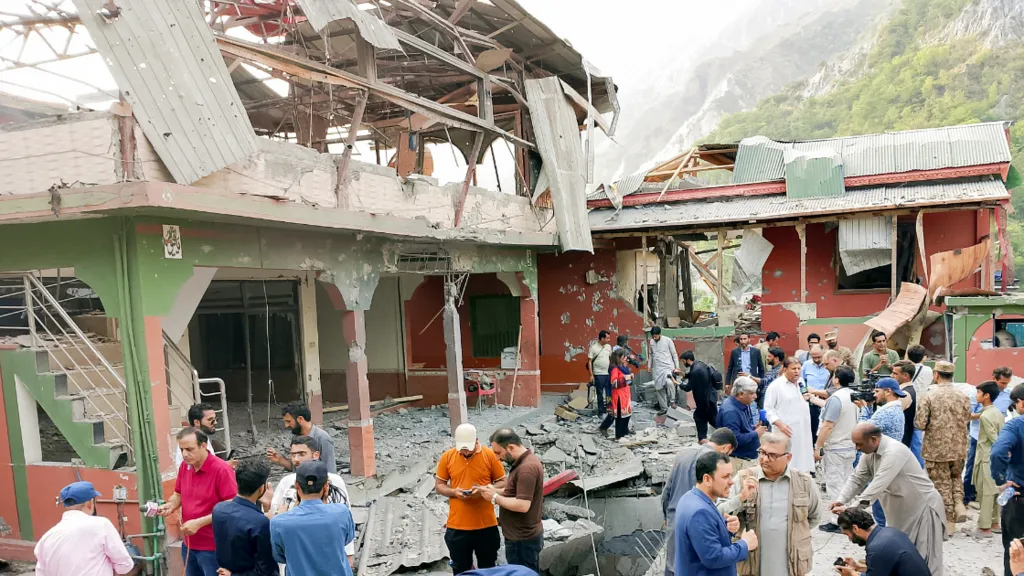
"Missile strikes by India in Pakistan-administered Kashmir targeted at least nine sites] where terrorist attacks against India have been planned."
"[The strikes - named] Operation Sindoor [were part of a] commitment [to hold] accountable [those responsible for the 22 April attack in Pahalgam, Indian-administered Kashmir, which left 25 Indians and one Nepali national dead]."
India Defence Ministry
https://ichef.bbci.co.uk/news/1024/cpsprodpb/1a45/live/5680fde0-2b69-11f0-8686-fb39aea3a90c.png.webp
People inspect a damaged mosque following India's strikes in Muzaffarabad in Pakistan-administered Kashmir   AFP via Getty Images
"Throughout 2024, violence continued in Kashmir in response to increasing efforts by New Delhi to consolidate territorial control. Attacks specifically targeted Indian travelers and workers in the region. In June 2024, militants opened fire on a bus carrying pilgrims traveling to a Hindu shrine in the town of Reasi. The attack killed nine and injured over thirty. In October, militants killed seven in Kashmir at a construction site for a tunnel project connecting Kashmir to the northern region of Ladakh."
"On April 22, 2025, tensions escalated after militants attacked Indian tourists in Kashmir, killing twenty-five Indian nationals and one Nepalese national. The incident marked the deadliest terrorist attack in Indian territory since the 2008 Mumbai attacks. India blamed Pakistan for harboring the group responsible for the attack and arrested two Pakistani nationals as suspects. Pakistan denied any involvement, and its defense ministry even suggested the attack was a “false flag operation.” Although no group has been officially identified as responsible for the attack, the Kashmir Resistance—an offshoot of LeT—claimed responsibility online."
Global Conflict Tracker
Both India and Pakistan have a stockpile of nuclear weapons, each 'reminding' the other of a guarantee of mutually assured destruction with neither country publicly disclosing their nuclear capabilities. Each is thought to have amassed between 170 and 180 warheads; short-, long- and medium-range. Each country has its own system of delivery to launch and propel their weapons to targets. The arsenals serve as a defense in prevention and deterrence of conflict beyond the conventional. 
 
Each is aware that neither Pakistan nor India could survive a first nuclear strike and be able to retaliate through "second-strike capability"; a sobering perspective for any government. Both lay claim to Kashmir in its entirety. Border skirmishes equate to instability in the region and have for decades. A heavily militarized border divides each country's part of Kashmir where three wars have been fought in the past. Armed insurgents on the Pakistan side of the divide resist Indian rule, with Muslim Kashmiris in support of the goal of uniting Kashmir under Pakistani governance. 
 
The number of border flare-ups and attacks in India's portion of Kashmir, prompted New Delhi toward an increasingly tough position on Islamabad, accusing it of supporting 'terrorism', which more than adequately describes the reality of the situation. India, as the most populous nation on the planet, spent $74.4 billion on defence in the current year; one of the world's largest arms importers.
 
https://microsites-live-backend.cfr.org/cdn/ff/RDbqGx7aEnmw-n5RZ1KSKoBUl1uLAB0Prufh-3_nV2M/1650906730/public/2022-04/14_India_Pakistan.jpg
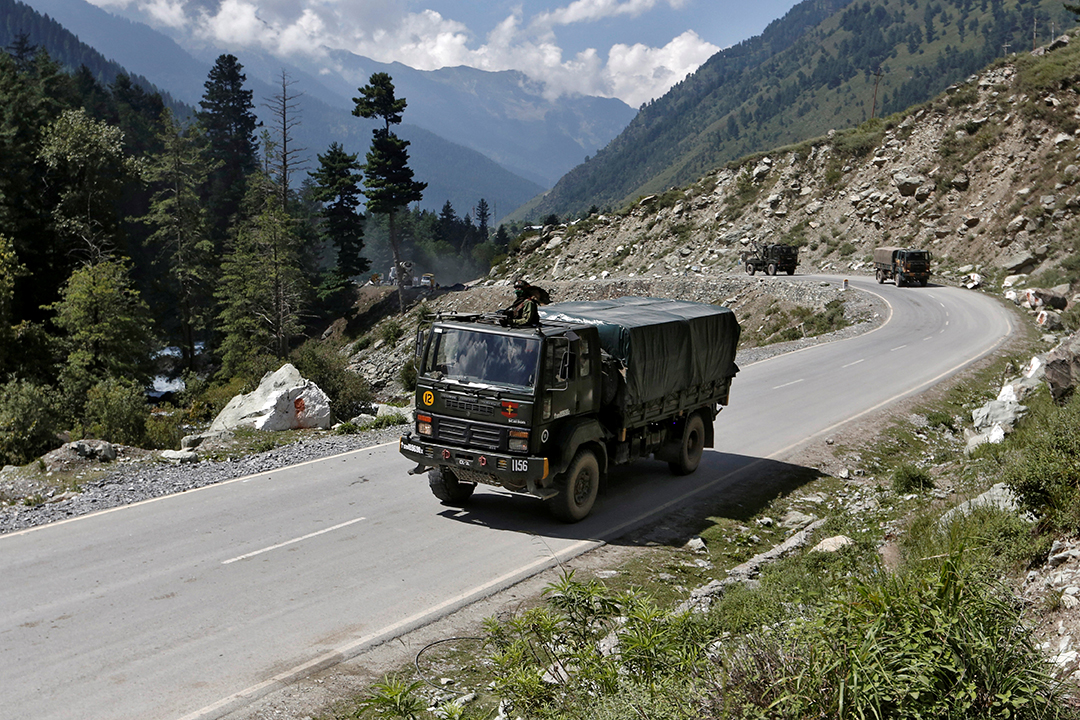
Indian army Trucks on highway leading to Ladakh, Kashmir    Danish Ismail, Reuters
 
Although Pakistan spends a considerable sum -- $10 billion last year -- in arms, India has over double the number of active armed forces personnel than Pakistan. But there is another looming threat that India has that Pakistan doesn't share; its neighbour China, with its aggressive maritime security stance in the Indian Ocean. On occasion both Pakistan and India launch operations into airspace and territories controlled by the other, intended for the most part to damage check-points, installations or sites used by militants. Their lethal antipathy toward one another is religion-driven, not territorial. 

For every step that India takes -- from closing down Pakistan's embassy in India, shutting off a traditional water supply agreement to Pakistan, closing its airspace to air traffic, to targeting sites in Pakistan known to harbour Islamist terrorist groups -- Pakistan follows suit and vows vengeance. Following missile strikes in Punjab province and Pakistan-administered Kashmir, a heavy exchange of fire between the two nations ensued. Pakistani Prime Minister Shehbaz Sharif commended his armed forces for shooting down five Indian jets, hit, he claimed after firing their missiles, while still in Indian airspace.
 
Three planes fell onto villages in India-controlled territory, although India made no official comments. During the April attack in Kashmir, some survivors informed Indian media that the gunmen singled out Hindu men and shot them dead at close range. Pakistan stands accused by India of being behind the attack by a new militant group, Kashmir Resistance. India has identified the group with links to Lashkar-e Taiba, a Pakistani militant group long accused by New Delhi of being supported by Pakistan. 

https://microsites-live-backend.cfr.org/cdn/ff/WFbm3fQomcDjBSRSwIfJtazBINAer5UJKwLB_XfuEwM/1745433127/public/2025-04/Pahalgam.JPG
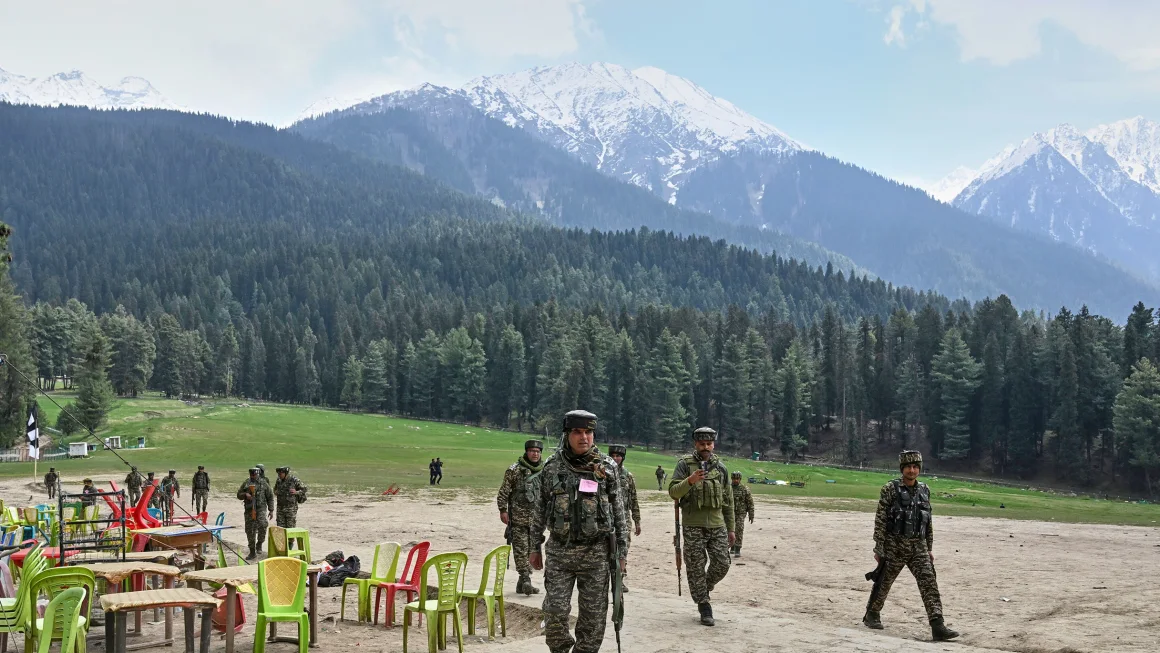
Adnan Abidi, Reuters  An Indian soldier stands guard on a highway in Kashmir
 

Labels: , , , , , ,

Saturday, April 26, 2025

"We Will Pursue Them to the Ends of the Earth"


"Those behind this heinous act will be brought to justice."
"Our resolve to fight terrorism is unshakable and it will get even stronger." 
"India will identify, track and punish every terrorist, their handlers and their backers."
"We will pursue them to the ends of the earth."
Indian Prime Minister Narendra Modi
https://i.guim.co.uk/img/media/cbefe9f5ff06aa31113fb0fe19f6961d9bcc4de5/232_0_1458_820/1458.jpg?width=620&dpr=1&s=none&crop=none
Tensions escalate between India and Pakistan after Kashmir attack – video

"We will not only reach those who have perpetrated this incident but also those who, sitting behind the scenes, have conspired to commit such acts on the soil of India."
Indian Defence Minister Rajnath Singh
 
"We cannot get over the fact that such an incident has occurred, and that too in the place we call heaven on earth."
"Tourists have been coming to Kashmir since the last three or four decades and they have never been touched."
Akib Chaya, hotel owner, member, Kashmir Chamber of Commerce
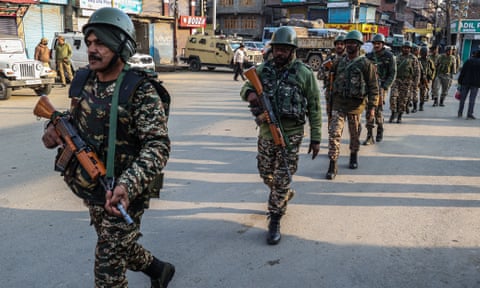
Indian soldiers in Anantnag, Jammu and Kashmir
Indian soldiers in Kashmir. The army confirmed there had been limited firing of small arms overnight. Photograph: Nasir Kachroo/NurPhoto/Rex/Shutterstock
 
"[Attempts to link Pakistan to the Pahalgam attack are] frivolous [Islamabad will respond to any Indian action]."
"Any threat to Pakistan’s sovereignty and to the security of its people will be met with firm reciprocal measures in all domains."
Pakistan statement
"Clear evidence of cross-border complicity" has been presented by Indian investigators in the wake of the gruesome attack on tourists in Indian Kashmir when gunmen opened fire in a deadly attack that saw 26 innocent people die. A group called the Resistance Front claimed responsibility for the attack. Indian officials identify it as a proxy for the Lashkar-e-Taiba based in Pakistan. For its part, Islamabad has vehemently denied any involvement, denying that India has in fact any proof of their accusations against Pakistan. 

The Kashmir attack represented the most deadly assault in years in the restive region, an attack that targeted civilians. The region has seen more than its share of anti-India attacks in the past thirty years. Indians are shocked and outraged at the deadly event, raising calls that their country take action against Pakistan. The initial claim for the attack was a terrorist group previously unheard of, that called itself the Kashmir Resistance. Pakistan's instant reaction was that there was no involvement on its part.
 
India's "belligerent measures" were condemned by Pakistan's National Security Committee. Claiming that while Pakistan remained committed to peace, it would never permit anyone to "transgress its sovereignty, security, dignity and inalienable rights". At a time when it was a Pakistani 'resistance' group that mounted the deadly attack, so in essence, Pakistan is condemning India for reacting to the transgression of ITS sovereignty, security, dignity and inalienable rights. How that makes sense is debatable. 

https://media.cnn.com/api/v1/images/stellar/prod/ap25113409962448.jpg?c=16x9&q=h_653,w_1160,c_fill/f_webp

The most immediate reaction was that of India, followed by Pakistan, cancelling visas for their nationals to enter the others' countries. New Delhi has been 'warned' by Islamabad for suspending a water-sharing treaty in the aftermath of the tragedy. All visas issued to Pakistani nationals were to be revoked effective Sunday; and all Pakistanis in India at the present time given notice they must leave before the expiration of their visas based on a revised timeline.
 
Other measures were also announced, including reducing the number of diplomatic staff, closing the sole land border crossing between the two nations, and suspending a crucial water-sharing agreement. Pakistan, in retaliation has closed its airspace for all Indian-owned or -operated airlines, as well as suspending all trade with India. Included in that suspension is trade to and from any third country. There were hints by government authorities representing both sides that matters could escalate militarily.
 
Both India and Pakistan claim Kashmir as their territory entirely, even as each administers a part of the disputed Kashmir. Clashes between the two countries' military break out occasionally and then die down almost spontaneously. Kashmiri separatists out of Pakistan mount terrorist raids of much smaller dimensions from time to time in a never-ending commitment to bring terror to Indian Kashmir. These are Islamist death squads brewed in Pakistan in reflection of the culture of war and confrontation between the two competitors for Kashmiri exclusive entitlement.
 
For the present, a number of Pakistani diplomats were ordered to leave New Delhi, while Indian diplomats were summarily recalled from Pakistan leaving diplomatic missions in each of the countries with reduced staff from May 1 forward. Indian citizens were advised not to travel to Pakistan by India's foreign ministry, which has also urged those of its citizens currently in Pakistan to depart for India.
 
The landmark water-sharing treaty in place between the two countries despite two wars and a major border skirmish, has now been suspended indefinitely, with Pakistan angrily responding to warn that any Indian attempt to stop or divert the flow of water would be considered an "act of war", to be met with "full force across the complete spectrum" of Pakistan's national power.
 
https://media.cnn.com/api/v1/images/stellar/prod/ap25113359875068.jpg?q=w_1160,c_fill/f_webp
 
"We very much appeal to both the governments … to exercise maximum restraint, and to ensure that the situation and the developments we’ve seen do not deteriorate any further."
"Any issues between Pakistan and India, we believe, can be and should be resolved peacefully through meaningful mutual engagement."
UN spokesperson, Stéphane Dujarric
 
"There are many imponderables Modi must deal with, including the significant capabilities of the Pakistan army."
"But given the horrific nature of the attack and the outrage that has convulsed the nation – the victims came from 15 states across India – the PM may have no option but to explore some major risks."
C Raja Mohan, veteran analyst, Indian Express
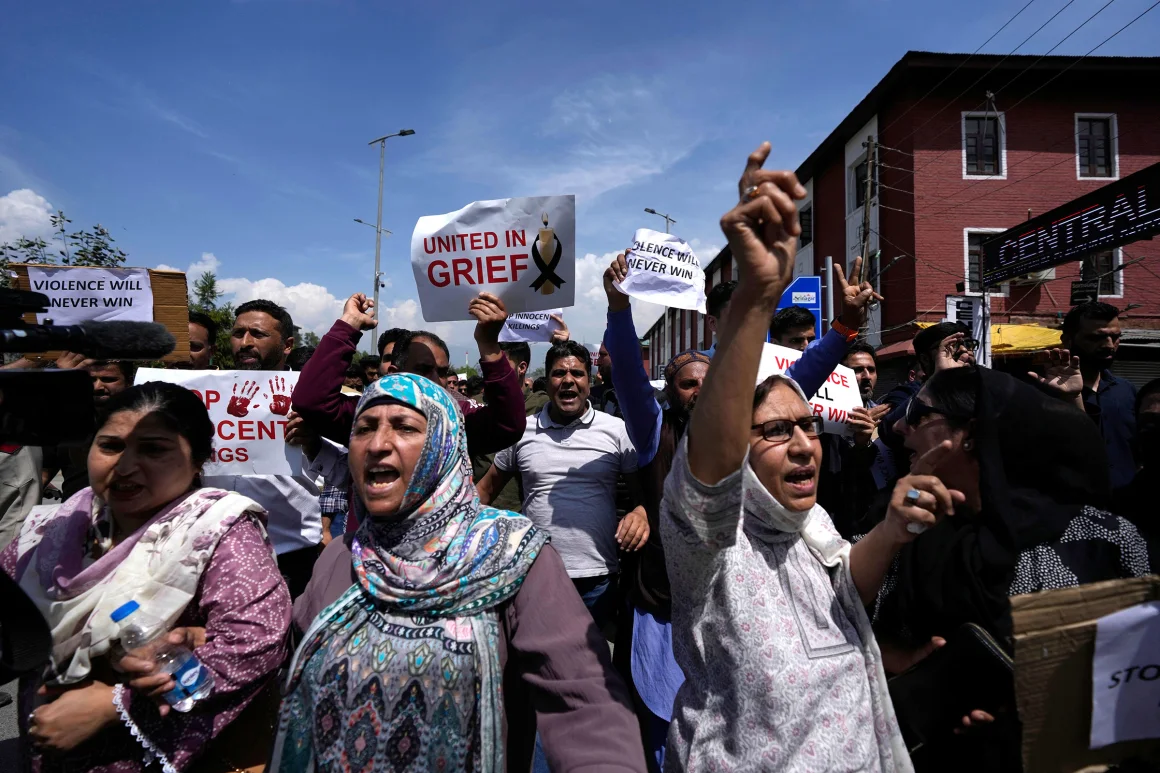
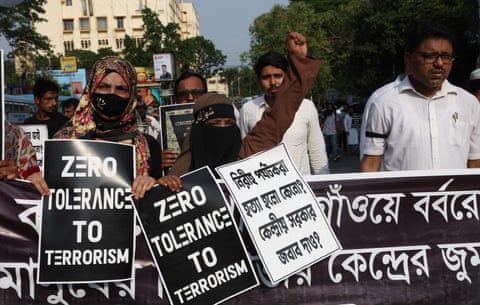
People hold placards at a protest
Supporters of the Indian Secular Front, along with others, stage a protest over the killing of more than 25 tourists at Pahalgam. Photograph: Rupak De Chowdhuri/NurPhoto/Rex/Shutterstock

Labels: , , , ,

Sunday, November 03, 2024

Failed Canada-India Diplomatic Relations

"To remain somewhat viable and respectable in the eyes of the United States and Canada and Britain -- the Western world -- he claims to be non-violent."
"And if he didn't [the media] wouldn't give him a nano-second of coverage."
"I think he has bamboozled all of you for a long time."
Ujjal Dosanjh, Sikh, former B.C. premier/federal cabinet minister

"We are just trying to tell India and the world that it's a ticking time bomb which could detonate due to India's constant policy of violently crushing even the peaceful initiative of a referendum."
"The [Prime Minister Narendra] Modi regime's constant policy of crushing the Sikh peoples' initiative of ballots with bullets may, against our wishes, push this purely political conflict into a cycle of violence...SFJ's videos are not inflammatory but rather informatory."
"People under occupation from Punjab to Palestine will react and violence begets violence. If India is going to keep occupying Punjab, there will be a reaction."
"SFK believes in ballots, SFJ believes in votes. The liberation of Punjab is on the cards. India, the choice is yours: ballot or bullet."
Gurpatwant Singh Pannun, exponent, Sikh independence movement: Khalistan
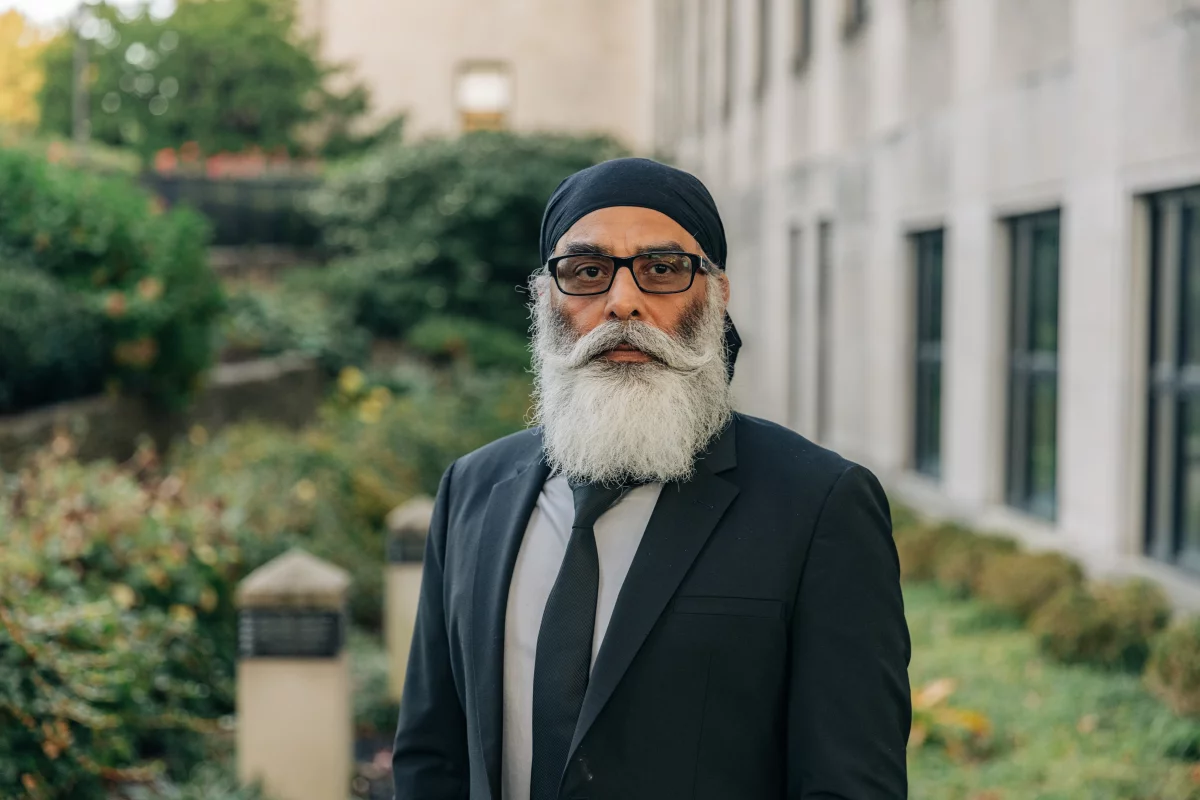
https://npr.brightspotcdn.com/dims3/default/strip/false/crop/4900x3268+0+0/resize/1200/quality/85/format/webp/?url=http%3A%2F%2Fnpr-brightspot.s3.amazonaws.com%2Fa0%2F93%2F74c7429a4c0cae23612a6b398470%2Fnpr-jeenah-0002.JPG
Sikh activist Gurpatwant Singh Pannun stands for a photograph in New York City on Oct. 25. Jeenah Moon for NPR
 
Pannun is a Canadian-American lawyer who has raised an issue of a global referendum to verify the Sikh independence-from-India movement, in a call to split India for the purpose of dividing the Punjab as a gift to Sikhs who view it as their homeland, one they call Khalistan. He is at great pains to deliver the message to Western democracies that his is the voice of reason, and his movement is one of moderation, wanting nothing other than recognition of the right of Sikhs to become a sovereign nation free of India.

He heads the group Sikhs for Justice. And in his online presence speaking for Sikhs for Justice, Pannun's rhetoric is volatile, his social-media posts appear to promote violence. Based in New York, Pannun speaks of the need to "balkanize" India in his mission to carve Punjab away from India's 'occupation', and includes support for other independence movements as well. Including common cause with Chinese President Xi Jinping, recommending he forcefully seize a disputed corner of Indian territory.
"President [Xi] Jinping -- now is the time to order the Chinese army to take Arunachal Padesh back."
"By 2047, the current boundaries and borders of India will be redrawn, and the current borders and boundaries will be wiped out from the world map."
"2024, one India. 2047, none India."
Gurpatwant Singh Pannum
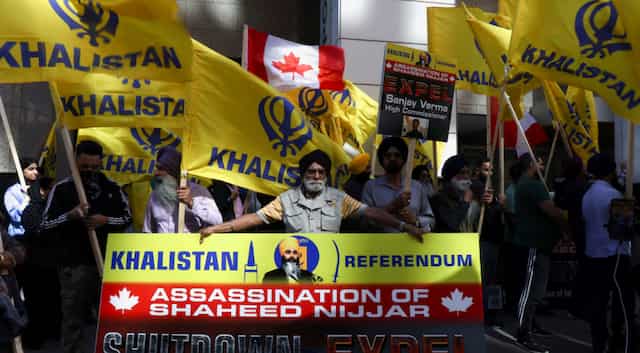
https://cdn.wionews.com/sites/default/files/styles/story_page/public/2024/05/06/429546-khalistan.png?imwidth=400
Protesters hold yellow flags with the word Khalistan, as well as a banner with the picture of Sikh separatist leader Hardeep Singh. Photograph:(Reuters)
 
"Violence begets violence" he warns; India has a choice between his referendum and possible armed rebellion: "ballots or bullets", comparing Palestinians to Sikhs in Punjab. In November, Sikhs, he said, should boycott Air India; those who fly on November 19 could endanger themselves. The shadow of 1985's bombing of an Air India flight by Sikh terrorists in Canada. Present at a Calgary rally for Sikhs, he led a chant: "Liberate Punjab, Kill India", a mild display of 'moderation'.

The non-binding referendum run by Sikhs for Justice asks whether Sikhs in Canada, Europe and anywhere the Sikh diaspora exists, asks whether there is support for making Punjab an independent country. Within India itself the issue appears to be of no moment. It is among the large expatriate Sikh community outside India -- particularly in Canada where the largest expatriate community lives -- that the issue of Sikh separation from Hindu India resonates and where Sikh fanatics overwhelm the Sikh-Canadian population uninvolved in the movement.

New Delhi, for which the prospect of such a separation is a non-starter, views Pannum as a terrorist. Interpol has been asked by India to issue a "red notice" for the arrest of the man. After deeming the request political or religious, not criminal, Interpol refused. Canada's large and influential Sikh population -- some 800,000 in number -- does not support political Sikhism/Khalistanis, but they are threatened and silent, harassed and fearful. Canada's Liberal government, however, appears to cater to the Khalistanis; some high-ranking Cabinet members who are Sikh are sympathetic to the Khalistan cause.
 
https://www.ctvnews.ca/content/dam/ctvnews/en/images/2024/4/30/justin-trudeau--khalsa-day-1-6867249-1714483527642.jpg
Prime Minister Justin Trudeau waits to speak to a crowd during Khalsa day celebrations at City Hall in Toronto, Sunday, April 28, 2024. THE CANADIAN PRESS/Cole Burston
 
Narendra Modi's government is fiercely opposed, needless to say, and disappointed and frustrated with the Trudeau government's response to its request for extradition of a number of Sikh-Canadians who have been found guilty of violent criminal activities in India. Justin Trudeau's public accusation of the government of India's involvement in the assassination of a committed Khalistani, denied by India, has caused a diplomatic rift in relations between the two countries, each expelling the others' diplomats.

Pannum, from his social media pulpit speaks of "genocidal violence" against Sikhs. In particular memory of the 40 years that have passed since a massacre of Sikhs by Hindus enraged after Indira Ghandi was assassinated by her Sikh bodyguards. Sikhs for Justice, he announced in a video, was in support of independence movements in the Indian states of Assam, Nagaland, Manipur and Kashmir. Another, earlier video had him connecting the Palestinian-Israeli conflict to the situation in Punjab: "People under occupation from Punjab to Palestine will react and violence begets violence".
 
https://akm-img-a-in.tosshub.com/businesstoday/images/story/202405/663a54f4a9872-canadas-justin-trudeau-and-pm-narendra-modi-062044391-16x9.jpg?size=948:533
   
"We have repeatedly raised our strong concerns regarding the violent imagery being used by extremist elements in Canada against our political leadership. Display of posters of Indian diplomats have also been put out across Canada threatening violence against them."
"Celebration and glorification of violence should not be a part of any civilized society. Democratic countries which respect the rule of law should not allow intimidation by radical elements in the name of freedom of expression."
"[We are concerned over the] security of our diplomatic representatives in Canada. [Ottawa should stop giving space to] criminal and secessionist elements."
Randhir Jaiswal, spokesperson, India’s foreign ministry

Labels: , , , , ,

Saturday, June 08, 2024

Foreign Interference in Canadian Politics

"The slow response to a known threat was a serious failure and one from which Canada may feel the consequences for years to come."
"The implications of this inaction include the undermining of the democratic rights and fundamental freedoms of Canadians, the integrity and credibility of Canada's parliamentary process, and public trust in the policy decisions made by the government."
"India seeks to cultivate relationships with a variety of witting and unwitting individuals across Canadian society with the intent of inappropriately exerting India's influence across all orders of government, particularly to stifle or discredit criticism of the Government of India." 
"The committee has also seen troubling intelligence that some parliamentarians are, in the words of the intelligence services, 'semi-witting or witting' participants in the efforts of foreign states to interfere in our politics."
National Security Intelligence Committee of Parliamentarians (NSICOP) report

"A number of the things in the NSICOP report are already being enacted in Bill C-70, the legislation before the House to counter foreign interference."
Public Safety Minister Dominic LeBlanc

"Some of these [actions] may be illegal ... but they're unlikely to lead to criminal charges, because we're still not able to deal with this long-standing issue of protecting classified information sources and methods in judicial processes."
"The members were unanimously struck by these example. And all agreed unanimously, that the behaviours as described here are deeply unethical."
"And they're in breach of the oaths and affirmations that parliamentarians take."
Liberal MP David McGuinty, chair, NSICOP
https://www.ctvnews.ca/content/dam/ctvnews/en/images/2024/5/2/foreign-interference-public-inquiry-1-6870913-1714671037771.jpg
A person enters the Public Inquiry Into Foreign Interference in Federal Electoral Processes and Democratic Institutions, in Ottawa, Monday, April 8, 2024. THE CANADIAN PRESS/Adrian Wyld
 
It would appear, from a deep investigation into foreign interference in Canada's internal political affairs, that there are some Members of Parliament who  were identified as"wittingly assisting" foreign stat actors, post-election. The Liberal government has been notoriously slow to take remedial action, the conclusion of which is that Canada could become starkly aware of consequences in years to come, posits a new report by a panel of Members of Parliament tasked to focus on intelligence.

The National Security Intelligence Committee of Parliamentarians revealed as well that both China and India sought an opportunity to interfere in Canada's internal affairs. Foreign interference tracked in the 2019 and 2021 federal elections saw that interference in play, but not limited to just those events, focusing as well on efforts to interfere in the country's democratic institutions to suit their purposes. It was the parliamentary panel's conclusion that the government's response to the issue has been laggardly.

Documents, some 33,000 pages of documents from the Canadian Security Intelligence Service, the RCMP and other departments focused on foreign interference to the tune of 33,000 pages that were scrutinized. Top-secret information minus redactions available for scrutiny by members of the committee. Their report affirmed that Canadians are broadly already aware through Canadian intelligence insiders having earlier learned that a former MP met with an intelligence official from another country, affirmed through media links. 

Previous reports viewed by the committee confirmed that China had interfered in individual ridings in the 2021 election, appearing to have spread misinformation about former Conservative MP Kenny Chin (within the Chinese voting community), successfully impeding his bid for re-election. Former Conservative leader Erin O'Toole was also deleteriously affected by foreign interference that sought to target him in particular for his politics.

There was a example cited of a Member of Parliament who sought a meeting with a foreign intelligence officer. The head of NSICOP, a Liberal MP, claimed that irrespective of whether the issues involved can be dealt with criminally, all parties' MPs agreed that the actions of some members of Parliament in their cooperation with foreign powers was clearly unsupportable. Significant changes were called on by the committee to party nominations, a weak link in political process operations. 

A notable example cited was that the Liberal party permits non-citizens to vote in party nominations. No party, it seems, is more careless than that of the ruling Liberals, among which no party has outside oversight of their nominations through Elections Canada.

Unnamed Parliamentarians:

  • Communicated frequently with foreign missions before or during a political campaign to obtain support from community groups or businesses to be mobilized by diplomatic missions;
  • Accepted knowingly, or through willful blindness, funds or benefits from foreign missions or their proxies which have been layered or otherwise disguised to conceal their source; 
  • Provided foreign diplomatic officials with privileged information on the work or opinions of fellow parliamentarians, knowing that such information would be used by those officials to inappropriately pressure parliamentarians to change their positions;
  • Responded to the requests or direction of foreign officials to improperly influence parliamentary colleagues or parliamentary business to the advantage of a foreign state

https://i.cbc.ca/ais/055ecd37-b9a5-48f7-809b-c639151fd488,1717464971343/full/max/0/default.jpg?im=Crop%2Crect%3D%280%2C0%2C1919%2C1079%29%3BResize%3D%28620%29
A new parliamentary report paints a stark picture of foreign interference in Canadian politics, characterizing the government's response as a 'serious failure' that could impact the country for years to come.  CBC

Labels: , , , ,

Monday, August 14, 2023

Russia and India Flew to the Moon to Fetch a Pail of Water

"[Russia] is a state capable of delivering a payload to the moon [and] ensure Russia's guaranteed access to the moon's surface."
Roscosmos, Russian space agency

"Study of the moon is not the goal. The goal is political competition between two superpowers -- China and the USA -- and a number of other countries which also want to claim the title of space superpower."
"Foreign electronics are lighter, domestic electronics are heavier."
"While scientists might have the task of studying lunar water, for Roscosmos the main task is simply to land on the moon -- to recover lost Soviet expertise and learn how to perform this task in a new era."
Vitaly Egorov, Russian space analyst
https://media.nature.com/lw767/magazine-assets/d41586-023-02536-2/d41586-023-02536-2_25911986.jpg?as=webp

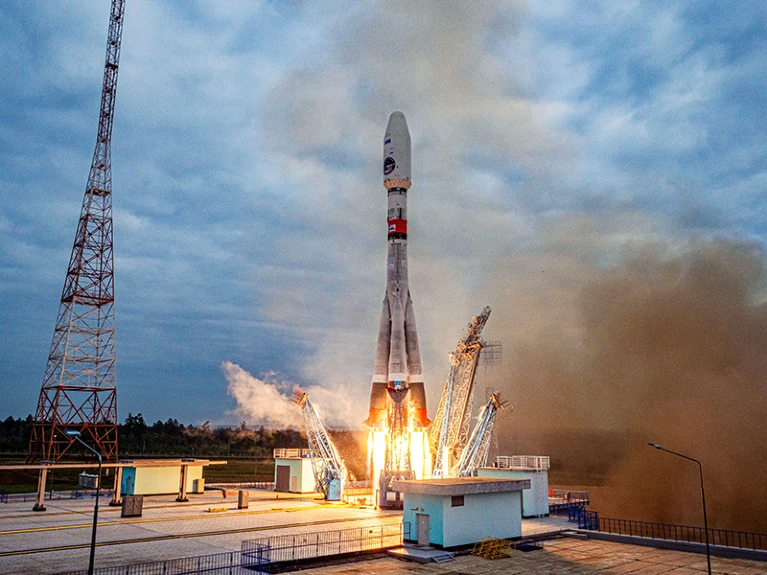
A Soyuz rocket launched Luna 25 to the Moon from Vostochny Cosmodrome in eastern Russia. Credit: ROSCOSMOS STATE SPACE CORPORATION/HANDOUT/EPA-EFE/Shutterstock

On Friday a rocket carrying a lunar landing craft shot into the high atmosphere of Earth and then beyond, representing a new beginning in Russia's near-half-century of space exploration. The launch represents a race to produce a landing on the moon, before India's similar launch a month earlier completes its mission to the far side of the lunar surface.

From its launch at Russia's Vostochny spaceport, the Luna-25 spacecraft's mission is actually the first that Russia has planned and executed since 1976, as the ruling dominant faction of the Soviet Union. It represents a double gamble; to execute a successful landing, and to see its arrival blast past India's spacecraft, its second attempt. The day the Russian lunar lander is expected to reach its goal on the moon is August 23, when India's craft also anticipates a successful landing.
 
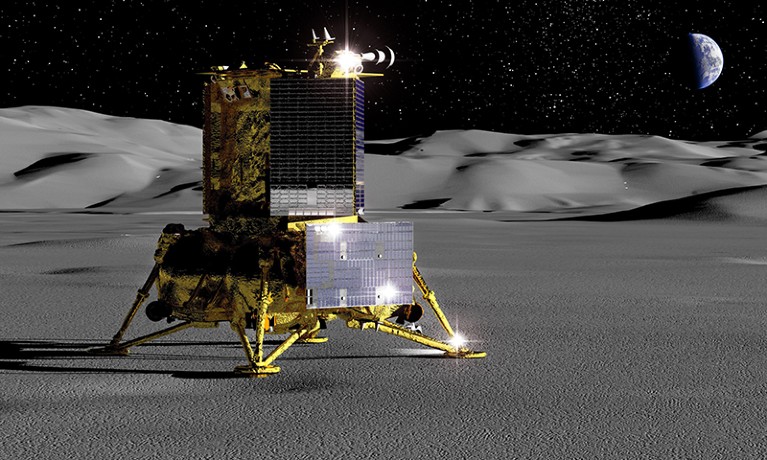
A 3D rendered artist's impression of the Russian Luna 25 lander on the lunar surface.

The Luna 25 lander is scheduled to land on the Moon’s surface  (artist’s impression).Credit: Mechanik/Alamy

The plan is for the Luna-25 to take roughly five-and-a-half days to reach the vicinity of the moon, with the following three to seven days orbiting at approximately 100 kilometres, before finally making for the moon's surface. Following in the footsteps of three previous successful moon landings: the Soviet Union, the United States, and China. India and Russia have chosen to become the first to land at the south pole of the moon.

Russia has found it far more difficult to access Western technology to achieve its goal, impacting its space program. It was Russia that declared it would no longer cooperate with the international space community, in response to the sanctions imposed after Russia invaded Ukraine. Initially planned for the Luna-25 to carry a small moon rover, that plan was abandoned in recognition of a need to reduce the craft's weight to improve reliability, according to analysts.
 
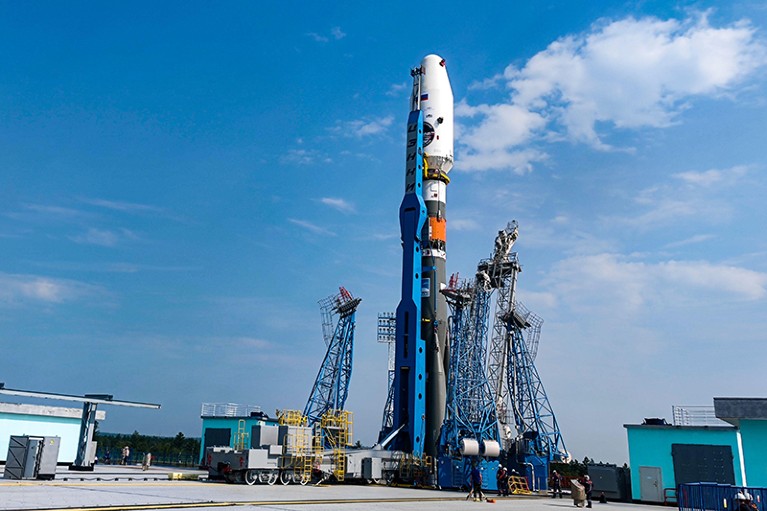
The Soyuz-2.1b rocket with the moon lander Luna 25 on the launch pad at the Vostochny Cosmodrome.

The Soyuz rocket on the launch pad at Vostochny Cosmodrome. Credit: Roscosmos State Space Corporation via AP/Alamy

The Vostochny Cosmodrome located in Russia's Far East, is seen by Russian President Vladimir Putin as key to his aspirations to see Russia take its rightful place as a space superpower. The spaceport is meant to replace Russian launches from the current location of the Baikonur Cosmodrome in Kazakhstan.

Of particular interest to scientists, the lunar south pole is believed to hold permanently shadowed polar craters that may contain water. That belief is that the frozen water within the rocks could be transformed into air and rocket fuel by explorers of the future. To that end, the Luna-25 is programmed to bring back to Russia samples of moon rock and dust.

Space scientists everywhere will be looking to see success in this Russian space venture, given recent attempts by other countries' space programs which have failed. Only China since 1976 has successfully landed on the Moon, with a lander and rover in both 2013 and 2018, along with a sample-return mission in 2020. Both India’s Chandrayaan-2 mission and Israel’s Beresheet lander crashed on the lunar surface in 2019. This April, Japan’s Hakuto lander came to a like unfortunate end.
"It’s an area where we might expect to see increased concentrations of water ice."
"As you go further towards the pole, it gets colder and the potential for water ice increases."
"By understanding how the Moon has collected water over time, we could start to piece together the history of water in the Solar System."
"We can start asking questions about the local conditions near Earth as it was evolving."
Simon Barber, planetary scientist, Open University, Milton Keynes, UK
https://cdn.mos.cms.futurecdn.net/RJkssNuiSKcpJQhKeegvuc-1200-80.jpg
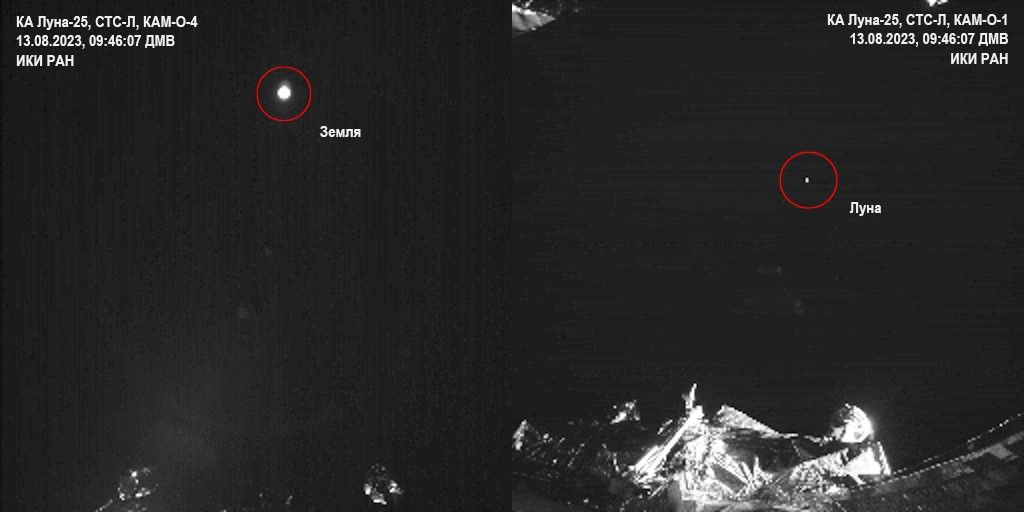
Images of Earth (left) and the moon (right) taken by the Luna-25 spacecraft during its flight to the moon on August 13, 2023, from a distance of about 192,625 miles (310,000 km) from Earth. (Image credit: IKI RAS

Labels: , , , ,

Tuesday, November 01, 2022

The Khalistani Rebellion

"We don't want any violence. We don't want any violence from pro-Khalistan forces or the Indian side."
"We are saying, let's give votes a chance ... We are fighting for our own political opinions to be heard."
Gurpatwant Singh Pannun, Sikhs for Justice
 
"They're using Canadian territory for activities which could jeopardize India's security and interests."
"If the [Canadian government can do something about the referendum] and try to prevent it, that would be useful because it only creates a bad atmosphere and incites violence against India and Indians."
Manish, Indian High Commissioner to Canada 

"Secessionism amongst Sikhs has been very much in retreat in India itself."
"My sense is that there aren't serious tensions between Hindus and Sikhs."
"The main attacks that Hindus or Muslims or Sikhs have faced have come from white nationalist groups -- racist groups -- attacking all of them equally as people of colour."
Dr. Narendra Subramanian, political science professor, McGill University
Trudeau and then-Defence Minister Harjit Sajjan, left, met with Chief Minister of Punjab Amarinder Singh in Amritsar . (Sean Kilpatrick/Canadian Press)
 
Relations between Canada and India, long friendly, have become somewhat strained in the last several years. Jagmeet Singh, the leader of Canada's third political party, the New Democratic Party (NDP) is a Khalistan proponent and supports the referendum being carried out on Canadian soil. Harjit Sajjan, now Minister of International Development was formerly Canada's Minister of Defence, and a supporter of a Sikh homeland in the Khalistan movement to separate the Indian Punjab from India to become a Sikh-autonomous region.
 
When Prime Minister Justin Trudeau visited India in 2018, his manner of dress was bizarre enough to draw the amazed attention of Indians; the Trudeau family costumed themselves throughout the trip in flashy outfits not even Bollywood stars would appear in. At a reception, the appearance of a former Khalistani convicted of attempted murder of a visiting Punjabi official to Canada, proved an embarrassment to Canada, and a provocation to Narendra Modi's government.
 
A former premier of British Columbia Ujjal Dosanjh, himself a Canadian Sikh, had years ago been savagely beaten by Sikh separatists for his public condemnation of the separation movement. A British Columbia Sikh newspaper editor who had also been critical of the movement was murdered by Sikh separatists. And Canada's worst terrorism event took place when in the mid-1980s Khalistani terrorists placed bombs on Air India Flight 182 flying from Canada to India, killing all 329 aboard. 

There are 800,000 Sikh Canadians comprising 2.1 percent of the Canadian population, a huge diaspora. In 2019 the Statistics Canada total for all Indo-Canadians came to 1,008,995. By no means does the total, whether Hindu or Sikh support the separatist movement of Sikh nationalists. After the Air India bombing, the Khalistan movement receded to a degree in its provocations. At the present time, however, another movement has arisen calling for a referendum on separatism among the global diaspora of Indian Sikhs.
 
Khalistan Referendum in Canada (Source: Twitter/@Azhar Javaid)
 
Called the Punjab referendum, it asks people of Sikh origin their opinion of the Sikh-majority Indian state of Punjab separating, fulfilling the dream of Khalistan. Canada has become one amongst the first to hold votes, organizers claiming that over 100,000 people participated in the balloting near Toronto a month ago. A group calling itself Sikhs for Justice is careful to point out theirs is a peaceful exercise in free will. A situation that New Delhi sees as an abhorrent attempt against its territorial integrity and sovereignty.

Whatever the outcome of the referendum it has no legal status; it is not binding, and completely unofficial. Its organizers hope to strike a 'moral' victory to enable it to apply international pressure on India. Voting on the referendum began in the U.K. a year ago, went on to Italy and Switzerland, and a second round resumed in Brampton, just outside Toronto a month ago. It is destined to move to Montreal, Edmonton, Calgary, Vancouver, Surrey and Abbotsford early in the coming year before travelling to the United States.

With the balloting complete, its organizers hope to be able to present a compelling proof to the United Nations that Indian Sikhs have a moral and traditional heritage right to their own geography independent of India to be self-governed by Sikhs alone. The ghostly horror of the partition of India and Pakistan, and Pakistan and Bangladesh in 1948 comes to mind. India's reaction to the movement has been predictably condemnatory.

The truly curious thing about the entire situation is that separation appears to be entirely led by the expatriate Indian Sikh community. Within India, Sikhs, particularly those living in the Punjab, appear rather less than interested in separating, more than a little comfortable with the status quo. Indian Sikhs appear not to be influenced by the strenuous, disruptive efforts of the diaspora to impose upon them a state they're not asking for.

And what is passing strange, is the fact that their peers populating the globe in foreign countries as citizens of those countries, expend time, energy and political will in expounding their vision of a dire need for an exclusionary homeland, one where neither they nor their descendants will cleave to and live within. In Canada, a rift is appearing between Canadian Hindus and Canadian Sikhs. The former becoming targets of the latter.

Liberal Member of Parliament Chandra Arya last month accused "Khalistani extremists' of painting  graffiti on the BAPS Shri Swaminarayan Mandir temple in Toronto. In July, a Rutgers University report warned of an explosion in "Induphobia:" online. The source not Sikhs, but white supremacists, Islamists and Iranian trolls sowing division.

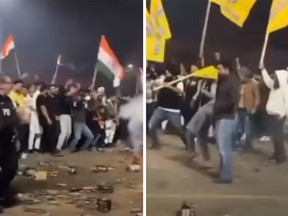
A crowd waving Khalistan flags faced off with nationalists brandishing the Indian flag in a Mississauga, Ont., parking lot on Diwali. Police watched as the two sides yelled and set off fireworks, but there was no violence.
A crowd waving Khalistan flags faced off with nationalists brandishing the Indian flag in a Mississauga, Ont., parking lot on Diwali. Police watched as the two sides yelled and set off fireworks, but there was no violence. Photo by SherePunjabRadio AM600 /YouTube

Labels: , , , , , ,

Friday, July 15, 2022

Terrorism in Canada

"[He was found] suffering from gunshot wounds. The man was provided first aid by attending officers until Emergency Health Services took over his care. The injured man succumbed to his injuries on scene."
"This appears to be a targeted shooting. A suspect vehicle was located in the 12200-block of 82 Avenue fully engulfed in fire."
"The investigation is in the early stages and police are still looking for the suspects and a second vehicle that may have been used as a getaway vehicle."
Constable Sarbjit K. Sangha
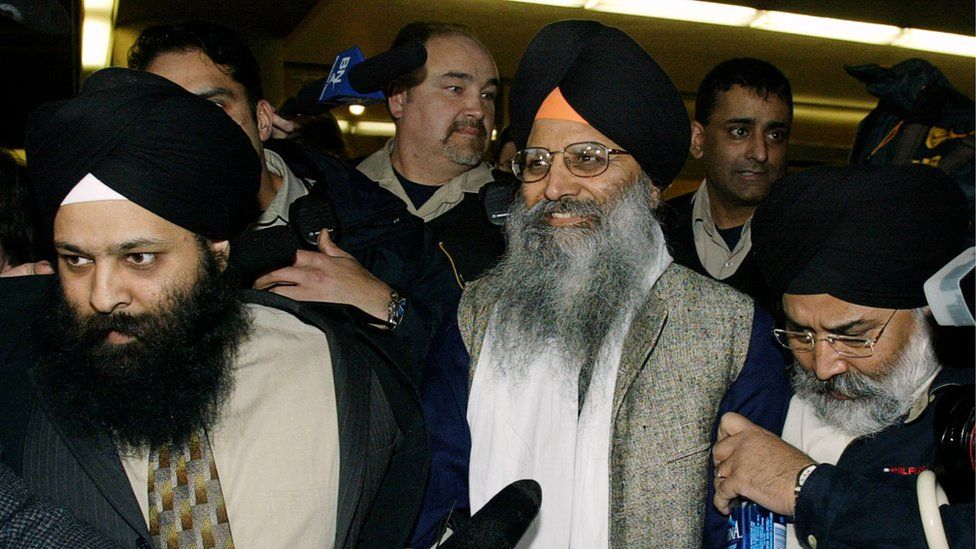
Sikh activist Ripudaman Singh Malik (centre) smiles as he leaves a Vancouver court March 16, 2005, after being found not guilty in the 1985
Sikh activist Ripudaman Singh Malik (centre) was found not guilty in the 1985 bombing of an Air India flight   Reuters
 
Back in 1985 a dreadful terrorist attack took place that took the lives of hundreds of Canadian citizens of East Indian origin. Two suitcase bombs had been planted on two Air India passenger jets. One detonated prematurely and took the lives of two Japanese baggage handlers at Narita Airport in Tokyo. The other exploded over the Atlantic and all 320 passengers and crew of Air India Flight 182 were killed. That was June 23, 1985. This pre-dated the 9/11 attack that took thousands of lives as the handiwork of al-Qaeda.

At the time, there was an active anti-India group in British Columbia comprised of Canadian Sikhs who campaigned (illegally in India) for a separate homeland they called Khalistan. After 1948's partition when Pakistan broke away from India to become a Muslim state, and then Bangladesh broke away from Pakistan, it's likely that India felt it had surrendered more than enough of its territory. There is simmering resentment between Hindus and Muslims in the region. 

The breakup of the territory that India claimed as its own gave rise to horrendous slaughter as Hindus and Muslims both lost tens of thousands in virulent bloodshed as Muslims streamed out of India to gather in Pakistan and Hindus left Pakistan to live among their own. Pakistan has the second largest Muslim community in the world, and India still ranks as the third largest home for Muslims in the world, after Indonesia, the most populous Muslim nation. 

India has untold numbers of ethnic groups, religions and languages represented within her vast population. As a democracy it is not spared the universal conflict that occurs when tribal, ethnic, sectarian groups conflict with one another. The Khalistan movement representing the yearning for a Sikh homeland is one of those conflicts. A man living in Vancouver, Inderjit Reyat, was convicted of manslaughter in both bombings.

The mastermind behind the plot was thought to be Ripudaman Singh Malik. And his associate in the bombing Ajaib Singh Bagri. At the time in Canada, other Canadian Sikhs were aghast at the militant violence being expressed by the Babar Khalsa group. Those who publicly condemned them, including a Sikh B.C. newspaper editor, became victims of violence. One of those victims later became premier of British Columbia, and later yet a Member of Parliament; Ujjal Dosanjh.

It took until 2005 before the two accused in the bombings were to stand trial. Ultimately after a controversial trial, both men were acquitted by a provincial Supreme Court justice, cleared of murder and consp8ircy charges. After the assassination of Indian Prime Minister Indira Gandhi by two of her Sikh bodyguards in retaliation for the Indian military entering the Golden Temple of Amritsar, Sikhism's most holy gurdwara, to roust out militant Sikhs from using it as a weapons depot and headquarters.

Ripudaman Singh Malik was a free man, able to go about his business and he had many businesses, including schools for Sikh-centric education that he founded as a highly respected member of his community. At his trial, it was decided that the harrowing testimony of guilty involvement given by a former member of the group detailing Malik's role in the bombing could not be trusted, leading to his acquittal. 

Yesterday a rather rough justice took centre stage, with Ripundaman Singh Malik's assassination. Just outside one of his businesses he was attacked, three gunshots rang out, an ambulance arrived to take him to hospital and he was pronounced dead. There will be an investigation. There will be an effort to discover the killers' identities and the reason for his assassination at this late date. The RCMP in its original investigation following Air India's bombing was unable to gather evidence to convict the man due to investigative incompetence. There may be a replay of that incompetence.

Labels: , , , ,

() Follow @rheytah Tweet