Politic?

This is a blog dedicated to a personal interpretation of political news of the day. I attempt to be as knowledgeable as possible before commenting and committing my thoughts to a day's communication.

Saturday, August 24, 2019

The Great Indian Democracy That Fails Half Its Population

"India’s criminal justice system remains inaccessible and insensitive to most survivors of sexual violence. These survivors face barriers in getting their cases registered with the police, have inadequate legal support, and are forced to wait years to have their cases heard."
"According to India’s National Crime Records Bureau, around 100 sexual assaults are reported to police every day. Shocking though that is, the actual number of attacks is far higher, with a government survey finding that 99.1% of sexual violence cases go unreported, often due to pressure from family members."
"Immediate, systemic change is needed to ensure expeditious trials and day-to-day hearing of cases, such as took place in the Kathua trial. Justice needs to be done and be seen to be done so that all survivors of sexual violence can place their faith in the legal system, safe in the knowledge that they will be heard and their claims treated seriously."
"The onus is now on the Indian government to move beyond token action and ensure that the criminal justice system is responsive to survivors needs and is equipped to handle the high volume of sexual violence cases that are currently pending."
"Better implementation of existing laws, the introduction of much needed procedural reforms, and clearing the large backlog of cases pending in criminal courts, are all key. So is handling sexual violence cases with greater sensitivity, a more accountable police force, and bigger budgetary allocation by the government to end gender-based violence."
"This includes giving sufficient funding to women’s rights organizations that are delivering vital support services at the grassroots to women and girls."
Divya Srinivasan, South Asia Consultant, Equality Now
NEW DELHI, Jun 28 2019 (IPS) - Early in 2018, India was shaken by the horrific details surrounding the abduction, gang rape, and murder of an 8-year-old girl in Kathua, a district in the north Indian state of Jammu and Kashmir.
One of the most populous nations on Earth, with its diverse population, languages, religious devotion, highly intelligent people achieving recognition in the arts, sciences and technology, along with those in the nation mired in extreme poverty, shut out of advantages and suffering under a still-resonant caste system though it is now illegal, India has its problems. The fundamentalist orthodox among the majority Hindu population and the extremists among the huge albeit minority Muslim population along with simmering Sikh separatist agitation keeps the government on its toes.

Beset with so many difficult headaches there is one yet more, and it victimizes fully half of the Indian population; its girls and women, susceptible to sexual violence, rape, murder and a combination of atrocities that beggar description. In India, more than in most other countries, the lives of girls and women are fraught with the danger of extreme violence, in a culture that refuses to surrender its view of women as expendable objects to be viciously exploited and discarded.

Indian women no longer keep their heads down hoping to avoid notice leading to harassment and attacks. They now publicly campaign for protection from predators. Although the Indian government has made some changes to its laws favouring a more stringent application of justice for women and punishment for their tormentors the prevailing attitude by police and security officials goes into fallback mode of shrugging and ignoring the situation. This is just what happened time and again in the state of West Bengal in the case of a resident who terrorized his neighbours.

The son of a village council leader with the Trinamool Congress party, Mafizul Haz, accused of violent crimes among which rape and bullying stand out, terrorized his community with complete impunity. He remained protected in the coddling aura of his father's political influence as the younger son of Ainul Haq, a council leader -- where in rural India the council system frequently replaces the authority of police, courts and jailers all at the same time.

And although there were countless accusations launched and registered against the man in the Tufanganj police station, no remedial action was ever taken; he has never been held to account for, nor held to be responsible for his vicious behaviour and psychopathic actions harming others. Which led the villagers to inaugurate their own form of action to punish the criminal living among them. Although the man probably deserved to be lynched that would without doubt have brought the wrath of the village council to snap to attention on the villagers themselves not the perpetrator of their problems.

Fed up finally with the lack of attention to their pleas for intervention by authorities, the residents of Balabhut in the district of Cooch Behar gathered at night at the predator's property to quietly and swiftly dig a deep trench surrounding his house, effectively marooning him from the village and its victimized population. Placing him in a position where, when he became aware of the situation that he was under siege, caused him to unwillingly plead with those taking revenge, to provide him with food and water.
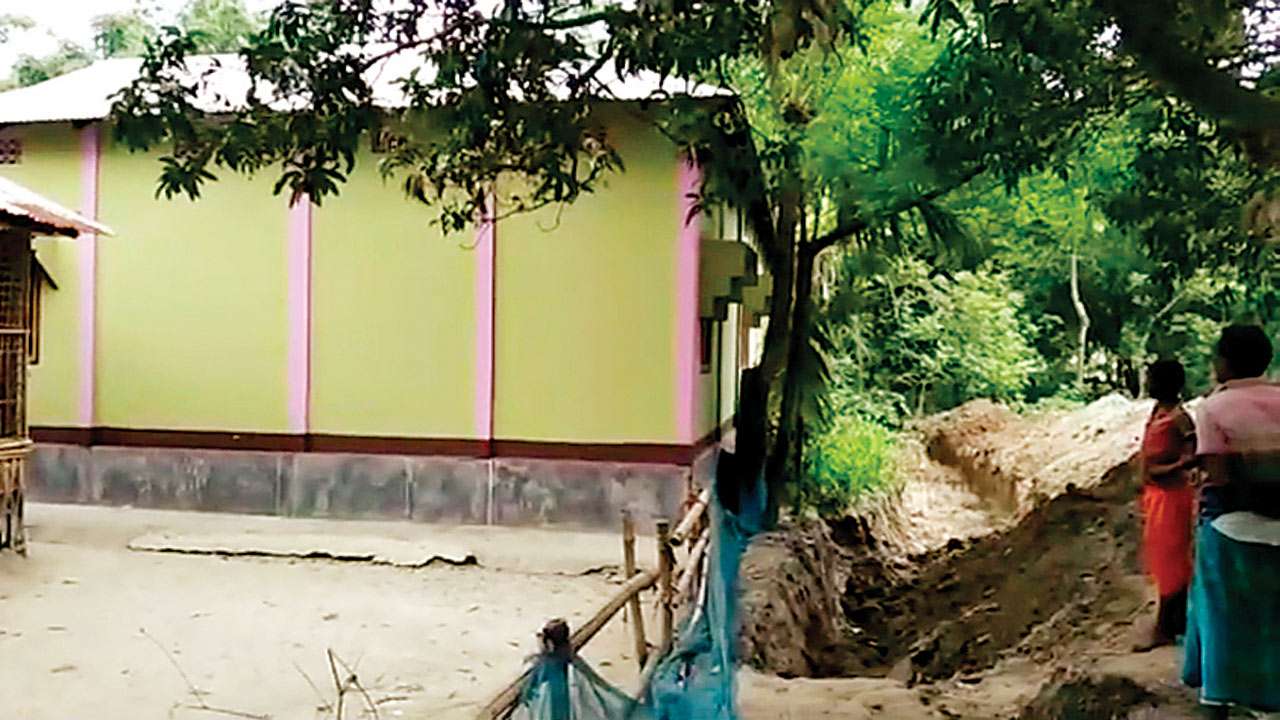
Home of Ainul Haq’s son

Villagers dug a five-feet deep gully around the home of Ainul Haq’s son


Labels: , , , , , ,

Sunday, June 03, 2018

Dreams Versus Reality for an Afghan Woman

"He promised when he came home that I could remove my burqa, and he was going to bring me good clothes, and we would have a good life. He was a good man, and a good husband."
"He would say, 'I will never leave my country to them [the Taliban], as long as there is blood in my body, I will fight them.' Whenever he went out, I was always watching the door until he came back."
"I lost him and I was thinking, 'How could this happen to me?' But it is God's decision, so I can say nothing."
"Once I had dreams, but I cannot talk about my dreams with anyone, because I am a woman."
"Once I wanted to study and be an educated woman who could stand on my own two feet, but in my culture it is not possible. Now my biggest dream is that I do not want this husband to be killed by the Taliban. I ask God to protect him."
Khadija, 18, Afghanistan
afghan-marriage-1.jpg
‘Some lesser person would not have survived what she has survived’

"My wife is very strong. Some lesser person would not have survived what she has survived."
"She is not expecting very much from me; financially I don't have much to give her, just good words and good behaviour."
"Even though I believe men should beat women when they don't listen, I have never had to beat her."
Shamsullah Shamsuddin, 19, Afghanistan
When Khadija was six years old she was married to her cousin, 21 year-old Zia Ul Haq. They lived in a farming community in Marja, Afghanistan. This was not an unexpected marriage between first cousins, but a traditional custom among the Pashtun, the most populous tribe in Afghanistan. The marriage would be consummated by custom, when Khadija reached 11 years of age, or when she reached puberty, whichever came first.

In Pashtun society the culture preordains women's lives; they are betrothed and married off when they are children. They bear children of their own while still children themselves. They wear burqas when in public, and rarely appear outside the home, since they are burdened with children at an early age and customary religious dictates are that women be confined to the home, that no part of her save her eyes be visible, that they shun the presence of men, that if they fail to comply they be beaten.

Her husband joined the Taliban after shrapnel from a U.S. air strike targeting a house where insurgents were thought to be in hiding, killed Mr. Haq's 8-year-old sister. "They brainwashed him. At first they forced him to join, but then they persuaded him", said his younger brother Shamsullah. A year later, a Taliban delegation carried his shrouded body back to his family, and Khadija was widowed at age ten.

But her married life was not over, for in Pashtun society it is the obligation of brothers to marry their deceased brothers' wives, and so Khadija married Aminullah, Mr. Haq's next-in-age brother. Her father decreed it and Khadija obeyed. Aminullah at 22 had a formidable reputation as a feared Taliban fighter, with the Afghan police. "He could handle every kind of heavy weapon, and the Taliban were afraid of him", said Shamsullah.

Khadija was pregnant with their daughter when Aminullah was killed in 2014 by a roadside bomb on a highway. Which is when the family left Marja, moving for greater safety to Lashkar Gah and it is where, at age 14 Khadija gave birth to her daughter. A wait of four months and ten days (stipulated by the Koran) later, saw Khadija married for the third time, to a third brother. It is a responsibility, marrying the wife of a dead brother, said her third husband: "When you look at her, you always see your brother".
afghan-police.jpg
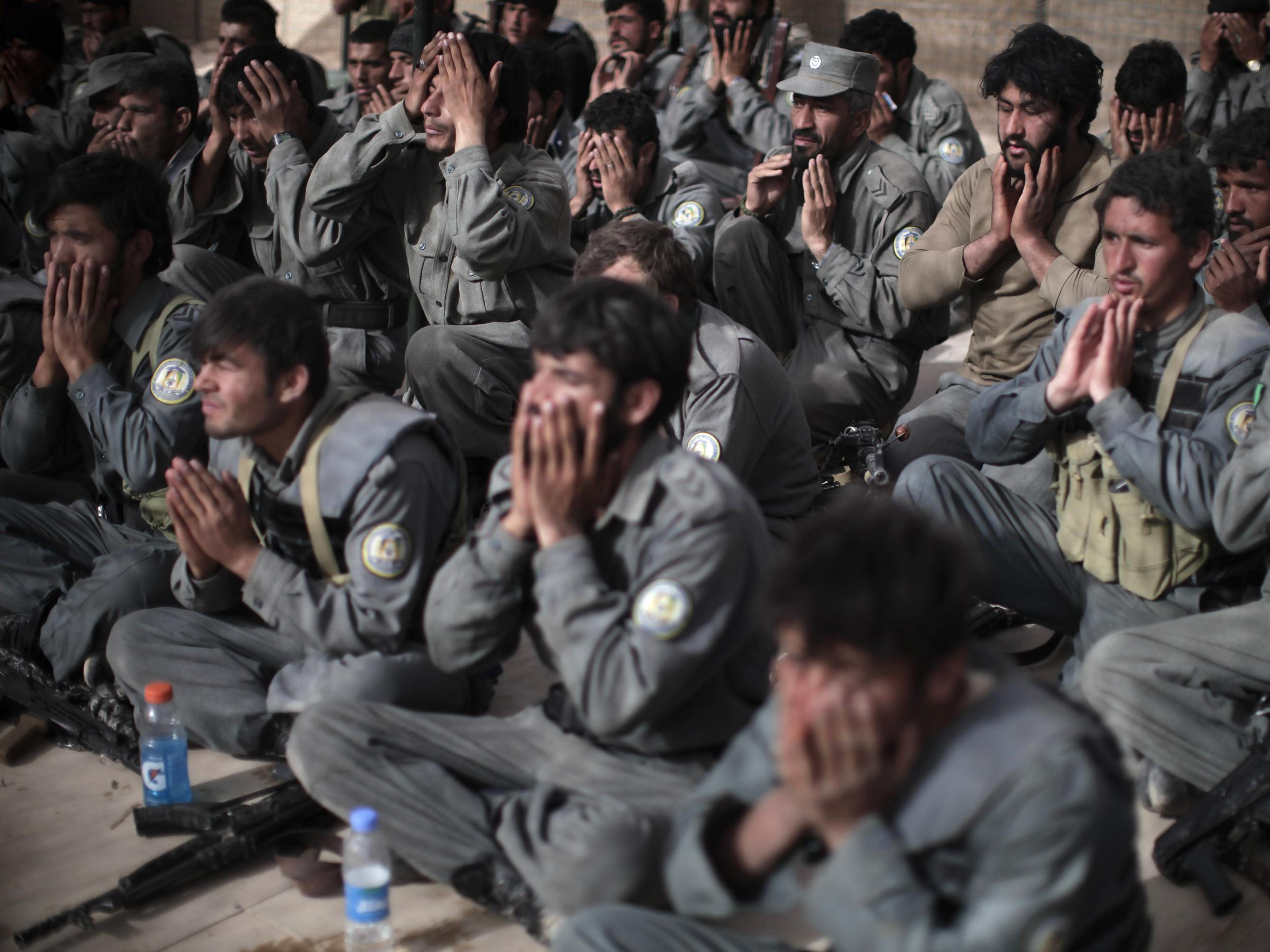
Afghan policemen pray at the US base in Marja 

Khadija and Shamsullah now have a son together, one-year-old Sayed Rahman. Khadija's new husband once worked as an interpreter for the U.S. Marines, for he had mastered English. When the troops left Afghanistan in 2013, he began work as a rickshaw driver at which he earns $5 daily. Because he worked with the U.S. military, the Taliban now threaten Shamsullah. "They say they will kill me and then kill Sayed Rahman."

Labels: , , , , ,

Saturday, December 02, 2017

Supremely Credentialled

"Guess who’s coming to Canada? It’s none other than the prima donna of the world Islamist movement, the grandson of the founder of the Muslim Brotherhood, Tariq Ramadan."
"Ramadan, who was barred from entering the U.S. until Secretary of State Hillary Clinton launched her “appease the Islamists” diplomatic initiative, will be speaking in Edmonton this weekend as a guest of local mosques (and, believe it or not, CTV is a sponsor). Later, he flies to Montreal where the Muslim Brotherhood-inspired Muslim Association of Canada will host him."
"Ramadan is a charming guy, but behind his smile lies a man committed to the goals of the worldwide Islamic jihad as laid out by his mentor, Sheik Qaradawi, and his father, the Trotsky of world Islamism, Said Ramadan."
"While the rest of us will join the labour movement in parades or relish the last days of summer around family and friends, the Islamists will congregate in Edmonton and Montreal to receive guidance from Tariq Ramadan. Just last year, he told an American Muslim audience their job in the North America was to colonize the continent: 'We (Muslims) should all be careful not to be colonized by something which is coming from this consumerist society … It should be us, with our understanding of Islam, our principles, colonizing positively the United States of America'."
"If that weren’t enough, Ramadan hinted that his presence in America and that of Muslims was not accidental, but the result of divine intervention. He said, 'By the way, we are not here by accident'."
In Edmonton, the group hosting Ramadan is a freshly minted organization that goes by the name "'Proud Muslims', Their claim the event is 'non-religious' is highly suspect as its main backers are 'all the mosques of Edmonton and Islamic Relief Canada'. Islamic Relief is the same organization that sponsored the radical Indian preacher Zakir Naik to speak in Toronto in 2010. However, Naik was barred from entering Canada after news reports quoted him praising Osama bin Laden: 'If (bin Laden) is fighting the enemies of Islam, I am for him … If he is terrorizing the terrorists, if he is terrorizing America the terrorist, the biggest terrorist, every Muslim should be a terrorist'."
"His hosts (sic) in Montreal, the Muslim Association of Canada (MAC), is unashamedly pro-Muslim Brotherhood and vows to work towards a 'Revolution in Islamic Work in Canada'. MAC makes no secret that it 'adopts and strives to implement Islam, as embodied in the Qur’an, and the teachings of the Prophet … and as understood in its contemporary context by the late Imam, Hassan Albanna, the founder of the Muslim Brotherhood'."
"While in Montreal, Ramadan intends to draw a parallel between the 'Arab spring' that led the Muslim Brotherhood to power in many Arab countries and the 'Maple spring' in Quebec, which refers to the students protesting tuition fees."
"It’s a dishonest attempt by Montreal Islamists to ride on the bandwagon of a popular secular student movement and appropriate it for their own agenda."
"We can’t blame Ramadan for using our Labour Day weekend to propagate the Muslim Brotherhood credo of 'destroying the West from within'. The blame lies with those who invite him to Canada. These Islamists must be held accountable, but they aren’t because Canada’s liberal intelligentsia will have nothing of that sort."
"It tries to bully us into silence, warning that any opposition to Islamism is nothing short of right-wing racism. However, this lifetime leftist will not be silenced by Islamists or their allies."
Tarek Fatah,  (Toronto Sun – August 28, 2012)
sun fatah ramadan
"It was something in my heart. I had a lot of difficulty with this for years, and I could not forget what happened to me that night with him, and so I decided."
"I just thought at that moment to free myself, free my words, and that did me some good. It relieved me a bit."
"But the name, I did not think it would cause such a noise."
"I took a long time to open my eyes, to understand that they [Islamist fundamentalists] indoctrinated us. It is important to say to all women that they should speak out, that they should not be scared, that they are not inferior beings to men, that they are equal to men, that they should fight to be respected and that you do not have to wear a veil to be a good Muslim."
Henda Ayari, French citizen, North African heritage

Henda Ayari on BFMTV, 30 Oct 17
 Henda Ayari accused Mr Ramadan of having beaten and raped her in a Paris hotel
BFMTV website (screenshot)
This woman who decided that she too would unburden herself of a wound seared into her psyche when a man she wholly trusted, believed to be incorruptible, spoke the truth of the sacredness of Islam and fostered in her confidence, overturned her trust in a violent act of forced sex that the world knows as rape, revealed her experience. Islam does place women on a lower, much lower rung than men. To prove she was raped she would have to produce, in a Sharia court, the testimony of three men as witnesses to her rape. A woman's testimony has no bearing in fact. If there are no witnesses it is obvious that she herself bears false witness and is herself guilty.

On Facebook she decided to post two photographs, one of herself in a full black Islamic veil, and another wearing a tight jacket and Tee-shirt, hair free to blow in the wind, and with it a denunciation of Salafist Islam, acknowledging its incitement of violent jihad among  young French Muslims, let alone the lowly place of women in the hierarchy of Islamist recognition. At 40 years of age she had the experience behind her of having lived with an Islamist when she was herself part of the fundamentalist movement.

Ten years of marriage and three children gave her ample experience to weigh what her life had become and what it had become was a dreary existence that led her to break away from the circumstance she now names as the straitjacket of radical Islam. Seeing the #MeToo campaign unfold in startling revelations baring the secrets and the shame of celebrity figures, professionals, respected men in all fields of public endeavour, she identified the man who had raped her five years earlier. Her October 2015 coming-out has garnered her respect and condemnation in equal measure.

Tariq Ramadan whom -- one of several women claiming he had been their rapist -- she identified as the man who violently raped her in a Paris hotel room in 2012; the Swiss-born Muslim intellectual known for teaching contemporary Islamic studies at Oxford University, familiar to viewers of television news programs where he waxes convincingly eloquent on Islam and the West, got his own outing. Concurrently to posting her confession on Facebook, Ms. Ayari filed a police complaint on the assault in Rouen, France, where she lives.

Accusing Ramadan of rape, sexual assault, willful violence, harassment and intimidation, she is no longer in his favour. He has responded by dismissing the allegations as unfounded, clearly in league with his enemies anxious to slander his good name. And he is taking steps to counter-sue for defamation. For her part, she sat down to write "I Chose to Be Free: A Survivor of Salafism in France", a book exposing the mental and physical subjugation she suffered within the Salafi community, knowing that other women were in the very same situation.

In the book, she had described a sexual assault without identifying her assailant. Even so, the result was threats and condemnation, with her own family disowning her. Her parents will not speak with her, her 18-year old son supports his father, her former husband, and she copes with torrents of online abuse. Her Tunisian ex-husband expected her to live a life of utter seclusion. And to appreciate that as her husband he had the right to be physically abusive. Leading her to leave, with her three children.

Coping with this upheaval in her personal life that left her stranded and without emotional support, she suffered a nervous breakdown, losing custody of her children for a two-year period. When she began following Tariq Ramadan's teaching she found him an understanding guide, a trusted mentor.

Labels: , , ,

Monday, November 13, 2017

Saudi Arabia's Sea-Change

"We are returning to what we were before - a country of moderate Islam that is open to all religions and to the world."
"We will not spend the next 30 years of our lives dealing with destructive ideas. We will destroy them today. We will end extremism very soon."
"We want to lead normal lives, lives where our religion and our traditions translate into tolerance, so that we coexist with the world and become part of the development of the world."
"Seventy percent of the Saudi population is under the age of 30. In all honesty, we will not spend 30 years of our lives dealing with extremist ideologies. We will destroy them today and immediately."
"Saudi was not like this before '79. Saudi Arabia and the entire region went through a revival after '79. ... All we're doing is going back to what we were: a moderate Islam that is open to all religions and to the world and to all traditions and people."  
"Some clear steps were taken recently and I believe we will obliterate the remnants of extremism very soon. I don't think this is a challenge. It reflects our values of forgiveness, righteousness and moderation. Righteousness is on our side."
Saudi Crown Prince Mohammed bin Salman
The prince made the announcement at an investor conference in Riyadh
The prince made the announcement at an investor conference in Riyadh Credit: AFP PHOTO / FAYEZ NURELDINEFAYEZ NURELDINE/AFP/Getty Images
"[I'm not optimistic about the reforms but would] still like to be optimistic … since everyone will suffer if they fail."
"[The reforms are] not engaging Saudi society, enough."
"We wish Mohammed bin Salman well, and we need economic [and social] reform but we also need to discuss [these issues. The change] is being done in very narrow circles. [Ordinary] people are not feeling engaged."
"Conservatives have already lashed out. They’ve been lashing out since 2003. Al-Qaida, or ISIS, or the radical Wahhabis … these are the extremists in Saudi Arabia … and they don’t want change. They have resisted, and will continue to resist. ... The only thing stopping them is [government] security."
Saudi commentator Jamal Kashoggi

"By weakening the clerical establishment and making clerics simple government workers [Mohammed bin Salman] will be able to give women more rights, as he is proposing."
"If 10 million women are given the right to drive in Saudi Arabia and if just a fraction of those women buy cars, take driving lessons or buy insurance, that would contribute to stimulating Saudi Arabia’s stagnant economy."
"Whenever the state clashes with the [conservative] clerical establishment, the state emerges victorious and there’s no reason to believe that things will not be the same, this time."
Hilal Khashan,  political science professor, American University of Beirut
Crown Prince Mohammed bin Salmon's promise to his countrymen that the strict, uncompromising version of Islam known as Wahhabism will be diluted, and that it did not always represent the norm in Saudi Arabia, is somewhat surprising since Saudi Arabia morphed out of Arabia in an agreement with colonial Britain based on the power structure and influence between the Saud dynasty and the rigid fundamentalism of Wahhabism, the movement founded by Muhammad ibn Abd al-Wahhab. 

It may have become more sternly observant with the rise of Iran's Ayatollah Khomeini, but it was never moderate. Moreover, Saudi Arabia, struggling to compete for influence with the new Shiite power in the Islamic Republic of Iran in 1979, as the custodian of the two most holy sites in Islam Mecca and Medina, took pains to portray itself as the true leader of Islam. And as such its punishment meted out for infractions led it to match Iran death-for-death in capital punishment. Yearly state deaths of 150 prisoners distinguished Islamic justice in Saudi Arabia, with claims by
Reprieve, a human rights group, that 41 per cent of those executed in Saudi Arabia in 2017 were killed for non-violent acts such as attending political protests.
Image result for how many people did Saudi Arabia execute this year?
The Independent


But Prince bin Salman is on a modernizing journey for his country, eager to open it to new economic opportunities since the price of fossil fuels plummeted, looking for diversification and foreign investment from the West. An anomaly and rather bizarre, given the massive investments Saudi Arabia has made, building its Wahhabist mosques and madrasses all over the world as it exported its brand of Islam globally, and with it the implementation of jihad and the support of jihadist groups the West calls terrorists. Now it invites Western investment in Saudi Arabia; exporting jihad, importing pluralistic capitalism.

Call the initiative what one will -- and the Prince obviously prefers enlightened and timely modernization -- it will certainly change this religion-straitened society. Given the prominence and influence of Saudi clerics, it will be an uphill struggle, one that Prince Mohammed obviously faces with the relish of a challenge, from the perspective of his 32 years, and the prospect of becoming King with the departure of his father, King Salman. If a signal that a change is on the horizon, the loosening of restrictions for women is prominent.

How many Saudi women will look forward to the opportunity of attending sports matches, an opportunity hitherto denied them, is debatable, once the thrill of offending men has passed. But the spectacle of a burqa-clad woman driving a car for the first time leaves much to be desired. Enveloped in a fabric cage, how free would a woman feel, driving a car toward independence? How independent is she requiring the permission of father, uncle, brother, husband, even son, to go abroad, to open a bank account, to sign a legal document?
"This prohibition on driving is just one in a vast series of laws and policies which prevent women from doing many things."
"The guardianship rule stops women from making every decision in her life without the assistance of a male relative, even if that relative is her 7-year-old son."
Liesl Gerntholtz, Human Rights Watch
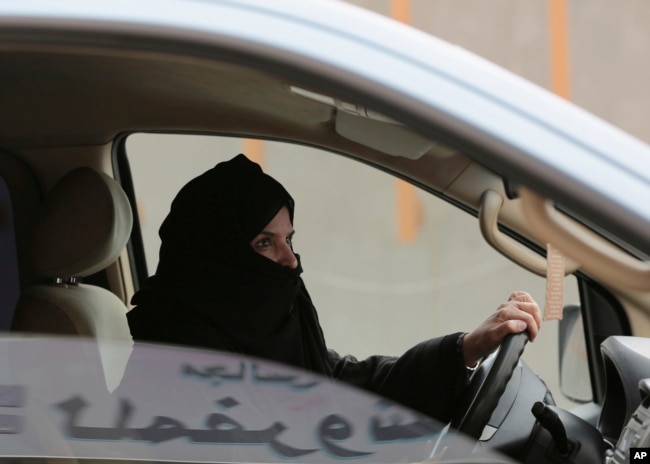
FILE - Aziza Yousef drives a car on a highway in Riyadh, Saudi Arabia, March 29, 2014, as part of a campaign to defy Saudi Arabia's ban on women driving.
The notice has been received by members of the royal family, state authorities and the business community that business as usual is being interrupted and so is the casual acceptance of nepotism and corruption. Having your freedom of movement, however temporary, suspended even by having to remain in a luxury hotel until advised otherwise, is a sobering reality that being part of the aristocracy the wealthy business class, the clergy, no longer would be their shield from imposed change of the social, religious and business order.

"For sure, it does not make me comfortable. Anything that has sin in it, anything that angers the Almighty -- it's a problem", voiced one cleric on news of women attending events where men would be present. "They did a pre-emptive strike. All those who thought about saying no to the government got arrested", observed another cleric. He would, however, accept the changes because Islam requires the Saudi ruler be obeyed. "People go through the door that you open for them", he said philosophically.

"Society in general at this time is very scared. It will push women into society. That is what is in their minds, that it is not right and that it will bring more corruption than benefits", stated  another cleric. One who disagrees stated his initial unwillingness to permit his wife and daughters to own cellphones, but that realities altered his way of thinking, and he feels that Saudi women driving cars would eventually face the same acceptance: "With time, if society sees that the decision is positive and safe, they will accept it", he avowed.

As for leading Islam finally in a more moderate, enlightened direction, away from threatening those of other religions, much less refusing to accept the presence of other religions, Prince Mohammed's drive to soften Saudi Arabia's Salafism in recognition of the 21st Century, has already been spoken of by another ruler, President al-Sissi of Egypt, whose declaration that it is past time Islam stopped being a threat to other religions and exporting jihad to wreak its destabilizing effect abroad, failed entirely to move the clerics of Al-Azhar University, the leading Islamic authority of Sunni Islam.


Labels: , , , ,

Saturday, September 09, 2017

Custom, Culture and Religion : Misogyny 

"It's putting a burden on these parents, because now they are having to choose between maintaining adherence to [the author's views], versus the Criminal Code [of Canada]."
"Any cutting of the genitalia for non-medical reasons is prohibited -- it has been prohibited [in Canada] for twenty years."
Corinne Packer, senior researcher, School of Epidemiology and Public Health, University of Ottawa

"Female genital mutilation in the form that cuts the clitoris or inhibits a woman's ability to achieve sexual pleasure in any way is absolutely against Islam and the values it preaches."
"Female circumcision in the form that removes the skin above the clitoris, thereby further exposing it and enabling a woman to achieve more pleasure during the sexual act, is something that scholars in the Islamic world have recommended for many centuries."
Muslim Council of Canada

"[This blog posting explains] how misogynists and feminists are feeding upon each other to denigrate an Islamic practice that brings untold benefits to women."
"[The truth about female circumcision has been obscured by] Islamophobic sentiments expressed by a largely Jewish-controlled media. [Jews attempt to hide the fact that limited female circumcision is another] feather in the cap [of Islam]."
Asiff Hussein, Centre for Islamic Studies, Sri Lanka

"It [circumcision] doesn't have any health benefits, of course."
"Circumcising women is clearly something that impacts on their sexuality on their right to bodily integrity ... It's very difficult to maintain that it is harmless."

Els Leye, professor, International Centre for Reproductive Health, Ghent University, Belgium
Although female genital mutilation in Africa has gained much attention in the West, it is practiced elsewhere in the Islamic world.

A website for Muslims in Calgary representing three local mosques one of which includes the Muslim Council of Calgary, an elected body representing the Muslim community which has given its support to a 'mild' type of circumcision which a foreign Islamic scholar describes in a blog post that was cross-posted to the Calgary website. The post discussed whether genital cutting of women and girls is useful. The author and the Muslim Council of Calgary agreed it is. And an unknown number of girls and women in Canada are exposed to this illegal cultural practise.

Ask Aayan Hirsi Ali, a Somali-born Dutch-American who in her native country was forced as a child to undergo the procedure. "It was done to me at the age of five, and 10 years later, even 20 years later, I would not have testified against my parents. It is a psychological issue. The people who are doing this are fathers, mothers, grandmothers, aunts. No little girl is going to send them to prison. How do you live with that guilt?" In never-ending pain and anguish, apparently.

Throughout the Middle East, parts of South Asia and Africa, it is routine to have a child undergo female genital mutilation. Any young woman who has intact genitals is considered impure, and thus unmarriageable, within the Muslim community. This, despite that the procedure is usually done with the use of unsterilized tools, and the child is exposed to excruciating physical pain in her disfigurement. The scars in adulthood cause discomfort and pain in urination and menstruation and, of course intercourse.

In some instances disfigurement is so all-encompassing, a women will be unable to give birth normally, placing her life and that of her baby in danger. The practise is culturally engrained as much as it is religiously indicated as a belief that faithful Muslims must continue its practise. It is a practise recognized as demeaning and injurious to women, but one that the societies which honour it view as a way to control women and it is typical in Muslim societies that women are needful of control. It is also a portable practise, one that Muslims take with them in their migration to other countries.

In countries of the Western world it represents a criminal act, an assault, not a medical practise. But in the Calgary Muslim community there is much that has been imported, from a penchant for recruitment to 'radicalization'; the attraction of jihad for restive young men, a hostility to non-Muslims, and in particular Jews viewed as 'Islamophobic' toward whom Muslims are only too happy to return the compliment in viral anti-Semitism, and in the belief that female circumcision supports the virtue and 'honour' of both the recipient and her family and tribe.

"Among social activists and feminists, combating female genital mutilation (FGM) is an important policy goal. Sometimes called female circumcision or female genital cutting, FGM is the cutting of the clitoris of girls in order to curb their sexual desire and preserve their sexual honor before marriage. The practice, prevalent in some majority Muslim countries, has a tremendous cost: many girls bleed to death or die of infection. Most are traumatized. Those who survive can suffer adverse health effects during marriage and pregnancy. New information from Iraqi Kurdistan raises the possibility that the problem is more prevalent in the Middle East than previously believed and that FGM is far more tied to religion than many Western academics and activists admit."
"Many Muslims and academics in the West take pains to insist that the practice is not rooted in religion but rather in culture. 'When one considers that the practice does not prevail and is much condemned in countries like Saudi Arabia, the center of the Islamic world, it becomes clear that the notion that it is an Islamic practice is a false one', Haseena Lockhat, a child clinical psychologist at North Warwickshire Primary Care Trust, wrote. True, FGM occurs in non-Muslim societies in Africa. And in Arab states such as Egypt, where perhaps 97 percent of girls suffer genital mutilation, both Christian Copts and Muslims are complicit."
"But at the village level, those who commit the practice believe it to be religiously mandated. Religion is not only theology but also practice. And the practice is widespread throughout the Middle East. Many diplomats, international organization workers, and Arabists argue that the problem is localized to North Africa or sub-Saharan Africa, but they are wrong. The problem is pervasive throughout the Levant, the Fertile Crescent, and the Arabian Peninsula, and among many immigrants to the West from these countries. Silence on the issue is less reflective of the absence of the problem than insufficient freedom for feminists and independent civil society to raise the issue."
Thomas von der Osten-Sacken and Thomas Uwer   The Middle East Quarterly
It represents the height of hypocrisy, ingenuousness and dissembling to claim that cutting of the clitoris represents a light surgical-cosmetic touch of great benefit to women. That through this process women will be exposed to greater sensual pleasure in the sex act. This is not and has never been the purpose of female circumcision; the direct opposite is the truth. The tradition is valued as a way to ensure that women will never realize physical pleasure in the sex act, as a way to ensure she will always be pure, chaste as custom demands. Herein lies family honour. 

female circumcision
Midwives wait for the next girl to be brought in for circumcision in Bandung, Indonesia. Photograph: Stephanie Sinclair / VII


Labels: , , , ,

Sunday, August 13, 2017

The Terror of Islamic Jihad and Female Enslavement

"ISIS recruiters offer (but don’t deliver) a stark alternative to the discrimination they describe. They promise a future where women hold a valued place of honor, where they’ll be 'lionesses', playing a foundational role in building the so-called caliphate. This often means being wives and mothers — but not always. Women are recruited to be informants and enforcers of ISIS rules. Recently, European observers have even noticed an uptick in female recruits who use the language of women’s rights — dignity and autonomy — to talk about their part in actually carrying out terrorist plots."
Heather Hurlburt, director, New Models of Policy Change initiative, New America's Political Reform program. Jacqueline O'Neill, president, Inclusive Security. Vox

"In our Breaking the ISIS Brand—the ISIS Defectors Interviews Project we were privileged to listen to (with Dr. Yayla and Dr. Shajkovci) to female and male defectors and returnees who described the roles of women in ISIS. Women (and men), who join ISIS are promised purpose, significance, dignity, prosperity and important roles in the organization and the chance to build an alternative to the existing world order which is sold as a utopian future. While its hard for Westerners to understand why women would join such a misogynist organization, we must grasp the hard facts that foreign women who join go to live under the so-called Islamic Caliphate do so for a multitude of reasons: to embrace traditional lifestyles; to follow what they believe is the “true” Islam; and to fight back against what they have come to believe are global injustices, as claimed in the terrorist narrative that Muslims, Islamic lands and even Islam itself is under attack by the West. They also go for adventure; romance; believing that they will be given significant and purposeful roles and even prosperity—including homes and cars. A Belgian female defector told me a few weeks ago that she was even promised diamonds and nurse’s training if she married someone she’d never met and traveled to Syria. Of course neither materialized."
Anne Speckhard, Ph.DICSVE

"In many Islamic countries, child marriages are common practice. Girls far below the age of puberty are often forcibly married to older persons (sometimes in their 50s and later) for various personal gains by the girls' guardian or with the intention to preserve family honor by helping her avoid pre-marital sex. Pedophilic Islamic marriages are most prevalent in Pakistan and Afghanistan, followed by other countries in the Middle East and Bangladesh.[1][2] This practice may also be prevalent to a lesser extent amongst other Muslim communities, and is on the rise among the growing Muslim populations in many non-Muslim countries, such as the United Kingdom[3] and the United States.[4]"
Wiki Islam Contemporary Pedophilic Islamic Marriages

A new study produced some interesting insights into the Islamic and Arab minefield of relations between the sexes within a pervasive culture of misogyny upheld by the Koran and by tribal heritage and custom whereby women are held to be inferior to men and are to be guided in all aspects of life by the men in their lives; fathers, uncles, brothers, husbands; secondary appendages useful for sex and absolutely required for the perpetuation of the tribe or the clan. Not to be seen in public other than in the company of a male relative, and at all times covered by an all-encompassing burqa.

None of that is new, and the custom travels well. In diverse countries of Europe in particular and occasionally in North America women are guided by the convention of Islamic societies that they must be 'modestly' garbed so that not an inch of skin is recognizable to the stray eye. Their own eyes should be all that is visible, with a niqab drawn over their faces. In North America it is more common to see the hair only covered with a hijab, or headscarf. Women's purpose is to provide sex, to bear children.

The Islamic State of Iraq and the Levant has deviated from this norm. While still prizing women as possessions for sex and childbearing, they also prescribe for women to become familiar with some aspects of terrorism, mostly for the purpose of carrying out suicide attacks voluntarily, guided by the same Koranic scriptures that enjoin to jihad. The difference being that for women who martyr themselves through violent terrorism the reward of nubile virgins in Paradise is not theirs; it is restricted to male martyrs who have earned that heavenly privilege.

The only surviving terrorist of the massacre that took place in Mumbai when the terrorist group Lashkar-e-Taiba in collaboration with Pakistan's Interservices Intelligence Agency sent a terror group into Mumbai, India's centre of commerce, to unleash mass violence, related his reason for joining Lashar to become part of its murderous enterprise. Was it for jihad, he was prompted by his interlocutors? "Well, my father wanted me to join so my brothers and I could get married", he responded astonishingly. Astonishing that is, to the Western mind.

Image result for photo, saudi man, riyadh, wedding dress
The Associated Press: A Saudi man buying a wedding dress in Riyadh, Saudi Arabia
The Islamic terrorist-producing societies conventionally pay bride price as an ingrained custom. One 'buys' a wife. And young men wishing to marry must have the financial wherewithal to enable that marriage. According to researcher Valerie Hudson at Texas A&M's Bush School of Government and Public Service, half the countries of the world practise bride price in marriage contracts; roughly 75 percent of the world population lives in those distinguished countries. Bride prices appear to be on a steady increase from Sudan to Nigeria and throughout the Middle East.

Young men of modest means seek any type of employment, including terrorist attacks that will be well compensated in theory, to raise the funds to enable them to 'buy' a wife through 'bride price'. For those men whom the injunction through the Koran to honour their obligation to Islam by being faithful to jihad is reason enough to involve themselves in terrorism, it is the promise of the leisure and honour in the hereafter that motivates them to dedicate their lives to jihad for Islam.

In a very real sense there is a reflection of this in the Palestinian Authority commending and honouring Palestinians for reacting to the campaign to 'resist' the 'occupation' and martyr themselves for the Palestinian 'cause' of what they claim is justice in regaining the land they claim that Israel has taken from the Arabs. Anyone who visits raging violence on Israeli Jews can be guaranteed hero status, and whether they die or are taken prisoner they and their families can look forward to generous monthly pensions for their lifetimes.

In Saudi Arabia, as an example, rehabilitation programs for extremists include the government paying the bride price for those extremists held to have been reformed, after they graduate from the programs meant for their rehabilitation. As for the women who are bought in this way, some are of the opinion that being paid for entitles their husbands to beat them and it also justifies marital rape. She has the status of a sex slave, she is the property of the man who paid the bride price.

It is an old pattern in tribal societies, one furthermore patterned in Islam, on the Prophet Mohammad's own example, including the taking of multiple wives and the marriage to underage girls. Women may wear seductive-appearing gowns and dresses but only for their husband's delectation; in public whatever she may wear in the discreet sanctuary of the home they share must be screened by a garment covering her from head to toe.

Grooms take part in a mass wedding ceremony in Riyadh, on June 24, 2008. Governor of Riyadh Prince Salman and a local group organized a mass wedding for about 1,600 couples to help young people who are unable to afford expensive ceremonies because of the rising cost of living. The government has recognized that marrying men is an effective strategy to stabilize the country and preserve national security.  Credit:Ali Jarekji/Reuters 
  

Labels: , , ,

Tuesday, August 08, 2017

"Saudi Vision" 2030 : Wait for It!

"The overall progress with the economic cities has been very slow, even before the collapse of the oil price."
"Since then, the pace of development has moderated even further with a number of projects being placed on hold."
Monica Malik, chief economist, Abu Dhabi Commercial Bank PJSC

"While the current authorities seem to be committed to open up the country to forms of entertainment previously banned, a big test will be the reaction of the more conservative parts of the Saudi society."
Philippe Dauba-Pantanacce, senior economist, geopolitical strategist, Standard Chartered Bank, London
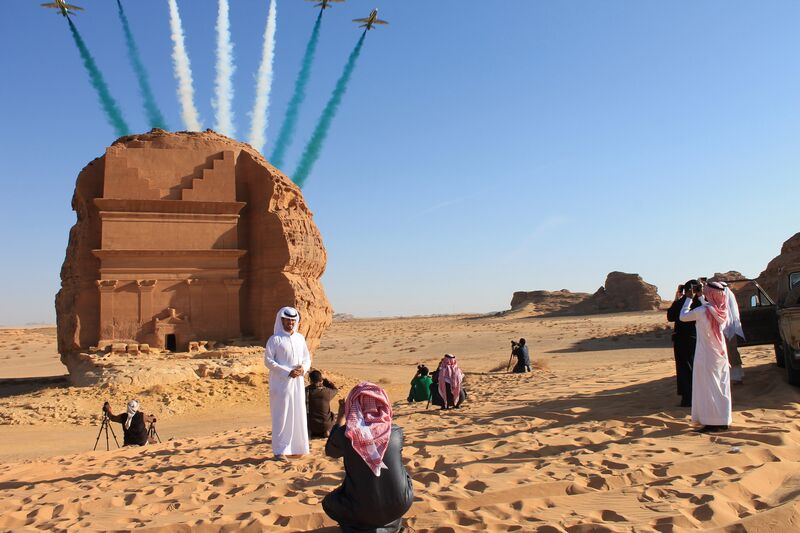
Mada’in Saleh  Photographer: Vivian Nereim/Bloomberg

As a tourism draw, aside from the massive annual trek -- Muslims only -- to Mecca, Saudi Arabia doesn't quite come first to mind. This repressive regime that will not permit the presence of any religious devotion to sully its landscape, other than Islam, which also strictly forbids entry to Mecca of any who are not Muslim (British explorer/adventurer extraordinaire Sir Richard Burton's disguise and Arabic proficiency enabled him in a sole instance of penetrating its sacred precincts in the 19th Century) and where women are expected to wear black, body-and-face-concealing burqas lest they arouse the lust of Muslim men -- doesn't seem at first thought to represent tourism material.

Second thought, recalling that it forbids the consumption of alcohol, frowns upon unseemly conduct such as unattached males and females appearing together in public, in casual social company, views music, dance and theatre as un-Muslim in character, also supports the impression that building specially designed tourism cities on the sands of Arabia might not represent the best of investments. On the other hand, despite the lower returns on petroleum resources, of which Saudi Arabia represents the world's foremost exporter, the Kingdom has untold wealth at its disposal.

Another jog of the memory in the fact that the Kingdom of Saudi Arabia is not particularly known for its charitable generosity. While it has spent and continues to spend, a king's ransom in the establishment of madrassas all over the global landscape, from the Middle East to North Africa, Southeast Asia to Europe and North America and beyond, to teach its very special Salafist brand of Islamic Wahhabism which has produced more than its share of jihadi terrorist groups that have gone on to slaughter Muslims and non-Muslims with fervent abandon, it has spent nothing in support of Muslim refugees.

Al-Shabab
Al Shabab    AtlantaBlackStar.com

The world has seen an unimaginable proliferation of refugees from the Muslim world fleeing the predations of Al Shabaab, the Taliban, Boko Haram, al-Qaeda in the Islamic Maghreb, Abu Sayyaf, Islamic State of Iraq and the Levant, among many others. And there is also the homeless produced by the civil conflict in Syria where its president, like Sudan's attack on Darfurians, has committed civilian slaughter by the hundreds of thousands as punishment for defying the rule of Bashar al-Assad. Neighbouring nations have taken in fleeing Iraqis and Syrians, yet Saudi Arabia which has vast empty spaces it plans to turn into tourism hubs has no space for Muslim refugees.

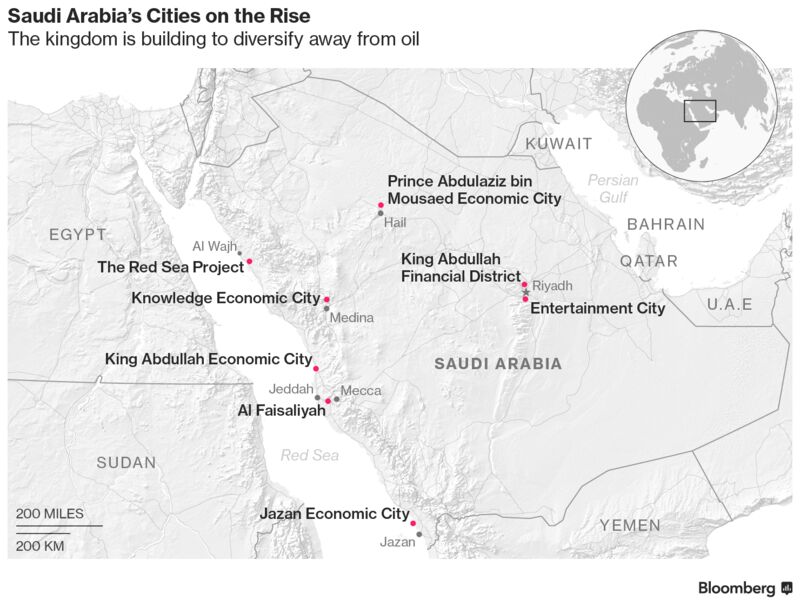
The Kingdom has announced two major developments, one for an area larger than Belgium, the other to include an airport and shipping port, along with a series of economic cities, designed as special zones for tourism, industry and finance. Fifty islands and 34,000 square kilometres along the coastline of Saudi Arabia on the Red Sea are to be transformed into a global tourism destination, to attract cosmopolitan wealthy tourists from every corner of the tourism-hungry world.

Sun-and-surf-lovers arriving to disport themselves on Saudi beaches could rival the millions of Muslim pilgrims trekking to the holy shrines in Mecca and Medina, according to Saudi development plans. West of Mecca, an emerging city to be named Al Faisaliyah, will be complete with thousands of upscale residential units, entertainment facilities, an airport, sea port, all on 2,450 square kilometres, with a completion date projected to 2050.

Another cultural, sports and entertainment city is to be developed southwest of the capital Riyadh, a project to be developed on 334 square kilometres, equipped with a safari area and a Six Flags Entertainment Corp. theme park.  The internal goal is to ensure that household spending on recreation is to double to six percent by 2030. But of course the larger aim is to attract the attention of he wealthy global community of fun-loving, entertainment-seeking tourists to Saudi Arabia. The country that brought to world attention the spectacle of 9-11 has its eyes on an alternate subject of rapt attention.

Labels: , , , , , , ,

Thursday, January 26, 2017

Modernizing Egypt, Slowly Empowering Egyptian Women

"Why cannot we, as a state concerned with the safeguarding of society ... issue a law that only legalizes divorce when done in the presence of a Maazoun [cleric authorized by government to officiate marriage and divorce] so we can give the couple a chance to reconsider?"
"It cannot be just a word that is casually uttered. [Children would be protected under a proposed law, preventing 'inappropriate behaviour'."
Egyptian President Abdel Fatah el-Sissi
(File : AFP)
Egyptian President Fatah el-Sissi, AP

President el-Sissi, with much on his agenda, not the least of which is Egypt's economy, its domestic crime rate, sectarian hostilities, the pressures of Islamists loyal to the now-outlawed Muslim Brotherhood, and the violent attacks taking place in the Sinai by Salafist Bedouin, Islamic State and el-Qaeda militias and Brotherhood-linked Hamas on Egyptian police and military, still obviously uses his nimble brain to ruminate on how Egyptian society could benefit by setting aside some of the Islamist-inspired cultural traditions such as a man's prerogative to end a marriage simply by stating "I divorce you" three times in succession. 

As a devout Muslim himself, President el-Sissi is aware of creeping fundamentalist Islamism and the violence that ensues, and has expressed his frustration in the past over ancient Islamic scripture being revived that reflects the mores of its medieval past, rather than moving forward into the 21st Century. In particular, he has spoken of Islamic exceptionalism and jihad, rejecting both as inappropriate for a world religion and deploring the existence of terrorist groups patterning themselves on the Islam of its early years of bloody conquest.

Now he has addressed himself to his nation's high divorce rate. He feels that legislation that would outlaw the verbally valid divorce in Sharia law -- to make it mandatory for Muslim men and their spouses to seek out alternatives to spur-of-the-moment sundering of a marriage contract -- would represent a step forward. President el-Sissi spoke recently during a televised address of his alarm on hearing from the head of the nation's Statistics Bureau that some 40 percent of Egypt's annual 900,000 marriages last a mere five years.

Legislation was required -- he suggested to the Grand Imam of Al-Azhar, the international authority of the Muslim world and of religious learning and jurisprudence -- that would de-legalize the too-simple social convention of three-times-repeated "I divorce you", which could be initiated only by a man. Divorce should ideally be legal only when announced in the presence of an officially authorized cleric, he sressed. The idea being to avert emotional arguments between husband and wife, descending to a splintering of the marriage.

The Religion of Peace

The old verbal protocol, announcing the dissolution of a marriage, satisfies the traditional patriarchy in Egypt which considers that kind of decision the prerogative of the male. President el-Sissi's foray into reforming such outdated cultural traditions is not popularly embraced by either conservative militants or fundamentalist clerics. President el-Sissi understands these dynamics well, that he requires the cooperation of Al Azhar's grand imam, sheik Ahmed al-Tayeb, for success in overturning the male-centric privilege.

But the Egyptian president is firm in his belief that Islam is badly in need of a new image, and to do so would require expunging the interpretation of the radical readings of the Koran, popularized by militant groups such as the Islamic State. "It's a harsh war and the entire world knows that we are fighting it alone", said President el-Sissi in contradiction of pro-government media asserting that the militants were on the verge of destruction, successfully challenged by the Egyptian military.

The President's views on sexual harassment in Egyptian society as a chronic social ill, has him speaking forcefully in condemning the practise. He guided his 596 seat parliament last year on producing tougher penalties for female genital mutilation, where amendments to punish perpetrators with up to 15 years in prison should a child die as a result of the medieval practise, and up to seven years for performing the procedure.

Egypt is well served under his tutelage and guidance.

Labels: , , , , , ,

Sunday, January 22, 2017

"I Have Done Nothing Wrong"

"Since there was suspicion of sexual relationship, the police sent the girl to forensic medical for virginity test."
Fraidoon Obaidi, chief, Kabul Police Criminal Investigation Department

"The virginity test has been banned. However, it's a long-lasting practice used wrongly by law enforcement authorities, especially police."
"However wrong, it is going to take some time to entirely be stopped and removed. But we are determined to change the practice."
Office of Afghan President Ashraf Ghani

"The circumstances of virginity test are never humane."
"In conducting virginity tests, no one asks for the consent of the victim or the suspect -- 99 percent of the virginity tests are conducted by force and without consideration of its legality."
Soraya Sobhrang, commissioner, Afghanistan Independent Human Rights Commission
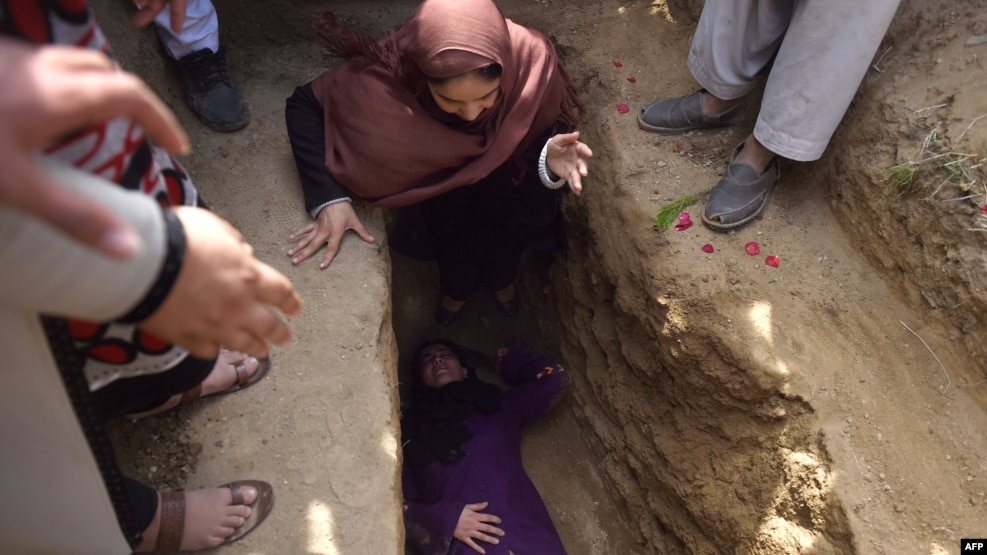
Violence against women remains a major issue in Afghanistan. File photo of Afghan civil society activist women weep and lie on the grave of Farkhunda, 27 after she was lynched by an angry mob in central Kabul on March 22.

AFGHANISTAN-WOMEN_
A human rights abuse and indignity of the highest order, virginity tests are conducted in a small chamber at Kabul's forensic center. The room has much in common in appearance with a storage space. The government's deputy director of forensic medicine, Khalil Ahmad Pashtoonyar, hastens to give his assurance that women are never forced to undergo the examination. Should a woman refuse, his facility simply returns the appropriate file to the police with the notation that the subject failed to give consent.

Entirely overlooking the very fact that in this fundamentalist society extreme public pressure and social expectations weigh heavily on a family's honour and the end result is that a woman has little option but to submit to the test. The social devastation of censure and isolation that can result from a refusal to accept the pressure and submit to authorities' demands that the public morality be respected ensures that few women have the courage to defend themselves against such an intimate intrusion.

Rights groups have repeatedly warned against the lack of basic rights for women in Afghanistan [AP]
Yet, even if the test is conducted as social mores demand, and the woman is found to be without the moral blemish of a disturbed hymen, the very fact that she has been submitted to such a test is indication enough of her presumed moral failure in this backward society. A 17-year-old girl and a young man she had been linked with were sitting in a vehicle when a mob descended on them, setting fire to the car. The two young people managed to escape. When police arrived on the scene it was not the lynching-prone mob that interested them.

Instead they arrested the teenage girl. She was ordered by police to undergo the standard virginity test at the forensic medical centre. The completed test verified that her hymen was intact; nonetheless, she was held for 40 days at the detention center meant to hold children under suspicion. And the public shame of the accusation against her by the ravening mob compelled her father to send his daughter out of Kabul, to be with family in a different province. "I have done nothing wrong", she wrote to her father.

Afghanistan's president had acceded to the demands of rights activists that forensic virginity tests be officially abolished. Regardless, the examinations remain forced by officials upon women and girls who in many instances have been raped or who have suffered some manner of sexual abuse. In other words, they are held responsible for the violent attacks rapists subject them to, guilty for being women inciting men -- by virtue of the fact that they are women -- to attack them.

Labels: , ,

Saturday, August 20, 2016

Instrument of Oppression, Innocent Modesty or Cultural Jihad?

"It's the symbolism. It's a symbol of radical Islam, a radical Islam that is trying to take root in Quebec."
Nathalie Roy, CAQ [Coalition Avenir Quebec] critic for secularism, Quebec

"If our society tolerates in the public place this obvious manifestation of the oppression of women, it confirms that this oppression is acceptable and accepted."
"We have a declared enemy, the Islamic State, which recruits people here to set bombs. Our only choice is to debate the prohibition of the burka. BEFORE a jihadi uses one to hide his movements for an attack, or AFTER."
Jean-Francoise Lisee, PQ Charter of Values architect

"[The Charter was associated with] a shift from a predominantly positive perception of inter-community relations to a predominantly negative one, particularly among women, immigrants and ... cultural or religious minorities."
"This is how ordinary violence insinuates itself into the very midst of normal life, taking a variety of subtle forms."
"Clearly, building a foundation for living together in harmony from which both immigrants and the host society would benefit still represents a major challenge for present-day Quebec."
Quebec research study: Transcultural Psychiatry journal
A woman in a burkini and the fight
Express: right: burkini; left riot in Corsica when three Moroccan men reacted to scantily-clad French women on a beach they insisted they were dedicating to Islamic principles outlawing the presence of swimsuits other than burkinis.

Clearly, hostility to any form of garb or symbol of religious affinity rankles in Quebec. The Charter that was developed by the former government of Quebec led by the Parti Quebec to promote Quebec values of secularism, was pretty well designed after France's promulgated secular values-driven effort to dissuade French Muslims from flaunting the much-despised veil seen as dismissing de rigeuer French culture in enlightened France.

And, to be certain, the sight of women dressing in all-encompassing black from head to toe, eyes only permitted to be bared to the world, all normal body and full-face language-expression denied to those they pass does unmistakeably personify total alienation, a message that whoever you are, you are not part of the universe these women inhabit. On the other hand, Muslim women who effect modesty whose expression is the hijab, or head scarf do not erect an impassable wall.

This is their preferred mode of dress and it should be disturbing to no one. The issue newly aroused in Quebec of social affront taken should a Muslim woman decide to go to a beach wearing what has been named a "burkini", a swimming costume designed with the religion's admonition to women to be modest in their attire, simply represents a piece of clothing that these women are comfortable in. Their faces are not hidden.

It is the face, and its emotive features hiding behind a niqab (face veil) or a burqa that is offensive in Western society. All the more so when women move behind a dense curtain of anonymity and alienation from any Western society to which they have migrated; it represents a dismissal, a distrust, a distaste of the prevailing society, since that totally covered body and partially disguised face represents a cultural, patriarchal-driven agenda.

The Supreme Court of Canada upheld the 'constitutional' right of a Muslim woman to wear a burqa even while swearing the oath of citizenship. This does represent an affront to Canadian values and the Canadian way of life. A Muslim woman wearing a headscarf symbolic of her belief that Islam requires this of her can be overlooked and accepted with a modicum of respect. The burkini can be seen in the same light; the only thing such an outfit hides is a woman's contours, not her identity.

Labels: , , ,

() Follow @rheytah Tweet