Politic?

This is a blog dedicated to a personal interpretation of political news of the day. I attempt to be as knowledgeable as possible before commenting and committing my thoughts to a day's communication.

Saturday, January 31, 2026

In Hindsight : Losing Canada

"Unfortunately, literally everything I said would  happen in 2015 has now come to pass."
"Trudeau's deficits will not be small. Mr. Trudeau has made tens of billions of dollars of spending promises; he said the budget will balance itself, he has no idea what he is talking about when it comes to these things." 2015
"These guys [2015 leadership opponents] would have had, in the last two weeks, us throwing open our borders and literally hundreds of thousands of people coming in without any kind of security checks or documentation."
"That would have been an enormous mistake."
Former (2006-2015) Prime Minister Stephen Harper 
https://i.cbc.ca/ais/1.1792054,1464286365000/full/max/0/default.jpg?im=Crop%2Crect%3D%280%2C0%2C779%2C584%29%3BResize%3D805
Stephen Joseph Harper, who led the Conservatives for 13 years, saw his party win the first majority government in over a decade in the May 2, 2011, election, with 166 seats, representing an increase of 23 seats from the October 2008 election, in which Harper won a strong minority. (Geoff Robins/AFP/Getty)
 
He was one of the most effectively reliable prime ministers Canada has had; principled, intelligent, informed, a man of earnest integrity and love of country. Some of those who voted him into office -- one minority and two majority governments -- missed him from the moment the Conservative Party of Canada lost the 2015 election and the Liberal Party of Canada became the governing body under the most unsuitable, unprepared and unprincipled prime minister Canada has ever had; Justin Trudeau. 
 
Now, the current Liberal Prime Minister Mark Carney promises to be the second-most unsuitable, out-of-his-depth prime minister of Canada.
 
Former Prime Minister Stephen Harper was an economist before he became prime minister and his administration bears no resemblance whatever to the current office-holder, a central banker, whose grasp of economics seems fairly incompetent. Perhaps not so much as his predecessor, Justin Trudeau, who felt the economy would look after itself:  "The commitment needs to be a commitment to grow the economy, and the budget will balance itself".
 
To that end, after inheriting a balanced budget, the Liberals claimed they would run a $10B deficit for three years to 'build infrastructure' after which a balanced budget would be produced by 2019. The first three years of Liberal mismanagement of the economy saw the deficit come in at $19 billion for starters. By 2025, when Trudeau left the prime ministership the national debt was $1.2 trillion, somewhat higher than the $612 billion he had inherited a decade earlier.
 
While in office, when the opposition Liberals and NDP insisted the government bring Syrian refugees into Canada en masse, PM Harper responded: "We do not want to pick up our entire communities ... and move them out of the region where they have lived for as long as history has been written. They do not want that. They want us to help them. That is why we provide refugee placements, friends. That is why we provide humanitarian aid." 
 
https://i.cbc.ca/ais/1.3177233,1464286588000/full/max/0/default.jpg?im=Crop%2Crect%3D%28692%2C54%2C1767%2C1325%29%3BResize%3D805
August 2015 long weekend, Harper stood outside Rideau Hall — dressed in Conservative blue — after asking Gov. Gen. David Johnston to dissolve Parliament, launching his fifth federal election campaign as party leader. He appealed to Canadians to consider leadership (and his experience) as the central issue at play. (Blair Gable/Reuters)
 
Fast forward ten years and "hundreds of thousands of people" entered Canada with scant security checks as the Liberal government ignored entire categories of quotas and checks on temporary immigration  (many dating from the Harper government); in the process seeing an unprecedented surge of temporary migrants entering Canada The number of 'non-permanent' residents soared by 1.7 million in three years, overwhelming the capacity to screen them. Leading to a 'standard' of foreign nationals claiming refugee status through an ever-so-convenient app. 
 
The Harper-era government brought in a measure to prevent corruption in awarding of contracts by government, leading to the Public Prosecutions Act, designed to prevent political interference in criminal prosecutions. The law enacted by the Harper government placed the situation in control of a politically independent 'director of public prosecutions'. It was this act that succeeded in revealing the 2019 episode when Trudeau pressed his then-justice minister to forgo a bribery case against a Quebec engineering company with close ties to the Liberals.
 
During his administration, PM Harper removed home delivery at the request of Canada Post management, reflecting the downward spiral of mail volumes making it too costly for letter-carriers to continue door-to-door daily deliveries. At that juncture, the national mail corporation still turned a profit and closing down home delivery meant the spigot of losing money was turned off. The Liberals campaigned on a promise to restore home delivery. Almost immediately it was restored hundreds of billions annually began hemorrhaging for Canada Post, leading it to the door of bankruptcy. 
 
In 2010 the Harper government suspended Canada's contributions to the UNRWA agency, a central provider of aid ad-infinitum to Palestinians in Gaza and the West Bank. Accusations the agency was intermingled with Palestinian terror groups such as Hamas led to that cancellation. The Liberals restored funding to UNRWA in 2015. By 2023 following the October 7 terrorist attack on southern Israel, hard evidence emerged of UNRWA employing members of Hamas and Islamic Jihad; including a top Hamas commander.
 
When the Liberals took the reins of power in Canada they spoke of an intention to 'modernize' the criminal justice system with the introduction of 'restorative justice' to reduce the number of Indigenous offenders in prison. Bill C-75, a crime bill, was made law in 2018 to simplify bail for accused criminals and codifying treating offenders more leniently based on race. Stemming from a 'vulnerable population', criminals received bail faster and were released earlier from prison. 
 
Since then, Statistics Canada's crime severity stats reflect that when Mr. Harper left office, homicides and violent crime were at lows never before seen in the history of Canada. Since his departure from office as prime minister, however, crime began trending uphill steadily, sitting now at the point where  homicides have hit 30-year highs. This represents the Liberal version of progress.
 
https://i.cbc.ca/ais/1.2502700,1445318089000/full/max/0/default.jpg?im=Crop%2Crect%3D%28391%2C0%2C2840%2C2130%29%3BResize%3D805
Mr. Harper and his wife, Laureen, visit the Mount of Olives, in Jerusalem in 2014. The Mideast featured throughout Harper's tenure, including most recently the exodus of refugees from the war in Syria. Harper pointed to ISIS as the root cause of the refugee crisis in Europe and reiterated Canada's military commitment to combating the extremist group. (Sean Kilpatrick/Canadian Press)
 

Labels: , , , , , ,

Monday, July 21, 2025

South African Crime and Punishment


https://global.unitednations.entermediadb.net/assets/mediadb/services/module/asset/downloads/preset/Libraries/Production%20Library/13-03-2023-SouthAfrica-unsplash.jpg/image1170x530cropped.jpg
Unsplash/Kyle-Philip Coulson
The sun rises over the capital of South Africa, Pretoria.

"The present report also focuses on grave abuses of the basic human rights of many
South Africans - but abuses which took place outside South Africa and for which the ANC,
not the South African Government, was directly responsible. Based on first-hand research
among surviving victims of such abuse, it documents a long-standing pattern of torture,
ill-treatment and execution of prisoners by the ANC's security department. It shows too that
this pattern of gross abuse was allowed to go unchecked for many years, not only by the
ANC's leadership in exile but also by the governments of the African front-line states who
allowed the ANC to set up bases, and prisons, on their territory. Such governments were at
best accessories to the abuses by the ANC; at other times they actively assisted those within
the ANC responsible for the grave human rights abuses which occurred."
                                        Amnesty International

https://mg.co.za/wp-content/uploads/2021/10/191409e0-graphic-torture-website-1000px.jpg 

* Torture exists and is real in South Africa today.
* Torture is a human rights violation and is prohibited in the Bill of Rights of the South African
Constitution
* Torture is now a recognized crime in South Africa and perpetrators of this specific crime can be
charged, tried and prosecuted under the Prevention and Combating of Torture of Persons Act
13 of 2013 (“The Anti-torture Act”).
* South Africa enacted anti-torture legislation on 25 July 2013 almost 15 years after ratifying
the United Nations Convention against Torture (CAT) – South Africa is yet to ratify the Optional
Protocol on the Convention against Torture (OPCAT)
* In Africa, 13 out of 54 countries have enacted anti-torture legislation.
* Article 5 of the African Charter on Human and People’s Rights prohibits torture and the Robben
Island Guidelines provides a guide on preventing torture in Africa
* In South Africa torture happens in police cells, correctional services, other places of detention
(or where freedom of movement is restricted), on the streets and in some cases in people’s
private spaces.
* Victims of torture in the post-apartheid South Africa include arrested persons, criminal sus-
pects, non-South African nationals and sex workers amongst others.
* The Anti-torture Act applies to state agents – members of the police, prison warders, nurses,
teachers and other officials responsible for detained persons or other people acting with the
consent and authorization of the State. 
                                                                                                      Amnesty International

A feature of the Apartheid era in South Africa was white-led police forces that terrorized Blacks with their brutal interrogation techniques. A tactic that involved plastic bags placed over a suspect's head, suffocating them while being questioned; a terrifying object lesson in a police state with no accountability, no link to human rights, no conscience alerting the abuser to the fact that in torturing a prisoner they were themselves criminals and those they suspected of criminality their victims whom they expected to incriminate themselves out of pure fear to put a stop to the unbearable atrocity they were suffering through.
 
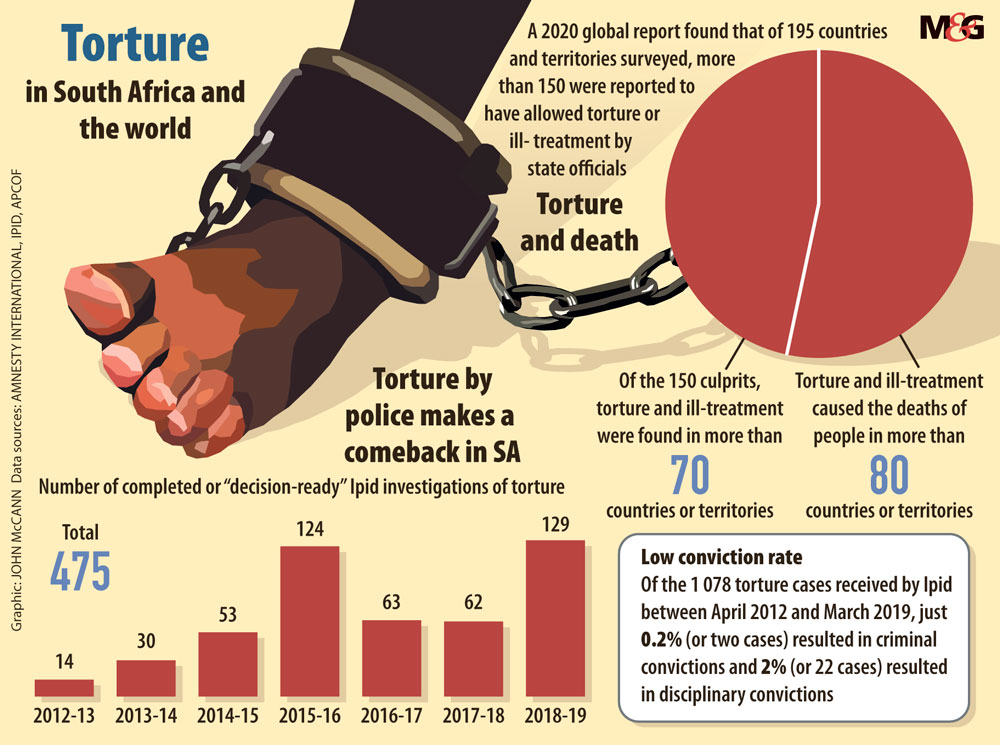
A White-on-Black crime. With the obliteration of apartheid, South Africa adopted a constitution outlawing such methods of interrogation involving torture. South Africa became a signatory to international treaties banning torture. The country was committed to the prevention of torture under any circumstances. Latterly, an analysis of government data has been undertaken by investigative journalists fully three decades since apartheid, only to discover that police in South Africa are still making use of the same suffocation tactic, called tubing.
 
https://i0.wp.com/www.dailymaverick.co.za/wp-content/uploads/2025/07/Viewfinder-tubing-poster.jpg?resize=1440%2C720&quality=89&ssl=1
Poster design by Viewfinder, with an archival photo of a tubing demonstration used with permission of the Wits Law Clinic. (Image: Supplied)
 
"They take two plastic bags – a Shoprite bag and a Pick n Pay bag –you know, those thick plastic bags."
"Then they put water inside and put it over your head. The water comes into your nose and your mouth."
"As soon as you think to breathe in again, the plastic bag comes right to your nose. You can't do nothing, nothing!"
"You can't even scream. You can scream as hard as you can, but no one can hear you."
"Before they beat you, they throw water over you, because they know it will be more painful. They make you take your clothes off. They leave you with only your shirt.
"They take some sticks from the tree. Then they take the cable ties – those long ones: the black ones or the blue ones. They beat you over the head and here by your neck," he says, pointing to his larynx. "Then they make you push your chest out and they beat you on the chest."
"They beat the hell out of me – like I'm not a man, you know? Like I'm a piece of paper. The way they beat me, I told myself: 'God, I'm dying today.'"
Mail&Guardian -- Africa's better future -- Brandon, South Africa  

An average of three people weekly from 2012 to 2023, filed complaints that the police had tubed them, according to Viewfinder, a South African journalism nonprofit. The liberation of Black South Africans led by freedom fighters gave way to a government that somehow finds it expedient to oversee a police force specializing in the very same torture techniques as those they were liberated from. Tubing: pulling a plastic bag over a prisoner's head, while fastening it securely around the neck. A technique that practising officers are not held accountable for.  
"I'm really shocked because it brings back very, very, very bad memories."
"The leadership of the A.N.C., when they came to power in 1994 made it clear: No soul should be subjected to that."
Khulu Mbatha, African National Congress liberation party 
The South African Independent Police Investigative Directorate (a government watchdog) identified some 1,700 tubing complaints over an eleven-year period. In one of those instances police dismissed an officer, later reinstated. In another six instances, officers were convicted in court. A confidential United Nations report dated 2023, warned commanders in the South African Police Service, along with top government officials about the use of torture. There was no response from government -- as is generally required by a signatory of a U.N. anti-torture protocol.
 
The police service "regards any allegations of torture as a serious misconduct", with measures to prevent it, according to Colonel Athlenda Mathe, a police service spokeswoman. Infamously, South Africa has a well-earned reputation as being among the world's highest countries suffering incidents of murder; its brazen crime rate earns it both internal and external criticism of its police response. Aggressive quotas for arrests and weapons seizures were established by the police establishment, ostensibly to address the critical issue of crime in South African society. 

Some commanders ignore allegations of torture, under pressure to meet the quota targets, according to a former senior police official fired four years earlier for having publicly criticized the national police commissioner. "It's easy for criminals to tell lies about police officers", stated the general secretary of the South African Policing Union, dismissing claims of torture as overblown rhetoric. 

A law criminalizing torture was passed by Parliament in 2013, with a maximum sentence of life imprisonment. Written guidance has been issued to officers in the police department, outlining the law. The training manual representing the police department includes techniques of interrogation reflecting global best prices. Yet there remain some commanders who believe that torture produces results, despite that experts are in agreement that anything gleaned through torture tends to be unreliable simply because victims tend to confess falsely while under physical duress.

https://mg.co.za/wp-content/uploads/2013/02/cdf54691-2013-02-28-amateur-video-brings-torture-into-light-of-day-image.jpg
Mail&Guardian -- Africa's better future


Labels: , , , ,

Friday, December 01, 2023

This Is Their Truth, Different From Yours

"You are not going to like this tweet so turn away if you are likely to be triggered: I am a very optimistic person; I am a fighter for Western values and liberties; I am a dogged defender of science, reason, and common sense. I must say though that I am unsure that the West can recover from its multifront civilizational suicide. Yes, I've talked about these issues for decades and wrote a book about it [The Parasitic Mind: How Infectious Ideas Are Killing Common Sense] but the past few weeks have crystallized the extent to which the problem has become intractable."
"It will be a long and ultimately bloody demise and the West will be the first society in recorded history to fully self-implode due to its parasitic ideological rapture. It is a gargantuan Greek tragedy that will shape the future of humanity. this is not hyperbole. Your grandchildren will pay a very high price for your 'progressive' arrogance rooted in the pursuit of Unicornia that only exists in the recesses of deeply flawed parasitized minds."
Gad Saad, evoluntionary behavioural scientist, professor, author: The Saad Truth about Happiness: 8 Secrets for Leading the Good Life 
https://smartcdn.gprod.postmedia.digital/vancouversun/wp-content/uploads/2016/03/trudeau-sikhs-2.jpg?quality=90&strip=all&w=1128&h=846&type=webp&sig=6_iRp6HChmc_P8mFgyYBdA
Justin Trudeau says Canada is the world's first "postnational state." But the goal of the alternative, transnationalism, is to override the rules, customs and sovereignty of individual nations and allow the virtually unrestricted flow of global money.  Vancouver Sun
 
Professor Saad lists parasitic ideas destroying the West, overturning the conventional, traditional values that expressed Enlightenment values that are the foundation of society by converting the minds of people in the public and those in authority from belief in the verities of existence, of conscience, and consciousness of human need based on reality, to reject these as outdated, to be replaced by ethereal, simplistic and unbalanced musings on a world free of base, unworthy values.

Canada has had ample experience these past eight years or so with post-nationalism, where nothing in the past that forms the base of respect for heritage and history is worth contemplating any longer, in a reflection of their colonialist, imperialist, white-man's entitled society unfair to the point of genocidal behaviour toward the original inhabitants of the land called Canada. A prime minister proud of his 'feminist' credentials, his unalloyed celebration of the LGBTQ-2-and-more community whose rights of recognition prevail above those of conventional social mores.

Postmodernism is a reflection of an idea pathogen, explains Professor Saad; a form of intellectual terrorism positing no objective truths since obviously subjective relativism taints claims of truth along with personal biases. The "antiquated" reality of what differentiates a man from a woman is a mere biological happenstance amenable to transition when the mind convinces the body it is a delusional aspect of creation. No longer will the world community cleave to a fixed idea of two sexes.
 
https://www.ctvnews.ca/content/dam/ctvnews/en/images/2023/9/18/trans-pride-march-1-6567286-1695083062295.jpg
People participate in the Trans Pride March in Toronto. THE CANADIAN PRESS/Eduardo Lima
 
After all, gynecologists clinging to progressivism aver that men can menstruate, not just women, and as for bearing children, why not men, too? Penises are in actual fact a type of  vagina, and this new reality has been recognized by medical professionals whose expertise lies in female medicine. The world, reality, biology and science have all undergone monumental changes and we hadn't noticed until these facts were placed before us, the science of progress in human nature settled.

And as for Diversity, Inclusion and Equity; long time coming that the entitled white elite whose exclusive entree to the corridors of power faced reality. No longer will the advantages bred of wealth and private schools, the pampering of spoiled minds usher in a future of ease and rich opportunities; universities and corporate offices are now headed by more open-minded, DIE-absorbing arbiters who favour opportunities for the downtrodden of society, people of colour, approval by BLM stalwarts; none others need apply.

The relativistic framework of cultural relativism looks kindly upon traditions unknown in Western culture, but a refreshing new lens is the medium through which issues such as female genital circumcision, honour killings, tribal/sectarian antipathies, child marriage and other such practices should be viewed. Why, after all, should Western values abhor the practise in some geographic settings of exposing and teaching children as young as six to view violent conflict and weapons handling as beneficial to their futures as martyrs for a sacred ideological cause?
 
Above all, equating cultural barbaric practices with government policies of multiculturalism is unworthy of any further thought. Foundational values of a welcoming society absorbing immigrants from far abroad whose experiences and heritage and religions are so at variance with that of the indigenous population that they join, should be optional for adoption. That incoming migrants, refugees and immigrants might choose to bring with them their own laws, values and commitments must be honoured. 

Additionally, to harbour hostility against people committing crimes with the expectation they be punished accordingly, is to deny them their human rights. And simply because those emanating from Africa and the Middle East commit crimes disproportionate to their numbers is a misunderstanding of their cultural heritage. In particular those arriving to prosper in Canada, for example, in a new beginning of their future lives whose baggage is replete with Jew-hate must not be admonished when they march in triumph over the slaughter of 1,200 Jews in Israel. 

https://i.cbc.ca/1.7018985.1699130946!/fileImage/httpImage/image.JPG_gen/derivatives/16x9_780/israel-palestinians-canada.JPG
Protesters hold Palestinian flags outside the U.S. Consulate in Toronto on Saturday. (Kyaw Soe Oo/Reuters)

Labels: , , , , , , ,

Tuesday, June 20, 2023

Canada, Safe and Secure

"I think policy makers and decision-makers need to realize that there are some very strong sentiments being expressed on these issues [involuntary addiction treatment, criminal charge bail, decriminalization of drugs]."
"We're seeing large percentages of people saying things are getting worse."
"I think there was a perception, correct or not, that safe injection sites would lead to a solution, and those problems are instead amplified probably ten-fold from where they were. So there's this frustration of, 'What else can we do. This isn't working'."
Andrew Enns, executive vice-present, Leger Marketing
https://smartcdn.gprod.postmedia.digital/nationalpost/wp-content/uploads/2023/06/JUSTICE1.png?quality=90&strip=all&w=1128&type=webp&sig=5e68fgveLAfNR1Kis3VdzQ
 
Little wonder Canadians are fed up. Inflation is raging, the cost of consumer goods sky-high, additional taxes on energy linked to the Trudeau government's environmentalist agenda has sent the price of gas at the fuel pumps soaring, homelessness is a growing concern, and more people than ever before are turning to food banks. Canada's once-proud universal health care system has been gutted; wait times for surgery, for access to medical specialists have become dangerously inadequate. The 911 emergency system is collapsing, ambulances are increasingly late responding to calls, and so are police.

But the latest poll by Leger Marketing looked at other acute concerns of Canadians; that of growing crime rates, of growing addiction rates and consequent deaths from overdosing. Fixes that governments have been relying on have proven to be failures. Leaving the public frustrated and angry. And those sentiments of failed government actions in addressing these societal problems were emphasized on the latest poll.

The status quo is unacceptable and the response of governments has been inadequate to say the least. Canadian public opinion was found through this latest poll to be completely opposite government priorities channelled through programs that have proven to be worthless. The issues of bail, involuntary addiction treatment, and the decriminalization of drugs in a desperate attempt to ease the growing problems in society are topmost in people's minds behind the cost of living.

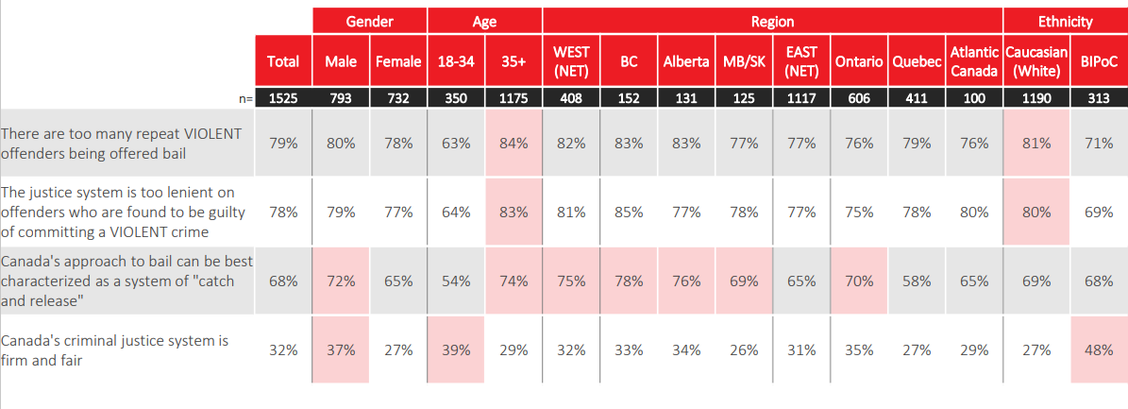
A clear majority of poll respondents agree the Canadian justice system is mishandling bail, too lenient on violent criminals. Example: the statement "there are too many repeat violent offenders being offered bail" had the agreement of 79 percent of the surveyed. The statement "the justice system is too lenient on offenders who are found to be guilt of committing a violent crime" was endorsed by 79 percent. While less than 32 percent agreed that Canada had a "firm and fair" system of justice.

On the issue of strengthening bail, solid agreement was seen, with 82 percent of Western Canadians, 77 percent of Eastern Canadians, 80 percent of men, 78 percent of women, 81 percent of white Canadians and 71 percent of BIPOC (Black, Indigenous, People of Colour) Canadians, reporting that too many violet offenders were given bail. General agreement was seen on the viewpoint that Canada's top priorities on criminal justice should be "violent crime", "illegal firearm possession" and "drug and substance abuse".
 
https://smartcdn.gprod.postmedia.digital/nationalpost/wp-content/uploads/2023/06/POLL2.png?quality=90&strip=all&w=1128&type=webp&sig=izSlvFJ_Yl8M7N159JTNlw
 
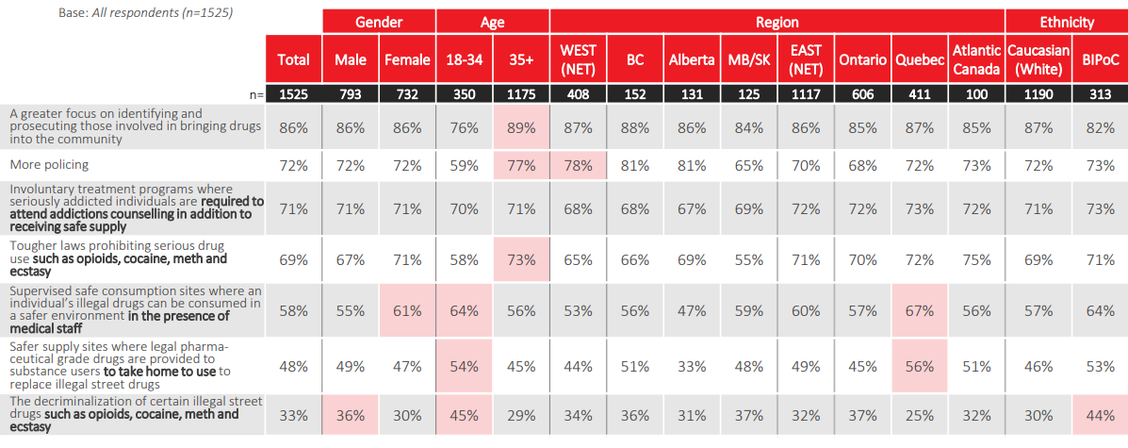
A course has been adopted in Canada of setting aside law enforcement from the equation of drug addiction, prioritizing harm reduction policies with the like of safe consumption sites. Included was British Columbia's experiment in decriminalizing personal use quantities of hard drugs like heroin and cocaine. Canadians indicated a more nuanced view of how Canada's climbing rates of fatal overdose could be addressed.

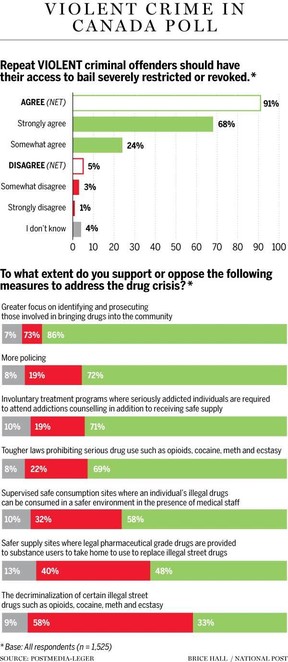
Major support was expressed (58 percent) for "supervised safe consumption sites", yet almost all respondents wanted to have drug dealers prosecuted and chronic addicts to be mandated to the necessity of treatment. Over 7 in ten respondents opted for "more policing" on drugs, the highest being expressed (at 81 percent) in British Columbia, the recognized epicentre of the overdose crisis. Asked should Canada focus on "identifying and prosecuting those involved in bringing drugs into the community", 86 percent agreed.

"There was one [safe consumption site] when we came into office in 2015, now there are dozens and dozens and dozens across the country and they are saving lives significantly", boasted Prime Minister Justin Trudeau. He slammed it as "unfortunate" and "anti-science" when Alberta began the pursuit of a treatment-centered approach to address its overdose crisis. His boast is  a hollow sham; lethal overdoses, in the face of 'dozens and dozens' of 'safe injection' sites, are on a pronounced upward curve. Moreover, the 'safe' opioids handed out at the sites are leaking onto the streets.

Although involuntary treatment for chronic addicts has been denounced as extreme by the Canadian political and public health establishment, it was endorsed by 71 percent of poll respondents who agreed "involuntary treatment programs where seriously addicted individuals are required to attend addiction counselling in addition to receiving safe supply", sounded like a solution. 
 
A graphic showing poll results
 
As for the criminal justice system reflected by government policy, opinion polls find majority support for capital punishment which since the 1970s was officially abolished in Canada. Incarceration and detention issues have hardened in the wake of recent murders and assaults committed by suspects either on bail or recent early releases from prison. Random fatal stabbings by people on parole for similar random attacks infuriate the public. 

The fatal shooting of an Ontario Provincial Police constable by a repeat violent offender on bail, prompted a letter co-signed by all 13 Canadian premiers urging the federal government to reform bail (the Trudeau government had loosened bail issues after the previous Conservative-led government had tightened them) and take steps to get violent criminals "off the streets". 

Canadian bail policies were described as a system of "catch and release" by over two-thirds of poll respondents, with white respondents at 69 percent and non-white respondents, 68 percent. If offenders keep committing crimes while on bail, in the opinion of the survey respondents, stop giving them bail. 92 percent of poll respondents endorsed the statement "repeat violent criminal offenders should have their access to bail severely restricted or revoked".

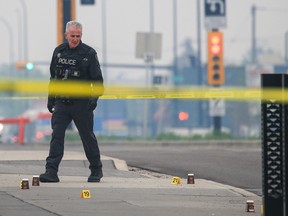
A police officer at a crime scene

Labels: , , , , ,

Wednesday, September 02, 2020

Predictive Policing : Algorithmic Technology

"We have to make sure that we're not putting forward technology as a solution to a problem that technology actually cannot solve."                                                   "The idea is [to] pinpoint with more accuracy where crime is more likely to happen, send officers to that particular [area] and deter the alleged future crime before it happens."                                                                                                              "We don't have a specific legal safeguard that says whether or not it's appropriate and sufficiently protective of privacy rights to re-purpose [those] databases in this way."                                                                                                                                           Cynthia Khoo, research fellow, technology and human rights lawyer, Citizen Lab, Toronto

City of Pittsburgh Police Officer Shane Kovach sitting in police car with a laptop
Officer Shane Kovach patrols Homewood, a Pittsburgh, Pennsylvania, neighborhood where predictive policing will soon be introduced. Stephanie Strasburg

Police agencies have professional experience in community safety and security and they have the invaluable intuition of seasoned officers to help in the never-ending confrontation between law and order and social alienation and criminal activities to help them distinguish which levels of society, which groups within society and which neighbourhoods in community settings may be largely responsible for anti-social and criminal acts harming the whole of society. Police then respond within the parameters of allowable protocols in aid and protection of community interests.

It's a difficult job, one fraught with problems as well as exposure to personal dangers, and liable to complaints from marginalized groups, ethnic groups, and those mired in poverty, simply because it is frequently from among those disaffected groups who view themselves as victims of society that much crime emanates. Usually white collar crimes are committed by the educated, by the well-off classes of society. Crimes of violence more generally from among those disenchanted with society for whom it is claimed equality is an elusive goal.

"The most significant weakness of the predictive aspects of these models is the difficulty of identifying, anticipating, and factoring in the impact of the variables expected to influence future crime trends. The quantitative models identified in this research did not, and probably could not, factor in the vast array of variables that may influence crime; most of the time series models used to predict future crime rates only took into consideration one or two key influential (demographic and macro-economic) variables. While there is substantial evidence of the impact that these variables have on the crime rate, a key reason they are used in crime forecasts is that their trends can also be quantitatively documented, and hence, forecasted into the future. What is absent from these mathematical models is the integration of influential variables that are more difficult to quantify through historical time series data such as technology, life-style changes, criminal justice responses, and the level of private security and crime prevention efforts undertaken by the public."   Predicting Crime: The Review of Research, Department of Justice, Government of Canada

That, in any event is the view of the progressive mind that feels the law should use a different standard of expectation on those whose backgrounds are less than ideal, citing childhood traumas, unequal treatment and poverty as causatives for social alienation that edges into gangs, drugs, guns and violence. Citizen Lab, a University of Toronto research group, has issued a report warning that the police use of algorithmic policing technology may infringe on the privacy of residents and impinge on their Charter rights.

Algorithmic policing may be new to Canada, relatively speaking, but it is advanced in the U.S. and U.K. in particular. A few forces in Canada are making use of algorithmic policing and Citizen Lab is warning against its use, calling for a halt until federal authorities complete a judicial enquiry into its use and its pitfalls. The Vancouver police department makes use of a machine learning-based system they launched four years ago in forecasting where break-and-enter crimes are likely to occur, responding by dispatching officers to patrol those areas.

Sounds sensible, doesn't it? It's proactive, stopping crimes before they occur by the simple medium of showing up, becoming more visible, the result being that the presence of police is sufficient in itself for deterring potential criminal acts from proceeding. A partnership between the provincial government, university and the Saskatoon police force feeds police data into a model to identify youth at risk of going missing. A much-needed alert that can prevent young people from taking desperate action that often does them great harm.

In Toronto and in Calgary, law enforcement agencies used social media surveillance techniques even as the RCMP put out a tender for similar services which other countries have used more widely. In the U.K., forces use facial recognition and automated risk-assessment systems. The Los Angeles Police Department ended a program using Palantir technology in response to intense protests and criticism from the Stop LAPD Spying Coalition, while retaining another crime location prediction system.

In Saskatchewan, authorities decided they would build an in-house system "to avoid the issues that they know can come with proprietary software", explained Ms.Khoo, to avoid private sector vendors charging that the details of their technology were breached. Citing commercial confidentiality, some forces chose to withhold documents that Citizen Lab's freedom-of-information requests sought, to aid in their research.

predpol
Predictive policing is built around algorithms that identify potential crime hotspots.. (PredPol)

Citizen Lab contends that algorithmic policing technologies could infringe on such Charter rights as freedom of expression, peaceful assembly, equality and liberty; essentially people's privacy rights. Its recommendation following the research it undertook and the conclusions it reached, was that forces not use the technique as the sole basis for arrest or detention. That court authorization be sought before deploying automated surveillance tools online in public places.

The report asks government to impose moratoriums on the use or training of algorithms on historical police data sets until such time as a national judicial inquiry examines the technology and its implications for Charter rights. Typically, historical police data is used in systems forecasting where crime may occur or whether an individual is likely to commit a crime. Numerous studies, posits the report, as well as court decisions, have pointed out that Black and Indigenous people are over-represented in carding, street-check, arrest, sentencing and incarceration data as a result of "biased criminal justice practices or systemic discrimination."

It is no great secret on the other hand, that it is from among the Black and Indigenous communities that a high proportion of criminal activity emanates and persists in emanating. The question is why should any group within society be held to a lower standard of civic behaviour than any other group? Why should expectations for respect of the law that applies equally to the entire population be lowered for these specific groups? Who may demand it, and when their goal is achieved feel it to be justified that they not respect law and order.


Labels: , , , ,

Friday, February 21, 2020

The Escalation of Youth Violence

"They went inside, ordered everyone to the ground and demanded cash from the safe."
"It definitely has been shocking for our community [though robberies by children are not unheard of]." 
"[York Region has seen a] big increase [in bank robberies, there have been upwards of 20 so far this year]."
"In previous years, the highest number for an entire year was 17 [in 2019]."
 Const. Laura Nicolle, York Regional Police
Four people were injured during an armed robbery at an RBC on Markham Rd., north of 16th Avenue, in Markham on Wednesday, Feb. 19, 2020. (Chris Doucette/Toronto Sun)

Male teens in the Toronto area appear to be on a rip lately. Teenagers have been involved in quite a number of violent bank robberies in and around Toronto in the past short while. A 911 call came in to police in the northeastern suburbs of Toronto, of a violent armed bank robbery then in progress on Wednesday night. On their arrival, the police discovered four injured tellers, two of whom had stab wounds. They were just in time to see three masked boys racing away from the crime scene.

With the use of dogs, the police ran after the boys, chasing them into a construction site. Overhead a police helicopter took elevated note of the proceedings as police cornered and then arrested three people who had attempted to hide inside a house under construction. One of the three is a 13-year-old boy from Mississauga, now facing charges of robbery with a firearm, aggravated assault, disguise with intent and several additional charges.

The other two boys with the 13-year-old were 15, and 16, and they have been identified as having been involved in a very similar violent attack that took place in the east of Toronto, whee Durham police explain they had pistol-whipped two employees, injuring another, in Pickering a week earlier. Three of the injured were treated in hospital for facial injuries. Charges including robbery with a firearm and three counts of assault causing bodily harm have been laid against the older two boys.

Durham police say the same boys, along with a 13-year-old, robbed this RBC branch in Markham. (Jeremy Cohn/CBC)
One of the older boys, 15, has also been charged with breaching probation. Under the Youth Criminal Justice Act the 13-year-old cannot be charged other than for a capital crime, as an adult. And as youth their names are withheld from public scrutiny. It just happened that while the three teens were in the bank assaulting the tellers -- in their possession, a firearm, a fake gun, and a knife -- someone standing outside the bank saw the commotion and dialled 911.

The three boys had driven to an RBC branch in Markham at closing time, 8:00 p.m. They were armed; a real gun, along with the fake, and knives. They drove a Chevrolet Impala, stolen a few days before in a Toronto car theft. During the carjacking the car owner had been stabbed. When the first officer to respond arrived on the scene the three teens ran off into a subdivision development site. A helicopter was called in, and eventually police dogs tracked them in the house under construction.

All are now charged with possession of property obtained by crime. And of course, under the youth act, their identities are not to be disclosed. The two older boys, 15 and 16 appear to be comfortably familiar with guns, hoisting both the handgun and the replica, while the 13-y6er-old had caused some of the injuries sustained by the tellers by kicking the victims in the face. Two male tellers were stabbed, a female teller was otherwise injured.

These are merely the latest of such violent attacks and robberies by youth and gangs in Toronto where guns are being acquired on the black market, usually slipped into the country through the United States. The prevalence of knife use by teens is growing along with the violence. Low income areas in the city in particular have seen a steep increase in violence and knifings largely attributable to the gangs and drug trade. And nor is Toronto the only city where such violence is an ongoing threat to public safety and security.

Ottawa, the nation's capital, is yet another venue among others. And many of the crimes, the stabbings and the shootings, usually related to drug trafficking and gang activities, take place with older teens and those in their 20s and 30s, and they are named. A majority of those named have Middle-East or North African backgrounds, disproportionate to their numbers within society. Appearing to have a disposition to violence, whether by upbringing or culture.

It would be interesting to know the names of these perpetrators of violence, but the Youth Criminal Justice Act shields youth from being publicly identified. This pertains elsewhere in t he world as well where rising crime, criminal gangs, drug trafficking, knifings and riotous behaviour takes place in France, Belgium, Germany and elsewhere, seeming to be linked with the entrance since 2015 of migrants from the Middle East and North Africa.

And elsewhere ..... in Germany .....
"The knives are growing longer, the attackers are ever younger. The number of knife attacks by asylum seekers grows constantly."
"I call on Interior minister Horst Seehofer to immediately take the suspects into detention pending deportation and then to eject them from the country."
"It needs to be clear that the state is using all its power to protect its citizens."
Alice Weidel, co-parliamentary leader of the Alternative for GermanyThe Local, Germany

"A review by Gatestone Institute of German police blotters found that 2018 was a record year for stabbings and knife crimes in Germany: Police reported more than 4,100 knife-related crimes in 2018, compared to around 3,800 reported during 2017 — and only 400 in 2008. Overall, during the past ten years, knife-related crimes in Germany have increased by more than 900% — from one a day to more than ten a day. The data shows a notable increase in knife crimes since 2015, when Chancellor Angela Merkel opened German borders to hundreds of thousands of migrants."
"German media do not report most knife-related violence. Crimes that are reported are often dismissed as "isolated incidents" that are unrelated to mass immigration. Moreover, many crime reports, including those in police blotters, omit references to the nationalities of the perpetrators and victims — apparently to avoid inflaming anti-immigration sentiments."
"Knives, axes and machetes have become weapons of choice for criminals in Germany, which has some of the strictest gun laws in Europe. People armed with knives, axes and machetes have brought devastation to all of Germany's 16 federal states. Knives have been used not only not only to carry out jihadist attacks, but also to commit homicides, robberies, home invasions, sexual assaults, honor killings and many other types of violent crime."
"Knife-related crimes have occurred in amusement parks, bicycle trails, hotels, parking lots, parks, public squares, public transportation, restaurants, schools, supermarkets and train stations. Many Germans have the sense that danger lurks everywhere, but the lack of official statistics seemingly allows German authorities to pretend that the problem is imaginary."
Soeren Kern, Senior Fellow, Gatestone Institute, New York 

Labels: , , , , , , ,

Wednesday, January 15, 2020

Law and Order : Contrasting Versions

"The NRT's [neighbourhood resource teams] are the centrepiece of the OPS [Ottawa Police Services] neighbourhood policing strategy."
"We are putting them in place in the communities that need the help the most."
"[Meanwhile, investigative units are targeting] violent repeat offenders who are victimizing the most vulnerable populations and marginalized neighbourhoods."
"Reinvesting in neighbourhood policing has been a clear priority all of those conversations [with patrol officers, the police association, senior officers, academics, city councillors, police services board...]" 
"We are looking at improving existing systems to provide the foundation for more action on violent crime. This will ensure that front-line officers have the most up-to-date information and resources available on every call."
Ottawa Police Services Chief Peter Sloly
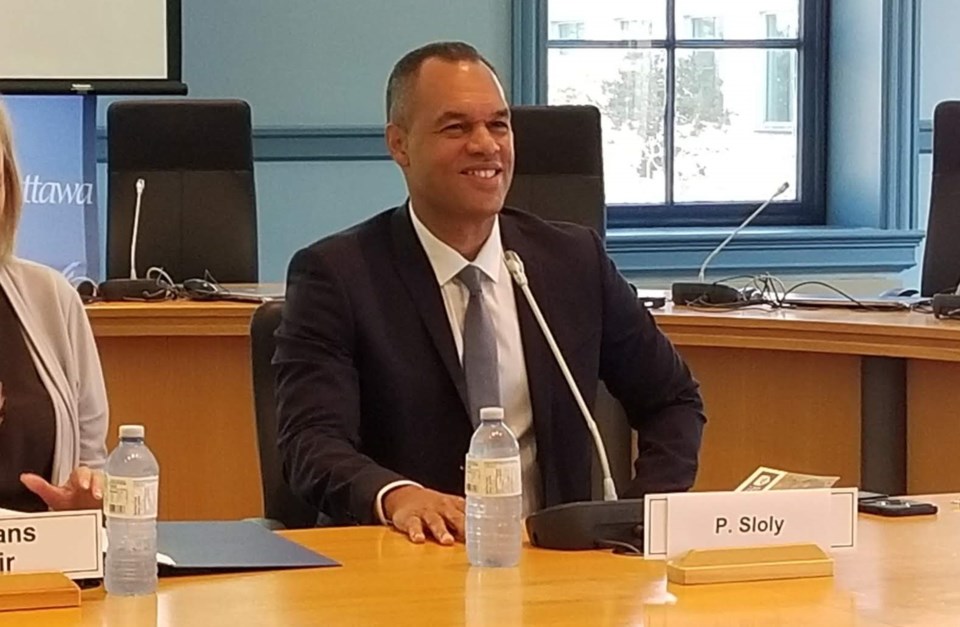
2019-08-26 ottawa police chief sloly JP1
Peter Sloly named Ottawa's new police chief, August 26, 2019, Photo: Jenn Pritchard, OttawaMatters.com

The cities of Toronto and Ottawa have a recognized and vexing problem with gang violence and shootouts primarily in low-income areas of both cities. The increasing crime statistics in both cities inclusive of gun, gang and drug-related violent crime, alongside the 'complex social issues that underpin most crime', identified as housing, employment, education and health are linked with marginalization and discrimination, according to both police services, paying obeisance to political correctness.

The City of Ottawa's new police chief served previously as Toronto's deputy police chief, a man known for his 'progressive' views on policing. Both cities have long been accused by members of racial minorities -- chiefly from the Black and Middle East communities -- of profiling them. That it is from among these communities that a disproportional activity level of crime is seen in both cities appears immaterial to the accusers. And in this politically correct climate of 'progressive' values the police have become sensitive to accusations of racism.

The idea is that neighbourhood resource policing teams are to give reassurance to those neighbourhoods acutely involved in high levels of crime (somewhat reminiscent of and possibly to prevent situations such as the self-segregated Muslim-immigrant-occupied banlieues in France rife with violence and criminal activities that have turned into no-go zones for police) and to gain trust among law-abiding citizens who are often targets of the criminals living among them. But the code of silence means that giving information to police is fraught with retributive danger.

On the other hand, the presence of these teams does result in a greater level of neighbourhood scrutiny to the benefit of residents, and their presence has resulted in charges being laid, and guns removed. Homicides in Ottawa fell from 15 to 13 in the past year, and shootings fell from 78 to 73, according to police reports, while a total of 70 "crime guns" were sized by police in 2019.
Ottawa police patrol. Errol McGihon / Postmedia

"It's just another one of the discretionary behaviours that officers have curtailed [diminished traffic stops] because of their perception around risk [the risk of being labelled racist]."
"You can send an officer to work in a neighbourhood, a particular geographic area, but  you can't dictate the kind of work that they do there. Supervisors can't dictate, minute to minute, what officers are going to do in the field."
"Police brutality and justifiable use of force can have the same outcome [where a man's nose can be broken in both instances but] brutality is in the motivation of the officer and the proportionality of the response, not in the outcome."
Greg Brown, former police officer, professor, Carleton University, Fulbright Visiting Research Fellow in the School of Criminal Justice 
Concurrent to Chief Sloly's announcement of an additional three NRTs being deployed as a "cornerstone" of the strategy in tackling street violence, Professor Brown regards neighbourhood officers in his study as being more likely to engage in de-policing. Predicated on the theory that officers partner with the community to understand issues leading to crime, the NRT units should be focusing on proactive discretionary interactions.

But the reality is that there now exists what he describes as a "universal phenomenon" of officers refusing to engage in proactive work, engaging instead on a prevailing 'f*ck it, drive on' mentality. This is an issue he has addressed in a study offering suggestions for police leaders to enable them to mitigate the effects of police disengagement for fear of repercussions. Professor Brown surveyed 3,660 front-line officers from 23 police services in Canada and the United States.

382 Ottawa police officers took part, from all 18 patrol platoons. The study, titled To Swerve and Neglect: De-policing throughout today's front-line police work, identified the reality that the overwhelming majority of front-line police officers representing 72 percent, practise some level of 'de-policing'; choosing not to engage in discretionary or proactive aspects of policing duties because of the fear of public scrutiny.
Officers are weighing the costs of engaging with the public and for many, the cons outweigh the pros. Photo by Ashley Fraser  / Postmedia

A racial profiling allegation, a disciplinary hearing, media scrutiny, a viral YouTube video, or a judge charging breach of charter rights all represent the potential risks of proactive policing. With those potential risks in mind through well-publicized incidents charging police officers practising due diligence in a discretionary manner as is expected of them, police officers make the choice of protecting themselves and decide to change their policing focus, according to acquired data.

Fully 28 percent of front-line police officers were found to police as intended, a group that Professor Brown identifies as new officers whose altruistic intentions, no major incidents with the public, never been (yet) beaten down by an occupational subculture, or have had no negative media scrutiny; "mission-oriented officers", who practise their jobs irrespective of any external factors.

Data collected out of a project reflecting a human rights settlement where the force was mandated to collect information on drivers' race who had been pulled over by officers initiated in 2013 showed that Ottawa police disproportionately pulled over young men with Middle Eastern or Black appearances. Additionally, data indicated traffic stops as an entirety were diminished. Traffic stops are considered to be proactive measures, while pulling someone over even if an offence is observed is not mandatory for police.
Decline in Ottawa proactive policing
This month, an Ottawa police patrol officer pulled over a car for running a red light. A loaded gun was found in the vehicle. Proactive measures allow police to track criminal behaviour -- all the more so when drivers flout the rules, meaning that good policing ensures that officers investigate such incidents. Professor Brown listed a number of recommendations for police services, in an effort to prevent de-policing, chief among those that all senior officers be on the front lines, working themselves.

That they go out on midnight shifts, take out a cruiser and perform the job expected of all officers, to bridge the disconnect between the front line and senior officers, helping to shift morale. Another recommendation is to educate the public on what manner of use of force is sanctioned by law. And that officers be encouraged to treat all whom they deal with, with respect, whether arresting someone or asking them to move a distance from an active scene; to "embrace the notion of procedural justice".
The three new neighbourhood resources teams (NRTs) add to the three already set up in Vanier and Overbrook, Heron Gate and South Ottawa and the Carlington and Caldwell neighbourhoods. Shaamini Yogaretnam / Postmedia

Labels: , , , ,

Sunday, September 08, 2019

I Spy With My Little CCTV Camera....

"Actively monitored CCTV schemes evidenced significant reductions in [property] crime, whereas passively monitored schemes were not associated with reductions in crime."
"This finding provides evidence against the use of CCTV as a stand-alone tactic."
Research team meta-analysis

"There is this panacea view of cameras [closed-circuit television -- CCTV] that has caught on. Especially since the terrorist attacks of September 11, 2001, here in the U.S., and subsequent bombings in the London underground. It has led to the view: 'Let's just put cameras up and that will solve everything'."
"The setting where cameras are most effective is in car parks. Surveillance cameras do not deter individuals from committing acts of violence. [
"[In Wales it was found that CCTV allows police to respond quickly.] They found that the severity of violence was lessened [as police break up fights[ or get there before a knife comes out or before some other weapon was involved. So the emergency room data showed that the severity of injuries was much less severe. [But] you can't say that the cameras did that. It was how the cameras were operationalized."
Brandon Welsh, professor of criminology, Northeastern University, Boston
LONDON — A bank of television monitors displays images captured by a fraction of London’s CCTV camera network within the Metropolitan Police’s Special Operations Room. Daniel Berehulak / Getty Images

CCTV cameras have been technologically developed far beyond the simple cameras used so familiarly by private enterprise; each shop, large or small that keeps tabs on customers' actions while in or around the premises used by millions of people daily, in an effort to reduce the issues of shoplifting or other types of disorderly disruption. Their modern cousins can now 'talk' to one another linking to follow a car or a person down the street block to block. Gunshots can be detected and instant alarms sent automatically.

"Computer vision technology" built into the newer versions are capable of picking up visible "images of concern" including firearms, fugitive vehicles or untoward actions. The analysis produced by Professors Welsh of Northeastern and David Farrington of Cambridge University, published in the journal Criminology and Public Policy set out to assess the practicality and usefulness of closed circuit television cameras in reducing crime. What they concluded was that it all depends. On whether the cameras are used in tandem with monitors, people to scan the television and react.

They also found that the cameras make little difference in the commission of violent crimes, but can make a difference in property crimes. They can help protect businesses and homes from break-ins. On the other hand, the fact that cameras are present must be well known to act as a deterrent. It isn't quite clear why the cameras are not successful in stopping violent crimes but the finger does point to passively monitored schemes; CCTV as a stand-alone tactic is not a huge success story.
"CCTV is generally most effective in deterring acts of property and vehicle crime, and has virtually no impact on deterring violent crimes. CCTV is more effective in terms of crime deterrence in Britain, than North America."
"Unless publicity and media coverage of CCTV cameras is maintained, then any initial deterrence effect tends to fade with time."
"Police largely view CCTV as a useful time-saving tool that supports their work in a variety of ways [since pictures help to identify criminals]."
Government of Scotland agency summary

"[The popularity of surveillance cameras represents] a paradox: video surveillance becomes widespread, in more and more numerous social and national spaces, while its effects in terms of crime prevention and/or law enforcement and community reassurance are not demonstrated."
"[Agencies find new ways to use surveillance technology] and progressively acquire its multiple uses that then become justification for its use, fuelling the buy-in process."
Severine Germain, Grenoble Institute of Political Studies, France
Cameras are known on occasion, however, to aid in the conviction of criminals being prosecuted by the law. The Boston Marathon bombing of 2013 is one example, where cameras recorded the Tsarnaev brothers at the scene of the crime with CCTV cameras capturing an image of Dzhokhar Tsarnaev before the bombs went off at the Marathon. The conviction of the Tsarnaev brothers owed greatly to the evidence captured within the video.
Screengrab of Dzhokhar Tsarnaev shortly before the Boston Marathon bombs went off on April 15, 2013. AP / jpg

A high school surveillance camera captured the luring of a child as she was led away when school was let out by a woman in 2009 who with her boyfriend, raped and murdered the little girl in Woodstock, Ontario. The kidnapping and murder of Tori Stafford represented a horribly sordid atrocity targeting a helpless child. The presence of that camera recording Terri-Lynne McClintic gaining the trust of the child and leading her to her death, helped convict her and her lover.

The prevalence of CCTV cameras is seen in a positive light by the public, who feel reassured at their presence. Despite which, those who have been violent, in interviews explain that exiting a club drunk one is unaware of the presence of cameras and prone to simply surrender to the urge of violence; it has no deterrent effect on people unaware because of alcohol and reacting to violent stimuli. And then there is the reaction of the civil liberty organizations, who decry the presence of cameras as an infringement on privacy rights.

A victim is attended to as a man was gunned down at about 9:30pm in the Byward Market near the Moulin De Provence Cafe. Wayne Cuddington / Postmedia

Labels: ,

Monday, March 25, 2019

The Thin[ner] Blue Line

"It was a bit of checkmate [trying to figure out which emergency calls to respond to]. We need to support these people in crisis, but the police are not the right ones to be dealing with them."
"It was all right, the police being the jack-of-all-trades, when there was a necessary amount of funding for the police. But if you've got 20,000 less police officers, less funding, then somebody needs to make the decision about what they want us to do."
"When the criminals realize that their gang is bigger than our gang, they start exploiting that."
Constable Richard Chant, West Midlands Police Department, Birmingham, England
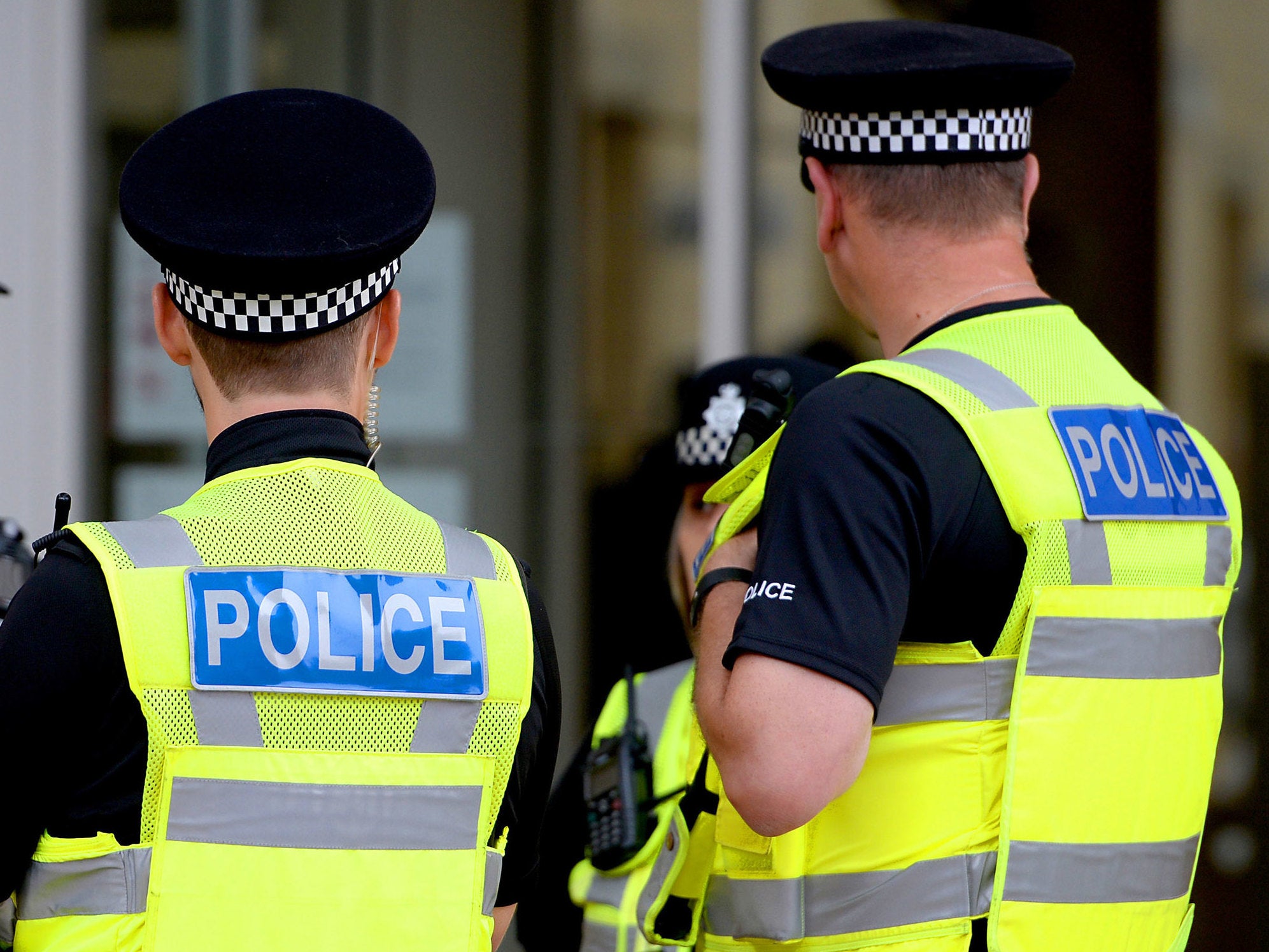
police-officers.jpg
Prioritisation programmes are aiming to ease pressure on officers while dealing properly with the most serious crime 

"We have got a budget to work to, we have demand to meet, and have to make decisions about what we prioritize."
"All incidents of crime are of the utmost importance, but of course I would much rather our detectives are investigating stabbings and diverting gang members rather than dealing with some of the work which was possible to do when numbers were not so tight."
"We have to admit there are going to be crimes that we are responding differently to than we would have in the past."
"I know this may cause concern to members of the public and perhaps lead to fears that fewer offences will be prosecuted, but I must stress that detection rates for crimes being investigated by the TDIU have not fallen. We cannot do everything in the way we could before, crime is continually changing and adapting, and our numbers are fewer. We have had to realign our resources and invest more in different areas to meet the challenges we are facing. I want to reassure the public that we are here and will do everything in our power to help."
Deputy Assistant Commissioner Mark Simmons, London Metropolitan Police
Photo: Andrew Testa / The New York Times   Investigating a burglary at a supermarket in Birmingham, England, in November. Crime is rising, but Conservative-led austerity measures have led to cutbacks in police services.
In an eight-hour period the West Midlands Police Department took 1,452 emergency calls. A number that posed too great a challenge for the force to respond to, with fewer police at their disposal as a result of lost funding due to Britain's austerity situation over fears to extending itself too greatly financially given the uncertainty of the Brexit climate and what will ensue eventually. For some of those cases hours and days transpired before the callers saw a responding officer.

Take Birmingham as an example of the new reality in law and order during this strained state of responsiveness surrendering to austerity. While the range of emergency calls and their numbers has skyrocketed both in Birmingham and in most other British cities, far fewer officers are available to respond adequately. Britain's withdrawal from the EU and the budget pressures that have been exerted are nowhere near over as far as concerns and consequences are concerned.

Since the initiation in 2010 of the Conservative government's austerity program, the West Midlands Police Department alone has had its budget cut by $220 million, while across England and Wales police staffing has been reduced by roughly 20,000 police officers, leaving questions about whether the cuts themselves are major contributors to a notable spike in violent crime. In England and Wales murders and robberies have risen to their highest levels in the past ten years.

Social services have also been pared back under austerity, creating metastasizing problems that often fall to the police.   CreditAndrew Testa for The New York Times

Parallel cuts to social services where addiction services, housing benefits, gang mediation programs and social services for adults and children have all seen severe funding restrictions has only added to the chaos of social and security responsiveness. Police are forced to speed between emergency calls and to handle them all as best they can, so they are left with little time to patrol streets, making themselves visible to reduce the likelihood of crime.

Increasingly, police hours on health and welfare calls have left little space to collect evidence and solve crimes and as a result victims not in immediate danger must accustom themselves to waiting days for a police response, leading to a situation where the investigation of property crimes has become a vanishing low priority simply not pursued because of other, more critical areas requiring attention.

The site of a break-in attempt in Birmingham. Robberies or assaults in which the offender has left are supposed to get attention within an hour, but frequently wait days, one officer said. CreditAndrew Testa for The New York Times

This, in lock-step with recent decades of increasing diagnoses of severe mental illness, at the very time when services for these people have been reduced. As a result, officers in England and Wales have taken to detaining 60 percent more people in need of psychiatric services in 2015-16 than what pertained a decade ago -- while London police receive mental illness related calls once every four minutes.

The solution would appear simple enough; hire and train more officers. Taxi robberies and home break-in patterns are not being pursued simply because cases are shelved, with not even a cursory investigation, leading to a sense of hopelessness among victims who simply stop calling police. A situation very much appreciated by criminals for whom the situation is quite agreeable to their future and ongoing prospects.

Prime Minister Theresa May, in her previous incarnation as home secretary, was the original architect of the cuts. She also cracked down on corruption in police associations and stop-and-frisk tactics, and was responsible for the cutbacks in police personnel. The solution as some see it is to restore funding to social services, instead of expanding police force personnel, relieving them of the onerous task for which they are not professionally designed, of responding to mental health crises.

The British government has announced additional funding for the police forces, but public health budgets are expected to keep shrinking through 2021.   CreditAndrew Testa for The New York Times

Labels: , , , ,

() Follow @rheytah Tweet