Two Rival Governments, No Responsible Authority in Libya
"Bodies are everywhere, inside houses, in the streets, at sea.""Wherever you go, you find dead men, women, and children.""Entire families were lost."Emad al-Falah, Benghazi aid worker, Derna"If there would have been a normal operating meteorological service, they could have issued the warnings.""The emergency management authorities would have been able to carry out the evacuation."World Meteorological Organization head Petteri Taalas
| People look for survivors in Derna, Libya, Wednesday, Sept.13, 2023. (AP Photo/Yousef Murad) |
Streets in Derna, the worst-hit eastern Libyan city devastated by flooding were being combed by search teams among the wrecked buildings and even in the sea, for bodies. The massive flooding that spelled catastrophe in Libya killed over 11,000 people, although the number of dead is expected to rise. Those in charge of the area -- in a country truncated by two competing governments that installed themselves in a country completely administratively dysfunctional which had left vital infrastructure to deteriorate -- struggled to provide aid to the coastal city of Mediterranean Derna following the deluge on Sunday that washed away access roads.
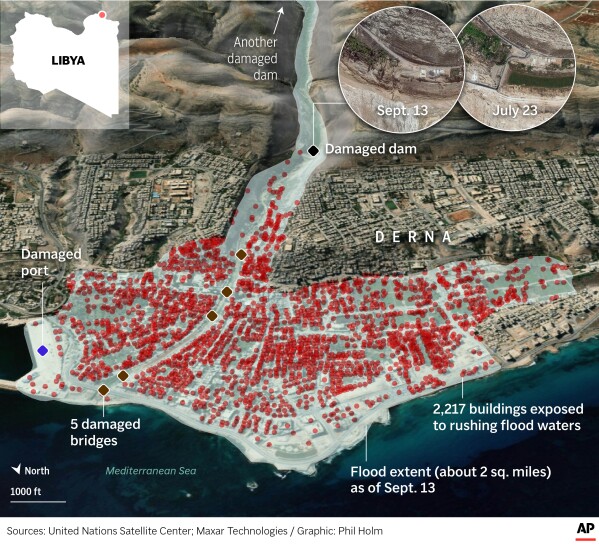
Those aid workers that did manage to reach the city found devastation at its center, and thousands of people missing, while tens of thousands had been left homeless. Storm Daniel was responsible for deadly flooding in many eastern Libyan towns on Sunday, but Derna was the poster-town of utter devastation. The city in the mountains above two dams that burst and collapsed and floodwaters washed down the Wadi Derna River, through the city centre sweeping entire city blocks before it.
In the deluge, waves rose up to 7 metres. The water was so deep it reached to the second storey of buildings. One man described what he saw from the rooftop of their apartment building where he and his family had rushed to escape the oncoming deluge. People below, women and children among them were simply washed away by the tide: "They were screaming, help, help. It was like a Hollywood horror movie", he said from a Derna field hospital.
| AP Photo: Yusuf Murad |
Only two roads remain passable located from the south, involving a long-winding route through the mountains where Derna sits on a narrow coastal plain on the Mediterranean Sea, steep mountains running along the coast. Using that route through the mountains, aid teams carrying supplies arrived finally, even as eastern Libyan authorities saw to the repair of the coastal access routes that were washed away, but which allowed much faster access to the stricken area.
Whatever rescue equipment was available was being used by local emergency workers with search teams combing through shattered apartment buildings to retrieve the dead, some floating offshore in the sea. The city centre was split by collapsed bridges over the river. While over 11,000 people were declared dead, another 7,000 were injured in the city, field hospitals set up by aid agencies treating the injured. At least 9,000 people are missing even as teams deploy, collecting bodies from the buildings, the streets and the sea.
The storm's intensity was responsible for the utter devastation in its wake. Yet the divided country with its rival governments, one east, the other west, was also responsible for the disaster in its neglect of vital protective infrastructure. The flooding displaced at least 30,000 people even as the city of Derna became close to inaccessible for humanitarian aid workers to enter and set up operations in aid of the traumatized population.
Egypt, Algeria and Tunisia, along with Turkey and the United Arab Emirates sent rescue teams and aid to their neighbour in distress. The United Nations is prepared to provide additional support. Bulldozers work to fix and clear roads to enable the delivery of humanitarian aid and heavy equipment. International aid began arriving on Tuesday to Benghazi, 250 kilometres from Derna.
 |
Labels: Emergency Operations, Flooding, Libya, Mediterranean Storm Daniel
posted by Pieface | 8:27 PM
|
0 comments