Politic?

This is a blog dedicated to a personal interpretation of political news of the day. I attempt to be as knowledgeable as possible before commenting and committing my thoughts to a day's communication.

Thursday, September 14, 2023

Two Rival Governments, No Responsible Authority in Libya

"Bodies are everywhere, inside houses, in the streets, at sea."
"Wherever you go, you find dead men, women, and children."
"Entire families were lost."
Emad al-Falah, Benghazi aid worker, Derna
 
"If there would have been a normal operating meteorological service, they could have issued the warnings."  
"The emergency management authorities would have been able to carry out the evacuation."
World Meteorological Organization head Petteri Taalas
People look for survivors in Derna, Libya, Wednesday, Sept.13, 2023. Search teams are combing streets, wrecked buildings, and even the sea to look for bodies in Derna, where the collapse of two dams unleashed a massive flash flood that killed thousands of people. (AP Photo/Yousef Murad)
People look for survivors in Derna, Libya, Wednesday, Sept.13, 2023. (AP Photo/Yousef Murad)

Streets in Derna, the worst-hit eastern Libyan city devastated by flooding were being combed by search teams among the wrecked buildings and even in the sea, for bodies. The massive flooding that spelled catastrophe in Libya killed over 11,000 people, although the number of dead is expected to rise. Those in charge of the area -- in a country truncated by two competing governments that installed themselves in a country completely administratively dysfunctional which had left vital infrastructure to deteriorate -- struggled to provide aid to the coastal city of Mediterranean Derna following the deluge on Sunday that washed away access roads.
 
Those aid workers that did manage to reach the city found devastation at its center, and thousands of people missing, while tens of thousands had been left homeless. Storm Daniel was responsible for deadly flooding in many eastern Libyan towns on Sunday, but Derna was the poster-town of utter devastation. The city in the mountains above two dams that burst and collapsed and floodwaters washed down the Wadi Derna River, through the city centre sweeping entire city blocks before it.

In the deluge, waves rose up to 7 metres. The water was so deep it reached to the second storey of buildings. One man described what he saw from the rooftop of their apartment building where he and his family had rushed to escape the oncoming deluge. People below, women and children among them were simply washed away by the tide: "They were screaming, help, help. It was like a Hollywood horror movie", he said from a Derna field hospital.
 
People look for survivors in Derna, Libya, Wednesday, Sept.13, 2023. Search teams are combing streets, wrecked buildings, and even the sea to look for bodies in Derna, where the collapse of two dams unleashed a massive flash flood that killed thousands of people. (AP Photo/Yousef Murad)
AP Photo: Yusuf Murad
 
Only two roads remain passable located from the south, involving a long-winding route through the mountains where Derna sits on a narrow coastal plain on the Mediterranean Sea, steep mountains running along the coast. Using that route through the mountains, aid teams carrying supplies arrived finally, even as eastern Libyan authorities saw to the repair of the coastal access routes that were washed away, but which allowed much faster access to the stricken area.

Whatever rescue equipment was available was being used by local emergency workers with search teams combing through shattered apartment buildings to retrieve the dead, some floating offshore in the sea. The city centre was split by collapsed bridges over the river. While over 11,000 people were declared dead, another 7,000 were injured in the city, field hospitals set up by aid agencies treating the injured. At least 9,000 people are missing even as teams deploy, collecting bodies from the buildings, the streets and the sea.

The storm's intensity was responsible for the utter devastation in its wake. Yet the divided country with its rival governments, one east, the other west, was also responsible for the disaster in its neglect of vital protective infrastructure. The flooding displaced at least 30,000 people even as the city of Derna became close to inaccessible for humanitarian aid workers to enter and set up operations in aid of the traumatized population.

Egypt, Algeria and Tunisia, along with Turkey and the United Arab Emirates sent rescue teams and aid to their neighbour in distress. The United Nations is prepared to provide additional support. Bulldozers work to fix and clear roads to enable the delivery of humanitarian aid and heavy equipment. International aid began arriving on Tuesday to Benghazi, 250 kilometres from Derna.
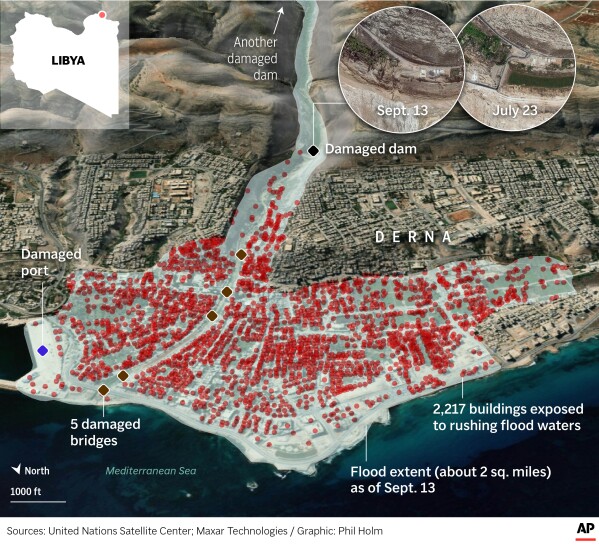
Libya flood map of the city of Derna

Labels: , , ,

Friday, November 19, 2021

Terrifying Flooding In British Columbia

These videos shared by Jordan Jongema to his Instagram detailed the devastation to his home in Yarrow and the conditions that stranded him and his dog Bowser on Monday overnight before crews rescued the pair.
These videos shared by Jordan Jongema to his Instagram detailed the devastation to his home in Yarrow and the conditions that stranded him and his dog Bowser on Monday overnight before crews rescued the pair. Photo by JORDAN JONGEMA / INSTAGRAM

Jordan Jongema
"Those ten hours were easily the most terrifying times I've ever experienced in my life."
"I had heard there were looters going around Yarrow to empty houses, so shame on me for staying just a few minutes too long to protect the place."
"As we were leaving, the water pooled over the road and it started like fountaining, like a stream. I could have been driving into a deeper pool so I just...went back to my house and we had to wait it out in there. And as time went by, it got worse and worse.”
"A massive wave of water started to rush [over the roadway and into his front yard]."
"By the time it was midnight, I was wading through the kitchen, swimming in the backyard up to my chest, trying to find any flotation devices. Pitch black and freezing cold water for hours."
"The fear of the pump station breaking and the Fraser River flowing through made me want to die. Bows and I lay on my bed with the water half-an-inch from covering it."
Jordan Jongema, B.C. flood victim, Yarrow, British Columbia
"I believe it was Coquitlam Fire or Coquitlam SAR, actually, went and got that dog right near the end of the [rescue] queue."
"He's a service dog and so the fellow was just over the moon."
"So it was really cool that they were able to pull that off. That was good customer service, definitely worth the risk."
Abbotsford Fire Chief Darren Lee
Bowser, a 120-pound Bernese mountain dog, is pictured in a rescue boat in the early hours of Tueday after he and his owner Jordan Jongema were rescued after flood waters breached his home and left the pair stranded.
Bowser, a 120-pound Bernese mountain dog, is pictured in a rescue boat in the early hours of Tuesday after he and his owner Jordan Jongema were rescued after flood waters breached his home and left the pair stranded. Photo by HANDOUT

British Columbia's Interior was  hit by a catastrophic rain event that started last Sunday with high winds and torrential rain. Between Sunday and Monday, more rain fell than normally would in a full month during the province's late fall rainy season. The local weatherman spoke of an 'atmospheric river' that drenched the province causing critical mudslides, rockfalls and floods leaving motorists stranded for 17 hours on highways between two road washouts. Rail lines were disrupted, bridges were washed out and so were highways.
 
Orders for evacuation went out for a number of places inundated by floods. Several hundred people stranded in their vehicles were airlifted by helicopter to safety. Farmers were desperately trying to lead their livestock to higher ground, many remaining behind on their farms despite orders to evacuate. The military was called in to provide logistical and rescue assistance. All of the province's many and varied rescue teams were tasked to endure unsafe conditions to rescue those trapped in flooded areas.
 
A person paddles a kayak past a submerged taxi after the major flood event in Abbotsford. More federal assistance is on its way to the province as reconstruction begins. (Ben Nelms/CBC)

Jordan Jongema was one of those trapped people. He and his dog Bowser, a 120-pound Bernese mountain dog, found themselves in a frightening impasse with rising flood waters. They were stranded when rising flood waters suddenly breached his home and property. He was in fact preparing to leave for safety from Yarrow where he lived, some 99 km east of Vancouver. He thought he had time to spare but was soon disabused of that reassurance. 
 
"A massive wave of water started to rush" over the road and into his front yard as he began pulling out of his driveway. With thoughts of his car being flipped by the debris-filled water he turned back, deciding that he and Bowser would stay where they were, safe at home while the water raged outside. Nature had other plans, as he soon discovered. The flood waters entered his house and by 1:00 a.m. reached up to his knees.

He thought about seeking respite from the rising waters on the roof of his house, but found himself struggling with trying to figure out how he might manage to get Bowser onto the roof. And then, an hour later, his phone battery died, leaving him feeling "emotionally butchered". He lay with Bowser on his bed, just minimally above the water level and no doubt imagining what might happen as the water kept inching up.

And then, at about 3:30 a.m., a boat sounded outside his window. He leaped to the window and shouted, shining a flashlight, hoping to attract the attention of whoever it was in the boat. As the rescuers in the boat edged close to the house, Jongema held Bowser up and shoved him out the window, then crawled himself out to the raft. One they reached dry land some kilometres distant, Jongema and Bowser were then driven to a safe site.

According to officials, eleven people in the vicinity that night were rescued overnight. Forty farmers chose to remain in the eastern portion of the Sumas Prairie, tending their properties and their livestock.

Farmers carry their livestock out of a flooded barn in Abbotsford. The city southeast of Vancouver is home to half of B.C.'s dairy farms and has been hit badly by the devastating floods. (Ben Nelms/CBC)

Labels: , , ,

Wednesday, November 17, 2021

B.C.'s Storm of the Century

"They [her six- and four-year-old children] are getting scared."
"My heart breaks listening to my kids [ask] for water and food and I have nothing to provide for them."
Angela Howard, marooned on a B.C. flood-swept highway

"We all had moments like,'Is this it? Is this the last time we're going to see our kids'?"
"We were talking to our parents and our families, but it was just a scary situation."
Melanie Forsythe, marooned between mudslides

"People were going off the side of the road. We had cars flipped over."
"A situation where one member [of rscue crew] had to throw in a life-jacket and swim out, wade out to a car that was overturned to bring someone back [to safety]."
Mike Serr, Abbotsford, B.C. Police Chief
Abbotsford, B.C., flooding, Nov. 16, 2021
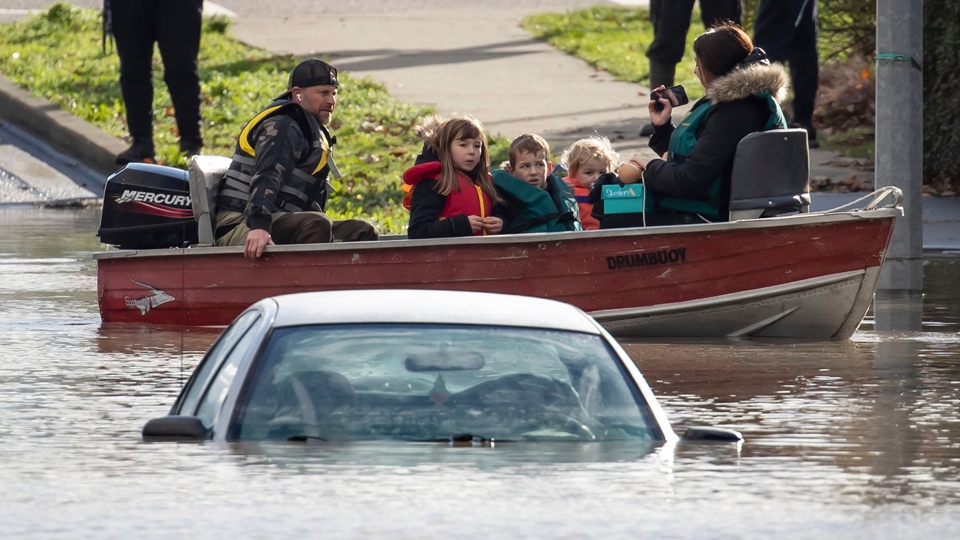
A woman and children who were stranded by high water due to flooding are rescued by a volunteer operating a boat in Abbotsford, B.C., on Nov. 16, 2021. THE CANADIAN PRESS/Darryl Dyck
 
Angela Howard did her best to rise to the emergency occasion for her children, rigging plastic bags to the outside of her vehicle in hopes of catching rainwater as her children slept fitfully behind her in their car seats during their interminable wait for rescue. Every now and again she would turn on the car to warm the interior, carefully watching the gas gauge. 

The monumental rains and windstorm that began on Sunday had dissipated by Tuesday, leaving the threat of flooding to remain a major risk with more evacuations ordered for large swaths of the British Columbia cities of Abbotsford and Chilliwack. Nearby farmland was under water. Farmers were helping one another to get their livestock to higher ground  The entire 8,000 population of Merritt was evacuated on Monday.

The Port of Vancouver sees $550 million in cargo pass through daily, everything from cars to food. Now that eastward routes are out of commission with road closures due to rock- and mud-slides, goods  will not be moving as they normally do, to arrive at final destinations in good time. The entire country will feel the impact of this weather catastrophe, not only the people living in the B.C. Interior.
 
Parts of southern British Columbia remained under local states of emergency on Tuesday after unrelenting rains caused severe flooding, stranding hundreds of people in their cars across multiple highways and swamping homes in the Fraser Valley. Here, people are transported on a boat after being rescued from an area that was cut off due to flooding in Abbotsford, B.C. Ben Nelms/CBC
 
"This is like having a labour strike, it's big. It will harm the flowthrough of goods for however long this lasts", increasing costs and slowing down delivery times, noted rail consultant Malcolm Cairns. All rail service to and from the port facility was halted, according to the Port of Vancouver. The province is preparing to provide 1,000 cots to be put up in shelters at churches and high schools for stranded motorists.

Mudslides and flooding had trapped hundreds of people in their vehicles, forcing others to evacuate homes in communities nearby. Helicopter rescuers airlifted 275  people to safety from where they had been stranded for over 17 hours between mudslides near Agassiz, B.C., some 120 m. east of Vancouver. One woman was found dead in her car under a mudslide near Lilooet.  Others are reported missing.
 
Homes and farmland in the community of Sumas Prairie are pictured underwater during flooding in Abbotsford. Dozens of families living in the area were ordered to leave their homes immediately on Tuesday as water levels started quickly rising. Ben Nelms/CBC
 
Rescuers equipped with diggers and dogs worked to dismantle huge debris and mud mounds looking for anyone left behind in cars trapped under the mudslides. "If a bit of machinery contacts a vehicle or the dogs indicate a person, that's when we stop -- and dig by hand until we find what they were indicating, to confirm whether it's a live victim of if it's a recovery", explained Capt.John Gormick of Vancouver's heavy urban search and rescue team.

By the time the heavy rainfall subsided Monday afternoon several areas had received 100 to 250 mm of rain over a period of 36 hours, an amount that usually falls during B.C.'s fall-to-winter rainy season in a month's time. The Weather Network called it an "atmospheric river" that triggered multiple mudslides across highways and bridges. Winds gusting up to 90 km/r continued to blow through the province. According to Environment Canada, 20 rainfall records were set on Sunday.

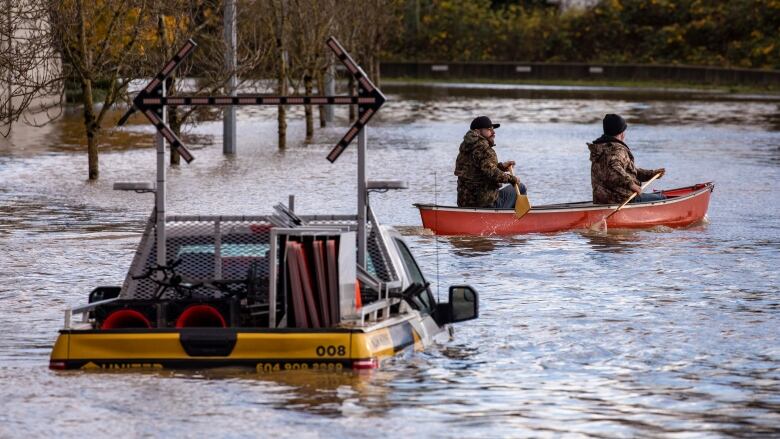
Two people canoe past a submerged truck near a flooded Trans Canada highway in Abbotsford, B.C., on Tuesday. Officials in the province were still assessing damage from floods and mudslides after torrential rains that began on the weekend finally started to subside. (Ben Nelms/CBC)

Labels: , , , , , ,

Wednesday, June 27, 2018

Hope Springs Eternal in the Human Heart

"If we find them, the first thing is to provide first aid and food before thinking of how to bring them up."
"We will not stop, we will work 24 hours. We're racing against time and we want them to be safe."
"The SEAL team will be working non-stop because it's already dark here too. So night and day doesn't make a big difference. They'll just need to rotate."
Thailand Interior Minister Anupong Paochinda

"We  hope this [electricians working to install electricity in the cave] will provide lights for work and fans for ventilation for the SEAL team."
"Also, it means we can use electric engines to pump water out of the cave as well."
Chiang Rai Governor Narongsak Osottanakorn
Rescue workers and park officials at Tham Luang Nang Non cave. Photograph: Chaichan Chaimun/EPA

Twelve boys, part of a soccer team, aged between 11 and 16, under the care of their 25-year-old coach had embarked late Saturday on an adventure that took them into the famed Chiang Rai province geological wonder represented by the Tham Luang cave. That the cave complex with its many large open chambers and tunnels is often flooded during monsoon season that takes in the month of June was perhaps something the coach was oblivious to.

But information published online by the tourist bureau makes it quite clear that entry to and exploration of the caves should be avoided during this vulnerable flooding period. Local authorities and rescue teams have become accustomed to the plight of tourists trapped during these floods in the caves and having to be rescued, on occasion after having been forced to spend days stranded before rescue could be safely completed.

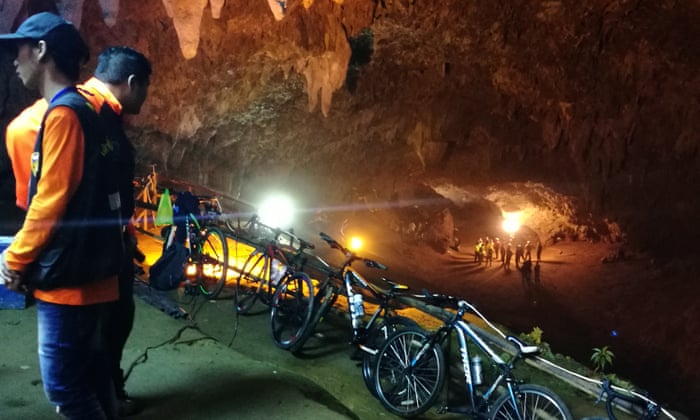
Hopes were high that the thirteen stranded people -- the boys and their coach -- would be quickly recovered and brought to safety. But as the days passed and the boys' families stationed in tents outside the cave forlornly view their children's bicycles, backpacks and soccer equipment resting beside the cave entrance, to be retrieved when the group emerged, time goes slowly and hope becomes fragile. The boys are believed to have made their desperate way to the back of the cave as the flooded area continued to expand and rise.

Thai Navy Seal divers are leading the search, handicapped by muddy water which in some of the cave's chambers has reached as high as the ceilings. They need breathing space to be enabled to proceed with safety, and water is being pumped out, but the rains have continued and the flooded areas continue rising, although the main cave entry remains dry. Special oxygen tanks that will enable the divers to remain under water for longer periods are being brought in.
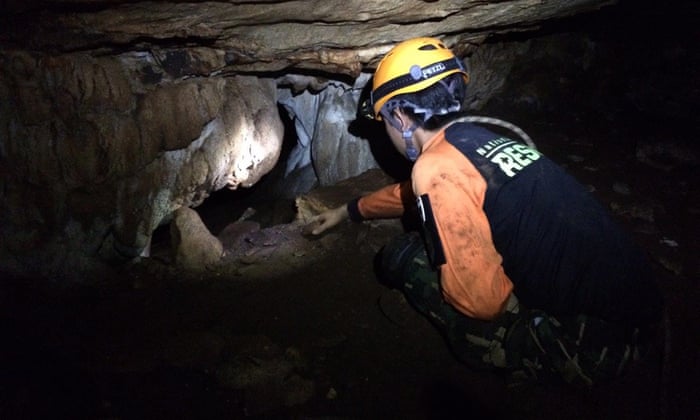
Thai rescue officers search for alternative entrances during the rescue operation for missing football players in Tham Luang cave. Photograph: DNP/EPA

Electricians had worked continually in the light of day and the dark of night to ensure that light and ventilation for divers was available. In a situation where flood waters rise up to seven metres inside the underground complex they are desperately working to penetrate deep into the area in hopes of finding the stranded group. The divers, facing such difficult conditions, have been forced to suspend operations on several occasions, hampering their search to find a way forward through the cave complex.

Two fissures in the rock on the mountain where the cave is located were thought to represent another option for use as a "chimney" to be descended to gain cave access but turned out not to be an entry point, after all. With the aid of the power line extended inside the cave the divers are able to communicate with those waiting and hoping on the outside. When the boys ventured into the cave late Saturday afternoon, their failure to return alarmed a mother who reported her son missing after soccer practice.

Thus began the desperate search and rescue operation. Off limits during the rainy season as a result of experiences with flooding in the past, the caves nonetheless presented as a lure to the adventurous sense of exploration lodged deep in the psyches of young boys and older men alike. "We are still optimistic they are alive", commented Thai deputy prime minister Prawit Wongauwon.

People pray near the Tham Luang caves during a search for members of an under-16 football team and their coach, in Chiang Rai, Thailand. Photograph: Soe Zeya Tun/Reuters

Labels: , , , ,

Monday, September 04, 2017

Flooding of Texas Acid Pits

"Superfund sites are known to be the most dangerous places in the country, and they should have been properly protected against flooding."
Kara Cook-Schultz, TexPIRG

"Is he going to help? Can he help?"
"I lost my home. My job is gone. My tools are gone. My car is gone. My life is gone. What is Trump going to do?"
Devin Harris, 37, construction worker, Houston, Texas
Marine veterans Rocky Damico with the Wounded Veterans of Oklahoma searches for residents in need of help after torrential rains pounded Southeast Texas following Hurricane and Tropical Storm Harvey causing widespread flooding on September 2, 2017 in Orange, Texas.
Scott Olson | Getty Images
Marine veterans Rocky Damico with the Wounded Veterans of Oklahoma searches for residents in need of help after torrential rains pounded Southeast Texas following Hurricane and Tropical Storm Harvey causing widespread flooding on September 2, 2017 in Orange, Texas.

In Houston, devastated by the 125 centimetres of rain it received over the past week, an estimated 100,000 houses were destroyed or damaged. The municipality is still struggling to shelter tens of thousands of displaced residents in local schools, government buildings and the like. And while the mayor of the fourth most populous city in the United States has already announced that his city is "open for business", there is other business that demands attention.

Houston, known as a centre of the American petrochemical industry, is also the site of over a dozen 'Superfund' sites. These are toxic-chemical storage sites that the Environmental Protection Agency (EPA) designates as among the most contaminated areas in the country, and many of them are under water, thanks to the flooding, leaving the risk that dangerous sediment is being stirred up.

Toxic sludge and sulphuric acid from oil and gas operations fills these areas. In the 1980s, an estimated 22,000 cubic yards of hazardous waste and soil was excavated from the acid pits, but they remain a potential threat to groundwater. People living in close proximity draw their water from wells which the EPA monitors.
Water from the Addicks Reservoir flows into neighborhoods in Houston as floodwaters rise Tuesday, August 29.
Water from the Addicks Reservoir flows into neighbourhoods in Houston as floodwaters rise August 29, CNN

Depending on the specific contaminants in the various Superfund sites which vary widely, along with their concentration, threats to human health and surrounding wildlife resulting from rising waters inundating those Orwellian-named sites differs. Still, a report issued by the EPA made specific mention of the risk inherent in floodwaters carrying and spreading toxic materials over a wider area.

Two dozen of those sites had been identified as particularly vulnerable to flooding and rising sea levels. Their vulnerability and the threat they pose to surrounding communities well recognized, but evidently no action taken to remove the contents and store them or dispose of them safely elsewhere.

The National Weather Services warned that the Neches River would crest at over 6.5 metres above flood stage, about 2.5 metres higher than its previous record, and would impact on the Bailey Waste Disposal site south of Beaumont.

Across the San Jacinto River from Houston in Crosby, two Superfund sites sit, adjacent a small working class neighbourhood, an area that was devastated by Hurricane Harvey's floods. One house remains from among the dozen nearby the acid pits. "You never know what happens with the pollution under the ground. It filters into the water system", observed Rafael Casas, a resident of the area in concern over his groundwater well.

Flooding, according to a security guard at another Superfund site off the Houston Ship channel in Deer Park, arrived further inland during the storm, the water since receding back into the bayou. Testing in the past has revealed the sediments in the bayou contain pesticides, toxic heavy metals and PCBs. Active petrochemical facilities surround the site, awaiting a plan for cleanup.

An EPA survey last year revealed that soil from the former waste pits contain dioxins and other long-lasting toxins with their links to birth defects and cancer. It has long been known that the Texas Superfund sites were prone to flooding. This, in a first-world country known to be environmentally active, the richest nation on Earth, oblivious to the vulnerability of its population, exposed through an unfettered and lauded free market system.
harvey
At the Highlands Acid Pit on Thursday, August 31, 2017, the No Trespassing sign on the barbed-wire fence encircling the 3.3-acre Superfund site barely peeked above the churning flood water from the nearby San Jacinto River. AP


Labels: , , , ,

Friday, September 01, 2017

Setting Legal Regulatory Limits 

"We're not perfect."
"We're doing our very best and will continue to work to get better."
"We will likely see additional incidents."
Arkema CEO Richard Rennard

"By all means, the plume is incredibly dangerous."
Brock Long, administrator, Federal Emergency Management Agency

"[The agency had received] no other reports of concerns [from other chemical plants in Texas]."
"The facility is surrounded by water right now, so we don't anticipate the fire going anywhere."
Andrea Morrow, Texas Commission on Environmental Quality
<div class='meta'><div class='origin-logo' data-origin='KTRK'></div><span class='caption-text' data-credit=''></span></div>
ABC-13 Eyewitness News

The floods hitting Houston, Texas, from the monumental storm Hurricane Harvey has brought Texans together in a spirit of overcoming a natural catastrophe that has taken 38 lives, destroyed countless homes and buildings and forced the evacuation of many residents of the area. Rescue teams fully expect to discover more casualties from the storm as they reach homes and stranded vehicles, finding the dead within. Survivors have heart-breaking stories to tell of their near brushes with death.

And the state and its people -- reports of looting aside -- will recover, given the resiliency of the American spirit and the wealth of the country enabling it to use the expertise of its various emergency agencies to assure the stricken and the homeless that there is help for them. Ferocious storms are not unknown in the area. Despite which 80 percent of homeowners had no flood insurance, for who could foresee such a dramatic and catastrophic weather system overwhelming all the failsafe systems in effect which in the end, failed the safety test.

Houston and its surrounding areas, it seems, has no municipal legislation regarding the kind of environmental site management that would not give legal license to build in environmentally vulnerable areas. So homes are built where floods, albeit not of the type that the hurricane brought on this occasion, occur with some regularity. To compound the dangers involved in the situation there is the placement of a chemical plant in an equally vulnerable and dangerous location.

Given the volatile nature of chemicals when things go awry, the authorization of the plant's location seems fairly negligent; too close to a city of millions of residents. And perhaps what is even more serious, the Arkema plant with its chemical compounds was built on a stretch of highway close to Houston where a concentration of refineries, pipelines and chemical plants abound. How wise is that? When electricity was lost as a result of the massive flooding, the Arkema chemicals began to degrade from lack of refrigeration and some caught fire, since they're volatile compounds.

Flames shooting into the atmosphere of 9 to 12 metres in height produced clouds of chemical vapours from the organic compounds. People in the area suffered respiratory irritation, but the EPA claimed air samples were void of toxic materials, in contradiction to the FEMA authority who characterized them as dangerous. There was "no way to prevent" the explosion, explained Arkema's CEO Rich Rowe.

When Arkema submitted a required risk management plan to the EPA resulting from the amounts of sulfur dioxide and methylpropene, (toxic chemical and flammable gas respectively), it holds, it included details about the effect of a potential release. Its 2014 submission stated a worst-case scenario would affect 1.1 million residents over 37 kilometres. Still, Arkema's argument was that this was an unlikely scenario assuming the plant's safety measures failed.

Arkema was fined $110,000 by the U.S. Occupational Safety and Health Administration related to ten safety violations that an inspection at the Crosby plant turned up. The violations were under the classification of "serious", having the potential to result in death or serious injury. Houston, cannot you do better than this in ensuring the compliance and safety of your residents?

The effects of a Hurricane of immense proportions cannot but be emergency-mediated, but certainly those effects coupled with an exploding chemical plant could be avoided?


Labels: , , , ,

() Follow @rheytah Tweet