Politic?

This is a blog dedicated to a personal interpretation of political news of the day. I attempt to be as knowledgeable as possible before commenting and committing my thoughts to a day's communication.

Friday, June 20, 2025

Russia's Africa Corps

"The usage of plausible deniability is now replaced by managed visibility."
"The transfer of Wagner assets in Mali to Africa Corps, which is a state co-ordinated mechanism of influence is more than symbolic, as it demonstrates a strategic transition from proxy to a power chain operated by the government."
"It is not unlikely to expect that the Africa Corps could present a more professional approach, but the operational playbook of including violence will remain intact."
"The brutal counter-insurgency tactics, such as massacres and collective punishment, are structural, not just personal." 
Security researcher Nicholas Chkhaidze, Tbilisi 
 
"The Kremlin will continue to provide direct support to Africa Corps, they'll continue sending in shipments of equipment and weapons."
"We'll see a steady pace of violence by the al-Qaida group in resistance to the involvement of Russia."
Beverly Ochieng, Africa analyst, Center for Strategic and International Studies 
https://i.abcnewsfe.com/a/b35bad36-137e-4210-b593-bcd2e70bae75/wirestory_b29349be737cbc14dfc435b3536711eb_16x9.jpg?w=992
The Russia-backed Wagner Group says it is leaving Mali after more than three and a half years of fighting Islamic extremists and insurgents in the country   ABC News
 
"Africa Corps is a Russian military company that was created in early 2024 as a replacement for the Wagner Group. This organization reflects Russia’s desire to extend its military influence on the African continent and to provide legitimacy to its official and public presence in the face of the European and American presence. Africa Corps is deployed in 5 countries: Libya, Burkina Faso, Mali, Central African Republic and Niger. Libya represents the core of the corps due to the previous activity of Wagner elements in the city of Tripoli…. Another factor in the choice of Libya as the headquarters of this corps is its strategic geographical location due to its connection with the Mediterranean coast, which ensures military supply lines and movement of corps members to other countries The Africa Corps’ modus operandi is entirely dependent on providing military support to African countries such as instructors and weapons. The company also is concerns with the development of strategies in cooperation with the Ministry of Defense, such as is the case in Mali and Niger… In short, the Africa Corps represents the new incarnation of Russian military influence in Africa."
Foreign Military Studies Office -- U.S. Army, Training and Doctrine Command
 
https://hg2wordpressfmsostor01.z2.web.core.usgovcloudapi.net/OE%20Watch%20Issues/2024-06/Zenn%2001%20Russian%20Deputy%20Defence%20Minister%20Yunus-Bek%20Yevkurov%20(left).jpg
Russian Deputy Defence Minister Yunus-Bek Yevkurov (left) is heading the newly formed Africa Corps, which under his leadership is set to become a key entity through which the Russian state will project power in West Africa.
 
Russia now is openly expanding its military footprint in Africa with the rise of a paramilitary force controlled by the Kremlin. The Africa Corps force is purposefully being used by Russia to increase influence in francophone West Africa, as France's colonialist interests are waning. The Russian defence ministry, operating Africa Corps, is filling the gap left by mercenary group Wagner, founded by the late Yevgeny Prigozhin, after it announced its departure from Mali. 
 
Expanding its presence as Mali, Burkina Faso and Niger led by juntas after coups between 2020 and 2023, have turned from France and moved closer to Russia. Dmitry Peskov speaking for the Kremlin, explained Moscow's intent to develop comprehensive cooperation with African countries: "This cooperation also extends to such sensitive areas as defence and security", he expanded.
 
Despite the shift, analysts have no expectation that the Russian paramilitary groups mean to change its tactics of human rights violations. Half of Africa Corps' personnel are Wagner veterans, prioritizing those who had fought in Ukraine, consisting mostly of former convicts. In its three years in Mali, Wagner kidnapped, detained and tortured hundreds of civilians. Victims spoke of waterboarding, beatings with electrical cables, and being burned with cigarette butts.
 
"In the eyes of the population, this is merely a name change with no positive developments in one of the worst security situations in ten years", stated Bakary Sambe, executive director, Timbuktu Institute think tank in Dakar. For Malians, the distinction between the two Russian paramilitary groups was superficial.
 
"The handover to Africa Corps means that Russia is comfortable having a ministry of defence asset openly operating there", remarked Christopher Faulkner of the U.S. Naval War College. The Central African Republic is the "last bastion" of Wagner operations in Africa, according to the Institute for the Study of War. And there too, the Russian defence ministry plans to replace Wagner with Africa Corps. 
 
/
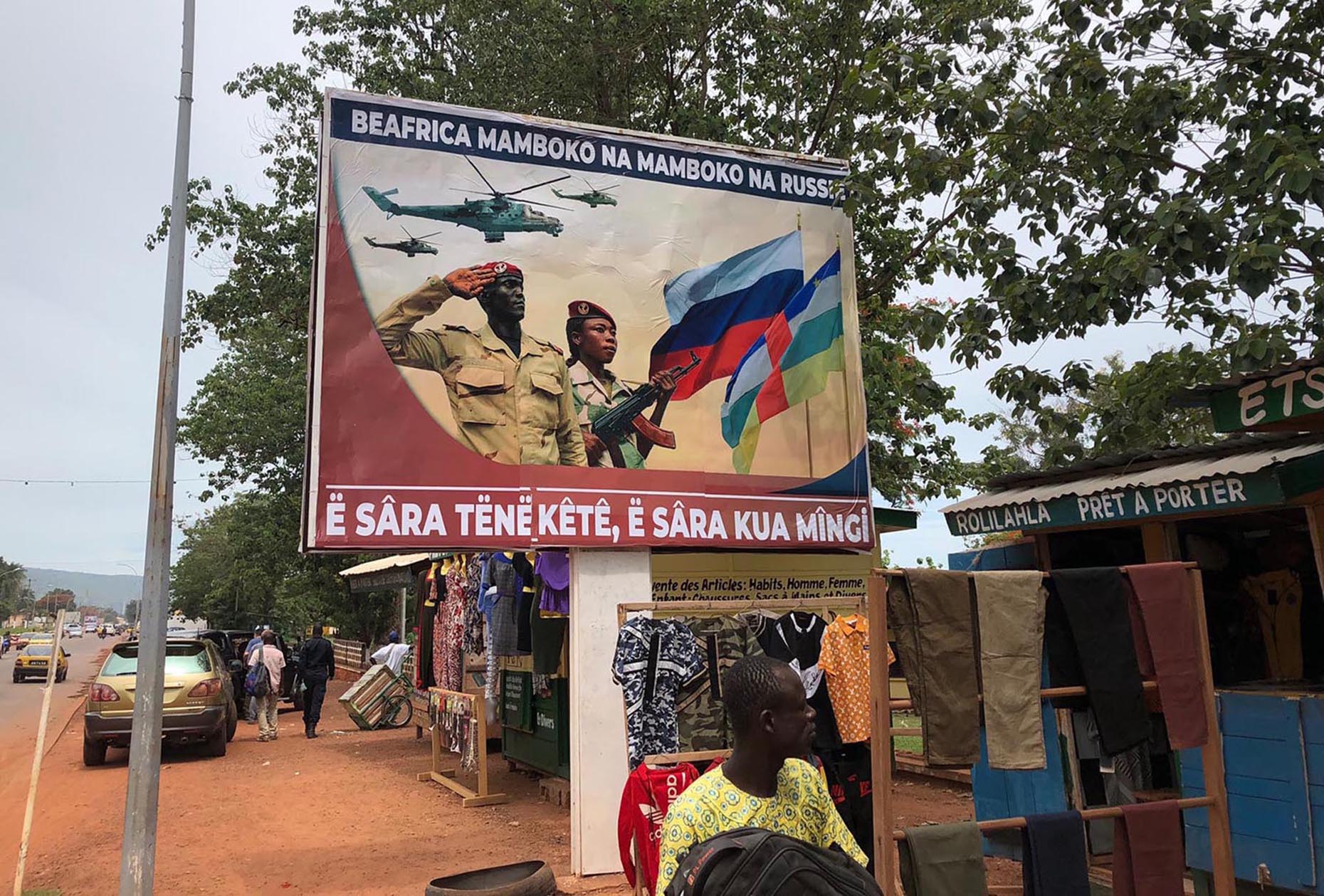
Posters across Bangui are reminiscent of old Soviet propaganda. The posters read: “Central African Republic is hand in hand with Russia” and “talk a little, work a lot.” - Credit: Sebastian Shukla/CNN
"[The shift to more overt Russian state presence in Africa could lead to] myriad domestic and geopolitical risks for the Kremlin." 
"The risk to Russian prestige may lead Russia to get more deeply entrenched in long-term conflicts to 'save face', which would ensnare the Kremlin in its own series of 'forever wars'."
"Wagner was more immune to such long-term entanglements and even abruptly withdrew from places, such as Mozambique, when the benefits outweighed their costs."
Institute for the Study of War 

Labels: , , , ,

Tuesday, November 21, 2017

The Resurrection of Slavery

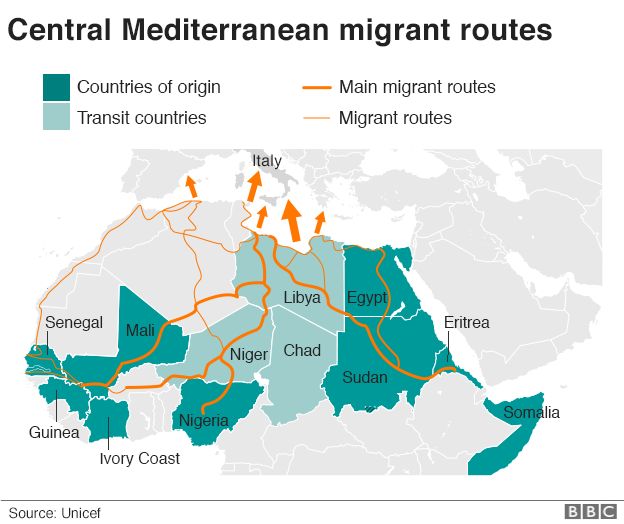
Map showing Central Mediterranean migrant routes
"Slavery has no place in our world and these actions are among the most egregious abuses of human rights."
"[The perpetrators must be brought to justice; appropriate UN bodies are] to actively pursue this matter."
UN Secretary-General Antonio Guterres

"[I plan to establish a] commission to investigate these reports in order to apprehend and bring those responsible to justice."
Ahmed Metig, deputy prime minister Government of National Accord, Tripoli, Libya
Migrants rescued from the Mediterranean arrive at a naval base in Tripoli in October.
Migrants rescued from the Mediterranean arrive at a naval base in Tripoli in October.   CNN
CNN has unleashed its findings on an active slave market in action in Libya, raising outrage in the West and the usual expressions of shock and denunciation in the United Nations, while Libyan authorities of course had no idea that anything of this nature was being carried out and they will immediately launch an investigation to get to the source of the problem. And then, of course, initiate steps to immediately resolve it to everyone's satisfaction.

There is a certain situation which has been previously addressed and that address has resulted in certain consequences. The situation being an ongoing flood of refugees and opportunity-seekers from across the Middle East and North and West Africa to enter Europe and declare themselves refugees, in expectation of being embraced by humanitarian groups and ushered into the countries of their choice which just happen to have the most generous social services available to meet their urgent needs.

But since the European Union, in understandable distress and no little amount of stress emanating from the situation from among their disparate members, many of which have had their resources strained and others which refuse to have their resources used at all, convinced the Libyan government that their coast guard should undertake a strategy to hold back the living tide of people willing to risk death at sea for the opportunity to coast into Europe.
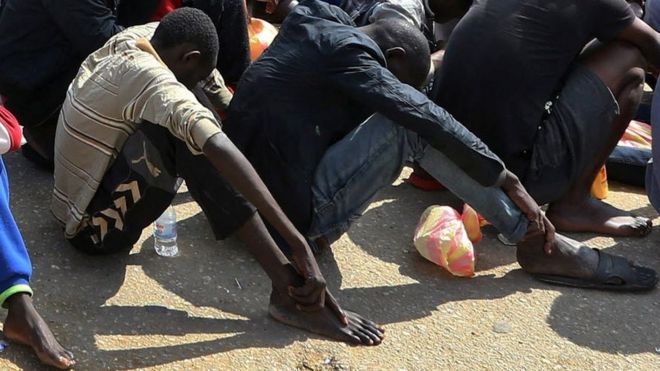
Migrants sit in a detention centre run by the interior ministry of Libya's eastern-based government, in Benghazi
Migrants sit in a detention centre run by the interior ministry of Libya's eastern-based government, in Benghazi Credit: Reuters
The consequences for having stemmed that tide to a sizeable degree is that Libya is stuffed with migrants and refugees. They have been warehoused, their immediate subsistence needs met with donations from the source that refuses them entry and NGOs, and a new business venture other than smuggling the foreigners out of Libya and into Europe has arisen. New opportunities always seem to present themselves, and enterprising criminal elements waste no time taking advantage.

Just think of it: Arab governments failed the needs of their people; Arab governments oppressed their people and when a popular uprising resulted, those same governments went to war against their people, and aside from slaughtering the impudent discontents, created massive numbers of dispossessed, displaced from their familiar geography, along with refugees. And now that the victims have sought alternatives for their lives, Arab traders in human lives have surfaced to gain profit.

According to testimony from the International Organization for Migration and other humanitarian agencies, for months refugees and haven seekers have been crowding the auction blocks of Libyan slave markets to be sold as working slaves throughout the region, where West Africans are advertised as "big strong boys for farm work". Bidders eyeing the migrants succeed in their purchases for as little as $400 for each slave.

The Treeq Alsika Migrant Detention Center in Tripoli, where some migrants are held by Libyan authorities before they are repatriated.
The Treeq Alsika Migrant Detention Center in Tripoli, where some migrants are held by Libyan authorities before they are repatriated.   CNN
So, then, it is not Arab governments at fault for creating these teeming numbers of refugees fleeing conflict, and migrants looking to find a promising future for themselves elsewhere than in their opportunity-scarce homelands, but the West, which has failed to continue absorbing migrants/refugees by their millions. If the smugglers in Libya cannot dispatch the refugees in those unseaworthy vessels taking all their available funds to do so, then they will make their hard-earned wealth by auctioning them off as slaves.

According to Alpha Conde, president of Guinea, chairman of the African Union -- the source of many of the migrants -- an inquiry and prosecutions reflecting the "despicable trade ... from another era", must result from these revelations, while the Senegalese government spoke of the slave market as a "blight on the conscience of humanity". Not a blight on Africa, on Arab and Muslim profiteers, but on "humanity", doublespeak for the West.

African migrants gather at the Tripoli branch of the Anti-Illegal Immigration Authority, in the Libyan capital, 23 March 2017
The International Migration Organization says it has gathered evidence of slavery in Libya   Getty Images


Labels: , , , , , ,

Saturday, November 01, 2014

The Fowler Report: All Is Forgiven

"So we created an arm's length expert panel beholden to no government and reporting to me as chairman of the relevant Security Council sanctions committee. I then went to Angola and interviewed half a dozen UNITA defectors and learned in exquisite detail where all the bodies were buried..."
On 20 March 2000 I issued the first of those two reports... For the first time in UN history, it 'named and shamed' a long list of those complicit in supporting UNITA [blood-drenched diamond trade], contrary to the dictates of a whole raft of Security Council resolutions outlawing such behaviour. The provisioning of UNITA had sustained the devastating civil war which over 25 years had killed over half a million people, displaced 4.3 million others, or a third of Angola's population and caused that country to be judged by UNICEF 'the worst place in the world to be a child'."
"Most prominent among the sanctions busters named in our report were two sitting African presidents, Gnassingbe Eyadema of Togo and Blaise Compaore of Burkina Faso."
"On the few occasions I ran into President Compaore between the publication of that Security Council report and my capture at Niger, it was clear that he had not welcomed the publicity I had provided."
"I told President Compaore that his cartons had nourished our bodies and his 'On va vous sortir de la' had sustained our wills. I said we would be eternally grateful, for he had done exactly what he said he would do..."
"Blaise Compaore, President of Burkina Faso, was, Omar allowed, the only one willing to step forward and endeavour to save our lives. 'Your future', he concluded, 'is now entirely in the hands of President Compaore'."
"The next morning we flew to Ouagadougou to pay our respects to President Compaore and to thank him, too, for the essential part he had played in allowing us to keep body and soul, indeed body and head, together and in bringing our ordeal to a happy conclusion.... President Compaore could not have been more gracious and welcoming..."
Robert Fowler -- A Season in Hell, My 30 Days in the Sahara With Al-Qaeda

And so, that in a nutshell, is former Canadian Ambassador to the UN Robert Fowler's account of his acquaintanceship and subsequent reconciliation/appreciation with the now-deposed leader of Burkina Faso, a dictator who had usurped the previous government by force to install himself as leader of the country for almost three decades. And, while leader, earning a stern rebuke from the United Nations investigation that led to the revelation that he had broken sanctions earned through devastating a population.

President Compaore was first portrayed in Mr. Fowler's account of his time as a prisoner of jihad, as what he represented, a dictator with no conscience, imposing his will on a population for whom he produced nothing to further their advance as an emerging African economy. A man who supported Charles Taylor, in Liberia, the warlord-turned-president now serving a 50-year sentence for war crimes and crimes against humanity in Sierra Leone.

Whom Mr. Fowler knew well through his UN stint as an investigator in Niger that President Compaore had supported rebel groups in Ivory Coast and Angola. But it is the dictator's role in helping to free Mr. Fowler and his colleague, Louis Guay from their tense and fearful hostage stage that he is a celebrated hero, in the opinion of the former diplomat who feels he owes his life to this dictator's intervention.

Anti-government protesters gather in the Place de la Nation in Ouagadougou, capital of Burkina Faso, October 31, 2014. REUTERS-Joe Penney
Anti-government protesters gather in the Place de la Nation in Ouagadougou, capital of Burkina Faso, October 31, 2014.    Credit: Reuters/Joe Penney

It took, finally, a popular revolt within the country when demonstrators in Ouagadougou, Burkina Faso's capital set fire to their parliament in a massive protest over plans to change the constitution to enable President Blaise Compaore to extend his 27-year-rule. One imagines that he felt if a great nation like Russia could allow its constitution to be altered so that Vladimir Putin could exchange the presidency for the prime ministership and then play revolving chairs with Dmitry Medvedev he could do likewise.

Four times elected simply wasn't enough for Mr. Compaore. After all, the great man extended his good will not to those civilian dependents of his own nation, but to the plight of foreigners taken captive by Islamists to negotiate their release. As an elder statesman which was how he envisioned himself, he had his legacy to look to, and a reputation to repair in the process, so negotiating with rebels became his valued speciality.

Labels: , , ,

Monday, October 27, 2014

Reaction and Over-Reaction

"Coercive measures like mandatory quarantine of people exhibiting no symptoms of Ebola and when not medically necessary raise serious constitutional concerns about the state abusing its powers."
Udi Ofer, executive director, American Civil Liberties Union, New Jersey

"This is not a situation I would wish on anyone, and I am scared for those who will follow me. I am scared about how health care workers will be treated at airports when they declare that they have been fighting Ebola in West Africa. I am scared that, like me, they will arrive and see a frenzy of disorganization, fear, and, most frightening, quarantine. The U.S. must treat returning health care workers with dignity and humanity."
Kaci Hickox, New Jersey quarantine
PHOTO: Kaci Hickox is pictured in this undated image provided by the University of Texas at Arlington.

Doctors Without Borders whom the world at large has supremely good reason to hold in the utmost respect for their selfless dedication to aiding the unfortunates of the world, urges "fair and reasonable treatment" of health workers fighting the Ebola outbreak. And this is a fair and reasonable request, since the humanitarian group-without-peer is hugely dependent on the intentions of volunteers to aid them in their work.

Should those volunteers feel put-upon, unfairly targeted, held responsible for something beyond their control, and fear facing discrimination on their return home after volunteering their time and medical expertise in West African countries facing the current Ebola virus epidemic, they will not feel quite so eager perhaps to embark on those missions, fearing the outcome on return. They are, however, exposing themselves to a dread disease and could conceivably contaminate others on return home.

Kaci Hickey, a nurse who volunteered with Doctors Without Borders and was placed in quarantine at a New Jersey hospital as a result of having had contact with Ebola patients as a medical volunteer is hugely critical of the manner in which she was bundled into quarantine. Taking note of the incubation period of Ebola, New York and New Jersey governors imposed a mandatory quarantine for all travellers having had contact with Ebola patients in Ebola-ravaged West-Africa.

Kaci Hickox is seen sitting inside the isolation tent she has been housed in at University Hospital in Newark, New Jersey.
Handout image  Kaci Hickox is seen sitting inside the isolation tent she has been housed in at University Hospital in Newark, New Jersey.

Fresh from her work in Sierra Leone, nurse Hickox was detained at Newark Liberty International airport on Friday, closely questioned and taken to a hospital in a state of nervous distress. There she remained isolated. "The best way to protect us is to stop the epidemic in Africa, and we need those health care workers so we do not want to put them in a position where it makes it very, very uncomfortable for them to even volunteer to go", said Dr. Anthony Fauci, director of the National Institute of Allergy and Infectious Diseases.

The governors felt that quarantine was a necessary measure to protect public health. They await the federal Centers for Disease Control and Prevention to validate their decision. Their own decision was arrived at in the wake of a New York doctor, Craig Spencer, freshly returned from Guinea, where he had been working for Doctors Without Borders, being diagnosed with having contracted Ebola. But not before he had been on public transportation and come in casual contact with a circle of other people.

Currently being treated at Bellevue Hospital Center, his condition has taken a turn for the worse, although he is expected to survive the virus replicating and spreading throughout his body. Common sense and caution would seem to mitigate in favour of mandatory quarantine. It seems reasonable that health workers, knowing the devastating effect on their profession in West Africa, would agree to surrendering their freedom for the 21-day incubation period until given a clean bill of health.

PHOTO: Dr. Craig Spencer and his fiance Morgan Dixon are seen in this undated photo from Morgan Dixon Community Facebook.
Morgan Dixon Community/Facebook   Dr. Craig Spencer and his fiance Morgan Dixon are seen in this undated photo from Morgan Dixon Community Facebook.

But nurse Hickox is outraged at her temporary loss of freedom and no doubt she equates it with a loss of personal dignity and autonomy. Her discomfort and misery at her position, being held without her will to agree has infuriated her, and because she was a selfless volunteer, others in her profession have come to her defence. She has been given leave to return to her home state of Maine to serve out the remainder of her quarantine period at home.

And she promises to sue the federal government for illegal confinement.

Labels: , , , ,

Tuesday, October 21, 2014

Banishing Ebola By Banning Travel?

"I wouldn't be surprised at all if we saw a case of Ebola in Canada in the weeks or months ahead."
"[...Entry screening of travellers may be reassuring to the public] but it's unlikely to have any meaningful impact in terms of preventing the introduction of Ebola virus into Canada."
"So traveller screening, whether it's exit screening or entry screening, isn't likely to have a big impact in terms of mitigating the spread of this disease."
"This is the type of outbreak where many might feel compelled to try and close down their borders and lock the disease out. That's really almost impossible. Source control is the real priority right now."
Dr. Kamran Khan, infectious disease physician, St. Michael's Hospital, Toronto

In the United States pressure is rising to have federal authorities ban flights to and from the affected regions of West Africa; Sierra Leone, Liberia and Guinea where there has arisen a total of 8,216 confirmed cases of Ebola resulting in 4,555 deaths to date, according to the World Health Organization. Projections into the near future -- a mere two months ahead -- conjecture the potential of 1.4-million Ebola cases diagnosed by the end of 2014.

By that time, should it occur, and the international effort to curtail the spread fail, there will be any number of Ebola cases diagnosed in Europe and North America, the Middle East and Asia, as well as an inevitable spread to the rest of Africa. That's the absolute worst-case scenario. With the belated alarm raised by the World Health Organization and the alarm felt around the world, it is entirely possible that well before that time the outbreak will be contained. And that is most certainly what everyone hopes for.

Reuters   A health worker is reflected in a mirror as he prepares protective equipment in Sierra Leone’s capital city, Freetown. Cuba has dispatched 165 health workers to the country to combat the Ebola outbreak.

Nations outside Africa are sending volunteer medical staff to help in the massive effort to stem the Ebola tide. Cuba, famous for its 'barefoot doctors' and its propensity over the years to send its physicians abroad to aid less developed countries when health scares such as this arises, has pledged to send 300 health workers to aid in the fight against the spread of Ebola.

There are any number of courageous, dedicated health workers from around the international community who have travelled to West Africa to aid how and wherever they can at risk to themselves. If a travel ban into and out of the countries involved occurs, the ban would make it impossible for such international volunteers to reach the sites requiring their assistance. Nor would medical equipment be permitted entry, further complicating matters.

Any medical personnel from abroad who become infected would then be forced to remain where they are, without the more advanced hygienic methods used in the West available to them, where water is plentiful and the luxury of technical advances can be applied, along with whatever ameliorating protocols can be advanced, from using blood transfusions from those who have survived Ebola, to experimental drugs.

An analysis published in the medical journal The Lancet, interpreted the expected number of internationally exported cases of Ebola virus, based on epidemic conditions and flights from Guinea, Liberia and Sierra Leone. The analysis team projects that three travellers infected with Ebola virus will depart their affected regions on commercial flights very month, on average. And the risk of transmission increases the longer the Ebola outbreak persists, and grows, according to study co-author Dr. Kamran Khan.

In their bid to estimate the potential for Ebola spread internationally Dr. Khan and his colleagues examined the size of each country's population, the number of active cases reported and the volume of outbound travellers leaving those affected areas. The research team estimated that for commercial airports where direct flights from Guinea, Liberia or Sierra Leone are absent, on average 2,512 travellers would have to be screened to identify one traveller originating from one of the three countries.

While exit screening takes place in the three affected countries, cases are certain to be missed, with the reality of the long incubation period -- up to 21 days -- when people may be infected, but do not yet show any symptoms, which was just what occurred with Thomas Eric Duncan whose Ebola fever showed up days after he landed in Texas, and who ended up contaminating a large swath of area, from the plane he arrived in to the apartment he stayed within to the Texas Presbyterian Health Hospital where transmission infected two health-care workers.

Labels: , , ,

Wednesday, October 15, 2014

Strident Ebola Insecurity

"Airborne transmission has not been ruled out and this is the fundamental disagreement that we're having with the government. We need to err on the side of safety."
Ontario Nurses' Association president Linda Haslam-Stroud

"It was the nurse in Texas that really rang the alarm bells for us."
"We will do our jobs 24/7 if we are well-protected, and we have the training. But we have to ramp up what we have on paper and ramp it up fast."
"My understanding is there are gaps. We are nurses for a reason. We know that you will be placed in some kind of danger, but the best option is to make sure you are well-trained and have proper personal equipment."
Linda Silas, head, Canadian Federation of Nurses Unions

"I think we passed the test in terms of the appropriate precautionary steps being taken, appropriate treatment being offered, lab tests being ordered in a rapid way. ... It was useful to see our planning that has been in place to now has really paid off."
Dr. Vera Etches, associate medical officer of health, Ottawa
A Doctors Without Borders (MSF), health worker in protective clothing carries a child suspected of having Ebola in the MSF treatment center on Oct. 5 in Paynesville, Liberia. The girl and her mother, showing symptoms of the deadly disease, were awaiting test results for the virus. The Ebola epidemic has killed more than 3,400 people in West Africa, according to the World Health Organization. (John Moore/Getty Images)

One Ottawa-area patient suspected of having the Ebola virus has been cleared. Clearance is awaited in yet another individual in Belleville. But the case of the nurse in Spain and the Texas nurse, both of whom acquired the virus from patients they were tending with Ebola, hangs heavy in the minds of Canadian nurses. The head of the organization representing 60,000 Ontario nurses expressed her fears that the province is not fully prepared.

Questions revolve around whether protective equipment should include special respirators to protect health workers from airborne particles. As well as some coverage offering more than simply gowns. Uncertainty about equipment and their protective capabilities stirs the fears of health care workers, particularly nurses across the country. Ms. Silas speaks of equipment problems she has heard of with some nurses complaining chins and necks were exposed, others that protective gowns had sleeves too short.

Equipment, she stressed, must be available at all facilities. The SARS epidemic, Ms. Haslam-Stroud reminded, infected dozens of health-care workers and death claimed three. That Canada is not yet fully prepared to cope with an epidemic in the country is a major concern to these nurses' representatives, particularly in light of the heavy death toll taken on health-care workers in the four West African countries most heavily impacted by Ebola.

And the World Health Organization warned that up to ten thousand new Ebola cases weekly could be surfacing in West Africa within the next several months. This, at the same time that it revealed the death rate in the present outbreak has risen, to 70 percent. Previous estimates given by the agency had given the Ebola mortality rate at around 50 percent. Contrast that to flu pandemics where the death rate typically is under two percent.

Ebola is considered a high-mortality disease, and the problem of isolating the ill, providing treatment as early as possible is being compounded by the increase in cases. Doctors Without Borders has said that 16 of its employees were infected with Ebola, nine of them having died. "Where is WHO Africa? Where is the African Union?" asked Sharon Ekambaram head of the South Africa unit of Doctors Without Borders. "We've all heard their promises in the media but have seen very little on the ground."

In Leipzig, Germany a 56-year-old medical worker with the United Nations infected in Liberia, died. Prompting Liberia's UN mission to place 41 other staff members under "close medical observation". In Dallas the American nurse who became Ebola-positive after treating a Liberian patient who then died, received a transfusion of plasma from Dr. Kent Brantly who received an experimental treatment to survive the virus.

The assistant nurse in Spain infected with Ebola has seen slight improvement while still in serious condition. Fifteen of her contacts were being monitored. And in the United States, over 200 people who shared a flight with another nurse from Texas Health Presbyterian Hospital who has now tested positive for Ebola are being sought for the purpose of isolating them until such time as their condition can be cleared.

The deadly spread appears inexorable... While withering the confidence of health-care workers to whom is entrusted the care of the infected.

Labels: , , , , ,

Monday, October 06, 2014

Evidently Not

From a humanitarian impulse to be of assistance in a medical emergency, to the oblivious understanding that he had become a vector conveying a dread viral disease to other parts of the world from his native Liberia, Thomas Eric Duncan has made history of an unenviable variety. "We expect people to do the honourable thing", Binyah Kesselly, chairman of the board of directors of the Liberian Airport Authority said.
thomas duncan
Thomas Eric Duncan, who is being treated for Ebola in Dallas, is shown at a wedding in Ghana in a 2011 photo provided by Wilmot Chayee. Photograph: Wilmot Chayee/AP
Perhaps one honourable thing was all that Mr. Duncan was capable of performing, shunting aside his moral and public responsibly when the opportunity presented to do the second honourable thing. Perhaps he was just tired of being honourable; responding to an medical emergency where he aided a young pregnant woman in dreadful distress was all he was capable of, and in most circumstances it would be more than enough to warrant him a medal of distinction.

Instead, he now has a worrisome medal of having transferred the dread Ebola virus from Liberia to the United States, coming into contact with a wide variety of people having no knowledge of his perilous state which could threaten their well-being in a way none might have been able to imagine. He, this neighbourly-helpful individual, had no wish for his travel plans to be delayed, so he preferred not to declare himself to have been health-compromised when he flew from Liberia to the U.S.

Planning to visit a member of his family. And when it became clear that Thomas Eric Duncan was indeed suffering from Ebola, and his extended family living in Dallas refused to accede to the order to confine themselves to their home until the incubation period for Ebola had passed, they too chose to deny reality and refused to honour that need. Requiring in response that an armed guard be posted to ensure they stayed put. Which wouldn't have been required if Mr. Duncan had stayed put.

Before he left Liberia for his trip to America, Mr. Duncan responded to aid his 1andlord's pregnant 19-year-old daughter who was experiencing stomach pains. The ambulance they were awaiting never arrived so Marthalene William's parents with Mr. Duncan's help lifted her into a taxi, with Mr. Duncan in the front seat taking the young, 7-month-pregnant woman to hospital where the crowded clinic was unable to accommodate her.

She died. In a matter of weeks everyone involved in aiding Marthalene was sick or dead.

Now, struggling for his life in a Dallas hospital, four members of his family remain confined to their home under armed guard, and authorities have made a prodigious effort to find the estimated 60 to 90 people Mr. Duncan may have come in contact with. Should Mr. Duncan survive his personal ordeal and return to his country, authorities there plan to prosecute him for lying about his health status when leaving the country.
thomas frieden
Centers for Disease Control and Prevention director, Dr Thomas Frieden, is confident US Ebola cases can be contained. Photograph: Tami Chappell/Reuters
As for his family members in Texas, the State health commissioner David Lakey explained the necessary measures taken in their quarantine: "We didn't have the confidence we would have been able to monitor them the way that we needed to", since they were "non-compliant" with the request to remain isolated. Not that local health personnel covered themselves in competent glory when Mr. Duncan first admitted himself to hospital, explaining where he'd come from and was sent home by a nurse with an antibiotic and told to rest.

Even lay people with no medical-health backgrounds know that antibiotics do nothing for viruses. Even the most dim-witted nurse must surely be aware of the health crisis ongoing in West Africa, and that Liberia is the area most impacted by Ebola? Evidently not. In the country that lauds itself as being the most capable of treating the virus should it ever gain a foothold there.

Don't all U.S. health professionals know that three thousand American military were dispatched to Africa to aid in the mission to halt the disease?

Evidently not.

Labels: , ,

() Follow @rheytah Tweet