Politic?

This is a blog dedicated to a personal interpretation of political news of the day. I attempt to be as knowledgeable as possible before commenting and committing my thoughts to a day's communication.

Sunday, January 21, 2024

Looking for Peace, Opportunity, Future

"[We're waiting for] border patrol to come pick us up and give us protection."
"It doesn't matter if it's cold. There is peace here."
Sudanese migrant, Izzeddin, 32, migrant encampment, Sasabe, Arizona

"In terms of migrants per day, December 2023 has been larger than any average we have ever seen."
"Every official who is commenting on it, on all levels, says they're near or past the breaking point."
"If you move to a place that's super remote, there won't be a lot of agents on staff, and that increases your chances of being released into the U.S."
"There is nowhere to put people They can't hold you."
Adam Isacson, migration expert, Washington Office on Latin America
Women wait in a hallway Friday, Dec. 15, 2023, at a Border Patrol station in Ajo, Ariz. (AP Photo/Gregory Bull)

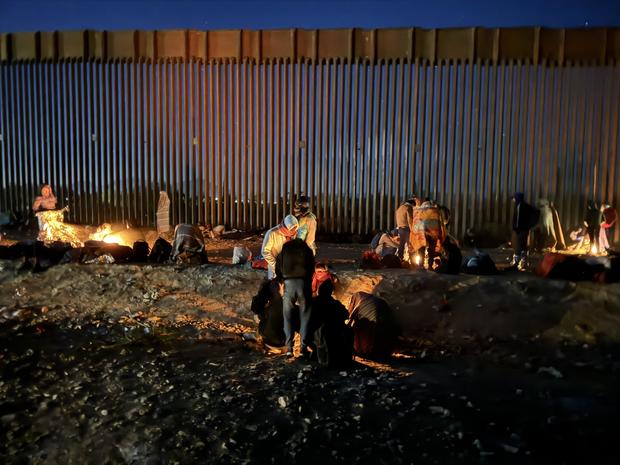
In a remote, cold and lonely place while awaiting the arrival of border guards, dozens of migrants huddle close to a hole in the border wall. They have been given coffee by aid group No More Deaths. Given blankets, food and emergency telephone calls should there be any there who sustained life-threatening injuries on their journey. Those hailing from Sudan have escaped another Darfur-like conflict, patiently waiting for their search for haven to end far from their homeland.

Among them are others, not only themselves fleeing war in Sudan, but those escaping from Central American violent gangs and Mexican cartels. All have crossed illegally into the United States, trekked over rugged terrain for tiring hours, to arrive near Sasabe, Arizona exhausted, hungry and cold. They wait to turn themselves over to authorities to be given the opportunity to ask for asylum; stranded in the Arizona desert, but hopeful.

Just as night time temperatures begin dropping, a convoy of American Border Patrol agents roll in. The men are loaded into a van where they're briefly processed. The van continues driving in its search for more people needing rescue. "We are not equipped to deal with this. It's a humanitarian disaster", comments Scott Carmon, a Border Patrol watch commander, of the crisis unfolding at the southern U.S. border.
 
A migrant walks along a road shadowed by the steel columns of the border wall separating Arizona and Mexico after crossing into the United States, Friday, Dec. 15, 2023, near Lukeville, Ariz. (AP Photo/Gregory Bull)
A migrant walking along a road shadowed by the steel columns of the separation border between Mexico and Arizona. AP
 
Once again, migrant encounters reach toward record levels, testing the capacity of American law enforcement. Thousands of migrants arrive daily, on their way from Africa, Asia, the Middle East or South America. Relentless violence, desperation, fear and poverty drive them from their places of birth where they can no longer find a future.

There was a broad sigh of relief in the spring when crossings into the U.S. declined after the lifting of pandemic border restrictions. The anticipation was that the floodgates would burst, but they held. More lately, numbers have spiked. The number of apprehensions in a recent week soared to over 10,000 a day -- the Border Patrol found itself stretched beyond capacity. 
 
Small towns on both sides of the border were overwhelmed with people funneled through new routes by human smugglers, to evade capture.

American officials monitored a caravan moving north through Mexico comprised of over 2,000 migrants, heading toward the United States; unlikely to complete their journey according to experts, but drawing significant media notice to the migrant tide crossing the border. What has caused the recent swell is as yet unknown.

Theories include larger numbers of Mexicans fleeing from cartel turf battles; rumours of a key legal pathway ending; smugglers who push desperate people of all nationalities to attempt entry at increasingly remote parts of the vast border. Border officials in Arizona closed a key port of entry to legal crossings early in December to enable them to focus on the unlawful entries.

Migrants huddle around fires for warmth along the U.S.-Mexico border near Lukeville, Arizona, on Thursday, Dec. 7, 2023.
Migrants huddle around fires for warmth along the U.S.-Mexico border near Lukeville, Arizona. Camilo Montoya-Galvez/CBS News


Labels: , , , , , ,

Wednesday, December 16, 2020

Fundamentals in the Best/Worst-Laid Plans of Mice and Men

"This is all part of China's education as a rising power. It has taken a flawed model that appeared to work at home, building large infrastructure projects, and hubristically tried to apply that abroad."
"Historically, most infrastructure booms have gone bust. Whether China can avert that fate may depend on its ability to renegotiate loans with countries now in urgent need of debt relief."
"If China is unable or unwilling to provide sufficient relief to its borrowers, it could find itself at the centre of a debt crisis in developing markets."
Jonathan Hillman, author, The Emperor's New Road

"In domestic Chinese media, the frequency of the topic occurring has come down a lot in the last few years, partly to downplay China's overseas expansion ambitions."
"I expect this retrenchment to continue."
Chen Zhiwu, professor of finance, Hong Kong University

"Volatile Sino-U.S. relations and more restrictive access to overseas markets for Chinese companies have prompted a fundamental rethink of growth drivers by Beijing's top economic planners."
"Naturally, if stste-owned enterprises decide to switch back to the domestic market in order to follow the leadership's wishes, the budgeted financial resources for overseas investments will reduce accordingly."
Yu Jie, senior research fellow on China, Chatham House think tank, United Kingdom
 
"This has to be the time for a rethink. It's been such a priority for Xi Jinping, he's invested so much in it that he's not going to just turn the lights off."
"But they need to seriously implement their own debt sustainability analysis and their own social and environmental impact tools."
Kevin Gallagher, director, Boston University Global Development Policy Center
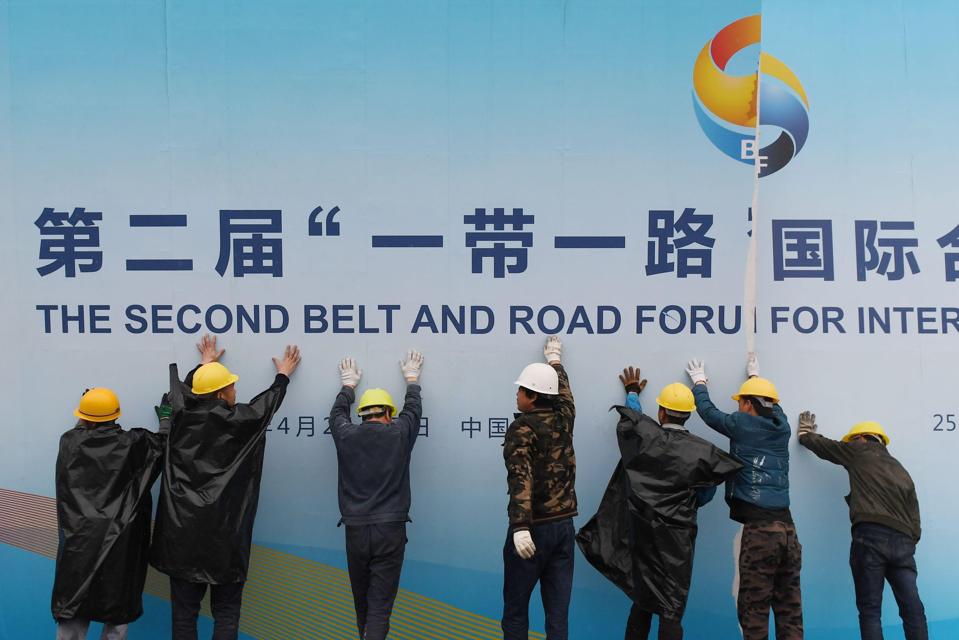
Workers take down a Belt and Road Forum panel.

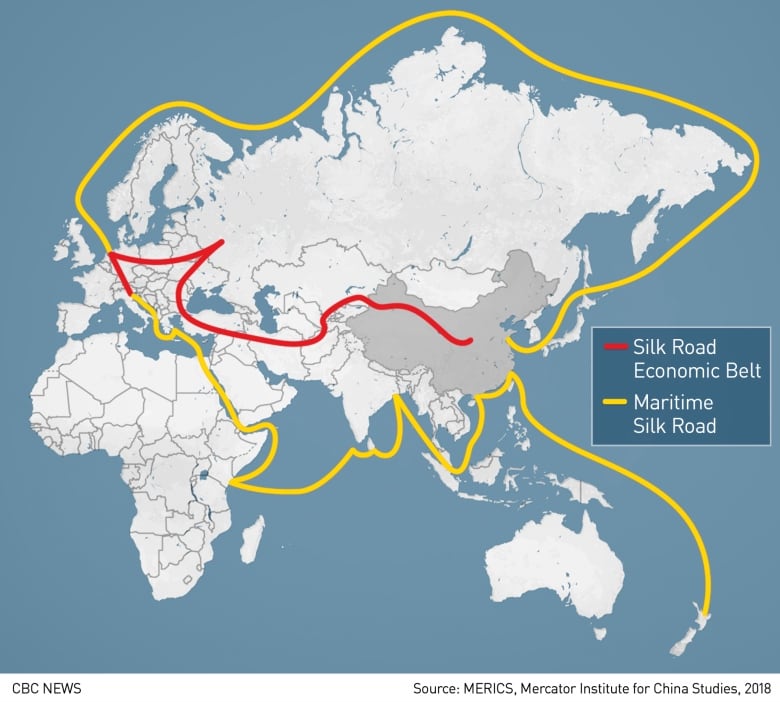
When China initially embarked on its ambitious Belt & Road project, it had plans to link itself to a new 'Silk Road', an enterprise that was meant ultimately to expedite Chinese trade and transport and shipping globally, the trade colossus thinking ahead to the future -- its future -- as the world's major producer and seller of goods. Its plan to finance major infrastructure projects was sold to countries in Africa and the Middle East and Europe convincingly assuring them that this would modernize their countries for the future in new highways and bridges and other forms of infrastructure.

That many of these countries had no basic infrastructure of the type Beijing was describing, or insufficient or outdated ones was because they lacked the financial wherewithal to build them. Beijing obviously reasoned and explained to any governments that were skeptical that the Belt & Road initiative would benefit all concerned; give immediate employment to their nationals in building the projects, and extend employment through operational ties that would ultimately result, enriching both China and the countries it was investing in, so they could pay back the huge loans.

Some economists raised concerns that this would result in massive indebtedness, that some of those countries would never be capable of extracting themselves from. And this was all well before anyone might have thought ahead to a massive economic blow that would strike globally with the introduction from China to the world at large of a global viral pandemic devastating world economies. Long before the Belt & Road initiative rang a bell of opportunity to Beijing it was busy investing in other countries' natural resources.

Security personnel stand guard near a "Golden Bridge on Silk Road" decoration for the Belt and Road Forum outside the China National Convention Center in Beijing earlier this year. (Jason Lee/Reuters) 

As it did in Venezuela, reaching agreement with Hugo Chavez where between 2007 and 2013 the China Development Bank loaned out to Venezuela close to $40 billion with Venezuela's oil wealth as surety, boosting Hugo Chavez's plan for "a Great Wall" erected to fend off U.S. hegemonic reach. And then Venezuela's oil resources ran into trouble with refining problems because no funding was directed to upgrading its oil infrastructure. After investing to that degree Beijing felt compelled to continue in the face of Venezuelan mismanagement and lent out another $20 billion, and all too soon Venezuela defaulted.

That might have been a lesson in not hedging bets, failing to look ahead to the future when all the signals were already in evidence. But the Belt & Road followed nonetheless. "Chinese foreign policy and policy bank officials entered into their outsized economic and political relationship with [Venezuela] with a combination of hubris, ambition and naivete. [This] has contributed to the region's worst economic, humanitarian, and political crisis in decades", wrote Matt Ferchen of Merics, a think tank based in Berlin.

And that hinted at what is now proceeding with the Belt & Road, where at least 18 processes of debt renegotiation with China have occurred in 2020 -- and yet another dozen countries still in discussions with Beijing, covering $28 billion in Chinese loans as renegotiations have proliferated since the pandemic hammered emerging economies in Africa and elsewhere wherein Beijing saw opportunities for  massive Belt & Road investment.

Originally, when Xi Jinping addressed a hall of heads of state and delegates from over 130 countries in Beijing, he proclaimed "a project of the century". Where he promised that China was prepared to spend a stunning $1 trillion on building infrastructure, mostly in developing countries around the world, financing almost all of it through its own financial institutions. Data published this week indicates that President Xi's script has been revised downward. The world's most ambitious development program is now on hold.
 
 
China is now looking at the unwanted potential of its first overseas debt imbroglio. Chinese financial institutions tasked to drive the Belt & Road in tandem with bilateral support to governments has hit a detour leaving Beijing mired in debt negotiations with a host of countries it had so assiduously wooed. Researchers at Boston University maintain an independent database on China's overseas development finance, and they have found lending by the China Development Bank and the Export-Import Bank of China in free fall, collapsed from a peak of $75 billion in 2015 to last year's $4 billion.

Falling under the direct control of China's state council the two banks function as arms of the state providing the overwhelming bulk of China's overseas development lending. Funds disbursed by the two banks rival in scale the disbursement of the world's largest multilateral lender, the World Bank. Between 2008 and 2019, the two Chinese banks loaned out $462 billion, a tad less than the $467 billion the World Bank extended. 
 
https://csis-website-prod.s3.amazonaws.com/s3fs-public/styles/csis_banner/public/page/190408_Risberg.jpg?itok=HBb7RiLW
Photo: LAKRUWAN WANNIARACHCHI/AFP/Getty Images
The sharp scale-back  of lending by the Chinese banks represents an economic earthquake and should it persist, an infrastructure funding gap in Asia alone will be exacerbated, a gap that has reached $907 billion at this point. Chinese credit has formed a large portion of infrastructure financing in Africa and Latin America, and the gap between what is needed and what may be available is expected to become wider, as well.

Beijing has regrouped, examined its losses and decided to scale back, retreating from overseas development finance, to shift policy from outside the country to internal investments. "China is consolidating, absorbing and digesting the investments made in the past", advised Wang Huiyao, an adviser to China's state council, president of the Centre for China and Globalization think tank. The politboro  will now place greater emphasis on China's domestic market, and less on commerce with the outside world.


Labels: , , , , , , , , , , ,

Tuesday, February 04, 2020

Israel, Harvesting Goodwill Among Former Enemies

"It was agreed to start co-operation leading to normalization of the relationship between the two countries."
"Netanyahu believes that Sudan is moving in a new and positive direction."
"[Sudan's leader] is interested in helping his country go through a modernization process by removing it from isolation and placing it on the world map."
Israeli statement

"If a friend says I want your embassy here rather than there I don't see why there would be ... "
"We are really working, we're studying that [the possibility of opening an embassy in Jerusalem]."
Ugandan President Yoweri Museveni

"You open an embassy in Jerusalem and I will open an embassy in Kampala."
"We hope to do this in the near future."
Israeli Prime Minister Benjamin Netanyahu
Prime Minister Benjamin Netanyahu (R) is welcomed by Ugandan President Yoweri Museveni at the State House in Entebbe, Uganda, February 3, 2020. (Sumy Sadurni/AFP)

"This meeting is a stab in the back of the Palestinian people and a blatant departure from the Arab Peace Initiative at a time when the administration of [US] President Donald Trump and Israeli Prime Minister Netanyahu are trying to liquidate the Palestinian cause."
Saeb Erekat, secretary general, Palestine Liberation Organization
How situations in the world change, forever in flux, careening from one state of affairs to another. Uganda, under its notorious dictator Idi Amin, was viewed as a threat to the world order as seen from the African continent. It was, in very fact, there that a 1976 PLO hijacking of an Air France airbus en route to Paris from Tel Aviv culminated, when the Popular Front for the Liberation of Palestine forced the plane to land at Entebbe airport in Uganda, with the full support of President Amin.

A tense standoff ensued, with the hijackers demanding the release of its terrorist members from Israeli prisons in exchange for the safe release of the hostages on the plane. Those passengers numbering 148 who were not Jews or Israelis were released and allowed to fly on to Paris, while the 94 Israeli and Jewish passengers and 12-member Air France crew were retained as hostages, and threatened with death should their demands not be met.

The Israel Defence Forces mounted a rescue operation to free the hostages, where a carefully planned operation began; Israeli transport planes with 100 commandos were flown at night the 2,500 miles to Uganda. The operation lasted 90 minutes and succeeded in rescuing 102 of the 106 hostages. Three of the hostages died during the raid on the airport. Five Israeli commandos were wounded, and a unit commander, Lt.Col. Yonatan Netanyahu was killed, the older brother of President Benjamin Netanyahu.

And now he found himself, in the interests of expanding Israel's diplomatic foreign relations with other nations, at the Entebbe home of current Ugandan President Yoweri Museveni to discuss friendly relations and the possibility of exchanging embassies in one another's capital cities. While there, he met Sudan's new president who took the place of the former leader Omar al-Bashir, wanted by the International Criminal Court for war crimes and crimes against humanity in his Darfur genocide.

Not so long ago Sudan was a threat to Israel, linked to its friendship with Iran, where the country was being used as a conduit for munitions smuggling overland through to the Gaza Strip to arm the terror group Hamas. According to regional sources, Israeli aircraft bombed an arms convoy in Sudan headed for Gaza, in 2009. Khartoum has since placed distance between its government and that of the Islamic Republic of Iran, leading Israel to the view that it no longer poses a threat to Israel.

Not only is Sudan now courting its own new links to civilized nations, but it has received an invitation from the United States for the head of its Sovereignty Council, Abdel Fattah al-Burhan, to visit Washington. It was in Sudan in 1967 that Arab states gathered, and where the "Three No's" were issued, targeting the State of Israel. 'No' recognition of Israel, 'no' peace with Israel,'no' negotiations with Israel.

Israel has diplomatic relations to date with 162 of the 193 member-nations of the United Nations, of which 31 countries don't recognize the Jewish state as a legitimate nation. Among them, Cuba and North Korea. There are signals ahead in the Middle East that countries like Oman, Saudi Arabia and United Arab Emirates, for example, are preparing to extend diplomatic ties with Israel on the basis of their common interests and their recognition finally that Israel is there and will remain where it belongs.
"I am a staunch supporter of my country establishing diplomatic ties with Israel. I know many people who are in favor of this move. Like myself they wonder why it has taken this long."
"[Israel has] immense influence in the region and throughout the world."
"I am convinced that forging ties with Israel will be in our mutual interest. One of the reasons we need to establish ties with Israel sooner rather than later is to bring an end to the war of the extremists that is being waged against our people on a daily basis."
"The bloodletting of our people must end sooner rather than later and we will need all the help we can get to achieve this goal."
Abdullahi Dool, senior Somali diplomat, former director, Somali foreign minster office -- fired in April for advocating ties with Israel
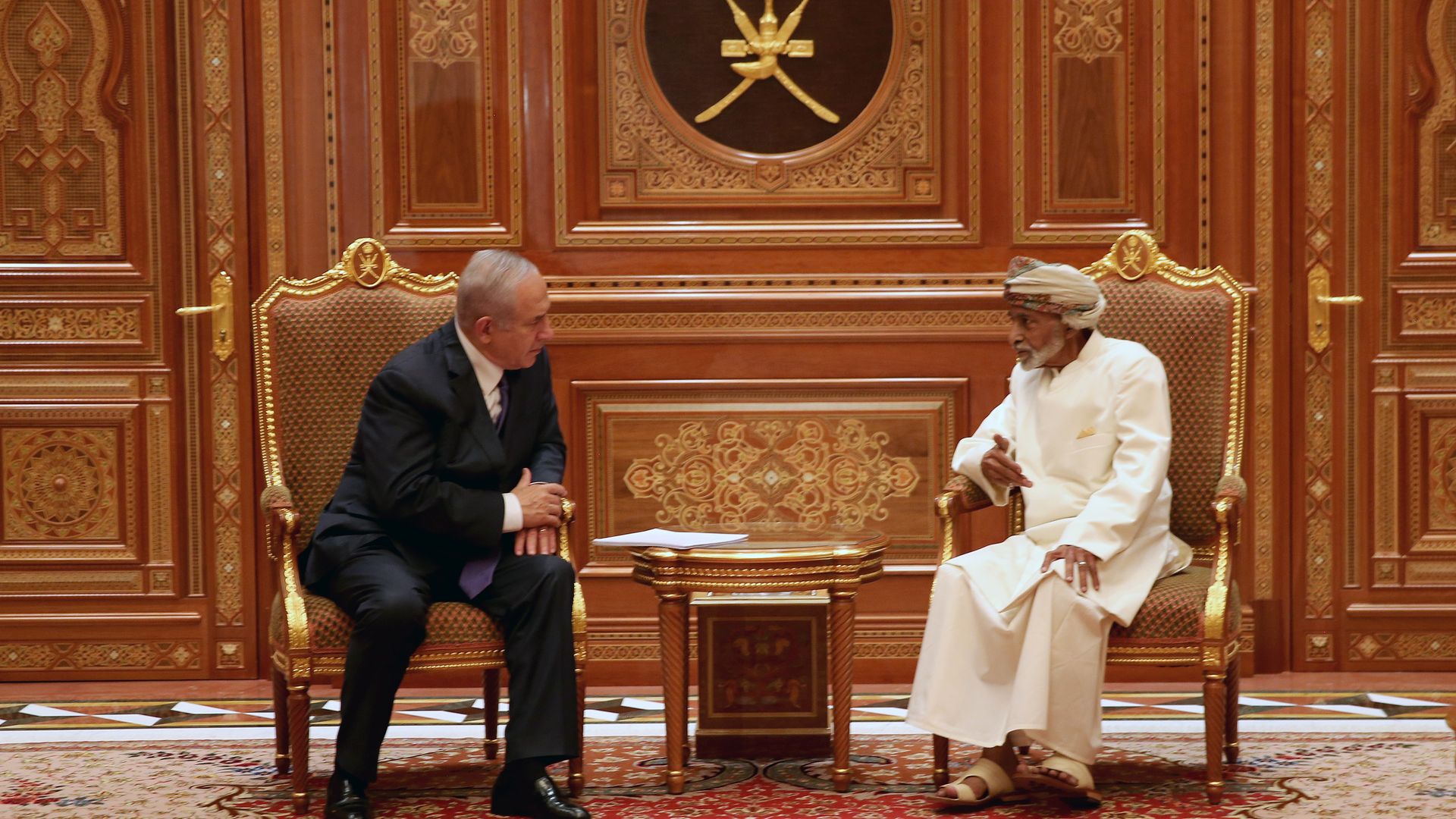
Netanyahu and Sultan of Oman
Netanyahu attends a meeting with the Sultan of Oman in Muscat, Oman, Oct. 26, 2018. Photo: Israeli Prime Ministry Office/Handout/Anadolu Agency/Getty Images


Labels: , , ,

Sunday, April 21, 2019

Nothing Succeeds Like Success

"I am a staunch supporter of my country establishing diplomatic ties with Israel. I know many people who are in favor of this move. Like myself they wonder why it has taken this long." 
"[Israel has0 immense influence in the region and throughout the world. I am convinced that forging ties with Israel will be in our [Somalia's] mutual interest. One of the reasons we need to establish ties with Israel sooner rather than later is to bring an end to the war of the extremists that is being waged against our people on a daily basis. The bloodletting of our people must end sooner rather than later and we will need all the help we can get to achieve this goal."
"I believe Israel can help us swing the pendulum of violence in our country’s favor. Israel can also open doors for Somalia because of its sheer influence. They say time and tide wait for no man and I believe ties with Israel should have been established a long time ago. But this is now something I have taken on as a mission that must be accomplished."
"The Palestinians are their worst enemies. They never miss an opportunity to miss a chance. They are idiots and losers in Gaza. They should be condemned each time they attack civilians. It is in our interest to welcome Israel.:
"As you know, our country is dependent on the international community for support and solidarity, and the practice of anti-Semitism in our government is unacceptable if not unthinkable. Bigotry in our government is against everything we stand for as a nation."
"There are over 20 Muslim countries that have diplomatic ties with Israel… There is absolutely no reason why Somalia too should not establish diplomatic ties with Israel."
"You are making it like coming out of a closet. I don’t see it that way. To the contrary, I think forging ties with Israel is in the national interest of my country. We can only ignore regional and global trends at [our own] peril."
Abdullahi Dool, senior Somali diplomat, fired for publicly advocating the establishment of formal relations with Israel


Hostility to Israel and the threats and violence that have characterized its neighbours' reaction to Israel's presence in the Middle East have undergone a sea change. Israel is located in a tough neighbourhood. Where tribal, clan and sectarian loyalties represent collaberative alliances and irrepressible flare-ups of antagonistic fervour. The nations of the Middle East, with its ethnic and tribal histories of warfare simmer beneath the facade of civilized demeanor, but none is too far from flare-ups reflecting a history of challenging one another for existential resources.

Even at a time when the oil sheikdoms, kingdoms and tyrannies have found themselves a source of wealth through the simple extraction of petroleum resources naturally endowed in the region, jealousies and power manoeuvring, along with sectarian hostilities ensures that suspicion rules. The people of Muslim-majority countries, tiring of the constant state of manipulated indebtedness to their rulers at a time when mass communication invites them to see how free people in democratic nations live in more equitably-shared wealth and personal freedoms, agitate for change.
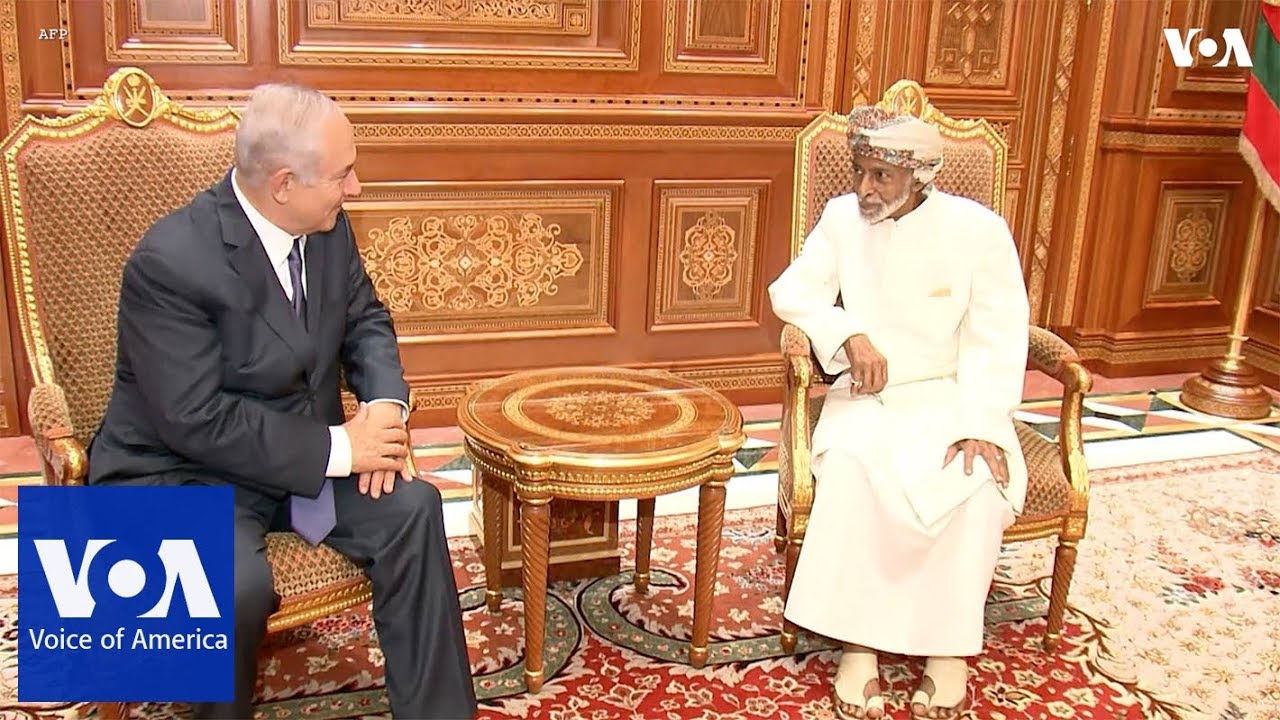
Benjamin Netanyahu and Qaboos Al-Said (VOA)

Current-day challenges and distractions along with ongoing divisions between more fundamentalist sharia-observing nations and less restrictive administrations opening themselves to European and Western types of governance and cultural refinements have tempered Sunni-led resistance to Israel's presence, moving from violent military attacks to isolating Israel, to finally relaxing relations toward toleration however grudging in character and critical outwardly, while discreetly opening diplomatic relations.

The rise of Iran's revolutionary Shi'ism and its stealth plans to dominate the region, first by making itself indispensable to the incitement of hatred against Israel through its dedicated aspirations of destroying its presence on 'consecrated' Islamic ground, carefully nurturing terrorist groups cradling a like agenda for themselves while orchestrating attacks against Jewish targets outside the Middle East has ensured that Israel's attention turned from its erstwhile adversaries' threats, now muted, to that of the Islamic Republic of Iran's.

Iran has succeeded in establishing a critical mass in a pincer movement pushing Arab Muslim countries into defensive mode in recognition of its threat inherent in a Shi'ite crescent including Lebanon, Syria, (nominally Qatar and Iraq) and Yemen, minorities though they may be in comparison to the majority Sunni states. Its insistence on establishing itself as a regional power and its unstoppable aspiration to acquire nuclear weapons concern the majority Sunnis. That they and Israel recognize a common enemy has aided their rapprochement.

Arab Inter-Parliamentary Union Flags

AE, Saudi Arabia, Egypt Reject Text Opposing Normalization with Israel at Inter-Arab Forum


Arabs respect power and might. They have no use for half-measures, for reassurances of accommodation in a civilized mode of conciliation. Military prowess as a show of strength and purpose is what gains their respect as opposed to appeasement in the interests of accommodation which is viewed as a sign of weakness. Israel has fought every step of the way to attain its statehood and to protect it from superior military numbers to its own; each of the conflicts forced upon the Jewish state was forcefully dealt with in Israel's favour.

The Arab powers might be angry and resentful but they also admire the determination and strength that achieved that outcome and with that came respect and the self-admission that their own stability in the region might be better achieved with cooperation with Israel against a common enemy. The Arab states became wealthy not because of entrepreneurial skills, scientific achievement, intellectual capability, but because they could rely on the riches of natural resources.

Israel became a power house of technical advances in water desalinzation and purification, agricultural expertise -- but also in advanced science, medicine and technology.
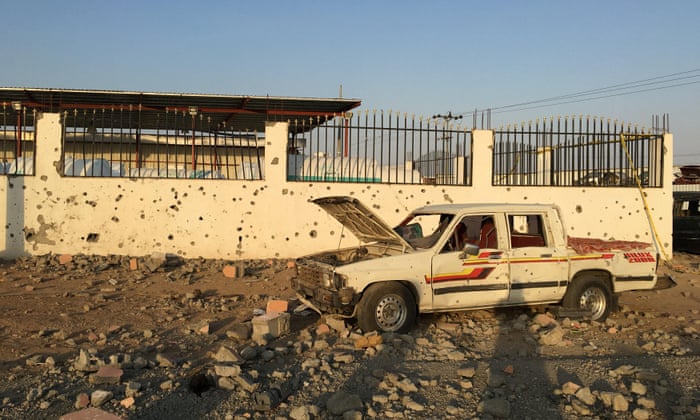
Buildings hit by Houthi rockets in Najran, Saudi Arabia, August 2016. Photograph: Reuters

Recognizing the need for diversification and to achieve skills in entrepreneurship to augment reliance on oil shipments abroad, and tourism, along with the need to protect themselves from the malignant plans of Persian Shi'ite Iran, it's little wonder the grudging admission that peace with Israel became an option, where any manner of 'normalcy' with the Jewish state up to now was anathema. The Palestinians are livid with this state of affairs, which they stigmatize as abandonment of their cause; it was those Arab states to begin with, that assured Palestinians in 1948 that Israel would be destroyed and Palestinians could return to 'their' land.

Alexander Shatilov shown on the screen singing along with Israel’s national anthem “HaTikvah” after winning a gold medal at the Gymnastics World Cup in Doha, Qatar. Photo: Screenshot.

Now, the United Arab Emirates has opened civil diplomatic relations with Israel. Prime Minister Netanyahu visited Oman with mutual compliments exchanged and interest expressed in forging closer alliances. A number of African nations have declared themselves interested in opening closer relations with Israel, thanks to Israel's active and deliberate outreach program. Qatar's Artistic Gymnastics World Cup featured an Israeli winning gold, with the Israeli national anthem and flag played and flown for the first time in an Arab state.
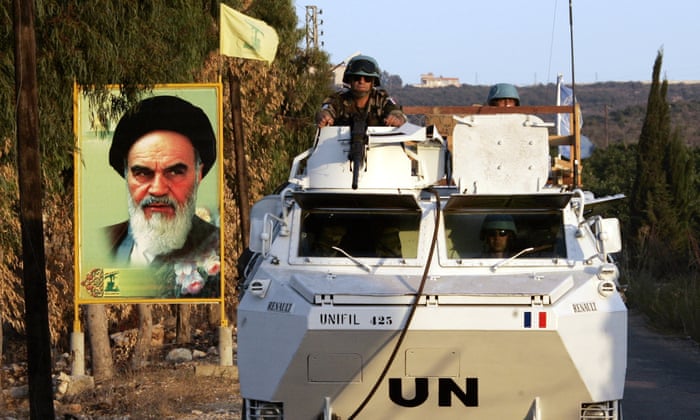
UN peacekeepers with a billboard showing Iran’s late leader Ayatollah Khomeini after the Israel-Hezbollah war, southern Lebanon, September 2006. Photograph: Francois Mori/AP

There was a time when Iran, under Shah Mohammad Rezi Pahlavi, before the 1979 Iranian Revolution, had good, stable relations with Israel. Turkey, until the ascension of Recep Tayyip Erdogan's Islamist Justice and Development Party had close collaborative relations with Israel, since deteriorated beyond repair. The Middle East and Muslim nations are nothing if not changeable and occasionally beyond fissionable.

Which brings us to Israel's relations with the Palestinians, Fatah and Hamas, the former a covert terrorist group, the latter overt, but both sharing a like goal; the elimination of Israel.

They have become lifelong enemies of Israel, aspirants to possession of the heritage Judaic land on which Israel sits. Both have inspired hatred and vengeance in their young through tutoring hate in school curricula, youth camps, television programs, to ensure the next generation of Palestinians willing and able to engage in violent assaults against Jews will not be terminated. Those who die in the attempt to extract life from Jews become celebrated martyrs whom schools, squares, public centers and soccer fields are named after, as heroes.
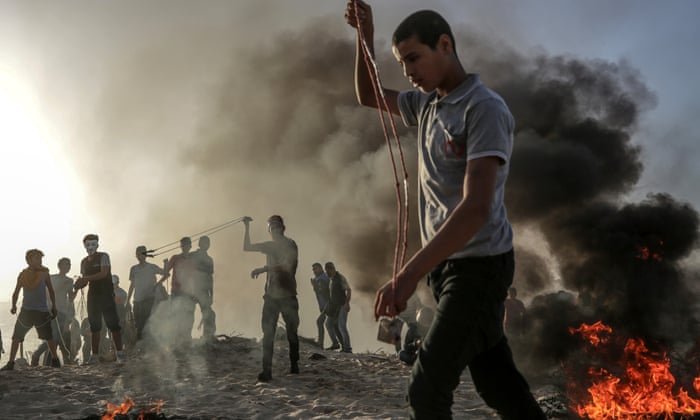
Palestinian 'protesters' on the border between Israel and the Gaza Strip, October 2018. Photograph: Mohammed Saber/EPA

Palestinian terrorists who plot violence against Israel, who are imprisoned for murdering Jews, are paid salaries by the Palestinian Authority. They view it as their sacred obligation to themselves to make certain that their population hates, fears and pledges to violence against Jews. The Palestinians, had they agreed to reconciliation, cooperation and a peace agreement, could at many junctures over the years have had a state of their own, and with that state as neighbours of Israel they would have benefited hugely, industrially, economically.

They chose, time and again, not to. The allure was vengeance.

Now, Arab states in their aggregate have come around to deciding otherwise, seeking economic benefits from connecting with Israel; seeing benefits that can accrue to them in many spheres of an improved economic, technological, scientific collaborative future with a capitalistic, democratic, liberal nation next to their own. But then, this being the Middle East, the lesson of Iran's and Turkey's once-close relationship with Israel expresses its own cautionary tale for the future.
Israeli prime minister Benjamin Netanyahu with the Sultan of Oman, Qaboos bin Said Al Said, in Muscat in October 2018. Photograph: Anadolu Agency/Getty Images

Labels: , , , , , ,

Wednesday, December 26, 2018

Neurodegenerative Disease: Youth/Elderly

"Notice the obvious paradox. Teenagers. In an epidemic. In norther Uganda. Dying of a neurodegenerative disease."
"It's totally remarkable. Nodding syndrome is a tauopathy. Our hypothesis is that nodding syndrome is a neurodegenerative disease, like Alzheimer's."
Michael Pollanen, chief forensic pathologist, Ontario
A 2012 image from Uganda shows an 11-year-old boy suffering from nodding syndrome.
JAMES AKENA/REUTERS

Nodding Syndrome is recognized as rare and as a disease whose origins are still unknown, mysterious. Understanding it, however, may give medical science a clue to origins and patterns recognized in Alzheimer's Disease. And Ontario's chief forensic pathologist, Michael Pollanen has produced some pioneering research that has been published recently in the journal Acta Neuropathologica. His insight may lead to a new understanding of the nature of age-related dementia and Alzheimer's; one of the oddities here is that Nodding Disease is a neurodegenerative disease that victimizes children, quite the opposite age spectrum that Alzheimer's strikes.

What Dr. Pollanen found remarkable, is that children were dying of an affliction that everywhere else in the world has symptoms that exclusively strike the elderly, with rare exceptions. What is also noted is that while children are being struck down by this degenerative attack on their neural system, their parents remain unaffected by Nodding Syndrome. "Why are the parents not affected?", asks Dr. Pollanen and the answer to that may very well answer a great deal more, with respect to the much broader worldwide issue of Alzheimer's Disease.

He has a scientist's educated hypothesis based on what he already is aware of that a convergence of genetic and environmental factors may be found to be at play. One such epidemic of Nodding Syndrome broke out in the 1960s in Tanzania, and in South Sudan in 1998. Now it has become an epidemic in Northern Uganda; all African nations, all countries that have been roiled by brutal conflicts, by issues of malnutrition and desperate existential fear.

Where it strikes is in impoverished and insecure environments, where subsistence-farming villages have become susceptible to its mysterious onset, along with those languishing in camps for internally displaced people. Only children between around five and fifteen years of age are affected; the disease peaks around the age of eleven. Societal turmoil appears to unleash its onset; in central Africa when the Lord's Resistance Army abducted children to be trained as soldiers or act as sex slaves.

The epidemic first surfaced in a camp for internally displaced persons in 2004 when children would initially display classical nodding, mistaken for atonic seizures; a generalized brief loss of muscle tone that degenerated to severe intellectual impairment, grand mal seizures and death. Victims become mute, some paralyzed in its later stages -- while others yet exhibit Parkinsonism-like symptoms.

These physical and mentally vulnerable children then become victim in a perilous environment of camps to being accidentlally burned in charcoal cooking fires, drowning in open water, injured when falling from heights, or they become the helpless victims of sexual violence. Strong epidemiological association with a common parasitic infection of a water-borne worm that can cause skin problems, blindness and affects the brain has been theorized.

As another theory would have it, Nodding Syndrome represents a lingering effect of the measles virus infection, leading to a neurodegenerative disease.

According to Dr. Pollanen, the U.S. Centers for Disease Control investigated Nodding Syndrome but it appears found no significant answers. It appeared that the agency found nothing in the dissected brains of the victims, leaving room for more intensive investigation. The brains of five fatal cases were studied by Dr. Pollanen; a typical 14-year-old girl had been malnourished, wasted, dehydrated, had multiple healing injuries and died of dehydration and malnutrition.

In their newly published paper, Dr. Pollanen and his colleagues describe a neurofibrillary tangle; distinctive brain lesions that are seen as playing a central role in Alzheimer's. In addressing an audience of doctors and epidemiologists how it would appear if these tangles were in the frontal cortex, the response was: "memory and cognitive impairments". And if the tangles were in the brain stem? Parkinsonism.

The general consensus reached is that Nodding Syndrome "recapitulates" in a manner not yet understood let alone proven -- in children, not adults, the type of neurodegenerative disease typically found in adults worldwide. Tangles in the neurons, age-related plaques in the brain's grey matter, all somehow appear to figure into the equation. What is also unclear is why it is that children born later in birth order are less likely to be affected.


Labels: , , , ,

Wednesday, July 11, 2018

A Puzzle Within a Conundrum Within a Problem Leading to a Dilemma

German Chancellor and leader of the Christian Democratic Union (CDU) party, Angela Merkel (L) and Austrian Chancellor Sebastian Kurz shake hands during the conference of the CDU Economic Council, “Economy Day 2018” in Berlin, on June 12, 2018. JENS BUTTNER/AFP/Getty Images
"A Europe without internal borders can only exist if it has functioning external borders."
"[It is vital that Europe preserve its borderless domain represent -- in a very real sense its raison d'etre -- since free movement of people across those borders] is the basis of the European idea, and we have to do everything to keep it alive."
"[This is] an important moment, a very sensitive time [for European survival]."
"The European Union is not only a great idea, but it's also an idea we must keep working on."
"What every generation must do is try to make Europe better than it was in the past."
Austrian Chancellor Sebastian Kurz

"They [resistant-to-migration European nations] are doing this [through the ascension of populist governments] in the name of Europe. But that is a very different kind of Europe." 
"The people who made it to Germany in 2015 crossed many hard borders to get there. So they pick up West Africans and send them back to Egypt?"
Gerald Knaus, director, European Stability Initiative, Berlin

"A lot of difficulties exist with the global asylum-system] But the idea that there is something wrong about claiming asylum in Europe -- that's quite a shift from a group of countries that created the Geneva Convention 60 years ago [governing refugee acceptance]."
"It's not just about what happens on the border, but what happens after the border."
Elizabeth Collett, director, Migration Policy Institute Europe
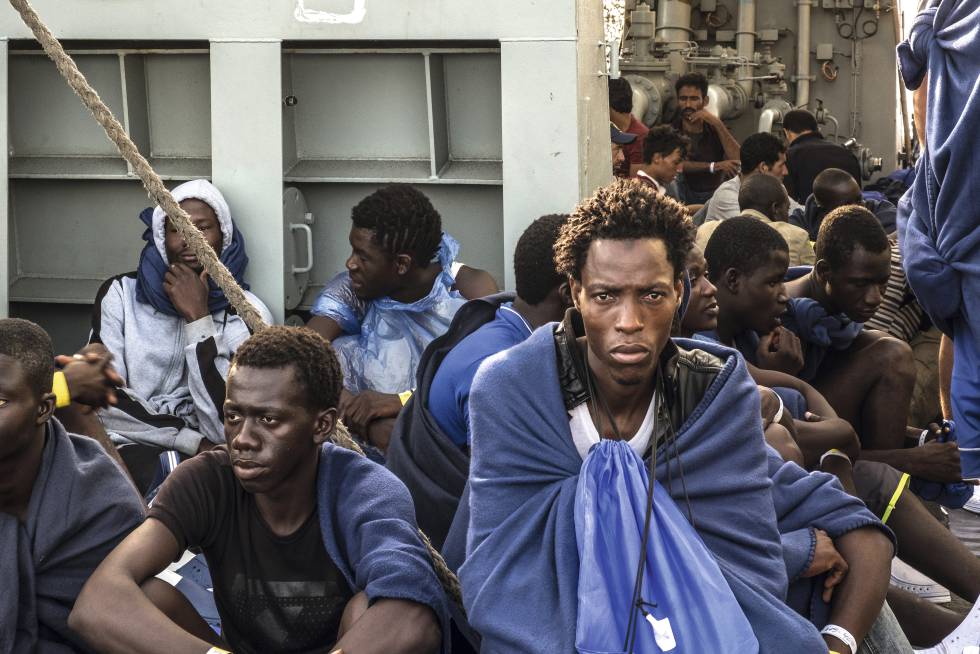
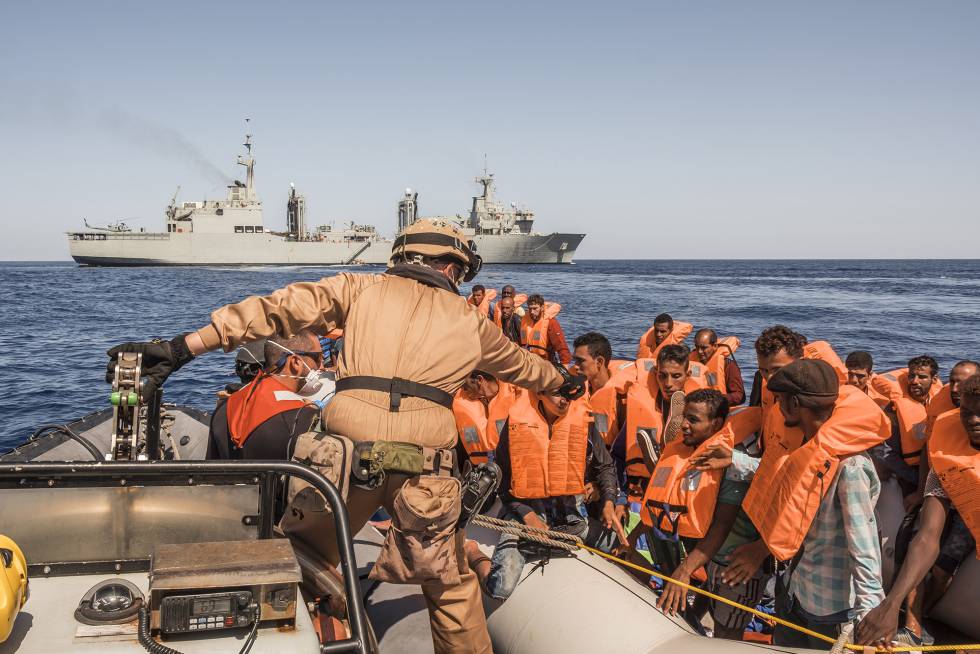
Migrants aboard the Cantabria, silent witnesses to the conflict.

Could the 28-member-country European Union be any more polarized? Eastern European countries have balked at the EU directive allocating shared acceptance of refugees, haven seekers, economic migrants that have flooded Europe for the past three years. At the same time, Western Europe was welcoming the Middle Easterners and North Africans, some fleeing conflict, exploitation, threats, economic hardships, maladministration and violations of human rights. Some determined to leave their countries of origin to seek haven, others to find economic heaven in wealthy, heavily social-service-oriented countries.

Entering Europe by the dangerous expedient of crowded, inadequate unseaworthy vessels operated by human smugglers disinterested whether those who pay them handsomely for the opportunity live or die, Greece and Italy became the link to Europe, while most of those entering Greece and Italy had no intention of remaining in countries struggling economically, most setting their sights for Germany, Austria, Sweden and other 'progressive', wealthy countries which they felt certain would pull out all the humanitarian stops for them, offering shelter, medical care, food and opportunities to advance.

They were correct in their assessment, and though by EU convention in law refugees were meant to remain in the first country they accessed, the reality is the refugees, haven seekers and economic migrants had other plans and steadily moved northward. To be welcomed initially, but when their numbers continued to swell and the welcoming countries became overwhelmed, their social services stretched to the limit and beyond, their indigenous populations alarmed and resentful, everything changed.
A group of migrants from the Ivory Coast in the ship after being rescued close to Libyan territorial waters.
Chancellor Kurz, firmly in the refusal-to-admit camp is president of the EU for the moment in its revolving chairmanship protocol. As a newly elected populist leader brought to office on his anti-migration platform wedging the EU to confront the quandary before it, that unrestrained entry to Europe through the generous compulsion to respond positively to the demands of the migrants and refugees was creating a broad backlash that required a solution. As far as Kurz is concerned preserving borderless visa-free travel throughout Europe is possible, but only if external European borders are firmly closed.

The EU as a liberal European order with trust between nations in a unified and open movement of people and goods is facing the reality of a growing revolt of the public against immigration from the Middle East and Africa. The indulgence of welcoming people from a milieu whose culture, heritage, laws and religion are so at odds with that of Europe in every conceivable index of social progress, equality and gender awareness threatens to swamp native values, ignore their laws and contest the heritage of religious devotion turning the original enthusiasm for acceptance to rejection.

Shutting down Europe's southern border, increasing patrols in the Mediterranean and returning migrant boats to their source -- for the most part Libya and  Egypt -- is seen as the solution by Austria, Italy, Hungary and others, in direct challenge to Germany. Yet Germany's Horst Seehofer, interior minister, a Bavarian whose province has firmly rejected any further absorption of migrants, threatened to bring down Chancellor Merkel's government if a hard border was not established.

In interests of preserving her ruling coalition Markel assented, agreeing to turn back asylum seekers already registered elsewhere, along with setting up transit camps along the Austrian border to assess status and arrange deportation when required. Angela Merkel's controversial 2015 decision that Germany was prepared to welcome and absorb over a million refugee/migrant swells heading for a Germany they had heard would welcome them, set the stage for the current emergency Europe is facing. With the knowledge they would not be turned away, they kept coming ... and coming.


Labels: , , , , , ,

Tuesday, June 26, 2018

The Unstoppable Migrant March : Solution? Expulsion, Abandonment

"Women were lying dead, men .... Other people got missing in the desert because they didn't know the way."
"Everybody was just on their own. I lost my son, my child."
Janet Kamara, Liberian migrant, Niger
Janet Kamara, from Liberia, was expelled from Algeria and left stranded in the Sahara while pregnant. Her baby did not make it.Al
Janet Kamara, from Liberia, was expelled from Algeria and left stranded in the Sahara while pregnant. Her baby did not make it.Al   AP Photo/Jerome Delay

"There were people who couldn't take it. They sat down and we left them. They were suffering too much."
"They [Algerian military] tossed us into the desert, without our telephones, without money."
Aliou Kande, 18, Senegalese migrant

"You're facing deportation in Algeria -- there is no mercy. I want to expose them now... We are here, and we saw what they did."
"And we got proof [phone videos of the process of directing migrants to cross the desert on foot, no food, no water, no directions]."
Ju Dennis, Liberian migrant, filming deportation

"They come by the thousands. This time the expulsions that I'm seeing, I've never seen anything like it."
"It's a catastrophe."
Alhoussan Adouwal, IOM (International Organization for Migration) official, Assamaka, Algeria
In this Tuesday, May 8, 2018 photo provided by Liberian migrant Ju Dennis, Algerian gendarmes carrying AK-47 assault rifles load migrants onto trucks to drop them off near the Niger border. Dennis filmed his deportation with a cell phone he kept hidden.
In this Tuesday, May 8, 2018 photo provided by Liberian migrant Ju Dennis, Algerian gendarmes carrying AK-47 assault rifles load migrants onto trucks to drop them off near the Niger border. Dennis filmed his deportation with a cell phone he kept hidden.   AP Photo/Ju Dennis
The flood of African migrants appears unstoppable. By word of mouth alone there is little doubt that those setting out to leave their places of origin are aware their presence in other countries where they hope to find sanctuary from the oppression, poverty, corruption, violence and conflict they have been subjected to, will be anything but welcome. Even those villages where they cross borders whose residents' compassion has been stirred to give aid, soon find they are suffocating with the presence of strangers whose needs consume their paltry resources and resentment soon sets in.

The desperately vulnerable men, women and children of Africa are setting out resolutely to find an elusive future of opportunity for themselves and their children. On the way they find indifference and resistance to their presence in neighbouring African countries so they dream of somehow making their way through to Europe, already saturated with the presence of other, earlier migrants and refugees calling upon humanitarian impulse to come to their aid. The generosity of strangers has its limits and those limits are reached when hardship is imposed through sheer strength of numbers.

Algeria now stands charged by the world community of deliberately abandoning over 13,000 people in the great heated, hostile environment of the Sahara Desert, left there to fend for themselves in search of haven and ultimately security. Over a fourteen-month period, men, women -- including those pregnant -- and children have been expelled and left without food or water, forced to trek, occasionally at gunpoint, under a pitiless sun. By the hundreds they march listlessly, attempting to escape the vastness of the overheated desert where death looms large under temperatures up to 45C.

The desolation is mind-numbing, and not all those who set out are sufficiently physically fit to reach safety. Hungry, thirsty, burning from the atmospheric conditions, they head for Niger to the border village of Assamaka. For some, a rescue team representing the UN, relieves their march; if they can be found before they perish, but still thousands have. The European Union, in desperation to solve the dilemma of the unwanted arrivals of millions of migrants, has pressured North African countries to counter migrants heading for Europe via Libya and the Mediterranean or breaching the barrier fences with Spain.
Nigerians and third-country migrants head toward Libya from Agadez, Niger, on June 4. (Jerome Delay/Associated Press)

Algeria has responded by expelling their migrants, scooping them up by the hundreds, loading them on trucks and driving them for hours to a central point in the Sahara where they are released to find their way to Niger. Some simply head back toward Algeria. Some will never reach any destination beyond death. According to the International Organization for Migration, the march survivors total 11,276 men, women and children. Another 2,500 accounted for entry on their desert trek to Mali. It is unknown how many altogether simply succumbed to conditions not conducive to human survival.

In the group of a thousand people wandering the Sahara that included Aliou Kande from Senegal, he reported the trek from 8:00 a.m. to 7:00 p.m. seeing a dozen people collapse in the sand, surrendering to weariness, hunger, thirst. They are among the 'missing' never to be seen again. One man, Ju Dennis, hid his cellphone from the military which had removed them from peoples' possession so they would have no means of communication. Dennis filmed the deportation process, those being expelled and the armed gendarmes.

The IOM estimates that of the tens of thousands who have died crossing the Mediterranean, twice as many may have found their death in the vast Sahara desert. Their figure is upwards of 30,000 dying in the desert since 2014.  Adouwal with the IOM stationed himself in Assamaka from where he alerts his organization at the arrival of new groups out of the desert, at which time rescuers fan out to look for those remaining in the desert. An IOM bus takes them to the town of Arlit, six hours to the south, then on to Agadez, the city in Niger known as a crossroad for African trade and migration.

From there, the migrants will ultimately be returned to their home countries on flights sponsored by the IOM. And as they return south they come across others making the trip north toward Algeria and Europe. Like clockwork each Monday evening, pickups crammed with hopeful migrants pass through a city checkpoint, the migrants carrying water and walking sticks, determined to reach their future.

Migrants from across sub-Saharan African - Mali, the Gambia, Guinea, Ivory Coast, Niger and more - are part of the mass migration toward Europe, some fleeing violence, others just hoping to make a living. (Jerome Delay/Associated Press)


Labels: , , , ,

Tuesday, May 31, 2016

Murderous African Despots

"Hissene Habre, this court finds you guilty of crimes against humanity, rape, forced slavery, and kidnapping [as well as war crimes]."
"The court condemns you to life in prison."
Gberdao Gustave Kam, Burkinabe president of the Extraordinary African Chambers (CAE) court

Habre raises his hand in defiance following the court proceedings in Dakar on Monday [AP]

"For many years, as Souleymane and his colleagues hit one obstacle after another on their path to justice, the common refrain was that they would never succeed. But in a case that looked dead so many times, the victims made it clear that they would never go away."
"[Hissene] Habre's conviction for these horrific crimes after 25 years is a huge victory for his Chadian victims, without whose tenacity this trial never would have happened. This verdict sends a powerful message that the days when tyrants could brutalize their people, pillage their treasury and escape abroad to a life of luxury are coming to an end."
"Habre's conviction signals that no leader is above the law, and that no woman or girl is below it ... This is the first time in history that a former head of state  has been convicted in an international trial of personally committing rape."
Reed Brody, lawyer, Human Rights Watch
Guilty as charged. Chad's former dictator was responsible for the deaths of 40,000 people, deliberately murdered under his regime, with tens of thousands more Chadians taken from the streets, imprisoned and tortured. Among those many who experienced imprisonment and torture was Souleymane Guengueng, a civil servant and accountant tortured under the regime. And it was this man's experience that hardened his resolve to bring Habre to justice.

There was also the Chadian lawyer Jacqueline Moudeina whom a 2001 grenade attack from a henchman of Habre failed to kill and who took the initiative to lead the former dictator's victims in a battle for justice. And another Chadian, Clement Abaifouta, called the "gravedigger" who had been forced to bury in mass graves other detainees who had been murdered. Mr. Abaifouta had stepped in to fill the role that Mr. Guengueng was forced to abandon when he was forced into exile by death threats.

Monday's conviction held Hissene Habre responsible for thousands of deaths and torture in prisons during the 1982 to 1990 period when he ruled the country. A Chadian Truth Commission in 1992 had accused his government of systematic torture, that while he was in power 40,000 people were murdered by his political police force. Guilty: of crimes against humanity; guilty: of war crimes, torture and sex crimes; sentenced: to life in prison.

The Extraordinary African Chambers in Dakar, Senegal, a creation of Senegal and the African Union was where Habre was tried and convicted, the first trial where the courts of one country successfully prosecuted the former ruler of another for human rights crimes. In essence, it is a reflection of the United Nations' 'responsibility to protect' provision whereby a government that abuses and torments its population can expect the international community to intervene on behalf of the population.

That the African Union has finally taken such a step is an enormous advance for human rights entitlements on the Continent where murderous regimes proliftrerate. The successful prosecution and punishment of Sudan's president who has already been tried and found guilty in absentia by the International Criminal Court might be another step in that same right direction.

Pencil sketch of a man being tortured with a rope around his head
Victims drew pictures of torture techniques Some of his victims were subjected to "supplice des baguettes" (torture by sticks), when the victim's head is put between sticks joined by rope which is then twisted.  BBC

Souleymane Guengueng had formed an association of victims after his 1990 release from prison. As part of his campaign he had gathered testimony of former prisoners and in the process collected over 800 accounts presented as evidence that would ultimately prove the case at trial against Habre. Despite his crimes, however, Habre was surrounded by supporters in court, cheering him as their champion.

As for Mr. Guengueng, he has finally been able to savour the sweet taste of justice not only for himself personally, but for his country and for the countless families of people who were murdered by the regime, let alone the thousands who had been imprisoned and tortured, yet lived to see another day bring them vindication.

"It's truly a great example for all the other victims around the world, particularly in Africa, to no longer remain silent. It's the people in charge who must now be afraid", said Mr. Guengueng.

If only.

Labels: , ,

Thursday, May 12, 2016

A Record 38-million People Displaced

"This is the equivalent of the combined populations of New York City, London, Paris and Cairo grabbing what they can carry, often in a state of panic, and setting out on a journey filled with uncertainty."
"Put another way, around 66,000 people abandoned their homes every day of 2015."
Jan Egeland, the Secretary General of the Norwegian Refugee Council (NRC)

"Having comprehensive and accurate figures is essential to efforts to alleviate the suffering and needs of tens of millions of highly vulnerable people. National governments have primary responsibility for collecting this data, and for protecting and assisting internally displaced people. Sadly, this responsibility is not fulfilled in many contexts."
"This report illustrates the many challenges to addressing this global crisis of internal displacement. It also highlights the glaring absence of political solutions to address displacement, and constitutes an important wake-up call to national governments and global policy-makers alike." 
"By reporting on all situations of internal displacement, regardless of their cause, our intention is to provide an ever more holistic picture of what has truly become a global crisis."
Alexandra Bilak, Director, IDMC [NRC's Internal Displacement Monitoring Centre] 

Photo: IDMC
Photo: IDMC

What could appear more staggeringly tragic than to see the classic picture of people forced to abandon all they hold dear, their homes and neighbourhoods, jobs, schools, every element of comfort and security, leaving all their possessions behind to flee for their lives in the hope that they will find haven elsewhere. The bleakness and hopelessness of people trudging away from the familiar, from all they have worked to attain, leaving their aspirations behind in a bid to sustain their lives is heart-wrenching.

The warning issued by the humanitarian group to national leaders to pay attention to the needs of their populations is rather redundantly absurd under the circumstances where tyrants and their cohorts, where fanatical sectarian imperialism mandates that those not of their persuasion must die, where corrupt governments haven't a thought to spare for the welfare of the indigenous poverty-stricken, rule, and prosecute their wars. The plight of those they oppress is of no concern to them whatever; their obligation is only to their ruling aspirations.

According to the figures amassed for this major aid agency, the Norwegian Refugee Council, a truly staggering 38-million people globally have been internally displaced as a result of ongoing conflicts, along with the dislocation that occurs when natural disasters strike. This global crisis expresses the consequences of both conflict and nature delivering extenuating catastrophes in the space of a single year. Ten countries have been identified as being the source of the highest number of internally displaced people through conflict. Of that ten, five have been on the list annually since 2003.

Colombia, Democratic Republic of the Congo, Iraq, South Sudan and Sudan have taken their place on the list for the past dozen years. Natural disasters added to the fallout and displacement in 2015 that occurred in 113 countries with the numbers affected through internal displacement estimated at 19.2 million. In the space of the past eight years, according to the data released by the report, disaster-related displacements record a total of 203.4 million people. South and east Asia have been the most seriously affected. India, China and Nepal account for 3.7 million, 3.6 million and 2.6 million respectively.


Yemen, states the group's report, accounted for one quarter of conflict-related displacement globally in 2015, the result of the country's grip in yet another sectarian Muslim war, with the Shiite Houthi rebels, supported by the Islamic Republic of Iran, battling forces loyal to the internationally recognized government whom Saudi Arabia's intervention is supporting, in an obviously proxy war between the two regional sectarian antagonists, Iran and Saudi Arabia. In Yemen's case, 2.2 million people have been uprooted in that impoverished country.

Displaced people from minority Yazidi sect, fleeing violence from forces loyal to Islamic State in Sinjar
town, walk towards Syrian border, on outskirts of Sinjar mountain (Photo: Stringer Iraq / Reuters, August 2014).
Displaced people from the minority Yazidi sect, fleeing violence from forces loyal to Islamic State in Sinjar town, walk toward the Syrian border, on the outskirts of Sinjar mountain (Photo: Stringer Iraq / Reuters, August 2014).


Syria, with its 1.3 million displaced, and Iraq with 1.1 million, round out the top three conflict-riddled countries responsible for the greatest number of internally displaced. Which doesn't address those having left the geographic boundaries of their home countries to become refugees, currently flooding European nations in their attempts to escape the dysfunctional dangers of their countries mired in ongoing conflicts that have their genesis in tribal, sectarian antipathies leading to massively bloody assaults.

Nepal's earthquakes represented the dangers of geophysical hazards created by unsettling natural environments, while other weather-related hazards such as catastrophic storms and floods created their own issues of frantic internal displacements. Criminal violence in Mexico and Central America, tied to illegal drug cartels and prevailing corruption have been another source of internal displacement affecting an estimated million people.


Labels: , , , , , ,

() Follow @rheytah Tweet