Politic?

This is a blog dedicated to a personal interpretation of political news of the day. I attempt to be as knowledgeable as possible before commenting and committing my thoughts to a day's communication.

Saturday, November 26, 2022

Another Earthquake, Another Tragedy for Indonesia

"The challenge is the affected area is spread out -- "
"On top of that, the roads in these villages are damaged."
"[Many of the victims were children at school at the time the quake hit]."
Henri Alfiandi, head, National Search and Rescue Agency
 
"Everything collapsed beneath me and I was crushed beneath this child."
"Two of my kids survived. I dug them up ... Two others I brought here [Cianjur hospital, in Cianjur, Indonesia] and one is still missing."
Cucu, 48, Cianjur resident
 
"At leas six of my relatives are still unaccounted for; three adults and three children."
"If it was just an earthquake, only the houses would collapse, but this is worse because of the landslide."
"In the residential areas there were eight houses, all of which were buried and swept away."
Zainuddin, Cugenant resident
Earthquake in Cianjur
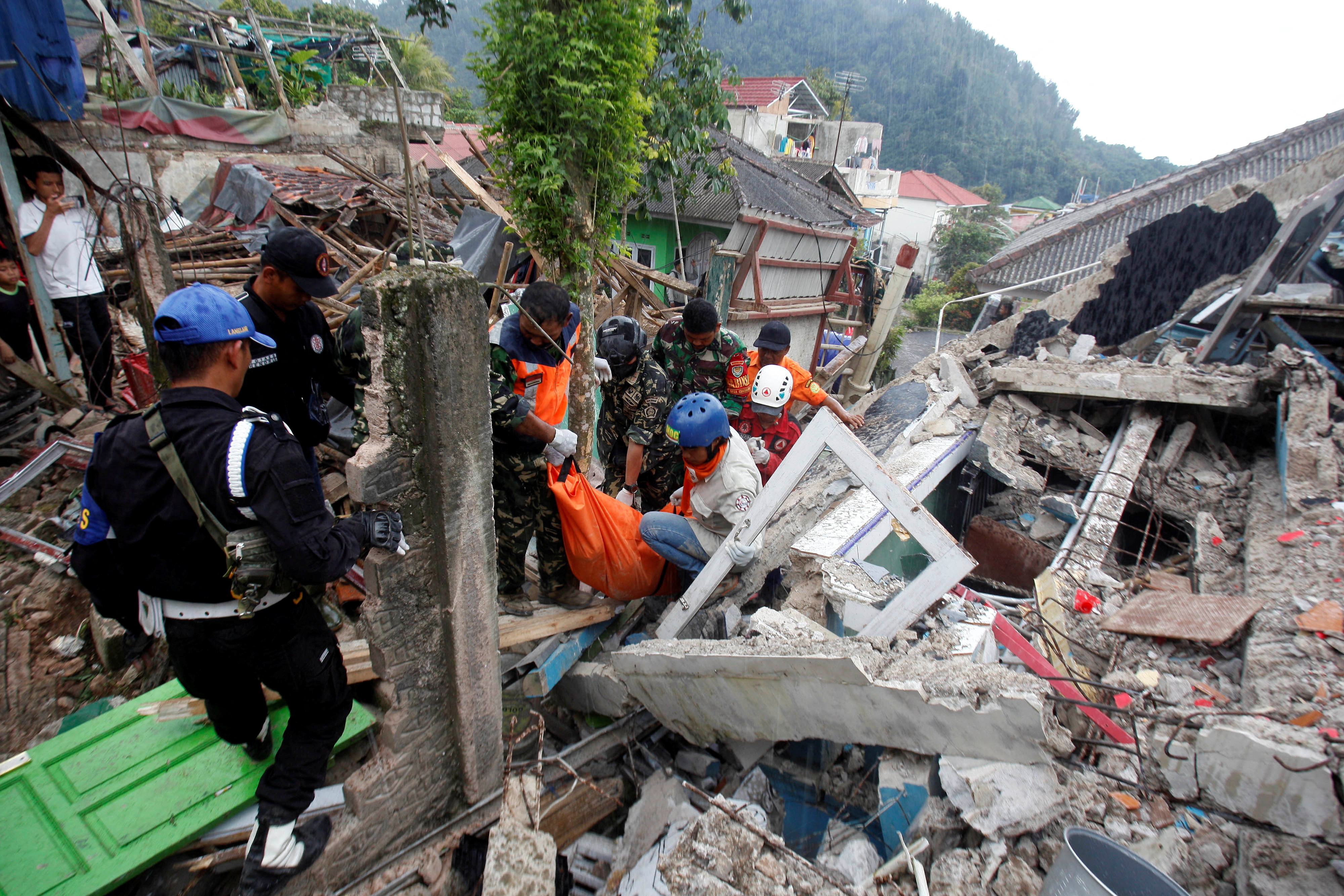
Rescuers carry a body bag with a victim through the rubble of collapsed buildings during a rescue operation after earthquake hit in Cianjur, West Java province, Indonesia, November 22, 2022, in this photo taken by Antara Foto. Antara Foto/Yulius Satria Wijaya/ via REUTERS

Indonesians live with the potential danger of earthquakes and resulting tsunamis. That ever-present danger and the island group's history of catastrophic events killing thousands of people over the years never prepares anyone for the new earth-shaking events that erupt from time to time, killing more people. As tremblors go, this was a relatively modest earthquake, but it was so close to the surface that its effects were devastating.
 
The earthquake that struck West Java killed 268 people, with the prospect of many more being found not to have survived an ensuing landslide that destroyed many buildings. Many of the dead were children in classrooms when the quake's effect created chaos and turmoil and unspeakable destruction. Days after the quake, 151 children were still missing as rescue teams worked unflaggingly to try to free those trapped in the earthquake rubble, hoping to find survivors.
 
The most populous province was struck on Monday afternoon with significant damage from a shallow 5.6-magnitude quake. Significant damage resulted in the town of Cianjur, some 75 kilometres from Jakarta, Indonesia's capital. At least one village is known to have been buried under a landslide that followed the quake. 
 
It was reported that over a thousand people were injured, and 58,000 people displaced, while 22,000 house were damaged. Rescue efforts were  hampered by landslides and rough terrain. Strong earthquakes of magnitude 6 or 7 are common enough in Indonesia, mostly offshore where fautt lines run, but this quake of a lower magnitude resulted in deadly consequences simply because it struck land at fairly shallow depth.
 
Many of the dead were killed when the poorly constructed buildings they lived in collapsed. Now, after the fact, and with a long history of vulnerability to earthquakes, President Joko Widodo is calling for earthquake-proof housing in reconstruction. "My instruction is to prioritize evacuating victims that are still trapped under rubble", he announced.
 
In the town of Cianjur, survivors gathered in the hospital parking lot where the injured were treated in tents while others were hooked up to intravenous drips on the pavement, medical workers stitching up patients under torch light in the night. "Many bodies are lying in the hospital grounds, it's very crowded", observed one individual whose relative was being treated. In one area of the hospital parking lot people held up cardboard signs pleading for food and shelter in the absence of the delivery of emergency supplies.
 
One of the worst-hit areas was Cugenang, struck by a landslide the quake had triggered. Footage of people digging into the earth and the rubble of destroyed buildings by hand using hoes, sticks, crowbars and other tools were shown on television news channels. In some areas rescue efforts were complicated by outages in electricity. In the wake of 145 after-shocks, officials warned of more landslides in coming weeks.
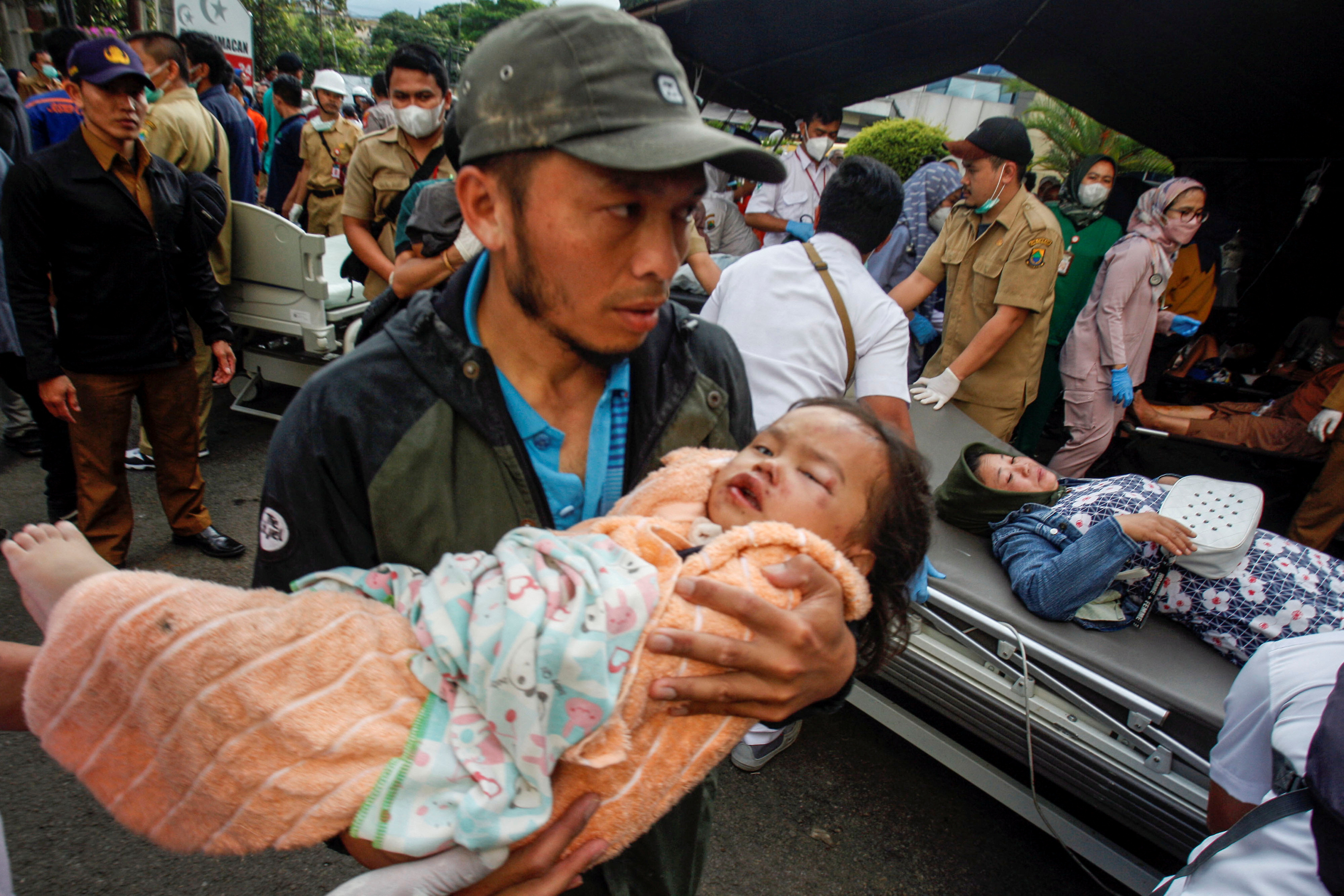
 
Earthquake in Cianjur
A man carries an injured child to receive treatment at a hospital, after an earthquake hit in Cianjur, West Java province, Indonesia, November 21, 2022, in this photo taken by Antara Foto. Antara Foto/Yulius Satria Wijaya via REUTERS

Labels: , , ,

Saturday, April 24, 2021

Indonesian Tragedy At Sea

"If it’s an explosion, it will be in pieces. The cracks happened gradually in some parts when it went down from 300 metres to 400 metres to 500 metres. … If there was an explosion, it would be heard by the sonar."
"We have found several pieces and parts that are believed to be parts or components that are attached to the submarine that would not come out of the ship if there had not been pressure from outside or a crack in the torpedo launcher."
"With the authentic evidence we found believed to be from the submarine, we have now moved from the `sub miss’ phase to `sub sunk'."
Indonesian Navy Chief of Staff Adm. Yudo Margono
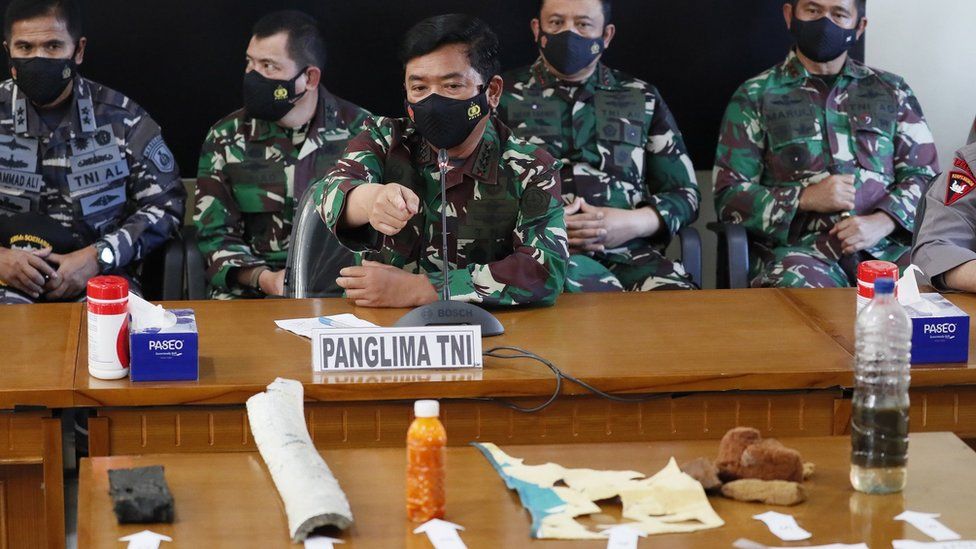
Indonesian naval officers with debris believed to be from the missing Indonesian sub - Bali, 24 April
A submarine missing since Wednesday off the coast of Bali with 53 people on board has been lost, the Indonesian navy said on Saturday.  EPA
"[The crew could still be found alive]."
"But if the submarine is in a 700-nmetre sea trough, it will be difficult for them to survive because underwater pressure will cause cracks and ruptures of the steel hull."
Connie Rahakundini Bakrie, Indonesian defence expert

"When you factor in the oxygen levels for the actual number of crew and then the time it takes to locate, assessment of recovery, then engagement in that recovery that timeline looks even longer."
Natalie Sambhi, expert on Indonesian military and security, Verve Research

"We've indicated that we will help in any way we can."
"We operate very different submarines from this one, but the Australian Defence Force and Australian Defence organization will work with defence operations in Indonesia to determine what we may be able to do."
Australian Foreign Minister Marise Payne
Time has not been on the side of rescue operations in the urgency of the missing Indonesian Navy submarine with 53 crew aboard missing since Wednesday, lost in the Bali Sea. Speculation with respect to the outcome of the disaster rests on two crumbling pillars; either oxygen would be depleted leading to death, or the submarine has already been crushed by immense water pressure.

Search helicopters and additional ships heading to the area where contact was lost with the KRI Nanggala-402 on Wednesday left Bali and a Java naval base. The head of the Indonesian submarine fleet was aboard the 44-year-old refurbished submarine as it prepared to conduct a torpedo drill. Officials feel that if the submarine was still intact it would have sufficient air to last only until Saturday at dawn.

"So far we haven't found it ... but with the equipment available we should be able to find the location", advised Achmad Riad, spokesman for the Indonesian military. Six tonnes of equipment was flown to a base to assist with the search, which included underwater balloons to help lift the vessel. There is speculation over whether the submarine had lost power during its dive and was unable to carry out emergency procedures, descending to a depth of 600 -- 700 metres, well beyond survivability limits.

Indonesian Navy Chief of Staff Yudo Margono announced that an aerial search had earlier spotted an oil spill close by the last location of the submarine, where an object with "high magnetic force" had been seen "floating" at a 40 to 100 metre depth. A depth of up to 400 metres could be withstood by the diesel-electric-powered submarine, but any greater depth could be fatal in the Bali Sea where depths of over 1,500 are known. Commander Harry Setiawan, commander of the Indonesian submarine fleet was on board.

The submarine, in active service in Indonesia since 1981, underwent a refit in South Korea in 2012, which brought it to good condition. Australia, India, Malaysia, Singapore and the United States all have sent specialized vessels or aircraft to Indonesia's aid in response to its assistance request. U.S.Defense Secretary Lloyd Austin in speaking with his Indonesian counterpart offered undersea search assets, along with the U.S. military's P-8 Poseidon aircraft assisting in the search for the submarine.
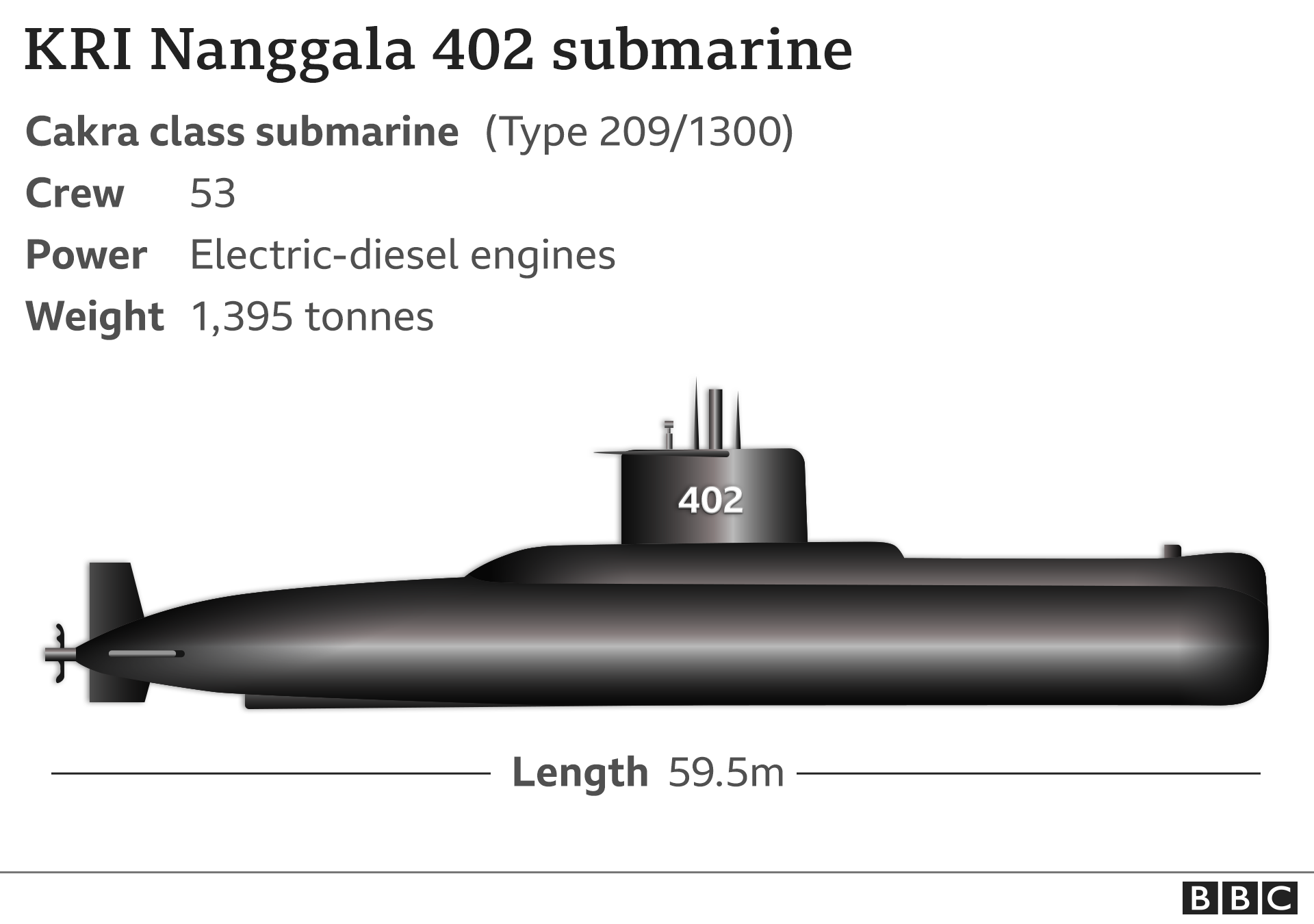
KRI Nanggala 402 graphic
 
The two Australian Navy ships heading toward the search area included a frigate with a helicopter and special sonar capabilities. The Indonesian fleet has five submarines in operation. It has planned to modernize its defence capabilities for some time, in recognition that some of its equipment suffers from elderly fatigue, a result of which has been a few fatal accidents in recent years.

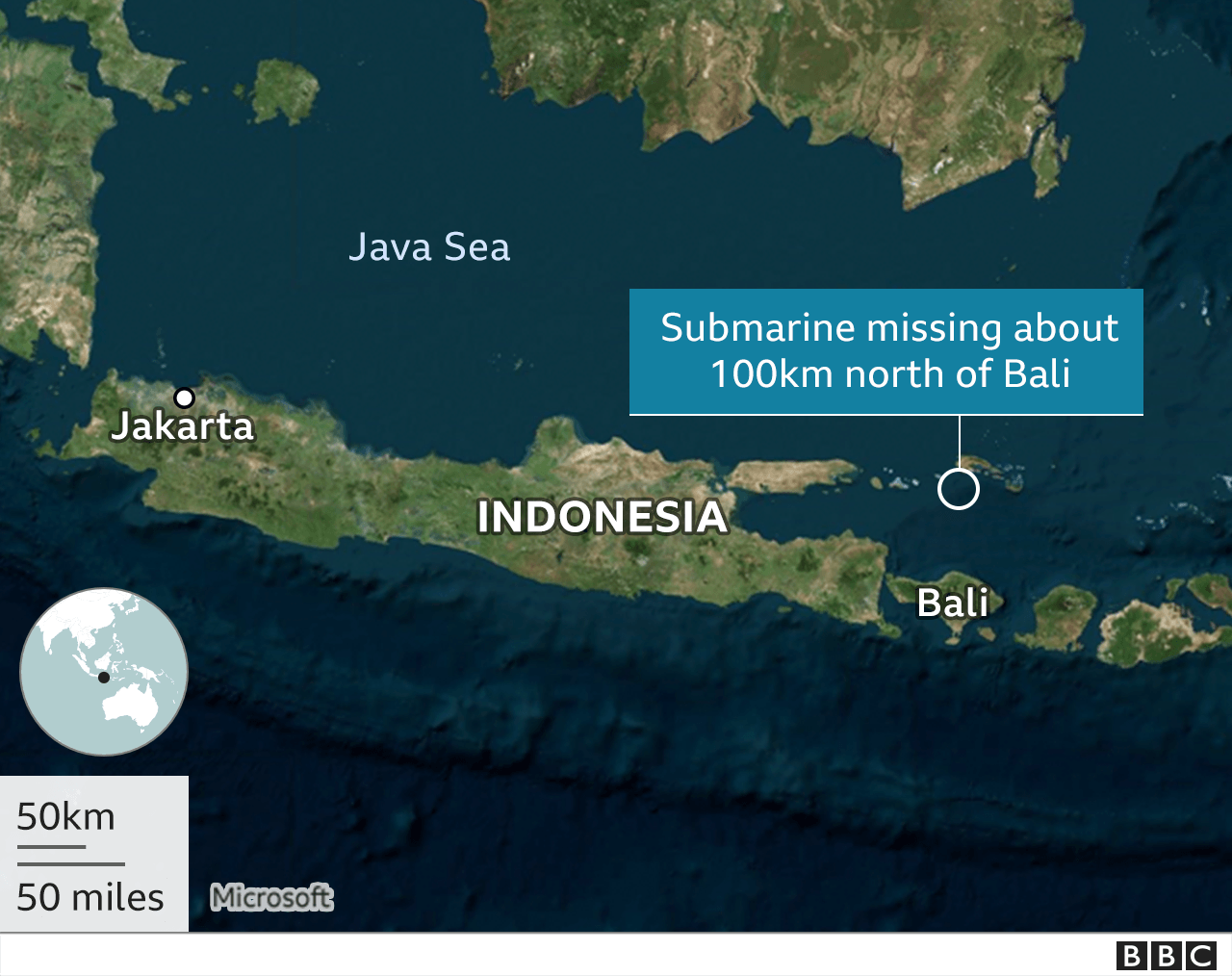
Image shows a map of Indonesia and the location where the submarine went missing

Labels: , , ,

Friday, January 24, 2020

Indonesia's Wildcat Gold Mining Dilemma

"I have no worry about mercury. I drank it. We gave it to the cows and the buffaloes. They drank it. Nothing happened."
"There's no problem."
Syarafuddin Iskandar, 58, illegal gold miner, Taliwang, Indonesia

"Initially, we thought of it as just illegal pillaging of resources."
"But when we looked deeper at it, we realized it is a more serious social problem."
"They [the illegal gold mines] are creating an environmental disaster."
Alexander Ramlie, director, Amman Mineral Nusa Tenggara, West Sumbawa, Indonesia

"This is a big dilemma."
"If we stop them [the tradition of the illegal miners] we are faced with the economic problem of how to feed them."
H.W. Musyafirin, regent, West Sumbawa
Rescuers work to bring miners out from a collapsed mine in North Sulawesi province, Indonesia.
They're termed wildcat miners. What they do is illegal. But the government of a country with huge poverty and mass unemployment, is loathe to stop the illegal miners. They're working, they're providing for their families. They've been untouchable. But the mining is not without its hazards. Aside from the dangerous and illegal use of proven carcinogenic chemicals, there are other dangers that lurk, such as collapse of illegal tunnels.

A year ago, an illegal gold mine collapsed, leaving people screaming for help and rescue teams leaping to aid them. Three people were confirmed dead by an official of the mine's disaster management division. Two of the dead were felled by falling rocks, reported Abdul Muin Paputungan, an official with the disaster management agency. "Some of the [100] victims who are still trapped are screaming for help. We can hear that they're (able to) respond to us, but we cannot reach them yet because the land is susceptible (to collapse) and moved easily."

Landslides, it would appear, are frequent occurrences that haunt these illegal mines. But in this instance it was the inadequate struts supporting the mine entrance that had given way and caused the collapse. It was the operation of the mine itself that caused the landslide. "The type of soil -- if it is stony or not -- how many trees or other forestation is present in the location, and the ability of the slope to support the burden if it rains (heavily)."
 
Sumbawa is an island 160 kilometers east of Bali. Makeshift mining camps are all over the hills in Sumbawa. These are miners, however illegal, forced to earn their living because of rife unemployment. They make use of mercury, now outlawed in legitimate mining operations in the extraction of gold from ore. Thousands of small-scale miners work illegally in West Sumbawa, using land the government has leased to large mining companies.
 
A rough estimate of a million small-scale gold miners operate across Indonesia where the use of mercury in these wildcat camps devastates health and the environment. Mercury, a heavy metal, is well documented as a slow-acting poison seeping into the food chain, the cause of birth defects, neurological disorders and death. 
 
On the other  hand, these mines boost the Indonesian economy in their employment of poor people, taking them out of poverty, leading the government to practice avoidance of disturbing the status quo. One licensed and land-leased mining company has taken the initiative to protect the environment, where the government itself hesitates to. Officers from a Police Mobile Brigade Corps shuttered dozens of outlaw mining camps on the initiative of PT Amman Mineral Nusa Tenggara mining company.
 
"We are crushed that they are closing this mine because we have no other way to make a living", Zaenal Abidin, an outlaw mine operator pointed out, of the campaign by the mining company to put a stop to illegal mining and the use of mercury. There are no government warnings, much less enforcement of the ban on the use of mercury, so miners dismiss the notion that the heavy metal is in any way hazardous.
 
An Amman Mineral-operated site called Idotan has seen the presence of 7,000 wildcat miners operating for decades with established permanent communities and an industrial-scale village for ore processing. Sumbawa native Anton, owner of several mines and mills, questions why it is that companies like Amman Mineral can get lucrative mining concessions when he and his fellow miners are considered to be illegal.
 
"Why do you allow the outsiders to operate while we, the locals, are forbidden from doing the work?" he has asked reasonably enough. Miners in the Taliwang region earn an average of 15 times over that of other occupations from their gold mining enterprises. Illegal operations represent the second-largest contribution to the West Sumbawa Regency after Amman Mineral's legal operation.
 
Ten percent of the population, representing 26 million people live in poverty. Leaving government officials with the dilemma of how to proceed. Their efforts at trying to persuade the miners to stop using mercury have gone largely unheeded.
 

Labels: , , , , ,

Tuesday, August 27, 2019

Discard the Old, Herald the New

"The location is very strategic -- it's in the centre of Indonesia and close to urban areas."
"The burden Jakarta is holding right now is too heavy as the centre of governance, business, finance, trade and services."
Indonesian President Joko Widodo

"The move will have an environmental impact. Jakarta has suffered so many failures from pollution, water crisis, and flooding."
"We don't want these problems in the new capital."
Jasmine Puteri, senior forest campaigner, Greenpeace

"By moving the capital you're not going to solve the problems of Jakarta."
"The ones really excited about moving the capital are the developers."
Elisa Sutanudjaja, executive director, Rujak Center for Urban Studies
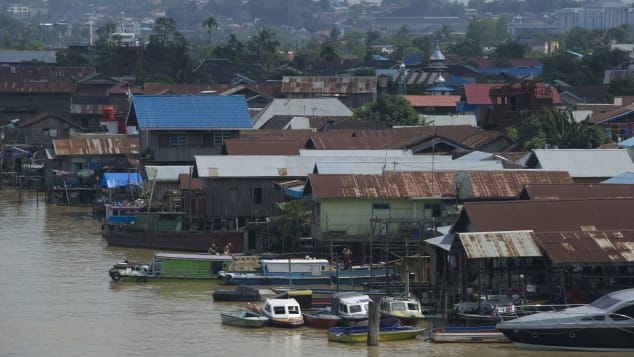
Floating houses on Mahakam river in Samarinda, near the site of the new capital.
BAY ISMOYO/AFP/Getty Images

Looking into the foreseeable future there are many island-states and cities in the world that have advance warning they will eventually be consumed by rising sea waters, among them Houston, Texas, Lagos, Nigeria, New Orleans, Louisiana, Washington, DC, Beijing, China. What most of these cities with the exception of Washington face has come about partially as a result of poor stewardship, using too much groundwater at a time of rising sea levels courtesy of climate change. Miami, Florida sees its Everglades receding as a result of irrigation of crops in an otherwise dry geology.

And in Jakarta, Indonesia, one of the world's mega-cities with its ten million population -- 30 million in its greater metropolitan population area, land misuse and abuse and groundwater extraction, exacerbated by rampant construction has resulted in environmental chaos. It is now classified as one of the fastest-sinking cities on the globe with a forecast that by 2050 a full third of the city may be fully submerged.

This is a disaster that has been seen unfolding for many years, and the process has simply accelerated since no remedial action has been undertaken. The subsidence of the city has left 40 percent of the city's residents without water piped into their homes. "The city is sinking by one to 20 centimetres a year", earth scientist Heri Andreas of Bandung Institute of Technology in Indonesia has stated along with his calculation that the ground in some areas of the city has already sunk two to four metres below sea level.
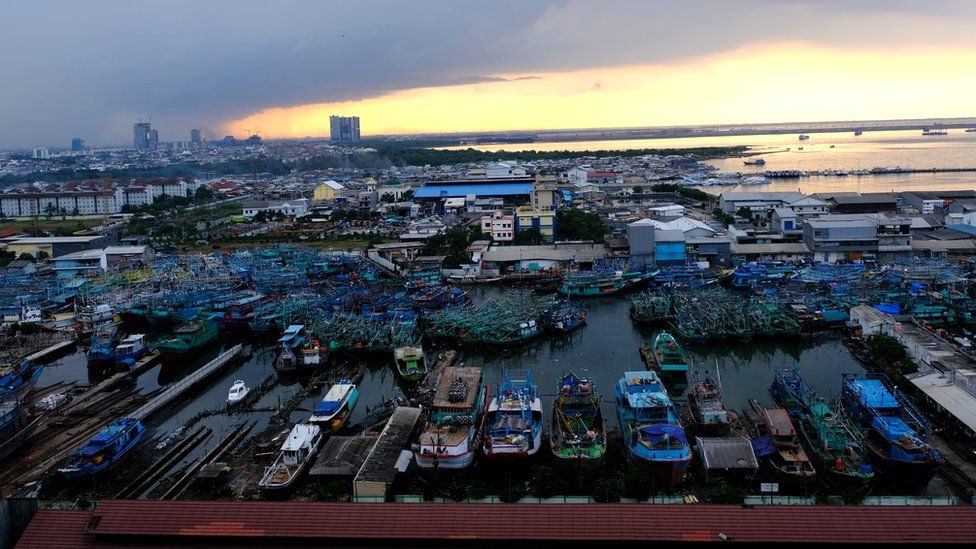
Picture of the fishing boats in North Jakarta.
North Jakarta is sinking by about 25cm every year

Jakarta seems doomed, and its government has decided on abandoning it to its fate, more or less. Indonesia is preparing to move its capital to the eastern edge of Borneo Island, shifting its political centre safely away from the megalopolis on the edge of disintegration. The city was built in an earthquake zone near the confluence of 13 rivers. Built on swampland, the city is the victim of poor urban planning, resulting in confining congestion and deadly pollution levels.
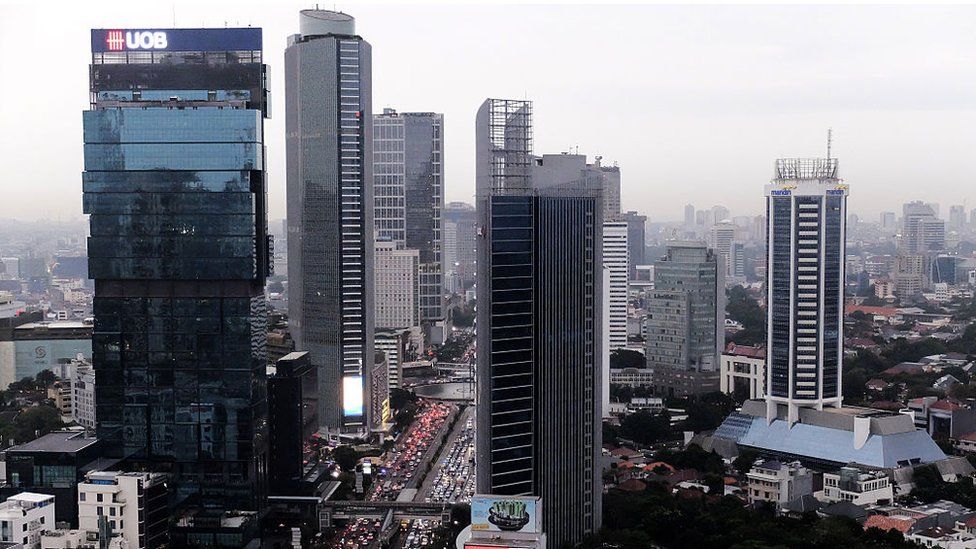
Picture of skyscrapers in Central Jakarta
An inspection of buildings in Jalan Thamrin, central Jakarta found many operators pumping groundwater without a permit   AFP

Now, the largest Muslim-majority country in the world has a proposed new location where it has been judged a "minimal" risk of natural disasters threaten. Indonesia owns 180,000 hectares of land on Borneo, with the Indonesian side of the huge island comprising five provinces known for rainforests, orangutans and coal reserves. The move will necessitate the building of new government offices and homes to accommodate the 1.5 million people who are civil servants.

The cost of this venture? About $44 billion. The government is prepared to submit a bill and a feasibility study results to its parliament for approval of a new capital. "The economic impact was good in Brazil" [when Brazil moved from Rio de Janeiro to the government-blueprinted Brazilia in 1960, a city cited as a model in well-planned, modernized urban architecture], enthused Rudy Prawiradinata, deputy minister for regional development.

"Environmental issues", he promised, would set the new city's design as yet another showpiece of urban architectural planning. Jakarta is to be retained as Indonesia's financial centre, while the city's chronic dysfunctional problems would be addressed responsibly, although it is already being suggested that the city will face neglect as the government focuses on its new site- and purpose-specific location, 'forgetting' the plight of its former capital.


GIF for Jakarta sinking story.


Labels: , , , ,

Monday, July 15, 2019

Boeing's Opaque Mea Culpa

"These funds will support education, hardship and living expenses for impacted families, community programs, and economic development in impacted communities."
Boeing Co.

"We were once told that a statue in memory of the victims and a health post for the local community will be built, and they also promised that the road to the crash site will also be built so that it will be easily accessible for visitors."
Malka Galato, 47, farmer, Gara-bokka, Ethiopia

"We've been assessing a variety of ways to assist the families and communities impacted and determined that this is a constructive step that we can take now ..."
"We're working through the process. Boeing plans to partner with local governments and non-profit organizations to address family needs."
Peter Pedraza, Boeing spokesman

"I stayed enclosed in my little house, in my grief."
"How much would it cost Boeing to personally apologize to the families of the victims? To offer professional counselling for all families who are grieving?"
Paul Njoroge, Canada

"The first thing they [Boeing] should do is reach the families to give their condolences."
"The second thing, they should offer professional counselling."
Pawel Konarski, Poland
INDONESIA-ACCIDENT-LION AIR
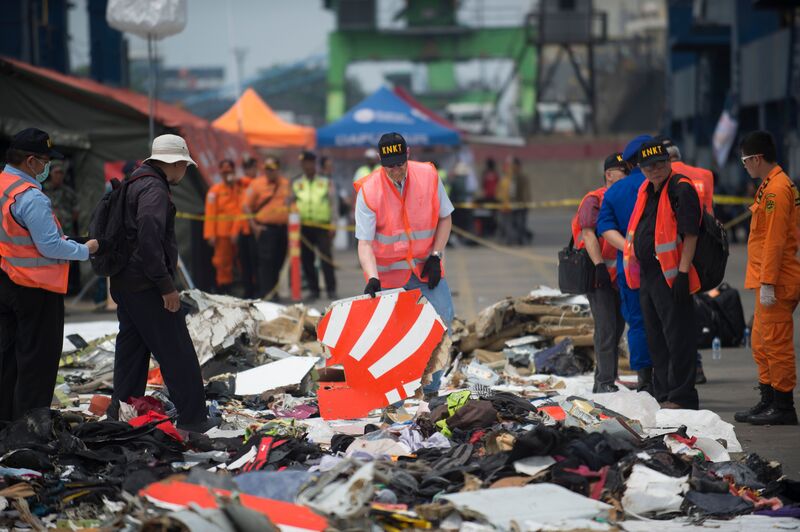
Debris recovered from Lion Air flight JT 610 in Jakarta in November 2018.
Photographer: Bay Ismoyo/AFP via Getty Images
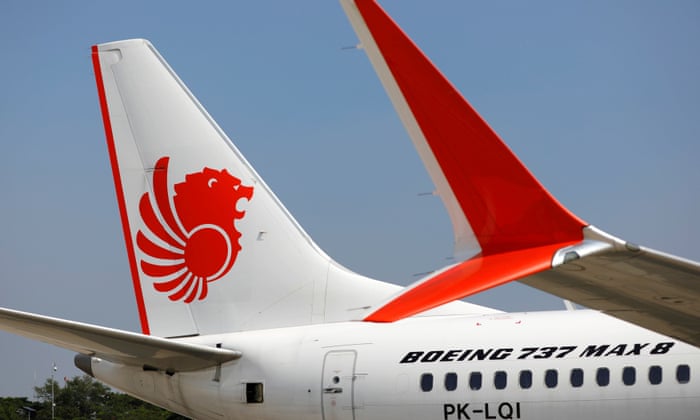
When two Boeing 737 Max planes crashed in Ethiopia and Indonesia late last year and early this year, a total of 346 people died. Early investigations indicate that the pilots flying new 737 Max 8 model planes were unable to override an automated system that malfunctioned and pointed the aircraft's nose in a downward position, causing both crashes.  The result was a massive death toll, impacting passengers who hailed from all over the world.

The Boeing model in question was then grounded worldwide, given a second crash in Ethiopia, with all the signposts of the malfunction that caused the first crash of the Lion Air flight in Indonesia in October. Boeing has its work cut out for it in redesigning the electronics of the plane to re-instill confidence in airlines that their newly-purchased fleets of the 737 Max are airworthy.

Regulators will have to approve whatever engineering and electronic fixes the company completes and training for pilots will have to resume before the jets can be approved for flight. A week ago, Boeing Co. made an offer of $100 million with the intention of giving aid to families and communities that were affected by those deadly crashes in Ethiopia and Indonesia.
tCreditJoe Raedle/Getty Images
Included would be not only the victims' families but also Ethiopian farmers whose fields have been fenced off, sites remaining littered with shards of debris, leaving the farmers shut out of farming their own agricultural land. These are poor farmers who cannot afford the expense of leasing land elsewhere, to plant. The money, according to Boeing would be given to local governments and non-profits to be dispensed.

This, aside from the many lawsuits launched by the families of the crash victims. Who will qualify or the offer timeline has not been made clear. But then, it is a highly unusual situation where it is a plane manufacturer and not an airline offering compensation. The Ethiopian and Kenyan governments have not yet been approached by Boeing; no details on the offer have been relayed to Ethiopian Airlines.

Farmers in Gara-bokka where the Ethiopian Airlines crash occurred are left to wonder what will become of their land surrounded by barbed wire fencing. With their fields fenced off they're unable to farm. There are questions from many involved as to whether funds given to government or charities might not even reach them. People from 35 countries had been aboard the Ethiopian Airlines flight; none of the families have heard from Boeing, the company has not sought opinions from any of them.

"Why does  take so long to acknowledge? Give our loved ones [the[ respect that they deserve", said Clariss Moore, of the death of her daughter Danielle, from Canada.

"Because there is still so much to learn about what occurred, it [Boeing's offer] also appears to be disingenuous. Frankly, Boeing's statement creates more questions than answers. Boeing does not understand that the families at this point in time are not interested in its money. The fact is that what is foremost on the minds of these families is getting back the human remains from the crash site. To date that process has been torturously slow without a great deal of communication from Ethiopia. If Boeing really wanted to help, it would take all that money and devote it to accelerating the remains recovery/identification process for these families", stated Robert A. Clifford of Clifford Law Offices

Boeing 737 MAX Hearing

Labels: , , , ,

Thursday, March 21, 2019

The Profit Motive Sidelining Corporate Responsibility and Safety -- Boeing Dereliction

"As the pilots of the doomed Boeing jets in Ethiopia and Indonesia fought to control their planes, they lacked two notable safety features in their cockpits. One reason: Boeing charged extra for them.
For Boeing and other aircraft manufacturers, the practice of charging to upgrade a standard plane can be lucrative. Top airlines around the world must pay handsomely to have the jets they order fitted with customized add-ons."
"Sometimes these optional features involve aesthetics or comfort, like premium seating, fancy lighting or extra bathrooms. But other features involve communication, navigation or safety systems, and are more fundamental to the plane’s operations."
Many airlines, especially low-cost carriers like Indonesia’s Lion Air, have opted not to buy them — and regulators don’t require them."
"Now, in the wake of the two deadly crashes involving the same jet model, Boeing will make one of those safety features standard as part of a fix to get the planes in the air again."
The New York Times
Boeing 737 Max 8 planes have been grounded in the UK.
Christopher Furlong/Getty Images
"They’re [manoeuvring characteristics augmentation system (MCAS)] critical, and cost almost nothing for the airlines to install."
"Boeing charges for them because it can. But they’re vital for safety."
Bjorn Fehrm, analyst, aviation consultancy Leeham

"[The 737 Max will be grounded until] the problem is solved. This country was one of the first to ground the 737 Max planes. That is absolutely the right thing to do. There are clearly some very alarming circumstances around the two accidents [Lion Air flight 610 and Ethiopian Airlines flight 302] that have taken place."
"It is something that Boeing clearly have to deal with because, unless and until the problem is solved, I can’t see countries like ours allowing those planes to fly again."
UK Transport Secretary, Chris Grayling
A Lion Air Boeing 737 Max 8 plane parked on the tarmac of Soekarno–Hatta international airport near Jakarta, Indonesia Photograph: Reuters
It has become standard for manufacturers such as Boeing not to include upgrades that can be critical to a plane's performance and ultimately the survival of its passengers and crew unless the purchaser is willing to pay an additional, hefty fee. Typically, low-cost airlines will consider upgrades as non-essential and opt not to spring for them. In the instance of both the Indonesian and Ethiopian carriers this has proven to be a massive error in judgement.

Almost as serious as the decision by Boeing to extract every last dollar possible out of their customers even if the end result might be airborne carnage.

Upgrades that in fact represent essential standard safety features eliminated because the buyer feels they're unnecessary and the seller feels their product can be used to squeeze every last bit of profit out of a reluctant buyer or they can face the consequences. It's hard to imagine that a 'reputable' manufacturer with global sales could not foresee that it too would face fallout as a consequence of their unwillingness to be responsible unless they're paid to be.

Now that the worldwide fleet of this model of a popular passenger jet is grounded and its future unknown after the entirely preventable mass deaths of two failures in air transport safety, the company deserves the censure coming its way. The company made the decision not to include a critical safety process leaving it up to airlines whether to pay to upgrade a standard plane and regulators are certainly at fault for enabling manufacturers to get away with a situation where low-cost carriers can opt not to buy 'optional' extras.

Safety is not optional.

The stunning communications failures all around demonstrate just how careless all major actors involved have been. When the downed Lion Air plane in a flight previous to the disaster exhibited the threat in its erratic performance and its pilots had no idea  how to respond, an off-duty pilot who happened to be flying with them leaped to the rescue, diagnosing the problem, instructing the crew how to respond to disable the malfunctioning flight-control system, saving the jet and its passengers and crew

That this air crew and the helpful pilot failed to report the incident and the plane once again took off with another crew having as lax training as the previous one, leading to a similar malfunction and the crash into the Java Sea where all 189 aboard were killed is beyond belief. But as hostile to reason as this event was, it evidently has aided investigators in understanding what happened to the Ethiopian airliner March crash and why it is some 737 Max pilots have no idea how to respond when the plane malfunctions.

Indonesia's National Transportation Safety Committee's report on the November crash contained no data that might have been useful to other carriers with this plane in their fleet, and their pilots inadequately trained in its operating details. The Lion Air crash on its second malfunctioning flight reveals through the cockpit voice recorder on investigation that the pilots desperately checked their quick reference handbook to attempt a response before crashing as the Indonesian officer called "Allahu akbar" as the plane hit the water.

Airline mechanics with Lion Air attempted to fix issues on the plane four times after reports from pilots of incorrect displays of speeds and altitude in two prior flights, replacing a key sensor. Both the plane manufacturer and Indonesia's safety committee are guilty of malfeasance in failing to tend to due diligent safety procedures. In requesting maintenance for the plane that had come close to disaster on its October 28 flight, no mention was made by the pilots of the stall warning and faulty sensor, still delivering false readings when it took off the next morning then crashed.

The March 10 crash of Ethiopian Airlines Flight 302 followed the same trajectory of events. Now questions are emerging over Boeing's design of the new 737 model, and how they were even approved. The inspector general of the U.S. Transportation Department is undergoing a review of the plane's certification while the U.S. Justice Department has struck a grand jury seeking records in a potential criminal probe of that certification.

The U.S. pilot's unions speak of the potential risks of the system, the Maneuvering Characteristics Augmentation System as having not been sufficiently explained in training. Boeing, required by the FAA to notify airlines about the system in the wake of the Lion Air crash, sent a bulletin to its customers with the Max in their fleets reminding them of the disabling process in response to an emergency.

Had their clients, including the Ethiopian Airlines disseminated that 'reminder' to upgrade the expertise of its pilots, why would the pilots on the March flight not have known how to disable the system?

Priests swing incense over empty caskets draped with the Ethiopian flag at a mass funeral at the Holy Trinity Cathedral in Addis Ababa on March 17. (Mulugeta Ayene/Associated Press)

Labels: , , , , ,

Sunday, June 24, 2018

Islamofascism in Indonesia

"His role was very important in spreading religious outreach online that made his followers conduct bombings."
"[Abdurrahman's] speeches, teachings and instructions have inspired his group [Jemaah Anshorut Daulah] and followers to commit criminal acts of terrorism in Indonesia."
Chief Judge Ahmad Zaini, Indonesian court, Jakarta

"This [his sentence of death] will turn him into a martyr. Much better to give him life imprisonment."
"If he had been given a long prison sentence, it's possible his ideological differences with the most extreme militants could have been used to divide the movement."
"But now that chance has been squandered."
Sidney Jones, director, Institute for Policy Analysis of Conflict in Jakarta
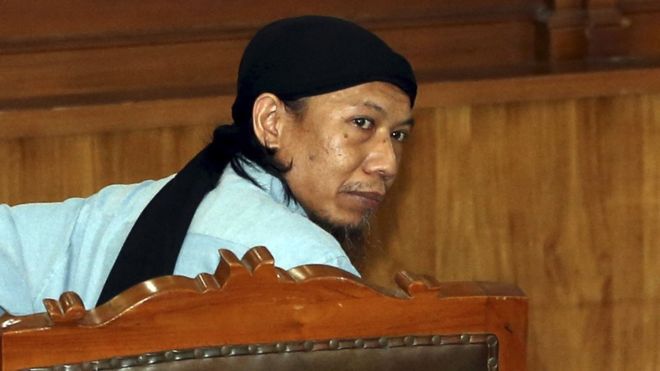
Islamic cleric Aman Abdurrahman is surrounded by security personnel in a courtroom after his verdict was announced in Jakarta. (Darren Whiteside/Reuters)

Indonesia, the world's largest Muslim-majority country, is considered to be a democracy. Travel some distance from the capital Jakarta and in the provinces the kind of Islam that is practised is not moderate as Indonesia likes to think of itself, but fundamentalist, practising medieval-era Islamic principles, the religious culture given to punishment of sexual transgressions dating back to the Middle Ages and beyond, and those accused of blaspheming Islam can anticipate a death sentence from the village council of elders.

At one time, not so distant, it was the Islamist militants from Jemaah Islamiyah that constituted Indonesia's greatest public threat, as when in 2002 on the island of Bali 202 people were killed when tourists were targeted by nightclub bombings. Indonesian security forces managed to crush the al-Qaeda-linked network over a ten-year period of extermination that saw the extra-judicial killing of the JI network leaders and bomb makers, when hundreds were arrested and the group fizzled out.

Like the multiple-headed hydra of Greek legend, however, Islamofascism is a monster that cannot be slain. The vacuum created by the destruction of the al-Qaeda linked JI was replaced by jihadist groups sympathetic to the allure of Islamic State of Iraq and the Levant. Aman Abdurrahman was instrumental in forming yet another violent group of radicals driven by the primary Koranic precept of jihad. "Praise be to God", he murmured when he heard the verdict pronounced by the chief judge.
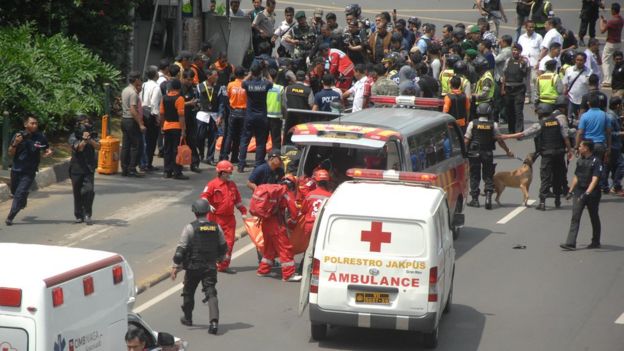
Police take the bodies of civilian victims of terrorist bomb explosion at the traffic police station to a hospital in Sarina, Jakarta on January 14, 2016
It was a scene of chaos in downtown Jakarta when gunfire and bomb explosions hit the city   Getty Images
The 46-year-old cleric responded directly to the judge that the verdict of a court whose authority he did not recognize inspired no fear in him, rather it inspired the religious fervour of gratitude that he would thus become a martyr, and he emphasized that by bending to kiss the floor. In recognition of the loyalty that this man could command among his followers dedicated to the ISIL ideology of unsparing brutality, caution was taken to ensure that hundreds of paramilitary and counterterrorism police were able to secure the Jakarta court.

The suicide bombings that took place this year in Surabaya, Indonesia's second most populous city which had been the result of whole families, children included involved in carrying suicide vests to create deadly mayhem spoke more than adequately of this cleric's capacity to inspire the tenets of the Islamist death cult in his followers. Even from prison serving a sentence related to terrorism, he was able to instruct his network of militants to carry out attacks in 2016 and 2017.

The court could see no possible reason for leniency to be extended to this man whose goal was to replace Indonesia's secular style of government with one in which Sharia law was paramount. Adhe Bhakti, an analyst at the Center for Radicalization and De-radicalization Studies in Jakarta spoke of the potential for Abdurrahman's death sentence to spark reprisal attacks across the country. "His words alone have been able to incite followers to carry out terrorism. The security forces must raise awareness and all intelligence services in Indonesia must co-ordinate well", he cautioned.

Indonesian terrorist suspect Aman Abdurrahman, alias Oman Rohman, looks on during his trial in Jakarta, Indonesia, 22 June 2018
The Indonesia cleric is considered to be the de facto head of IS supporters in the country   EPA

Labels: , , ,

Saturday, January 06, 2018

On Track to Become an Undersea City 

A scale model of a waterfront city planned for one of the 17 artificial islands, Island G.
High rises, gated compounds and marinas: the Islands    The Guardian

"Nobody here believes in the greater good, because there is so much corruption, so much posturing about serving the public when what gets done only serves private interests."
"There is no trust."
Sidney Jones, director, Institute for Policy Analysis of Conflict, Indonesia

"We need big steps now. If all the discussions get tied up with fishermen and development, there will eventually be a massive calamity and deaths and no choice but to give up on whole parts of Jakarta."
"If this wall [newly built Coastal Wall] breaks, there's simply no holding back the Java Sea."
"Jakarta  will flood all the way to the center of town, six kilometers from here. I could take you to twenty other places just like this."
Jan Jaap Brinkman, Dutch hydrologist

"Jakarta could become a 21st-Century version of Tokyo in the 20th Century, an example for urban redevelopment."
"A city that can't deliver basic services is a failed city. On top of conventional issues like flooding and urbanization, we now have climate change, tipping the scale."
"And at this rate, people will be fighting in the streets for increasingly limited resources like clean water and safe living spaces."
"Nature will no longer wait."
Irvan Pulungan, climate researcher, adviser to Jakarta's governor
Photo by CEphoto, Uwe Aranas.

Jakarta may appear like a modern, technologically advanced city of the 21st Century with its freeways and skyscrapers, but look a little more critically and you see ports, high-rises, fish markets, slums, power plants, malls and polluted canals weaving their way through the area. Water is piped to fewer than half the population of 10-million, not by the authority of the municipality operating water plants, but by private companies charging extortionate rates through government concessions.

Rain forests in Indonesia have been burned down in favour of palm oil forests and the building of textile factories, causing air pollution floating over the country, reaching out to Malaysia. Waste and chemicals are dumped into waterways, leaving drinking water supply contaminated. The rural poor have migrated to the capital Jakarta to set up informal kampungs clustering along its canals, huts built on stilts, contaminating the waterways with their sewage.
Forget Venice. The fastest-sinking city is the Indonesian capital, parts of which are dropping at 25cm a year. Can an outlandish plan for a giant seawall and luxury waterworld city in the shape of a mythical bird save Jakarta from drowning? The Guardian
And everywhere in the city and beyond, residents dig their own wells in such numbers that the aquifers beneath the city are depleting and the city is sinking. Jakarta is sinking lower and faster than any other city on the Globe; the sea around it rises remorselessly and rainfall fails to resupply the shrinking aquifers because so much of the ground in Jakarta is covered with buildings, with roadways; concrete making the rain run off rather than into the earth.

Close to 40 percent of Jakarta now is below sea level.

The city suffers some of the worst traffic snarls in the world, while buildings sink in this city that suffers from lack of planning and municipal sewers. According to hydrologists, Jakarta has a decade in which to make an effort to halt its collapse into the sea. Over 97 percent of Jakarta is covered with concrete and asphalt; fields that once absorbed rain are no longer there. Shantytowns and apartment towers have displaced the native mangroves that once relieved monsoon-swollen rivers.

A former governor of Jakarta ordered the eviction of waterfront slums. He was a geological engineer by training, and as governor he undertook to solve some of the city's largest problems, to take control of the water supply from private companies, assembling a sanitation crew to remove sediment and garbage from rivers and canals, clearing out some of the informal slums obstructing waterways and soon a difference was seen as rain instead of causing floods, drained in  hours.

He failed to be re-elected, opposition was so strong against his efforts. Replaced by Islamists in this most populous of all Muslim countries, he was brought up on charges of blasphemy and served a two-year prison sentence. Climate scientist Ardhasena Sopalheluwakan feels it would be best "to give back part of North Jakarta to nature", to "reintroduce mangroves and rejuvenate some of the dozens of reservoirs that were actually part of old Jakarta".

Just "counteracting subsidence will account for 90 percent of what this city needs to do to deal with climate change", according to to hydrologist, Jan Jaap Binkman. Post WWII, Tokyo had sunk four meters since 1900. The city poured resources into infrastructure and established stricter rules on development. In a decade Tokyo became a symbol of urban innovation, able to cope with the effects of climate change.

Photo by CEphoto, Uwe Aranas.

Labels: , , , , ,

Friday, September 22, 2017

The Passion of Muslim Violence

"Vigilante justice, like the case that just happened in Bekasi, happens so frequently."
"It reflects a lack of trust toward legal institutions. The police are seen as insufficiently responsive."
Alghifari Aqsa, lawyer, Legal Aid Institute

"The legal system is seen by many people as too lenient for petty theft."
"Now more strangers are passing through these areas, and often the residents don't know what their purpose is."
"If there is indication of a crime, it can lead to a lynching."
Sana Jaffrey, doctoral researcher, University of Chicago

"Let's not have there be any future victims of vigilante justice."
"If this keeps up, how can we be considered a nation of laws?"
Siti Zubaidah, 25
Siti Zubaidah, Mr. Zahra’s widow, with her 4-year-old son. “Let’s not have there be any future victims of vigilante justice,” she said. Credit Rony Zakaria for The New York Times

Ms. Zubaidah is pregnant, and has become a widow. Her husband, a seller of electronics, was a recent victim of mob violence. He was accused by a mob of having stolen an amplifier from inside a mosque. He protested his innocence, by telling his accusers "I'm not a thief", but the mob was intent on blood and they beat him to death, then burned his body. An act of public savagery in Bekasi, Indonesia that shocked the public presumably, but satisfied the mob which shouted triumphantly as the man's body burst into flames.

Earlier, 30-year-old Muhammad al-Zahra had been lynched in a suburb of Jakarta, the Indonesian capital. Society is now agonizing at the vicious vigilante mobs terrifying in their rabid and swift version of justice for crimes unproven, but charged. Between 2007 and 2014 mob attacks saw an increase of 25 percent, a figure from the National Violence Monitoring System, a program through the World Bank which records vigilante killings in Indonesia.

The program records 33,627 incidents of vigilante violence where people were victimized, an estimated 1,549 of whom were killed by the violence visited upon them. The picture is not quite complete since the program is set to monitor only violence that takes place in half of the provinces of Indonesia. According to Ms. Jaffrey, who had headed the program for the World Bank, residents of impoverished districts feel the Indonesian legal code is too lenient with petty thieves so they have mandated themselves to exact stiffer penalties.

The men arrested as ringleaders of the mob that had beaten Mr. Zahra to death had no idea what he had been accused of, according to Rizal Marito, a police official: "They thought he was a motorbike thief", he stated at a news conference. For a nation that prides itself on its democratic governance, the most populous Muslim country in the world, its level of tolerance for the minorities within, Christian, Buddhist and Hindu, leaves much to be desired.

The usual hostility of Islam toward the presence of other religions is manifest; churches failing to obtain the proper 'licence' are subject to state destruction, yet obtaining permission to build is a difficult procedure not readily granted. What is common among Muslims in a generalized way, is their collective and individual reaction to assumed slights against Islam. And the presence of any religious symbol representing another religion is hateful and insulting to Islam as far as its orthodox faithful are concerned.

It doesn't take much for a mob to go on a vindictively violent rampage, whether or not they're in possession of reliable evidence to back up the wild claims made against people seen as offensive to Islam. The world was witness to the reaction of Muslims across the globe in mass violence as the faithful protested the Mohammad cartoon contest launched by Jyllands Posten. Mobs go on pathologically berserk rampages of violence in response to perceived mockery of Islam.

It is as though in lock-step with the surrender to Islam by the faithful, a dose of virulent paranoia is inherited, along with obeisance to the Koran and the Hadiths and the requirements to pray five times daily.
"The jailing of Jakarta’s Christian governor for two years for blasphemy is a shocking and harsh ruling in a case that should never have been brought. It goes further than even prosecutors had sought; they had asked for a suspended one-year sentence for Basuki Tjahaja Purnama – better known as Ahok – on a lesser charge. He had cited a verse from the Qur’an which he said was misused to deceive voters into believing non-Muslims should not lead Muslims. His lawyer says he will appeal."
"Indonesia is not only a relatively recent democracy, but the world’s third largest; it also has the largest Muslim population. It has been welcomed as proof that Islam and democracy are compatible; and – though deeply scarred by periodic outbreaks of communal and inter-ethnic violence of various kinds – it likes to pride itself on moderation, pluralism and tolerance."
The Guardian newspaper
Governor Basuki Tjahaja Purnama, popularly known as Ahok, arrives at a courtroom for his verdict and sentence in his blasphemy trial in Jakarta on 9 May
Jakarta governor Basuki Tjahaja Purnama, a Christian, popularly known as Ahok, who was sentenced to two years in prison for blasphemy. Photograph: Jefta Images/Barcroft Images


Labels: , , ,

Thursday, May 21, 2015

Islamic Humanitarianism

"As we came close, I was shocked. I saw them crammed onto the boat. It left me speechless, and I broke down in tears as I watched them screaming, waving their hands and clothes."
"I could not let them die, because they are also human beings. Just like me. I am grateful to have saved hundreds of lives."
Razali Puteh, fisherman, Aceh, east Indonesia
Rohingya migrants sit in a boat as they're towed closer to land by fishermen, off the coast near the city of Geulumpang, in Indonesia's East Aceh on May 20, 2015 (AFP Photo/Januar)

"This is not an ASEAN problem. This is a problem for the international community."
"[Malaysia and Indonesia agree to offer temporary shelter] provided that the settlement and repatriation process will be done in one year by the international community."
Malaysian Foreign Minister Anifah Aman

"A year is the maximum. But there should be international co-operation."
Indonesian vice-president Jusuf Kalla

Over three thousand people representing Rohingya Muslims, persecuted in Myanmar where they are seen as illegal Bangladeshi economic migrants, though many have lived there for generations, have boarded overcrowded boats, landing on the shores of southeast Asian countries. Thousands more are estimated to be stranded at sea. A crackdown on human traffickers has led ship captains and smugglers to abandon their boats, and those aboard, to the mercy of the sea.

Leaving the desperate migrants fleeing misery, poverty and violence in Myanmar to fend for themselves, without food, without water, without medical attention, without hope.  Malaysia called an emergency meeting with the foreign ministers of Indonesia and Thailand. They had already stated they had no intention of taking in any of the migrants; they provision the incoming boats with food and water and send them back to sea.

Now they have agreed to offer temporary shelter. With the proviso that the international community must take up settlement of the refugees and alternately undertake repatriation. When these countries were hit with the tragic disaster of a tsunami in 2004 after a massive earthquake, the international community was quick to come to their aid; the deaths of hundreds of thousands of people appalled the world community and humanitarian aid was swift to appear.

Indonesia in particular took to charging humanitarian groups customs and duties on the emergency supplies they were bringing in to help save lives. At that time the world saw no line of separation between unaffected nations and those for whom the devastating earthquake-tsunami disaster impacted to create mass death; foreign government reaction was swift and positive, with donations pouring in from all over the world.

This, on the other hand, is indeed an ASEAN dilemma, one which should be solved regionally, with an uptake of refugees, giving them the opportunity to settle in countries where their religion, for which they suffered under Buddhist rule in Myanmar, would not be a discriminatory issue in Malaysia and Indonesia, two majority-Muslim countries with vast populations.

The Aceh fisherman who originally came across the migrant boat holding over 430 weak and hungry people didn't react by ignoring them in the belief that it wasn't his business to save them but that of his government's. He urged them to wait aboard their wood trawler, and left to bring back other fishing boats to pull the trawler to shore, and its desperate cargo to haven.

Labels: , , , ,

Wednesday, May 13, 2015

A Tidal Migration

"At this point, I'm not sure what the concrete next steps are or should be. There is a real sense o f urgency, but there doesn't seem to be a clear mechanism in this region for responding to something like this."
Vivian Tan, UNHCR regional press officer, Bangkok
An armed police officer stands guard as ethnic Rohingya men gather upon arrival at a temporary shelter for the migrants whose boats were washed ashore on Sumatra island on Sunday, in Lhoksukon, Aceh province, Indonesia, Wednesday, May 13, 2015. More than 1,600 migrants and refugees have landed on the shores of Malaysia and Indonesia in the past week and thousands more are believed to have been abandoned at sea, floating on boats with little or no food after traffickers literally jumped ship fearing a crackdown. (AP Photo/Binsar Bakkara)

The great surge of migrants desperate to escape threats to their existence and choosing to expose themselves to other threats to their existence since one threat appears more inimical to their futures than the other, are paying conscienceless, unscrupulous human hyenas to arrange for sea passage to Europe. People desperate to escape imminent death looming over them in the countries of their origin where privation and oppression is all they have ever known, are prepared to gamble that facing dangerous seas in inadequate vessels will offer them better odds on salvation.

It is Muslim populations from Africa, from the Middle East, from Myanmar who seek to escape religious persecution, tribal and ethnic oppression, inter- and intra-state conflicts, and above all the malign barbarism of fundamentalist Islamists in their sectarian conflicts and their focus on conquest of non-Muslim countries through jihadist violence, or alternately the forced migration leading to an inundation of European countries by Muslim hordes seeking haven.

Tens of thousands of Africans and Arabs have taken to the Mediterranean, and thousands have plunged into the seas to drown in their attempts to reach Europe to escape their social and economic deprivation, the conflicts forced upon them by viral Islamism in its violent paroxysms of rendering service to the Islamist doctrine of tribal and sectarian hatreds demanding that Sunnis slaughter Shiites and the reverse in a cataclysmic clash of the sects.

And taking inspiration from the hope that pity and compassion mandate that comparatively wealthy Europe absorb hopelessly fearful Muslims from their fate as fodder in the internecine wars, the Rohingya Muslims from Bangladesh, fleeing their homes in Myanmar are also embarking in their thousands hoping to take refuge and find their futures in the continent of Europe, which they imagine is prepared to absorb them all.

Suffering from state sanctioned discrimination and persecution in Buddhist-majority Myanmar, scorning them as illegal immigrants even while many have lived for generations in the country, they flee the violence that has been unleashed upon them. A new exodus of boat people seeking shelter elsewhere, other than where employment is refused them, let alone citizenship and the merest hint of societal equality, denied.

Most have attempted to reach Malaysia, which has conducted its own crackdowns on human trafficking networks. Reflecting what European leaders are going through, attempting to figure out how to stem the tide of teeming human beings determined to escape a future with no hope for themselves and their offspring. Embarking from Libyan waters to reach Italy, Greece and Malta, hoping to get to Britain and Germany.

Abandoned at sea by the smugglers who take their money, their inadequate vessels, short of food and water become traps. And even while many boat people are rescued after their abandonment, left to fend for themselves, countries like Indonesia and Malaysia, Muslim countries, have no wish to absorb the human flotsam that washes up on their shores.

Their own countries, from Bangladesh, to Burma (Myanmar), Libya to Syria, Gaza to Somalia and Eritrea, have failed their human needs, offering them oppression and poverty, and other Muslim countries like Indonesia and Malaysia have no wish to absorb the refugees, even while wealthy countries like Saudi Arabia and its Gulf cousins make no move to bring in a share of Muslim refugees.

Which hasn't stopped Saudi Arabia from pursuing leadership in the United Nations of its human rights group. All the Muslim countries are content to have Europe deal with the aftershocks of their refusal to accept responsibility for the welfare of huge numbers of Muslim migrants in need. Which spells out rather incongruously Muslim compassion for fellow Muslims.

Labels: , , ,

Saturday, December 13, 2014

Islamic "Education"

Those who speak of resentment from the world of Islam at the place that the West now has in being foremost among world communities in education, science, technology, economic well-being and social stability being one of the identifiable causes of tensions between East and West, point out that Islamic values act as a restraint against educating people in a meaningful manner meant to improve the human condition.

With a focus on the strict parameters of a religion based in the 6th Century, a religion that has never undergone a period of enlightenment, which indeed has gone backward from a much earlier era during which science, mathematics, medicine and astronomy were celebrated, studied and great strides in human knowledge made, Islam has stagnated as far as education is concerned.

If any doubts existed, they were put to rest in 2012 when the Organization for Economic Cooperation and Development [OECD] published the results of its education report titled "Program for International Student Assessment [PISA]", viewed by experts in the field of education as representing the globe's most comprehensive such survey.

Its purpose is to assess acquired key knowledge and mathematics skills, reading, science and problem-solving accessed by 15-year-old national students through exposure to each of the 65 OECD member nations' education systems. For the purposes of this report the PISA survey included 510,000 students worldwide. The conclusion was rather less than encouraging for Muslim nations.

Seven predominantly Muslim member nations of the OECD ranked in the lowest portion of the ranking, and they were: the United Arab Emirates at 48th; Malaysia at 52nd place, Tunisia taking 60th place; Jordan distinguishing itself at the 61st place, Qatar even worse, at 63rd, and Indonesia, the most populous Muslim country in the world, whose student performance came out 64th place out of 65 countries studied.

Oh yes, Turkish pupils ranked well down on the list as well; 44th out of 65 countries. And nor did Turkish universities perform much better. A higher education surveyor (Quacquarelli Symonds [QS] ranked three Turkish universities within the world's top 500 list of universities. Nine Turkish universities, out of a total of 175 found listing within the world's 800 best universities; the best within the 430 to 450 bracket.


Since a yardstick of future performance in all indices of human potential attainment can logically be held to be recognized through how well the young of the nation absorb education through the quality of the schooling they are exposed to, it becomes clear enough, looking at these statistics and the educational values behind them, why it is that Islamic countries lag so badly behind their Western peers.

And what is a country like Turkey doing to address the issue? Well, forging right along to correct the situation, of course, as would any self-respecting nation wishing to forward its interest in a bright future. And so, last year the government of Turkey, an increasingly Islamist one under Recep Tayyip Erdogan, ruled it compulsory for fourth grade students and forward to have "religion" classes.

Such forward-looking progress means that the Turkish curriculum in those religion classes almost exclusively focuses on the values and virtues of Sunni Islam. Non-Muslim students too in Turkey must attend these compulsory classes. Under appeal by a non-Muslim family [non-Muslim Turks are Christians, Jews and other minority-members] The European Court of Human Rights concluded the Turkish education system "still [was] inadequately equipped to ensure respect for parents' convictions", violating the "right to education."

"Turkey has to remedy the situation without delay, in particular by introducing a system whereby pupils could be exempted from religion and ethics classes without their parents having to disclose their own religious or philosophical convictions."


A situation clearly calling for an immediate solution to overturn the deficit in Turkish children's education, and so Turkey's National Education Council met to debate recently how to achieve an improvement in the education system and for that purpose make recommendations to be received by the government. The meeting side-lined discussion over the poor PISA rankings, and no discussion revolved around an improvement in the math and science curricula.

A teachers' union, loyal to the government, proposed that religion be a required pre-school course, that children aged three to six in Turkey be taught Islam. This was not adopted, but Sunni Islam classes were made compulsory for first, second and third grade students (ages six to eight).

Now that's progress! On the other hand, Kemal Ataturk might think otherwise.

Matthew Cassel/Al Jazeera
Like in Turkish schools, a picture of Kemal Ataturk, the founder of modern Turkey, hangs over 
classrooms for Syrian refugees.

Labels: , , , , , ,

() Follow @rheytah Tweet