Politic?

This is a blog dedicated to a personal interpretation of political news of the day. I attempt to be as knowledgeable as possible before commenting and committing my thoughts to a day's communication.

Thursday, November 29, 2018

Transition to Haven and Freedom

"I'm not a killing machine and I don't want any part in destroying Syria. I don't want blood on my hands."
"It's very clear by now that there is no place for me on this earth as no country is allowing me in."
"I did not believe it [that he would be going to Canada as a privately sponsored refugee] until they showed me the ticket. I said until I reach Canada, nothing is sure."
"I've done my time in airports, no more airports. I'd rather use a horse if there's no car."
Hassan Al Kontar, 37, stranded Syrian refugee
Hassan Al Kontar arrives in Vancouver after flying from Kuala Lumpur, Malaysia on Monday. (Ben Nelms/Canadian Press)

This man's story has been experienced by others before, and it has become a fixed point for film portraying a man with no official documentation, unable to pass visa requirements to enter any country, and stranded as a result, stateless, without hope of leaving the precincts of an airport yet despite isolation and a scarcity of opportunity eventually finding an escape to a country that would finally accept him. For Hassan Al Kontar, stuck for months in Malaysia, unable to enter the country, permitted to remain in the airport terminal, Canada was that country.

He had left Syria in 2006 for a job in the United Arab Emirates in the insurance business. His intention was to evade military service in Syria. His work visa in the UAE ran out, wasn't renewed and the Syrian government refused to renew his passport in 2011, when the civil war began its long agonizing trajectory into the brutal history of the Middle East. He had the option of returning to Syria but the original intention of evading military conscription was even more valid at that point than when he originally left.

His passport expired and with it his work permit. So he worked illegally in the UAE for a number of years, was discovered, arrested and ordered to leave the country. He then flew to Malaysia on a visa that granted him a three-month tourist visa and began working to save for a ticket to take him to Ecuador. Only to discover when he went to board the plane to take him to South America, he would be turned away with no explanation.

He flew on to Cambodia but was refused permission to enter there, forcing him to return to Malaysia where he was informed he could not re-enter the country having overstayed his visa. His money gone, he settled into the terminal where days turned into weeks, and then months. Through the kindness of strangers he was given food to sustain him. He posted photographs of himself on social media tending a potted plant he called his 'garden', and walking a stuffed animal on a leash. His attempts at humour gained him an audience, mesmerized by his plight.
Al-Kontar took to social media to document his daily life in the Kuala Lumpur airport terminal [Hassan al-Kontar/Facebook]

He posted a screenshot of an email he sent to NASA asking to join the next Mars mission, inspired by "a lot of space movies", he had seen. He posted complaints that world leaders violated his human rights refusing to grant him asylum. The monotony of Terminal 2, his home for so many months, led him to gratitude over small gifts from well-wishers, like a Starbucks instant coffee. Once, a janitor propped open a door onto the tarmac and for the first time in over a hundred days he was able to breathe fresh air.

"This is what I call a great day", he wrote on Twitter and posted a photograph of sunlight flooding the hallway. Thousands of people followed the daily updates of his video diary, among them Whistler, B.C.'s Laurie Cooper. Along with a group of like-minded friends she petitioned Canada's Immigration Minister to admit the man as a refugee and began a crowdfunding campaign to raise the $13,600 they needed to privately sponsor a refugee.

In October Mr. Kontar was arrested by Malaysian officials for being in a restricted airport area without a boarding pass. His sponsors in British Columbia stepped up the momentum of their contacts with immigration officials in fear he was about to be deported back to Syria. But on Sunday Ms. Cooper received a text message from her friend that he was on his way. A new video appeared on his Twitter feed. He was at the airport.

Hassan Al Kontar talks with Laurie Cooper, who sponsored him to come to Canada. (Ben Nelms/Canadian Press)

He arrived in Vancouver Monday night wearing a T-shirt, jeans and flip-flops, more than a trifle inadequate for a winter evening in Canada, even in Vancouver. Ms. Cooper is prepared to host him in her home. He has received a job offer from a hotel in Whistler where he will be staying. "I'm very grateful that Canadian officials, when Hassan was truly in peril, worked very, very hard to expedite the process", said Ms. Cooper.

"In real life, there are moments that are more beautiful than the dream itself", he said of his journey from Malaysia to Canada and freedom. "For me, walking on the street again and smelling the fresh air, it's not a normal thing: It's the sound and smell of freedom."

Labels: , ,

Sunday, May 27, 2018

Deadly Missile Strike Source: Russian Federation

"State responsibility comes into play when states fail to uphold provisions of international law and that's clearly the case [where the Russian military involved itself in the ethnic Russian Ukrainian revolt, supplying the rebels with guidance, military irregulars, and deadly equipment]."
Dutch Prime Minister Mark Rutte, The Hague

"If military weapons can be deployed and then used to bring down civilian aircraft in what was essentially a war zone, then international security is at risk and we call on all countries to inform the Russian Federation that its conduct [in this  very grave incident] is unacceptable."
Australian Foreign Minister Julie Bishop

"It is time for Russia to acknowledge its role in the shooting down of MH17 and to cease its callous disinformation campaign."
"As the findings of the joint investigative team made clear, the BUK missile launcher used to bring down the passenger aircraft is owned by the Russian Federation and was assigned to the Russian 53rd anti-aircraft brigade near Kursk."
"It was brought into sovereign Ukrainian territory from Russia, was fired from territory controlled by Russia and Russia-led forces in eastern Ukraine, and was then returned to Russian territory."
Heather Nauert, spokeswoman, U.S. State Department

"The Kremlin believes it can act with impunity. The Russian government must now answer for its actions in relation to the downing of MH17." "This is an egregious example of the Kremlin’s disregard for innocent life."
"The UK will continue to offer its full support to the efforts of the joint investigation team, the Dutch and Australian authorities and other grieving nations to deliver accountability for this terrible act and justice for all those who died."
British Foreign Secretary Boris Johnson
FILE - In this July 17, 2014. file photo, people walk amongst the debris at the crash site of a passenger plane near the village of Grabovo, Ukraine. An international team of investigators says that detailed analysis of video images has established t
In this July 17, 2014. file photo, people walk amongst the debris at the crash site of a passenger plane near the village of Grabovo, Ukraine. . (AP Photo/Dmitry Lovetsky, File)

Nothing new about the conclusion reached by international prosecutors  holding Russia fully to account for the downing in 2014 of Malaysian passenger jet MH17, flying some 10,000 metres over eastern Ukraine, to be torn apart by a Buk missile known to have been fired from a geographic area then in control of pro-Russian rebels. A reporter had seen the Buk missile in transit and had photographed it.

That evidence was available from day one. And a radio conversation that took place between a Russian-Ukrainian rebel leader and a Russian military officer whose transcript had the rebel leader revealing to the Russian that they had shot down the passenger jet was additional undeniable confirmation of the source of the disaster. The shredding of the lives of 298 passengers and crew of the airliner was clearly the responsibility of Vladimir Putin and the Kremlin for whom the rebel cause was their cause.
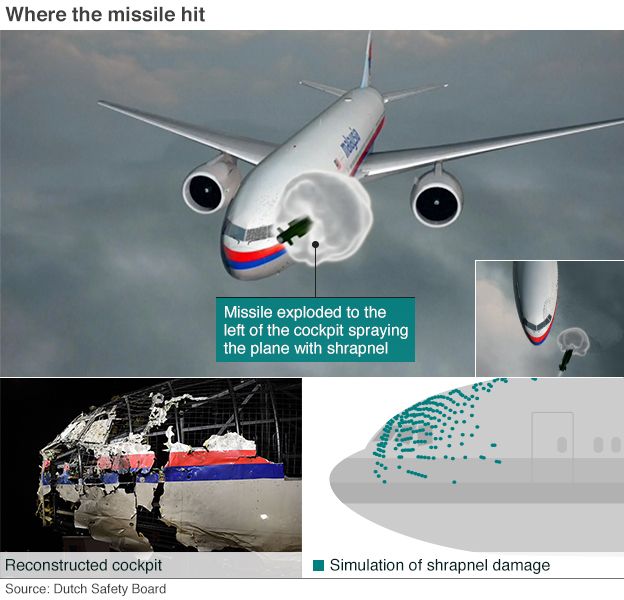
Plane image showing impact location of missile and area of damage


So, now that the Netherlands and Australia have finally zeroed in on holding Moscow to legal responsibility for its undeniable role in the missile attack, how will they enforce their accusation and demand for accountability? Relations between the Russian Federation and the West are already beyond strained. Mutual hostility between NATO countries and a Russia that is bellicose in a way that harks back to the bad old days of the Cold War when the Soviet Union was a world power cannot conceivably become any more bitter.

Vladimir Putin has thrown around casual and not-so-casual nuclear threats, from his address a year ago to graduating students of a military academy in Russia to his video showcasing of technologically advanced, powerful stealth missiles, nuclear submarines and doomsday weapons Mr. Putin declares places his nation in the military driver's seat, are not exactly empty of warning that he feels the West is pushing Russia around and he won't stand for it.
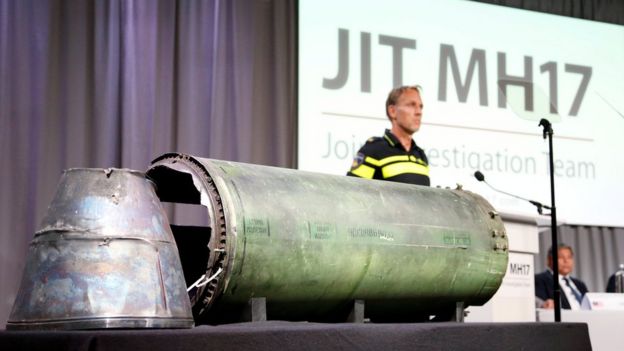
A damaged missile is displayed during a news conference by members of the Joint Investigation Team, comprising the authorities from Australia, Belgium, Malaysia, the Netherlands and Ukraine who present interim results in the ongoing investigation of the 2014 MH17
A damaged missile is shown by the joint investigators at a press conference on Thursday  Reuters
Russia, on the other hand, really has resorted to pushing and shoving on the international scene, in the air, on the ground, in the waters adjoining the near-abroad and the globally distant nations who continue to note actions meant to alarm Russia's adversaries and instill caution in dealing with its eruptions of provocations. Putin's foray into Syria, his support for a ruthless slaughterer of Syrian civilians, his ability not to bat an eyelash at chemical weapons targeting unarmed civilians does him no credit.

But as long as he can continue persuading the Russian population that once again, it is their proudly honourable nation against a hostile world jealous of Russia's prowess in military technology, its progress in establishing itself as a country to be reckoned with, the internal blinkers work to his advantage, while those who advocate against his rule have succumbed to lethal accidents or are arrested, charged with espionage or corruption and incarcerated, politically neutralizing challengers.

The Thursday announcement of the international investigators of evidence that the Buk missile system that shattered the Amsterdam-Kuala Lumpur flight was the responsibility of a Russia-based military unit, the 53rd anti-aircraft missile brigade in Kursk is old news in a new package. There are no shiny new revelations, so why has it taken four years for the official accusation to be aired?

At the time of the air disaster, Putin had said Russia would be fully compliant in the investigation; his dour sense of puckish humour. The shooting down of the the Boeing 777, Putin said at the time was done by Ukraine, targeting the aircraft and counting on world condemnation pointing at innocent Russia, as an elaborate smear job. Nor much has changed there; from St.Petersburg President Putin suggests the Ukrainian military might have been responsible; a replay of an old theme.

Besides which, since Russia was not invited to take part in the international investigation, how could it trust any conclusions brought to bear by an investigation undertaken by countries with a clear bias?

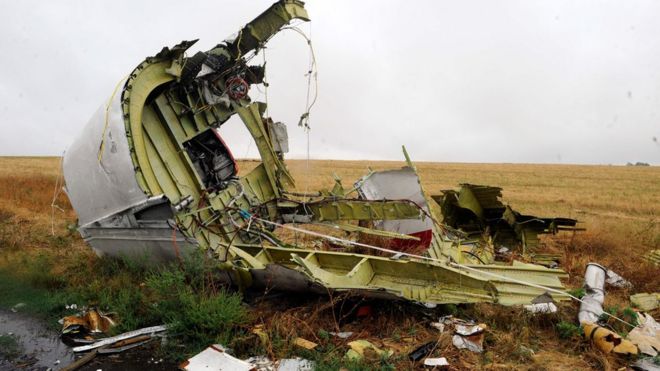
In this file photo taken on September 09, 2014 shows part of the Malaysia Airlines Flight MH17 at the crash site in the village of Hrabove (Grabovo), some 80km east of Donetsk.
Image copyright AFP
Image caption The remains of the Boeing 777, photographed at its crash site in 2014

Labels: , , , , ,

Sunday, August 02, 2015

Destroying a Fantasy

"It's the first real evidence that there is a possibility that a part of the aircraft may have been found. It's too early to make that judgement [that it is indeed part of the missing plane] but clearly we are treating this as a major lead."
Australian Transport Minister Warren Truss

"It has been more than one year, and now they claim to have found debris of MH370 on an island? We don't accept this. We do not believe what they claim."
"The finding does not constitute anything."
Dal Shuqin, sister of of downed plane victim

The devastating loss of 239 people who travelled aboard Flight 370 on March 8, 2014 which disappeared mysteriously when it lost contact with air traffic control and failed to respond to anxious calls, then seemingly veered off its flight path, has left grieving family members still insisting on the belief that the plane had landed somewhere, and eventually all the passengers and crew will be found, alive.

News that a piece of detritus from a Boeing 777 has washed ashore on the French island of Reunion in the western Indian Ocean is no reassurance to these family members, but a threat that reality will impinge on their dreams of being reunited with their loved ones. That a wing flap has shown up on Reunion and that Flight 370 is the only missing Boeing 777 must seem a cruel irony.

The mystery of what happened and how it happened may not be advanced by discovery of the wing part, however, even if French investigators feel there is a possibility that some data may be gleaned from the wing part as to whether an explosion had occurred. The plane part travelled on ocean currents so far from where the plane is assumed to have gone down that it is unlikely searchers will be led to that area where the plane disappeared.

A marine geologist at Australia's James Cook University has explained that large objects travelling vast distances across the Indian Ocean do not represent a rare anomaly. When a man lost his vessel off the Western Australia coast in rough seas last year it turned up eight months later off the French island of Mayotte, west of Madagascar, some 7,400 kilometres from its point of disappearance.

Investigators believe that satellite data point to the plane turning south into the Indian Ocean once it vanished from radar. An alternate theory holds that the plane travelled north, or landed somewhere after being hijacked, and it is this latter belief that keeps bereaved family members hoping that their lost ones will eventually show up.

They have no wish understandably, for investigators to conclude after closely examining the wing flaperon that damage points to the plane breaking up in the air, or doing so as it hit the ocean and how violently it hit. The hope they hold so fondly will be destroyed and they will be further devastated.

Labels: ,

Thursday, May 21, 2015

Islamic Humanitarianism

"As we came close, I was shocked. I saw them crammed onto the boat. It left me speechless, and I broke down in tears as I watched them screaming, waving their hands and clothes."
"I could not let them die, because they are also human beings. Just like me. I am grateful to have saved hundreds of lives."
Razali Puteh, fisherman, Aceh, east Indonesia
Rohingya migrants sit in a boat as they're towed closer to land by fishermen, off the coast near the city of Geulumpang, in Indonesia's East Aceh on May 20, 2015 (AFP Photo/Januar)

"This is not an ASEAN problem. This is a problem for the international community."
"[Malaysia and Indonesia agree to offer temporary shelter] provided that the settlement and repatriation process will be done in one year by the international community."
Malaysian Foreign Minister Anifah Aman

"A year is the maximum. But there should be international co-operation."
Indonesian vice-president Jusuf Kalla

Over three thousand people representing Rohingya Muslims, persecuted in Myanmar where they are seen as illegal Bangladeshi economic migrants, though many have lived there for generations, have boarded overcrowded boats, landing on the shores of southeast Asian countries. Thousands more are estimated to be stranded at sea. A crackdown on human traffickers has led ship captains and smugglers to abandon their boats, and those aboard, to the mercy of the sea.

Leaving the desperate migrants fleeing misery, poverty and violence in Myanmar to fend for themselves, without food, without water, without medical attention, without hope.  Malaysia called an emergency meeting with the foreign ministers of Indonesia and Thailand. They had already stated they had no intention of taking in any of the migrants; they provision the incoming boats with food and water and send them back to sea.

Now they have agreed to offer temporary shelter. With the proviso that the international community must take up settlement of the refugees and alternately undertake repatriation. When these countries were hit with the tragic disaster of a tsunami in 2004 after a massive earthquake, the international community was quick to come to their aid; the deaths of hundreds of thousands of people appalled the world community and humanitarian aid was swift to appear.

Indonesia in particular took to charging humanitarian groups customs and duties on the emergency supplies they were bringing in to help save lives. At that time the world saw no line of separation between unaffected nations and those for whom the devastating earthquake-tsunami disaster impacted to create mass death; foreign government reaction was swift and positive, with donations pouring in from all over the world.

This, on the other hand, is indeed an ASEAN dilemma, one which should be solved regionally, with an uptake of refugees, giving them the opportunity to settle in countries where their religion, for which they suffered under Buddhist rule in Myanmar, would not be a discriminatory issue in Malaysia and Indonesia, two majority-Muslim countries with vast populations.

The Aceh fisherman who originally came across the migrant boat holding over 430 weak and hungry people didn't react by ignoring them in the belief that it wasn't his business to save them but that of his government's. He urged them to wait aboard their wood trawler, and left to bring back other fishing boats to pull the trawler to shore, and its desperate cargo to haven.

Labels: , , , ,

Wednesday, May 13, 2015

A Tidal Migration

"At this point, I'm not sure what the concrete next steps are or should be. There is a real sense o f urgency, but there doesn't seem to be a clear mechanism in this region for responding to something like this."
Vivian Tan, UNHCR regional press officer, Bangkok
An armed police officer stands guard as ethnic Rohingya men gather upon arrival at a temporary shelter for the migrants whose boats were washed ashore on Sumatra island on Sunday, in Lhoksukon, Aceh province, Indonesia, Wednesday, May 13, 2015. More than 1,600 migrants and refugees have landed on the shores of Malaysia and Indonesia in the past week and thousands more are believed to have been abandoned at sea, floating on boats with little or no food after traffickers literally jumped ship fearing a crackdown. (AP Photo/Binsar Bakkara)

The great surge of migrants desperate to escape threats to their existence and choosing to expose themselves to other threats to their existence since one threat appears more inimical to their futures than the other, are paying conscienceless, unscrupulous human hyenas to arrange for sea passage to Europe. People desperate to escape imminent death looming over them in the countries of their origin where privation and oppression is all they have ever known, are prepared to gamble that facing dangerous seas in inadequate vessels will offer them better odds on salvation.

It is Muslim populations from Africa, from the Middle East, from Myanmar who seek to escape religious persecution, tribal and ethnic oppression, inter- and intra-state conflicts, and above all the malign barbarism of fundamentalist Islamists in their sectarian conflicts and their focus on conquest of non-Muslim countries through jihadist violence, or alternately the forced migration leading to an inundation of European countries by Muslim hordes seeking haven.

Tens of thousands of Africans and Arabs have taken to the Mediterranean, and thousands have plunged into the seas to drown in their attempts to reach Europe to escape their social and economic deprivation, the conflicts forced upon them by viral Islamism in its violent paroxysms of rendering service to the Islamist doctrine of tribal and sectarian hatreds demanding that Sunnis slaughter Shiites and the reverse in a cataclysmic clash of the sects.

And taking inspiration from the hope that pity and compassion mandate that comparatively wealthy Europe absorb hopelessly fearful Muslims from their fate as fodder in the internecine wars, the Rohingya Muslims from Bangladesh, fleeing their homes in Myanmar are also embarking in their thousands hoping to take refuge and find their futures in the continent of Europe, which they imagine is prepared to absorb them all.

Suffering from state sanctioned discrimination and persecution in Buddhist-majority Myanmar, scorning them as illegal immigrants even while many have lived for generations in the country, they flee the violence that has been unleashed upon them. A new exodus of boat people seeking shelter elsewhere, other than where employment is refused them, let alone citizenship and the merest hint of societal equality, denied.

Most have attempted to reach Malaysia, which has conducted its own crackdowns on human trafficking networks. Reflecting what European leaders are going through, attempting to figure out how to stem the tide of teeming human beings determined to escape a future with no hope for themselves and their offspring. Embarking from Libyan waters to reach Italy, Greece and Malta, hoping to get to Britain and Germany.

Abandoned at sea by the smugglers who take their money, their inadequate vessels, short of food and water become traps. And even while many boat people are rescued after their abandonment, left to fend for themselves, countries like Indonesia and Malaysia, Muslim countries, have no wish to absorb the human flotsam that washes up on their shores.

Their own countries, from Bangladesh, to Burma (Myanmar), Libya to Syria, Gaza to Somalia and Eritrea, have failed their human needs, offering them oppression and poverty, and other Muslim countries like Indonesia and Malaysia have no wish to absorb the refugees, even while wealthy countries like Saudi Arabia and its Gulf cousins make no move to bring in a share of Muslim refugees.

Which hasn't stopped Saudi Arabia from pursuing leadership in the United Nations of its human rights group. All the Muslim countries are content to have Europe deal with the aftershocks of their refusal to accept responsibility for the welfare of huge numbers of Muslim migrants in need. Which spells out rather incongruously Muslim compassion for fellow Muslims.

Labels: , , ,

Monday, June 30, 2014

And So Be It

"In the context of a pluralistic society, religious sensitivities, especially related to Islam as the religion of the federation, should be respected."
Malaysian king, Sultan Abdul Halim Mu'zdzam
image Malaysia's new King Abdul Halim inspected an honor guard during the welcoming ceremony at Parliament Square in Kuala Lumpur on Tuesday. Mr. Halim, 84, the ruler of northern state of Kedah, took the oath of office to become Malaysia's 14th king, a largely ceremonial post  - The Wall Street Journal

In Malaysia, a 'secular' Islamic country, Muslims represent 61% of the population, Buddhists 20%, and Christians bring up the rear with 9% of its population. Abdullah Zaik, head of a Muslim-Malay rights organization feels Malaysian Christians should set aside their 'stubbornness' in the name of national unity. They must respect Islam, and it seems they do not do so sufficiently, in claiming their heritage right, though Christians, to refer to Allah as God in their scriptures.

A leading Islamic Malaysian scholar, Mohd Sani Badron, states that the use of "Allah" for "God" must be curtailed to absolute extinction. It is only Muslims and Muslims only who have the right to speak of Allah, to use that sacred name. Others doing so commit blasphemy. And in using Allah for God, the ages-old custom "erroneously represents the two religions as equal", and quite obviously, in so doing causes Islamic anger.

Another leading Malaysian cleric states that Christians in his country who resist a new ruling of the highest court of the land which issued a judgement denying Christians the use of the word "Allah", are deliberately "trying to cause chaos", and in so doing, raise the possibility of ... disharmony. And here we thought that it was only China that was transfixed by the need for social "harmony", abhorring "splittists".

Non-Muslims labour under the misapprehension that the word Allah refers to a universal god. It clearly does not. It refers to the one true god of a transcendentally superior religion, one which has, through its perfection, superseded all others. And, despite that for centuries Arab and Malaysian Christians have been accustomed to reading in their Bibles the name of the deity whose son was Jesus, as Allah, they may no longer do so.

When the judgement came down on Monday, Muslims gathered before the court in a group waved signs and celebrated: "Unite in defending the word Allah. Fight to the last drop of blood." Admittedly, Muslims are very good in distinguishing themselves by fighting to the last drop of blood; theirs and everyone else's.

In Malaysia, government officials claimed that the word "Allah" in a Christian context might be capable of confusing good Muslims to the extent that it might cause them to become ... Christians. And though the Roman Catholic Church in Malaysia appealed to use the word, their activism caused arson and vandalism to take place, on both sides.

Malaysia does have a National Development Policy. That policy gives preferential treatment in schools, jobs and housing to the majority Malays and indigenous tribes, protecting them from the competition of non-native Malays, identified as Malaysian Chinese and Malaysian Indians. This is the Malaysian version of 'affirmative action'; enabling not the minority, but the majority.

Labels: , , ,

Sunday, May 04, 2014

Malaysian police deny al-Qaeda links to MH370

Al Aribaya -- 4 May 2014
A woman walks past graffiti of the missing Malaysia Airlines Flight MH370 in Kuala Lumpur. (File photo: Reuters)
Malaysian police on Sunday rejected a British report linking the missing Malaysian flight with al-Qaeda, described it as “rubbish.”

Earlier, it was reported that a group of eleven suspected terrorists with links to al-Qaeda were arrested on suspicion of being involved in the disappearance of Malaysian flight MH370 and were being interrogated yesterday.

The suspects had reportedly formed a new terror group that is believed to be carrying out bomb attacks in Muslim countries. They were arrested last week in the Malaysian capital Kuala Lumpur and in the state of Kedah.

“That’s rubbish! This has nothing to do with the plane,” Inspector-General of Police Tan Sri Khalid Abu Bakar told The Star on Sunday.

Flight MH370 disappeared from radar screens in the early hours of March 8, about an hour into its flight from Kuala Lumpur to Beijing, after climbing to a cruising altitude of 35,000 ft.

No distress signal was sent from the lost plane, and about two-thirds of the 227 passengers and 12 crew aboard the plane were Chinese. The airline said other nationalities included 38 Malaysians, seven Indonesians, six Australians, five Indians, four French and three Americans. It is thought to have crashed into the Indian Ocean

Despite an extensive multi-million-dollar air and sea search, no trace of the plane has been found.
The Daily Mail  had reported: “The interrogations come after international investigators, including the FBI and MI6, asked for the militants, whose ages range from 22 to 55 and include students, odd-job workers, a young widow and business professionals, to be questioned intensively about Flight MH370.”

Last month, an alleged plot by Malaysian Islamists to hijack a passenger jet, in a similar style to the Sept. 11, 2001 attacks, was linked to the disappearance of Flight MH370, Britain’s Telegraph reported.

The connection to the Malaysia Airlines flight, which went missing on March 8, was being investigated following claims from an al-Qaeda “supergrass” who recently spoke of a Malaysian plot in a New York court.

Saajid Badat, a British-born Muslim from Gloucester, had said that four to five Malaysian men had been planning to take control of a plane, using a bomb hidden in a shoe to blow open the cockpit door, according to the newspaper.

But in one of the most shocking revelations, Badat said that he had met the Malaysian jihadists in Afghanistan, given them a shoe bomb to use to take control of an aircraft, and that one of them was a pilot.

Badat had been giving evidence at the trial in New York of Sulaiman Abu Ghaith, Osama bin Laden’s son-in-law. He told the court via video- ink that he believed the Malaysians, including the pilot, were “ready to perform an act.”

The pilot of the flight, Captain Zaharie Ahmad Shah, had also increasingly become spotlighted by the media, after it was reported by Britain’s Mail on Sunday that he was an ‘obsessive’ supporter of Malaysia’s opposition leader, Anwar Ibrahim.

Last Update: Sunday, 4 May 2014 KSA 13:53 - GMT 10:53

Labels: , ,

Saturday, March 29, 2014

MH370 stays missing for want of data-sharing among intelligence searchers

DEBKAfile Special Report March 28, 2014, 7:50 PM (IST)
The hunt for the missing Malaysian airliner
All of a sudden Friday, March 28, the search for the Malaysian airliner still missing after three weeks, switched to a new site, 1,120 kilometers north of a part of the Indian Ocean where the day before 300 objects were hailed as “the most credible items yet.” The explanation for this sudden shift to a new area was that the Boeing 777 was traveling faster than previously estimated, had used up more fuel and had therefore flown a shorter distance into the Indian Ocean. The new information based on the analysis of radar data placed the new “credible search area” between the South China Sea and the Strait of Malacca. 
So what about the “credible items” found earlier? All the various experts including radar specialists would say was that the new area was more convenient for the search. They regretted the waste of time and resources expended in shifts every few days from place to place.

After the plane went missing on March 8, satellites, planes and ships focused first on the Bay of Thailand, and then the Andaman Sea near India, before looping round to Central Asia and settling briefly on Kazakhstan. They then hared off to a broad patch of Indian Ocean between Australia and Antarctica.

Now they have moved north to a new search area of approximately 319,000 sq. km. which Australia’s investigation agency determines is “the most credible lead to where debris may be located.”
What keeps on driving the search in so many directions?

1. The searchers are groping in the dark. They have still not turned up a single piece of information or material evidence as leads to the location of the Malaysian flight or the cause of its disappearance. Their only guides are speculation about which way the currents in any presumed crash site may have caused the wreckage to drift.

2.  Last week, Malaysian Prime Minister Najib Razak, in an attempt to bring this tragic episode to some conclusion, cited data provided by the British Inmarsat’s new technology as evidence that the plane had ended its flight in the Indian Ocean and all 239 aboard were lost.

Radar experts explained that Immarsat picked up “pings” from debris sighted up to 2,000 miles in the sea distant from Perth after 17 days in the water.

Five days after this dramatic discovery, the searchers and the Malaysian authorities appear to have forgotten all about it and are chasing a new theory, that the plane traveled faster and its route was shorter than first estimated.

3.  The governments involved in the search, the US, China, India, Malaysia, Vietnam, Thailand, Britain, Canada, Australia and New Zealand, are using their resources not just to locate the missing Boeing, but for purposes of their own: a) Trials of their innovative intelligence and military technology; b) Checking out the satellite and electronic cyber resources of fellow-agencies engaged in the hunt and c)  Discovering the outer limits of their colleagues’ intelligence capabilities and range in one of the most forbidding places on earth.

The lessons these powers are drawing from their own and their rivals’ performance are providing them with a study text on their comparative strengths and weaknesses in the event of potential sea, air or cyber conflicts.

It is worth noting in this regard that neither Russia nor France has volunteered to help Malaysia in the search. France’s contribution would be especially valuable in the light of its experience in the search for the Air France flight which crashed in the Atlantic in 2009 en route from Rio de Janeiro to Paris. Neither was prepared to expose its satellite and intelligence resources to the competition.

The fourth week is likely to focus on scouring the sea bed for the black box of MH370. But if nothing substantial crops up yet again, the disappearance of the Malaysian airliner will have to go down as one of the unsolved mysteries of modern aviation.

The only chance of cracking it lies in all the governments taking part in the search setting aside their rivalries, pushing their experts and agents into one room and ordering them to come clean and piece together all the data they have collected. Perhaps then a true picture will finally emerge. But that is not about to happen.
 

Labels: ,

Thursday, March 27, 2014

Malaysia plane disappearance no accident, pilot solely responsible

Mar 26, 2014 at 1:33pm 
MalayPilotDemocracyDead

This is not a conclusive indication that the plane fell prey to a jihad attack. Still, there are several disquieting indications that that cannot be discounted as a possibility: just before takeoff, the pilot, Zaharie Ahmad Shah, got a call from someone using phone obtained under false identity, raising “fears of a possible link between Captain Zaharie, 53, and terror groups whose members routinely use untraceable SIM cards.” Also, Zaharie was a “fanatical” follower of Anwar Ibrahim, who is linked to Sheikh Yusuf al-Qaradawi, who has praised Hitler and justified suicide bombing. Anwar Ibrahim is a founder of the International Institute of Islamic Thought; it is well established that the IIIT is a Muslim Brotherhood front.

“Malaysia plane disappearance no accident, says investigator,” by Mahi Ramakrishnan for USA Today, March 26:
KUALA LUMPUR, Malaysia — The pilot of the missing Malaysia Airlines jet is believed to be solely responsible for the flight being taken hundreds of miles off course and there is no evidence of a mechanical failure or hijacking by a passenger, according to a source involved in the investigation.
A high-ranking officer attached to a special investigative branch of the Malaysia police force in Kuala Lumpur said Wednesday that investigators are pressing relatives of the pilot, Capt. Zaharie Ahmad Shah, for information on his behavior leading up to the March 8 flight. They believe he “deliberately” redirected the plane, said the official.
The Boeing 777 was bound for Beijing when it vanished from civilian radar. Malaysia says satellite data indicate the plane veered west about an hour after takeoff and then flew south deep into the southern Indian Ocean.
The lack of places to land there, and the amount of fuel needed to get there, indicates that the flight must have ended there and that there is no realistic hope the 239 people on board survived, according to Defense Minister Hishammuddin Hussein.
A French satellite scanning the Indian Ocean for remnants of a missing jetliner found a possible plane debris field containing 122 objects, he said, calling it “the most credible lead that we have.”
The search resumed Wednesday after fierce winds and high waves forced crews to take a break Tuesday. A total of 12 planes and five ships from the United States, China, Japan, South Korea, Australia and New Zealand were participating in the search.
“This was premeditated,” the investigator, who has been on the case since the beginning, told USA TODAY. “If you scrutinize the crew and passenger list, you will know there is no one else besides the captain who has the experience and expertise to fly the plane.”
The official could not speak on the record because he is not authorized to talk publicly on the investigation. He said investigators have found no connection between Zaharie, 53, and any militant groups, and the 27-year-old co-pilot on the flight did not have the experience to manage such a diversion, they believe.
Zaharie was a firm supporter of the opposition party to the current ruling regime and his flight left the day that the party’s leader, Anwar Ibrahim, was sentenced to five years in prison on sex crimes his supporters say are fraudulent. Zaharie was in the courtroom when the verdict was announced.
The official said there “is nothing amiss” in Zaharie’s finances to suggest he did something drastic for money. And he refuted reports in British media that Zaharie received a phone call moments before the flight was to depart from a woman who used a false name to obtain a cellphone SIM card to make the call.
He said as far as investigators knew, he did not receive a phone call to his cellphone at that time.

Labels: , ,

Sunday, March 23, 2014

On The Face of the Earth or Below the Sea

"It's about the most inaccessible spot that you could imagine on the face of the Earth, but if there is anything down there, we will find it.
"We owe it to the families and the friends and the loved ones of the almost 240 people on Flight MH370 to do everything we can to try to resolve what is as yet an extraordinary riddle."
Australian Prime Minister Tony Abbott, Papua New Guinea

australian navy mh370

Captain Allison Norris scans the ocean from the bridge of HMAS Success in search of missing flight MH370. Photograph: Abis Julianne Cropley/AFP/Getty Images

If anything can be said of the disappearance from the air and telephonic and radar contact with Malaysian air traffic by Malaysian Airlines Flight 370, it is that the mysterious events leading up to its vanishing act has captured a rapt audience worldwide. While at the same time leaving the families of the primarily two-thirds-Chinese passengers on the flight in deep, anxious mourning for the plight of their loved ones. Demanding answers, and receiving puzzled shrugs in return.

The Government of Malaysia has been accused of failing to share intelligence it has gathered, both on its own and through the helpful auspices of the various nations involved in assisting it with satellite images, surveillance aircraft and the most up-to-date methods that can be shared to help find the mystery of what happened to a normal routine flight that took off two weeks ago and failed to arrive at its destination.

There is no end of questions, and a singular lack of answers. None of the sightings of floating objects in the immense expanse of ocean has yet given any clues of what might have occurred to the ill-fated flight. Theories abound, many of them emanating from the experienced minds of those acclaimed for their knowledge of flight trajectories, airplane structure and dynamics, and the unexpected potential for accidents to occur.

Needless to say, the spectre of fear associated with malevolent actions by those who might deliberately attempt to destroy an airliner full of innocent people to make an impression on the international psyche in defence of their extreme, malign ideology of religious-based insanity is always going to crop up as a possible cause. Nothing has as yet been ruled out as a possible cause of the plane's disappearance, and nothing as yet has cropped up to lead to any conclusion.

One of two Japanese Government P-3 aircraft arrives at RAAF base Pearce March 23, 2014 in Bullsbrook

Surveillance planes have scoured several oceanic regions, returning with not one iota of information that might be helpful to the cause of discovery. Chinese and Japanese technologically advanced aircraft and search equipment have been added to the Australian planes searching thousands of kilometres southwest of Perth. A flotilla of Chinese ships is under sail to the region. Poor weather conditions have closed in, hindering the search.

In Kuala Lumpur, where the plane took off on its flight to Beijing, Malaysian Defence Minister Hishammuddin Hussein spoke of the over two dozen countries involved in a search whose area stretches from Kazakhstan in Central Asia to the southern Indian Ocean. The search area represents a four-hour round-trip flight from western Australia, leaving planes with fuel to search only for about two hours before having to turn back.

"Noting that we got no radar detections yesterday (Friday), we have replanned the search to be visual. So aircraft flying relatively low, very highly skilled and trained observers looking out of the aircraft windows and looking to see objects", explained John Young, manager of the maritime safety authority's emergency response division. Malaysia is awaiting undersea surveillance equipment from the U.S., a technology only it possesses.

Sunday's search, according to Flight Lieutenant Russell Adams of the Royal Australian Air Force, was frustrating, because "there was cloud down to the surface and at times we were completely enclosed by cloud", speaking of the planes taking off from Perth, working for the search mission.

Meanwhile, satellite and meteorology experts have doubts of the prospect of finding those objects in the Indian Ocean believed linked to the missing flight, spotted by satellite, pointing out that debris might have drifted hundreds of miles on strong currents, since first detection.
Plane crash link

Labels: ,

Saturday, March 22, 2014

That Colossal Search

"Objects that have drifted for two weeks will have travelled a long way in that time. If you have currents at four knots, that means four nautical miles per day and a considerable distance in 14 days."
"After  you have identified and examined some debris,  you can piece together how the plane broke up. Was it in the air, was it during a sea landing, or did it hit the ocean surface? From that you can build up a scenario."
Captain of the Hoegh, St.Petersburg, Norwegian cargo vessel
Scanning the seas: A Royal Australian Air Force AP-3C Orion plane passes over the Norwegian car transport ship Hoegh St Petersburg during the search for the missing flight MH370

To speak, however theoretically -- and at the same instance, the most intelligently experienced theorizing -- of an airplane carrying 239 men, women and children disintegrating over a vast ocean with all lives most assuredly lost, is to give no comfort to the distraught families of those who were passengers or crew on Malaysia Airlines Flight MH370.

Who, in their agony, would far prefer to visualize their loved ones patiently awaiting rescue from the landing the plane took under duress on a remote archipelago in a vast oceanic landscape, which rescuers have not yet discerned to be the resting place of that errant airliner. Their relatives will be exhausted, frightened, hungry and miserable, and perhaps some will be in need of emergency medical treatment, but they will be alive.

Concern: Relatives of Chinese passengers aboard missing Malaysia Airlines flight MH370 watch a TV news program about the missing plane after attending a meeting with Malaysian officials at a hotel in Beijing

Their cherished lives will not at all have been lost. They will recover from their unspeakable ordeal, and so will their relatives, in everlasting gratitude to the real events that took place, not the imagined ones where a terrorist bomb exploded over the ocean concealed in the luggage compartment of the plane, or a deranged pilot planning suicide decided to take along with him company for the afterlife. Their lives would resume, and they would forevermore treasure one another more than ever.

This is their tenuous, passionately-hoped for reality. One that, when the lost plane is finally discovered on an unused runway overgrown by an encroaching jungle, with those on board eking out their existence on whatever food was left in the plane's pantry, anxious for discovery and grateful that they would soon resume their normal lives. The other reality -- the one that rational minds unencumbered by personal grief hark to -- is to identify the detritus floating on the ocean.

Say, for example, one or more of the ships and aircraft dispatched to one of the remotest places of deep oceanic presence on the planet, roughly 2,500 kilometres southwest of Australia to isolate the "credible sighting" of what might be wreckage of the plane. The world is a large place, and its oceans are vast and unknown to a degree complicated by their very isolated distance.
Flight Lieutenant Neville Dawson (centre) monitors instruments aboard the Royal Australian Air Force AP-3C Orion on the second day of an extensive search of the remote reaches of the southern Indian Ocean

But the satellite image that sighted that debris several days earlier is viewed as "the best lead we have" in the search for the plane that so mysteriously disappeared from contact in what has been seen as evasive, secretive steps to make itself invisible. Wild seas, miserable weather, shrinking visibility and an area of search in a stretch of ocean 4,000 metres deep have all contributed to the plane's -- or its remnants' -- invisibility.

A satellite image released by China shows an object in the southern Indian Ocean.
A satellite image released by China shows an object in the southern Indian Ocean. 22 March 2014

Are there submersibles conceivably capable of descending to that depth to find the presence of the sunken body of the airliner and its sad passengers? Is the retrieval of a 'black box' that might help investigators discover, or enable them to advance an educated projection of what had occurred between the time the Malaysia Airlines plane took off in its night-flight, and the time since then, even possible?

There will be no relief, in this lifetime, for the family members of the Malaysian Airlines Flight MH370 from the nightmare their lives have descended into. Two weeks following the disappearance of the plane, there is no reasonable possibility of the fantasized vision of survival.

But the searchers, after expending time, energy, imagination, experience and money in conducting the search among 24 nations taking part, could find closure in any possible discovery of devices that might solve the puzzle of a plane vanishing from a regularly scheduled flight taking with it all those doomed souls.
Amsa map of search area for 21 March

Labels: ,

Wednesday, March 19, 2014

Bizarre Indeed

"It's just bizarre they didn't come forward before. It may be too late to help the search ... but maybe (they) and the Malaysian military should do joint military exercises in incompetence."
Scott Hamilton, managing director, aviation consultancy Leeham Co.

"[At 1:28 a.m. Thailand's military radar] was able to detect a signal, which was not a normal signal, of a plane flying in the direction opposite from the MH370 plane [back to Kuala Lumpur]. [Why did it take so long to release the information?] Because we did not pay any attention to it. The Royal Thai Air Force only looks after any threats against our country."
Air Vice-Marshal Montol Suchookorn, Thailand

Early in the search for Malaysia Airlines Flight 370, Malaysian officials suspected the plane had doubled back toward the Strait of Malacca, west of Malaysia. Malaysian military radar data took a week for them to confirm that suggested route. And just next door in Thailand their radar showed an unidentified plane, which might have been Flight 370, flying toward the strait, minutes after the jet's transponder signal was cut off.

The Thai air force spokesman Vice-Marshal Suchookorn, could not say with any degree of certainty whether the plane its military radar had detected was indeed Flight 370. Inconsequential, incidental, unimportant, coincidental, dismissed. At a minimum, according to safety experts, that radar data might have saved time and initial effort spent searching the South China Sea, far from the Indian Ocean.

"It's tough to tell, but that is a material fact that I think would have mattered", John Goglia, a former member of the U.S. National Transportation Safety Board stated.

Once the plane caught on Thai radar had turned back toward Kuala Lumpur it turned right, toward Butterworth, a Malaysian city along the Strait of Malacca. Infrequent radar signals were received, not including data like the flight number. Thailand may not have wished to become involved, indifferent to the problems a neighbour was experiencing and the possible loss of 239 lives, but 25 other countries are making an effort.

Aircraft and ships are involved, scouring great tracts of territory, half in the remote waters of the southern Indian Ocean. Commander Williams Marks, speaking for the U.S. 7th Fleet described the search for the missing plane akin to locating a few people somewhere between New York and California.

Labels: ,

A “Startlingly Simple Theory” About the Missing Airliner is Sweeping the Internet. It’s Wrong.

The Citizen's Guide to the Future
March 18 2014 6:03 PM

A “Startlingly Simple Theory” About the Missing Airliner is Sweeping the Internet. It’s Wrong.

479224881-cambodian-residents-of-a-community-light-candles-as
Has someone finally solved the MH370 mystery?
Photo by TANG CHHIN SOTHY/AFP/Getty Images
Chris Goodfellow doesn’t have much patience for the uncertainty concerning Malaysia Airlines Flight 370. The instrument-rated Florida pilot found the theories and countertheories mooted on outlets like CNN “almost disturbing.” (I’ve appeared on CNN to discuss Flight 370, but I’ll try not to take Goodfellow’s remarks personally.) So he set about cutting through the clutter, using nothing more than the machete-like incisiveness of his own intellect. “I tend to look for a more simple explanation,” he writes in a Google Plus post that was republished on Wired.


As he read up on the incident, he got to the part where Malaysia military radar detected the aircraft making a 90-degree turn to the left and leaving its planned flight path, just after it had passed the last navigational waypoint in Malaysian territory, and after its transponder and ADS-B (“Automatic dependent surveillance-broadcast”) reporting system had stopped working. His eye followed the track that the airplane made as it headed west, toward the Malay peninsula and to the Andaman Sea beyond. And there, close by the western shore of the peninsula and just a few miles south of the plane’s recorded track, he spotted the island of Langkawi. In a flash, everything made sense.

“Thanks to Google earth I spotted Langkawi in about 30 seconds, zoomed in and saw how long the runway was,” Goodfellow wrote on his Google Plus page on March 14. “I just instinctively knew this pilot knew this airport.”

He knew what the lost pilot and co-pilot had been thinking when they made that turn, and it was something he’d thought himself, while behind the yoke of an aircraft, many times before. “We old pilots were always drilled to always know the closest airport of safe harbor while in cruise,” he wrote. "Airports behind us, airports abeam us and airports ahead of us. Always in our head. Always.”

In the scenario that Goodfellow laid out, MH370 suffered a fire in the cockpit as it climbed to cruise altitude en route to Beijing. Sensing the urgency of the crisis, the flight crew turned toward Langkawi and its 13,000-foot runway, while at the same time pulling circuit breakers to stop the fire. But it was no use. The smoke rendered the men unconscious, and “the flight continued on deep into the south Indian ocean” until it ran out of fuel and crashed.

In a stroke, Goodfellow had solved the mystery of MH370—not only what caused the crash, but where the wreckage would be found. What’s more, his revelation rehabilitated the reputations of the captain and first officer, who have come under an increasing cloud of suspicion. “This pilot,” Goodfellow wrote, “was hero struggling with an impossible situation. … Smart pilot. Just didn’t have time.”

Goodfellow’s posting may be the most (first?) popular thing ever to have come out of Google Plus. After exploding across Twitter, it was reprinted by Wired and praised by James Fallows of the Atlantic, who wrote, “his explanation makes better sense than anything else I've heard so far.”

Goodfellow’s account is emotionally compelling, and it is based on some of the most important facts that have been established so far. And it is simple—to a fault. Take other major findings of the investigation into account, and Goodfellow’s theory falls apart. For one thing, while it’s true that MH370 did turn toward Langkawi and wound up overflying it, whoever was at the controls continued to maneuver after that point as well, turning sharply right at VAMPI waypoint, then left again at GIVAL. Such vigorous navigating would have been impossible for unconscious men.

Goodfellow’s theory fails further when one remembers the electronic ping detected by the Inmarsat satellite at 8:11 on the morning of March 8. According to analysis provided by the Malaysian and United States governments, the pings narrowed the location of MH370 at that moment to one of two arcs, one in Central Asia and the other in the southern Indian Ocean. As MH370 flew from its original course toward Langkawi, it was headed toward neither. Without human intervention—which would go against Goodfellow’s theory—it simply could not have reached the position we know it attained at 8:11 a.m.

To make a good theory, Einstein is said to have asserted, “everything should be kept as simple as possible, but no simpler.” Unfortunately, Christopher Goodfellow’s wildly popular theory errs on the side of too much elegance.

Update, March 18, 2014: This blog post was revised to make consistent which version of Goodfellow's article was used for quotations. The quotes are now all from Goodfellow's Google Plus account, rather than the Wired version.
Future Tense is a partnership of SlateNew America, and Arizona State University.

Labels: ,

Malaysia plane relatives dragged from news conference

BBC News online -- 19 March 2014
Relatives were forcibly removed while trying to speak to journalists
Frustration with the search for missing flight MH370 boiled over into chaotic scenes as Chinese relatives were dragged away from journalists.

They were attempting to speak to Chinese journalists outside the daily press conference in Kuala Lumpur.

A BBC reporter was pushed away from the relatives, who were carrying banners criticising the handling of the case.

Teams from 26 countries are trying to find flight MH370, which went missing on 8 March with 239 people on board.

One of the relatives, a middle-aged woman, cried: "They give different messages every day! Where's the flight now? Find our relatives! Find the aircraft!"

The Malaysian government said later it regretted the scenes and ordered an investigation, saying "one can only imagine the anguish they are going through".
The BBC's Jonah Fisher faced a wall of police when trying to speak to relatives after the news conference in Kuala Lumpur

During the daily briefing, Malaysia's acting transport minister rejected reports that emerged on Tuesday that the plane had been spotted in the Maldives.

Five reasons why disappearance is unlikely to be caused by terrorism

  • There has been no claim or celebration by any known group
  • Government agencies did not detect any "ambient intelligence" or "chatter" about an imminent attack prior to the flight or afterwards
  • No obvious motive and no VIPs onboard
  • Background checks on flight crew and passengers have come up blank
  • No groups in the region are thought capable of such a sophisticated attack. South-east Asian militant group Jemaah Islamiya is greatly diminished, Chinese Uighurs are not thought capable, and both the Pakistani Taliban (TTP) and Afghan Taliban have denied involvement.
A local councillor on the island of Kudahuvadhoo has told the BBC that about 10 people described seeing a large aeroplane some hours after it disappeared.

The acting transport minister, Hishammuddin Hussein, also said the authorities had investigated almost all the passengers and crew of the plane, but had so far found no information of significance.
"We have received passengers' background checks from all countries apart from Ukraine and Russia," he told reporters. There were two Ukrainians and one Russian on the plane.

Malaysian police chief Khalid Abu also said some data had been deleted from the flight simulator found at captain Zaharie Ahmad Shah's home on 3 February, and that investigators were trying to recover the deleted files.

Mr Hussein stressed the captain should be considered innocent until proven guilty and that members of his family were co-operating with the investigation. Deleting files would not necessarily be suspicious, particularly if it were to free up memory space.

Chinese citizens made up the overwhelming majority of the passengers on the plane, which had been heading from Kuala Lumpur to Beijing.

Responding to complaints among relatives of those on board that they are not being kept fully informed, the Malaysian authorities said they would send a team to Beijing to liaise with Chinese families waiting for news.

An official takes away a banner reading (in Chinese) "We are against the Malaysian government for hiding the truth and delaying the rescue. Release our families unconditionally!" An official takes away a banner reading: "We protest against the Malaysian government for hiding the truth and for wasting time in finding the passengers. We want our MH370 loved to be returned to us!"
Relatives were escorted away from press by security officials, preventing them entering the media centre The relatives were prevented from entering the media centre, before being bundled away
Chinese relatives of passengers from the missing Malaysia Airlines flight MH370 are escorted away by Malaysian police from entering the media centre before the start of a press conference at a hotel near Kuala Lumpur International Airport The relatives kicked and shouted as they were being escorted out by police and other staff
 
Police in the Maldives have said they are looking into local reports that a low-flying aeroplane was sighted above Kudahuvadhoo, south-west of the capital Male, around 06:15 local time (01:15 GMT) on 8 March and that its colours matched those of the missing plane.

The Maldives National Defence Force said that although nothing had been detected on its radar, it would provide any assistance needed for the search.

If the plane was indeed flight MH370, it would have flown far slower than normal, in order for the timings to be possible, reports the BBC's Charles Haviland in nearby Sri Lanka.

Theories abound about what may have happened to flight MH370

The main Maldives airport is one of those featured in the flight simulator discovered at the home of the captain.

The Malaysian authorities have said the evidence so far suggests the Boeing-777 was deliberately turned back across Malaysia to the Strait of Malacca, with its communications systems disabled. They are unsure what happened next.

Investigators have identified two giant arcs of territory spanning the possible positions of the plane about seven hours after take-off.

This is based on its last faint signal to a satellite - an hourly "handshake'' signal that continues even when communications are switched off. The arcs stretch up as far as Kazakhstan in central Asia and deep into the southern Indian Ocean.

Investigators are considering the possibility of hijacking, sabotage, terrorism or issues related to the mental health of the pilots or anyone else on board.

Map showing search area for MH370

Labels: ,

() Follow @rheytah Tweet