Politic?

This is a blog dedicated to a personal interpretation of political news of the day. I attempt to be as knowledgeable as possible before commenting and committing my thoughts to a day's communication.

Saturday, February 05, 2022

The Strangers Next Door

"They kept to themselves and our kids played with their kids occasionally outside, but we never socialized with them."
"We thought they could have gone through a lot, but as you know, here everyone has a tragedy and people rarely speak of what happened to them these years and everyone prefers to keep to themselves."
Ameena, resident of the ground floor, Atmeh, Syria
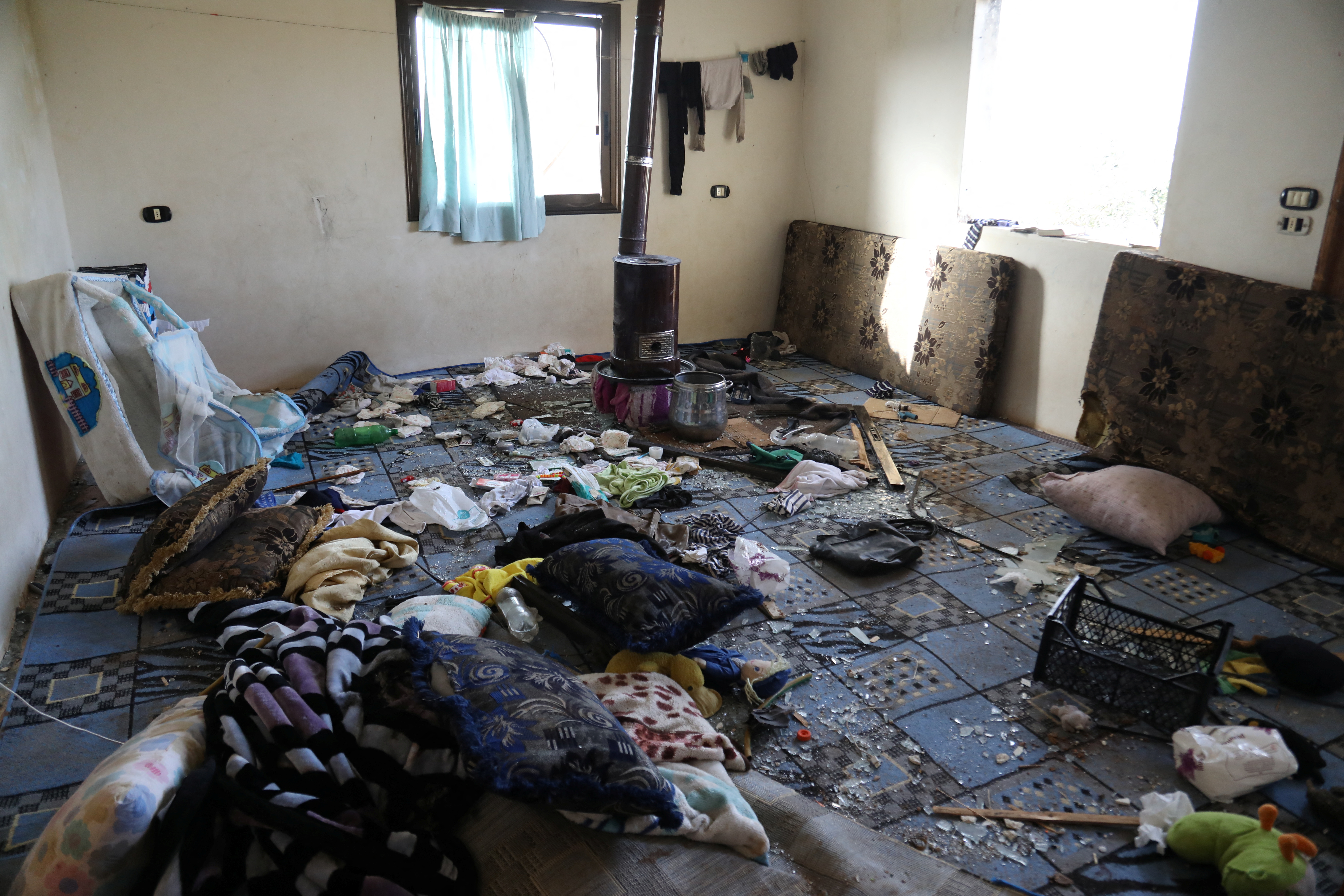
Interior of a building destroyed in the aftermath of a counter-terrorism mission conducted by the U.S. Special Operations Forces is seen in Atmeh, Syria, February 3, 2022. Mohamed Al-Daher/Handout via REUTERS
Interior of a building destroyed in the aftermath of a counter-terrorism mission conducted by the U.S. Special Forces  Reuters

When Osama bin Laden established himself and his family in a compound in Abbotabad, Pakistan, his neighbours were not familiar with the presence of an Islamist terrorist warlord in their midst. There was a Pakistani military garrison for elite officers in the very near vicinity and it's quite likely they had knowledge of his presence. And a next-door neighbour, a Pakistani doctor had his suspicions. His aid to the CIA in positively identifying the occupants of the bin-Laden compound when on a medical pretext he gained entry, earned him the reward of imprisonment by the government of Pakistan, as a traitor.

This was not the case with Abu Ibrahim al-Hashemi al-Quraishi, past-current head of Islamic State. His presence in the small town in a corner of Syria full of refugees fleeing 11 years of civil war, ostensibly as yet another misplaced person was not questioned by the nearby residents. He had rented two floors of a three-story building serving as home to a number of families. His family was on the third floor, and other members of ISIL who had his confidence were on the second floor.
 
From the second floor, a man and a woman exchanged fire with the several dozen U.S. troops that had been helicoptered to the town, surrounding the building. Before the exchange of fire the U.S. military had instructed all those occupying the first floor of the building to evacuate, and they did. Soon afterward, before being confronted by the presence of U.S. military personnel within the building, Quraishi blew himself up, evading capture, in the process killing his wife and children along with others located on the second and third floors of the building
.

People inspect a destroyed house following an operation by the U.S. military in the Syrian village of Atmeh, in Idlib province, Syria, on Feb. 3.  Ghaith Alsayed/The Associated Press

Locals had been of the belief that Quraishi was a Syrian merchant who had fled Aleppo, bringing his family with him to Atmeh, distant from Syrian front lines, and close to the Turkish border. No one imagined that the Iraqi head of the Islamic State of Iraq and the Levant was living among them. He kept his children  out of sight for the most part, though they occasionally accompanied their mother on shopping expeditions in the town.
 
The death of this, the second head of ISIL, follows a pattern. In 2019 an American assault force entered Idlib province four miles from the Turkish border. After dispatching ISIS forces that "demonstrated hostile intent against U.S.Forces" by two airstrikes from U.S. helicopters, they continued on to the nearby compound of ISIL founder Abu Bakr al-Baghdadi, surrounding it and urging people within to leave, among them 11 children.

Just as they did when they confronted and shot the al-Qaeda leader in Abbotabad, U.S. forces retrieved documents and electronics from the Quraishi compound, before detonating explosives to destroy a building that could become a 'shrine' to the former leader. To "ensure that it would not be a shrine or otherwise memorable in any way". On that occasion too, Baghdadi who had taken himself and his family into a tunnel, detonated a suicide vest collapsing the tunnel, killing three young children with him.

Beyond the internally displaced millions in war-torn Syria there are also foreign Islamists, dedicated fighters and volunteers for jihad. Crowded throngs of people seeking haven from the Alawite Syrian regime's killing machine of Bashar al-Assad. In the attack and blast on the three-story building in Atmeh, thirteen people altogether were killed once the raid began, including four women and six children.

A building destroyed in the aftermath of a counter-terrorism mission conducted by the U.S. Special Operations Forces is seen in Atmeh, Syria, February 3, 2022. Mohamed Al-Daher/Handout via REUTERS  REUTERS
Building destroyed in the aftermath of a counter-terrorism mission conducted by the U.S. Special Operations Forces   Reuters

Labels: , , ,

Monday, February 11, 2019

Islamist Demands

"Then finally he said you have to come, but I was studying English and Middle Eastern studies. I didn't know anything about ISIS or anything. He said just come and see. Come and see."
"You're eating Pringles and Twix bars ... you don't feel like you're in a war."
"Do I regret it, coming [to Syria] you mean? No, I don't, in the sense I had my kids here [in the ISIS caliphate]."
“Briefly, just briefly I heard about some executions taking place. When I came here I heard [of the Islamic State atrocities committed against the Yazidi minority]. I haven’t seen one but…. Well, having slaves is part of Sharia [Islamic law]. I believe in Sharia, wherever Sharia is. We must follow whoever is implementing the way, the law."
Dura Ahmed, 28, Torontonian, obedient Muslim and ISIS wife
Dura Ahmed, 28, from Toronto has no regrets about traveling to join her ISIS husband. The mother of two is now trying to get out of Syria.SCREENGRAB/ CNN


"He's like, 'it's obligatory for you to come here. You have no choice, and as your husband I'm telling you to come here'. And as a Muslim wife you have to obey, even though it was really hard for me to do it. I had to."
"I was just trying to be an obedient wife." 
"I'm not the kind of person who watched the news. I didn't follow any of this kind of stuff. I used to be a graphic designer and I used to work from home and just take care of the kids. I was never interested in what was going on in the world."
"It was too dangerous [to send her children to school in Raqqa] and there were too many bombings. They don't speak Arabic. So I taught them myself."
Name withheld, Albertan Muslima, 34

Suspicion and distrust will trail those who threw in their lot, willingly or otherwise, with the so-called Islamic State.

Two Canadian citizens. Two women who grew up in Canada, attended school in Canada, the younger still a university student when she left Canada in 2014 to join her husband, an ISIL fighter in Syria, in the capital of the caliphate, Raqqa, the other a stay-at-home mother to her two sons, working from home as a graphic designer. Cosmopolitan you might think, given their youth and occupations and the country they lived in. But no, Muslima who subscribed to Sharia, Islamists by inclination claiming to have known nothing about the war being waged by Islamic State against everyone else; Shiites, Kurds, Yazidis, Christians, insufficiently devout Sunnis and of course Western interlopers.

Neither had any idea of the beheadings of British and American journalists, of the videoed butchery of prisoners. ISIL children in Raqqa were being fiercely indoctrinated into the ideology, shown gruesome videos, taught how to use weapons, encouraged to take part in executions, proudly displayed as ISIL 'lion cubs', but these women, though living within the caliphate, in its very centre and capital, had no knowledge of any of this. Too busy eating Pringles, evidently.

In any event, it was the men who were at fault. The men they married. They were totally innocent of any wrong-doing, just doing their thing, whatever it is that Sharia requires of unquestioning, obedient Muslim wives subservient to the wishes of Muslim husbands. The meter on their humanitarian instincts appears to have gone off-kilter, verified by their frank responses to an interviewer. Frank, or simply expressions of entitlement as stalwarts of Islamist conquest?
Civilians who have fled fighting in Bagouz wait to board trucks after being screened by members of the Syrian Democratic Forces (SDF) at a makeshift screening point in the desert on February 9, 2019 in Bagouz, Syria. Chris McGrath/Getty Images

These are only two who have been identified as Canadians. Presumably there are many more. More just like them from all over the Western world who gravitated to Syria to join the brave new world of the caliphate. Women with the children they happily begot with ISIL terrorists. only to them they're Islamic heroes, merely performing pious acts required of them by Islamic tradition which is not to be questioned; duty is to enlist in jihad and that is final. The caliphate they were so anxious to join they are now equally anxious to leave, prepared now to embark on another life experience; rescue from discomfort in a refugee camp for displaced ISIL family members as the Free Syrian Army, mostly led by Kurds destroys what little remains of the caliphate.

The so-called caliphate's former subjects  arrive dusty, exhausted, scared and disoriented.

The unnamed woman's Bosnian swain died after leaving Canada to fight with ISIL, leaving her on her own for two years in Raqqa until she married another Canadian ISIL fighter whose spawn she now carries. From graphic designer to hanger-on in a Syrian war zone. Obedient to Islam and the sequential husbands. Second husband too now dead, although to be sure, he was a cook for ISIL, not an active fighter, she insists, leading one to the impression that ISIL had a whole lot of cooks, a non-combat contingent who just happened to die in battle.

Fighters from the Syrian Democratic Forces (SDF) attend the funeral of a fellow fighter from the Kurdish women’s protection units (YPJ), who was killed while fighting against ISIL in northeastern Syrian Kurdish-majority city of Qamishli on February 9, 2019. DELIL SOULEIMAN/AFP/Getty Images

While the Syrian Democratic Forces are busily eliminating the last of the geographic caliphate, reports are circulating that ISIL forces are re-assembling, prepared to re-enter those areas they once held as soon as the military forces supporting the FSA militias take their leave of Syria. Those sleeper cells in Syria and Iraq are not inactive, laying groundwork for an insurgency, much as the Taliban in Afghanistan have done for many years. Counterterrorism is not a part-time occupation wherever violent Islam has taken root, and that is just about everywhere in the Muslim world.

Bring these women and their children back 'home' to Canada? They've found their spiritual home in Syria, why deprive them of it? Why on the other hand, burden Canada with the upkeep of such detestable creatures with their ghoulish preoccupation with Sharia and how slavery is permissible, consigning women of other cultures and religious beliefs to rape and soulless degradation? To spread their venomous beliefs back in Canada?

The good old days in Raqqa where the Pringles were plentiful. GETTY IMAGES


Labels: , , , , ,

Sunday, June 24, 2018

Islamofascism in Indonesia

"His role was very important in spreading religious outreach online that made his followers conduct bombings."
"[Abdurrahman's] speeches, teachings and instructions have inspired his group [Jemaah Anshorut Daulah] and followers to commit criminal acts of terrorism in Indonesia."
Chief Judge Ahmad Zaini, Indonesian court, Jakarta

"This [his sentence of death] will turn him into a martyr. Much better to give him life imprisonment."
"If he had been given a long prison sentence, it's possible his ideological differences with the most extreme militants could have been used to divide the movement."
"But now that chance has been squandered."
Sidney Jones, director, Institute for Policy Analysis of Conflict in Jakarta
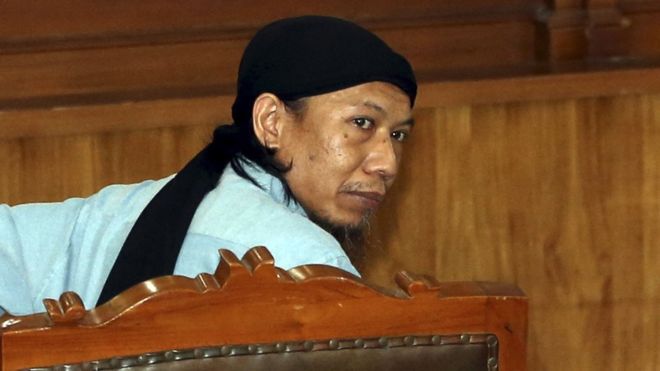
Islamic cleric Aman Abdurrahman is surrounded by security personnel in a courtroom after his verdict was announced in Jakarta. (Darren Whiteside/Reuters)

Indonesia, the world's largest Muslim-majority country, is considered to be a democracy. Travel some distance from the capital Jakarta and in the provinces the kind of Islam that is practised is not moderate as Indonesia likes to think of itself, but fundamentalist, practising medieval-era Islamic principles, the religious culture given to punishment of sexual transgressions dating back to the Middle Ages and beyond, and those accused of blaspheming Islam can anticipate a death sentence from the village council of elders.

At one time, not so distant, it was the Islamist militants from Jemaah Islamiyah that constituted Indonesia's greatest public threat, as when in 2002 on the island of Bali 202 people were killed when tourists were targeted by nightclub bombings. Indonesian security forces managed to crush the al-Qaeda-linked network over a ten-year period of extermination that saw the extra-judicial killing of the JI network leaders and bomb makers, when hundreds were arrested and the group fizzled out.

Like the multiple-headed hydra of Greek legend, however, Islamofascism is a monster that cannot be slain. The vacuum created by the destruction of the al-Qaeda linked JI was replaced by jihadist groups sympathetic to the allure of Islamic State of Iraq and the Levant. Aman Abdurrahman was instrumental in forming yet another violent group of radicals driven by the primary Koranic precept of jihad. "Praise be to God", he murmured when he heard the verdict pronounced by the chief judge.
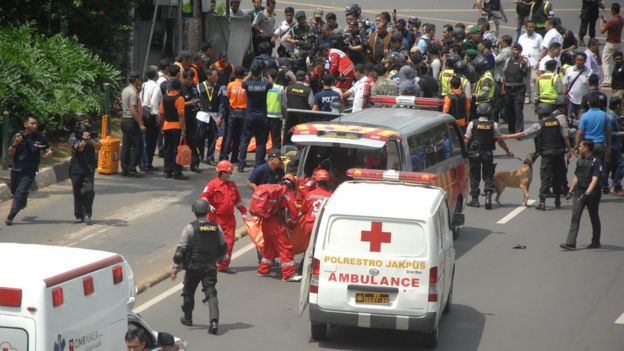
Police take the bodies of civilian victims of terrorist bomb explosion at the traffic police station to a hospital in Sarina, Jakarta on January 14, 2016
It was a scene of chaos in downtown Jakarta when gunfire and bomb explosions hit the city   Getty Images
The 46-year-old cleric responded directly to the judge that the verdict of a court whose authority he did not recognize inspired no fear in him, rather it inspired the religious fervour of gratitude that he would thus become a martyr, and he emphasized that by bending to kiss the floor. In recognition of the loyalty that this man could command among his followers dedicated to the ISIL ideology of unsparing brutality, caution was taken to ensure that hundreds of paramilitary and counterterrorism police were able to secure the Jakarta court.

The suicide bombings that took place this year in Surabaya, Indonesia's second most populous city which had been the result of whole families, children included involved in carrying suicide vests to create deadly mayhem spoke more than adequately of this cleric's capacity to inspire the tenets of the Islamist death cult in his followers. Even from prison serving a sentence related to terrorism, he was able to instruct his network of militants to carry out attacks in 2016 and 2017.

The court could see no possible reason for leniency to be extended to this man whose goal was to replace Indonesia's secular style of government with one in which Sharia law was paramount. Adhe Bhakti, an analyst at the Center for Radicalization and De-radicalization Studies in Jakarta spoke of the potential for Abdurrahman's death sentence to spark reprisal attacks across the country. "His words alone have been able to incite followers to carry out terrorism. The security forces must raise awareness and all intelligence services in Indonesia must co-ordinate well", he cautioned.

Indonesian terrorist suspect Aman Abdurrahman, alias Oman Rohman, looks on during his trial in Jakarta, Indonesia, 22 June 2018
The Indonesia cleric is considered to be the de facto head of IS supporters in the country   EPA

Labels: , , ,

Sunday, December 10, 2017

Back to Square One in Iraq

"Honourable Iraqis, your land has been completely liberated. The liberation dream has become a reality. We achieved victory in difficult circumstances and with God's help, the steadfastness of our people and the bravery of our heroic forces we prevailed."
"The flag of Iraq is flying high today over all Iraqi territory and at the farthest point on the border."
"I urge everyone to refrain from returning to the inflammatory and sectarian discourse that empowered gangs to occupy our cities and villages. Our people have paid a dear price. We must turn this page forever."
Iraqi Prime Minister Haider al-Abadi

"All Iraqi lands are liberated from terrorist Daesh gangs and our forces completely control the international Iraqi-Syrian border."
Lt.Gen. Abdul-Amir Rasheed Yar Allah, Iraqi military commander

"[The United States offers] sincere congratulations to the Iraqi people and to the brave Iraqi Security Forces, many of whom lost their lives heroically fighting [Daesh]."
Heather Nauert, U.S. State Department spokesperson
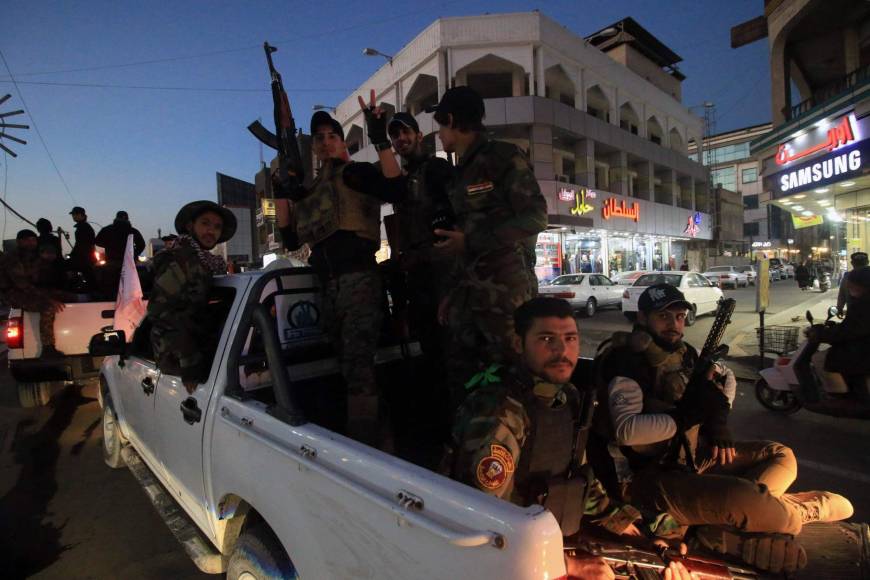
Iraq forces stage victory parade to mark defeat of Islamic State
Members of the Iraqi forces flash the victory gesture as they ride in the back of a pickup truck on a street in the southern city of Basra on Sunday amid victory celebrations after Baghdad declared victory in the war against the Islamic State (IS) group. | AFP-JIJI

Three years ago the courageous Iraqi military fled in panic as Islamic State of Iraq and the Levant jihadists neared Mosul, their fiercely barbarian reputation for atrocities preceding them. In their desperate haste to leave the city of two and a half million people to fend for itself, they left behind a treasure trove of American-supplied military vehicles and arms caches for the jihadis to take advantage of. ISIL was also, in the absence of the Iraqi military, able to loot the Mosul main bank of a billion dollars to advance their agenda.

Mosul's Sunni population initially might have welcomed the Sunni terrorists feeling living under them could not be any worse and might improve on the oppression they lived with under the Shiite government. They were soon to learn otherwise, as ISIL turned to enforcing life in their version of Sharia upon the majority Sunnis in Mosul, once they had finished with the Shias, the Christians and the Yazidis and the city became accustomed to capital punishment meted out in public squares to any deemed to be delinquent in their ISIL-type Islamism.

Prime Minister Abadi's conciliatory words to Iraqis, his urging that sectarian differences not flare up again is no doubt aimed at Iraqi Sunnis and at Kurds; with his now-secure alliance with Iran and the Iran-backed Shiite militias and the re-empowerment of Syria's regime with its Hezbollah back-up, there is obviously no need of remediation of the ruling Shiites in their persecution of the Sunnis. A situation which led to the former Saddam Hussein-era military commanders becoming ferocious ISIL leaders.

The Prime Minister's speech was notable for the deliberate absence of any mention of the Peshmerga. It would be strange, that omission, since it was the Kurdish Peshmerga whose fighting spirit and courage protected Iraq's minority populations, and who were in the forefront of the fighting, meeting ISIL in battle that the Iraqi forces shrank from, but not viewed through the lens of denial of sovereignty. Without the U.S. air power nothing would have been accomplished in ridding Iraq of the terrorists. And without the Peshmerga forces the United States would have been absent a fighting ally they could depend upon.

The Kurds had their reward when they assumed that after all their sacrifices and their proven record in establishing an egalitarian and welcoming society based on universal human values along with their heritage traditions and their sheer ethnic numbers augmented by their aspirations to have their ancestral homeland finally recognized for the sovereign nation it is, the Iraqi Prime Minister sent in those brave Iraqi troops backed by Shiite militias to quell the hopes raised high after a referendum that saw the vast majority of Kurds voting for independence.

Baghdad's central government is determined, like that of Erdogan's Turkey, al-Assad's Syria and the Ayatollahs' Iran to deny the 40-million Kurds in their collective territory the recognition they deserve.
To that end, Abadi snubbed the Kurds entirely, praising in his speech the Iranian trained and backed Popular Mobilization Forces loyal to Iran, prepared at the drop of a hat to persecute Iraqi Sunnis, and not averse to threatening Kurds, while withholding any mention whatever of the peshmerga's role in defeating ISIL, a backhand slap at the Kurdistan Regional Government.

Nabih‏Verified account @nabihbulos
#Kurd-ish troops cheer when they see an explosion among the #Iraq-i ranks. A sad day for what's left of the country's unity.
In his speech the Iraqi Prime Minister deftly laid out another position which no doubt has been the cause of much discussion in the Shiite cabinet, that the state should have a 'legitimate' monopoly on arms: "Weapons should only be in the state’s hands. The rule of law and respect for it are the way to build the state and achieve justice, equality, and stability". That would have great resonance with Iraqi Kurds in their recall of the devastation that Saddam Hussein carried out with his deadly chemical attacks on Kurdish towns and villages.

"The joy of victory is complete with Iraq’s unity after it was on the verge of division. The unity of Iraq and its people is the most important and greatest accomplishment", he waxed self-congratulatorily, the man responsible in large degree for the rise of the terrorist opposition of Sunni Iraqis left out of any positions of equality in the sectarian atmosphere of traditional suspicion and hatred between Iraqis.


Labels: , , , , , ,

Wednesday, June 14, 2017

The Iran/Shiite, Saudi/Sunni Divide

"The mastermind and commander of the team [that had carried out the assaults in Tehran has been killed']."
"[He] was sent to hell by the Unknown Soldiers of the Imam of the Age."
"Terrorists do not wear a special uniform. They are like other people, like other youths. They are not easy to recognize. Sometimes, finding a terrorist in the 14-million population of Tehran is like finding a needle -- not in a haystack, but in ten haystacks."
Mahmoud Alavi, Iranian Intelligence Minister

"The Salafi groups have been very active in mosques and public places in Iranian Kurdistan, and even they have been socializing with families and the youths."
"They were peaceful [men wearing long beards]. As long as the Salafi groups are not taking arms, they must be tolerated."
Jalal Jalalizadeh, (former) member of Parliament, Iranian Kurdistan

"To us, it feels as if those Salafis can easily roam around in Iranian Kurdistan."
"I want to get as far away from these people as possible. They give us Kurds a bad name."
Nikvan Ghaderi, 24, tire shop worker, Baneh, Iran

"Unlike other countries where Kurds live, in Iran we are part of the social fabric, share a common history and our languages are very close to each other."
"There is no apartheid for Kurds, like in Turkey, for instance."
"Over the past  ten years, we have suddenly seen these extremists coming out of nowhere. I feel that if there was more political openness in Iranian Kurdistan, more dialogue with us, we would not witness the rise of these extremist groups."
Hiwa Aminnejad, 43, Kurdish documentary filmmaker, Sanandaj, Iran
People attend the funeral of the victims who were killed on the June 7 attack at the Iranian parliament and Ayatollah Khomeini's mausoleum, in Tehran [Reuters]People attend the funeral of the victims who were killed on the June 7 attack at the Iranian parliament and Ayatollah Khomeini's mausoleum, in Tehran [Reuters]

The two attacks purportedly carried out by Islamic State, one on the Iranian Parliament and the other on the Ayatollah Ruhollah Khomeini's mausoleum -- the two most sensitive political/religious sites in Iran -- appears to have concluded with the Islamic Republic of Iran being avenged on those they claim were Kurdish terrorists. In a sense, it is a departure for Iran to accuse those living within the confines of their borders for violence against the Republic. Usually Israel ('the Zionist entity') or the United States (the 'Great Satan') are named as the perpetrators.

Such grave impudence, violence committed directly upon the blessed memory of the founder of the Republic, the man who engineered the Islamic Revolution for Iran, transforming it from a troubled but emerging-into-the-20th Century Middle East, non-Arab, Shiite nation, into a Sharia-driven, hostile, theocracy of social/cultural backwardness. Unbelievably intolerable. And so, Saudi Arabia, Iran's political-religious arch-enemy would have to be involved. Practising Salafist Sunni Wahhabism, Iran accuses the Saudis of nurturing Islamic State for its nefarious purposes.

The most obvious of which purposes is to deny Iran its goal of achieving a Shiite crescent of allies to counter the power and influence of the greater Arab Sunni bloc of Middle East and North African nations. Iranian intelligence operatives searched the region representing the contiguous border with Iraqi Kurdistan to find the transgressors. Iranian intelligence is increasingly convinced that Iranian radicalized Kurds are responsible for the attacks. All five of the attackers were killed, with one identified among them as an Iranian Kurd from a city close to the border with Iraq; a recruiter for ISIL.

A research study conducted by Iran's Interior Ministry claims that Sunni 'extremists' have a foothold in the Kurdish areas of Iran. How that might be infuriating to Iran could be balanced against Iran's support for the Lebanese Shiite Hezbollah terrorists whom the Republic directs against Iraqi Sunnis, for example. Iranian Kurdistan, according to an Interior Ministry report, has embraced ultraconservative Salafist ideology enabling Islamic State to increase its recruitment of Iranian Kurds to the Sunni ISIL cause of establishing its broad-based caliphate.

Dozens of Iranian Kurds have been arrested after being accused of responding to recruitment efforts by ISIL terrorists, linking them to last Wednesday's attacks in Tehran. The arrests are increasing in Iranian Kurdistan, with a safe house being raided where suicide vests, weapons and bomb-making equipment were purported to have been discovered, according to a report by the Intelligence Ministry. On Iranian social media Kurds are being increasingly singled out for accusations of pending war and aspirations toward separation.

And in Saudi Arabia, Internet posts supporting Kurdish independence have been reported, infuriating Iran at Saudi Arabia's role in promoting Iran's geographic sundering. That, playing off against others using social media in Iran in expressions of support for the Kurds, recognized as having taken up an important role fighting ISIL in Iraq and in Syria. Iran has neglected the well-being of the eight million Kurds where employment opportunities are scarce and state investments equally scarce.

Iran says five Tehran attackers had fought for ISIL
Police officers outside the shrine of the late Iranian revolutionary founder Ayatollah Khomeini, after an assault of several attackers in Tehran on June 7, 2017. Ebrahim Noroozi/AP Photo

Labels: , , , ,

Tuesday, May 09, 2017

Finally : Stew In That, Erdogan!

"Yesterday, the president authorized the Department of Defense to equip Kurdish elements of the Syrian Democratic Forces as necessary to ensure a clear victory over ISIS in Raqqa, Syria."
"The SDF, partnered with enabling support from U.S. and coalition forces, are the only force on the ground that can successfully seize Raqqa in the near future."
"We are keenly aware of the security concerns of our coalition partner Turkey. We want to reassure the people and government of Turkey that the U.S. is committed to preventing additional security risks and protecting our NATO ally."
Dana W. White, chief Pentagon spokeswoman


Kurdish militia fighters from the Y.P.G. next to American armored vehicles at the Syrian-Turkish border last month. Credit Youssef Rabie Youssef/European Pressphoto Agency

NATO ally Turkey will not be pleased at this turn of events. In fact, it can be guaranteed that Recep Tayyip Erdogan, Turkey's Islamist tyrant will be apoplectic with righteous rage that the United States administration under this new President Trump, as crude, volatile and eruptive as Erdogan himself, has chosen to defy his constant admonitions that to arm Kurds is to permit terrorists to have their way, since all Kurds, according to Erdogan's reckoning, are terrorists. That Erdogan's Turkey is terrorizing Kurdish civilians is another story altogether.

Under President Obama, only small arms were allotted to the Kurds who have more than amply demonstrated that theirs are the only reliable fighting forces whose effectiveness and determination can be expected to counter and defeat the forces of the Islamic State. Although U.S. and other NATO members like Germany and Canada sent military trainers to support the Kurds, the military hardware of a calibre to at least match that in the possession of ISIL was repeatedly denied them. Now, under a president whose impressions and reactions no one can second-guess, that stalemate has been broken.

Battle-hardened, dedicated fighters, the Kurds were lacking anti-tank missiles, heavy machine guns, mortars and armoured vehicles for the fighting field to be levelled between them and the Islamic State fighters. ISIL captured American-issued arms and military vehicles, advanced missiles and ammunition from the military bases they captured in Iraq and Syria when the regime's military forces fled in panic, abandoning their military bases, their stations and their equipment for fear of coming into direct conflict with the Islamist militias whose barbaric reputation preceded them.
"Political recognition [of the Kurdish demand for sovereignty] is just a matter of time now. It should come, but it needs time and needs changes to international laws."
"This is the natural development of the U.S. relationship with the Kurds since they first gave support for our operations against Isis in Kobani [in 2014]."
Nawaf Xelil, a former leader of the Syrian Kurdish PYD
Now, with the long-needed heavier weapons at their disposal, the only fighters capable of meeting the Islamic State fighters head on will have the fighting chance they have called for, to retake Raqqa and clear ISIL out of their Islamic State 'capital'. The Y.P.G. have too long been forced to have their experienced fighters exposed to uneven fighting conditions. Erdogan will have the opportunity to express his displeasure directly to President Trump when they meet in the White House, next week. That should be an interesting exchange.

But Mr. Erdogan has more to say to Mr. Trump about what he should and should not do. Erdogan declares that it would be unwise to the point of enraging him personally once again, and insultingly offensive to the Arab/Muslim world should President Trump decide to honour his election promise to move the U.S. Embassy from Tel Aviv to Jerusalem, thus recognizing finally, Israel's real capital as a reflection of its status as a Jewish state, and its undeniable heritage.

It is so charitable of Mr. Erdogan to take the  trouble to give tutelage in administering the affairs of a nation and non-interference in the affairs of another, to a world leader in his novice learning stages of finding his momentum, so it will be of monumental interest to witness the results of Mr. Trump's grateful response.

Erdogan says US debates over Jerusalem embassy move 'wrong'
The New Arab Turkish President Recep Tayyip Erdogan on Monday said debates over the possibility of moving the US embassy in Israel from Tel Aviv to Jerusalem are "extremely wrong" and should be dropped


Labels: , , , , ,

Friday, April 14, 2017

Take Appropriate Cover, Evacuate, Bomb/s Away!

"The enemy had created bunkers, tunnels and extensive mine fields, and this weapon was used to reduce those obstacles so that we could continue our offensive in southern Nangarhar,"
"As ISIS-K losses have mounted, they are using IEDs, bunkers and tunnels to thicken their defence."
"This is the right munition to reduce these obstacles and maintain the momentum of our offensive against ISIS-K."

Gen John Nicholson, chief U.S. military commander in Afghanistan
Why the 'mother of all bombs' and why now?
U.S. Airforce

"[Islamic State are] not human beings, they are savages."
"They used to marry our daughters and wives to their fighters, blamed residents for spying, they beheaded, cut [off] hands and did not allow mobile phones that had cameras."
Mir Alam Shinwari, Achin resident, Afghanistan

"[The GBU-43 is] just another tool the military has. It allows us to go after deeply buried and hardened structures. It's good use against tunnels and it's also good use because it's going to set off IEDs in the area."
"Although the size of the bomb was a bit larger than normal, it was a routine military mission against a routine military target."
Mark Kimmitt, (retired) U.S. Army brigadier-general, (former) deputy assistant secretary of defence

"ISIL doesn't concentrate its forces ... so you have to target it in many different places."
"A bomb of this magnitude could cause a lot of collateral damage."
"But when you're using it in a remote, rural part of Nangarhar province in Afghanistan, you presumably can have some confidence that you'll not have civilian casualties, or at least not many of them."
Peter Galbraith, former US diplomat, former UN deputy special representative for Afghanistan
In this U.S. Air Force handout,  a GBU-43/B bomb, or Massive Ordnance Air Blast (MOAB) bomb, explodes November 21, 2003 at Eglin Air Force Base, Florida. MOAB is a 21,700-pound that was droped from a plane at 20, 000 feet.
Still from video -- CNN

Large it certainly is, at a massive 21,600lb (9,800kg). It evidently resulted in what those who ordered it into action  anticipated; a huge, resounding boom heard and felt and seen for a huge distance, its message unmistakable: the U.S. Air Force was here, and will return as and when needed. As weapons go, this is a huge one, GPS-guided, dropped from a MC-130 plane which carried the bomb on a specially designed cradle outfitted within the aircraft from which it is extracted by a parachute.

Its purpose was delineated clearly enough; to penetrate and destroy caves and bunkers used by Islamic State in Afghanistan, also known as ISIS-K. The Thursday night operation was a surprise, as much as the surprise the week before when 59 Tomahawk missiles were sent careening into a Syrian airfield, delivering a message there. On this occasion the target of the GBU-43/B Massive Ordnance Air Blast bomb, was a network of fortified underground tunnels in use by ISIS to stage attacks from, targeting Afghan government forces.

The good-news scenario, according to both Afghan and U.S. officials, was that the operation was a stunning success, where the blast destroyed three underground tunnels along with weapons and ammunition, and of course, no civilians were hurt, miraculously, Contrary to what occurs when such attacks have taken place in the past. Afghans living in the area reported feeling and hearing the blast, as though it had taken place close beside them, though they were kilometres distant. And just as well.

The branch of Islamic State of Iraq and the Levant in Afghanistan was the first that ISIL established outside of the Middle East, and the area it now controls however geographically remote it is, enables them to prey on Afghans in the near vicinity. People who have had also to contend with al Qaeda also installed in the area, competing for greater areas to control in efforts to wrest them from the Taliban which itself controls fully one-third of the Afghan geography.

The Afghan branch of ISIL-K (Khorosan, an ancient name for Afghanistan), has emulated the tactics of al-Qaeda in occupying natural caves in the geology of the mountains region between Pakistan and Afghanistan; as in the early days after the invasion of Afghanistan by NATO troops led by the United States seeking Osama bin Laden after the destruction of the World Trade Towers on 9/11. And just as American forces dropped bombs on the caves that al-Qaeda and its leader were occupying at that time, this is a repeat performance many years later.

The aim of dropping this powerful bomb in a remote mountainous region to hit tunnels, caves and other underground hideways was as much the opportunity to test a reputedly dreadful new weapon in the non-nuclear arsenal of the United States in a real-combat situation, as it was to send an equally powerful message to countries like North Korea and Iran of what the United States is capable of committing to, in its wrath against international offenders of the terrorist stripe.

It was certainly a costly message, to the tune of $16-million for the bomb, though not as costly as an the plane that dropped it. That $16-million will be written off as the price to pay for sending a message of incendiary capability. The death count from the blast of the GBU-43B dropped from a U.S. Air Force MC-130 plane (unit cost: $160-M) in the Achin district of Nangarhar province (not all that far from the infamous Tora Bora of bin Laden infamy) was just around 36 ISIL fighters. That, out of a reputed 600 to 800 in the area.
An MC-130H Combat Talon refuels a CV-22B Osprey during the honorary commanders change of command ceremony on Hurlburt Field, Fla., Sept. 25, 2015. The honorary commander program allows local community leaders frequent opportunities to visit Hurlburt Field and learn about the mission, participate in base functions and to express their views on issues of mutual concern. (U.S. Air Force photo by Senior Airman Meagan Schutter)
An MC-130H Combat Talon refuels a CV-22B Osprey during the honorary commanders change of command ceremony on Hurlburt Field, Fla., Sept. 25, 2015.  (U.S. Air Force photo by Senior Airman Meagan Schutter)

What seems curious, however, in the face of the fact that the mission and use of the MOAB was to destroy tunnels and caves was its choice. This behemoth of a bomb was designed for softer targets like surface facilities, tunnel entrances and troop concentrations. And while it was reported that weapons caches were hit and destroyed, along with the 36 ISIL terrorists, one of whom was a commander, it is doubtful, although an assessment will be done, whether the powerful bomb could have been as useful to the purpose as another bomb in the U.S. arsenal.

Another non-nuclear massive weapon called the Massive Ordnance Penetrator (MOP), larger physically, but carrying a somewhat smaller conventional explosives load, is specifically designed to destroy targets that have been deeply buried, like reinforced bunkers. Somehow, it seems puzzling that this was not the weapon of choice for this very particular purpose targeting reinforced bunkers and tunnels. This bomb has never been used before in combat and it seems counter-intuitive that it would be sidelined in consideration of this mission.

Labels: , , , , , ,

Monday, April 10, 2017

Christian Copts in ISIL's Crosshairs

"I was at the altar when I heard the explosion. I fell to the ground."
"I kept looking at the human remains, but I didn't recognize who was who because their faces were so damaged, even though I knew them."
Victor Foad, church steward, Tanta, Egypt

"When the police officer tried to stop him [suicide bomber] by force, he exploded the explosive belt, killing the police officer and himself."
Kameel Sadiq Sawiras, secretary general, church council, Alexandria, Egypt
Egyptian cabinet approves three-month state of emergency starting Monday
ahramonline  Al Ahram
"I believe the goal of the first attack in Mar Girgis Church in Tanta was to be a diversion from the main target of the attack which is St.Mark's Church in Alexandria where Pope Tawadros II himself was leading the Palm Sunday service."
"These attacks can be a message to show how the group is expanding in Egypt with different targets from Cairo to Sinai and Alexandria to Tanta."
Ali Bakr, researcher in terrorist organisations, Al-Ahram strategic centre
Egypt's Christian Copts are the most ancient of Christian groups and the largest in the Middle East, comprising ten to fifteen percent of Egypt's 92-million population. They have been a target of hatred and resentment from among fundamentalist Muslims and particularly so as Islamism has proliferated in the past decades in the Middle East. Egypt's President Abdel-Fattah El Sisi has stated his intention to give the community full protection, a relief from their more vulnerable status under his predecessor Mohammad Morsi of the Muslim Brotherhood.

In the two Palm Sunday attacks that took place in the Nile Delta city of Tanta and at St.Mark's Cathedral in coastal Alexandria, a total of 44 people were killed, including four police officers at the cathedral. "There were bodies and body parts everywhere, outside and inside the gate. I saw a man put together what was left of his son in a bag", explained Fadi Sami who had been inside the cathedral when a guard stopped a suicide bomber at the gate who then exploded his vest, killing both, along with three other police guards.

In these deadly attacks, 126 innocent worshippers were wounded. In the aftermath of the worst such attacks against Copts in years, President El-Sisi ordered military special forces to assist police in securing vital state facilities all over the country, declaring a three-month state of emergency. Egypt's local affiliate of Islamic State, Ansar Bait Al-Maqdis, had claimed both church attacks and has threatened more to come. The ISIL-linked group has attacked Christians in North Sinai, resulting in families fleeing to other governorates for safety.
 
Worshippers at the Holy Week morning service at St. George's Church in Tanta were shown on television footage singing traditional Easter hymns. The bomb was exploded, the screen turned black, while screams and cries could be heard reflecting the anguish and agony of the people wounded in the attack. The bomb was exploded close to the church alter, exposing priests and the church choir most directly, and it was from among them that the greater casualties ensued.

"Everything is destroyed inside the church", stated parishioner Peter Kamel. "I ran to the church to find my lifelong friend shattered to pieces by the bomb", Mona Faiez, 61, who lives close to the church explained, of what greeted  her eyes when she ran to the church after hearing the detonation. The church deacon, Soliman Shaker, was killed, and this was her lifelong friend. "What kind of human could do this and why?" she cried.

The entrance to the church had a weapons and explosives detector installed. So the issue of security in most peoples' minds was set aside, conscious of the danger they lived as Christians in a majority Muslim country where attacks are known to occur, albeit not of the savage intensity and death count of these two. The explosion that took 27 lives at St. George's was followed several hours later by the second suicide bomber succeeding in his martyrdom at St.Mark's Cathedral where another 16 were left dead.

Tanta
Blood stains pews inside the St. George Church after a suicide bombing, in the Nile Delta town of Tanta, Egypt, Sunday, April 9, 2017 AP

Pope Tawadros II, who had led Palm Sunday services at the cathedral, was no longer there at the time of the attack. Grand Sheikh Ahmed el-Tayeb the renowned head cleric of Egypt's Al-Azhar centre of Sunni Islam, recognized as the world's leading authority and clerical educational academy of ancient lineage and global respect, condemned the attacks, characterizing them as "despicable terrorist bombing that targeted the lives of innocents".

Yet this is also the respected Islamic authority who has refused to condemn Islamic State and their jihadist ethos, pointing out that the only way Al Azhar could condemn a hypothetical Muslim (for the purpose of debate over condemning Islamic State) would be if the fundamental principles of Islam, such as the shahada (There is no god but Allah and Mohammad is his messenger), and Islamic scriptures were rejected by them, could that person (or entity in the case of Islamic State) be condemned.


This is where Egypt's President El-Sisi and the Al Azhar institute's globally influential scholar-cleric part company; the Egyptian President condemns all violent jihad and deplores the Islamist fundamentalism that has led to violence in the Middle East and abroad, attempting to persuade Al Azhar and its principals to adapt Islam to a softer and more pluralistic egalitarianism accepting of other religions -- to no avail.

Labels: , , , , , ,

Sunday, December 25, 2016

Iraq's Christians

"We will not have a light Christmas. Despite what we have suffered, we will have a real Christmas of understanding of the birth of Jesus on a cold night at a difficult time. Because that, too, is our situation."
"Those who make such decisions [Canada voting down a motion agreeing that Islamist threats to Christians represents a form of genocide] have lost nothing. They sit in their nice homes and make such decisions."
"Our people live in tents and suffer in the cold. Look at what ISIL did. This whole area is a crime scene. They captured women and tortured and raped them. They murdered us. They wrecked our churches."
Sister Diana, Syriac Catholic Church, Bartella, Iraq

"They tried to kill all of us and our traditional practices."
"Even the graves of our saints were destroyed. Nothing was sacred to them."
Matuos, Nineveh Protection Unit, Khidr Elias, Iraq
group destroy latin Church in , which was opened in 1873 as continue to face persecution.

Towns and villages situated close to Mosul that once were the homes of the majority Christian presence from antiquity forward, were largely vacated by the ancient Christian sect of Iraq under threat of conversion-or-die by Islamic State of Iraq and the Levant, when it entered Mosul and declared it part of the ISIL caliphate. The homes were plundered, the church interiors were looted and destroyed. Christian lives became forfeit to Islamist jihad in a land where Christians were established then imperilled, since the 7th Century.

In the 14th Century, Tamerlane according to history, had 150,000 Christians beheaded in Baghdad and Tikrit [centuries later the home town of Saddam Hussein]. Up to 12 percent of Iraq's population as late as 1947 was Christian with the pre-2003 Christian population as high as five percent of the population; roughly 1.5-million people. At the present time, the population has fallen to two percent. As many as 243 churches were destroyed by ISIL, Roads and buildings in Bartella and Khidr Elias along with other towns were left with booby-trapped explosives.

On the eastern outskirts of Mosul conflict is ongoing between the Iraqi military and their allies, in conflict with and opposing ISIL's presence. Mosul and its Nineveh region was once regarded as the cradle of Christianity. For the third consecutive winter, the venerable Christian enclave lacked worshippers at Christmas mass, absenting the Christian presence where Christianity arose and worshipped for the past two thousand years.

ISIL used a Syriac Catholic Church in the town of Khidr Elias as its regional headquarters. The church interior was scribbled with jihad-glorifying jihad. The Christian militiamen now occupying the church grounds expunged the words praising ISIL, and Qur'an quotations with their own sentiments, mocking the propaganda ISIL espouses, including that ISIL was prepared for eternal rule.

In Bartella, the church of St.George has survived relatively intact though its interior was trashed. Still, a battered statue of the Virgin Mary was resurrected and at the church nave a large cross recovered from the wreckage was erected back in place. Over 100,000 Christians who evaded death at ISIS's onslaught left Mosul for haven in Baghdad, Turkey or Ankawa, a suburb of Kurdish Erbil. Whether they will ever feel safe enough to return to their ancestral homes is another matter.

Labels: , , , ,

Saturday, December 03, 2016

Expanding the Jihadist Base

"[As] training possibilities [for Islamist extremists have decreased, Islamic State's] involvement with potential violent jihadists in the West seems to be shifting from training to coaching primarily self-taught operatives."
Europole, European Police Office report
Image result for isil photos
The News Chronicle

The European Union's police agency's report is yet another heads-up for the new direction being taken by the Islamofascist Islamic State of Iraq and the Levant, finding themselves facing an ever-decreasing geographic caliphate. With the diminution of their geographical territory -- thanks to the U.S.-led assaults against ISIL in Iraq and Syria -- hailed by Muslim fanatics as the groundwork for a new empire whose dominion would spread to encompass ever greater territory, the allure and appeal among young Muslims as recruits has waned.

That is, the allure of travelling to that vaunted caliphate, to become one of its warrior-citizens, establishing a home base and a family where wives serve their ISIL fighting men and raise their children as the 'lion cubs' of ISIL steadily diminishes. Now that the territory of the caliphate has been vulnerable to a shrinking dimension, the new paradise-on-earth has become tarnished in reality if not in conceptual theory.

Guiding the leadership of Islamic State to look elsewhere for those willing to sacrifice themselves for the greater good of Islamist conquest. For as the world well knows, death is very attractive to Islamist fundamentalists; lives readily expendable, their own and those of non-Muslims, the greater the latter number the better for the glory and sacrifice of the former's hero-status and his rewarding welcome to Paradise.

If Islamist jihadists remain endangered where they were determined to expand their Middle Eastern base, one of their other options would conceivably be to expand their non-Muslim base to become more actively involved and committed to expending time, energy and lives to further the universal cause of the universal caliphate. And this is precisely what Europol's report points out.

ISIL is designing its near future to incorporate its far-abroad constituency as another front line, one which has moved its platform and program more conveniently located to extract maximum advantage from the very forces that have combined to eradicate it from its home base. In Europe and North America, its sleeper agents are being nudged awake and into an atmosphere of activated reaction to the shrinking caliphate.

Europol stresses that the "weapons of choice" for terrorist cells in Europe and elsewhere remain the automatic firearms so beloved of guerrillas everywhere in the world. But not to entirely negate the landmark terror signature of Islamic State's tactical architecture of terrorism, the use of catastrophically explosive vehicular bombs. The success of the use of such guerrilla armaments can in fact be traced to the Iran-enabled, then-emerging Hezbollah militias in Lebanon.

When in 1983, a massively explosive truck bomb targeted the American marine base in Lebanon, to kill 241 U.S. servicemen, including 220 marines. Simultaneous to the Marine barracks attack, a suicide bomber crashed an explosives-laden pickup truck into a building housing French paratroopers where 58 French soldiers were killed. And when again, a similar bombing attack hit the American Embassy in Beirut, Lebanon, that killed 63 people, including 17 American embassy staff and CIA members.


US Marines searching for victims in Beirut eight days after an attack that killed 241 American soldiers on October 23, 1983.

Islamist perpetrators of bombing atrocities on a grand scale have never looked back. But they did become more inventive with the use of passenger jets hijacked by Muslim terrorists to become deadly projectiles whose cost in lives approached three thousand in New York City, Washington and Pennsylvania. When mass murder becomes such a satisfying celebratory occasion in the minds of Islamists, their triumph of death-delivery can only be enhanced with the potential use of weapons of mass destruction on a truly grand scale.

For the meanwhile, another shift in tactics has been identified, that ISIL may begin "planning and dispatching" attacks from Libya, a handy "second springboard" for its death-central enterprise. They also point out that while most of the attacks under the ISIL flag have been carried out by "inspired" terrorists, the move now would be to "directed" attacks, whereby an "external terrorism" branch of ISIL has exported fighters to the European and North American theatre, prepared to reveal their presence through the commission of massacres.

European and North American intelligence and government authorities are indeed aware of all this and more and the potential for foreign fighters returning to home countries bringing with them all they have experienced and become proficient in through their radicalization will have ample opportunity to share with an unaware and oblivious public in their countries of return, the deadly divisions between the Islamic and non-Muslim communities.

Labels: , , , , , , ,

Saturday, September 03, 2016

Stabilizing the Terrorist Threat Within : On Guard For Thee

"Mr. Uddin in his mind was trying to do something positive, which wasn't done in the right way."
"He's not going to answer any questions [about destroying his son's weapon, 'having destroyed a restricted firearm']."
Omer Chaudhry, lawyer for Mohammad Uddin

"At a court appearance in Brampton, Kadir Abdul, 27, signed a peace bond that the RCMP had sought against him after he was arrested at Pearson airport on April 15 upon returning from Turkey, where he had allegedly been detained."
"The peace bond restricts him from leaving Ontario. He cannot possess a passport or weapons. He must also stay off the Internet, except under supervision. It further says he cannot “associate or communicate” with ISIL, Jabhat Al-Nusra or Samuel Aviles."
Stewart Bell, National Post, July 15, 2016

Kadir Abdul of Toronto leaves the Brampton courthouse on Thursday April 21, 2016 following an appearance on a terrorism peace bond.
Stewart Bell/National Post    Kadir Abdul of Toronto leaves the Brampton courthouse on Thursday April 21, 2016 following an appearance on a terrorism peace bond.

Arrested in April after having been detained in Adana, eastern Turkey by security personnel there, suspecting the 27-year-old Canadian of Bangladeshi origin was planning to enter Syria to fight with a terrorist group, he was returned to Toronto where the RCMP arrested him. He signed a peace bond with the understanding that he would be released from prison on his own recognizance as long as he honoured the security provisions of the peace bond.

Prosecutor Matthew Giovinazzo, in the Ontario Court of Justice, gave information revealing that police had executed a search warrant at the Brampton apartment Kadir Abdul shared with his family, after he had left for Istanbul in March. They were looking for an assault rifle they were certain was in his possession. The Windham Weaponry semi-automatic rifle, a restricted weapon, wasn't found by the police in their search.

Abdul's father, Mohammad Uddin, informed investigators that he had smashed the weapon into pieces, throwing them down the apartment garbage chute. He destroyed his son's firearm possession and acquisition license as well, leading him to be charged with two firearms offences on May 19. He had failed to report "having destroyed a restricted firearm".

The 57-year-old father using a Bengali interpreter, pleaded guilty to the charges brought against him. "There are clearly concerns from the federal government with the accused's son", stated prosecutor Giovinazzo. The concerns have become more acute since an ISIL supporter setting out to stage a suicide bombing in a crowded venue in Strathroy, Ontario was apprehended by police at the cusp of his action, and when a bomb was released, police shot the jihadi dead.

The RCMP administers firearms licensing in Canada. If the license holder is considered a potential safety risk to others the license can be refused or revoked: "Continuous" screening takes place "to identify any public safety risk", states the RCMP website. Muhammad Aqeeq Ansari was deported last year on charges of being a member of a Pakistani terrorist group. A home in Peterborough he was living in had been raided where a stockpile of a dozen firearms and ammunition was discovered.

When acquiring his firearms licenses the home address Kadir Abdul gave should logically have alerted authorities. A Canadian named Malik Abdul was identified on leaked ISIL documents smuggled by a defector out of Syria, as having joined the terrorists in July of 2014. The contact number appearing on the ISIL registration forms matched the land line in Kadir Abdul's building listed to "M. Uddin", his father.

Abdul left Canada in March, was arrested in Adana, 30 kilometres from the border with Syria, in the company of another Canadian, Samuel Aviles, according to Turkish officials.A probe into the presence of the two men by the Turkish intelligence services led to their arrest and detention for two weeks. Their return to Toronto took place two weeks later, where the RCMP made their arrest and terrorism peace bonds were sought.

Labels: , , ,

Wednesday, December 02, 2015

Tribal Sectarian Umbrage

"It doesn't matter whether they're Kurdish or Arab -- if they've burnt our homes and kidnapped our women we won't forgive them."
Sulaiman Omar, 37, Yazidi fighter

"How can we let Arabs back? We lived with them for hundreds of years and they stabbed us in the back."
"Arabs who lived here either [Sinjar, Iraq] helped ISIL militarily, financially or sympathized with them."

"We've not seen one example of an Arab helping a Yazidi."
Jadan Darush Jadan, Yazidi peshmerga colonel

"[Yazidis] believe all Muslims are ISIL."
"Zuher [his brother] was about 70 metres from the [Yazidi] ambush and he was the first to surrender. We heard the Yazidis yell, 'ISIL have killed many of us, we will kill you."
Sadiq Saleh, 41, Sunni Kurd, Qabusi, Iraq
Kurdish Peshmerga forces, police and local officials raise Iraqi and Kurdish flags in Sinjar after a Kurdish-led offensive backed by the U.S. recaptured the city from Islamic State on Nov. 13. Kurdish Peshmerga forces, police and local officials raise Iraqi and Kurdish flags in Sinjar after a Kurdish-led offensive backed by the U.S. recaptured the city from Islamic State on Nov. 13. Photo: Ben Kesling/The Wall Street Journal 
 
In the city of Sinjar located in Nineveh province, Arabs, Kurds, Yazidis, Turkmens and Christians had traditionally lived together amicably as neighbours. Since the Islamic State jihadis flooded into Sinjar and targeted ethnic and religious minorities as they have done anywhere they have taken towns and cities in Syria and Iraq, the plight of the Yazidis in particular came to world attention. Yazidis practise a religion whose origins are not quite understood, but which Sunni Muslims regard as demonic.

In the onslaught of Sinjar thousands of Yazidis were slaughtered, women and children raped and taken as sex slaves. Yazidi families that survived fled in terror up Mount Sinjar to escape from ISIL terrorists and their homeless plight galvanized Syrian YPG Kurds to come to their rescue, while the Kurdish peshmerga of Iraq seemed incapable of mounting a rescue. Bad feelings between the two Kurdish militias has since emerged over their mutual blame, each wanting to be recognized as the supporters of the Sinjar Yazidis.

The Yazidis represent a minority tribal anomaly, distant relatives of the Kurds, practising their own customs and religious devotion. The Kurds, though not Arabs, are Muslims. And ethnic and sectarian groups that once lived together in peace find themselves newly aggrieved against one another since the arrival of Islamic State and the rise of sectarian hatreds, Sunni and Shiite Muslims contending each represents heretical worship.

With the help of U.S.-led airstrikes over Sinjar to dislodge Islamic State, the Iraqi peshmerga forces, the Syrian YPG Kurds and the Turkish PKK Kurds were enabled to free the city of its occupiers. Sinjar is a city in ruins. With its liberation from Islamic State and the entry of peshmerga fighters, both Kurds and Yazidis, looting of Sunni-owned homes and shops took place. The claims being that the Sunnis betrayed the Yazidis whom they lived among.

Sinjar had a majority-Yazidi population, the largest in the world. The fate of over a thousand Yazidi women remains unknown, sold into bondage for the most part. Sulaiman Omar had six brothers and among them many daughters. Long after the ISIL invasion, he has no idea whether any of his brothers are still alive, and the presence of their daughters is completely unknown; he partially blames his former neighbours.

The city is not yet re-occupied by its former residents; the city is a devastated ruin, and must be rebuilt. Hostility by the Yazidis has been extended as well to their former Kurdish neighbours, since they too are Muslim Sunnis. Sadiq Saleh, a shepherd who decided to remain in his hometown of Qabusi south of Sinjar when everyone else fled, to take care of his 200 sheep, was finally able to escape ISIL with the help of the peshmerga.

On arrival in Sinjar a group of Yazidi peshmerga accused him of stealing the sheep. Peshmerga Lt.Khero Khider witnessed events that led to the death of three Yazidi peshmerga and three Kurds. Zuher Hamza Abdullah, 21, younger brother of Sadiq, was shot seven times and bled o death. Two other Kurds were also killed. Another Kurdish man who had been freed from Qabusi described being kicked and close to killed by Yazidis.

"A group of women shielded me and they stopped", Abu Qasem, 63, explained. "Half of my family is under ISIL. We can't stop ourselves from wanting to stop the peshmerga from letting them [Kurds] through", said a young Yazidi peshmerga fighter who said that he would not have allowed Kurds to leave Qabusi. Yellow flags of the KDP, Iraqi Kurdish President Massoud Barzani, hang from lampposts.

"The blood of the peshmerga" had freed Sinjar, he said, to "become part of Kurdistan".

"The Yazidis don't trust the peshmerga and the peshmerga don't trust the Yazidis. Sinjar cannot be a place of coexistence again", stated a Yazidi tribal leader. As far as the PKK and its Syrian offshoot the YPG is concerned, there is little agreement with President Barzani's stance; they feel that Sinjar should be left to the Yazidis, their traditional home.

It is confounding that at a time in their history when Kurds should be cooperating and standing with one another to achieve their long-dreamed-of Kurdish state they should be reduced to arguing among one another over primacy. But they live in a volatile, violent neighbourhood, and where dysfunction and bloodshed are common currency, the proclivity to remain civil and open to one another diminishes in strength.

Labels: , , , , ,

() Follow @rheytah Tweet