Politic?

This is a blog dedicated to a personal interpretation of political news of the day. I attempt to be as knowledgeable as possible before commenting and committing my thoughts to a day's communication.

Friday, November 27, 2020

Ethiopia's Ministry of Peace at a Time of Internecine Military Assault

"[The TPLF may be able to call on more than 200,000 fighters - from militias in villages to special forces in the regional government.] Because of the changed political dynamics over the last two years, there has been significant recruitment and training in Tigray."
"In the west, joint federal and Amhara control may be more established because those forces outnumbered and overpowered local Tigray forces." 
"There are also more flat areas in the west, giving a conventional army more advantage. [This was unlike the terrain in the] core [of Tigray, around cities in the east, like Mekelle, where it was rugged and mountainous, making it more conducive for guerrilla warfare]." 
"Though federal officials claim the opposite, many Tigrayans seem to oppose the intervention because they believe it is to remove a legitimately elected regional government."
"Tigray is blockaded. The TPLF cannot sustain a conventional war."
International Crisis Group Ethiopia analyst William Davison 
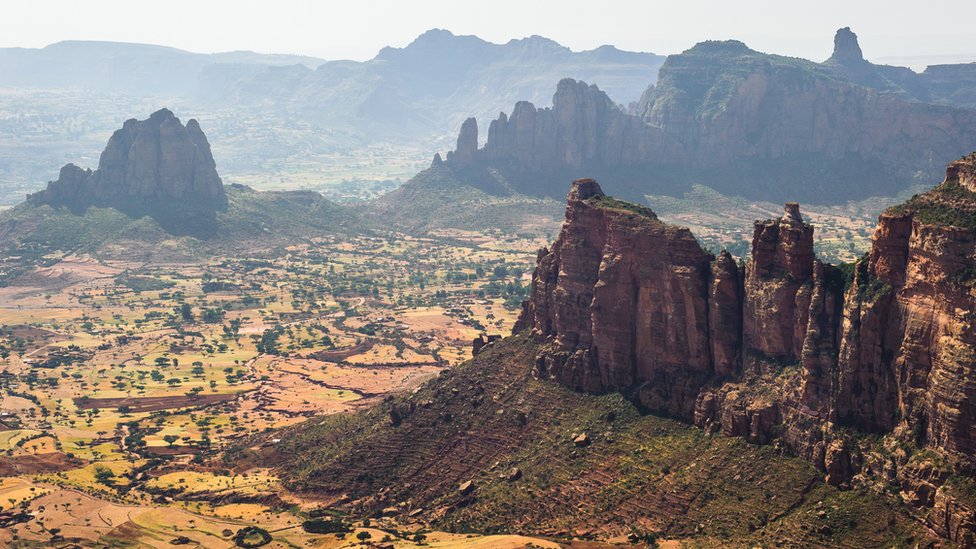
A mountainous landscape in Tigray, Ethiopia
Tigray's mountainous landscape makes it conducive for guerrilla warfare    Getty Images

"The 72-hour period granted to the criminal TPLF clique to surrender peacefully is now over and our law enforcement campaign has reached its final stage."
Ethiopian Prime Minister Ably Ahmed

"This humanitarian assistance will now be further reinforced with the opening of a humanitarian access route to be managed under the auspices of the Ministry of Peace."
PM Ably's Office
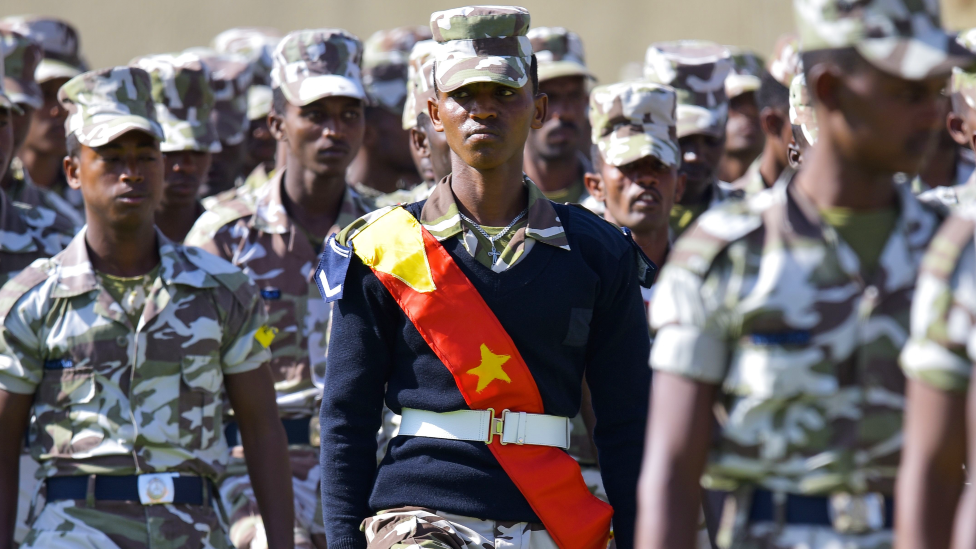
Tigray special forces pictured in February 2020
The regional government in Tigray has a powerful force  AFP
 
While the Ethiopian Nobel Laureate honoured for making peace with neighbour Eritrea which had broken away from Ethiopia and a long war had been occasioned between them with Ably finally making peace between the two, a different story emerges with the autonomy of Tigray Province. Tigreans in their majority province of Ethiopia, a country riven by tribal differences, are now under military assault by the Ethiopian army.

The government of Ethiopia refuses to negotiate with the Tigrean leaders because they are 'terrorists', a familiar mantra well known to those who study countries at war over sectarian and tribal divides; those who declare a wish to govern themselves in their heritage, majority landscapes, are automatically prescribed the role of 'terrorists'. Cue the Kurds in Turkey, the Sunni Syrians in Shia-dominated Syria.

Close to 43,000 Ethiopian refugees have fled to Sudan. The humanitarian coordinator in Ethiopia for the United Nations has no idea what and where and how the described humanitarian access route referred to by is; she's never heard of it, seen it, or suspected its existence. Yet the Ministry of Peace in a country that has declared part of its population 'terrorists' and denies bombing civilian areas, has launched a military campaign against that population.

Ethiopian authorities claim to be bearing down on the Tigray capital region. While at the same time Ethiopian army chief Birhanu Jula claimed that WHO head Tetros Adhanon Ghebreyesus has been procuring arms and diplomatic backing for the TPLF whom he once served as a minister when the TPLF led Ethiopia's coalition government. He, according to Ethiopia's government is a 'criminal'. Dr.Tedros responded by denying the accusation, calling on both sides to work for peace.

Hundreds if not thousands have been killed in the three-week-old conflict, along with the tens of thousands of refugees crowding into Sudan. Last week a federal air strike injured university students in the Tigray capital of Mekelle with its half-million population which the Tigray People's Liberation Front rules. "It [the air strike] resulted in heavy casualties of many university students and other civilians", noted a post from the TPLF on Facebook.

"Our defence forces are moving forward and closing in on Mekelle. There are a number of towns that have fallen", stated government spokesperson Redwan Hussein of the war that has pitted the central government against one of the most heavily militarized of ten ethnic states that comprise Ethiopia. Claims by the government are that the TPLF is holding power illegally in Tigray while the TPLF responds that the war is an unconstitutional assault on regional rights.
 
The Tigray region's special police forces

According to UN estimates, 1.1 million Ethiopians will require humanitarian aid resulting from the conflict. It is unable to enter Tigray to deliver aid given the bombing by government forces. Those that have fled to Sudan are also in desperate need of help. Though both sides claim that serious damage has been inflicted on the other side, the Deputy Director of the Africa Program at the International Crisis Group states "...Federal forces appear closer to Mekelle amid reports of heavy combat between the two sides yesterday."

But for some Ethiopians good news comes not too soon as Israel’s Ethiopian-born Minister of Immigrant Absorption is set to return briefly to Ethiopia to bring back to Israel hundreds of Ethiopian Jews. Minister Pnina Tamano-Shata will fly to Ethiopia with representatives of the Jewish Agency, where they're prepared to meet with a group of  prospective immigrants from Addis Ababa and Gondar, and will accompany them back to Israel on two Jewish Agency planes. Called Beta-Israel, thousands have left Ethiopia over the years to become Israeli citizens.

Jewish Agency chairman Isaac Herzog (center) and Minister of Aliyah and Integration Pnina Tamano-Shata welcome 119 Ethiopian immigrants to Israel, May 21, 2020. Photo: Shlomi Amsalem.


Labels: , , ,

Monday, July 15, 2019

Boeing's Opaque Mea Culpa

"These funds will support education, hardship and living expenses for impacted families, community programs, and economic development in impacted communities."
Boeing Co.

"We were once told that a statue in memory of the victims and a health post for the local community will be built, and they also promised that the road to the crash site will also be built so that it will be easily accessible for visitors."
Malka Galato, 47, farmer, Gara-bokka, Ethiopia

"We've been assessing a variety of ways to assist the families and communities impacted and determined that this is a constructive step that we can take now ..."
"We're working through the process. Boeing plans to partner with local governments and non-profit organizations to address family needs."
Peter Pedraza, Boeing spokesman

"I stayed enclosed in my little house, in my grief."
"How much would it cost Boeing to personally apologize to the families of the victims? To offer professional counselling for all families who are grieving?"
Paul Njoroge, Canada

"The first thing they [Boeing] should do is reach the families to give their condolences."
"The second thing, they should offer professional counselling."
Pawel Konarski, Poland
INDONESIA-ACCIDENT-LION AIR
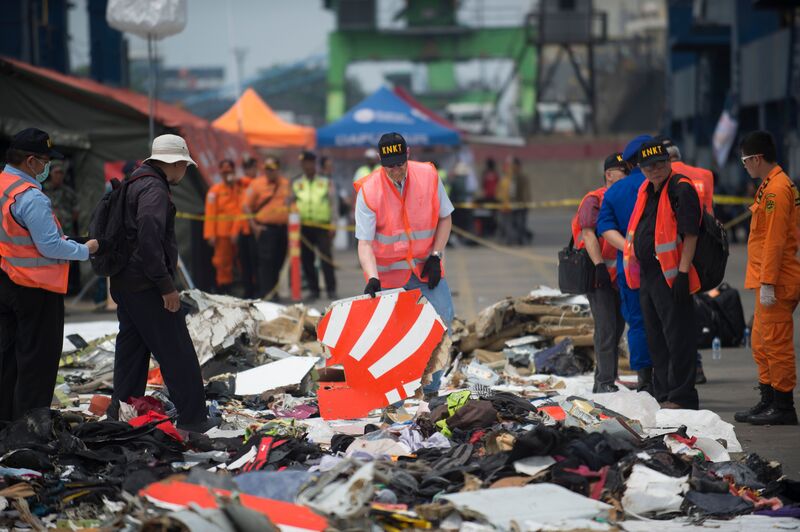
Debris recovered from Lion Air flight JT 610 in Jakarta in November 2018.
Photographer: Bay Ismoyo/AFP via Getty Images
When two Boeing 737 Max planes crashed in Ethiopia and Indonesia late last year and early this year, a total of 346 people died. Early investigations indicate that the pilots flying new 737 Max 8 model planes were unable to override an automated system that malfunctioned and pointed the aircraft's nose in a downward position, causing both crashes.  The result was a massive death toll, impacting passengers who hailed from all over the world.

The Boeing model in question was then grounded worldwide, given a second crash in Ethiopia, with all the signposts of the malfunction that caused the first crash of the Lion Air flight in Indonesia in October. Boeing has its work cut out for it in redesigning the electronics of the plane to re-instill confidence in airlines that their newly-purchased fleets of the 737 Max are airworthy.

Regulators will have to approve whatever engineering and electronic fixes the company completes and training for pilots will have to resume before the jets can be approved for flight. A week ago, Boeing Co. made an offer of $100 million with the intention of giving aid to families and communities that were affected by those deadly crashes in Ethiopia and Indonesia.
tCreditJoe Raedle/Getty Images
Included would be not only the victims' families but also Ethiopian farmers whose fields have been fenced off, sites remaining littered with shards of debris, leaving the farmers shut out of farming their own agricultural land. These are poor farmers who cannot afford the expense of leasing land elsewhere, to plant. The money, according to Boeing would be given to local governments and non-profits to be dispensed.

This, aside from the many lawsuits launched by the families of the crash victims. Who will qualify or the offer timeline has not been made clear. But then, it is a highly unusual situation where it is a plane manufacturer and not an airline offering compensation. The Ethiopian and Kenyan governments have not yet been approached by Boeing; no details on the offer have been relayed to Ethiopian Airlines.

Farmers in Gara-bokka where the Ethiopian Airlines crash occurred are left to wonder what will become of their land surrounded by barbed wire fencing. With their fields fenced off they're unable to farm. There are questions from many involved as to whether funds given to government or charities might not even reach them. People from 35 countries had been aboard the Ethiopian Airlines flight; none of the families have heard from Boeing, the company has not sought opinions from any of them.

"Why does  take so long to acknowledge? Give our loved ones [the[ respect that they deserve", said Clariss Moore, of the death of her daughter Danielle, from Canada.

"Because there is still so much to learn about what occurred, it [Boeing's offer] also appears to be disingenuous. Frankly, Boeing's statement creates more questions than answers. Boeing does not understand that the families at this point in time are not interested in its money. The fact is that what is foremost on the minds of these families is getting back the human remains from the crash site. To date that process has been torturously slow without a great deal of communication from Ethiopia. If Boeing really wanted to help, it would take all that money and devote it to accelerating the remains recovery/identification process for these families", stated Robert A. Clifford of Clifford Law Offices

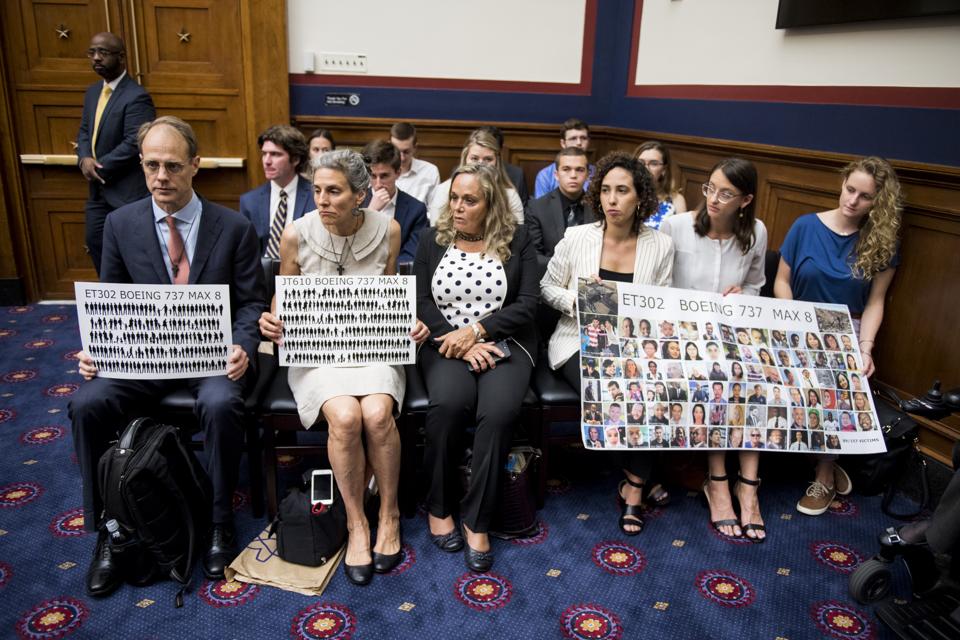
Boeing 737 MAX Hearing

Labels: , , , ,

Thursday, March 21, 2019

The Profit Motive Sidelining Corporate Responsibility and Safety -- Boeing Dereliction

"As the pilots of the doomed Boeing jets in Ethiopia and Indonesia fought to control their planes, they lacked two notable safety features in their cockpits. One reason: Boeing charged extra for them.
For Boeing and other aircraft manufacturers, the practice of charging to upgrade a standard plane can be lucrative. Top airlines around the world must pay handsomely to have the jets they order fitted with customized add-ons."
"Sometimes these optional features involve aesthetics or comfort, like premium seating, fancy lighting or extra bathrooms. But other features involve communication, navigation or safety systems, and are more fundamental to the plane’s operations."
Many airlines, especially low-cost carriers like Indonesia’s Lion Air, have opted not to buy them — and regulators don’t require them."
"Now, in the wake of the two deadly crashes involving the same jet model, Boeing will make one of those safety features standard as part of a fix to get the planes in the air again."
The New York Times
Boeing 737 Max 8 planes have been grounded in the UK.
Christopher Furlong/Getty Images
"They’re [manoeuvring characteristics augmentation system (MCAS)] critical, and cost almost nothing for the airlines to install."
"Boeing charges for them because it can. But they’re vital for safety."
Bjorn Fehrm, analyst, aviation consultancy Leeham

"[The 737 Max will be grounded until] the problem is solved. This country was one of the first to ground the 737 Max planes. That is absolutely the right thing to do. There are clearly some very alarming circumstances around the two accidents [Lion Air flight 610 and Ethiopian Airlines flight 302] that have taken place."
"It is something that Boeing clearly have to deal with because, unless and until the problem is solved, I can’t see countries like ours allowing those planes to fly again."
UK Transport Secretary, Chris Grayling
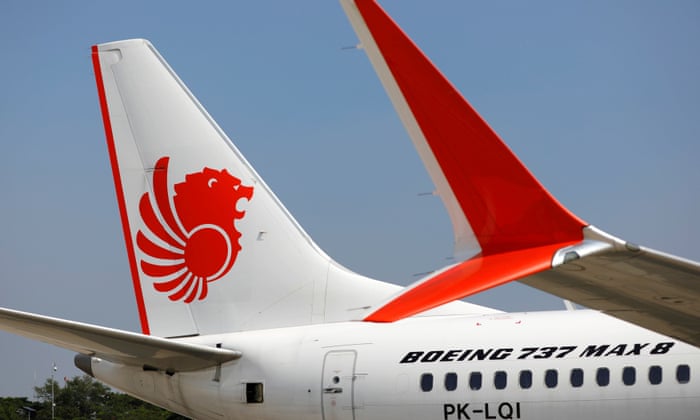
A Lion Air Boeing 737 Max 8 plane parked on the tarmac of Soekarno–Hatta international airport near Jakarta, Indonesia Photograph: Reuters
It has become standard for manufacturers such as Boeing not to include upgrades that can be critical to a plane's performance and ultimately the survival of its passengers and crew unless the purchaser is willing to pay an additional, hefty fee. Typically, low-cost airlines will consider upgrades as non-essential and opt not to spring for them. In the instance of both the Indonesian and Ethiopian carriers this has proven to be a massive error in judgement.

Almost as serious as the decision by Boeing to extract every last dollar possible out of their customers even if the end result might be airborne carnage.

Upgrades that in fact represent essential standard safety features eliminated because the buyer feels they're unnecessary and the seller feels their product can be used to squeeze every last bit of profit out of a reluctant buyer or they can face the consequences. It's hard to imagine that a 'reputable' manufacturer with global sales could not foresee that it too would face fallout as a consequence of their unwillingness to be responsible unless they're paid to be.

Now that the worldwide fleet of this model of a popular passenger jet is grounded and its future unknown after the entirely preventable mass deaths of two failures in air transport safety, the company deserves the censure coming its way. The company made the decision not to include a critical safety process leaving it up to airlines whether to pay to upgrade a standard plane and regulators are certainly at fault for enabling manufacturers to get away with a situation where low-cost carriers can opt not to buy 'optional' extras.

Safety is not optional.

The stunning communications failures all around demonstrate just how careless all major actors involved have been. When the downed Lion Air plane in a flight previous to the disaster exhibited the threat in its erratic performance and its pilots had no idea  how to respond, an off-duty pilot who happened to be flying with them leaped to the rescue, diagnosing the problem, instructing the crew how to respond to disable the malfunctioning flight-control system, saving the jet and its passengers and crew

That this air crew and the helpful pilot failed to report the incident and the plane once again took off with another crew having as lax training as the previous one, leading to a similar malfunction and the crash into the Java Sea where all 189 aboard were killed is beyond belief. But as hostile to reason as this event was, it evidently has aided investigators in understanding what happened to the Ethiopian airliner March crash and why it is some 737 Max pilots have no idea how to respond when the plane malfunctions.

Indonesia's National Transportation Safety Committee's report on the November crash contained no data that might have been useful to other carriers with this plane in their fleet, and their pilots inadequately trained in its operating details. The Lion Air crash on its second malfunctioning flight reveals through the cockpit voice recorder on investigation that the pilots desperately checked their quick reference handbook to attempt a response before crashing as the Indonesian officer called "Allahu akbar" as the plane hit the water.

Airline mechanics with Lion Air attempted to fix issues on the plane four times after reports from pilots of incorrect displays of speeds and altitude in two prior flights, replacing a key sensor. Both the plane manufacturer and Indonesia's safety committee are guilty of malfeasance in failing to tend to due diligent safety procedures. In requesting maintenance for the plane that had come close to disaster on its October 28 flight, no mention was made by the pilots of the stall warning and faulty sensor, still delivering false readings when it took off the next morning then crashed.

The March 10 crash of Ethiopian Airlines Flight 302 followed the same trajectory of events. Now questions are emerging over Boeing's design of the new 737 model, and how they were even approved. The inspector general of the U.S. Transportation Department is undergoing a review of the plane's certification while the U.S. Justice Department has struck a grand jury seeking records in a potential criminal probe of that certification.

The U.S. pilot's unions speak of the potential risks of the system, the Maneuvering Characteristics Augmentation System as having not been sufficiently explained in training. Boeing, required by the FAA to notify airlines about the system in the wake of the Lion Air crash, sent a bulletin to its customers with the Max in their fleets reminding them of the disabling process in response to an emergency.

Had their clients, including the Ethiopian Airlines disseminated that 'reminder' to upgrade the expertise of its pilots, why would the pilots on the March flight not have known how to disable the system?

Priests swing incense over empty caskets draped with the Ethiopian flag at a mass funeral at the Holy Trinity Cathedral in Addis Ababa on March 17. (Mulugeta Ayene/Associated Press)

Labels: , , , , ,

() Follow @rheytah Tweet