
Politic?

This is a blog dedicated to a personal interpretation of political news of the day. I attempt to be as knowledgeable as possible before commenting and committing my thoughts to a day's communication.

Saturday, January 06, 2018

On Track to Become an Undersea City 
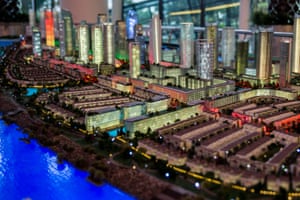
A scale model of a waterfront city planned for one of the 17 artificial islands, Island G.
High rises, gated compounds and marinas: the Islands    The Guardian

"Nobody here believes in the greater good, because there is so much corruption, so much posturing about serving the public when what gets done only serves private interests."
"There is no trust."
Sidney Jones, director, Institute for Policy Analysis of Conflict, Indonesia

"We need big steps now. If all the discussions get tied up with fishermen and development, there will eventually be a massive calamity and deaths and no choice but to give up on whole parts of Jakarta."
"If this wall [newly built Coastal Wall] breaks, there's simply no holding back the Java Sea."
"Jakarta  will flood all the way to the center of town, six kilometers from here. I could take you to twenty other places just like this."
Jan Jaap Brinkman, Dutch hydrologist

"Jakarta could become a 21st-Century version of Tokyo in the 20th Century, an example for urban redevelopment."
"A city that can't deliver basic services is a failed city. On top of conventional issues like flooding and urbanization, we now have climate change, tipping the scale."
"And at this rate, people will be fighting in the streets for increasingly limited resources like clean water and safe living spaces."
"Nature will no longer wait."
Irvan Pulungan, climate researcher, adviser to Jakarta's governor
Photo by CEphoto, Uwe Aranas.

Jakarta may appear like a modern, technologically advanced city of the 21st Century with its freeways and skyscrapers, but look a little more critically and you see ports, high-rises, fish markets, slums, power plants, malls and polluted canals weaving their way through the area. Water is piped to fewer than half the population of 10-million, not by the authority of the municipality operating water plants, but by private companies charging extortionate rates through government concessions.

Rain forests in Indonesia have been burned down in favour of palm oil forests and the building of textile factories, causing air pollution floating over the country, reaching out to Malaysia. Waste and chemicals are dumped into waterways, leaving drinking water supply contaminated. The rural poor have migrated to the capital Jakarta to set up informal kampungs clustering along its canals, huts built on stilts, contaminating the waterways with their sewage.
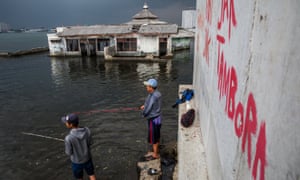
Forget Venice. The fastest-sinking city is the Indonesian capital, parts of which are dropping at 25cm a year. Can an outlandish plan for a giant seawall and luxury waterworld city in the shape of a mythical bird save Jakarta from drowning? The Guardian
And everywhere in the city and beyond, residents dig their own wells in such numbers that the aquifers beneath the city are depleting and the city is sinking. Jakarta is sinking lower and faster than any other city on the Globe; the sea around it rises remorselessly and rainfall fails to resupply the shrinking aquifers because so much of the ground in Jakarta is covered with buildings, with roadways; concrete making the rain run off rather than into the earth.

Close to 40 percent of Jakarta now is below sea level.

The city suffers some of the worst traffic snarls in the world, while buildings sink in this city that suffers from lack of planning and municipal sewers. According to hydrologists, Jakarta has a decade in which to make an effort to halt its collapse into the sea. Over 97 percent of Jakarta is covered with concrete and asphalt; fields that once absorbed rain are no longer there. Shantytowns and apartment towers have displaced the native mangroves that once relieved monsoon-swollen rivers.

A former governor of Jakarta ordered the eviction of waterfront slums. He was a geological engineer by training, and as governor he undertook to solve some of the city's largest problems, to take control of the water supply from private companies, assembling a sanitation crew to remove sediment and garbage from rivers and canals, clearing out some of the informal slums obstructing waterways and soon a difference was seen as rain instead of causing floods, drained in  hours.

He failed to be re-elected, opposition was so strong against his efforts. Replaced by Islamists in this most populous of all Muslim countries, he was brought up on charges of blasphemy and served a two-year prison sentence. Climate scientist Ardhasena Sopalheluwakan feels it would be best "to give back part of North Jakarta to nature", to "reintroduce mangroves and rejuvenate some of the dozens of reservoirs that were actually part of old Jakarta".

Just "counteracting subsidence will account for 90 percent of what this city needs to do to deal with climate change", according to to hydrologist, Jan Jaap Binkman. Post WWII, Tokyo had sunk four meters since 1900. The city poured resources into infrastructure and established stricter rules on development. In a decade Tokyo became a symbol of urban innovation, able to cope with the effects of climate change.

Photo by CEphoto, Uwe Aranas.

Labels: , , , , ,

Tuesday, December 12, 2017

Cold and Dark, But It's Home

"Norilsk is a unique city. It was put here by force."
"It is like a survivor. If it had not been for Norilsk, there would have been another principle of life in the Arctic: You came, you worked, you froze = and you left."
Alexander Kharitonov, owner, printing house

"Everything else [beyond the city] is a vast wild land with a wild nature and no people."
"This is where the last wild mammoths died. When they dug the foundations of the buildings, they found the bones of mammoths."
Vladimir Larin, scientist, Norilsk
Due to its location, Norilsk might appear even more isolated than other arctic cities, without ground connections with the rest of the world. The air is the only way to reach it, together with seaway and river boats when the navigation is possible

It was once a dark, frozen, isolated gulag. That was during Soviet times, when Stalin had subversives, enemies of the state and just pure unfortunates sent to this remote city in northern Siberia to work as slave labourers. It was a vast slave prison, part of Stalin's infamous Gulag, where harsh punishment was meted out to people enslaved in a harsh landscape between 1925 and 1956. At its height, an estimated 650,000 prisoners were sent to the camp known as Norillag.

They must have thought they were in Hell, in a place that was perpetually dark throughout the long winter months from late November to June where the sun is never seen and the polar winter is brutal and they worked until they dropped. It was thought that during the two decades of its use, 250,000 of the prisoners died of overwork, of starvation of the effects on the human body of continual exposure to misery and cold, where the temperature was known to drop to minus 62 Celsius.

The place was closed by Nikita Khrushchev in 1956, when human rights became a recognized issue and the-then President dismantled Stalin's slave labour camps. Even so, no foreign visitors may even now access the city without a permit issued by Russia's Federal Security Service. What any foreigner would see if he ventured there now would be a thriving city of 174,000 people living there year-round; a population comprised of descendants of some of the labourers and of the majority who came voluntarily, lured by the prospect of high salaries and the stark beauty of the place.

The city is well populated but the wilderness extending beyond it is uninhabited wilderness for the most part. When winter breaks, and the two months of darkness relent, melting snow brings buried remains of the prisoners to the surface. The city is so remote only plane or boat on the Arctic Ocean offer passage out.

Those who came for the steady work on offer do hard, well-remunerated labour in Norilsk's metallurgical industry, a large complex of mines and smelters representing Norilsk Nickel a former state company since privatized, the world's largest producer of the rare metal palladium as well as a supplier of nickel copper and other metals. In recognition of difficult living and working conditions there are 90 days of paid holiday time, and retirement age is set at 45.
Every year, more than 2 million tons of gas (mainly dioxide sulfur, but also nitrogen oxides, carbon and phenols) are expelled into the atmosphere
Move than 6,000 square kilometers have been turned into a dead zone characterized by dead trees, by mud and snow. More sulfur dioxide is belched out of the company's chimneys that what all of France produces in a year. Its residents, however, are proud of their city and their ability to survive in a harsh environment. Lake Dolgoye even has its dedicated contingent of swimmers eager for the bracing experience when they dip into its icy waters in a lake that only partially freezes; where hot water pipes from a power plant warms it to below freezing.
The Norilsk’s citizens suffer ‘the polar night syndrome’, resulting in anxiety, nervousness, drowsiness or insomnia, depending of the seasons, while the psychological discomfort and poor emotional stimuli also generate many cases of depression. Pictured in January locals celebrate Epiphany by swimming in Lake Norilsk 
The Norilsk’s citizens suffer ‘the polar night syndrome’, resulting in anxiety, nervousness, drowsiness or insomnia, depending of the seasons, while the psychological discomfort and poor emotional stimuli also generate many cases of depression. Pictured in January locals celebrate Epiphany by swimming in Lake Norilsk

There are some newly-introduced social amenities in the city, such as Internet service, and the presence of the Norilsk College of Arts, as well as the Norilsk Greenhouse growing fresh product in heated greenhouses. There is home brew available and live music at the Zaboi Bar whose owner claims to struggle with the climate, dreading returning to the city after being away, yet never failing to return to the city he "really do[es] not want to go back" to.
This huge pollution has a strong influence on the people’s health. Life expectancy is 10 years less than in other regions of Russia, the risk of cancer is two time higher and respiratory diseases are widespread 
This huge pollution has a strong influence on the people’s health. Life expectancy is 10 years less than in other regions of Russia, the risk of cancer is two time higher and respiratory diseases are widespread

“It is really impossible to emphasize just how otherworldly this place was. Most people, including the city's nuns and head doctors, claim that those from Norilsk have better health. And this is without mentioning that all nature in a radius almost the size of Germany is dead from severe air pollution. I already knew that the people of Norilsk loved their hometown, but I didn't expect them to so openly contradict medical findings [of cancer ten times the rate elsewhere in Russia].”
Victoria Fiore, filmmaker
In the winter, children are allowed for a walk outside only under certain conditions. Sometimes children have to spend several months indoors
Many buildings have been gradually abandoned 

Labels: , , ,

Friday, October 06, 2017

Monitoring Air Quality

"This dropping of the rocket stages is of considerable concern to the Inuit of Canada and Greenland, who only learned about the practice in 2016."
"Given this concentration of biota, the North Water Polynya is an inappropriate location for dropping rocket stages with toxic residual fuel on board." 
"The [incoming rocket] stage does in fact break up during re-entry but the fuel does not burn up and disappear, it turns into an aerosol and then it drifts gradually down onto the Earth over a wide area with very serious health consequences and environmental consequences in Kazakhstan and Russia and quite possibly therefore in Canada and Greenland."
"It’s [UDMH] a devastating chemical, in Russia it is referred to as ‘devil’s breath. It is very volatile, very useful for launching rockets but also it has this very dark and dangerous side in the toxicity."
"You are prohibited under the United Nations Convention on the Law of the Sea to cause pollution to the ocean with objects that pass through the atmosphere. There is a specific provision in the Law of the Sea Convention that prohibits pollution through the atmosphere."
"I don’t need to prove that damage is caused. Under international law there is something called the precautionary principle, the burden of proof is on them and not on me. They need to prove that there is no risk of damage and unless they can prove there is no risk of damage, they are not allowed to do this launch."
"The message that the governments involved in this case need to hear is: ‘Look you have technological alternatives, there is no excuse to using this old technology, this old dangerous fuel in 2017'. Switch the type of rocket, pay a little bit of extra money to do this in a safe way, in a way that does not create a risk for the Arctic environment and most importantly for the Inuit who live there."
"There are lots of non-toxic alternatives so the focus of my effort right now is to shame the European Space Agency, to shame the government of the Netherlands to pay a little bit more money to launch this satellite in [an] environmentally risk-free way."
"As part of my research I then discovered that there was a very disturbing set of scientific articles concerning the damage caused by this rocket fuel in Kazakhstan and Russia as a result of rocket stages falling on land in those countries, causing cancer rates that were twice the average in unpolluted areas, causing widespread deaths of fish in lakes in northern Russia. And that’s when I started to connect the dots that this wasn’t just a hypothetical risk but there was a very real risk."
Arctic scholar Michael Byers, University of British Columbia, Canada Research Chair

"[UDMH [rocket fuel]is found around Baikonur] in vegetation, soil and sediments, subsoil and surface waters, in concentrations far in excess of those permissible according to the Russian hygienic standards."
Union for Chemical Safety, 1999 report, Russia
The North Water Polynya, or Pikialasorsuaq « The Great Upwelling » in Inuktitut, is the largest Arctic polynya and the most biologically productive region north of the Arctic Circle. (Source: Inuit Circumpolar Council)
"What is being planned by Russia and European Space Agency to launch a satellite where it will drop a fuel rocket into the North Water between Greenland and Ellesmere Island Canada is very disturbing and scary." 
"Not only do we [Inuit] on both sides of the largest open water depend on the wildlife for sustenance, but the distance between the two countries is very small.  The closest gap further north between the two islands is only 32 kilometers."
"What if we get killed?"
Larry Audlaluk, Inuit hunter, Grise Fiord

"The Pikialasorsuaq Commissioners spent the past 16 months listening to the people who live and use this magnificent Arctic marine region and heard clearly that Inuit do not want any action that would affect the sustained productivity of the Pikialasorsuaq."
Nancy Karetak-Lindell, International Commissioner, Acting Chair, Inuit Circumpolar Council
A Rockot launch vehicle lifts of the Sentinel-3A satellite from the Plesetsk Cosmodrome in northern Russia on Feb. 16, 2016. (Stephane Corvaja/European Space Agency)
The rocket fuel in question, UDMH, at one time was used by space and missile programs globally. As its extreme toxicity was more fully understood, the fuel fell into disfavour and was no longer used by most space programs. In 2004 a report out of the United Nations Development Programme made note of the chemical as "dangerous in all methods of transmission to people". Yet a Rockot launch has been scheduled for October 13, to carry a European Space Agency probe designed to monitor air quality.

If that little note of intention and concern isn't enough in and of itself to reflect a supreme irony, it should, yet the European Space Agency, while acknowledging the danger inherent in the use of the fuel, insists it must proceed with the October launch because the Sentinel-5P probe was built to specifications of the soon-to-be disused rocket, an elderly variant of a Russian nuclear-tipped missile used by Russia to launch satellites into orbit.

The fact that the fuel is responsible for having caused pollution in areas adjacent former Soviet spaceports doesn't appear to unduly unsettle the European Space Agency, no more than it does the Russian agency that uses the highly toxic fuel phased out in most of the rest of the world. The high stupidity of polluting the atmosphere to launch a probe meant to monitor air quality does not appear to have made an impact of absurdity in the great minds that designed this venture.

Each time that Russia launches a space vehicle, tonnes of this polluting fuel is dumped into Canadian waters when UDMH is used to power the first two stages of a "Rockot". As the vehicle gains altitude the initial UR-100N stages are jettisoned into Arctic waters, enabling the vehicle to gain altitude. In June of 2016 a launch resulted in a Rockot dropping its second stage into water between Greenland and Ellesmere Island, in Canada.

An estimated eight tonnes of UDMH could potentially be dropped as unburned fuel with each launch, vaporizing and misting over Nunavut. An area of year-round open water teeming with whales, seal, polar bears and seabirds called the North Water Polynya is where most of those Rockot stages have been landing.

In Russia itself in areas surrounding the Baikonur Cosmodrome at the Kazakhstani spaceport where most of the space launches took place during the former Soviet Union's era, UDMH was present everywhere. A health examination of 48,000 people living in the area of Baikonur concluded that merely 26.5 percent of the adult population presented as "healthy people".  Death rates from blood and liver diseases were seen at 30 percent higher around Baikonur than elsewhere.

Mass die-offs of fish were observed in lakes under the UDMH-burning rockets' flight paths. Although Russia is in the process of phasing out UDMH, its use is continuing, reflecting the inexpensive availability of surplus UR-100N missiles, converted into Rockots.
A polar bear stands on a ice floe in Baffin Bay above the Arctic circle as seen from the Canadian Coast Guard icebreaker Louis S. St-Laurent. The North Water Polynya or Pikialasorsuaq in Inuktitut is a biologically and culturally unique region and is a breeding ground and migration area for animals such as narwhal, beluga, walrus, bowhead whales and migratory birds. (Jonathan Hayward/The Canadian Press

Labels: , , , ,

Friday, May 24, 2013

First-World City, Third-World Lapse

Montreal, arguably at least one of Canada's most populous cities, and for a first-world country, a recognizable name internationally for its cosmopolitan flavour, its distinct architecture, its pride in culture and language and heritage; not least the pluralistic society it has become, thanks to an open immigration policy, welcoming newcomers from across the world; French-speaking preferentially.
It is a wealthy, technologically advanced city by any standards.

However, its standards have temporarily, but irritatingly slipped in the provision of one of the most fundamental services that any city should be able to offer with complete confidence to its residents -- without interruption, and without concerns about purity as a result of possible contamination: potable water. Residents of that great metropolis were advised it would be best for their health were they to boil their tapwater for a minimum of one minute.

Alternatively, they could rush over to their nearest supermarket to purchase bottled water. When brushing teeth, use that bottled water. As long as one doesn't feel too queasy at the contamination sources which no one in authority had any real idea about -- but since the problem seems to have emanated with a water quality purification plant, that brown, muddy-looking liquid gushing out of taps when it should be reliably crystal-clear -- think waste-water, the green light given to washing dishes with it.
"To my knowledge it's the first time that we have in Montreal a boil-water advisory for so many people. Once we get the results, we will be able to maintain the advisory or take it down. The water (at the plant) dropped to a very low level. The sediments that were at the bottom ended up in the aqueducts."
Valerie De Gagne Montreal city spokesperson

The Atwater filtration plant is the second-largest in Canada. Unsurprisingly, given the size of the city, second in size of population only to Toronto.  Tests were being undertaken to determine whether the water, murky in appearance and rather malodorous, had become contaminated. The advisory concerned water being supplied not to the entire city, but to 1.3-million of its residents.

In response some of the city's boroughs had begun purging their fire hydrants hoping to clear away the muddy-appearing water. But they were required to halt that procedure for fear they would deplete adequate water supplies for the city. Unrelated, but an interesting double-calamity for those depending on the functionality of integral civil services, the city's metro system suffered a complete shutdown during rush hour because of computer problems.

"I hope Montreal's still under warranty", quipped one resident in a delightful tweet. It isn't known whether any tweeted advice to evacuate to Toronto, or to move the affected population to one of the many northern-based provincial reserves, returning the compliment when said First Nations reserves encounter problems with the reliability of their potable water due to some malfunction, or responding to spring flooding conditions mandate temporary evacuation to nearby cities.

Labels: , , , , , ,

Wednesday, February 20, 2013

Frustrated businessman challenges Chinese official to swim in polluted river in exchange for $32,000

This picture taken on Nov. 17, 2012 shows workers cleaning up the heavily polluted Nanming River in Guiyang, southwest China's Guizhou province.
AFP / Getty Images Files    This picture taken on Nov. 17, 2012 shows workers cleaning up the heavily polluted Nanming River in Guiyang, southwest China's Guizhou province.
 
BEIJING — A Chinese businessman angry about a filthy river has come up with an equally dirty dare: He’ll give an environmental official about $32,000 just for swimming in the polluted waterway.
Businessman Jin Zengmin posted on his microblog photos of a garbage-filled river in his hometown of Rui’an city in the eastern province of Zhejiang. He dared the local environmental protection chief, Bao Zhenming, to swim in it for a cash prize of 200,000 yuan.

The challenge, made Saturday, reflects growing frustration among the Chinese public over widespread pollution and lack of governmental action. It quickly inspired at least one other offer: A posting Tuesday under an alias on an online forum offered a 300,000 yuan ($48,000) cash prize to the environmental protection chief in the nearby county of Cangnan if the official swam in polluted rivers there.

Jin said on his microblog that a rubber shoe factory has been dumping wastewater into the river, and that the area had an exceptionally high cancer rate.

A Rui’an government official who would give only his surname, Chi, would not say Wednesday whether Bao would accept Jin’s challenge. But Chi said the bureau had contacted Jin and will take some measures, including working with residents to clean up trash in the river and putting up signs warning against dumping.
“We will also step up efforts in controlling industrial pollution sources,” Chi said.
He also said that the public should shoulder responsibility in protecting the environment, and that the environmental protection bureau welcomes public supervision and participation in cleaning up local rivers.

China’s booming economy has brought more water pollution, some of it shockingly serious. High-profile industrial accidents along major rivers have disrupted water supplies to big cities in recent years.

Hu Siyi, vice minister of water resources, said last year that 20 percent of China’s rivers were so polluted that their water quality was rated too toxic for human contact, and that up to 40 percent of the rivers were seriously polluted, according to state media.
The environmental agencies are obligated to make efforts and solve the problem
Last month, about nine tons of aniline, a chemical used to make polyurethane, leaked into a river in northern China. It took five days for the leak to be reported, and by then it had contaminated the water supply of a city in a neighboring province.

Yang Jianhua, a researcher at the Zhejiang Academy of Social Sciences, told the state-run China News Service that the cash-prize challenges reflect the public’s deep worries about pollution.
“The environmental agencies are obligated to make efforts and solve the problem,” Yang told China News.

Labels: , , , ,

() Follow @rheytah Tweet