Politic?

This is a blog dedicated to a personal interpretation of political news of the day. I attempt to be as knowledgeable as possible before commenting and committing my thoughts to a day's communication.

Friday, August 15, 2025

Canada Is Afire!

"Climate change is greatly increasing the flammability of the fuel available for wildfires because the trees, fallen trees and underbrush are all so dry."
"This means that a single spark, regardless of its source, can rapidly turn into a blazing inferno."
Natural Resources Canada
 
"What we're getting now is bigger fires, faster-moving fires and also a faster return rate of those fires."
"Instead of burning through once every 50 to 200 years, they're coming through every five years, every 10 years." 
John Vaillant, author, Fire Weather: A True Story from a Hotter World
A helicopter battles wildfires near Coombs, B.C., on Sunday, Aug. 3, 2025. THE CANADIAN PRESS/Chad Hipolito
 
This week alone in Canada, 7.4 million hectares of forest has burned; twice as much damage as wildfires caused to date this year in the United States; almost as much as burned areas of Argentina, Chile and Columbia in combination. Saskatchewan and Manitoba declared states of emergency; a few other provinces ordered residents out, even entire communities in view of the fast-moving fires and dangerous smoke. Air-quality alerts have been triggered in the largest of Canadian cities.
 
In this country of massive, magnificent forests, firefighting resources are stretched to breaking across Canada. The Canadian Interagency Forest Fire Centre - the country's national firefighting co-ordinating body -- reported 721 fires raging across the country; 158 of that total are classified as out of control. The CIFFC states that national wildfire preparedness level is at the highest possible rating -- Level Five; translating to all national firefighting resources having been deployed. 


In Atlantic Canada, the Weather Network states the region could expect thundershowers shortly; the other option is for the hot, dry weather to continue, fanning wildfires. Saskatchewan has lost 2.8 million hectares to wildfires this year, far more than the 1.9 million during the 2023 season which was Canada's worst year for wildfire devastation. In neighbouring Manitoba, 1.7 million hectares have been scorched; the second hardest-hit province. 
 
Wildfire devastation has spread throughout the country with the exception of Prince Edward Island. British Columbia, Alberta and Ontario are experiencing above normal fire numbers with more forest than usual being consumed. Newfoundland's wildfires threatened  St. John's and in New Brunswick 15 active wildfires were announced, two out of control. Nova Scotia is battling a new wildfire. A bolt of lightning, a discarded cigarette, a spark from a piece of machinery, all represent a source of ignition; with the right conditions the initial flame erupts and rapidly spreads.
 
Hotter temperatures trigger more lightning strikes. According to Natural Resources Canada, those lightning strikes cause about fifty percent of all fires, yet account for about 85 percent of annual area burned. Fires on average burn 2.1 million hectares of forest annually in Canada, according to government statistics; a fraction of the 15 million acres consumed by the 2023 inferno, barely a quarter of the loss this year to date.
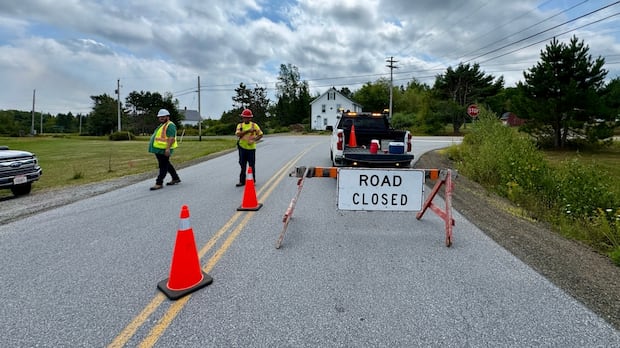
 
An out-of-control wildfire in the Annapolis County community was estimated to be 300 hectares in size on Thursday, prompting a mandatory evacuation. CBC
 
Saskatchewan's Public Safety Agency states that about 80 percent of the 2025 fires in the province were caused by human activity, mostly accidental in nature, and that statistic holds for Manitoba as well. In heavily forested British Columbia, however, six of ten wildfires this year were attributed to lightning strikes. Whereas an open fire left  unattended by someone began  the wildfire at Susie Lake on the outskirts of Halifax, this week.
 
Eight firefighters died in their battle with the 2023 blazes. During the 2013-2018 period, records show that wildfire smoke contributed to some 240 premature deaths per year in Canada. A growing body of research found links between exposure to particulates from wildfires and the likelihood of being diagnosed with dementia and experiencing worsening symptoms of epilepsy and cognitive decline.
 
At the present time, wildfire response is a provincial and territorial responsibility. The country's fire chiefs for the past decade have been calling for a body to coordinate, support and strengthen wildfire responses across Canada. "Work is already underway to identify and advance options to improve Canada's wildfire response capacity, including better co-ordination across jurisdictions and building long-term resilience", announced Emergency Management and Community Resilience Minister Eleanor Olszewski. 
 
Traffic is diverted as the Trans Canada Highway remains closed outside of St. John's N.L. due to a wildfire in the Paddy's Pond area on Wednesday, August 13, 2025. File photo by The Canadian Press/Paul Daly
 

Labels: , , ,

Tuesday, August 29, 2023

Playing China's Environmental Challenges Game

"It is, above all, a political institution and its purpose is to bring in money and legitimacy to China's often feeble attempts at combating local pollution and climate change overall."
"By making foreigners and foreign organizations invest in this political venture, they effectively silence them."
Czech sinologist Filip Jirous

"As the world faces the interrelated crises of climate change, pollution, and biodiversity loss -- threats that cross all borders and require urgent international co-operation -- CCCED [China Council for International Cooperation on Environment and Development] has been a been a meaningful forum for global sustainable development."
International Institute for Sustainable Development
 
"Existential global environmental challenges cannot be effectively addressed without China's contribution, given its size, population and carbon-intensive economy."
Samuel Lafontaine, spokesman, Environment Canada

"Canada's funding is, I believe, a rather pathetic way of keeping our foot in the door in Beijing."
"Unfortunately, it also helps sustain the fiction that China is somehow unable to act in its own self-interest, much less in ours."
David Mulroney, Canadian ambassador to Beijing, 2009- 2012
China buys almost 50 per cent of coal exported by Canada.
Cars move along a highway in a coal-producing region in Yulin in northwestern China's Shaanxi province on April 24, 2023. (Ng Han Guan/AP)
 
Canada's Environment Minister Steven Guilbeault is on a visit to China to attend a climate conference. Diplomacy between China and Canada is at its lowest ebb in recent memory. China, taking fierce umbrage at Canada taking a Huawei executive (daughter of its founder) into custody on an extradition warrant issued by the United States, took its own steps by immediately imprisoning two Canadians and charging them with espionage in a revenge hostage-taking. They were imprisoned for almost two years before the U.S. dropped its charges against Meng Wanzhou and Michael Kovrig and Michael Spavrig were released and returned to Canada.
 
A Canadian think tank actually dating from the time of the arrest of the two Michaels, has been acting as the international secretariat for a Chinese environmental agency whose head is a powerful Communist Party leader. Canadian-led projects for the China Council for International Cooperation on Environment and Development (CCICED) under Winnipeg-based International Institute for Sustainable Development manages international donations and appoints advisers, government having taken over the secretariat from Simon Fraser University.
 
The project is spearheaded by the Canadian government, providing funding equal to China's own. Its supporters claim that it is vital to engage with the advisory organization since China is recognized as key to combating climate change, given it is the world's highest source of carbon emissions. Chair of the Chinese group is China's vice premier, Ding Xuexiang, a member of the Politburo standing committee and formerly director of the office of President Xi Jinping. And Canada's Guilbeault is executive vice chair of the council.
"Even before the meeting starts, they're giving us our marching orders."
"Don't push the envelope. Don't push China to do more. And frankly, the minister [Guilbeault] himself said he was going to have an open and frank conversation. Good for him."
"That makes for a potentially constructive discussion with them."
"They're holding out that carrot that if you're sufficiently deferential and polite, and if you say everything we want you to say, and don't challenge us on climate change and the environment, then maybe, just maybe, other elements of the Canada-China relationship will be improved."
"That's just another way of putting us down, so that we are on our back foot at the beginning of the meeting [China's Global Times reporting that Canada's unusually intense wildfire season 'has resulted in significant excess carbon emissions'.]"
Margaret McCuaig-Johnston, board member, China Strategic Risks Institute
The CCICED focuses on green issues but is the leading organization in the campaign by China to co-opt environmentalists globally, according to sinologist Filip Jirous, who reported to the Jamestown Foundation in Washington, detailing that some of its top officials have backgrounds in agencies involved in globally projecting China's influence. Environmentalists from the West who work with Chinese groups avoid criticism of China, which doesn't take kindly to critical observations.

With the distinction of being the world's largest generator of carbon dioxide emissions (the United States second) and Canada 11th, Beijing, though having invested heavily in renewable energy and electric vehicles, continues to build new coal-fired generating plants, the largest emitter of pollution worldwide. In fact, Canada's largest export in raw materials to China is coal. 

Even as Chinese propaganda is heralding the significance of Canada's environment minister's trip, warnings abound that Guilbeault not take a "condescending tone with his Chinese counterparts". Recent revelations of Beijing's interference in Canadian elections saw Canada expel Chinese diplomat Zhao Wei after it was revealed he was involved in intimidating a Conservative Member of Canadian Parliament. China responded by expelling a Canadian diplomat.

Interviewed by CBC News before his departure to China, Guilbeault refused to commit to raising the matters of election interference and Chinese human rights abuses. "We will confront them when we have to confront them. But we will also co-operate on issues like climate change and nature", he stated.
 
Environment and Climate Change Minister Steven Guilbeault still plans to travel to China on Saturday, despite concerns from opposition parties.
Environment and Climate Change Minister Steven Guilbeault speaks at the opening of the Seventh Global Environment Facility Assembly in Vancouver on Aug. 23, 2023. (Ethan Cairns/Canadian Press)
"We cannot solve the climate crisis without international co-operation -- which means continuing engagement, even when tensions are high."
"CCICED has played an important role in fostering this diplomatic dialogue with China over the years."
Caroline Brouillette, Climate Action Network Canada


Labels: , , , ,

Sunday, October 02, 2022

Energy Superpower

"With Europe importing 80 percent of its solar panels from China, dependencies would merely shift from imported oil or gas to imported solar equipment, leaving much to be desired when it comes to the solar sector as a genuine source of energy security and strategic autonomy."
European Parliament backgrounder
visualization of global solar pv panel manufacturing capacity by country/region.
 
China's big break came when in 2001 Western powers agreed it should become a member of the World Trade Organization. Actually, its big opportunity came when Western consumers became enthralled with the prospect of buying Chinese goods offered for sale at prices substantially reduced for common household goods manufactured in their own countries where production costs were higher, mostly because of higher worker wages and benefits amidst union-corporate bargaining and national standards that China's vast production network was untroubled by, particularly relating to environmental degradation. 

It took dogged patience for Beijing's Chinese Communist Party, and careful planning but in fact, took no time at all for China to dominate the manufacturing and trade market globally, while manufacturing in the West closed down, unable to compete with China, and corporate investment from the West ensured that name brands once proudly home-grown were now produced in China keeping their bottom lines healthy and Chinese industry booming. The environment in China suffered; all-enveloping smog from coal-fired production, poisoned lakes and rivers reflecting no national standards.
 
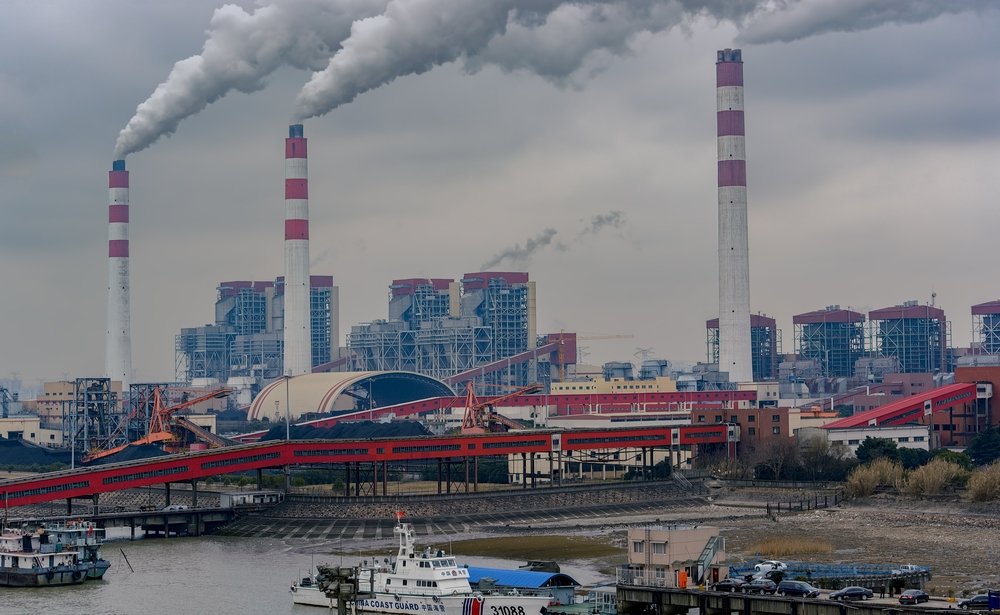
Chinese Coal Power Plant
SHANGHAI, CHINA - Feb 21, 2017: Chinese Coast Guard (CCG) offshore patrol vessel No. 31088 berthed at the pier next to China's biggest coal-fired power plant in Shanghai.
 
Now, add to that China, the world's greatest energy user and contributor to greenhouse gases playing to the environmental game of Climate Change and green energy, vowing at the United Nations to do its part in reducing carbon output, while at the same time building new coal-fired power projects at home and abroad. Remember the Olympic Games held in Beijing when corporations were ordered to temporarily shut down their production facilities and stop emitting particulate matter and carbon in an effort to reduce the dense smog responsible for shortening life spans?

Anxious efforts to show the incoming world spectators that there were blue skies over Beijing, after all, lasted as long as the Games went on, and then it was full throttle ahead, again. And more coal-fired projects on the agenda, not only in China itself, but elsewhere in the world where less-advanced economies responded to Chinese investment and planned coal-fired projects through Chinese generosity willing to advance foreign economies, upgrading bridges and roads in the Belt and Road initiative.

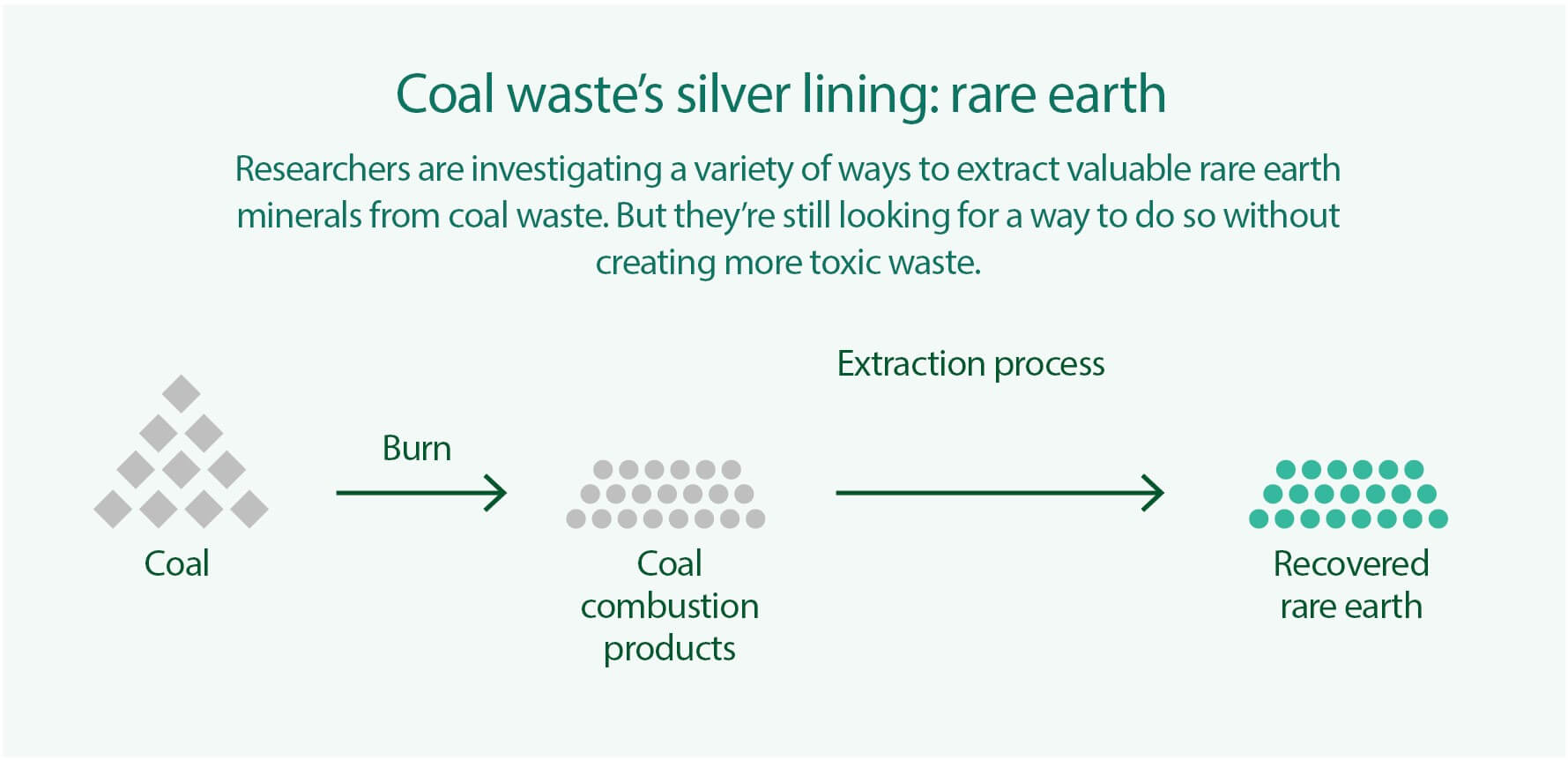
In the West the argument by advocates of decarbonization of industrialized economies, that the oil and gas energy dependency would be replaced with new "green jobs" has failed to materialize. On the other hand, China has been advantaged there, too. Even while China continues to benefit economically as it dominates global production with inexpensive coal-generated power, and has secured a near monopoly on solar panel production and rare earth elements which the West is hungry for in its quest for clear energy and electric vehicle production.


Labels: , , , , ,

Saturday, June 25, 2022

"Doing Things Right" Through Global Collaboration

"The space station, high above, is a microcosm ... an international collection of people living in a finite area with finite resources, just like the planet below."
"I got to see the world, in effect, take one breath out of 4.5 billion breaths ... There has been life, uninterrupted, on Earth, for four billion years."
"That's really optimism-building. Life isn't going anywhere. The world isn't going anywhere."
"The question is: How good a quality of life do we want for people, and how sustainable do we want it to be?" 
"Everyone on the space station, their lives are in each other's hands If anybody makes a mistake, everyone else dies."
"[If ever we doubt our capacity to collaborate, we need only] look up, morning and night, and watch the space station fly over. It's a pretty clear example of what we do together when we do things right."
Canadian astronaut Chris Hadfield

"You flush the toilet, and yesterday's coffee becomes today's water."
"It is the greatest lesson of the international space station; the opportunity to learn how effective collaboration actually works [in hoping to address climate change collaboratively]." 
"You're developing technologies, many of which are going to help with the greening economy and ... enable us to have less environmental impact."
"[Earth is] a beautiful blue oasis cast against the infinite void of space."
Astronaut Dave Williams
 
"The globe, like the ISS, is a closed loop. It depends on finely-tuned connections between the land, oceans, atmosphere, the freshwater cycle, flora and fauna."
"The planet is whole. And it's integrated."
"[A mutant virus originating in Asia and wreaking havoc on the world may seem unbelievable to most, but] for an astronaut, that is very easy to appreciate."
"The view out the window takes everyone by surprise. There's [something] about seeing the Earth with  our naked eyeball and seeing it from above The privileged position that you have, somehow, it just amplifies the beauty and majesty of it all." 
"[The view of the Earth from space was] personally transformative. Viewed from afar, our marbled-blue planet is alone for hundreds of millions of kilometres, surrounded by nothing but void."
"There is a network of ground-based measurements for greenhouse gases across the world. But the thing about those measurements is it's so unequally distributed ... If you ever want a global picture, it's really lacking. And satellites can do that."
Astronaut Robert Thirsk
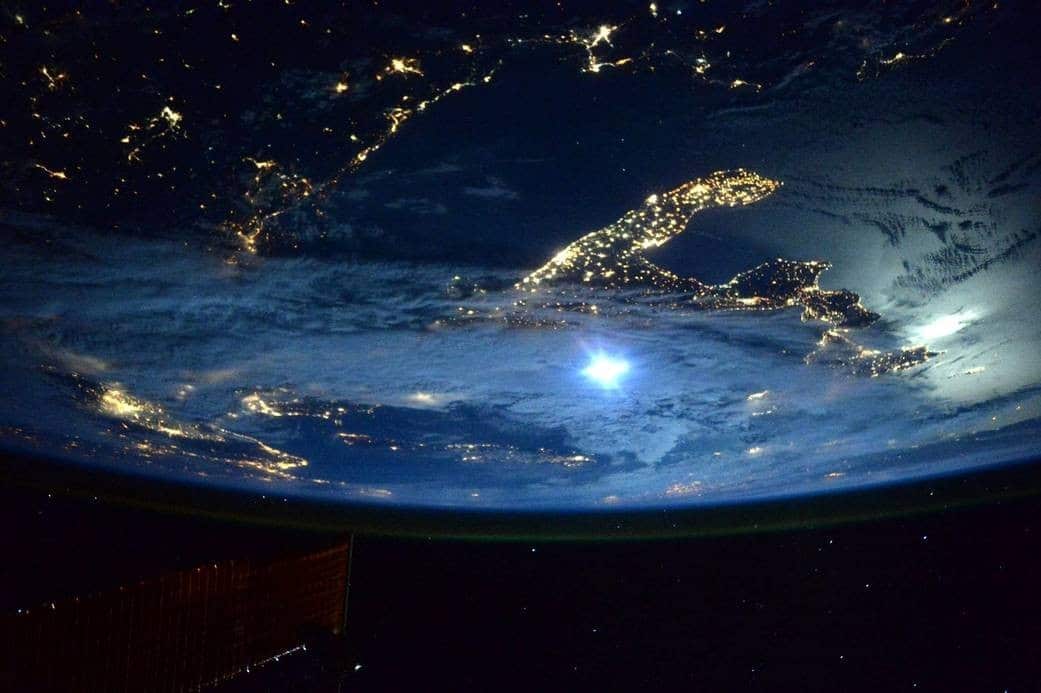
Amazing views from the International Space Station - Space Adventures
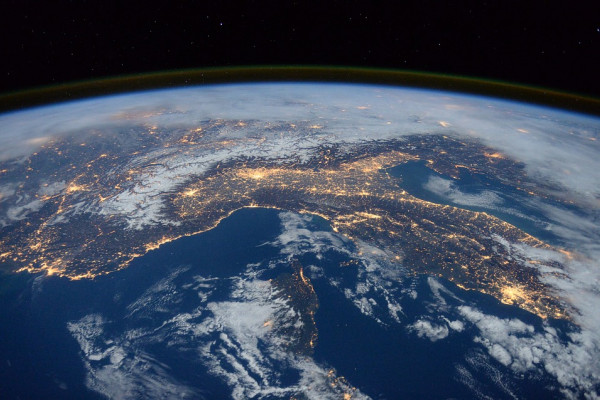
Views from the International Space Station  Space Adventure

The limited living resources on the International Space Station leads to people within the confines of the station performing everyday personal routines from sleeping, eating, reading, writing, discussing theories and examining and interpreting viewed and experimental issues, to work together, both independently and as a team to make the most of the resources available to them. All aboard the station are keenly aware of their isolation, emphasizing their reliance on technology and on their collegial, professional relations with their astronaut peers.
 
Yet the conditions in which they must perform their tasks motivate them to appreciate the closed-loop heating and water systems that make them independent of outside sources for vital day-to-day management of their needs. The astronaut team on board at any given time represent members from the international community bringing with them a range of technical and professional expertise, with all working to maintain and operate the "habitability systems" of the station.
 
And they liken that situation and their experiences to those of the planet. Humanity's natural habitat with its related resources that make life possible and manageable for all creatures that exist on Earth. There is the stewardship of resources and the absolute need to be aware of how we are using and abusing those resources along with a dire need to communally agree to husband them and not to violate the very source of our habitable world. The space economy valued at $424 billion is set to create new employment opportunities linked to climate innovation.
Spacewalking: the view from the Space Station | Naked Scientists
TheNakedScientists.com
 
But the innovative technology developed to make space travel and exploration and experimentation feasible itself has benefits for greater use on Earth itself. Necessity, the mother of invention, saw many new technical innovations to fit into a temporary lifestyle aboard a closed space capsule where inhabitants had to be self-reliant, making use of whatever was available to them for survival. Technology in food preparation suitable for a weightless atmosphere, and the fabrication of new metals more durable and flexible and tougher...

Sitting in the space station and viewing space through its generous windows, astronauts watch the unfolding of natural events on one side of the world after another. Forest fires in Siberia drift over to North America, diminishing air quality there. An initially unassuming atmospheric depression in the south Atlantic becomes a Category 4 or 6 hurricane affecting residents along the Gulf Coast. The ISS travels at 8 km/s; 25 times the speed of sound, completing a single orbit of the globe every 90 minutes. ISS occupants witness a sunrise and a sunset every 45 minutes.

Astronauts from their perch within the ISS can see the ecological crisis in real time, every day, peering out and down at the world below them. Jagged strips peeled deep into the Earth's crust from mining ventures; polluting smog, grey and opaque, hovering over cities below. Clear-cut in the Amazon rainforest to make way for agriculture. It isn't only astronauts eyeing the world from above. Satellite companies now keep an eye on emissions from their space vantage. GHGSat Inc. sends satellites into space to track methane emissions.

One of its satellites detected 13 plumes of methane emissions from a coal mine in Russia in January, the largest methane leak ever detected by the company. Methane is 25 times more effective in trapping heat in the atmosphere than carbon dioxide. Methane leaks were pinpointed by a GHGSat satellite in Turkmenistan where emissions equivalent to 240,000 gas-powered cars were being released into the atmosphere. A landfill in Pakistan was detected in 2021 with a methane plume.

The astronauts failed to breach a divide on the solutions to the climate crisis, but did reach agreement that addressing the issue would require precise political cooperation. On a planetary scale, pointed out Mr. Williams, disagreements are more complex, involving greater numbers of authorities making it difficult to find solutions that work for all governments. The difference: "We're just a bunch of people up there" remarked Mr. Hadfield. "All the crews from all the nations, the cultures that are represented, have a single-minded focus on accomplishing the mission objectives", pointed out Mr. Thirsk.

A common language of equally felt responsibility is the first step, they argued. Astronauts aboard the ISS are required to speak English and Russian, while English serves as the interstellar lingua franca. Yet, said Mr. Thirsk, even so, "when you're on board the space station as a crew member, most of us tend to think of ourselves as humans first." Humans are not regimented nor disciplined to think as a multi-reliant group like bees or ants. Therein lies our reasoning brilliance and our potential failure.
"I do worry about the motives of some of these world leaders who have created an unstable geopolitical situation. I don't se the older generation showing enough leadership in making the difficult decisions, today."
"It's really easy to be critical of the lack of collaboration. There are areas that, quite clearly, where we are not collaborating here on Earth and areas that we are."
Astronaut Robert Thirsk
Best Photos From the International Space Station Show Earth's Beauty
Business Insider

Labels: , , ,

Tuesday, July 27, 2021

Climate Change: Intense Heat Waves, Pyrocumulonimbus Firestorms

"We haven't seen anything close to the most intense heat waves possible under today's climate, let alone the ones we expect to see in the coming decades."
"Every time record temperatures or precipitation go well beyond what we've experienced during our lifetime, that's usually when we're unprepared and the damage is largest."
"We should no longer be surprised if we see records smashed by large margins."
Erich Fischer, climate scientist, ETH Zurich 

"[New research shows that] we must expect extreme event records to be broken -- not just by small margins, but quite often by very large ones."
"This highlights the huge challenge to improve preparedness, build resilience and adapt society to conditions that have never previously been experienced."
Rowan Sutton, climate scientist, National Centre for Atmospheric Science, University of Reading
B.C. Wildfire Service responded to the Brenda Creek wildfire (K51924) burning south of the Okanagan Connector, highly visible from the roadside.
As scientists with the Intergovernmental Panel on Climate Change begin two weeks of virtual meetings for the purpose of finalizing their next global climate science assessment, a study was published Monday in the journal Nature Climate Change, that warned the next three decades would see "record-shattering" heat waves, two to seven times more frequently around the world, than what has occurred over the past three decades.

Canada, Cyprus, Cuba, Turkey, Northern Ireland, Antarcitica have all recorded their warmest-ever temperatures in the past two years. Should current greenhouse gas emissions trend continue record-breaking heat waves may be three to 21 times more frequent beyond 2050, according to the study.The researchers used climate modelling in the calculation of the likelihood of record-breaking heat lasting at least seven consecutive days, far surpassing earlier records.

Given such extremes, the study warns that communities need to be preparing for such extremes. The June heat wave that struck Canada was responsible for the deaths of hundreds of people in British Columbia, reaching 49.6C in the village of Lytton, when a heat dome straddled the sky over the area, the intense heat contributing to an explosion of wildfires, one of which completely destroyed the evacuated town.
 
Damaged buildings are seen in Lytton, B.C., on July 9, after a wildfire destroyed most of the village on June 30. (Darryl Dyck/The Canadian Press)
 
The study suggests that should greenhouse gas emissions be cut aggressively the likelihood of heat waves while remaining high, would result in diminishing opportunities of exceeding heat records over time.
"It was probably the single largest pyrocumulonimbus storm of the year so far. In fact, we're still tracking the smoke plume from that storm as it's travelling around the world and it's about to kind of come full circle back over [the] U.S.A. and Canada."
"When you get all those three things together [fuel, heat and wind], you get the perfect triple that we call fire weather. So, hot, dry and windy."
"It’s just like if you have a stove and you have a small burner — you’re not going to get as much of a fast boil in your pot as if you had a really hot, intense burner."
"So, the big, large fire just makes it that much easier for the air to be completely upset. And then if you do form a cloud, then that generates even more buoyancy and that feeds back down to the fire."
Michael Fromm, meteorologist, U.S. Naval Research Laboratory

"The fire creates the storm and then the storm creates lightning, which can cause more fires."
"That runaway feedback is the dangerous part."
Simon Donner, climate scientist, University of British Columbia

"It's been an exceptional year."
"Most of them [Canadian Forces firefighting teams] are actually camping along the fire lines overnight."
"During the day, they walk the fire line and check for any areas where there's flare-ups or hot spots and they suppress those."
Lt.-Col. Jesse van Eijk
pyrocumulonimbus clouds above australia 2019
A pyrocumulonimbus cloud generated by the Clear Range bushfire to the south of Canberra, Australia, February 1, 2020, Brook Mitchell/Getty  
 
Wildfires in Canada generated through a combination of intense heat and drought conditions are so extreme they generate their own weather systems. The phenomenon is known as a pyrocumulonimbus firestorm, tracked this year as they occur in British Columbia, Saskatchewan, Alberta, Manitoba and Ontario. The first one tracked in May occurred in Manitoba. B.C.'s Lytton brewed up firestorms on two successive days in late June, hitting a Canadian temperature high of 49.6C a day prior to a wildfire erupting.

Emergency Management BC announced the presence of over 250 active wildfires charring B.C. forests where 4,142 square kilometres of land has burned since April 1 from 1,215 wildfires. The situation so dire that Canadian Forces were deployed to British Columbia and Manitoba to fight the fires, assisting crews from the province in monitoring wildfires. 

fire

Labels: , , ,

Friday, July 16, 2021

Swept Away -- A Cautionary Tale

"[Some parts of Western Europe have received up to two months of rainfall in the space of two days.] What made it worse is that the soils were already saturated by previous rainfall."
"[It was too soon to blame the floods and preceding heat wave on rising global temperatures but] Climate change is already increasing the frequency of extreme events. And many single events have been shown to be made worse by global warming."
Clare Nullis, spokesperson, World Meteorological Organization
"In the hour of need, our country stands together."
"It's important that we show solidarity for those from whom the flood has taken everything."
"Only if we decisively take up the fight against climate change will we be able to limit the extreme weather conditions we are now experiencing."
German President Frank-Walter Steinmeier
"It's a very sad scene. Streets, bridges and some buildings are destroyed. There's garbage everywhere." "Parts of buildings are in the road, people are sitting and crying. It's so sad. People have lost their homes, their cars are in fields flooded."
"My city looks like a battle has taken place."  
Gregor Jericho, Rheinbach, North Rhine-Westphalia
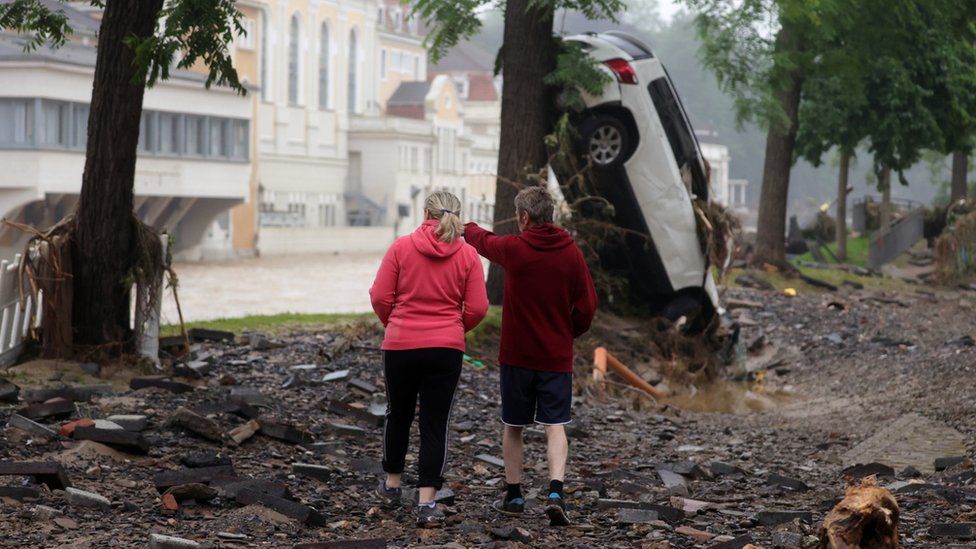
Two persons stand amid the debris near a damaged car and trees after flooding in Bad Neuenahr-Ahrweiler
As many as 1,300 people are still unaccounted for in the western German district of Ahrweiler   EPA

"The deaths and destruction across Europe as a result of flooding is a tragedy that should have been avoided."
"Forecasters issued alerts early in the week, and yet the warnings were not taken seriously enough and preparations were inadequate."
"The fact that other parts of the northern hemisphere are currently suffering record-breaking heatwaves and fires should serve as a reminder of just how much more dangerous our weather could become in an ever-warmer world."  
Hannah Cloke, Professor of Hydrology, University of Reading, U.K. 
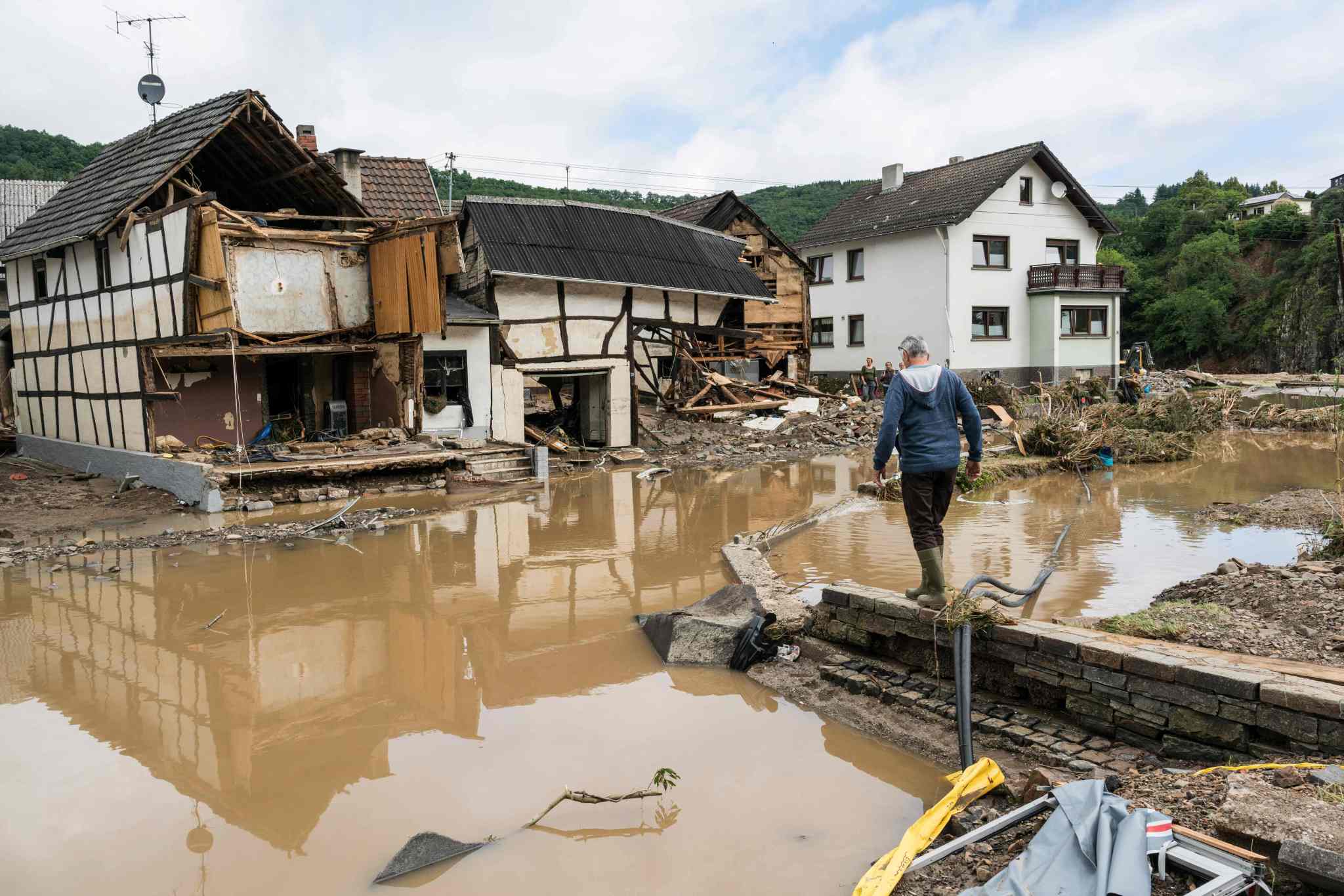
A man walks through the floods towards destroyed houses in Schuld near Bad Neuenahr, western Germany, on July 15, 2021.
A man walks through the floods towards destroyed houses in Schuld near Bad Neuenahr, western Germany, on July 15, 2021. BERND LAUTER/AFP via Getty Images

Western Europe is in the throes of catastrophic flooding. The number of deaths and missing will certainly increase from its last count of 120 deaths and hundreds of people whose presence is unaccounted for. Swollen rivers, the result of record rainfall across the western part of the continent ravaged towns and villages. Cars were swept away and upended, houses destroyed, and people were left stranded on the roofs of their houses, awaiting rescue.

When the Ahr river flowing into the Rhine broke its banks in Rhineland Palatinate state, it took down a handful of houses in its mad rush. South of Bonn over a dozen people died as those in the region were urged to evacuate their homes. Torrential rain swept two men to their death in Belgium, while a 15-year-old girl swept away by an overflowing river is now among the missing. Clearly, too many towns and villages are located in flood planes.

Authorities have deployed hundreds of soldiers, with 2,500 relief workers helping police in their desperate efforts at rescuing people in Germany. Tanks were brought out to clear roadways of landslides and fallen trees. Helicopters winched stranded people from their rooftops to safety, Hunreds of thousands of homes were without power. 
 
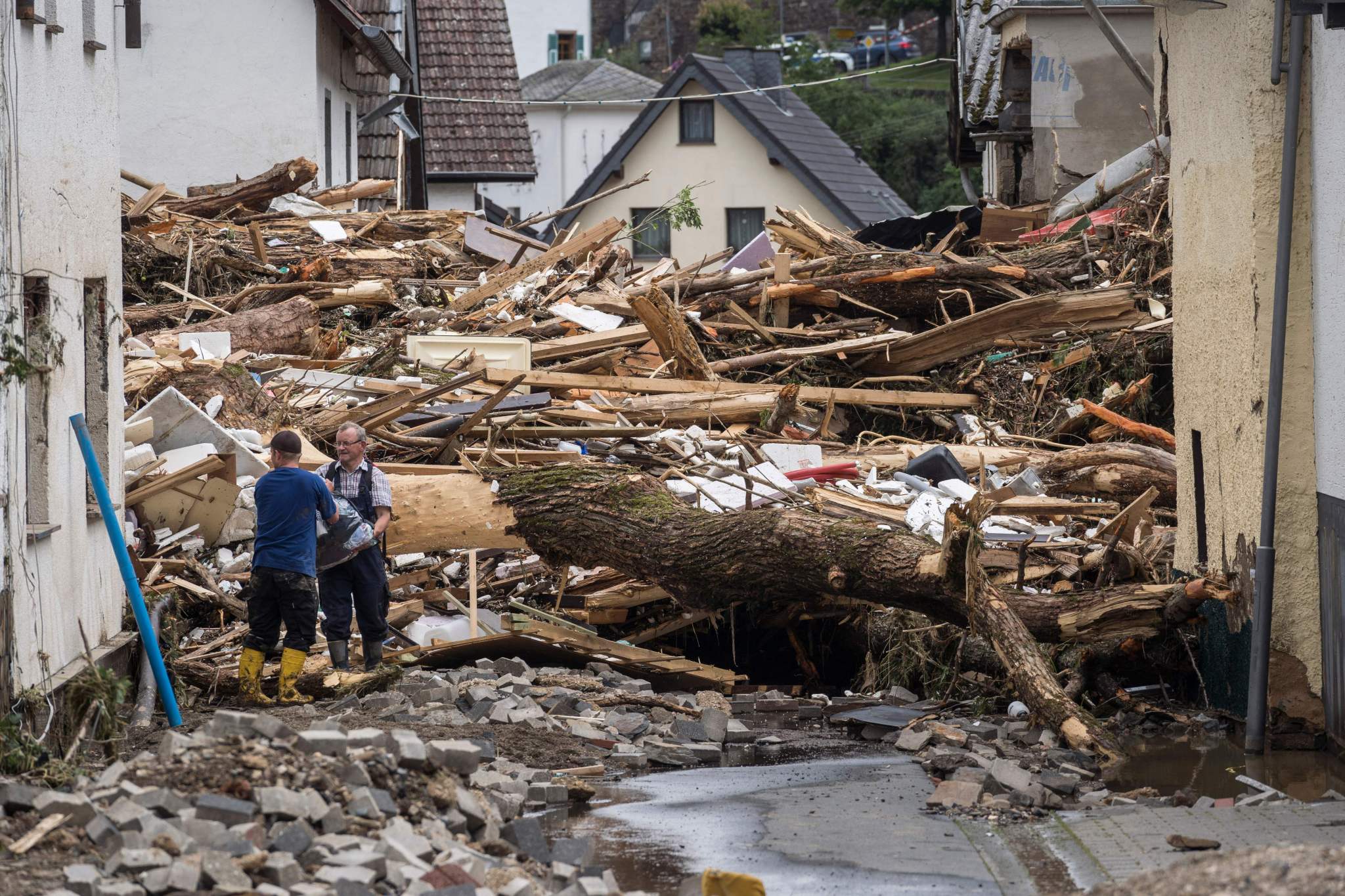
Two men try to remove goods from next to the debris of houses destroyed by the floods in Schuld.
Two men try to remove goods from next to the debris of houses destroyed by the floods in Schuld. BERND LAUTER/AFP via Getty Images
 
Wrecked vehicles in Ahrweiler wee propped against the town's stone gate. Local homeowners swept mud from their homes with snow shovels and brooms. With flood waters receding shops were trying to assess the damage they had received as efforts at clean-up were underway. Flooding in 2002 killed 21 people in eastern Germany along with over 100 across central Europe. This year's flooding is that much worse. 

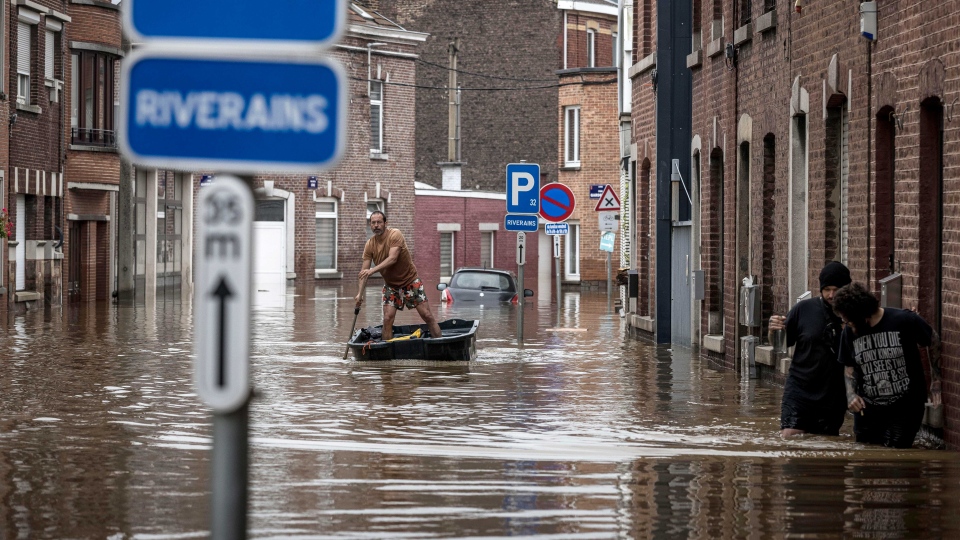
Houses collapsed  in Belgium when the river Vesdre flooded the eastern town of Pepinster with over a thousand homes evacuated. In the Netherlands, thousands were urged to leave their homes to escape floods when rivers were on the brink of bursting their banks. Two firefighters died in North Rhine-Westphalia. Houses were crushed to piles of debris and broken beams in the town of Schuld; roads blocked by wreckage and fallen trees.

Europe flooding
A man rows a boat down a residential street after flooding in Angleur, Province of Liege, Belgium, Friday July 16, 2021. (AP Photo/Valentin Bianchi)


Labels: , , , , ,

Wednesday, April 28, 2021

China: Energy Use and Climate Show-and-Tell

The closing meeting of the fourth session of the 13th National People's Congress (NPC) is held at the Great Hall of the People in Beijing, capital of China, March 11, 2021. Leaders of the Communist Party of China and the state Xi Jinping, Li Keqiang, Wang Yang, Wang Huning, Zhao Leji, Han Zheng and Wang Qishan attended the meeting, and Li Zhanshu presided over the closing meeting and delivered a speech. (Xinhua/Xie Huanchi)
 
"One of the main constraining factors in China’s quest to raise living standards, modernize, and become a major world power has been a persistent shortage of energy."
"Energy shortages have greatly hindered the industrial, agricultural and social development of China."
Elspeth Thomson, economic historian
 
"The discovery and development of the supergiant Daqing and Shengli oilfields in the 1960s briefly promised to end the country’s heavy reliance on coal, and even turn China into a major oil exporter."
"By the late 1980s, however, production from Daqing and Shengli was peaking, and no further readily exploitable major discoveries had been made, forcing a renewed focus on coal."
"In 1993, China turned into a net oil importer as domestic consumption outstripped domestic production, and the gap has grown steadily since."
"China had become the largest importer in the world by 2019, importing more than 10 million barrels per day, and relying on imports to meet almost 75% of its consumption".
"For similar reasons, China has also become one of the world’s largest natural gas importers, relying on imports to meet more than 40% of its domestic needs."
"The problems with relying on coal as the primary source of energy have been well understood by Chinese and international policymakers since at least the 1980s".
"Moving huge volumes of unwashed and unprocessed coal from mines to power plants has put immense pressure on the country’s rail network and periodically contributed to congestion."
"Coal’s contribution to urban air pollution, acid rain, and climate change was extensively analyzed in a landmark report on 'China: Long-Term Development Issues and Options' published by the World Bank in 1985."
John Kemp, Reuters market analyst
Solar and wind are now competitive with coal in China
"China’s coal activities remain a large concern and are inconsistent with the Paris Agreement. It would need to phase out coal before 2040 under 1.5˚C compatible pathways, but it appears to be going in the opposite direction. After lifting a previous construction ban on new coal plants in 2018, China has rolled back policies restricting new coal plant permitting in each of the last three years. By mid-2020 China had permitted more new coal plant capacity than in 2018 and 2019 combined, bringing its total coal capacity in the pipeline to 250 GW, and brought 10 GW of new plants online. China is going against the global shift away from coal and now possesses roughly half of the world’s coal power capacity as well as coal-fired power plants in development."
Climate Action Tracker
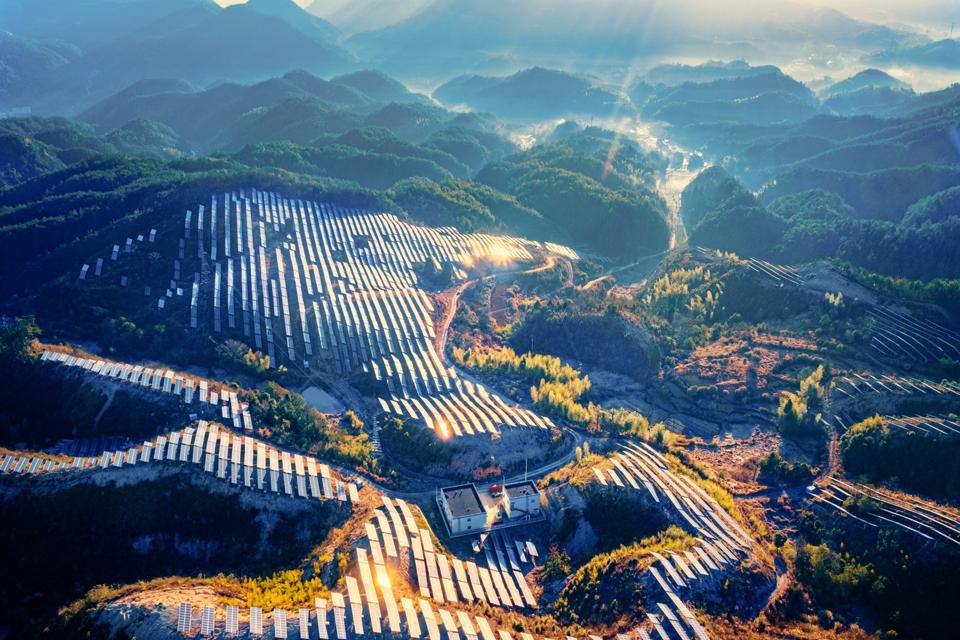
Aerial Photovoltaic Panels
photovoltaic panels lined up in the rising sun in Shangzhang township, Xianju county, Taizhou City, Zhejiang Province, China.- Costfoto/Barcroft Media via Getty Images) 

The West, fully invested in Climate Change and the need by governments worldwide to pledge to reduce their carbon emissions in aid of fostering a healthier environment and off-setting rising emissions leading to weather patterns that threaten world stability, looks to China, the world's largest emitter by far of carbon dioxide emissions to make good on its pledges in a collaborative effort to firm up commitments in the greater interests of saving the planet.
 
China has made promises and been happy to make some strides in public relations moves to demonstrate its sincerity in pledging its commitment to effecting a reversal of its colossal emissions in a common strategy to fight climate change. What it has also cagily offered is negotiations of a sort whereby the West will put a rein on its human rights charges in exchange for good news from Beijing on its climate/energy intentions.
 
Prepared to make firmer commitments as long as trade sanctions targeting Xinjiang Province and the slanderous charges of genocide against the Turkic Muslim Uyghurs commences to its satisfaction because after all, Beijing is as committed to battling climate change, cleaning up the environment, as it is to upholding human rights as a highly principled government. So, thus the choice, pull back on sanctions for the compliance so urgently needed with China buying in to climate pledges.
 
That does create a bit of a dilemma for Beijing, one that it prefers to keep close to its vest. Since China has strategic objectives to meet, and it cannot reach those goals by decreasing its C02 emissions, simple as that. The gargantuan consumer production behemoth that has cornered the world market in inexpensive and wide-ranging product manufacturing cannot continue to uphold its commitment to remaining the world's premier factory-linked shipper without vast stores of energy.
 
It is hugely dependent on foreign oil and gas sources and its National Development and Reform Commission is tasked with ensuring that those energy supplies continue unobstructed by do-good environmental pledges. The National People's Congress heard from the National Development and
Reform Commission in its 2020 annual report pledging to "ensure energy security" to "improve our contingency plans in response to major changes in supply and demand at home and abroad".
 
Xi goes mask-free at congress, raising questions over vaccination status |  The Japan Times
Xi Jinping,  Congress, Great Hall of the People,  Japan Times
 
March 5 saw the current year's report delivered to the People's Congress giving short shrift to climate change and promising weak commitments to decarbonization. The priority was securing energy supplies, and to "boost oil and gas exploration and development" while "systematically increas[ing] our ability to ensure the supply of coal". The huge smoke stacks adjacent every manufacturing plant throughout China are going nowhere.

The international community of sport enthusiasts may or may not recall the Beijing Olympics where it was necessary to order production facilities to shut down for days in hopes of clearing the air of effluent and making for some reasonable visibility in view of the constant yellow 'fog' that obscures normal sightlines in the metropolis and entirely reflective of the dismal air quality in China's many megalopolises, home to much of its 1.4 billion population.

China's foreign oil dependence reached 50 percent for the first time, in 2008, and by last year it had reached 73 percent dependence. China's oil imports increased by 7.3 percent in 2020 while its domestic production rose merely 1.6 percent; self-sufficiency its goal but hardly achievable as its energy need continues to rise exponentially in lock-step with the Chinese Communist Party's drive for world domination in production, communication, technology and AI inventiveness. 

What really concerns China is that its oil and gas imports mostly must make it through the South China Sea, the Strait of Hormuz and the Strait of Malacca, connecting the Indian Ocean to the Pacific to transit China's imported oil. Sea lanes in the control of other states vexes China. The prospect of potential conflicts with Taiwan, Japan, India, even the United States cause for concern. The Suez Canal blockage served as a urgent reminder to China to guarantee its energy-derived security.

Militarization of the South China Seas where the world's largest navy patrols, to protect oil and gas tanker routes into China. Claims of its ownership of disputed areas with its neighbours encompassing, land, sea and air all play in to China's concern over its undisputed future destiny as a world giant in influence and control of the global community. 

From Turkmenistan to Xinjiang, overland oil and gas routes from Russia and Burma, China aggressively develops assurances of energy provision. Oh, and from Iran too, of course, helping it through its own sanctions. And its most secure and dependable energy source? Why, coal, of course, dredging coal out of its very own mines and financing and installing new coal mines abroad. Coal which still accounts for a massive share of China's energy consumption.

China's gigawatt power of new coal-fired installations represents over three times the new capacity built in the entire rest of the world, with another 247 gigawatts planned or in development. The proposed additional coal plants represent 73.5 gigawatts of power, fully five times what the rest of the world combined proposes. But then, a superpower not quite oblivious to the concerns of its critics for the most part, expertly plays the game of 'we're with you' on climate change.
 
Cumulative global installed solar capacity 2010-2019
 

Labels: , , , , , , , ,

Wednesday, October 16, 2019

When Climate Change and Facts Impact Professions

"[I was constantly] astonished to learn that every single teacher believed that only a few hundred to a few thousand polar bears were left [in the wild]."
"I talk to groups about the adaptive features of polar bears that allow them to survive changes in their Arctic habitat."
Zoologist Dr. Susan Crockford

"[I am] appalled and distressed [by the removal of Dr. Crockford from her appointment as adjunct professor and from the UVic Speakers Bureau]."
"[When did] universities turn against open debate? There's now a climate of fear on campus."
G.Cornelisvan Kooten, UVic professor of economics, Canada Research Chair, environmental studies

"I will not be endorsing your [Dr.Crockford's] request to be included in the Speakers Bureau roster for 2017-18. [While you may speak as a private citizen you may not do so] as a representative of UVic -- (University of Victoria)."
"[While I respect] issues of academic freedom [Crockford's talks had] generated concern among parents regarding balance [and this concern had] been shared with various levels of the university."
Dr.Ann Stahl, Chair, Anthropology Department, chief, Speakers Bureau
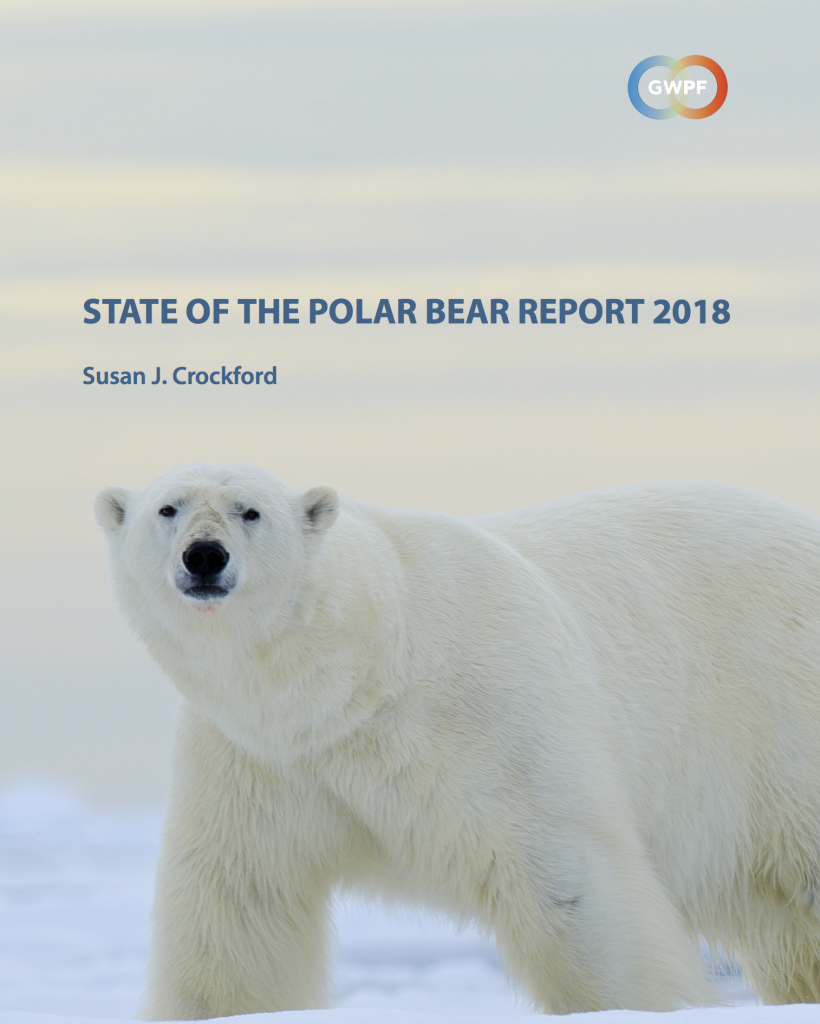
Zoologist Dr. Susan Crockford says that, contrary to the claims of environmental activists, polar bears are currently thriving and are at no risk of extinction from climate change.   Postmedia

Dr.Susan Crockford, an expert in animal bone identification, known world-wide for her expertise, has lost the confidence of the University of Victoria which has rescinded its recognition of her as an expert on polar bear survival in a world of climate change, by deciding not to re-appoint her to the university as an adjunct professor, nor to permit her to rejoin their speakers' bureau to address school classes, sharing her knowledge of the natural world and the place of polar bears within it.

A zoologist hired routinely by biologists and archaeologists within Canada and abroad to identify the remains of mammals, birds and fish, she has aided in the cataloguing of museum collections, assisted police with forensic analyses, reflecting the broad level of esteem in which her expertise is held. Henceforth, however, students at the University of Victoria will be deprived of exposure to her expertise.

With the retraction of her university affiliation, her applications for research grants has concomitantly dried up.

She has described her predicament as "an academic hanging without a trial, conducted behind closed doors". So secretive in fact, that no explanation has been given her with respect to either situation, even though her position with the university had previously been renewed with unanimous consent in 2016 for a three-year term. She has fallen into decidedly bad odour with the university and its academic appointment committees.

Author of a popular blog, polarbearscience.com, author of five books on polar bears, such as Polar Bear Facts and Myths, translated into four languages, her crime is that of having committed the sin of contradicting claims of environmental activists that polar bears are facing extinction resulting from global warming and climate change, whereas her research and experience informs that polar bears are thriving, at no risk of extinction from climate change to which they have successfully adapted.


“We now know that polar bears are very resourceful creatures. They have made it through warm periods in the past and they seem to be taking the current warming in their stride too”. 
“The people of Nunavut are not seeing starving, desperate bears – quite the opposite. Yet polar bear specialists are saying these bears are causing problems because they don’t have enough sea ice to feed properly. The facts on the ground make their claims look silly, including the abundance of fat bears. Residents are pushing their government for a management policy that makes protection of human life the priority.”
Dr.Susan L.Crockford


Dr. Crockford has delivered unpaid lectures to elementary and high school students for the past decade, along with lectures to adult community groups. One of her talks related to the early origins of domestic dogs, while another had the title of Polar Bears: Outstanding Survivors of Climate Change, a subject of obvious forbidden conclusions rooted in the controversy of climate change and the impacts on the world around us. In fact, Dr. Crockford's doctoral dissertation opened new ground regarding how wolves evolved into domestic dogs.

Adjunct professors mentor students, they sit on thesis committees, delivering lectures on occasion. Despite adjunct professorships being unpaid positions, they do confer certain strategic academic credentials and privileges on the holders. Gaining official academic standing and full access to library research services, for example. A recognition of their professional status as experts in their chosen field, introducing them as equals to the academic community. Dr.Crockford is set to commence a five-country European speaking tour with audiences in Oslo, London, Paris, Amsterdam and Munich.

Crockford skull
Dr.Susan Crockford, Photo: polarbearscience.com

There, she will speak about her research, her arguments will be evaluated by her audience, and they will draw their own conclusions in an exchange of professional courtesy and data-sharing. However, the University of Victoria, in their politically-correct wisdom, while claiming to support freedom of speech and in particular academic liberty to speak freely and openly about controversial subjects, has deigned not to legitimize Dr. Crockford's particular expertise because it rattles the bones of contention.

A former chair of the university's philosophy department, Dr.Jeffrey Foss, feels confident enough to assert his opinion that his colleague has been duly punished for airing her opinion, irrespective of the fact that it is a professional opinion of an individual whose expertise is unquestioned and whose research led her to the conclusion she ventilates openly. In denying Dr. Crockford academic freedom and not allowing her to speak freely, Dr. Foss confessed: "I'm beginning to lose faith and hope in the university system".

"It’s long past time for polar bear specialists to stop holding out for a scientifically accurate global estimate that will never be achieved and determine a reasonable and credible ‘best guess’."
"Since they have so far refused to do this, I have done it for them. My extrapolated estimate of 39,000 (range 26,000-58,000) at 2018 is not only plausible but scientifically defensible."                                                               Dr.Susan Crockford
Polarbear1_wikimedia_Andreas Weith photo Svalbard sm
polarbearscience.com   Dr. Susan Crockford


Labels: , , , ,

Tuesday, August 27, 2019

Discard the Old, Herald the New

"The location is very strategic -- it's in the centre of Indonesia and close to urban areas."
"The burden Jakarta is holding right now is too heavy as the centre of governance, business, finance, trade and services."
Indonesian President Joko Widodo

"The move will have an environmental impact. Jakarta has suffered so many failures from pollution, water crisis, and flooding."
"We don't want these problems in the new capital."
Jasmine Puteri, senior forest campaigner, Greenpeace

"By moving the capital you're not going to solve the problems of Jakarta."
"The ones really excited about moving the capital are the developers."
Elisa Sutanudjaja, executive director, Rujak Center for Urban Studies
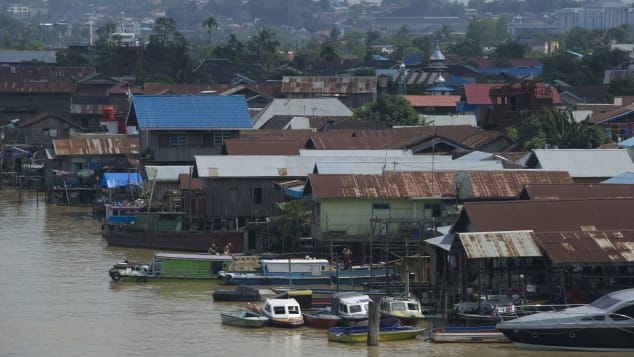
Floating houses on Mahakam river in Samarinda, near the site of the new capital.
BAY ISMOYO/AFP/Getty Images

Looking into the foreseeable future there are many island-states and cities in the world that have advance warning they will eventually be consumed by rising sea waters, among them Houston, Texas, Lagos, Nigeria, New Orleans, Louisiana, Washington, DC, Beijing, China. What most of these cities with the exception of Washington face has come about partially as a result of poor stewardship, using too much groundwater at a time of rising sea levels courtesy of climate change. Miami, Florida sees its Everglades receding as a result of irrigation of crops in an otherwise dry geology.

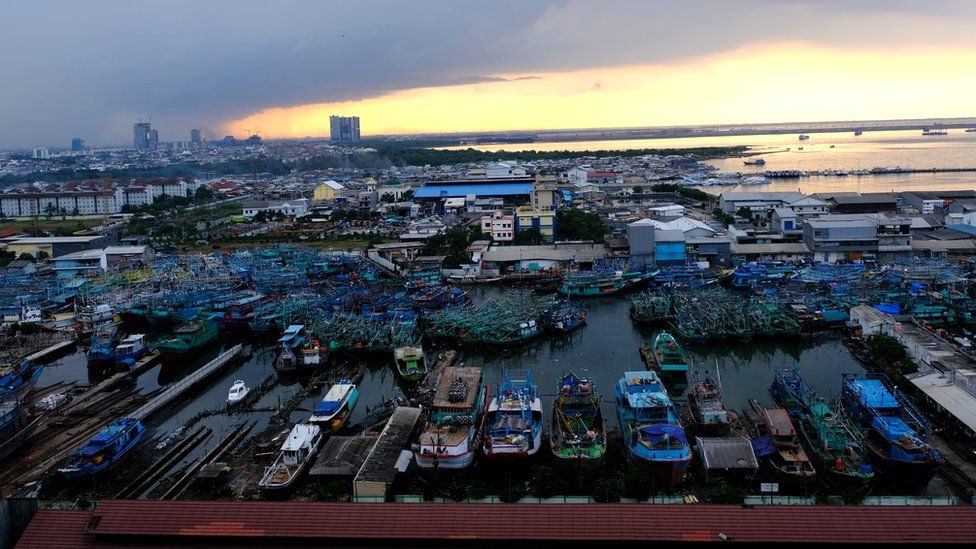
And in Jakarta, Indonesia, one of the world's mega-cities with its ten million population -- 30 million in its greater metropolitan population area, land misuse and abuse and groundwater extraction, exacerbated by rampant construction has resulted in environmental chaos. It is now classified as one of the fastest-sinking cities on the globe with a forecast that by 2050 a full third of the city may be fully submerged.

This is a disaster that has been seen unfolding for many years, and the process has simply accelerated since no remedial action has been undertaken. The subsidence of the city has left 40 percent of the city's residents without water piped into their homes. "The city is sinking by one to 20 centimetres a year", earth scientist Heri Andreas of Bandung Institute of Technology in Indonesia has stated along with his calculation that the ground in some areas of the city has already sunk two to four metres below sea level.
Picture of the fishing boats in North Jakarta.
North Jakarta is sinking by about 25cm every year

Jakarta seems doomed, and its government has decided on abandoning it to its fate, more or less. Indonesia is preparing to move its capital to the eastern edge of Borneo Island, shifting its political centre safely away from the megalopolis on the edge of disintegration. The city was built in an earthquake zone near the confluence of 13 rivers. Built on swampland, the city is the victim of poor urban planning, resulting in confining congestion and deadly pollution levels.
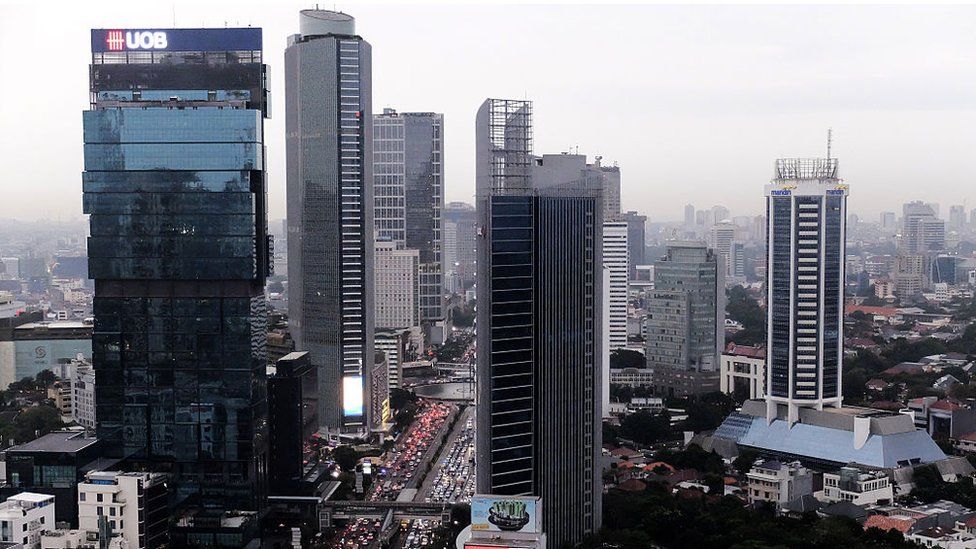
Picture of skyscrapers in Central Jakarta
An inspection of buildings in Jalan Thamrin, central Jakarta found many operators pumping groundwater without a permit   AFP

Now, the largest Muslim-majority country in the world has a proposed new location where it has been judged a "minimal" risk of natural disasters threaten. Indonesia owns 180,000 hectares of land on Borneo, with the Indonesian side of the huge island comprising five provinces known for rainforests, orangutans and coal reserves. The move will necessitate the building of new government offices and homes to accommodate the 1.5 million people who are civil servants.

The cost of this venture? About $44 billion. The government is prepared to submit a bill and a feasibility study results to its parliament for approval of a new capital. "The economic impact was good in Brazil" [when Brazil moved from Rio de Janeiro to the government-blueprinted Brazilia in 1960, a city cited as a model in well-planned, modernized urban architecture], enthused Rudy Prawiradinata, deputy minister for regional development.

"Environmental issues", he promised, would set the new city's design as yet another showpiece of urban architectural planning. Jakarta is to be retained as Indonesia's financial centre, while the city's chronic dysfunctional problems would be addressed responsibly, although it is already being suggested that the city will face neglect as the government focuses on its new site- and purpose-specific location, 'forgetting' the plight of its former capital.


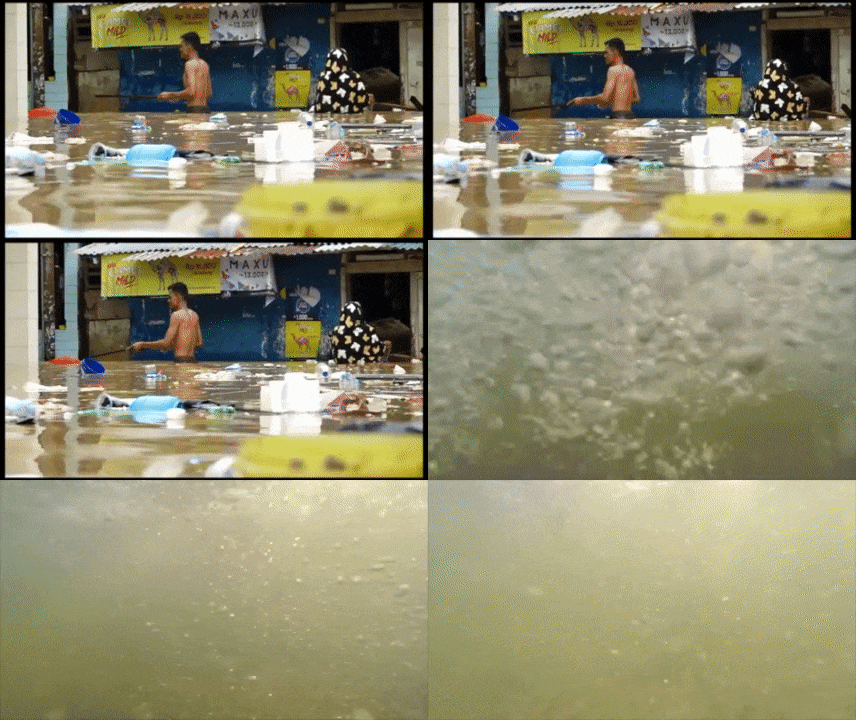
GIF for Jakarta sinking story.


Labels: , , , ,

() Follow @rheytah Tweet