Politic?

This is a blog dedicated to a personal interpretation of political news of the day. I attempt to be as knowledgeable as possible before commenting and committing my thoughts to a day's communication.

Friday, June 22, 2018

Overwhelming Jihad

"Islamist preachers use the population’s poverty to expand their flocks."
"They’re banking on the fact that the schools are almost free of charge and have no minimum education requirements. In exchange, they only demand that pupils convert to Islam."
"And schoolgirls are required to wear a veil."
Henrilys Rakotounarivo, school inspector. Vohipeno, Madagascar

"They’re takfiris [the new piously Salafist clerics entering the country]! They call anybody who doesn’t think like them apostate."
"They’re under the influence of preachers from Pakistan, building mosques and madrassas everywhere, without government authorization."
Mohamed Zubaïr, Amadiyya imam, Manakara mosque
Noor Mosque.jpg
Noor Mosque Antananarivo Madagascar
"It’s very easy for a child to convert and become a Muslim for life: He only needs to come here, take a shower and pronounce the Shahada [the Islamic profession of faith]."
"Things are easy for me. I am a servant of truth. It’s my life. And the only truth is in the Koran." 
"[Women] complement men, but are not equal to men. Sure, women are technically capable of driving a car, but it’s the freedom they’re given to do so that is a problem. Women don’t know how to handle their freedom."
Nadeem Dolip, Mauritian head, new Islamist school (madrassa)
Madagascar, known historically as one of the 'spice' islands is the major source of the world's supply of vanilla beans. It has little industry, and it is an impoverished African country in the Indian Ocean, a population of 23 million, with electricity provided to 15 percent of the island's homes. The Malagasy people arrived on the island originally from South East Asia, so this is the origin of the population but it's considered to be an African nation, the size of France or Belgium. 

Extreme poverty and a weak government and its strategic placement between Africa and the India subcontinent makes it a target for Islamization.

The country is about 85 percent Christian with a long-established Muslim component representing a mere six percent of the population. Moderate Amadiyya Muslims who have no wish to contest the island's major religion have always existed side by side with their Christian counterparts with no friction. That is changing. Saudi Arabia which financed the building of Salafist orthodox Islamist madrassas teaching Wahhabist Islam in Arabic installed these schools in Pakistan, Somalia, Turkey, Europe and elsewhere around the world. Where young boys are taught the fundamentals of medieval Islam in a language they neither speak nor understand.

It is these schools which have largely produced Islamist jihadis with the instruction to go out into the world and convince non-believers to convert to Islam by any means that will work; missionary work to terrorism. In Madagascar where parents cannot afford to send their children to schools operated by the state and through churches, Islamist organizations offer to educate their children at no cost to the parents, but their children must convert to Islam and practise all the precepts of the faith. 

And so conversion becomes a simple matter of offering something of value at a price that seems negligible. 

As an example, the mayor of a small town on Madagascar was born into a poor Catholic farming community. As a student he made his community proud as he completed his education. But university was out of bounds until a proposal arrived from Saudi Arabia offering him university study for a four year period at no charge. As long as he converted to Islam.

Saudi Arabia has become a destination of choice for students from Madagascar to study abroad; in the process they become Muslims. And Vohipeno’s young mayor is Muslim. As a former colonial power France also offers tuition for students.

Since the 19th Century Madagascar has been predominantly Christian. The island, dependent on tourism and entrepreneurs in the food industry has seen some alarm being expressed in the recognition that Islam is being spread wholesale, thanks to the vigorous interference and investments being made by Saudi Arabia and Turkey. Both of which are building mosques away beyond the need for them in relation to the numbers of Muslims, most of whom were Amadiiya and well served in the past by their own mosques.

The spread of Salafi Islam has alarmed the Amadiiya Muslims as well, who live in harmony with their Christian counterparts, and whose women eschew the veil, demanded by Wahhabist Islam. The proliferation of mosques and madrasses on Madagascar's southeast coast and the northwest side of the island has not brought peace of mind to this minority sect of Islam traditionally persecuted by their orthodox brethren.

And as young boys from age seven to 14 sit on the floor of madrassas wearing skullcaps and djellabas reciting verse after verse from the Koran in a language foreign to them (Arabic or Urdu) these ultra-strict boys-only schools, the producers of jihadists, represent a real subject of concern. "Ten years ago, there wasn't a single veiled woman to be seen. Now they're everywhere. They get subsidies in exchange for wearing a veil", noted a 60-year-old nurse doing her local rounds. In her district alone, she said, over one hundred mosques unauthorized by the government have been opened.

A challenge to the tolerant, traditional syncretic form of Madagascan Islam which dates to the 13th Century, representing six percent of the population.

Saudi Arabia and the Gulf States spend vast financial resources on the spread of Wahhabist Islam pursuing their duties as pious Muslim leaders to ensure that Islam grows by leaps and bounds using whatever techniques work; in this instance, extolling the virtues of Islam in providing free 'educations' to poor children. Yet they will not sully their own territories by absorbing any of the countless refugees that dysfunctional Islamic governments are producing all over the world. By ignoring the needs of Muslim refugees and economic migrants ensuring that those Muslims relocate to Europe further spreading Islam.

The devil is in the details.

king-mohammed-vi-performs-friday-prayer-in-dakar-grand-mosque
Morocco's King Mohammed VI, accompanied by Prince Moulay Ismail, performed the Friday prayer at the Antananarivo Mosque in Madagascar.

Labels: , , , ,

Monday, November 13, 2017

Saudi Arabia's Sea-Change

"We are returning to what we were before - a country of moderate Islam that is open to all religions and to the world."
"We will not spend the next 30 years of our lives dealing with destructive ideas. We will destroy them today. We will end extremism very soon."
"We want to lead normal lives, lives where our religion and our traditions translate into tolerance, so that we coexist with the world and become part of the development of the world."
"Seventy percent of the Saudi population is under the age of 30. In all honesty, we will not spend 30 years of our lives dealing with extremist ideologies. We will destroy them today and immediately."
"Saudi was not like this before '79. Saudi Arabia and the entire region went through a revival after '79. ... All we're doing is going back to what we were: a moderate Islam that is open to all religions and to the world and to all traditions and people."  
"Some clear steps were taken recently and I believe we will obliterate the remnants of extremism very soon. I don't think this is a challenge. It reflects our values of forgiveness, righteousness and moderation. Righteousness is on our side."
Saudi Crown Prince Mohammed bin Salman
The prince made the announcement at an investor conference in Riyadh
The prince made the announcement at an investor conference in Riyadh Credit: AFP PHOTO / FAYEZ NURELDINEFAYEZ NURELDINE/AFP/Getty Images
"[I'm not optimistic about the reforms but would] still like to be optimistic … since everyone will suffer if they fail."
"[The reforms are] not engaging Saudi society, enough."
"We wish Mohammed bin Salman well, and we need economic [and social] reform but we also need to discuss [these issues. The change] is being done in very narrow circles. [Ordinary] people are not feeling engaged."
"Conservatives have already lashed out. They’ve been lashing out since 2003. Al-Qaida, or ISIS, or the radical Wahhabis … these are the extremists in Saudi Arabia … and they don’t want change. They have resisted, and will continue to resist. ... The only thing stopping them is [government] security."
Saudi commentator Jamal Kashoggi

"By weakening the clerical establishment and making clerics simple government workers [Mohammed bin Salman] will be able to give women more rights, as he is proposing."
"If 10 million women are given the right to drive in Saudi Arabia and if just a fraction of those women buy cars, take driving lessons or buy insurance, that would contribute to stimulating Saudi Arabia’s stagnant economy."
"Whenever the state clashes with the [conservative] clerical establishment, the state emerges victorious and there’s no reason to believe that things will not be the same, this time."
Hilal Khashan,  political science professor, American University of Beirut
Crown Prince Mohammed bin Salmon's promise to his countrymen that the strict, uncompromising version of Islam known as Wahhabism will be diluted, and that it did not always represent the norm in Saudi Arabia, is somewhat surprising since Saudi Arabia morphed out of Arabia in an agreement with colonial Britain based on the power structure and influence between the Saud dynasty and the rigid fundamentalism of Wahhabism, the movement founded by Muhammad ibn Abd al-Wahhab. 

It may have become more sternly observant with the rise of Iran's Ayatollah Khomeini, but it was never moderate. Moreover, Saudi Arabia, struggling to compete for influence with the new Shiite power in the Islamic Republic of Iran in 1979, as the custodian of the two most holy sites in Islam Mecca and Medina, took pains to portray itself as the true leader of Islam. And as such its punishment meted out for infractions led it to match Iran death-for-death in capital punishment. Yearly state deaths of 150 prisoners distinguished Islamic justice in Saudi Arabia, with claims by
Reprieve, a human rights group, that 41 per cent of those executed in Saudi Arabia in 2017 were killed for non-violent acts such as attending political protests.
Image result for how many people did Saudi Arabia execute this year?
The Independent


But Prince bin Salman is on a modernizing journey for his country, eager to open it to new economic opportunities since the price of fossil fuels plummeted, looking for diversification and foreign investment from the West. An anomaly and rather bizarre, given the massive investments Saudi Arabia has made, building its Wahhabist mosques and madrasses all over the world as it exported its brand of Islam globally, and with it the implementation of jihad and the support of jihadist groups the West calls terrorists. Now it invites Western investment in Saudi Arabia; exporting jihad, importing pluralistic capitalism.

Call the initiative what one will -- and the Prince obviously prefers enlightened and timely modernization -- it will certainly change this religion-straitened society. Given the prominence and influence of Saudi clerics, it will be an uphill struggle, one that Prince Mohammed obviously faces with the relish of a challenge, from the perspective of his 32 years, and the prospect of becoming King with the departure of his father, King Salman. If a signal that a change is on the horizon, the loosening of restrictions for women is prominent.

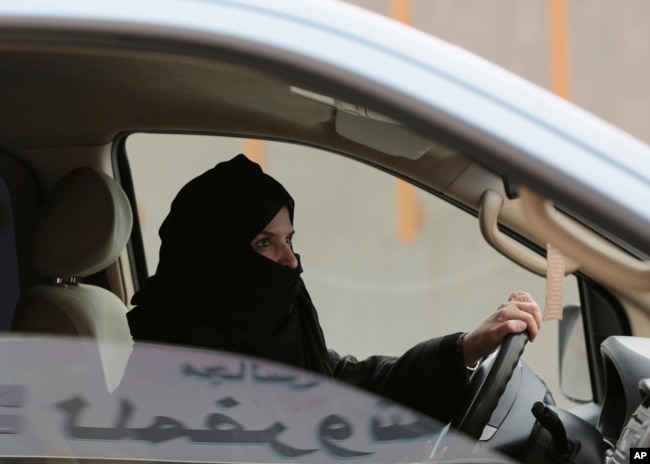
How many Saudi women will look forward to the opportunity of attending sports matches, an opportunity hitherto denied them, is debatable, once the thrill of offending men has passed. But the spectacle of a burqa-clad woman driving a car for the first time leaves much to be desired. Enveloped in a fabric cage, how free would a woman feel, driving a car toward independence? How independent is she requiring the permission of father, uncle, brother, husband, even son, to go abroad, to open a bank account, to sign a legal document?
"This prohibition on driving is just one in a vast series of laws and policies which prevent women from doing many things."
"The guardianship rule stops women from making every decision in her life without the assistance of a male relative, even if that relative is her 7-year-old son."
Liesl Gerntholtz, Human Rights Watch
FILE - Aziza Yousef drives a car on a highway in Riyadh, Saudi Arabia, March 29, 2014, as part of a campaign to defy Saudi Arabia's ban on women driving.
The notice has been received by members of the royal family, state authorities and the business community that business as usual is being interrupted and so is the casual acceptance of nepotism and corruption. Having your freedom of movement, however temporary, suspended even by having to remain in a luxury hotel until advised otherwise, is a sobering reality that being part of the aristocracy the wealthy business class, the clergy, no longer would be their shield from imposed change of the social, religious and business order.

"For sure, it does not make me comfortable. Anything that has sin in it, anything that angers the Almighty -- it's a problem", voiced one cleric on news of women attending events where men would be present. "They did a pre-emptive strike. All those who thought about saying no to the government got arrested", observed another cleric. He would, however, accept the changes because Islam requires the Saudi ruler be obeyed. "People go through the door that you open for them", he said philosophically.

"Society in general at this time is very scared. It will push women into society. That is what is in their minds, that it is not right and that it will bring more corruption than benefits", stated  another cleric. One who disagrees stated his initial unwillingness to permit his wife and daughters to own cellphones, but that realities altered his way of thinking, and he feels that Saudi women driving cars would eventually face the same acceptance: "With time, if society sees that the decision is positive and safe, they will accept it", he avowed.

As for leading Islam finally in a more moderate, enlightened direction, away from threatening those of other religions, much less refusing to accept the presence of other religions, Prince Mohammed's drive to soften Saudi Arabia's Salafism in recognition of the 21st Century, has already been spoken of by another ruler, President al-Sissi of Egypt, whose declaration that it is past time Islam stopped being a threat to other religions and exporting jihad to wreak its destabilizing effect abroad, failed entirely to move the clerics of Al-Azhar University, the leading Islamic authority of Sunni Islam.


Labels: , , , ,

() Follow @rheytah Tweet