Politic?

This is a blog dedicated to a personal interpretation of political news of the day. I attempt to be as knowledgeable as possible before commenting and committing my thoughts to a day's communication.

Wednesday, March 11, 2026

Qatar, Terrorism Central -- Friend and Benefactor of the West

"We will be a moderate country."
"I have a genuine fear of prosecution from the Qatari government. And I've faced a lot of issues being outside Qatar. [There is a] high cost [for a security detail]. If they have the chance to get me, they will get me."
"I support peace with Israel and I definitely have opened the diplomatic channels with Israel."
"[Under my leadership Qatar would] absolutely never [bankroll designated terror groups]."
"That's one of the main things that a lot of Qatari people actually want. Because Hamas should not be existing in Qatar, al-Qaida should not be in Doha. Taliban should not be in Qatar."
"We should not pay the salaries of Hamas leaders. We should not pay the salaries of all these terror groups."
Sheikh Khalid Al-Hail, exiled Qatari political leader
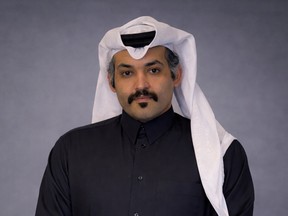
Sheikh Khalid Al-Hail
Sheikh Khalid Al-Hail, the president of the Qatari National Democratic Party, and self-proclaimed opposition leader. Photo by Handout /Postmedia
 
President of the Qatari National Democratic Party, founder and opposition leader to the current Qatari government, Sheikh Al-Hail lives in exile in London, building a government-in-waiting, for a Doha far different from the current reality. As a wealthy businessman, Sheikh Al-Hail had once served as chairman of the board of over 30 Qatari companies with large-scale ventures country-wide. He left for London in 2013 as chairman and chief executive of Qatar Investment and Development Co.
 
In the space of a year, political differences of vast dimension between himself and newly-installed Emir Sheikh Tamim bin Hamad Al Thani saw his status changed from a highly respected Qatari businessman to a political opponent no longer welcome in his country of birth. A country while ostensibly an ally of the United States, the ruling elite of Qatar shelters and bankrolls Islamist Hamas, Taliban, al-Qaida affiliates and networks of the Muslim Brotherhood as one of the world's key state jihadi terrorism enablers.
 
Al Jazeera, the state's media arm, while barred in ten Arab countries, acts as a spokespiece for the Muslim Brotherhood and Hamas positions in the interests of shaping opinion through media propaganda across the West and throughout the Arab world. Formerly an associate of a previous Qatar prime minister Hamad bin Jassim, Sheik Al-Hail was once welcome within the inner circle of the ruling elite before his break with the regime. The party he now leads began in 2010 as the Qatari Youth Rescue Movement, its goal to "reform the system in Qatar".  
"[I envision a Qatar governed by a constitutional monarchy, with a] normal parliament, house of commons, house of lords -- democracy is key. We believe in freedom of speech and freedom of faith."
"[The sitting rulers, a coterie of family members, are] a gang and a mafia, that control our country and our wealth, and that's not acceptable."
"What you face in Qatar is actually the policy makers, most of them Muslim Brotherhood, and pro-Hamas. Qatari people have nothing to do with Muslim Brotherhood."
Sheikh Khalid Al-Hail 
https://images.prageru.com/o?width=640&quality=75&image=https%3A%2F%2Fimages.ctfassets.net%2Fqnesrjodfi80%2F3rOgHjAGGVIDeP5VQOdGDU%2Fed95fad70ecc20215a275bb8cc00b211%2FThe-brief-Khalid-Al-Hail_extended-clip-web.jpg

Prager U

He first began to loom in the critical notice of the regime when he spoke publicly of "a corrupt financial system", propped up by political favouritism and patronage from the emir of Qatar. In 2014, the Sheik returned to Qatar after the assurances of Al Thani that he would be welcomed back. On his arrival back in Qatar he was taken to a "national security detention" centre, under accusations of planning a regime change. "I was surprised and shocked". In the 22 days that followed, he was tortured and bound through 20 hours of daily interrogation. 
 
He managed to escape with outside intervention, ("my people managed to smuggle me outside") -- fled to Egypt with over 9,000 documents revealing the extent of corruption by Qatari officials which included a scheme to overthrow the ruling family of Saudi Arabia. Qatar, he said "turned on Israel" in stages; cutting formal ties under regional pressure at the time of the Second Intifada; followed by  patronizing the terrorist group Hamas and its leaders. As a first act on becoming leader of Qatar, the Sheikh spoke of putting the Muslim Brotherhood and Hamas on a plane to be "sent to Israel to face justice".  
 
Qatar's influence and the Muslim Brotherhood networks reach deep into Canada and other western democracies, stated the Sheikh. The largest foreign investor in US. higher education routing $6.6 billion into major universities, as a design to buy influence. Billions of Qatari dollars were infused into U.S. governmental institutions and policy-shaping systems, according to the Foundation for Defense of Democracies as well as a report by the Wall Street Journal.
 
https://images.prageru.com/o?width=640&quality=75&image=https%3A%2F%2Fimages.ctfassets.net%2Fqnesrjodfi80%2F40uo8E2gWn28LxrZ92ybYE%2F66f29136f2111888697fb5b57d4c5ce5%2FThe-brief-Khalid-Al-Hail_Thumbnail-web__1_.jpg

Prager U

As for Canadian Prime Minister Mark Carney's recent trip to Qatar and announcement of increased ties with the country -- in defence, trade and high tech -- this would have the effect of further ensnaring Canada into the same trap laid out for the United States, of a benign, trustworthy Middle East country -- despite all indications to the contrary -- with the allure of profitable bilateral trade, blinding Ottawa to the threats inherent in the presence of Qatari-aligned groups in Canada; Hezbollah and Hamas along with the Muslim Brotherhood among them. 
"The Canadian government has given tens and tens of millions of dollars to Muslim-Brotherhood-aligned groups, for Islamophobia file projects."
"For you to be Liberal is not an issue; but for you to be stupid, that's the problem."
Sheikh Khalid Al-Hail 

Labels: , , , , , , , , ,

Tuesday, August 01, 2023

The Democracy That Is Nuclear Pakistan

"The rising instability and militant attacks provide a window to all militant organizations, including ISKP [branch of Islamic State centred in Afghanistan], to ramp up their attacks."
"These attacks on police, political rallies and security forces have ended the brief illusion of peace in Pakistan."
Zahid Hussain, political analyst
 
"People were chanting 'God is Great' as the leaders arrived."
"[I was standing outside the tent] and that was when I heard the deafening sound of the bomb."
Khan Mohammad, local resident
https://i.guim.co.uk/img/media/71f986fdfba28d17bded61b5ef60db992f04928c/306_224_3150_1890/master/3150.jpg?width=620&dpr=2&s=none
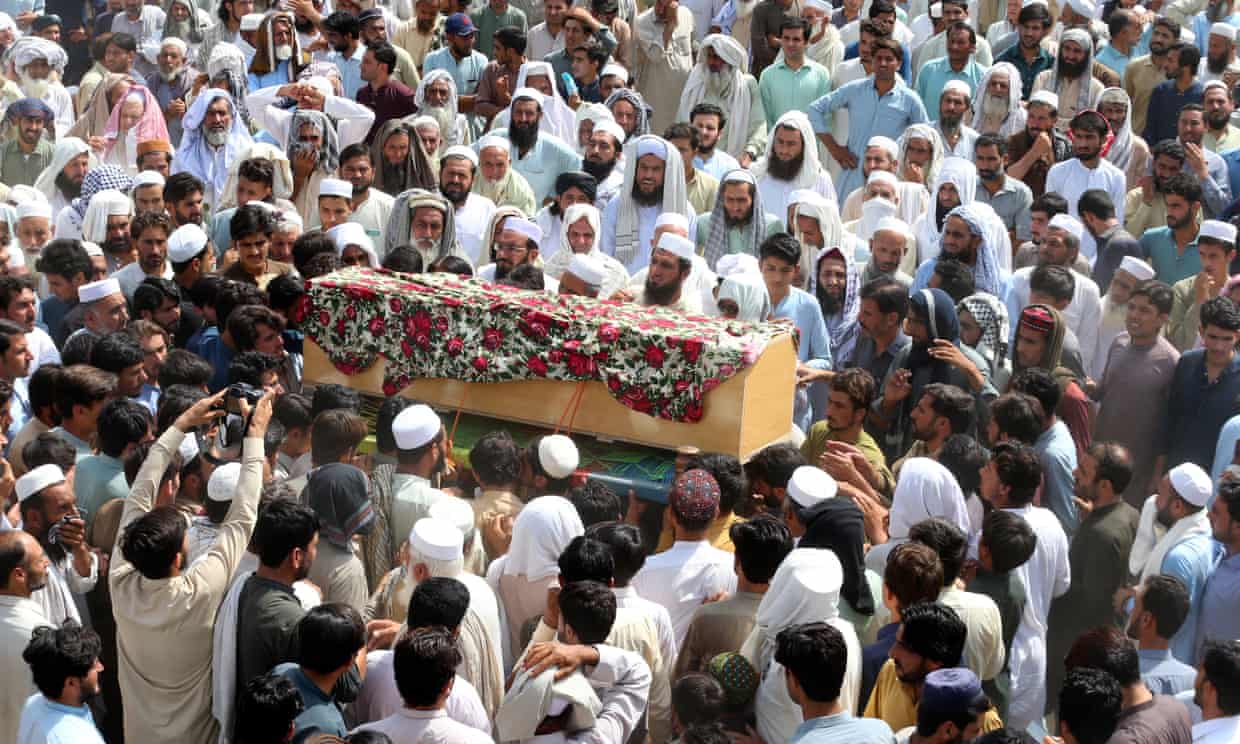
Relatives and mourners carry the casket of a victim killed in Sunday's suicide bombing in Khyber Pakhtunkhwa, Pakistan. Photograph: Mohammad Sajjad/AP

Violent Islamists have long made a comfortable home for themselves in Pakistan. It is where Osama bin Laden, the leader of al-Qaeda was given safe haven at Abbottabad, when U.S. troops in Afghanistan were searching for his whereabouts after the mastermind of the 9/11 events publicly celebrated its success. Masquerading as a 'partner' with the West in the campaign against terrorism, Pakistan's military and its Inter-Services Intelligence agency founded, trained and equipped the Afghanistan Taliban, recognized universally as a terrorist group.

Pakistan's leaders appear to have overlooked the growing militancy of its own Taliban in the process of supporting one that would eventually misrule its neighbour. The tribal villages in the mountains between Afghanistan and Pakistan are a never-ending source of vibrant, violent extremism, and a threat to Pakistan itself necessitating that the Pakistan military engage in battles as the tribal extremists made an effort to extend their territory, endangering nearby nuclear weapons depots.

From Pakistan, a terrorist group of extremist Islamists infiltrated and attacked Indian Mumbai in a bloody four-day assault and massacre that succeeded in killing over 160 people, by Lashkar-e-Taiba (LeT) or Army of the Pure, in November of 2008. The country is a breeding ground for terrorist groups. And now the Islamic State has claimed responsibility for the latest suicide bombing that killed 56 people attending an election rally for a pro-Taliban cleric.

The bombing took place in Bajur, wounding close to two hundred people, killing at least five children. A reflection of tribal/sectarian antipathies between Islamist groups, present in Kyber Pakhtunkhwa province, bordering Afghanistan. The ISIL group targeted the Jamiat Ulema Islam party whose chief is cleric and politician Fazlur Rehman, with ties to both the Afghan and Pakistani Taliban.

An estimated thousand people were crowded within a tent near a market, for a rally preparatory to fall elections. Khan Mohammad, a local resident who stood outside the tent and witnessed the aftereffects of the bomb blast, stated later that he had heard people crying for help. Minutes afterward, ambulances arrived to begin evacuating the hundreds of wounded people.
 
An ambulance arrives to pick up injured people.
An ambulance is set to transport injured people after a bomb explosion in the Bajur district of Pakistan's Khyber Pakhtunkhwa province on Sunday. (Rescue 1122 emergency service/The Associated Press)

 Investigating police knew well before the statement implicating the Islamic State in the carnage, that an initial investigation led them to believe that the regional affiliate of Islamic State, a Taliban rival, would be the likeliest source to have been involved. This, despite that a Pakistani security analyst pointed to factions that had broken off from the Pakistani Taliban as possible suspects, instead. Pakistan does not lack for any number of viral, vicious Islamist terror groups; they find their natural home there.

By Monday funerals were taking place for the dead. Local customs mandate that female relatives and children at their family homes, cry out loudly in their grief, while beating their chests in anguish. Hundreds of men gathered around to follow caskets to mosques and open areas for funeral prayers and then to trek into the hills for burial services in rituals as old as time itself.

Those that could be treated for relatively light wounds sustained in the blast were released from hospital while the critically wounded were transported to the provincial capital of Peshawar by army helicopters. Some critically wounded people died while in hospital and it is expected that the death count may yet climb again as more succumb to their grievous wounds.

https://i.cbc.ca/1.6922566.1690733683!/fileImage/httpImage/image.jpg_gen/derivatives/original_1180/pakistan-bomb.jpg
A worker inspects the scene of the explosion in the Bajur district of northwest Pakistan on Sunday. (Rescue 1122 emergency service/The Associated Press)

Labels: , , , , ,

Thursday, April 06, 2023

Pakistan, Teetering on Insecurity Stilts

"Pakistan is facing a triple crisis. It's facing a threat from the Pakistani Taliban. A collapsing economy; And, polarization and political chaos on the street."
"Pakistani leaders seem woefully unprepared for tackling the challenge and continue to fight each other rather than finding solutions for the country"
Farahnaz Ispahani, former Pakistan parliamentarian

"Looking at the seven years from FY16 to FU22. Pakistan's cumulative current account deficit was $74.5 billion, while the State Bank's forex reserves fell by $3.6 billion during this period."
"This means Pakistan needed financing of $70.9 billion, and borrowed $65 billion."
"Foreign investment barely financed the external deficit, so the government just kept borrowing."
"Since foreign creditors are reluctant to continue lending, Pakistan's external sector has become unsustainable."
Dawn, Pakistan's leading English language newspaper
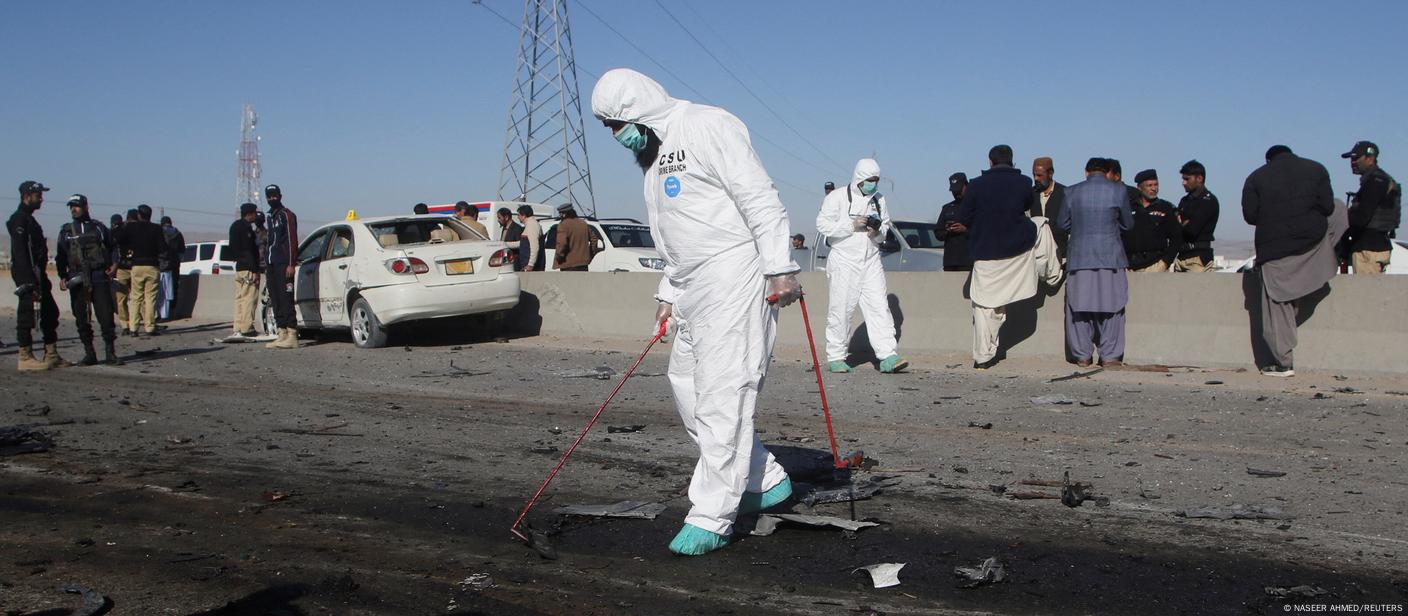
A member of a crime scene unit surveys the site after a suicide bomb blast on a police patrol in Quetta on November 30, 2022
The banned militant group Tehreek-e-Taliban Pakistan (TTP) has ended a cease-fire agreement with the government, and vowed to launch attacks across Pakistan. What will this mean for the country's economy?  DW.com
 
Pakistan, one does best to recall, is a seething cauldron of backward Islamists. Violence and uninhibited threats percolate on the streets of Pakistan's cities when fiery-throated Islamists go about preaching jihad while deploring the presence of western-style shops selling music, and where male and female friends congregate together in restaurants. A country where the minority Christian population is threatened and persecuted when haters can accuse Christians of denigrating the Prophet Mohammad and face a death penalty.

The successive governments of Pakistan plotted against Afghanistan, anxious their neighbour not form an alliance with India. Pakistan invested itself in forming, training and arming the Afghan Taliban, giving its leaders haven at a time that US. forces led an international, UN-NATO force to dislodge the Taliban and al-Qaeda's Osama bin Laden who took credit for planning the aerial attacks against the World Trade Center in New York, the Pentagon in Washington.

Osama bin Laden himself had sanctuary in Pakistan where his family compound was discovered in Abbottabad, not far from an elite military academy. A Pakistani doctor whose own home was next to the bin Laden compound, a secret location for an 'unknown' occupant, helped the CIA identify that unknown occupant whom Navy Seals subsequently dispatched. The Pakistani doctor was arrested, held responsible as a traitor, and incarcerated.

Pakistan's military with its embedded Intelligence Agency, was well infiltrated by their own Taliban, as radical a group of hardcore Islamists as the Afghan Taliban. As a nuclear nation the very prospect of these terrorists potentially having access to Pakistan's nuclear arsenal is mind-boggling. The Taliban threat that Pakistan now faces is one that emerged many years ago, its growth to the point where it challenges the government of Pakistan, just as Afghanistan experienced with the viperous group Pakistan bequeathed to its neighbour.

Now, the Islamic Republic of Pakistan with its immense population of close to 233 million. occupying a land mass of 881,913 square kilometres faces an existential crisis brought about by its own incapacity to govern itself wisely and well. Its focus on its hostility with India from which it broke away in 1947 following British rule leading to a cataclysmic separation and the retaliatory deaths of countless Muslims and Hindus has kept the threat of resurgent conflict alive, over the mutually contested Kashmir.

Pakistan's army has been the traditional fount of emerging leaders. Since its independence there have been three military coups and four military rulers. One of its non-military rulers, Benazir Bhutto, was assassinated by raging fanatical Islamists. Pakistan is currently in a state of political and financial collapse. Former prime minister Imran Khan whose tenure came to a forced halt in April 2022 through a non-confidence parliamentary vote imprisoned other politicians including one of his predecessors, Nawaz Sharif, along with Maryan Nawaz Sharif, the daughter.

Now presiding as Prime Minister of Pakistan is younger brother Shehbaz Sharif. A turf war between Khan's Pakistan Tehreek-e-Insaf political party and a coalition of opposition parties, the Pakistan Democratic Movement, has Pakistan at a political standstill. The Pakistani army sides with the U.S. State Department, and Khan was leading the country into a Russia-Chinese camp. Unseated from power he encourages supporters to violent encounters with the law.

Inadequately governed, Pakistan's institutions are collapsing; educational institutions in particular. High unemployment, poverty and an increase in the Consumer Price Index of 31.5 percent has sent more families into poverty. What the country desperately needs is guidance from a secular-minded, seriously capable leader who can lead it toward normalization with India and the establishment of diplomatic relations with Israel. 

And what the world needs from Pakistan, is the accepted presence of an internationally designated body of specialists to manage Pakistan's nuclear arms in the assurance that should its condition further destabilize those nuclear arms will not be seized by the fanatics crawling about in huge disruptively threatening numbers in Pakistan.

<strong>With Pakistan’s economy in freefall, Chinese economic and military influence is likely to grow in the country</strong>
In the midst of yet another economic crisis, Pakistan is currently facing significant upheaval in the political, economic, and security domains. Amplified by near-historic polarization among ruling elites, the rapidly deteriorating situation has significant implications on near- and long-term Chinese influence in the country.  Atlantic Council

Labels: , , , , ,

Friday, August 05, 2022

Settling Old Scores in Afghanistan

"[American intelligence spent] weeks, if not several months, of making sure that we had the right guy."
"Once we knew that we had an effective pattern of life and opportunities that could be taken, it was really down to stitching together how you were going to take that opportunity and with what."
John Kirby, U.S. National Security Council
In this undated photo, Ayman al-Zawahiri (R) sits next to Osama bin Laden (L).
Undated photo of former Qaeda leaders Ayman al-Zawahiri (right) and Osama bin Laden.
Visual News/Getty Images
 
When U.S. Special Operations flew in to Abbottabad to rappel down to the secret bin Laden family compound a short distance from a Pakistani officer corps installation, they had the estimable assistance of a Pakistani doctor whose house lay in close proximity to the bin Laden compound. He had agreed to work with the CIA in identifying the mysterious resident who seemed never to venture outside the compound. He now languishes in a Pakistani prison, accused of treason.

Whether or not a local Afghan committed to giving insider information to U.S. Intelligence may never be known. Although, strangely enough, a high-placed member of the Taliban was quoted as having stated that someone like Ayman al-Zawahiri, Osama bin Laden's replacement as head of al Qaeda should never have been given haven in Afghanistan, it isn't likely he would risk that kind of public statement if he had been so involved.

The Taliban, after all, are known for their practise of searching out Afghans who had worked for foreign embassies or as translators for foreign military groups -- when U.S. forces and NATO-associated allies occupied Afghanistan to roust out al-Qaeda and their patrons, the Taliban -- for reprisals for betraying Islamist values by aligning themselves with the West.
Image
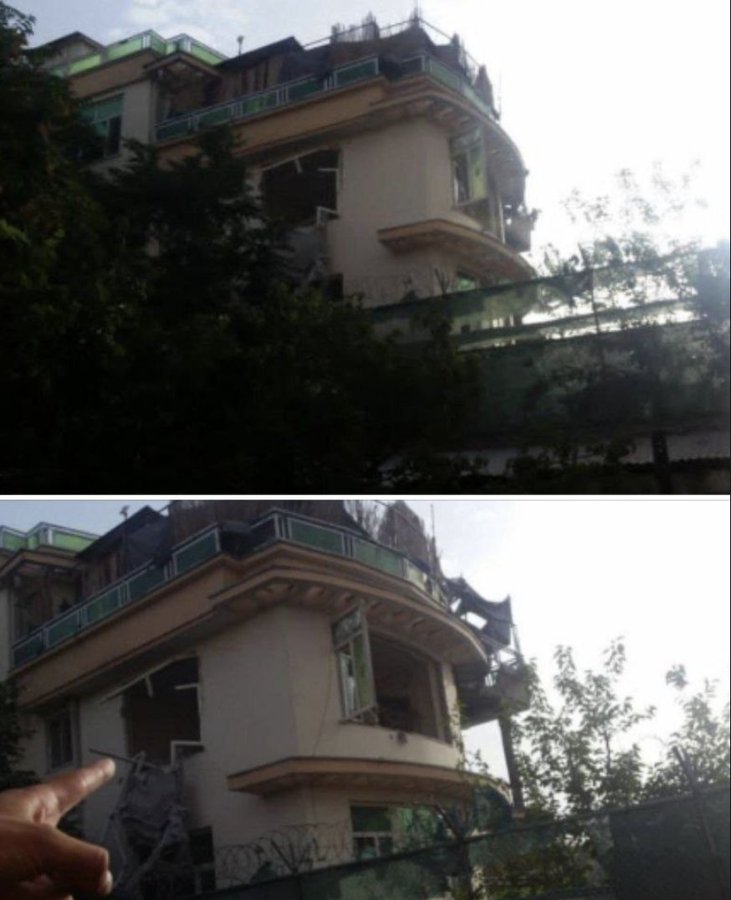
This is reportedly an image from the scene of the strike, in Kabul's Sherpur neighborhood. Charles Lister
 
Pakistan fostered the Taliban. Portraying themselves as 'partners in the war against terrorism', the country notoriously guided, helped form, trained and equipped the Taliban and al Qaeda along with the CIA who meant them to counter Soviet forces who then occupied Afghanistan to install their puppet, Moscow-chosen leader. The Pakistan Inter-Agency Intelligence group, al Qaeda and the Taliban were bonded.

Hardly surprising that the Taliban, despite their 'pledge' to the outgoing Americans last summer who left Afghanistan along with their Western allies, to fend for itself under the re-established rule of the Taliban that they would never again give haven to terrorist groups, would do so again. Not only is al Qaeda quite at home in Afghanistan, so too is the Islamic State group. 

Ayman al-Zawahiri, as one of the 9-11 masterminds, and the planner behind many other mass atrocities aimed at the West and specifically U.S. military was by now a figurehead, an icon of Islamist terrorism. The Egyptian medical man from a prosperous, elite background viewed himself as a dedicated Islamist revolutionary, determined to destroy the effete West and replace it with an Islamic Caliphate.

The West he so passionately targeted turned the tables and targeted him. Not necessarily to prevent any more atrocities planned by this master strategist but as revenge for those he had helped perpetrate. He had been watched for months to determine both his identity and his habits. It is habit that becomes so integral a part of daily life that helped take his life.

He was known to spend a few moments every morning of restful contemplation in the fresh air of the balcony on the third floor of the apartment he lived in with his family in an upscale part of Kabul, where once an international coterie of diplomatic missions under the occupation forces were ensconced in a protected area of the city. Embassies now abandoned, he was ensconced in a 'safe house' owned by a senior Taliban.

Morning prayers finished, it was time for him to depart this mortal coil. High above where he stood on his balcony just after six in the morning, flew a drone. Two R9X 'ninja' Hellfires were fired from the drone. No explosives, instead hyper-accurate missiles with unfolding razor-like blades, six of them which hit their target and no one else, ripping the man to shreds. Much as the explosives and the planes he sent on missions ripped innocent peoples' lives from them.

American intelligence operatives witnessed the Haqqani Taliban network close off access to the safe house, take possession of the remnants of the corpse, move his family elsewhere, removing all evidence that the Taliban had accommodated Ayman al-Zawahiri, hiding him from the relentless American search for the whereabouts of the al Qaeda atrocity mastermind.

An illustration of the Hellfire R9X missile.

"The president made it very clear when he made the decision [to proceed with the assassination] that he wanted to make sure we avoided civilian casualties, and we know we did from a series of intelligence and other sources that we have available to us."
John Kirby

Labels: , , , ,

Sunday, June 19, 2022

Riding the Devil in Afghanistan

"There's a lot of good people here. Engineers, doctors, educated people."
"But they have problems with drugs. The problem is getting worse, day by day."
Drug addict, Pul-e-Sukhta underpass, Kabul, Afghanistan
 
"I was a graduate from school and I prepared for college and loved a girl and I was unsuccessful. The family did not approve."
"After that, there was no chance for me, so I just used heroin to calm myself."
"When I came out [of Kabul's Ibn Sina rehabilitation hospital], what could I do? There was still no work."
"I have been to the hospital, but I became addicted again when I left."
Syed Ramin, 32, drug addict, Kabul
 
"By order of our supreme leader, Haibatullah, there has been a decision to reduce the problem."
"Nowadays there has come a reduction of our drug problem."
Abdul Nasir Munqad, Taliban leader appointee, hospital director
 
"Our problem is different to European countries, where people take drugs for pleasure. If we ask our patients, they have no jobs, they have no income."
"We started our religious classes because our country is a religious country and it has a good effect. It is our experience that we can root out this problem with religious classes." 
Dr. Atiq Azimi, secretary to the Ibn Sima rehabilitation hospital director
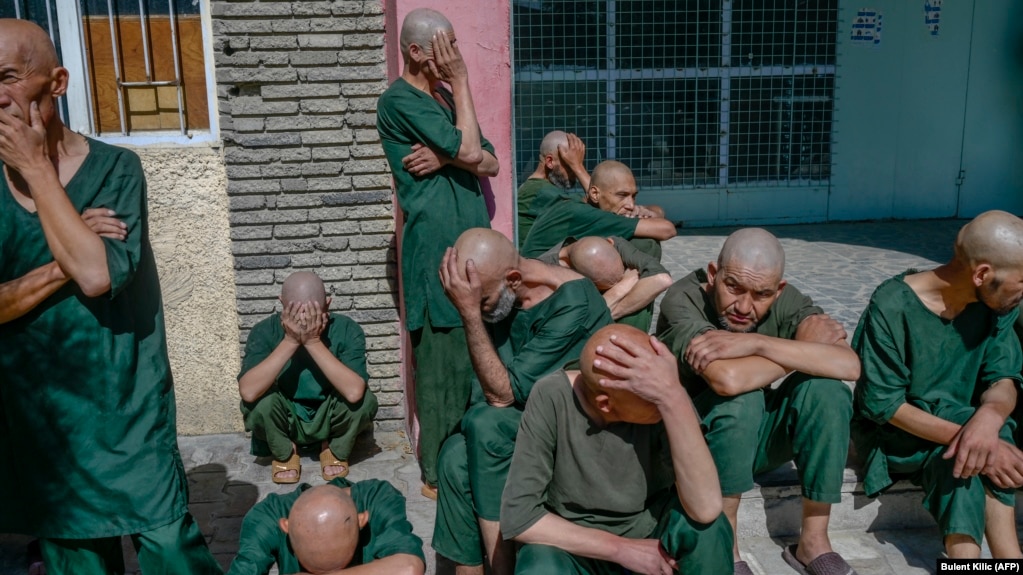
Drug addicts rounded up by the Taliban and forced to shave their heads brace for 45 days of withdrawal at the Avicenna Medical Hospital for Drug Treatment in Kabul. Many others have been sent to prisons that lack any drug treatment

Afghanistan is held to have one of the highest proportions of opium or opiate use within its population, in the world. In a nation of 39 million people, the country has an estimated 1.9 to 2.3 million regular drug users, according to a survey undertaken in 2015. The situation has become worse since then with the economic collapse that struck the country when international aid that supported many of Afghanistan's institutions disappeared with the return of the Taliban.

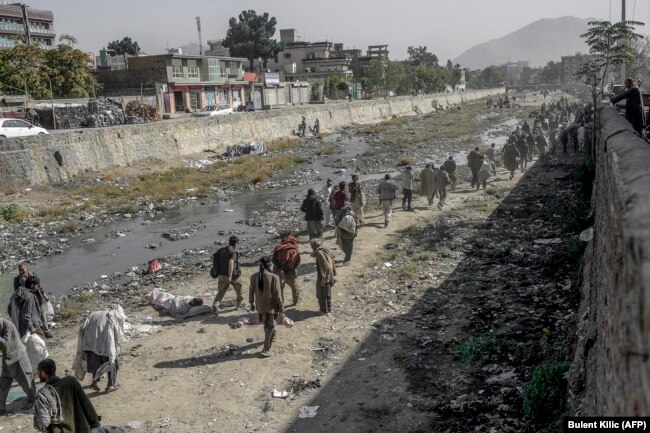
In one place along the outskirts of the capital Kabul, there are nearly a thousand drug addicts who shelter under a bridge in a western neighbourhood of the city. People stumble about, barely conscious of their surroundings, skeletal, disinterested in anything, focusing on drugs. To the curious onlooker many of those who exist within this area appear to be close to death. Yet among the living corpses, tradespeople selling tea move about.

Above the bridge underpass a regular stream of traffic moves, its noise barely noticed by those of the living dead below. All efforts to put a stop to the country's drug trade have failed. There is a burgeoning new trade in methamphetamine, exacerbating the situation where traditionally opiates ruled the market. Most of the addicts living under the bridge relate their stories of addiction to heroin or meth; some explain their addictions began as migrant workers in Iran.

Others speak of the dangers of grinding tours of the southern provinces while with the Afghan military, fighting the Taliban, which led them to drug use. When the Taliban resumed power in August of 2021 one of the initiatives it spoke of was to solve the country's addiction problem. They took to rounding up thousands of addicts off the streets, to force them into the Ibn Sina rehabilitation hospital.

Taliban fighters round up drug addicts in Kabul.

There are a thousand beds in the hospital and following the Taliban raids such crowding occurred as to see three patients in each of those beds. Overcrowding led to violence and conditions where little prospect of weaning addicts away from drugs seemed possible. Hospital doctors persuaded the Taliban to stop funneling addicts into the hospital. Many were taken to prisons instead. The hospital, now administered by a former prisoner of Bagram high-security prison, houses far fewer patients now.

Each of those patients undergoes a 45-day program to help with drug withdrawal where the firs 14 days are devoted to detoxification, followed by rehabilitation. Since enforced roundups were stopped almost all patients are 'voluntary'. Brought by their families to the hospital they cannot leave during treatment in a situation which houses them like inmates. Some of the patients try to escape their confinement. There are frequent clashes between patients and staff and violence occasionally breaks out.

"There are big differences between treating drug addicts in prisons and proper addiction-treatment centers. If patients think they are being forced to quit addiction...they will never accept treatment."
"No one can quit drugs if they are not ready to. The only way a drug addict can quit is to satisfy himself and prepare himself psychologically, which is not possible in prison."
 
Salem Sadid, local psychologist, Farah, Afghanistan

"Definitely when there are economic hardships, when the population is displaced, they want to seek mechanisms to cope with their hardships."
"That definitely makes people vulnerable to more regular drug use."
Kamran Niaz, Office on Drugs and Crime, United Nations


Labels: , , ,

Tuesday, May 17, 2022

Relying on Canada...

"In two months I won't be able to fly because of liability issues with airlines. This whole situation is a nightmare, it feels like we're not living real life."
"How can a government of the free world look down and leave me and my husband to live one more day like this?"
"Every day it feels like I don't think I can do this another day, but we push on."
"People [in Pakistan] are suspicious of me because of my husband's ethnicity, especially the men, who know I'm pregnant and that my husband is far away. They say disgusting words to me."
"Women pretend to be my friend just to get personal information, like that my husband fought Taliban. Here, a lot of people support Taliban."
"I don't go outside anymore. I hide all day. I know some Afghans on special measures had everything paid for, but after all this we want only a stamp."
"I know if my husband comes back to Pakistan, he will end up in jail or dead. I just want my baby to have a dad."
Former Afghan interpreter (name withheld)
A former Canadian Armed Forces interpreter, whom the National Post isn't naming out of concerns for her safety, in an undated photo. She is six months pregnant and stranded in Islamabad, in her agonizing journey through Canadian bureaucracy.
Canada committed to bringing all its former Afghan assistants, office workers, locally engaged diplomatic staff, language interpreters with the Canadian military, to safety in Canada when the Taliban returned to power to transform Afghanistan once again from a nascent democratic model to the Islamic Emirate of Afghanistan under its fundamentalist aegis. The Taliban are known to hunt down Afghans who worked for the former Afghan government, members of the Afghan military, and above all, those they consider traitors; Afghans who worked for foreign countries stationed with a NATO/U.S.-led contingent in the country.

Some Afghans numbering in the thousands were fortunate enough to have been flown to Canada in a universal rescue undertaken by all western nations as they decamped from the country on the cusp of the Taliban's conquest. Others were far less fortunate, following orders of operation issued to them from Canada's Immigration and Refugee ministry, but which were fairly useless, leaving these people behind in fear of their lives at the hands of the Taliban. Paperwork is the fundamental stumbling block.

This woman interpreter married to a Canadian soldier is awaiting but one stamp on her passport to enable her to be brought to safety.She had followed Canadian instructions to leave Afghanistan for Pakistan on a visa, but her Pakistani visa was running out and she is in a helpless, vulnerable position. Pakistan views former helpers of foreign countries only marginally less favourably than the Taliban whom, after all, the Pakistani military and Inter-Agency intelligence group fostered, armed and protected.

The Pakistani government would not hesitate to return a former Afghan interpreter to Canadian forces to her country of origin. Where the Taliban would be prepared to take her into custody and her fate, following that, would be anyone's guess. Her own guess is none too hopeful. This woman's husband desperately urges and awaits action on the part of the bureaucrats of Canada's Immigratation, Refugees and Citizenship ministry. Action that has not been forthcoming, and whose lack of movement places this pregnant woman in danger for her life.

She has already been accepted into a special immigration program which grants Canadian Armed Forces interpreters the right to come to Canada as landed immigrants and eventually to achieve citizenship; she would be joining her Canadian husband in Canada. Instead, she languishes in fear and suspense awaiting rescue from Pakistan. She is fearful of going out in public. Simple excursions such as shopping or a medical visit place her in danger.

She and her husband barely managed to secure a rented place to stay from a reluctant landlord who demanded a steep fee for the privilege. In the interim her visa to remain in Pakistan expired and the potential of deportation looms. The lapsed visa makes is more difficult for her to find new lodgings. All the promises for swift action from the government of Canada have come to nothing.

Half a year after they returned to power in Afghanistan, Taliban arrests of Westerners are growing in frequency.

Labels: , , , ,

Tuesday, May 03, 2022

Risking Their Lives For Which Country?


"In a way we are being punished for our services because, frankly speaking, we were the eyes and ears of the Canadian government on the ground." 
"We risked our lives and our families' lives and this is the reward we get ..."
"It could not be any more un-Canadian."
Afghan, formerly locally engaged at the Canadian Embassy in Kabul

"We can't forget that these Afghans put their lives on the line to assist Canadian diplomats and armed forces during the war and in its aftermath."
"We owe them a debt of gratitude."
Member of Parliament Michael Chong, co-chair, Afghanistan committee

"In the last few years, when there was a large number of targeted assassinations ... we felt a lot of danger going and coming from the office."
"Many of us did receive [threats]."
Afghan, formerly locally engaged at the Canadian Embassy in Kabul
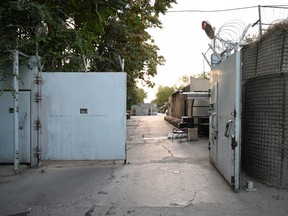
The entrance gate of Canada's embassy in Kabul after Canadians evacuated, Aug. 15, 2021.
Canada rescued many but not all of the Afghan citizens who had worked for the Canadian Embassy, for Canadian troops stationed in Afghanistan as interpreters, office workers, and in many other capacities. They took these positions presumably because they welcomed a foreign presence in their troubled country, so long abandoned to conflict between religious factions, the population's liberty held under threat by the fundamentalist Islamist Taliban. They also worked in these positions to be paid salaries far in excess of what Afghans normally earn.

The entry of a UN-approved, NATO/US-sponsored mission to find Osama bin Laden, al-Qaeda forces and oust the Taliban, sheltering them in Afghanistan while governing the country as a theocratic Islamist dictatorship succeeded for the years of the military occupation at keeping the Taliban -- supported, trained and armed by the Inter-Agency Services of the Pakistani government -- at bay. When the Taliban finally returned to power on the strength of overwhelming Afghan government troops through violent insurrection, NATO nations departed under a disastrous agreement between the Taliban and the U.S.

Most of those nations felt obligated to help Afghan nationals who would be targeted in revenge action by the Taliban, to escape their country of origin, and Canada was among them. Thousands of Afghan civilians and their families were flown at their request, from Afghanistan where they felt threatened, to Canada, to be re-settled there as landed immigrants. While Canadian servicemen and those assigned to the mission felt a loyalty to the safety of the Afghans who had worked among them, the Afghans now living in Canada courtesy of the government and the generosity of taxpayer, feel themselves put upon.

People who live in undeveloped or under-developed, or developing countries envy a Canadian way of life because they have the impression that Canada is a wealthy society. And it is. Yet that same wealthy society has among its population an economically poor demographic of people living hand-to-mouth, supported by governmental social services and charity. The Afghan citizens, now in Canada as landed immigrants and heading toward citizenship, were gifted entry to Canada, and social supports on arrival.
 
They were also the recipients of large cash payouts representing severance and pension payouts since they were of necessity laid off when Canada closed its embassy on the return to power of the Taliban. That cash payout was taxed; in instances where the payout amounted to a lump sum of $300,000, the tax deducted was $130,000. The recipients of the payouts paying tax on the funds are outraged; claimng it to be un-Canadian. How so? And what would they know about Canadian taxation, which in fact, paid for their rescue?
 
Canada's airlift mission from Kabul ends, leaving many behind | CBC News
Photo: Reuters
 
When Canadians abroad are in trouble, are robbed, lose their passports and their money, they call on Canadian consular officials for aid. Who then go about effecting their return to Canada. Their Canadian bank accounts are accessed to fund their airfare returning to Canada. If they have no banked funds, the government uses tax dollars to return them to Canada, to the nearest point of entry, allows them an amount of cash, and they're on their own.

Those complaining of being taxed on funds they feel they are entitled to, join Canadians in protesting high taxes, and at the same time understanding that taxes fund the services they receive as Canadians. Claiming that their actions in working for Canadian aid agencies, military and the diplomatic mission in Kabul was a sacrifice for Canada, putting their lives on the line, have a strangely skewed perspective. 
 
In actual fact, they sacrificed themselves for their country, envisioning the kind of government they would vastly prefer to live under. And it was their hope to attain that kind of government for their country that they 'risked their lives' for. Canada was merely an instrument hoping to help Afghanistan approach that goal. And the initiative failed.

Canada's gratitude to those whom they employed as 'locally engaged' in the Kabul mission should be matched by the locally-employed, flown to Canada with their families to ensure their safety and allow them a different future for themselves. This complaint over helping to pay their way is ungracious and unseemly. Taxation, in this instance, is logical and it is fair. 
 
Welcome to Canada.

Entitled just so much, and no more.
"[Taxation is based on residency status at the time of payment] and not where the money was earned."
"In the case of Kabul LES [locally engaged staff], they have the permanent residence, a Canadian bank account and social security numbers and this being said, they have established significant residential ties in Canada."
Information mailed to LES by Global Affairs Canada
RCAF operates largest evacuation flight from Kabul since Op Aegis began -  Skies Mag
RCAF operates large evacuation flight from Kabul

Labels: , , , , ,

Friday, April 01, 2022

Afghan Promise -- Holding the Liberal Gov't of Canada to Account

"The Taliban [interrogating those they suspect of having worked with the West in Afghanistan] the first question is, 'Why do you need a family passport?"
"Who did you work for and who did your family work for'?"
Ghulam Faizi, former Afghan interpreter, Canadian citizen
 
"They were promised that they would bring their family members here to Canada within weeks."
"It has now been almost three months since they submitted their applications following the government's instructions."
"Three hundred families have submitted their applications. Not one family member has made it to Canada."
New Democrat Member of Parliament Jenny Kwan 
Members of the Afghan National Police meet with soldiers from the Canadian Armed Forces in Kandahar, southern Afghanistan, on April 20, 2006. When Canadian soldiers left Afghanistan in 2011, they left behind local Afghans — former interpreters and mission staff — who helped them navigate the country they had landed in nine years earlier. (John D. McHugh/AFP/Getty Images)
 
Canada's federal government has been in no hurry to rescue vulnerable Afghan citizens who had worked with the Canadian military, diplomatic missions and NGOs and whom the Taliban regard as traitors they mete out capital punishment to. Despite having pledged that it could be relied upon to bring these interpreters, office workers, maintenance people, to Canada to start a new life in the West, as recompense for placing themselves in danger during the years that Canada had a military/diplomatic presence in Afghanistan, the Liberal government of Justin Trudeau has failed to respond.

It is well enough known the danger that these Afghan citizens live under. That the Taliban has a punishment agenda it carries out, despite denying that it targets former government workers, those who collaborated with the NATO-member countries in the U.S.-led, UN-approved mission to oust al-Qaeda and the Taliban from Afghanistan. The U.S., tired of its unending role in the war-torn country, chose to negotiate a 'peace agreement' with the Taliban. This, even while the Taliban kept mounting violently deadly attacks in the country.

With foreign Western troops geared to depart the country, led by the United States in a hasty retreat, the Taliban made swift strides in gaining control, and finally toppling the government in Kabul. So much for a peace agreement, a power-sharing deal. Despite that the Taliban leadership claimed they had no intention of hunting down those they consider to be traitors, this is precisely what has occurred, making the urgency to withdraw the vulnerable slated for death an imperative.

A recent press conference organized by one of the government's opposition parties saw interpreters warning they plan to hold a hunger strike in protest against government inaction to save their loved ones. Although these are people who managed to make it to Canada in previous organized flights out of the country to arrive in Canada, their families were left behind. Families they now say are fleeing from house to house in hopes of evading the door-to-door searches the Taliban have undertaken.

Afghans who applied for passports to leave the country following Canadian government instructions, points out Ghulam Faizi, now a Canadian citizen, formerly an interpreter in Afghanistan, are being interrogated by the Taliban. He spoke of the long wait for Canada to process papers in neighbouring countries like Pakistan, where the Afghans there seeking temporary haven see their visas expiring and the threat of deportation back to Afghanistan looming.

Afghans gather outside the passport office in Kabul on Oct. 6, 2021, after Taliban officials announced they would start issuing passports to citizens again following months of delays that hampered attempts by those trying to flee the country after the Taliban seized control. (Jorge Silva/Reuters)

"We feel like we have been lied to from day one"
, he said. Jenny Kwan, the Member of Parliament, urged the government to treat Afghans in the same expeditious manner as they do Ukrainians fleeing the Russian invasion. To stop the persecution of these vulnerable Afghan families, their entry to Canada must be speeded up, the processing of their papers and biometric data can be carried out once they arrive, rather than waiting for everything to be done before they're permitted entry to Canada.

To date, none of the promised Afghan families have been enabled to travel to Canada under special immigration measures already introduced last year. This, despite interpreters living now in Canada, anxious about their families' fate in Afghanistan repeatedly met with government officials and the immigration minister citing delays and logistical problems.

To date, the government brought close to 10,000 Afghans to Canada, of the 40,000 they promised would be arriving. Meanwhile the situation in Afghanistan is fraught with danger for those implicated and identified by the Taliban as accessories to the 'criminal acts' of their relatives who had worked under the former government of Afghanistan with foreign forces.

Afghan people fill out their details to register to leave the country in front of the British and Canadian embassy in Kabul, Afghanistan, on Aug. 19, 2021. Those trying to arrange a way out of the country following the Taliban takeover say it's taking too long and their window for escape is narrowing. (Wakil Kohsar/AFP/Getty Images)

Labels: , , , ,

Friday, March 25, 2022

The Afghan Refugees Canada Left Behind

"Those refugees face an uncertain and volatile future in neighbouring countries, and Canada is here to help them as well."
"In an initial effort to alleviate the emerging humanitarian crisis in the region, Canada will build on our earlier special immigration program to welcome over 20,000 vulnerable Afghan refugees in total."
Immigration Minister Marco Mendicino, September 2021
 
"The defence team remains ready to support the whole-of-government effort to get these Afghan nationals out of harm's way."
"The Canadian Armed Forces will provide additional flights as required, and DND will continue to support the vetting process and advise on contingency plans for a range of scenarios as our government monitor the evolving security situation in Afghanistan."
Then-Minister of Defence Harjit Sajjan, August 2021
 
"Yes, I'm a bit frustrated, I'm happy that they actually acted, and that there's a process in place. But that process needs to be considerably accelerated or we're really going to be faced with a disaster, which I don't think any Canadian would be willing to accept."
"There needs to be more communication with these legitimate Canadian organizations that are connected to the Afghans who supported us in Kandahar, Kabul and across the country so that we can communicate the plan to them and speed the process,"
(retired) Major-General Denis Thompson, commander, Canadian troops in Afghanistan, 2008-2009
 
"We could have done so much more. It's hard for me just to think about those that I know that are still there. What do I say to them now?"
"What are all the other veterans going say to their interpreters? Sorry? Good luck?"
Retired corporal Dave Morrow, Canadian-Afghan Interpreters group
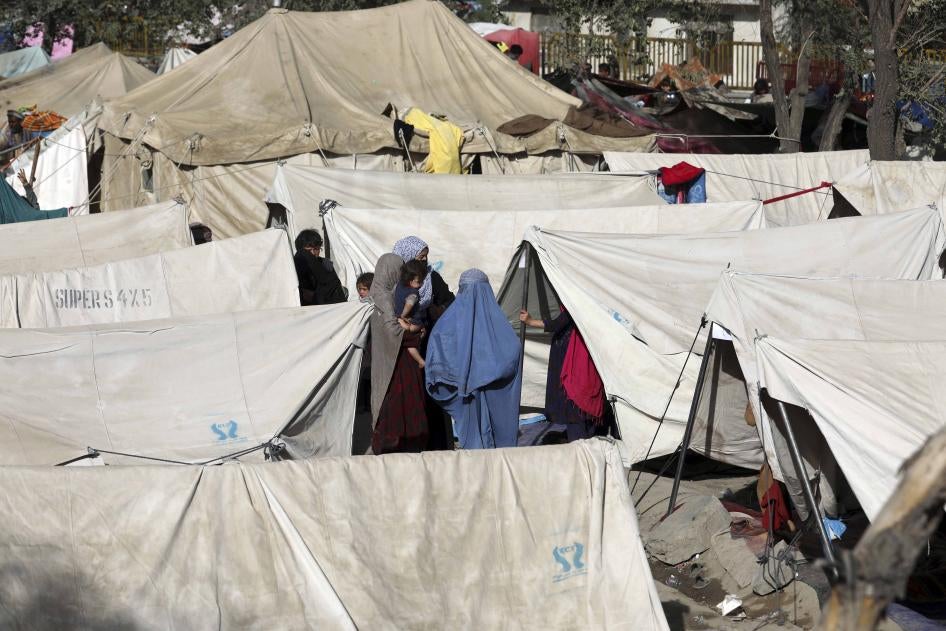
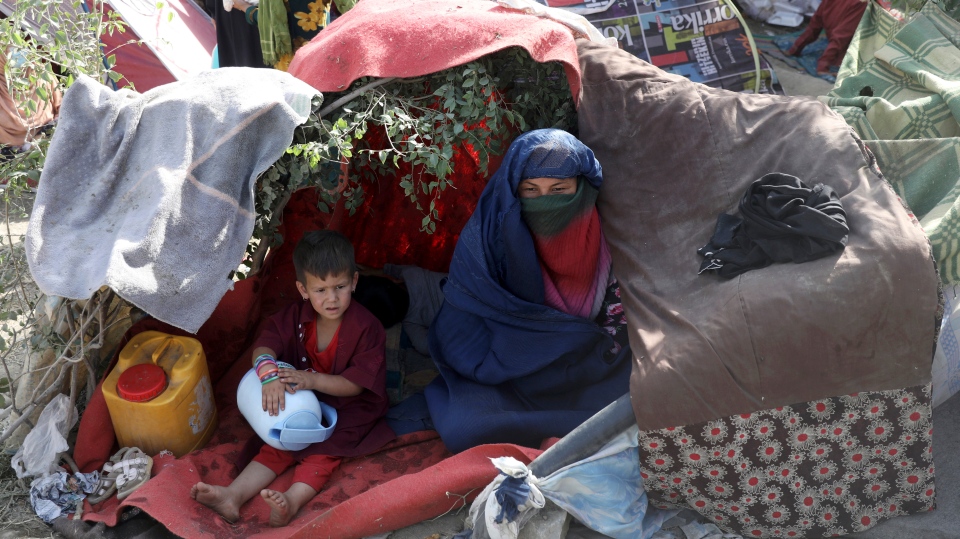
Afghans from northern provinces who fled their homes due to the fighting between the Taliban and Afghan security forces take refuge in a public parc in Kabul, August 13, 2021. 
Afghans from northern provinces who fled their homes due to the fighting between the Taliban and Afghan security forces take refuge in a public park in Kabul, August 13, 2021.  ©2021 AP Photo/Rahmat Gul
On the return of the Islamist fundamentalist Taliban to power in Afghanistan in August of 2021, Canada pledged it would relocate 20,000 refugees. This is the government of Justin Trudeau's Liberals. This is the prime minister of Canada who called a surprise election the very day that Afghanistan fell to the Taliban. Never one to miss an opportunity, during the election campaign that followed, it was stated rhat the government was prepared to set aside $350-million to resettle Afghan refugees.

And then it promised even more; that the number of refugees from Afghanistan would be doubled to 40,000 once the Liberals were returned with a minority government last September. The refugees would primarily consist of those citizens of Afghanistan who worked as contractors in various capacities for Canada; as interpreters, consular employees and such. And would also include Afghans escaping the fear of violence under the Taliban, fleeing to neighbouring countries for haven.
 
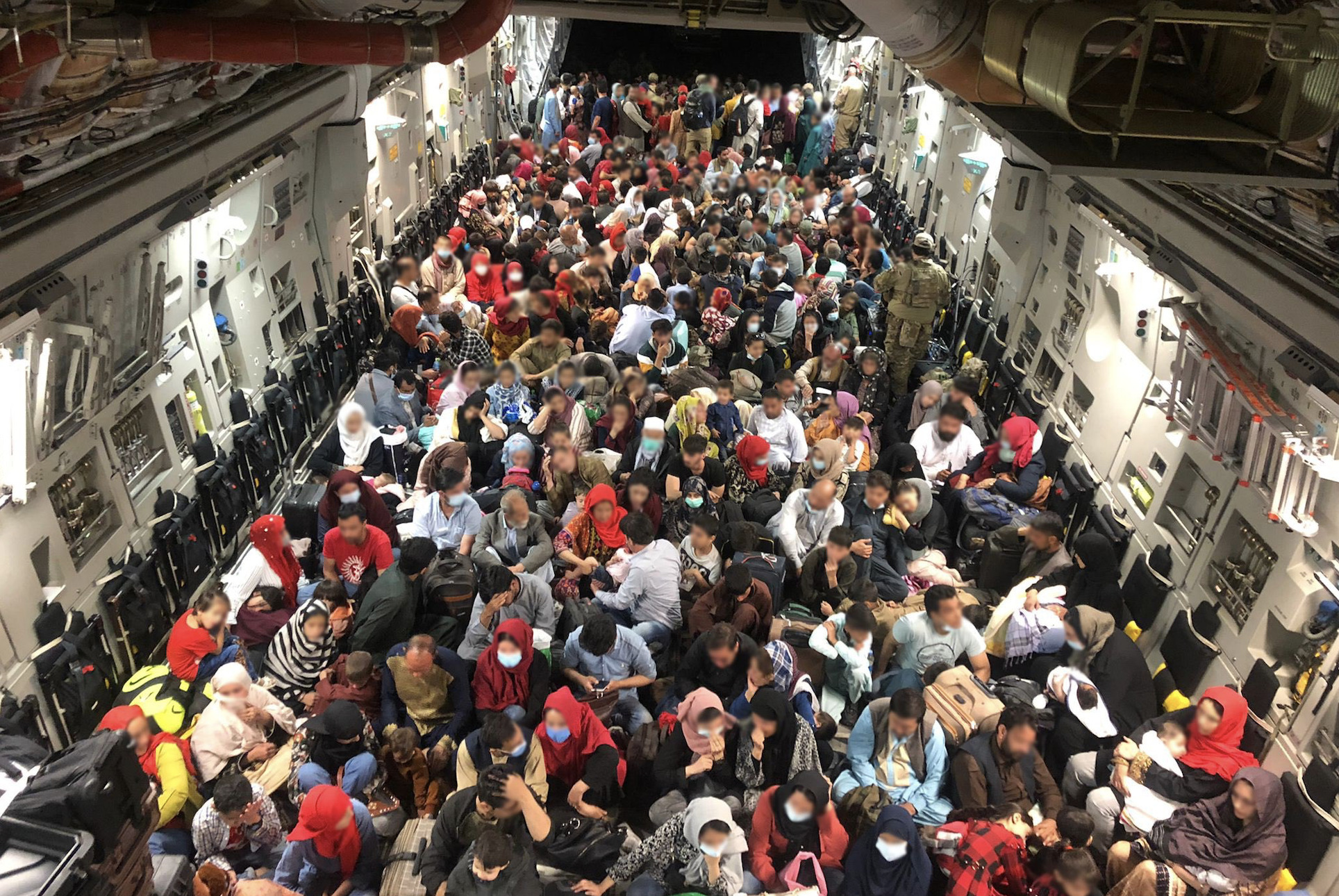
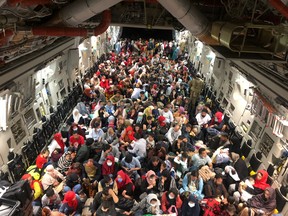
Evacuees termed Canadian Entitled Persons sit in a Royal Canadian Air Force C-177 Globemaster III transport plane for their flight to Canada on Aug. 23.
Evacuation efforts for those who had given aid to Canadian troops had barely begun and suddenly came to a crashing halt in late August once American forces summarily pulled out, leaving Kabul's airport in total chaos. While other countries sent in  helicopters or armed patrols in evacuating refugees, Canada's department of foreign affairs informed Canadian-linked evacuees they were on their own, to find transport to the airport.

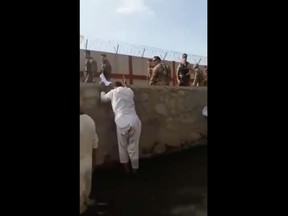
Through efforts fraught with violence and danger those refuge-seeking Afghans who had been promised Canadian haven, appeared at the airport only to be turned away by soldiers; some captured on video ignored by Canadian troops even while they held aloft their approval letters from Canada's immigration department along with their passports, begging to pass through to board the aircraft they were promised would take them to safety.

These were Afghans and their families who had risked their future to work alongside foreign troops in a NATO-US-led mission who were left to their own devices despite having been promised for years that their service would be repaid with safety in Canada. Canadian government officials ignored the urging of volunteers intent on saving those Afghans whose safety was compromised by their having committed to working with Canadian diplomatic offices and military personnel.

Now figures that have been released show that a mere 2,385 Afghan nationals who had given assistance to Canada over the 13-year mission in Afghanistan actually arrived in Canada, out of over 6,000 applications that had been approved for immigration. The thousands of interpreters and civilian contractors employed by the Canadian Armed Forces had forwarded applications to Canada's Immigration, Refugees and Citizenship department as "Government-Assisted Refugees" under special immigration measures.

IRCC had received 14,380 applications. Government approved 6,184 of those applications for relocation, and of that total only 2,385 were relocated to Canada. The Afghan security guards, embassy staff and fixers working for Canada were considered 'traitors' by the Taliban, and as such the pressure to leave before they were discovered and summarily executed qas of utmost importance. As of March 23, according to numbers posted by IRCC, 9,560 Afghan refugees arrived in Canada across all immigration streams and programs.

Afghan citizens numbering 4,325 arrived under government or privately-sponsored refugee programs. This Liberal government talks a good line about how welcoming Canada is to immigration from abroad and how responsive it is to to world crises leading to vast increases in the world's refugee crises. It makes promises along with grandiose statements of accountability, yet the final analysis of actual accomplishments leave much to be desired.

Displaced Afghans
Internally displaced Afghans from northern provinces, who fled their home due to fighting between the Taliban and Afghan security personnel, take refuge in a public park Kabul, Afghanistan, Friday, Aug. 13, 2021. (AP Photo/Rahmat Gul)

Labels: , , ,

Saturday, February 12, 2022

Abandoning the Liberal Government of Canada's Promise to Afghan Civilians

"In our conversation today you suggested we shouldn't be so involved and should step back and 'let the  professionals  in the Ministries handle it' or something to that effect."
"I hate to tell you, but everyone on the ground considers our government's management of this amounts, so far, to be a total disaster."
"It is, however, a little galling to suggest our office is an impediment and the Ministries are doing a great job."
"These men [Afghan civilians who worked for Canadian diplomats and Canadian forces] have not only provided their own countrymen with selfless service at their own risk, but are in part the reason why many soon-to-be Canadian citizens are alive and able to apply to these special immigration measures." 
"Retired General Thompson, who used to command the special forces, called me this A.M. and said he was 'livid' when he saw the video [depicting Canadian soldiers ignoring GAC-approved evacuees at Kabul airport]."
"The fact we continue to place getting the paperwork right above saving lives, outrageous as it is, seems to me classical Canadian government bureaucracy and therefore not totally surprising."
"Separating families, like parents from their children, is however, something that I would think is totally un-Canadian."
"I know that our government can't, for security reasons, reveal its plans and that we need to 'have faith' that we are doing everything we can to help the Afghans we claim to be trying to help. I am however, sorry to say, starting to lose faith."
Marcus Powlowski, Liberal Member of Parliament, Thunder Bay-Rainy River, mid-August, 2021

"I am astounded that a member of the embassy biometrics team, or members of the embassy staff in general, would even have access to the names and nicknames of those who are working with using this capacity [referring to an Afghan  interpreter by his underground nickname identifying him as an Aman Lara operator]."
"I'm appalled that this information would be shared in this casual manner, and with no apparent understanding of the impact communicating this knowledge in such a manner could have."
Drummond Fraser, Aman Lara co-founder, retired lieutenant-colonel
Afghans who appear to have documents approving their evacuation to Canada plead with troops to let them in to Kabul's airport last week, while standing in an open sewer.


Source: Handout
During that brief period when the Taliban was speedily taking over districts and provinces, villages, towns and cities in Afghanistan on its way to reaching its final destination, the capital Kabul, to oust the legally constituted government supported by Western powers, allies Germany, the United States and the United Kingdom undertook dangerous and determined missions to rescue their personnel and remove them from the path of the incoming Taliban, and with them the Afghans and their families who had worked for them as office workers and interpreters.

Canada spoke quite a bit about its moral and ethical duty to rescue the Afghan civilians who had worked with Canadian diplomats and military, Prime Minister Justin Trudeau assured everyone that he had the matter well in hand and would never abandon the Afghans whose lives were in danger from the Taliban who would make every effort to root them out, imprison, torture and kill them. No fewer than 23 Members of Parliament collectively approached the Liberal government to make haste.

On the day Kabul fell to the Taliban, and the days that followed to the end of August when all foreign troops were to leave the country, a prodigious effort was underway to rescue thousands of Afghans to ferry them out of harm's way and ultimately bring them to the countries which they had assisted during the NATO presence in war-torn Afghanistan. But in Canada, the prime minister saw an opportunity to call a snap election and turned his attention to persuading Canadians to give him a majority government.

It had been known for months that the Taliban agreement with the U.S. for troop withdrawal meant that a narrow window existed to extract the vulnerable Afghan civilians who had brushed away risks to work with foreign countries, and that moral indebtedness dictated they be taken out of harm's way. A Canadian veterans' group had taken steps the government had not, establishing a group they called Aman Lara, to rescue Afghan civilians whom Canada owed a debt of gratitude to, and their families.
 
Evacuees termed Canadian Entitled Persons — many interpreters were left behind — sit in a Canadian Air Force C-177 Globemaster III transport plane for their flight to Canada from Kabul on Aug. 23, 2021.
Evacuees termed Canadian Entitled Persons — many interpreters were left behind — sit in a Canadian Air Force C-177 Globemaster III transport plane for their flight to Canada from Kabul on Aug. 23, 2021. Photo by Canadian Armed Forces/Handout via REUTERS
 
This group of veterans had attempted repeatedly to infuse the government with a sense of mission and timing, and failed. Member of Parliament Powlowski was brought into the rescue fold when Drummond Fraser, a co-founder of Aman Lara, a retired lieutenant-colonel, apprised him of a threatening phone call one of their safe-house coordinators in Kabul had received: "Who works for infidels and taking people out from our country and sending them to the infidel country...Don't worry, we will be soon your guests."

Which alarmed and motivated the Member of Parliament to initiate his own efforts to infuse the government with a sense of urgency. Concerns were raised of Taliban spies infiltrating safe houses, used by the Aman Lara group to house vulnerable Afghans and their families until they could be air-lifted out of the country to safety. Evacuation for most, however, never took place. Although recommendations for the immediate transport of Afghans with established links to Canada should take place expeditiously to a safe third country while their safe have in Canada was being processed, hundreds had little option but to go into hiding.

Immigration, Refugees and Citizenship Canada had its bureaucratic routines and paperwork, and Foreign Affairs Canada had its preoccupations and the Canadian military lacked orders to act with alacrity, and so nothing was done to evacuate desperate Afghans though they themselves flooded local internet cafes to complete their applications as instructed and in the process were inadvertently exposed to Taliban collaborators.

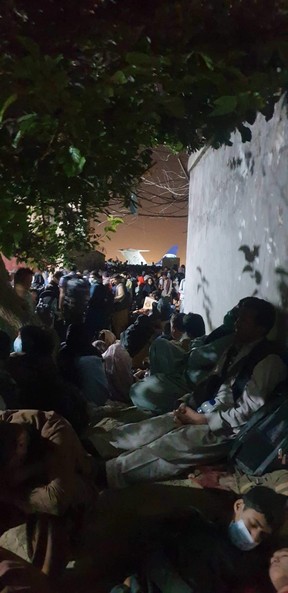
The scene at a gas station outside the Kabul airport after the Taliban take-over, where Afghan ex-employees of Canada, approved to immigrate here, gathered in hopes Canadian troops would escort them inside the airfield. It never happened.
Afghan ex-employees of Canada awaiting rescue
In one instance a Canadian embassy staffer openly referred to an Afghan by his underground nickname during a biometrics appointment, identifying him as an Aman Lara operator. The Prime Minister's Office lectured MP Powlowski to extract himself from involvement in the matter, that matters would proceed at their pace and all would be well. Even as panic and confusion in the capital of Kabul grew with Afghans terrified of their future prospects hunted by the Taliban.

Nothing stopped MP Powlowski from reiterating  his concerns, made all the more urgent by new revelations that very few interpreters were being allowed aboard Canadian relief flights. All the more shocking with the appearance of a video showing approved evacuees being turned away by Canadian forces at the Kabul airport. Afghan nationals were forced to stand in an open sewer waving their passports, visas and government-issued letters guaranteeing safe passage on relief flights. Few made it out.

And that timing coincided with the Taliban conducting door-to-door searches of homes looking for so-called 'collaborators and traitors'. That category also matched the position of Afghan civilians who had worked for the former Afghan government, and members of the Afghan military as well. All considered to be puppets of the West, enablers and unfaithful to the Islamic Emirate of Afghanistan represented by the Taliban.

Labels: , , , , ,

() Follow @rheytah Tweet