
Politic?

This is a blog dedicated to a personal interpretation of political news of the day. I attempt to be as knowledgeable as possible before commenting and committing my thoughts to a day's communication.

Monday, November 13, 2017

Saudi Arabia's Sea-Change

"We are returning to what we were before - a country of moderate Islam that is open to all religions and to the world."
"We will not spend the next 30 years of our lives dealing with destructive ideas. We will destroy them today. We will end extremism very soon."
"We want to lead normal lives, lives where our religion and our traditions translate into tolerance, so that we coexist with the world and become part of the development of the world."
"Seventy percent of the Saudi population is under the age of 30. In all honesty, we will not spend 30 years of our lives dealing with extremist ideologies. We will destroy them today and immediately."
"Saudi was not like this before '79. Saudi Arabia and the entire region went through a revival after '79. ... All we're doing is going back to what we were: a moderate Islam that is open to all religions and to the world and to all traditions and people."  
"Some clear steps were taken recently and I believe we will obliterate the remnants of extremism very soon. I don't think this is a challenge. It reflects our values of forgiveness, righteousness and moderation. Righteousness is on our side."
Saudi Crown Prince Mohammed bin Salman
The prince made the announcement at an investor conference in Riyadh
The prince made the announcement at an investor conference in Riyadh Credit: AFP PHOTO / FAYEZ NURELDINEFAYEZ NURELDINE/AFP/Getty Images
"[I'm not optimistic about the reforms but would] still like to be optimistic … since everyone will suffer if they fail."
"[The reforms are] not engaging Saudi society, enough."
"We wish Mohammed bin Salman well, and we need economic [and social] reform but we also need to discuss [these issues. The change] is being done in very narrow circles. [Ordinary] people are not feeling engaged."
"Conservatives have already lashed out. They’ve been lashing out since 2003. Al-Qaida, or ISIS, or the radical Wahhabis … these are the extremists in Saudi Arabia … and they don’t want change. They have resisted, and will continue to resist. ... The only thing stopping them is [government] security."
Saudi commentator Jamal Kashoggi

"By weakening the clerical establishment and making clerics simple government workers [Mohammed bin Salman] will be able to give women more rights, as he is proposing."
"If 10 million women are given the right to drive in Saudi Arabia and if just a fraction of those women buy cars, take driving lessons or buy insurance, that would contribute to stimulating Saudi Arabia’s stagnant economy."
"Whenever the state clashes with the [conservative] clerical establishment, the state emerges victorious and there’s no reason to believe that things will not be the same, this time."
Hilal Khashan,  political science professor, American University of Beirut
Crown Prince Mohammed bin Salmon's promise to his countrymen that the strict, uncompromising version of Islam known as Wahhabism will be diluted, and that it did not always represent the norm in Saudi Arabia, is somewhat surprising since Saudi Arabia morphed out of Arabia in an agreement with colonial Britain based on the power structure and influence between the Saud dynasty and the rigid fundamentalism of Wahhabism, the movement founded by Muhammad ibn Abd al-Wahhab. 

It may have become more sternly observant with the rise of Iran's Ayatollah Khomeini, but it was never moderate. Moreover, Saudi Arabia, struggling to compete for influence with the new Shiite power in the Islamic Republic of Iran in 1979, as the custodian of the two most holy sites in Islam Mecca and Medina, took pains to portray itself as the true leader of Islam. And as such its punishment meted out for infractions led it to match Iran death-for-death in capital punishment. Yearly state deaths of 150 prisoners distinguished Islamic justice in Saudi Arabia, with claims by
Reprieve, a human rights group, that 41 per cent of those executed in Saudi Arabia in 2017 were killed for non-violent acts such as attending political protests.
Image result for how many people did Saudi Arabia execute this year?
The Independent


But Prince bin Salman is on a modernizing journey for his country, eager to open it to new economic opportunities since the price of fossil fuels plummeted, looking for diversification and foreign investment from the West. An anomaly and rather bizarre, given the massive investments Saudi Arabia has made, building its Wahhabist mosques and madrasses all over the world as it exported its brand of Islam globally, and with it the implementation of jihad and the support of jihadist groups the West calls terrorists. Now it invites Western investment in Saudi Arabia; exporting jihad, importing pluralistic capitalism.

Call the initiative what one will -- and the Prince obviously prefers enlightened and timely modernization -- it will certainly change this religion-straitened society. Given the prominence and influence of Saudi clerics, it will be an uphill struggle, one that Prince Mohammed obviously faces with the relish of a challenge, from the perspective of his 32 years, and the prospect of becoming King with the departure of his father, King Salman. If a signal that a change is on the horizon, the loosening of restrictions for women is prominent.

How many Saudi women will look forward to the opportunity of attending sports matches, an opportunity hitherto denied them, is debatable, once the thrill of offending men has passed. But the spectacle of a burqa-clad woman driving a car for the first time leaves much to be desired. Enveloped in a fabric cage, how free would a woman feel, driving a car toward independence? How independent is she requiring the permission of father, uncle, brother, husband, even son, to go abroad, to open a bank account, to sign a legal document?
"This prohibition on driving is just one in a vast series of laws and policies which prevent women from doing many things."
"The guardianship rule stops women from making every decision in her life without the assistance of a male relative, even if that relative is her 7-year-old son."
Liesl Gerntholtz, Human Rights Watch
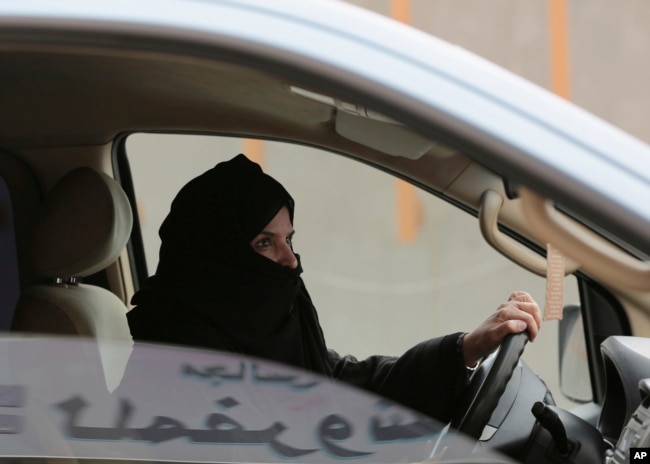
FILE - Aziza Yousef drives a car on a highway in Riyadh, Saudi Arabia, March 29, 2014, as part of a campaign to defy Saudi Arabia's ban on women driving.
The notice has been received by members of the royal family, state authorities and the business community that business as usual is being interrupted and so is the casual acceptance of nepotism and corruption. Having your freedom of movement, however temporary, suspended even by having to remain in a luxury hotel until advised otherwise, is a sobering reality that being part of the aristocracy the wealthy business class, the clergy, no longer would be their shield from imposed change of the social, religious and business order.

"For sure, it does not make me comfortable. Anything that has sin in it, anything that angers the Almighty -- it's a problem", voiced one cleric on news of women attending events where men would be present. "They did a pre-emptive strike. All those who thought about saying no to the government got arrested", observed another cleric. He would, however, accept the changes because Islam requires the Saudi ruler be obeyed. "People go through the door that you open for them", he said philosophically.

"Society in general at this time is very scared. It will push women into society. That is what is in their minds, that it is not right and that it will bring more corruption than benefits", stated  another cleric. One who disagrees stated his initial unwillingness to permit his wife and daughters to own cellphones, but that realities altered his way of thinking, and he feels that Saudi women driving cars would eventually face the same acceptance: "With time, if society sees that the decision is positive and safe, they will accept it", he avowed.

As for leading Islam finally in a more moderate, enlightened direction, away from threatening those of other religions, much less refusing to accept the presence of other religions, Prince Mohammed's drive to soften Saudi Arabia's Salafism in recognition of the 21st Century, has already been spoken of by another ruler, President al-Sissi of Egypt, whose declaration that it is past time Islam stopped being a threat to other religions and exporting jihad to wreak its destabilizing effect abroad, failed entirely to move the clerics of Al-Azhar University, the leading Islamic authority of Sunni Islam.


Labels: , , , ,

Sunday, October 19, 2014

In one short interview, the two Muslim speakers had ensured that: a Zionist conspiracy is in place; ISIS is not really dangerous; the West is at war with Muslims, and the killing must continue; Muslims must not speak out on Western media about violence within the faith, and those who do are liars desperately seeking the limelight. So most Muslims stay silent.
This brand of boxed and packaged Islam, started by Iran's Ayatollah Khomeini, has been so cleverly marketed that most Muslims do not even know what hit them.
Then there are those have moved outside the box -- scholars, reformers and academics, who, like me, are considered heretics but are still part of the faith. We do not accept the branded, "boxed" version of Islam -- exported largely from Saudi Arabia on the wings of billions of petro-dollars in unobtrusive packaging -- that is trying to pass itself off as mainstream Islam.
The debate about "Moderate Muslims" has gone viral. From Bill Maher to Ali Rizvi in his Huffington Post article, it is trending.

As someone who used to call herself a moderate, I am now moving away from that terminology. One reason is a recent interview a cable TV talk show called Bilatakalluf.

On the program were two members of The North American Muslim Foundation (NAMF) -- Imam Shehryar and Farooq Khan -- and the discussion was about ISIS and being a Canadian Muslim. Below is a translation of some of the "quotable quotes":
  • "I honestly think the news about ISIS is extremely exaggerated – there are other interests fanning the flames -- we do not know if ISIS is Muslim or not, could be anyone."
  • "When we look at history and the way the West has lied, it is obvious... I refer to Iraq -- this drama has been done before, so the reports we are getting are not credible as they are coming from Western media, which has a track record of being No. # 1 liars -- once you tell a lie over and over again it becomes credible -- look at the Jihad/Sharia hype?"
  • "We must establish authenticity of the [beheading] TV clips -- it is a man wearing a niqab so how do we know whether he is a Mossad guy or ISIS?"
  • "I have heard reports that some people living under ISIS are peaceful -- at least the Sunni areas are better patrolled."
  • "Having a Caliphate is an integral part of faith. Every believing Muslim prays for a true Khalifah."
And on the topic of Canadians going for Jihad?
  • "There are one million Muslims in Canada... only 0.13% have "allegedly" joined ISIS, and they have gone for many reasons -- it is a hot issue with media -- 150 Jewish Zionists have gone to Gaza for a one-sided slaughter."
  • "Mossad had an integral part in creating Hamas. The PLO Al-Fatah meetings in 1960's were held in the house of a guy who was an Israeli agent -- a Jewish Zionist Israeli agent."
  • "There are vested interests -- 1.8 million Muslims cannot be digested by the powerbrokers so they aim to keep the area troubled -- the grand policy of the West is to have rivers of blood flowing -- they don't say it, but they are at war with the Muslims. The West will keep propping up proxy groups so that the violence does not end."
There is more, but suffice it to say that this was enough. Today, that is the voice of so-called moderate Islam. This cable program reaches over 100,000 homes across North America. These are the voices heard in Muslim homes, where they have credibility because they come from an Imam and his sidekick who are well dressed, well-spoken and articulate. In one short interview, the two speakers had ensured that: a Zionist conspiracy is in place; Western media are liars and cannot be trusted; ISIS is not really dangerous; the West is at war with Muslims, and that the killing must continue to adjust the world population.

Is there concern that most Muslims will believe what was said on this show? Yes. They live within the "Box of Islam," where the majority of Muslims hide today, to avoid facing reality. They are not interested in discussion or debate; they look upon the best years of Islam as during the early Caliphates. This boxed and packaged version of Islam was first branded by Iran's then Supreme Leader, Ayatollah Ruhollah Khomeini, who wanted to export his revolution in the late 1970s. At that time, the branding was that of a fiery bearded Mullah with an extreme message.

Since then this brand of Islam has taken on a modern, moderate look; it is "the new normal." Today, it is being exported largely from Saudi Arabia on the wings of billions of petro-dollars in an unobtrusive packaging. Case in point: There is a version of the Quran that is given away free at Dundas Square in Toronto, where the opening prayer has been tampered with. The original ends with the words "keep us on the straight path and not the path of those who have gone astray." To the "Dundas" version have been added the words "like the Jews and Christians."

This brand of boxed and packaged Islam has been so cleverly and cunningly marketed through the mosque pulpits, print media and electronic media that most Muslims do not even know what has hit them. It is beamed directly into their homes and hearts; they are not encouraged to dissent. This point was made by the Imam on the Bilatakalluf talk show: he said that Muslims should not speak out on Western media about sectarian issues or about violence within the faith. He went on to say that those Muslims who do speak out are liars desperately seeking the limelight. So most Muslims either stay silent or deflect the problems into conspiracy theories.

"Boxed" Muslims therefore now believe (among other issues) that anyone who does not toe their line of Islamist thinking is an infidel and will go to hell; anyone who leaves the faith by choice is an apostate (the punishment for which is death); homosexuals should be thrown off the highest cliff; Sharia law and jihad are benign; an authentic Muslim woman must wear a niqab or at least a hijab; every problem across the Muslim world is due to outside influences; adultery should be punished by 100 lashes, and that hanging and amputation of hands is justified.

Then there are those who have moved outside the box -- scholars, reformers and academics who, like me, are considered heretics but are still part of the faith. We do not accept the branded, "boxed" version of Islam that is trying to pass itself off as mainstream Islam. We believe that there are many paths one can follow and that there really is "no compulsion in religion" (from the Quran); that all believers are equal; we accept that there is special mention of "people of the book" in the Quran that includes Zoroastrians, Jews and Christians, whom we must respect. Sharia law needs to be reformed and brought into the 21st century; we cannot live with archaic laws any longer. Armed jihad is no longer valid. The Quran asks women only for modesty, but the hijab has become a political symbol. The Quran does not speak about killing homosexuals but prohibits lust; and beheading, hanging and cutting off hands should be abolished along with slavery.

The author Ibn Warraq says that "moderate Muslims" do exist, but that he does not believe "Islam is moderate." He is also not optimistic about how quickly moderate Muslim theologians will be able to bring about a religious reformation that will be acceptable.

What does this make us who are genuinely moderate: progressive, liberal or heretics? Whatever we are "branded," we will continue to speak out and light a fire under the feet of all of us: the reform needs to begin.
Raheel Raza is the President of the Council of Muslims Facing Tomorrow.

Labels: , , ,

() Follow @rheytah Tweet