Politic?

This is a blog dedicated to a personal interpretation of political news of the day. I attempt to be as knowledgeable as possible before commenting and committing my thoughts to a day's communication.

Friday, December 06, 2024

Random Stranger Attacks

"Residents in Vancouver are sick of this cap. It's bulls---t."
"[The incident was] devastating. There's a lot of anger actually."
"We can talk about how crime's down, violence, assaults are down, but when these things happen, they're jarring and they really impact the entire community."
"The federal government needs to step up, or at least have a conversation with us.Their responsibility is to help us out because we don’t have the jurisdiction." 
"It isn’t only those in Vancouver who are fed up, but] residents of this entire country."
"The federal government, we need them to come to the table, or just tell the country they’re not serious about this, and they’re going to do nothing about it, and then we’ll deal with it."
"But don’t waste our time and don’t tell people that you’re going to deal with the issue."
Vancouver Mayor Ken Sim
The very Vancouver that is widely recognized as a beautiful city in a geographically spectacular province of mountains, lakes, rivers and forests, is also considered one of best cities of the world to live in. This, despite, the infamous Downtown East Side with its homeless, drug-addicted individuals, the presence of opioid 'harm-reduction clinics' set up to prevent drug overdoses, and the greatest number of deaths from Fentanyl in any Canadian jurisdiction.

https://i.cbc.ca/1.7402587.1733433428!/cumulusImage/httpImage/image.jpg_gen/derivatives/16x9_780/7-eleven-shooting.jpg
Vancouver police officers on the scene outside a 7-Eleven store after police shot and killed a man who injured two people in downtown Vancouver, British Columbia, on Wednesday, Dec. 4, 2024. (Ben Nelms/CBC)

Vancouver's problem -- and it's one that plagues most of Canada's large cities -- is random 'stranger' attacks. Random stabbing sprees have become distressingly all too common. It is a symbol of a justice system incapable of protecting the public from the erratic behaviour of violent criminals. On Wednesday one such individual went into an Original Joe's shop located close by the Vancouver Public Library, where he stole a knife and a bottle of liquor. He then went on to stab random strangers in the neighbourhood before being shot fatally by police inside a 7-11.

In January 2022, a man by the name of David Morin repeatedly plunged a knife into a stranger's back at a Vancouver Tim Horton's. Vancouver Police revealed last week that though classified as a "high risk to reoffend", the man had been set free. It all seemed to begin back in 2002 when a 22-year-old Korean student, Ji-Won Park, was attacked in Stanley Park, while he was out jogging. "Stranger attacks" are now a near-daily event. Not all are stabbings, sometimes a push, a shove, a jab, a punch.

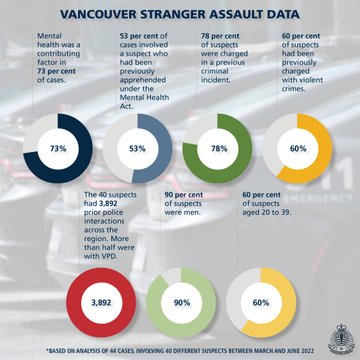
Wednesday's attack was one of the more serious events. A predictable pattern of such attacks begin with a mentally unstable offender, one with a criminal record, and often someone with that background, out on bail or probation. Vancouver Police analyzed 44 separate stranger attacks that took place over a three-month period, with the finding that mental health was a factor in 73 percent of cases; 60 percent of suspects had been charged previously with a violent crime.

The problem seems to stem from two sources, one impacting the other; a mental health system unable to keep violent mental health patients from stalking and harming the public. Aligned with a justice system for which bail and early release are routinely granted, even when the most brazen repeat offenders are before them. A random stabbing spree in September saw 70-year-old Francis David Laporte killed, and a man in his 50s mutilated, his hand severed. Both had been strolling the downtown core, then were suddenly victimized by multiple stab wounds.

An erratic and "very troubled" 34-year-old Brendan McBride was arrested. He had been on probation and credited with a lengthy history of court-ordered psychiatric care. "I think that we have to realize that there's too many unwell people walking around in our streets", commented Vancouver Police Chief Adam Palmer. Coast Mental Health called the incident an indictment of the B.C. approach to mental health: "Nothing excuses what's happened here. People want answers. They're not easy solutions", said CEO Kier Macdonald.

https://i.cbc.ca/1.7402910.1733445851!/fileImage/httpImage/image.jpg_gen/derivatives/original_1180/robson-stabbing-suspect.jpg
An image of the man alleged to have stolen liquor from a bar and wounded two people in downtown Vancouver before being shot and killed by police. CBC News has not yet learned the man's identity. (Submitted to CBC News by a witness)

At the September 2023 Light Up Chinatown festival, the suspect who had stabbed several people randomly, turned out to be a man with a history of stabbing attacks. He was hospitalized, but was given a day pass from a local psychiatric hospital. Charged with three counts of aggravated assault, Blair Donnelly had stabbed his own daughter to death in 2006. Found not criminally responsible for the murder as a result of a mental disorder, Donnelly had been accused since then of stabbing someone while on leave from a mental hospital.

The legal system -- and this is not confined solely to British Columbia -- has proven willing to grant constant release to violent and unpredictable offenders. Leading police forces in British Columbia to refer to a new category of 'super-prolific offenders', defined as an offender with over 30 convictions. Mohammed Majidpour with 30 convictions to his name, in September 2022 randomly attacked a 19-year-old woman in Downtown Vancouver with a pole. Later that same day he set fire to a car. When he was arrested he spent a weekend in detention and then was out on bail.

After which he was arrested several more times. Majidpour was on bail less than three hours before being arrested again for attempting to steal $300-worth of merchandise. Two officers who had arrested Majidpour the previous day on a separate incident, followed him until he broke the law once more. "At the time of his arrest, the suspect had been out of custody for two hours, 18 minutes" a police statement read of the event. 
"If this is a prolific offender, and if the courts will not keep them off our streets, then we should be using the Mental Health Act."
"We need to strengthen the Mental Health Act so that these people who are at risk of harming themselves or others can be held and treated and not be released until they’re no longer a risk."
John Rustad, B.C. Opposition Conservative Leader

https://vancouver.citynews.ca/wp-content/blogs.dir/sites/9/2024/12/04/Vancouver-Police-Downtown-Stabbing-Robson-Hamilton-14-1536x864.png
Vancouver Police officers responded to a “violent” incident that left multiple people injured Wednesday. (CityNews Image)


Labels: , , , ,

Tuesday, June 20, 2023

Canada, Safe and Secure

"I think policy makers and decision-makers need to realize that there are some very strong sentiments being expressed on these issues [involuntary addiction treatment, criminal charge bail, decriminalization of drugs]."
"We're seeing large percentages of people saying things are getting worse."
"I think there was a perception, correct or not, that safe injection sites would lead to a solution, and those problems are instead amplified probably ten-fold from where they were. So there's this frustration of, 'What else can we do. This isn't working'."
Andrew Enns, executive vice-present, Leger Marketing
https://smartcdn.gprod.postmedia.digital/nationalpost/wp-content/uploads/2023/06/JUSTICE1.png?quality=90&strip=all&w=1128&type=webp&sig=5e68fgveLAfNR1Kis3VdzQ
 
Little wonder Canadians are fed up. Inflation is raging, the cost of consumer goods sky-high, additional taxes on energy linked to the Trudeau government's environmentalist agenda has sent the price of gas at the fuel pumps soaring, homelessness is a growing concern, and more people than ever before are turning to food banks. Canada's once-proud universal health care system has been gutted; wait times for surgery, for access to medical specialists have become dangerously inadequate. The 911 emergency system is collapsing, ambulances are increasingly late responding to calls, and so are police.

But the latest poll by Leger Marketing looked at other acute concerns of Canadians; that of growing crime rates, of growing addiction rates and consequent deaths from overdosing. Fixes that governments have been relying on have proven to be failures. Leaving the public frustrated and angry. And those sentiments of failed government actions in addressing these societal problems were emphasized on the latest poll.

The status quo is unacceptable and the response of governments has been inadequate to say the least. Canadian public opinion was found through this latest poll to be completely opposite government priorities channelled through programs that have proven to be worthless. The issues of bail, involuntary addiction treatment, and the decriminalization of drugs in a desperate attempt to ease the growing problems in society are topmost in people's minds behind the cost of living.

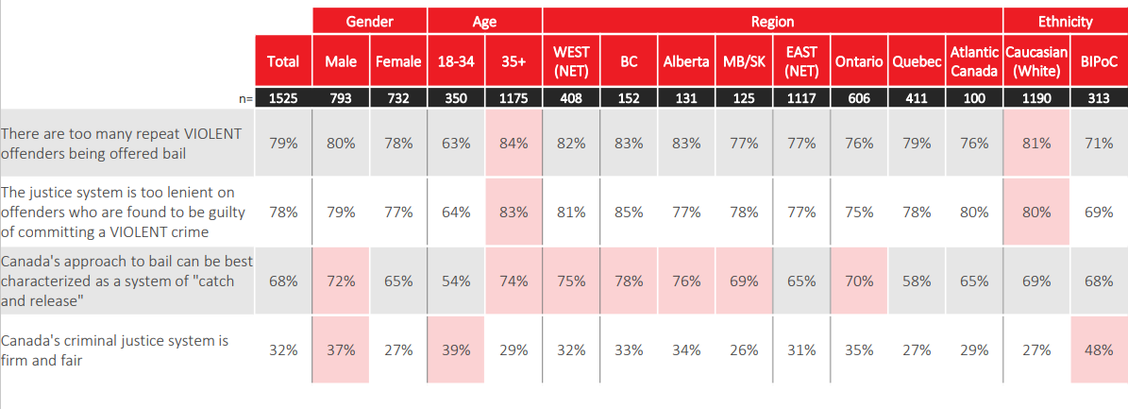
A clear majority of poll respondents agree the Canadian justice system is mishandling bail, too lenient on violent criminals. Example: the statement "there are too many repeat violent offenders being offered bail" had the agreement of 79 percent of the surveyed. The statement "the justice system is too lenient on offenders who are found to be guilt of committing a violent crime" was endorsed by 79 percent. While less than 32 percent agreed that Canada had a "firm and fair" system of justice.

On the issue of strengthening bail, solid agreement was seen, with 82 percent of Western Canadians, 77 percent of Eastern Canadians, 80 percent of men, 78 percent of women, 81 percent of white Canadians and 71 percent of BIPOC (Black, Indigenous, People of Colour) Canadians, reporting that too many violet offenders were given bail. General agreement was seen on the viewpoint that Canada's top priorities on criminal justice should be "violent crime", "illegal firearm possession" and "drug and substance abuse".
 
https://smartcdn.gprod.postmedia.digital/nationalpost/wp-content/uploads/2023/06/POLL2.png?quality=90&strip=all&w=1128&type=webp&sig=izSlvFJ_Yl8M7N159JTNlw
 
A course has been adopted in Canada of setting aside law enforcement from the equation of drug addiction, prioritizing harm reduction policies with the like of safe consumption sites. Included was British Columbia's experiment in decriminalizing personal use quantities of hard drugs like heroin and cocaine. Canadians indicated a more nuanced view of how Canada's climbing rates of fatal overdose could be addressed.

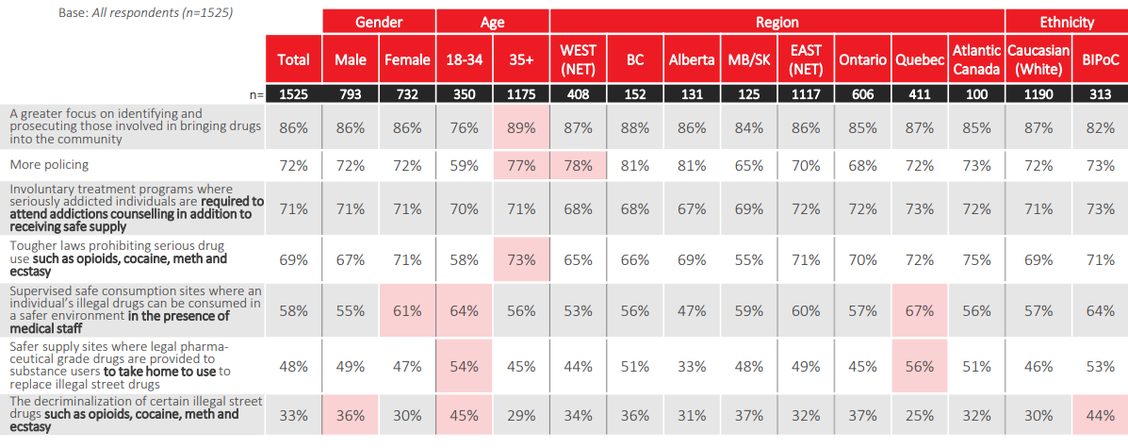
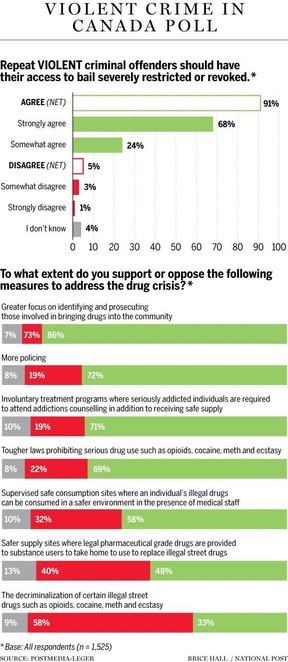
Major support was expressed (58 percent) for "supervised safe consumption sites", yet almost all respondents wanted to have drug dealers prosecuted and chronic addicts to be mandated to the necessity of treatment. Over 7 in ten respondents opted for "more policing" on drugs, the highest being expressed (at 81 percent) in British Columbia, the recognized epicentre of the overdose crisis. Asked should Canada focus on "identifying and prosecuting those involved in bringing drugs into the community", 86 percent agreed.

"There was one [safe consumption site] when we came into office in 2015, now there are dozens and dozens and dozens across the country and they are saving lives significantly", boasted Prime Minister Justin Trudeau. He slammed it as "unfortunate" and "anti-science" when Alberta began the pursuit of a treatment-centered approach to address its overdose crisis. His boast is  a hollow sham; lethal overdoses, in the face of 'dozens and dozens' of 'safe injection' sites, are on a pronounced upward curve. Moreover, the 'safe' opioids handed out at the sites are leaking onto the streets.

Although involuntary treatment for chronic addicts has been denounced as extreme by the Canadian political and public health establishment, it was endorsed by 71 percent of poll respondents who agreed "involuntary treatment programs where seriously addicted individuals are required to attend addiction counselling in addition to receiving safe supply", sounded like a solution. 
 
A graphic showing poll results
 
As for the criminal justice system reflected by government policy, opinion polls find majority support for capital punishment which since the 1970s was officially abolished in Canada. Incarceration and detention issues have hardened in the wake of recent murders and assaults committed by suspects either on bail or recent early releases from prison. Random fatal stabbings by people on parole for similar random attacks infuriate the public. 

The fatal shooting of an Ontario Provincial Police constable by a repeat violent offender on bail, prompted a letter co-signed by all 13 Canadian premiers urging the federal government to reform bail (the Trudeau government had loosened bail issues after the previous Conservative-led government had tightened them) and take steps to get violent criminals "off the streets"

Canadian bail policies were described as a system of "catch and release" by over two-thirds of poll respondents, with white respondents at 69 percent and non-white respondents, 68 percent. If offenders keep committing crimes while on bail, in the opinion of the survey respondents, stop giving them bail. 92 percent of poll respondents endorsed the statement "repeat violent criminal offenders should have their access to bail severely restricted or revoked".

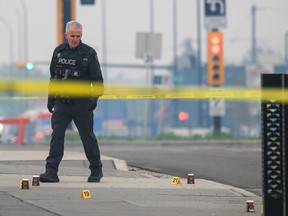
A police officer at a crime scene

Labels: , , , , ,

Saturday, May 13, 2023

Canada, a Consequence-Free Jurisdiction for Public Violence

"He was brought before a judge and released with conditions and the charges were later stayed."
Edmonton Police Chief Dale McFee
 
"[There is] over-incarceration of Indigenous and other marginalized people in custody [relatable to increased criminality with its roots in societal traumas brought by the Indian Residential School system]."
"It's sad to see, but we still have a responsibility to ensure the public safety of our communities, because 99 percent of the time the offender is Indigenous and so is the victim." 
Daren Montour, Chief of the Six Nations Police Service
 
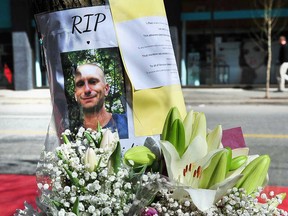
Flowers adorn a memorial to Paul Stanley Schmidt, a 37-year-old father who was stabbed to death outside a Starbucks coffee shop in downtown Vancouver on March 26, 2023.
Edmonton Police are loathe to release the name of the man dubbed a 'suspect' -- a man who acted as yet another perpetrator of 'stranger attacks' occurring all over Canada -- who stabbed to death in broad daylight outside a school, an Edmonton mother and her 11-year-old child. Their assailant was a complete stranger. What the Edmonton Police did release is that he had a long history of random violent encounters , including some against children, and had only recently been released from prison.

The spike in random violence is being attributed to a systemic failure of Canadian bail policy, where chronic violent offenders are released from custody, readily and too frequently, according to a near-unanimous coalition of police and political leaders. The situation is seen as the unintended consequence of a program set up to address the country's 'over-reliance' on incarceration as well as the 'over-representation' of marginalized groups within the prison system.

Canada, as it happens, had one of the lowest incarceration rates in the democratic world. Under the Liberal government of Prime Minister Justin Trudeau, this low rate of incarceration has dropped even lower, reflecting progressive compassion for the perceived underdog, over government responsibility to ensure that cities and towns and their inhabitants anywhere and everywhere in Canada are safe and secure from violence.

In 2015, when the Trudeau Government took office, statistics indicated 87.9 people jailed for evry100,000 Canadians. The last count in 2022 showed 66.8 for every 100,000, representing a 24 percent reduction. The non-profit World Prison Brief in 2016 identified Canada with a lower overall incarceration rate than Luxembourg, Spain and the U.K.; tied roughly with Belgium and France.

Now at the lower end of incarceration rates among G20 nations, in 2021 prison investigators issued a report in Australia concluding that Canada's incarceration rate was over 50 percent lower than its own. In comparing Canada to the rest of its hemispheric coevals, the disparity becomes particularly pronounced. Major South and Central American countries have an incarceration rate orders of magnitude higher than Canada's.

Canada ranked 164th in the world for incarceration rate, according to the tally maintained by World Prison Brief, with 2020 data. A ranking that has Canada with an incarceration rate of 85 per 100,000, in comparison to 531 for the United States, and 174 for Mexico. The only countries with lower prison populations are either European with exceptionally low rates of crime, or African countries lacking resources to maintain comprehensive criminal justice systems.

The-then Justice Minister in 2015 was tasked to explore "sentencing alternatives" and "bail reform" as well as "initiatives to reduce the rate of incarceration amongst Indigenous Canadians". A project no doubt dear to the heart of the-then minister, herself an Indigenous Canadian of high repute and accomplishment. In less than a few months the Justice Ministry released consultation reports focusing on Canada's "Over-reliance on incarceration".
 
Bill C-75 included a "modernization" of the bail system, requiring judges to consider a suspect's ethnic background when reaching judgement whether to release them from remand. Bail hearings previously had for the most part focused on flight risk and public safety. Following that, the Department of Justice produced Bill C-5, proposing to drop mandatory minimum sentences for a wide variety of firearms offences, openly declaring the justice system to be shot through with "systemic racism".
 
Image
Bill C-75 is held by its critics to have yielded the consequence of increasing urban disorder and criminality by removing the option of police enforcing release conditions. Minister of Justice Murray Rankin in British Columbia's government, one led by the New Democratic Party, pointed out that the law had initiated a sharp rise of violent, repeat offenders attacking strangers on the streets of British Columbia.
 
Canada, it seems, has released so many non-Indigenous prisoners they have failed to address core justifications in pursuing the Trudeau government's prison reform in the first place: Indigenous "over-representation".
 
Canada's most recent statistics, according to the Correction Service of Canada, of "custodial admissions identify as Indigenous, a slightly higher share than in 2015, when the Justice Department first began studying the problem of "over-representation of Indigenous people".


Labels: , , , , ,

() Follow @rheytah Tweet