Politic?

This is a blog dedicated to a personal interpretation of political news of the day. I attempt to be as knowledgeable as possible before commenting and committing my thoughts to a day's communication.

Wednesday, September 02, 2020

Predictive Policing : Algorithmic Technology

"We have to make sure that we're not putting forward technology as a solution to a problem that technology actually cannot solve."                                                   "The idea is [to] pinpoint with more accuracy where crime is more likely to happen, send officers to that particular [area] and deter the alleged future crime before it happens."                                                                                                              "We don't have a specific legal safeguard that says whether or not it's appropriate and sufficiently protective of privacy rights to re-purpose [those] databases in this way."                                                                                                                                           Cynthia Khoo, research fellow, technology and human rights lawyer, Citizen Lab, Toronto

City of Pittsburgh Police Officer Shane Kovach sitting in police car with a laptop
Officer Shane Kovach patrols Homewood, a Pittsburgh, Pennsylvania, neighborhood where predictive policing will soon be introduced. Stephanie Strasburg

Police agencies have professional experience in community safety and security and they have the invaluable intuition of seasoned officers to help in the never-ending confrontation between law and order and social alienation and criminal activities to help them distinguish which levels of society, which groups within society and which neighbourhoods in community settings may be largely responsible for anti-social and criminal acts harming the whole of society. Police then respond within the parameters of allowable protocols in aid and protection of community interests.

It's a difficult job, one fraught with problems as well as exposure to personal dangers, and liable to complaints from marginalized groups, ethnic groups, and those mired in poverty, simply because it is frequently from among those disaffected groups who view themselves as victims of society that much crime emanates. Usually white collar crimes are committed by the educated, by the well-off classes of society. Crimes of violence more generally from among those disenchanted with society for whom it is claimed equality is an elusive goal.

"The most significant weakness of the predictive aspects of these models is the difficulty of identifying, anticipating, and factoring in the impact of the variables expected to influence future crime trends. The quantitative models identified in this research did not, and probably could not, factor in the vast array of variables that may influence crime; most of the time series models used to predict future crime rates only took into consideration one or two key influential (demographic and macro-economic) variables. While there is substantial evidence of the impact that these variables have on the crime rate, a key reason they are used in crime forecasts is that their trends can also be quantitatively documented, and hence, forecasted into the future. What is absent from these mathematical models is the integration of influential variables that are more difficult to quantify through historical time series data such as technology, life-style changes, criminal justice responses, and the level of private security and crime prevention efforts undertaken by the public."   Predicting Crime: The Review of Research, Department of Justice, Government of Canada

That, in any event is the view of the progressive mind that feels the law should use a different standard of expectation on those whose backgrounds are less than ideal, citing childhood traumas, unequal treatment and poverty as causatives for social alienation that edges into gangs, drugs, guns and violence. Citizen Lab, a University of Toronto research group, has issued a report warning that the police use of algorithmic policing technology may infringe on the privacy of residents and impinge on their Charter rights.

Algorithmic policing may be new to Canada, relatively speaking, but it is advanced in the U.S. and U.K. in particular. A few forces in Canada are making use of algorithmic policing and Citizen Lab is warning against its use, calling for a halt until federal authorities complete a judicial enquiry into its use and its pitfalls. The Vancouver police department makes use of a machine learning-based system they launched four years ago in forecasting where break-and-enter crimes are likely to occur, responding by dispatching officers to patrol those areas.

Sounds sensible, doesn't it? It's proactive, stopping crimes before they occur by the simple medium of showing up, becoming more visible, the result being that the presence of police is sufficient in itself for deterring potential criminal acts from proceeding. A partnership between the provincial government, university and the Saskatoon police force feeds police data into a model to identify youth at risk of going missing. A much-needed alert that can prevent young people from taking desperate action that often does them great harm.

In Toronto and in Calgary, law enforcement agencies used social media surveillance techniques even as the RCMP put out a tender for similar services which other countries have used more widely. In the U.K., forces use facial recognition and automated risk-assessment systems. The Los Angeles Police Department ended a program using Palantir technology in response to intense protests and criticism from the Stop LAPD Spying Coalition, while retaining another crime location prediction system.

In Saskatchewan, authorities decided they would build an in-house system "to avoid the issues that they know can come with proprietary software", explained Ms.Khoo, to avoid private sector vendors charging that the details of their technology were breached. Citing commercial confidentiality, some forces chose to withhold documents that Citizen Lab's freedom-of-information requests sought, to aid in their research.

predpol
Predictive policing is built around algorithms that identify potential crime hotspots.. (PredPol)

Citizen Lab contends that algorithmic policing technologies could infringe on such Charter rights as freedom of expression, peaceful assembly, equality and liberty; essentially people's privacy rights. Its recommendation following the research it undertook and the conclusions it reached, was that forces not use the technique as the sole basis for arrest or detention. That court authorization be sought before deploying automated surveillance tools online in public places.

The report asks government to impose moratoriums on the use or training of algorithms on historical police data sets until such time as a national judicial inquiry examines the technology and its implications for Charter rights. Typically, historical police data is used in systems forecasting where crime may occur or whether an individual is likely to commit a crime. Numerous studies, posits the report, as well as court decisions, have pointed out that Black and Indigenous people are over-represented in carding, street-check, arrest, sentencing and incarceration data as a result of "biased criminal justice practices or systemic discrimination."

It is no great secret on the other hand, that it is from among the Black and Indigenous communities that a high proportion of criminal activity emanates and persists in emanating. The question is why should any group within society be held to a lower standard of civic behaviour than any other group? Why should expectations for respect of the law that applies equally to the entire population be lowered for these specific groups? Who may demand it, and when their goal is achieved feel it to be justified that they not respect law and order.


Labels: , , , ,

Sunday, August 23, 2020

Disposing of Critics

Medical specialists carry Russian opposition leader Alexei Navalny on a stretcher into an ambulance on their way to an airport before his medical evacuation to Germany [Alexey Malgavko/ Reuters]

"Tests were immediately taken for the presence of toxic substances in the body. Already today we can say that oxybutyrates, barbiturates, strychnine, convulsive or synthetic poisons have not been found. Alcohol and caffeine were found in the urine." 
Omsk regional health ministry

"So clearly, being an outspoken opposition leader or being a corruption fighter or a whistle-blower in Russia is a dangerous business indeed."                               "Navalny was doing a lot of work exposing corruption, including at the highest level … and this is what they do to retaliate against their critics."                                     Ariel Cohen, senior fellow, Atlantic Council

"He survived the flight and he's stable. It's obvious that something terrible happened. He's a healthy, strong man with a good constitution -- the night before the attack he was swimming in a river."                                                       "Obviously this was an attack on his life ... A healthy man suddenly was in life danger and maybe could have died and maybe he can still die."                           Jaka Ibzili, German organization Cinema For Peace   

"It takes a while to rule things out. And particularly if something is highly toxic — it will be there in very low concentrations, and many screening tests would just not pick that substance up."                                                                                             Alastair Hay,  emeritus professor, toxicology expert, school of medicine, University of Leeds

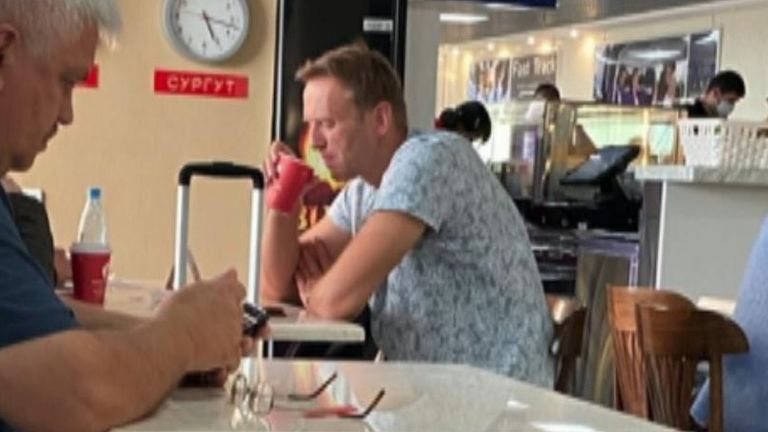
Alexei Navalny is seen at a Siberian airport before boarding the plane where he was taken ill. Pic: @djpavlin
Mr Navalny is on a ventilator after drinking what is thought to have been poisoned tea. Pic: @djpavlin

A standoff between doctors and allies of Kremlin critic Alexei Navalny came to a head on Friday when official clearance was granted for his transfer to a Berlin hospital from the Omsk Emergency Hospital where he was being treated after collapsing and falling into a coma on a routine flight from Siberia to Moscow. It is assumed that he was poisoned, a not-incongruent method frequently used to silence critics of the Kremlin and of Vladimir Putin, and possibly the second time poison was used on Mr. Navalny himself who survived the first attempt and may this one as well.

Others have been less fortunate. Conflicting accounts on Mr. Navalny's condition and whether he might be taken aboard a specially outfitted German medical evacuation flight waiting to receive him at the Omsk airport were eventually concluded. Omsk Emergency Hospital chief physician, Alexander Murakhovsky early on Friday said the patient's state of health mandated he not be moved, but hours later he reversed himself, saying transfer to German care could proceed.

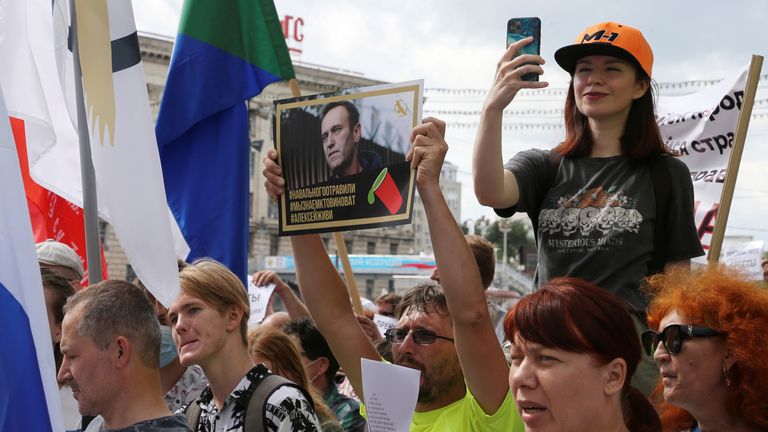
An anti-Kremlin protester's poster reads: "Navalny was poisoned. We know who is guilty. Alexei, live"
Anti-Kremlins: 'Navalny was poisoned. We know who is guilty. Alexei, live'

Dr.Murakhovsky also stated that no indication presented itself that Mr. Navalny had been a victim of poisoning, despite that he had said earlier it would take two days before laboratory results would be received. Those speaking for Mr. Navalny were under no illusions that he hadn't been a poisoning target, the most recent victim of state-ordered poisoning. His condition had improved from Thursday when he had been stricken, but no details were available from attending doctors.

The human rights activist Jaka Bizilj's Cinema for Peace Foundation was eager to leave Saturday with the patient on a chartered ambulance aircraft, for Berlin. When it arrived in Omsk Friday, three German physicians were aboard who eventually were permitted to examine Mr. Navalny. The German doctors were made unavailable -- forcibly escorted elsewhere by Russian authorities -- for their conclusions to be shared with Yulia Navalnava, Mr. Navalny's wife, nor with his colleagues; all blocked from speaking with them.

As far as Mr. Navalny's spokeswoman Kira Yarmysh was concerned, Russian doctors were guilty of endangering the stricken man's life by prolonging his Omsk Hospital stay rather than assent to his immediate departure for Berlin, as a reflection of their intentions to hinder an investigation "until the poison in his body can no longer be traced". She charged that "The ban on transporting Navalny is an attempt on his life, which is now being carried out by the doctors and the deceitful authorities who sanctioned it."

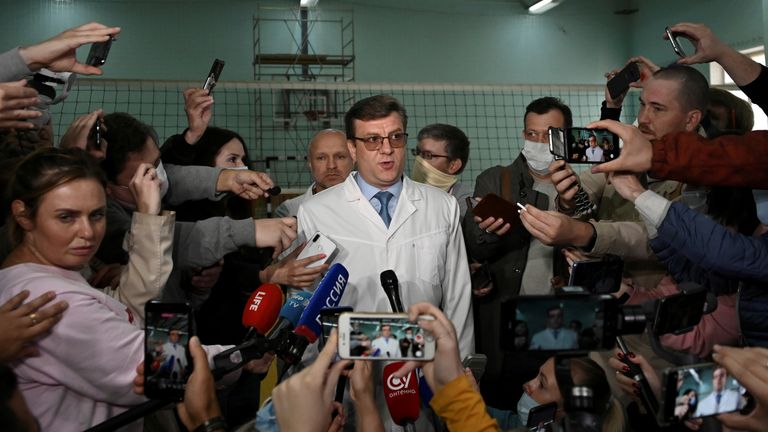
Chief doctor Alexander Murakhovsky tells media in Osmk, Russia there is no trace of poison in Mr Navalny's body
Doctors in Omsk hospital said there was no trace of poison in Mr Navalny's body  Sky News

Doctors at his hospital, said Dr.Murakhovsky, were possessed of "five working diagnoses", without divulging any details. The most likely cause of the coma that Mr. Navalny fell into, he later stated is "a metabolic disorder caused by a sharp drop in blood sugar levels during the flight [from Siberia to Moscow, which was aborted when Mr. Navalny fell suddenly ill]." Transportation police, on the other hand, had informed a Navalny associate, Ivan Zhdanov, that they had discovered poison deemed a danger not only to Mr. Navalny but anyone else close to him, meaning access to Navalny not be permitted without the protection of a full haz-mat suit.

The explanation proffered by the Omsk physicians was an industrial chemical substance found on Mr. Navalny's clothing, denying that the chemical poisoned Mr. Navalny. Mr. Navalny's enemies are those of whom he has been ultra critical; his Anti-Corruption Foundation served to expose excesses and corruption carried out by members of Russia's elite, enriched through their Kremlin connections.

"The plane with Alexei has taken off for Berlin. A huge thank you to everyone for your support." "The struggle for Alexei's life and health is just beginning and there will be much more to go through, but at least now the first step has been taken."  Kira Yarmysh

The emergency medical plane transporting Mr Navalny lands at the Tegel airport in Berlin


Labels: , ,

Tuesday, June 16, 2020

Consorting With The Devil

"Everyone in a leadership role carries a responsibility for transparency and to be open and honest, otherwise it becomes difficult to create a sense of trust and safety."
"For too long violence against women has been viewed as a personal and private matter rather than a public one. Everyone has a role to play in ending violence against women."
"Community leaders are held to a higher account and there is a need for authenticity because they are in a position of trust and power."
Jennifer Hutton, chief executive, Women's Crisis Services of Waterloo Region, Ontario

"The matter of media releases comes under the direct purview of the Chief of Police who is charged with the administration and oversight of the service's operations."
Robert Carter, chair, Guelph Police Services Board

"I live in the riding he represents and I am very concerned for these allegations and more concerned about the censoring of information relating to the case."
"How are we as voters supposed to understand if this person has the moral authority to represent us if we are not able to get any information?"
Jason Morris, riding of Kitchener South-Hespeler
A sitting Liberal Member of Parliament, charged with a serious criminal offence, arrested, placed in prison to await a bail hearing, and no word of the event was aired, either to report it to Liberal authorities in the House of Commons, or to release it as a news item of general interest to media, local or provincial. This, when the leader of his party and the current prime minister, celebrates himself as a feminist, places women's rights front and center of his agenda, and dismissed two other Liberal MPs several years back for rumours of sexual harassment, effectively ending their political careers.

The Guelph Police Service in Guelph Ontario -- where the incident took place on Easter weekend, located about 90 kilometres west of Toronto -- and the Member of Parliament in question, Marwan Tabbara, evidently made a decision that his arrest and all the allegations that went along with it, would be kept private as though this was not a public figure accountable for his actions to the public, and particularly to the voters in his region. A man whose character had assumed baggage at variance with that of the perception of those who voted him into office, and who decided deceit was the best policy for him.

This is a man who was charged with stalking a woman over a three-month period, to the point where she became fearful for her life. This man broke into the home of the woman and assaulted the woman and a male who was with her in the home. Police were called, and Tabbara was arrested and charged with break-and-enter, and two counts of assault. The Guelph police in their decision to forego releasing information on the incident and the identity of the accused, did so, they said, as they judged Tabbara not to represent a risk to the public.

Because of the general lockdown due to COVID-19, and the court system operating via video, Tabbara's hearing took place over video link. He was not required to appear at the courthouse, and was released promising to pay a penalty of $1,000 should he breach any condition of his release -- and a publication ban placed on evidence. The Liberal caucus heard and knew nothing of their colleague's arrest over a criminal assault.

A manual produced by the House of Commons Procedure and Practice states: "If a member is arrested on a criminal charge or is committed for a contempt of court, the House should be notified by the authorities if it is in session." A spokesperson for the Speaker of the House of Commons responded by informing the news media: "This practice is no longer scrupulously and/or consistently followed. Parliamentary authorities note that the failure to inform the Speaker or the House has not been viewed as a matter of privilege."

This is a Member of Parliament appointed chair of the House of Commons subcommittee on international human rights. A position from which he has now resigned. In the wake of the event and the charges laid against 35-year-old Tabbara becoming public knowledge, he resigned from the Liberal caucus, remaining a sitting Member of Parliament, as an independent.

"I personally believe strongly in the right of every individual to live a life free of the hurt and trauma of physical, verbal or emotional abuse. I continue to receive counselling and treatment for anxiety and depression". And there you have it, moral cowards always tend to revert to snivelling confessions of depression causing them to behave in virulently anti-social ways, so it's not really their fault, but that of the Devil.

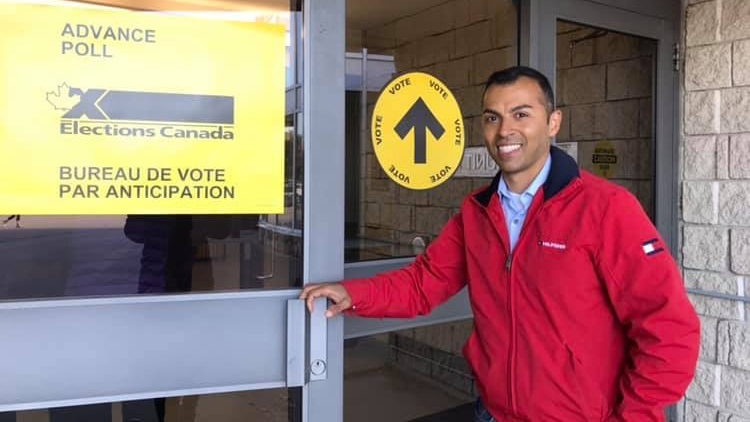
Marwan Tabbara Liberal incumbent Marwan Tabbara after casting his vote at an advance poll. (Source: Tabbara team)

Labels: , , , , ,

Sunday, March 22, 2020

Prudently Tried-and-True

"These are bad, mad and uncertain times — for all of us humans. To stop a virus that scientists acknowledge they do not yet fully understand, all of human interaction is being remade."
"And as it happens, here in Israel, this rapidly, radically altering framework for our daily existence happens to coincide with an ongoing political crisis, in which our war on the coronavirus killer is being directed, and directed well we broadly think, by a deeply controversial politician. Netanyahu is a leader who has always been divisive, who the state legal hierarchy alleges is corrupt, and who has led an assault on core institutions of our democracy in the past two years as he faced off against police investigators and state prosecutors. Netanyahu is also a leader some of whose reasonable measures to thwart the spread of the disease — the closure of most court functions, for instance is not unique to Israel — just so happen to serve his narrow interests as well."
"When his carefully selected ministers and party allies send most of our judges home, when they introduce the monitoring of all our phones, and when they suspend the activities of the parliament that is meant to provide at least some oversight of his government, Israel finds itself in the midst of two crises."
"I think it’s the virus we should be more worried about."
David Horovitz, founding editor, The Times of Israel
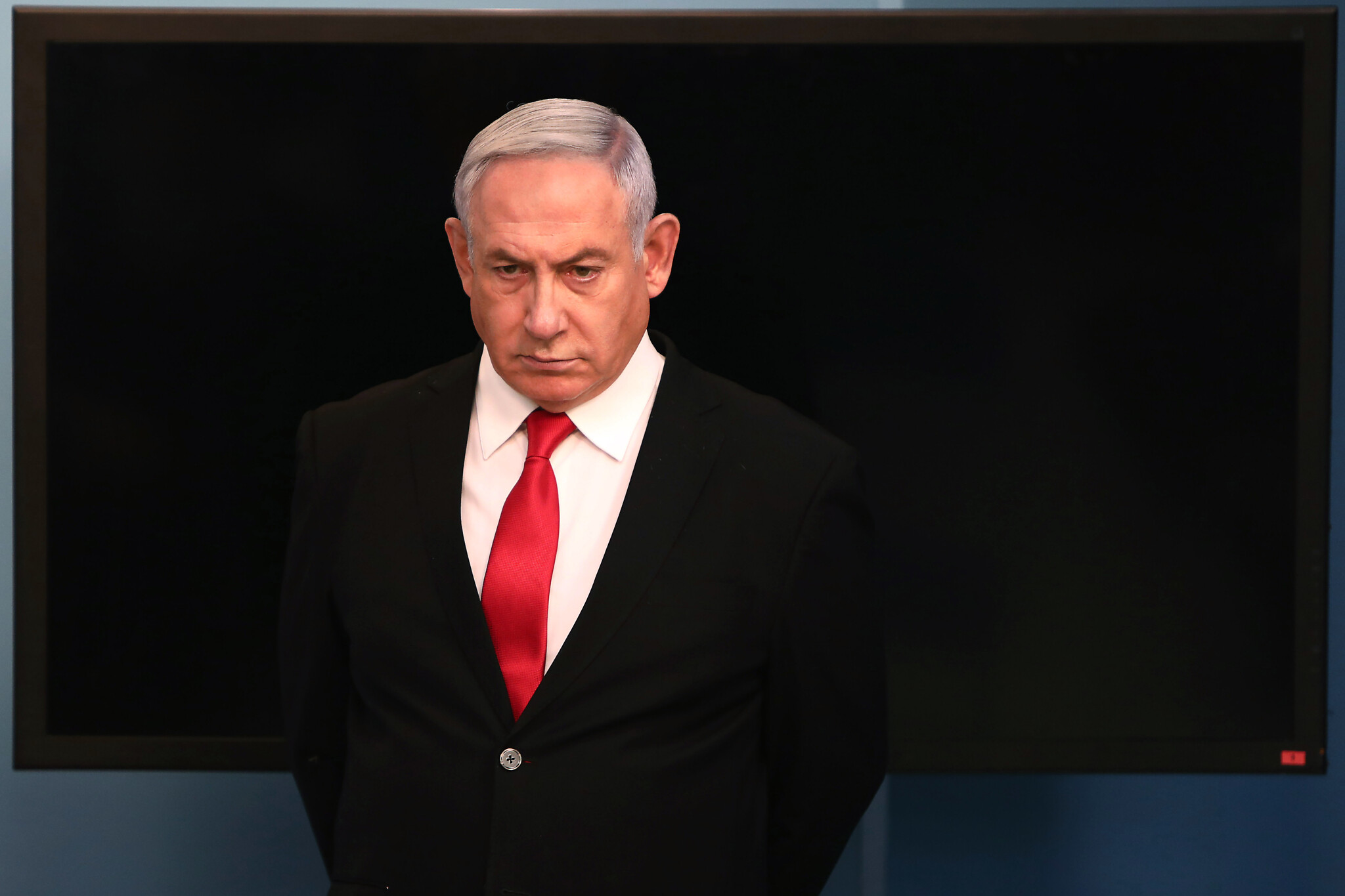
In this Saturday, March 14, 2020 file photo, Israeli Prime Minister Benjamin Netanyahu arrives for a speech from his Jerusalem office amid the coronavirus crisis. (Gali Tibbon/Pool via AP, File)

This is a prime minister fighting for his political life and his legacy. As the longest-serving prime minister Israel has ever had in the short history of its re-emergence from the historical record, no one can deny that this is a man whose acumen and intelligence has served the country extremely well. That old adage warning about the dangers inherent in changing horses midstream certainly applies here, as Israel, accustomed to facing existential challenges on an ongoing basis, is now faced with a dread and sometimes deadly virus threatening to diminish lives, destroy the economy and compromise its already-complicated politics. 

The emergence of the noval coronavirus out of Wuhan, China, its spread throughout the east and in this world of interlocking globalization and communication, its swift contamination in Europe, Oceania, North America and the Middle East, fast approach in Africa, has spelled out unforeseen panic out of a situation that had been foreseen by science, but ignored by politics. Since mid-January, news of mass quarantines in China alerted Israeli political leaders, public institutions and other officials to an oncoming storm.

The focus was how to manage a crisis that would migrate globally and hit Israel just as it would most of the countries on Earth. Nothing quite fixes the mind, individual and collective, as does a threat to longevity. And it is not as though this country in particular hasn't faced many such events heralding doom, which resolve, skill and the will to endure allowed Israel to subdue those threats, time and again. Living on the cusp of threatening disaster has hardened its population against vulnerability and fear, made it more resolute and capable of surviving.

The response was rapid and rude to the very idea of a nation united in adversity, with some believing the reactions were too emphatic, and others that they failed to go far enough. As Israel's second largest trading partner after the U.S. with a flow of goods and people between the two countries significant, three weeks before the first case was diagnosed in Israel, direct flights between China and Israel were suspended. Then, a woman repatriated from the cruise shop off the coast of Japan brought the first case of COVID-19 to Israel.

Health officials re-directed passengers on a flight from South Korea, sending them home when it became evident that among the tourists were individuals who were coronavirus positive. Proactive responses to the anticipated arrival of the novel coronavirus were exercised, with each day new announcements, recommendations, even while Israelis were in the throes of a tense third election in a year. When the government understood that the virus was firmly established in the U.S., issues of the economy, security, family connections arose.

In stepped U.S. Vice-President Mike Pence managing the U.S. domestic coronavirus response, asking Prime Minister Benjamin Netanyahu to impose a global ban on all travellers entering Israel; handing the administration an avoidance of singling out the United States. Leading to Israel's ban on entry of all foreign nationals; the first country to enact such a preventive step. Directives requiring all Israelis to remain at home with limited exceptions, and surveillance will ensure that they will. The measures taken by Singapore and Hong Kong, quite similar in nature, proved hugely successful.

Israel was intent on 'flattening the curve', the best scientific medical advice in getting a step ahead of the infectious novel coronavirus. "We want to be like South Korea, not Italy", said the prime minister, in defending his directives. The intention, to control the rate of contagion to ensure overload is avoided and with it the breakdown of the national health-care system. Community transmission prevention is a critical tool in flattening the curve, controlling the spread, not preventing something that cannot at this stage be 'prevented'.

"This is a war. We have to adapt to a new way of life", Mr. Netanyahu has informed his public. And wars are what Israelis are all too familiar with. This is a man who has many enemies, detractors whose deepest wish is for the prime minister to be convicted of the charges pending against him. This is also a man who had distinguished himself as a brilliant manager of crises, an eloquent public speaker. This man's intuition bolsters an impressive intelligence capable of assimilating complex detail, then to translate it into terms anyone can understand.

As a tactician he has few peers to manage diplomatic issues and the nation's security. So what a shock when in the aftermath of three inconclusive elections, President Reuven Rivlin tasked Benny Gantz, the Blue and White party leader, intent on unseating Mr. Netanyahu, to make an effort to form a governing coalition, effectively sidelining Benjamin Netanyahu and his 'right wing' bloc. In the intensity of the coronavirus crisis, Prime Minister Netanyahu has appealed to Mr.Gantz, to form a coalition government. The measure of the man will be seen in Mr. Gantz's response.

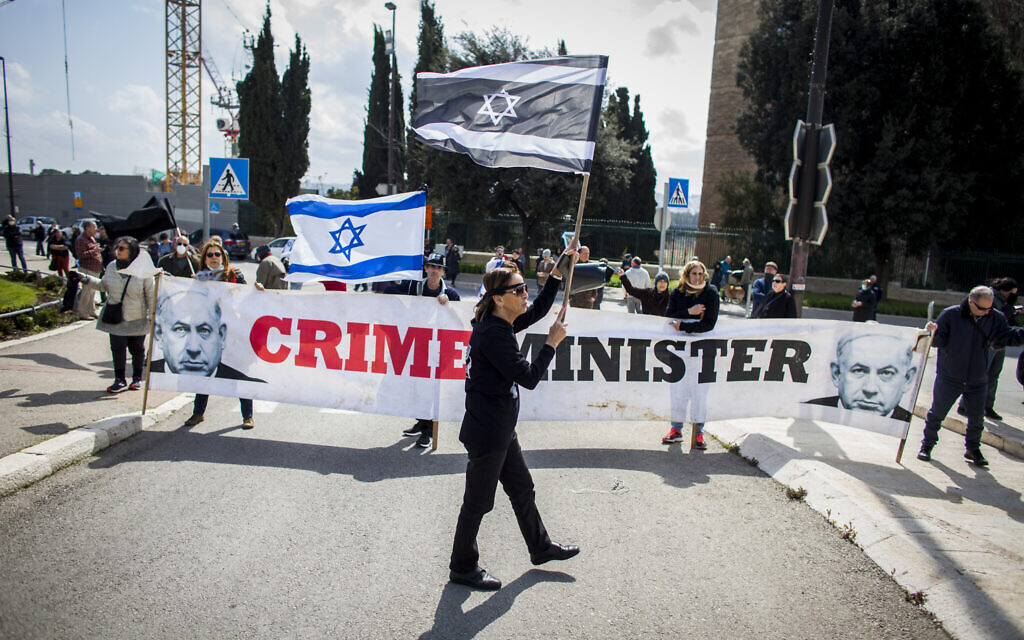
People wave Israeli flags, inverted Israeli flags and banners during a protest outside the Israeli parliament in Jerusalem, Thursday, March 19, 2020, accusing Prime Minister Benjamin Netanyahu's government of exploiting the coronavirus crisis to cement his power and undermine Israel's democratic foundations. (AP Photo/Eyal Warshavsky)

Labels: , , , , , ,

() Follow @rheytah Tweet