This is a blog dedicated to a personal interpretation of political news of the day. I attempt to be as knowledgeable as possible before commenting and committing my thoughts to a day's communication.
"I think policy makers and decision-makers need to realize that there are some very strong sentiments being expressed on these issues [involuntary addiction treatment, criminal charge bail, decriminalization of drugs]."
"We're seeing large percentages of people saying things are getting worse."
"I think there was a perception, correct or not, that safe injection sites would lead to a solution, and those problems are instead amplified probably ten-fold from where they were. So there's this frustration of, 'What else can we do. This isn't working'."
Andrew Enns, executive vice-present, Leger Marketing
Little wonder Canadians are fed up. Inflation is raging, the cost of consumer goods sky-high, additional taxes on energy linked to the Trudeau government's environmentalist agenda has sent the price of gas at the fuel pumps soaring, homelessness is a growing concern, and more people than ever before are turning to food banks. Canada's once-proud universal health care system has been gutted; wait times for surgery, for access to medical specialists have become dangerously inadequate. The 911 emergency system is collapsing, ambulances are increasingly late responding to calls, and so are police.
But the latest poll by Leger Marketing looked at other acute concerns of Canadians; that of growing crime rates, of growing addiction rates and consequent deaths from overdosing. Fixes that governments have been relying on have proven to be failures. Leaving the public frustrated and angry. And those sentiments of failed government actions in addressing these societal problems were emphasized on the latest poll.
The status quo is unacceptable and the response of governments has been inadequate to say the least. Canadian public opinion was found through this latest poll to be completely opposite government priorities channelled through programs that have proven to be worthless. The issues of bail, involuntary addiction treatment, and the decriminalization of drugs in a desperate attempt to ease the growing problems in society are topmost in people's minds behind the cost of living.
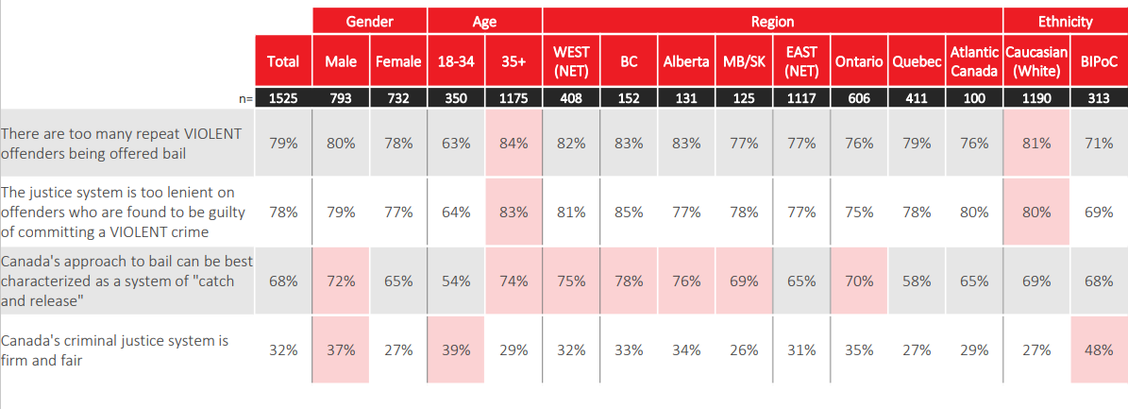
A clear majority of poll respondents agree the Canadian justice system is mishandling bail, too lenient on violent criminals. Example: the statement "there are too many repeat violent offenders being offered bail" had the agreement of 79 percent of the surveyed. The statement "the justice system is too lenient on offenders who are found to be guilt of committing a violent crime" was endorsed by 79 percent. While less than 32 percent agreed that Canada had a "firm and fair" system of justice.
On the issue of strengthening bail, solid agreement was seen, with 82 percent of Western Canadians, 77 percent of Eastern Canadians, 80 percent of men, 78 percent of women, 81 percent of white Canadians and 71 percent of BIPOC (Black, Indigenous, People of Colour) Canadians, reporting that too many violet offenders were given bail. General agreement was seen on the viewpoint that Canada's top priorities on criminal justice should be "violent crime", "illegal firearm possession" and "drug and substance abuse".
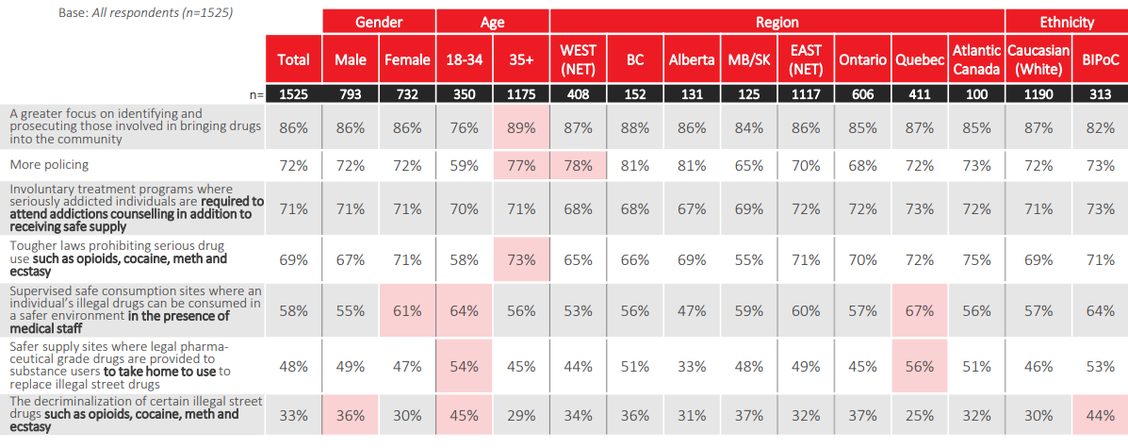
A course has been adopted in Canada of setting aside law enforcement from the equation of drug addiction, prioritizing harm reduction policies with the like of safe consumption sites. Included was British Columbia's experiment in decriminalizing personal use quantities of hard drugs like heroin and cocaine. Canadians indicated a more nuanced view of how Canada's climbing rates of fatal overdose could be addressed.
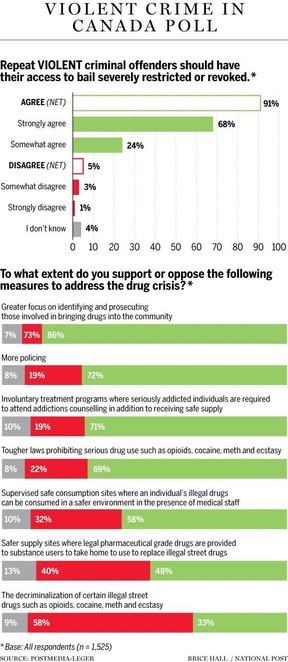
Major support was expressed (58 percent) for "supervised safe consumption sites", yet almost all respondents wanted to have drug dealers prosecuted and chronic addicts to be mandated to the necessity of treatment. Over 7 in ten respondents opted for "more policing" on drugs, the highest being expressed (at 81 percent) in British Columbia, the recognized epicentre of the overdose crisis. Asked should Canada focus on "identifying and prosecuting those involved in bringing drugs into the community", 86 percent agreed.
"There was one [safe consumption site] when we came into office in 2015, now there are dozens and dozens and dozens across the country and they are saving lives significantly", boasted Prime Minister Justin Trudeau. He slammed it as "unfortunate" and "anti-science" when Alberta began the pursuit of a treatment-centered approach to address its overdose crisis. His boast is a hollow sham; lethal overdoses, in the face of 'dozens and dozens' of 'safe injection' sites, are on a pronounced upward curve. Moreover, the 'safe' opioids handed out at the sites are leaking onto the streets.
Although involuntary treatment for chronic addicts has been denounced as extreme by the Canadian political and public health establishment, it was endorsed by 71 percent of poll respondents who agreed "involuntary treatment programs where seriously addicted individuals are required to attend addiction counselling in addition to receiving safe supply", sounded like a solution.
As for the criminal justice system reflected by government policy, opinion polls find majority support for capital punishment which since the 1970s was officially abolished in Canada. Incarceration and detention issues have hardened in the wake of recent murders and assaults committed by suspects either on bail or recent early releases from prison. Random fatal stabbings by people on parole for similar random attacks infuriate the public.
The fatal shooting of an Ontario Provincial Police constable by a repeat violent offender on bail, prompted a letter co-signed by all 13 Canadian premiers urging the federal government to reform bail (the Trudeau government had loosened bail issues after the previous Conservative-led government had tightened them) and take steps to get violent criminals "off the streets".
Canadian bail policies were described as a system of "catch and release" by over two-thirds of poll respondents, with white respondents at 69 percent and non-white respondents, 68 percent. If offenders keep committing crimes while on bail, in the opinion of the survey respondents, stop giving them bail. 92 percent of poll respondents endorsed the statement "repeat violent criminal offenders should have their access to bail severely restricted or revoked".
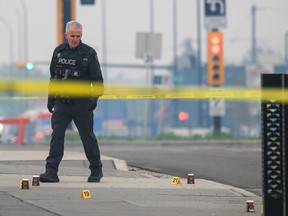
Canadians
were generally in agreement that the country’s top priorities on
criminal justice should be “violent crime,” “illegal firearm possession”
and “drug and substance abuse.”Photo by Gavin Young/Postmedia
"I feel like a TTC [Toronto Transit Commission] ambassador. The city needs to do something for the homeless and the shelters."
"I've felt the increase of police in the last two weeks. Probably every hour I see a cop going by at every station I play at. Great. That's better than nothing."
"In my personal opinion they did this too late. They waited for all of these horrific incidents to happen before they acted on it. They should have acted on this ten years ago."
"People are freaking out. They don't want to take the subways. A lot of people don't want to ride it because of all those incidents."
Leo Zhang, cellist, 25-year experience as a subway busker, Toronto
"I also want, as Chief of Police, to remind people that we live in a safe city."
Myron Demkiw
"I know many people who use the TC, the passengers, are anxious and even scared and they must know that we are doing everything we can that will be helpful to address their concerns."
Toronto Mayor John Tory
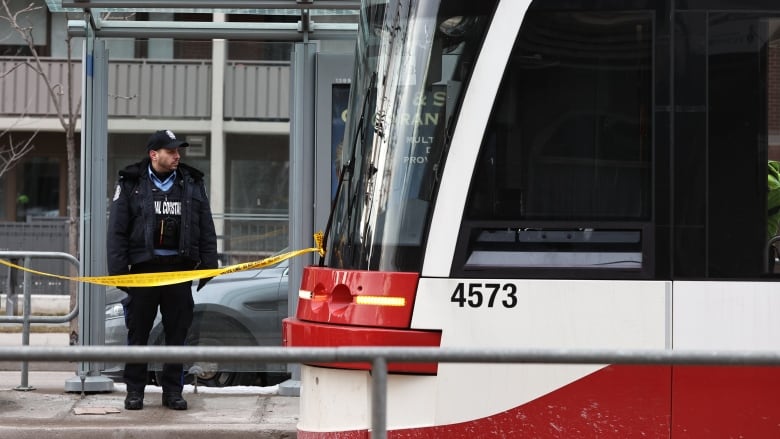
Toronto's police chief says upwards of 80 police officers will be in
place throughout the TTC every day in an effort to enhance public
safety. (Evan Mitsui/CBC)
Toronto is gripped in an aura of public fear over the state of growing insecurity, random attacks on unsuspecting people, and sudden deaths occurring in an ever-growing metropolis, the largest city in Canada, where new immigrants settle in with older generations of immigrants and their offspring hailing from countries all over the world. Minority groups representing ethnic, religious, cultural and geographical migrants, refugees and immigrants from everywhere. There are more foreign languages spoken in Toronto than any other North American community.
Much of the public violence seems now to have gravitated to the city's extensive subway system, odd, spontaneous attacks on people going about their business. Some committed by another community, that of the homeless who find respite and haven from the cold in subway stations. Many of them suffering from mental illness, drug addiction, resentment against a society that looks past their homeless plight. Toronto's mayor, its chief of police and others in municipal authority have reason to be concerned. This is not the Toronto of yore.
Social media is abuzz over this new Toronto. Expressions of disbelief over the dangers inherent in venturing onto the subway system that carries millions of people to daily destinations all over the sprawling city. "Arm the TTC workers", one comment; "It's no longer Florida man, now it's Toronto man because every day on the TTC you be fighting for your life"; comments of trepidation and fear, stoking a broad undercurrent of panic.
"These recent incidents at the TTC, impacting both our employees and customers, are incredibly worrisome to me and the entire TTC organization."
"We know the TTC really is a microcosm of what's happening around the city right now and we recognize that there is a bigger society and systemic issue at play here and that these issues are complex, and the solutions aren't always easy."
TTC CEO Rick Leary
ATU Local 113
president Marvin Alfred says that while extra police patrols will help
keep Toronto transit a safe place for employees and passengers, that
alone will not solve the true cause of the problems they face.
The TTC Authority forced buskers to leave its property as a result of pandemic restrictions. Their absence saw homeless people filling the vacuum. Now, post-pandemic, riders have returned and so have the musicians, and the homeless balk at leaving. And dangerous incidents keep occurring. Like the woman who died after being set on fire on a bus. Another woman knifed to death. Outside a station a man shot dead. People shoved onto the tracks. Passengers and staff stabbed, slashed, punched, chased, robbed, threatened and swarmed.
With the recent meeting of authorities, the announcement of another 80 police officers tasked with high-visibility TTC patrols. TTC supervisors to be more visible; cameras added; Streets to Homes workers brought in. Another $50 million added to the $1.36 billion police budget. Why the subway system? Because they are gathering places. Ordinary people launching themselves off to work during work rush-hours, rubbing elbows with poverty and privilege, racism, aggression, entitlement, anxiety and fear.
Toronto, the massive Ontario people-hub, has many problems that are common to all other areas of the nation, but exacerbated by size and population level. Endemic poverty, a frail economic outlook, expensive housing, rising cost-of-living costs, an opioid crisis, mental health issues, rising crime rate, and a universal health system struggling to meet the needs of the population, brought to its knees by the influx of severe health issues courtesy of the coronavirus pandemic.
"If it drifts up for a few years, I don't know that's need for panic [slight rise in major crime]. I think you've got to think carefully about what is happening and what's going on."
"Most people aren't going to do something criminal right in front of a police officer, but you might have just pushed it elsewhere. Hot-spot policing tends to just relocate things. It's not addressing the problem."
"You need long-term thinking about how you keep society safe generally. You need to fund prevention programs really well and the thing is, you're not going to see results from these things within an election cycle."
"There is no political gain for doing this, so no one wants to. They can't claim credit for it in their election cycle. But if you shove money at police or change a law, then it is something you can point to, and people momentarily feel safe."
"You need to care about violence even in years of decline. You can't just not care and leave it and then suddenly care."
"The fear is real. But how can it not be? Every day you're being told of everything that happened on a TTC ground across the city."
"There have been warning signs for years."
Jane Sprott, professor of criminology, Toronto Metropolitan University
The Toronto Transit Commission announced late Friday that additional
management staff will be "highly visible" and rotate through the subway
network during peak service hours. (Arlyn McAdorey/The Canadian Press)
"There's a lot of good people here. Engineers, doctors, educated people."
"But they have problems with drugs. The problem is getting worse, day by day."
Drug addict, Pul-e-Sukhta underpass, Kabul, Afghanistan
"I was a graduate from school and I prepared for college and loved a girl and I was unsuccessful. The family did not approve."
"After that, there was no chance for me, so I just used heroin to calm myself."
"When I came out [of Kabul's Ibn Sina rehabilitation hospital], what could I do? There was still no work."
"I have been to the hospital, but I became addicted again when I left."
Syed Ramin, 32, drug addict, Kabul
"By order of our supreme leader, Haibatullah, there has been a decision to reduce the problem."
"Nowadays there has come a reduction of our drug problem."
Abdul Nasir Munqad, Taliban leader appointee, hospital director
"Our problem is different to European countries, where people take drugs for pleasure. If we ask our patients, they have no jobs, they have no income."
"We started our religious classes because our country is a religious country and it has a good effect. It is our experience that we can root out this problem with religious classes."
Dr. Atiq Azimi, secretary to the Ibn Sima rehabilitation hospital director
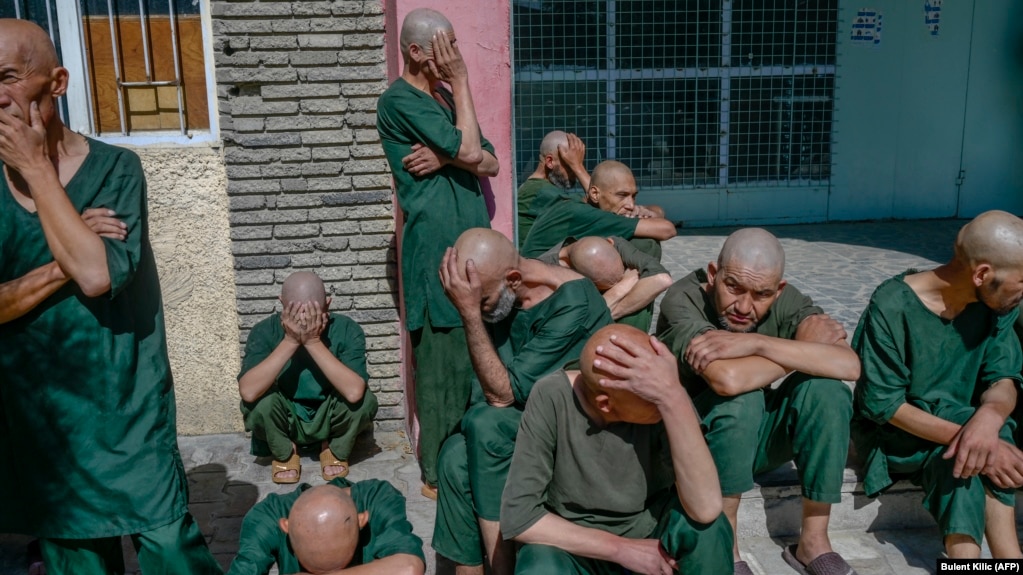
Drug
addicts rounded up by the Taliban and forced to shave their heads brace
for 45 days of withdrawal at the Avicenna Medical Hospital for Drug
Treatment in Kabul. Many others have been sent to prisons that lack any
drug treatment
Afghanistan is held to have one of the highest proportions of opium or opiate use within its population, in the world. In a nation of 39 million people, the country has an estimated 1.9 to 2.3 million regular drug users, according to a survey undertaken in 2015. The situation has become worse since then with the economic collapse that struck the country when international aid that supported many of Afghanistan's institutions disappeared with the return of the Taliban.
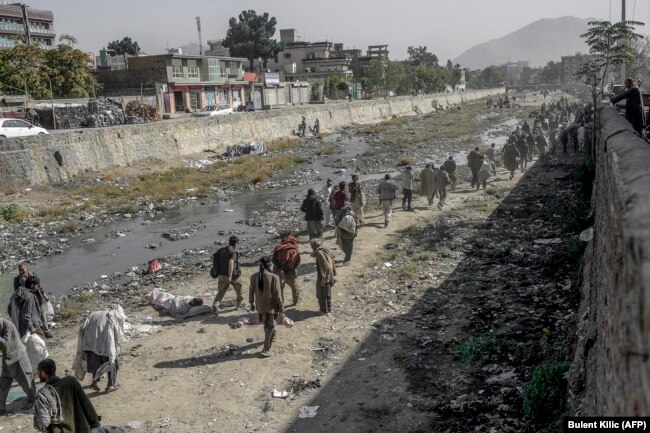
In one place along the outskirts of the capital Kabul, there are nearly a thousand drug addicts who shelter under a bridge in a western neighbourhood of the city. People stumble about, barely conscious of their surroundings, skeletal, disinterested in anything, focusing on drugs. To the curious onlooker many of those who exist within this area appear to be close to death. Yet among the living corpses, tradespeople selling tea move about.
Above the bridge underpass a regular stream of traffic moves, its noise barely noticed by those of the living dead below. All efforts to put a stop to the country's drug trade have failed. There is a burgeoning new trade in methamphetamine, exacerbating the situation where traditionally opiates ruled the market. Most of the addicts living under the bridge relate their stories of addiction to heroin or meth; some explain their addictions began as migrant workers in Iran.
Others speak of the dangers of grinding tours of the southern provinces while with the Afghan military, fighting the Taliban, which led them to drug use. When the Taliban resumed power in August of 2021 one of the initiatives it spoke of was to solve the country's addiction problem. They took to rounding up thousands of addicts off the streets, to force them into the Ibn Sina rehabilitation hospital.
Taliban fighters round up drug addicts in Kabul.
There are a thousand beds in the hospital and following the Taliban raids such crowding occurred as to see three patients in each of those beds. Overcrowding led to violence and conditions where little prospect of weaning addicts away from drugs seemed possible. Hospital doctors persuaded the Taliban to stop funneling addicts into the hospital. Many were taken to prisons instead. The hospital, now administered by a former prisoner of Bagram high-security prison, houses far fewer patients now.
Each of those patients undergoes a 45-day program to help with drug withdrawal where the firs 14 days are devoted to detoxification, followed by rehabilitation. Since enforced roundups were stopped almost all patients are 'voluntary'. Brought by their families to the hospital they cannot leave during treatment in a situation which houses them like inmates. Some of the patients try to escape their confinement. There are frequent clashes between patients and staff and violence occasionally breaks out.
"There are big differences between treating drug addicts in prisons and
proper addiction-treatment centers. If
patients think they are being forced to quit addiction...they will never
accept treatment."
"No one can quit drugs if they are not ready to. The only
way a drug addict can quit is to satisfy himself and prepare himself
psychologically, which is not possible in prison."
Salem Sadid, local psychologist, Farah, Afghanistan
"Definitely when there are economic hardships, when the population is displaced, they want to seek mechanisms to cope with their hardships."
"That definitely makes people vulnerable to more regular drug use."
Kamran Niaz, Office on Drugs and Crime, United Nations