This is a blog dedicated to a personal interpretation of political news of the day. I attempt to be as knowledgeable as possible before commenting and committing my thoughts to a day's communication.
"[I had discussed my hunger strike with family to prepare them in advance -- it was not an] impulsive decision."
"I thought about it a long time. It wasn't some sort of product or symptom of mental illness."
"It's a product of a deeply found or held moral belief in what's right."
Iain Aspenlieder, 46, Ottawa resident
"There is an undeniable humanitarian crisis
unfolding in Gaza. As Prime Minister Mark Carney stated, Israel’s
handling of humanitarian aid in Gaza constitutes ‘a violation of
international law.’ People are starving. Children are dying."
"Mr.
Aspenlieder has accepted responsibility for his actions. When he is
sentenced later this year, the court will hear that his conduct, while
unlawful, was driven by a profound sense of compassion and moral
urgency—not by hatred or prejudice. He looks forward to demonstrating
that his motivation was rooted in a desire to call attention to human
suffering, not to cause harm or spread intolerance."
Michael Spratt, lawyer for Iain Aspenlieder
"The Ottawa Police Service (OPS) is investigating an
act of vandalism that occurred overnight at the National Holocaust
Monument, located at 1918 Chaudière Crossing."
"The monument was defaced with red paint."
"The Hate and Bias Crime Unit is actively leading the
investigation and urges anyone with information to contact their tip
line at 613-236-1222, extension 5625."
"The OPS treats incidents of this nature seriously and recognizes the profound impact they have on the community."
"We encourage anyone who witnesses or experiences such incidents to report them to police. Reporting hate-motivated incidents is an important step in stopping cycles of hatred."
Ottawa Police Service, June 9, 2025
"That person is no longer an employee [in the legal department] at the City of Ottawa."
"The
National Holocaust Monument is a sacred place in our city, an important
place in our city."
"And I know that members of the
Jewish community were very distraught and disturbed to see it
vandalized."
Ottawa Mayor Mark Sutcliffe, June 29, 2025
The City of
Ottawa has fired one of its lawyers after he was charged earlier this
month with vandalizing the National Holocaust Monument. He was on leave
at the time of the incident. CBCNews
According to the Law Society of Ontario website, a man named Iain David Aspenlieder -- who was until recently employed by the City of Ottawa as a legal counsel, and released from his position when he was arrested on June 27 and charged with mischief to a war monument, mischief exceeding $5,000 and harassment by threatening conduct -- has been "suspended administratively" and is no longer permitted to practice law.
The Ottawa Holocaust memorial, dedicated to the memory of the six million Jews who were murdered during World War II by state action of the Nazi government in Germany, was defaced with red paint, the words "FEED ME" scrawled in large block letters across its austere side. The man who perpetrated this unspeakable act of malicious disrespect to the memory of millions of innocent people sacrificed to the excesses of racist hatred pleaded guilty on Friday to the charges brought against him.
Court documents register "an acknowledgement of criminal responsibility". Imprisoned since his arrest, the man who professes a 'deeply held moral belief in what's right' as his motivation for scorning and defacing a memorial to man's inhumanity to man, is to be under strict house arrest now, with GPS monitoring in line with a plan proposed for his release on bail, pending sentencing.
Aspenlieder was caught by surveillance cameras on his arrival by bicycle at the monument at 2:59 a.m. on June 9, along with bags containing cans of paint. The video shows him throwing paint cans at the monument and brushing his "FEED ME" malice on the monument, then evacuating the area at 3:08 a.m. He had left behind his red-painted handprint for good measure. But this act of contempt is not to be viewed as anything but the expression of moral outrage over Israel's response to the Hamas carnage in southern Israel that necessitated a siege of Gaza.
When he was arrested, Aspenlieder wore a shirt with red paint spattered on it informing police he was wearing 'incriminating evidence'. Police seized a backpack, a Palestinian flag, a floral cap and running shoes, all of which were, given the red paint each revealed, 'incriminating evidence'. A bicycle, also sporting red paint, along with booklets and magazine with titles sch as "Why does Canada choose to be complicit in Israel Apartheid?" and "Five Principles for Dismantling Antisemitism" were also taken as evidence of the man's moral outrage.
While affirming to police that he accepted responsibility, he deigned not to provide information of his beliefs, ideology or the disposal of the paintbrush he had used, while denying mental health disorders prompted his behaviour. Court was informed during a June 28 bail hearing that Aspenlieder was engaged in a hunger strike that would end only when Prime Minister Mark Carney stated that Israeli Prime Minister Benjamin Netanyahu was a 'war criminal', 'complicit in genocide'. Presto, Carney obliged without any prompting on this criminal's part, and the hunger strike is over.
According to Justice of the Peace Stephen Louis Dibblee, the painted message "FEED ME" lacked context and it appears to him to represent Aspenlieder's hunger strike as "he takes a radical means of voicing his position on the (Israel-Palestine) conflict". For his part, Carney wrote on Twitter that Israel was violating international law by imposing blockades on desperately needed humanitarian aid reaching starving Palestinians, accusing the Israeli government of failing to prevent the humanitarian crisis in the Gaza Strip. No mention, evidently of Hamas.
No one has yet recommended that Carney and his foreign minister be stripped of their official duties as morally incompetent and politically focused on the reactions to be evidenced on the part of newly-arrived Gaza 'refugees' joining the cohorts already present in Canada and working ferociously day and night to foment civil unrest, and divisions between Canadian communities as they fire up the sleeping embers of antisemitism into a blast furnace of hate against Canadian Jews.
Police investigating vandalism to the National Holocaust Monument in downtown Ottawa on June, 9, 2025. Photo by Jean Levac /Postmedia
"My father is a Holocaust survivor. His sister and his mother and
father were all killed. My daughter is named after his sister" said Lawrence Greenspon, co-chair of the monument committee.
"When
somebody defaces the National Holocaust Monument, it is personal and it
hurts, and particularly when it is such an act of hatred and
antisemitism."
Greenspon called on world leaders to go beyond 'bland and banal' condemnations and take action against antisemitism. He also said
government leaders should "stop blaming Israel for the current conflict
in the Middle East" — a clear shot at Carney.
"Every time that a leader, including our own prime minister, stands with
the leaders of France and Britain and condemns Israel for the situation
in Gaza, it just feeds the fuels of antisemitism."
Ardent Victimization in the Somali/Muslim Community
"We need to feel safe in our city. Change needs to happen, not empty gestures."
"Enough is enough. The time is now. Justice may have been denied in the trial of the killer of Abdirahman Abdi, but we can still choose justice as a city and make community safer for us."
"We need to stop sending untrained people with guns when our neighbours and loved ones are in crisis."
IfrahYusuf, chair, Justice For Abdirahman Coalition
"I don't mind screaming because we need to scream our voices very loud of [sic] what's been going on to our people."
"We must come together. I'm going to say it as loud as I can: Their fists may beat us, their guns may kill us, but they will never, ever silence our voices. Our voices are the most powerful of tools and the most powerful of weapons ..."
"The killings of Indigenous peoples and Black people, it must stop."
Claudette Commanda, Algonquin Anishinaabe, Kitigan Zibi First Nation
Ifrah
Yusuf, incoming chair of the Justice for Abdirahman Coalition, leads
the march from its starting point at McNabb Park on Saturday.Photo by Ashley Fraser /Postmedia
Black, Muslim and Indigenous communities in Canada have forged a bond of victimization. They hold the greater white community at fault for their colonialist past and their current attitudes, citing them as being racist and prejudiced against people of colour, against Islam, against First Nations. These are groups within the larger society that see themselves as vulnerable minorities whose rights and entitlements are given short shrift, and who are constantly victims of an unjust legal system.
What they also have in common is that they frequently live at or below the poverty line. As well, they tend to sequester themselves in deliberately separated blocs, choosing not to integrate with the greater society. A feeling of alienation, of victimhood and vulnerability to unfair treatment and public condemnation is also shared between them. Needless to say that in the greater society there are people living in poverty who are not of colour, not representing any religion, and downtrodden primarily because life has been unkind to them in the circumstances of their lives. Including mental illness and substance dependency.
Another issue both communities have in common is that of criminal activity disproportionate to their share of numbers in the community. Gangs, violence, weapons, smuggling, drug dealing, gang rivalry, and intimidation of members of their own communities who fear reporting their illegal and often violent behaviour for fear of retribution. Minor details which keep police busy, involved in their duty to uphold the law and ensure community safety.
Abdi Abdirahman was a 37-year-old Somali refugee, living with his family in Ottawa as a member of the extended Somali community. He had a mental illness for which he received medical treatment as an out-patient and was prescribed anti-psychotic medication to control his outbursts of mental illness. It appears his family failed to agree with the medical professionals who diagnosed, treated and prescribed medication for this man, and they were successful in having that medication dropped as a therapy to keep h8is mental instability in check.
The Justice for
Abdirahman Coalition protest started in McNabb Park before turning into a
march, blocking traffic on several nearby streets.Photo by Ashley Fraser /Postmedia
One day in July of 2016 Mr. Abdirahman went to a neighbourhood cafe as apparently he often did. A busy place, there were many others at the cafe and they were witness to his violently forcing himself on a few women, one after another, at the cafe. One woman was so viciously gripped by him that others present came to her rescue and with difficulty detached him, escorting him out to the street. And there, on the street was a young mother with an infant in a bicycle carrier who had just stopped outside the cafe. His attention turned to her, in turn.
Police had been called about the altercation, and one police officer arrived in a police car and attempted to take Abdirahman into custody, struggling to place him in handcuffs. Abdirahman picked up a 30-pound road construction standard swinging it about wildly. Pepper spray failed to stop him. He then sprinted toward the apartment where he lived nearby with his family, the police officer in chase, having radioed for help. When the first officer finally caught up with Abdirahman, again struggling to place him in handcuffs, he was unable to overcome Abdirahman's physical resistance.
A second police officer soon arrived, appraised the situation, and added his physical presence to the struggle where both officers together appeared unable to overcome the resistance of the man in full psychotic fervour. The second officer, Const.Daniel Montsion, hit Abdirahman several times with his gloved hand in the face and on his thigh. Mr. Abdirahman's nose was broken, and suddenly he became still and stopped breathing. The two officers applied CPR attempting to restore him to consciousness. When soon afterward responding paramedics arrived they pronounced Mr. Abdirahman dead.
A coroner's report pointed out that Mr.Abdirahman had died of a heart attack. Brought on by the episode of psychotic attack, and that he had a previously undiagnosed serious heart condition. Const.Montsion was charged with manslaughter, aggravated assault and assault with a weapon (the police-force-issued reinforced gloves). At his trial witnesses for the prosecution were found to have given testimony that was contradicted by surveillance videos. Ontario Court Justice Robert Kelly found Const.Montsion innocent of all charges after taking all evidence and testimony into account.
The Justice for Abdirahman protest started in McNabb Park on Saturday.Photo by Ashley Fraser /Postmedia
But some raucous members of the Ottawa-Somali community will not be convinced that Const.Montsion is not a murderer and was simply discharging his professional duty to the security and safety of the public in extremely difficult circumstances. An ongoing saga of victimization and blame has been released anew by the Justice for Abdirahman Coalition which launched another protest through downtown streets shouting "No justice, no peace", carrying placards and shouting "Black lives, they matter here" and "They say get back, we say fight back".
Traffic was brought to a standstill by the march of several hundred people while organizers unfurled yellow caution tape about the intersection. And five demands were delivered through a megaphone announcement with the coalition calling on the Ottawa Police Services board to freeze the budget for police and city council to oppose any budget increase for police so funding should instead be targeted for public health and social services for the city's Black and indigenous communities.
They also called for "demonstrably racist, misogynist and/or violent officers" to be fired, starting with Const.Montsion, including the Ottawa Police Association president, along with other instructions to be fulfilled to their satisfaction by the City of Ottawa. An alternative to a police response to interventions with people in mental health crisis to be immediately substituted. "No more deaths, fire OPS" was chanted by people in the crowd. "Defund the police", protesters shouted holding Black Lives Matter and Justice for Abdirahman banners.
A Justice for
Abdirahman protest started in McNabb Park and then turned into a march,
stopping traffic on nearby streets, Saturday October 24, 2020. Before
the protest began a group of the supporters took a moment to pray.Photo by Ashley Fraser /Postmedia
Abdirahman Abdi. Const. Daniel Montsion right, Const. Dave Weir
"How many more lives need to be lost? How many more sleepless nights must our mothers endure? How many more Greg Ritches do we need to see die? How many more [Anthony Austs] do we need to see leave this world [two young men of colour who died during confrontations with police]."
"How many more Abdirahman Abdis do we need to see in this fate? When will our lives matter?"
"Today we received the devastating news of an acquittal in a trial that held the power to course-correct the system that desperately needed correction."
"Today was nothing short of catastrophic. Today we have no demands for the system and the system did not fail us -- it was not built for us."
"For years, our coalition has negotiated and discussed, politely urged those in authority to make changes. For years we have said that there's a need for legislative reform. Today we've understood a very hard truth.:
"Today the crack of the whip stung us, but it will never kill us. Today there was no conviction, but conviction remains firmly in our hearts."
Farhia Ahmed, Justice for Abdirahman Coalition
Const. Daniel Montsion, right, on trial for manslaughter, aggravated
assault and assault with a weapon in the 2016 death of 37-year-old
Abdirahman Abdi, left. (Supplied)
"[I am not satisfied the Crown had met the] criminal standard [ on any of the three charges]. I'm also left with a reasonable doubt on whether Const.Montsion's acts caused Mr. Abdi's nasal injuries, and even if they did, whether those acts caused his death."
"I find Const.Montsion not guilty of all the charges. I cannot safely make this finding on the criminal standard. [My] closest examination of the evidence leaves me with a reasonable doubt on this issue. I need not address excited delirium or psychotic illness as potential causes of death [though the] evidentiary record on these issues may invite speculation."
"I have looked at all of the circumstances based on the evidence as a whole. I have not ignored the Crown's submissions emphasizing that when Const.Montsion arrived as the second officer on scene, Mr. Abdi was not holding a weapon and was not actively assaulting Const.Weir."
"Nor was Mr. Abdi striking the two officers when he was on the ground, although he was struggling hard for some time, and with some success against the force of two trained police officers. This is a close call."
"In the end, my assessment of the evidence as a whole, under the governing principles of law, leaves me in a state of reasonable doubt about whether the standing blows and the blows on the ground exceeded the bounds of reasonable police force response in the totality of the circumstances."
Ottawa Court Justice Robert Kelly, from 112-page ruling
Still from witness video shot after a confrontation involving police and Abdirahman Abdi in Hintonburg.jpg
In Ottawa, a member of the Somalian community with a mental illness and who stopped taking his medication, 37-year-old Abdirahman Abdi who lived with his parents in an apartment building in central Ottawa, on a day in July 2016, went to a nearby coffee shop which he occasionally frequented. There he began physically assaulting women in a sexual manner so violently that others present had to come to the assistance of the women struggling to free themselves from his grasp. Workers at the coffee shop called police.
Outside the coffee shop, the man assaulted another woman who had bicycled to the area with her infant in a child seat on the bicycle. A passing psychotherapist remarked later that in his professional opinion the man was having a psychotic attack. Abdirahman Abdi also had other health issues, primarily an undiagnosed heart condition of serious dimensions. After he was forcibly made to leave the coffee shop a police constable responded to the urgent call, confronting Abdi, who resisted arrest and whom pepper spray appeared to have no effect on, as grappled with the officer, then freed himself.
With abnormal strength he picked up a 30-pound road construction weight and swung it about, threatening Const.Dave Weir, then sprinted away, running toward his apartment. Outside the apartment doors, the constable caught up to the man, attempting to take him into custody. It was then that a second constable appeared, responding to a police call for assistance. This was Const.Daniel Montsion who then gave aid to his fellow constable, both attempting to manacle Abdi whose physical strength appeared equal to the efforts of the two police.
At Const.Montsion's trial, Const.Weir testified about his attempts to subdue and handcuff Abdi, including that none of his strikes with his police baton to subdue the man succeeded. It was when Const.Montsion arrived, seeing his colleague struggle with the now-exhausted but still offensive man that he hit him several times with a gloved hand with rubber studs, several times in his face, and again on his thighs. They managed together to handcuff Abdi, who by then was not moving. When the constables realized that he was unconscious they began administering CPR until paramedics arrived, who soon concluded Abdi had died.
Of a heart condition brought on by excessive excitement giving him unusual physical strength and which caused him to have a massive heart attack. The postmortem that was carried out following Abdi's death found no trace of drugs or alcohol in his system —
including the antipsychotic medication he had been prescribed and which his family decided he no longer needed to take. Now that the judgement as to guilt for the death of Abdi has been decided, Justice Kelly having considered Const.Montsion's "overall conduct" during the arrest, taking into account the Crown's argument that de-escalation techniques should have been attempted, the case should be closed.
But the black community has no intention of leaving matters as they presently lie. Insisting that racism was involved, that Mr. Abdi's death amounted to institutional murder by a police force that has no regard for the life and safety of blacks. Had it been a white man who had assaulted the women and discharged himself afterward in a like manner to Mr. Abdi's, society would have done a mental shrug of 'most unfortunate'. The black community is on a roll. That there is racism and that blacks have suffered from it is undeniable.
That blacks themselves are often their own worst enemies, is also undeniable, with the community representing more than their 'share' of gangs, violence and criminal activity, with community members cowering in fear, yet unable to bring themselves to aid police in winnowing out those who prey on their own communities, to hold them accountable for their crimes -- shootings for example that are all too common in drug wars. Instead, they focus on white-on-black incidents where legitimate efforts to respond to social deviants, irrespective of skin colour, are singled out as racism.
The embrace of victimhood sits uncomfortably on any group, but when accusations and hysteria rule the day muddying the waters of real issues of racism, conflating them with the pursuit of law and order, society itself suffers as a whole and solutions evade. Every community has an obligation to themselves and to the greater society to comport themselves in a manner consonant with responsible citizenry. When issues arise where real events of racism arise, false alarms have a dampening effect on remedial action.
Demonstrators
march from Somerset Square park to Ottawa Police headquarter on Elgin
street during the March for Justice – In Memory of Abdirahman Abdi.
Saturday, July 30, 2016.Photo by James Park /Postmedia
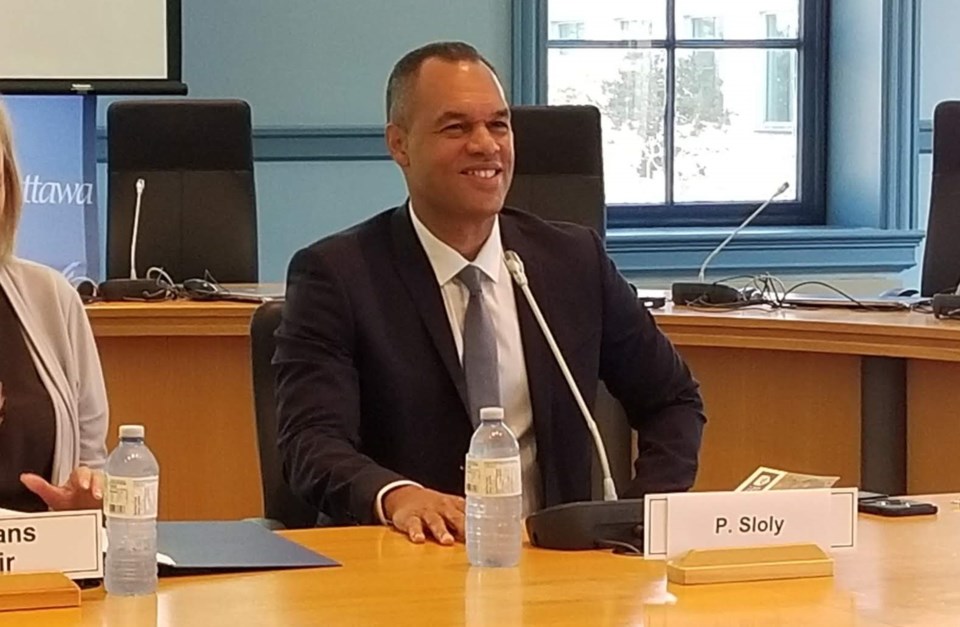
"The NRT's [neighbourhood resource teams] are the centrepiece of the OPS [Ottawa Police Services] neighbourhood policing strategy." "We are putting them in place in the communities that need the help the most." "[Meanwhile, investigative units are targeting] violent repeat offenders who are victimizing the most vulnerable populations and marginalized neighbourhoods." "Reinvesting in neighbourhood policing has been a clear priority all of those conversations [with patrol officers, the police association, senior officers, academics, city councillors, police services board...]" "We are looking at improving existing systems to provide the foundation for more action on violent crime. This will ensure that front-line officers have the most up-to-date information and resources available on every call." Ottawa Police Services Chief Peter Sloly
Peter Sloly named Ottawa's new police chief, August 26, 2019, Photo: Jenn Pritchard, OttawaMatters.com
The cities of Toronto and Ottawa have a recognized and vexing problem with gang violence and shootouts primarily in low-income areas of both cities. The increasing crime statistics in both cities inclusive of gun, gang and drug-related violent crime, alongside the 'complex social issues that underpin most crime', identified as housing, employment, education and health are linked with marginalization and discrimination, according to both police services, paying obeisance to political correctness.
The City of Ottawa's new police chief served previously as Toronto's deputy police chief, a man known for his 'progressive' views on policing. Both cities have long been accused by members of racial minorities -- chiefly from the Black and Middle East communities -- of profiling them. That it is from among these communities that a disproportional activity level of crime is seen in both cities appears immaterial to the accusers. And in this politically correct climate of 'progressive' values the police have become sensitive to accusations of racism.
The idea is that neighbourhood resource policing teams are to give reassurance to those neighbourhoods acutely involved in high levels of crime (somewhat reminiscent of and possibly to prevent situations such as the self-segregated Muslim-immigrant-occupied banlieues in France rife with violence and criminal activities that have turned into no-go zones for police) and to gain trust among law-abiding citizens who are often targets of the criminals living among them. But the code of silence means that giving information to police is fraught with retributive danger.
On the other hand, the presence of these teams does result in a greater level of neighbourhood scrutiny to the benefit of residents, and their presence has resulted in charges being laid, and guns removed. Homicides in Ottawa fell from 15 to 13 in the past year, and shootings fell from 78 to 73, according to police reports, while a total of 70 "crime guns" were sized by police in 2019.
Ottawa police patrol. Errol McGihon / Postmedia
"It's just another one of the discretionary behaviours that officers have curtailed [diminished traffic stops] because of their perception around risk [the risk of being labelled racist]." "You can send an officer to work in a neighbourhood, a particular geographic area, but you can't dictate the kind of work that they do there. Supervisors can't dictate, minute to minute, what officers are going to do in the field." "Police brutality and justifiable use of force can have the same outcome [where a man's nose can be broken in both instances but] brutality is in the motivation of the officer and the proportionality of the response, not in the outcome." Greg Brown, former police officer, professor, Carleton University, Fulbright Visiting Research Fellow in the School of Criminal Justice
Concurrent to Chief Sloly's announcement of an additional three NRTs being deployed as a "cornerstone" of the strategy in tackling street violence, Professor Brown regards neighbourhood officers in his study as being more likely to engage in de-policing. Predicated on the theory that officers partner with the community to understand issues leading to crime, the NRT units should be focusing on proactive discretionary interactions.
But the reality is that there now exists what he describes as a "universal phenomenon" of officers refusing to engage in proactive work, engaging instead on a prevailing 'f*ck it, drive on' mentality. This is an issue he has addressed in a study offering suggestions for police leaders to enable them to mitigate the effects of police disengagement for fear of repercussions. Professor Brown surveyed 3,660 front-line officers from 23 police services in Canada and the United States.
382 Ottawa police officers took part, from all 18 patrol platoons. The study, titled To Swerve and Neglect: De-policing throughout today's front-line police work, identified the reality that the overwhelming majority of front-line police officers representing 72 percent, practise some level of 'de-policing'; choosing not to engage in discretionary or proactive aspects of policing duties because of the fear of public scrutiny.
Officers are weighing the costs of engaging
with the public and for many, the cons outweigh the pros. Photo by
Ashley Fraser / Postmedia
A racial profiling allegation, a disciplinary hearing, media scrutiny, a viral YouTube video, or a judge charging breach of charter rights all represent the potential risks of proactive policing. With those potential risks in mind through well-publicized incidents charging police officers practising due diligence in a discretionary manner as is expected of them, police officers make the choice of protecting themselves and decide to change their policing focus, according to acquired data.
Fully 28 percent of front-line police officers were found to police as intended, a group that Professor Brown identifies as new officers whose altruistic intentions, no major incidents with the public, never been (yet) beaten down by an occupational subculture, or have had no negative media scrutiny; "mission-oriented officers", who practise their jobs irrespective of any external factors.
Data collected out of a project reflecting a human rights settlement where the force was mandated to collect information on drivers' race who had been pulled over by officers initiated in 2013 showed that Ottawa police disproportionately pulled over young men with Middle Eastern or Black appearances. Additionally, data indicated traffic stops as an entirety were diminished. Traffic stops are considered to be proactive measures, while pulling someone over even if an offence is observed is not mandatory for police.
This month, an Ottawa police patrol officer pulled over a car for running a red light. A loaded gun was found in the vehicle. Proactive measures allow police to track criminal behaviour -- all the more so when drivers flout the rules, meaning that good policing ensures that officers investigate such incidents. Professor Brown listed a number of recommendations for police services, in an effort to prevent de-policing, chief among those that all senior officers be on the front lines, working themselves.
That they go out on midnight shifts, take out a cruiser and perform the job expected of all officers, to bridge the disconnect between the front line and senior officers, helping to shift morale. Another recommendation is to educate the public on what manner of use of force is sanctioned by law. And that officers be encouraged to treat all whom they deal with, with respect, whether arresting someone or asking them to move a distance from an active scene; to "embrace the notion of procedural justice".
The three new neighbourhood resources teams
(NRTs) add to the three already set up in Vanier and Overbrook, Heron
Gate and South Ottawa and the Carlington and Caldwell neighbourhoods. Shaamini Yogaretnam / Postmedia