This is a blog dedicated to a personal interpretation of political news of the day. I attempt to be as knowledgeable as possible before commenting and committing my thoughts to a day's communication.
"An Intensely Hostile Minority can Generate a Disproportionate Number of Incidents Against a Particular Community"
"[Hate crime counts show how] an intensely hostile minority can generate a disproportionate number of incidents against a particular community even when attitudes toward that community are less negative."
"[Half of Canadians express a negative opinion of Islam] but more than half of that group place themselves in the most negative category."
"[Suggesting attitudes are] not merely characterized by uncertainty or discomfort but are fairly entrenched for more than one in four."
"The biggest change is in views toward Judaism."
Jack Jedwab, president, Association for Canadian Studies
Statistics Canada recorded 788 hate crimes
targeting Jewish people in 2025, down 16 per cent from 943 a year
earlier, but still 71 per cent of all religion-motivated incidents.Photo by Ashley Fraser/Postmedia
The results of a new opinion poll, commissioned by the Association for Canadian Studies, in a Leger survey, leaves the message that Islam is the most negatively viewed faith in Canada. Even so, public opinion of Judaism was seen to have fallen furthest over a 15-month period, summed up by Jack Jedwab, president of the Association for Canadian Studies that "the biggest change is in views toward Judaism."
The opinion of twenty-six percent of Canadians was positive for Islam, while 50 percent gave their opinion as negative; more people were negatively disposed toward Islam which in the poll stood out as the only faith tested where more people expressed negative opinions than positive. A year earlier the same question saw the split at 30 percent positive, and 49 percent negative for Islam.
On every survey measure, Judaism shifted, with forty percent saying they had a positive (down from 49 percent) and 32 percent claiming a negative opinion (increased from 25 percent). Nine percent noted their opinion of Judaism as very positive, a decrease from 15 percent, while 12 percent called their Judaism opinion very negative, increased from its former eight percent position. For Islam, on the other hand, 28 percent gave their opinion as very negative increased from 24 percent in March of 2025.
According to Leger’s latest survey on perceptions of Israel,
only 22% of Canadians say they have a favourable impression of Israel.
That is down from 33% in 2023. At the same time, unfavourable views have
risen sharply, reaching 61%. The findings point to a major
deterioration in public sentiment, even as Canadians continue to hold
more balanced views on certain underlying principles tied to security,
statehood, and coexistence. Leger
788 hate crimes were recorded by Statistics Canada targeting Jewish people in 2025, a decrease of 15 percent from 943 a year earlier. Which still left the position of 71 percent of all religion-motivated incidents targeting people of Jewish extraction. While religion-motivated hate crime fell 18 percent overall to 1,115 incidents and Muslims were targets in 204, a decease of 11 percent.
"Christianity] is more familiar and elicits a response from a larger share of Canadians."
"[It]
consequently has the higher positive rating across the complete sample,
but not among respondents who actually express a view."
Jack Jedwab
In 2023, incidents targeting Jewish people peaked at 959, last year's 788 events being 60 percent above the 492 incidents recorded in 2021. The survey questions posed separately on Jews and Arabs as groups, resulted in 50 percent positive for Jews, 20 points higher than for Judaism, and 44 percent claimed positive for Arabs, as opposed to the 25 percent for Islam. Negative views of Arabs rose to 33 percent from 25 percent in 2025, with negative views of Jews rising two percentage points to 15 percent.
Fifty-seven percent of respondents were positive on Christianity, a reduction from the previous 58, while the portion calling for very positive fell six points to 20 percent. On the survey for the first time, Atheism was treated positive by fifty percent, and 29 percent had no opinion. Among Canadians aged 18 to 24, 41 percent were positive for Islam, as opposed to 22 to 25 percent in every other age group.
Among francophone respondents, 15 percent were positive on Islam and 25 percent on Judaism. representing the lowest on both, of any language group. Francophones were the sole group to rate Atheism above Christianity. Judaism sat at 27 percent positive in Quebec, 13 percentage points below the national figure. The online survey reached 1,428 people from June 19 to 21 through an online panel. Sikhism,Hinduism and Buddhism were not among the tested categories.
50% of Canadians Hold a Negative View of Islam. Muslim Network TV
"[Antisemitism is producing] an exceptionally high and disproportionate share of religion-motivated criminal incidents."
"[But that] shouldn't diminish the importance of addressing hostility toward all faith communities."
Jack Jedwab, President Association for Canadian Studies
Although Passive in Response, a Majority of Canadians Support Removal of Pro-Hamas Encampments at Canadian Universities
"For many, they had already made their point, and/or they were not going to achieve their objective, however it was understood -- which was also unclear to many Canadians."
"[The protesters' goals and objectives] are being seen as increasingly unclear."
"For many, the underlying issue was a matter of trust, and the 55-plus group trusts the university leaders to a much greater extent than they did the encampment organizers."
"[A] considerable [49 percent of students in the survey said they didn't know or preferred not to answer] potentially suggesting a high degree of stigma associated with taking a position on either side of this."
Jack Jedwab, president, Association for Canadian Studies
According to a new national poll conducted by Leger for the Association for Canadian Studies, most Canadians support police having taken down illegal, disruptive pro-Palestinian encampments at Canadian universities. Some 70 percent of Canadians surveyed were in agreement that officials were correct in having police and private security dismantle an encampment at McGill University and at downtown Victoria Square in Montreal.
On the morning of July 5, police in riot gear began to dismantle the camp at Victoria Square, mere days following the province's public security minister accusing the city in public of being too passive with the presence of the protesters in the public arena. Once Victoria Square was cleared of the encampment, in another five days police and private security firm agents were at McGill using excavators and front-end loaders to disassemble about a hundred tents and tarps at the McGill encampment after over two months of legal battles, counter protests, accusations of antisemitism and concerns over security risks.
Twice, Quebec courts refused to issue an injunction against the encampments. Finally, flyers promoting a "revolutionary summer program", ostensibly to 'educate' those not sufficiently imbued with hatred for Jews and Israel, who needed an additional propaganda boost to venerate the terrorist group Hamas. The flyers featured photographs of keffiyeh-wrapped Palestinian fighters with raised rifles.
Members of the Divest for Palestine Collective had planned and organized the Victoria Square camp, in an effort to apply pressure on Quebec's pension fund manager to sever links with Israeli institutions that the group accused of being complicit in the conflict in Gaza between Hamas and Israel. Spurred by encampments set up at universities in the United States, the McGill University encampment was the first to appear in Canada. Quickly followed by over a dozen other Canadian universities, including University of British Columbia, University of Toronto and University of Alberta.
Workers dismantle the anti-Israel encampment at McGill University in Montreal on July 10.Photo by John Mahoney /Montreal Gazette
Demands were noisily issued that universities cut ties with Israel, end all collegial arrangements with Israeli universities and divest from any companies or corporate interests that supply arms to Israel, or which profit from the war with Hamas. Those protesters enjoyed the support of 19 percent of Canadians, according to earlier Leger polling. McGill and Victoria Place, according to Jack Jedwab of the Association for Canadian Studies were seen as valid proxies for public opinion on other encampments.
A majority of Canadians over -- 69 percent -- agreed with their removal. Twice as many students favoured removal of the encampment of those expressing an opinion, while 40 percent agreed that police were right to take down encampments, while 18 percent disagreed. 42 percent of students responded they preferred not to answer, or just did not know. The degree of opposition to the encampments with just 13 percent of Canadians of all ages polled disapproving of their removal suggested protesters increasingly perceived them as disruptive to student life and the broader community.
The encampment at McGill was described by its vice chancellor Deep Saini as a "heavily fortified focal point for intimidation and violence" organized largely by outsiders who used tactics designed to "threaten, coerce and scare people". Support for encampment removal was highest among Canadians aged 55 and older, with 62 percent reporting they "strongly agree" officials were correct for police and private security to take down the McGill tents.
Nearly half (48 percent) of 18- to 34-year-olds strongly or somewhat agreed with the removal of the McGill encampments, even as 24 percent strongly disagreed. Of that age group, 27 percent said they did not know or preferred not to answer.
Aerial view of the pro-Palestinian camp on the McGill University campus in downtown Montreal on Thursday, May 9, 2024.Photo by Dave Sidaway /Montreal Gazette
"I think policy makers and decision-makers need to realize that there are some very strong sentiments being expressed on these issues [involuntary addiction treatment, criminal charge bail, decriminalization of drugs]."
"We're seeing large percentages of people saying things are getting worse."
"I think there was a perception, correct or not, that safe injection sites would lead to a solution, and those problems are instead amplified probably ten-fold from where they were. So there's this frustration of, 'What else can we do. This isn't working'."
Andrew Enns, executive vice-present, Leger Marketing
Little wonder Canadians are fed up. Inflation is raging, the cost of consumer goods sky-high, additional taxes on energy linked to the Trudeau government's environmentalist agenda has sent the price of gas at the fuel pumps soaring, homelessness is a growing concern, and more people than ever before are turning to food banks. Canada's once-proud universal health care system has been gutted; wait times for surgery, for access to medical specialists have become dangerously inadequate. The 911 emergency system is collapsing, ambulances are increasingly late responding to calls, and so are police.
But the latest poll by Leger Marketing looked at other acute concerns of Canadians; that of growing crime rates, of growing addiction rates and consequent deaths from overdosing. Fixes that governments have been relying on have proven to be failures. Leaving the public frustrated and angry. And those sentiments of failed government actions in addressing these societal problems were emphasized on the latest poll.
The status quo is unacceptable and the response of governments has been inadequate to say the least. Canadian public opinion was found through this latest poll to be completely opposite government priorities channelled through programs that have proven to be worthless. The issues of bail, involuntary addiction treatment, and the decriminalization of drugs in a desperate attempt to ease the growing problems in society are topmost in people's minds behind the cost of living.
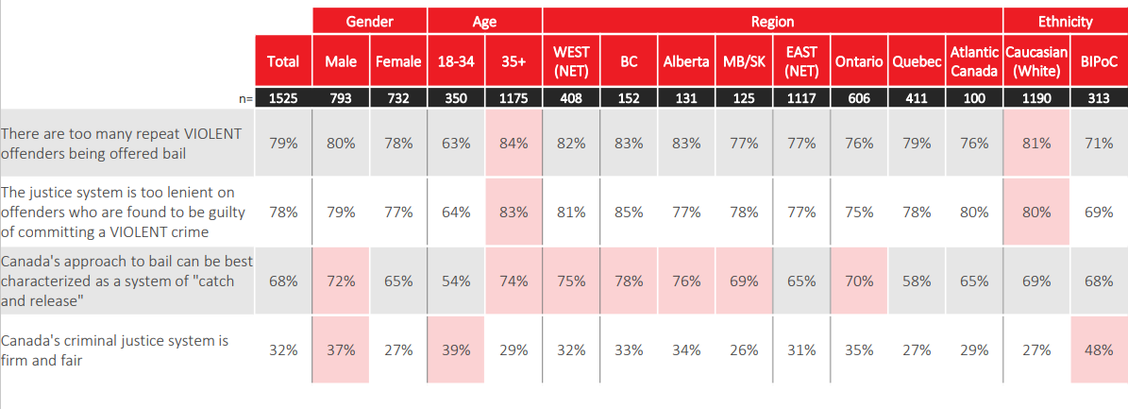
A clear majority of poll respondents agree the Canadian justice system is mishandling bail, too lenient on violent criminals. Example: the statement "there are too many repeat violent offenders being offered bail" had the agreement of 79 percent of the surveyed. The statement "the justice system is too lenient on offenders who are found to be guilt of committing a violent crime" was endorsed by 79 percent. While less than 32 percent agreed that Canada had a "firm and fair" system of justice.
On the issue of strengthening bail, solid agreement was seen, with 82 percent of Western Canadians, 77 percent of Eastern Canadians, 80 percent of men, 78 percent of women, 81 percent of white Canadians and 71 percent of BIPOC (Black, Indigenous, People of Colour) Canadians, reporting that too many violet offenders were given bail. General agreement was seen on the viewpoint that Canada's top priorities on criminal justice should be "violent crime", "illegal firearm possession" and "drug and substance abuse".
A course has been adopted in Canada of setting aside law enforcement from the equation of drug addiction, prioritizing harm reduction policies with the like of safe consumption sites. Included was British Columbia's experiment in decriminalizing personal use quantities of hard drugs like heroin and cocaine. Canadians indicated a more nuanced view of how Canada's climbing rates of fatal overdose could be addressed.
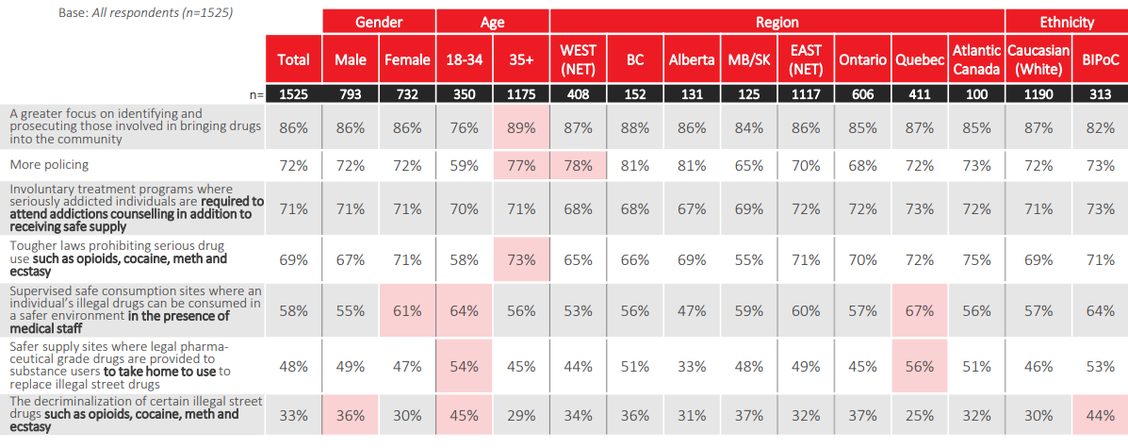
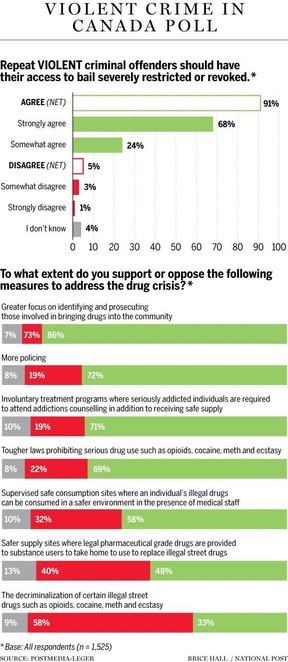
Major support was expressed (58 percent) for "supervised safe consumption sites", yet almost all respondents wanted to have drug dealers prosecuted and chronic addicts to be mandated to the necessity of treatment. Over 7 in ten respondents opted for "more policing" on drugs, the highest being expressed (at 81 percent) in British Columbia, the recognized epicentre of the overdose crisis. Asked should Canada focus on "identifying and prosecuting those involved in bringing drugs into the community", 86 percent agreed.
"There was one [safe consumption site] when we came into office in 2015, now there are dozens and dozens and dozens across the country and they are saving lives significantly", boasted Prime Minister Justin Trudeau. He slammed it as "unfortunate" and "anti-science" when Alberta began the pursuit of a treatment-centered approach to address its overdose crisis. His boast is a hollow sham; lethal overdoses, in the face of 'dozens and dozens' of 'safe injection' sites, are on a pronounced upward curve. Moreover, the 'safe' opioids handed out at the sites are leaking onto the streets.
Although involuntary treatment for chronic addicts has been denounced as extreme by the Canadian political and public health establishment, it was endorsed by 71 percent of poll respondents who agreed "involuntary treatment programs where seriously addicted individuals are required to attend addiction counselling in addition to receiving safe supply", sounded like a solution.
As for the criminal justice system reflected by government policy, opinion polls find majority support for capital punishment which since the 1970s was officially abolished in Canada. Incarceration and detention issues have hardened in the wake of recent murders and assaults committed by suspects either on bail or recent early releases from prison. Random fatal stabbings by people on parole for similar random attacks infuriate the public.
The fatal shooting of an Ontario Provincial Police constable by a repeat violent offender on bail, prompted a letter co-signed by all 13 Canadian premiers urging the federal government to reform bail (the Trudeau government had loosened bail issues after the previous Conservative-led government had tightened them) and take steps to get violent criminals "off the streets".
Canadian bail policies were described as a system of "catch and release" by over two-thirds of poll respondents, with white respondents at 69 percent and non-white respondents, 68 percent. If offenders keep committing crimes while on bail, in the opinion of the survey respondents, stop giving them bail. 92 percent of poll respondents endorsed the statement "repeat violent criminal offenders should have their access to bail severely restricted or revoked".
Canadians
were generally in agreement that the country’s top priorities on
criminal justice should be “violent crime,” “illegal firearm possession”
and “drug and substance abuse.”Photo by Gavin Young/Postmedia