Politic?

This is a blog dedicated to a personal interpretation of political news of the day. I attempt to be as knowledgeable as possible before commenting and committing my thoughts to a day's communication.

Monday, July 21, 2025

South African Crime and Punishment
 

https://global.unitednations.entermediadb.net/assets/mediadb/services/module/asset/downloads/preset/Libraries/Production%20Library/13-03-2023-SouthAfrica-unsplash.jpg/image1170x530cropped.jpg
Unsplash/Kyle-Philip Coulson
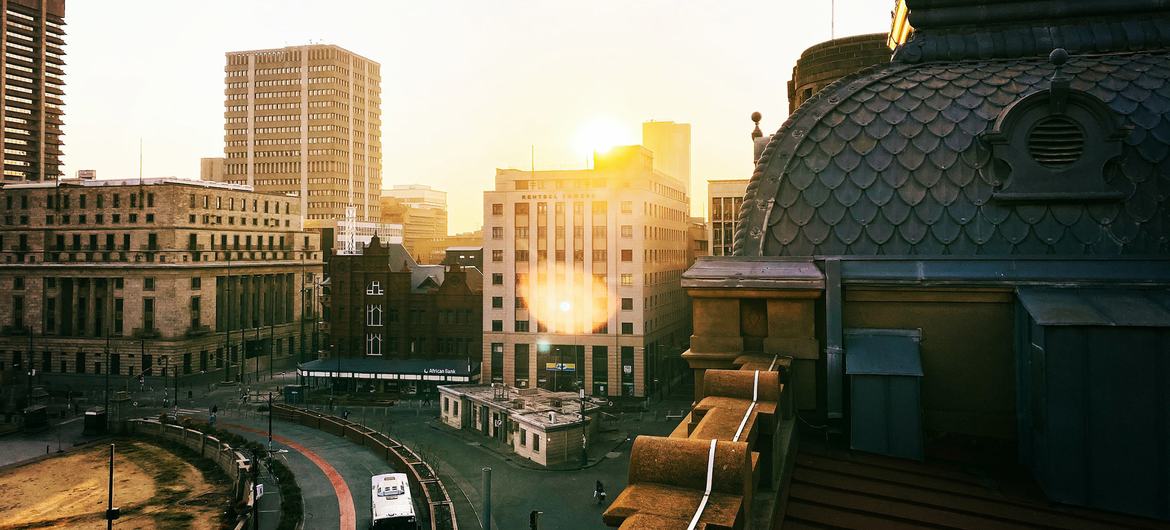
The sun rises over the capital of South Africa, Pretoria.

"The present report also focuses on grave abuses of the basic human rights of many
South Africans - but abuses which took place outside South Africa and for which the ANC,
not the South African Government, was directly responsible. Based on first-hand research
among surviving victims of such abuse, it documents a long-standing pattern of torture,
ill-treatment and execution of prisoners by the ANC's security department. It shows too that
this pattern of gross abuse was allowed to go unchecked for many years, not only by the
ANC's leadership in exile but also by the governments of the African front-line states who
allowed the ANC to set up bases, and prisons, on their territory. Such governments were at
best accessories to the abuses by the ANC; at other times they actively assisted those within
the ANC responsible for the grave human rights abuses which occurred."
                                        Amnesty International
https://mg.co.za/wp-content/uploads/2021/10/191409e0-graphic-torture-website-1000px.jpg 

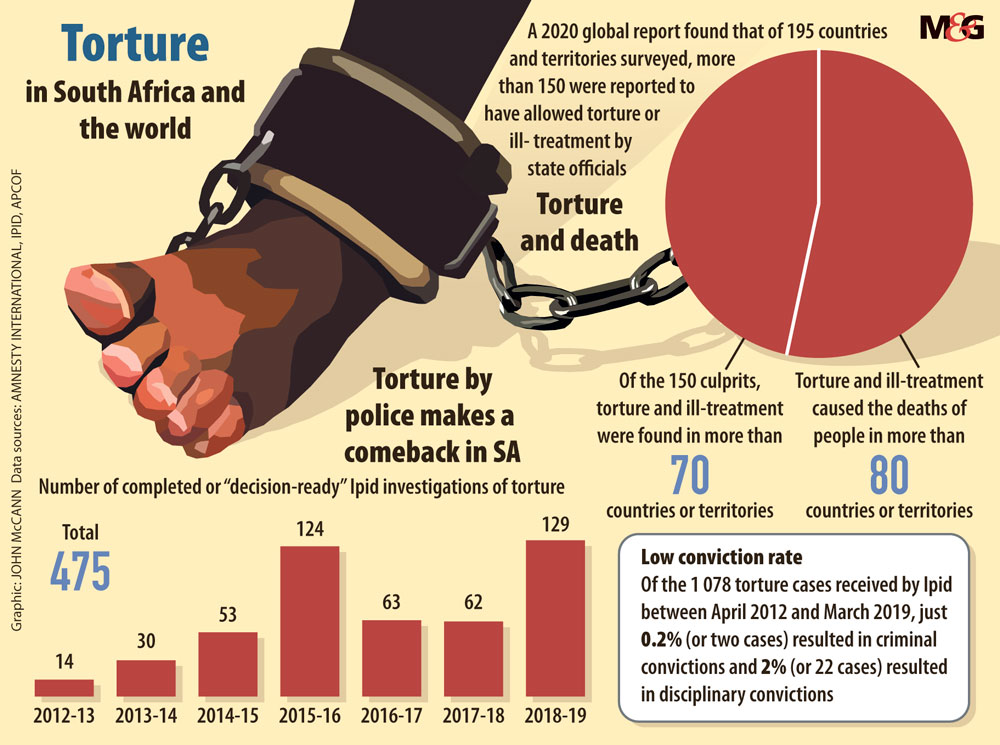
* Torture exists and is real in South Africa today.
* Torture is a human rights violation and is prohibited in the Bill of Rights of the South African
Constitution
* Torture is now a recognized crime in South Africa and perpetrators of this specific crime can be
charged, tried and prosecuted under the Prevention and Combating of Torture of Persons Act
13 of 2013 (“The Anti-torture Act”).
* South Africa enacted anti-torture legislation on 25 July 2013 almost 15 years after ratifying
the United Nations Convention against Torture (CAT) – South Africa is yet to ratify the Optional
Protocol on the Convention against Torture (OPCAT)
* In Africa, 13 out of 54 countries have enacted anti-torture legislation.
* Article 5 of the African Charter on Human and People’s Rights prohibits torture and the Robben
Island Guidelines provides a guide on preventing torture in Africa
* In South Africa torture happens in police cells, correctional services, other places of detention
(or where freedom of movement is restricted), on the streets and in some cases in people’s
private spaces.
* Victims of torture in the post-apartheid South Africa include arrested persons, criminal sus-
pects, non-South African nationals and sex workers amongst others.
* The Anti-torture Act applies to state agents – members of the police, prison warders, nurses,
teachers and other officials responsible for detained persons or other people acting with the
consent and authorization of the State. 
                                                                                                      Amnesty International

A feature of the Apartheid era in South Africa was white-led police forces that terrorized Blacks with their brutal interrogation techniques. A tactic that involved plastic bags placed over a suspect's head, suffocating them while being questioned; a terrifying object lesson in a police state with no accountability, no link to human rights, no conscience alerting the abuser to the fact that in torturing a prisoner they were themselves criminals and those they suspected of criminality their victims whom they expected to incriminate themselves out of pure fear to put a stop to the unbearable atrocity they were suffering through.
 
A White-on-Black crime. With the obliteration of apartheid, South Africa adopted a constitution outlawing such methods of interrogation involving torture. South Africa became a signatory to international treaties banning torture. The country was committed to the prevention of torture under any circumstances. Latterly, an analysis of government data has been undertaken by investigative journalists fully three decades since apartheid, only to discover that police in South Africa are still making use of the same suffocation tactic, called tubing.
 
https://i0.wp.com/www.dailymaverick.co.za/wp-content/uploads/2025/07/Viewfinder-tubing-poster.jpg?resize=1440%2C720&quality=89&ssl=1
Poster design by Viewfinder, with an archival photo of a tubing demonstration used with permission of the Wits Law Clinic. (Image: Supplied)
 
"They take two plastic bags – a Shoprite bag and a Pick n Pay bag –you know, those thick plastic bags."
"Then they put water inside and put it over your head. The water comes into your nose and your mouth."
"As soon as you think to breathe in again, the plastic bag comes right to your nose. You can't do nothing, nothing!"
"You can't even scream. You can scream as hard as you can, but no one can hear you."
"Before they beat you, they throw water over you, because they know it will be more painful. They make you take your clothes off. They leave you with only your shirt.
"They take some sticks from the tree. Then they take the cable ties – those long ones: the black ones or the blue ones. They beat you over the head and here by your neck," he says, pointing to his larynx. "Then they make you push your chest out and they beat you on the chest."
"They beat the hell out of me – like I'm not a man, you know? Like I'm a piece of paper. The way they beat me, I told myself: 'God, I'm dying today.'"
Mail&Guardian -- Africa's better future -- Brandon, South Africa  

An average of three people weekly from 2012 to 2023, filed complaints that the police had tubed them, according to Viewfinder, a South African journalism nonprofit. The liberation of Black South Africans led by freedom fighters gave way to a government that somehow finds it expedient to oversee a police force specializing in the very same torture techniques as those they were liberated from. Tubing: pulling a plastic bag over a prisoner's head, while fastening it securely around the neck. A technique that practising officers are not held accountable for.  
"I'm really shocked because it brings back very, very, very bad memories."
"The leadership of the A.N.C., when they came to power in 1994 made it clear: No soul should be subjected to that."
Khulu Mbatha, African National Congress liberation party 
The South African Independent Police Investigative Directorate (a government watchdog) identified some 1,700 tubing complaints over an eleven-year period. In one of those instances police dismissed an officer, later reinstated. In another six instances, officers were convicted in court. A confidential United Nations report dated 2023, warned commanders in the South African Police Service, along with top government officials about the use of torture. There was no response from government -- as is generally required by a signatory of a U.N. anti-torture protocol.
 
The police service "regards any allegations of torture as a serious misconduct", with measures to prevent it, according to Colonel Athlenda Mathe, a police service spokeswoman. Infamously, South Africa has a well-earned reputation as being among the world's highest countries suffering incidents of murder; its brazen crime rate earns it both internal and external criticism of its police response. Aggressive quotas for arrests and weapons seizures were established by the police establishment, ostensibly to address the critical issue of crime in South African society. 

Some commanders ignore allegations of torture, under pressure to meet the quota targets, according to a former senior police official fired four years earlier for having publicly criticized the national police commissioner. "It's easy for criminals to tell lies about police officers", stated the general secretary of the South African Policing Union, dismissing claims of torture as overblown rhetoric. 

A law criminalizing torture was passed by Parliament in 2013, with a maximum sentence of life imprisonment. Written guidance has been issued to officers in the police department, outlining the law. The training manual representing the police department includes techniques of interrogation reflecting global best prices. Yet there remain some commanders who believe that torture produces results, despite that experts are in agreement that anything gleaned through torture tends to be unreliable simply because victims tend to confess falsely while under physical duress.

https://mg.co.za/wp-content/uploads/2013/02/cdf54691-2013-02-28-amateur-video-brings-torture-into-light-of-day-image.jpg
Mail&Guardian -- Africa's better future


Labels: , , , ,

Thursday, June 14, 2018

Making a Silk Purse Out of a Sow's Ear - On Trudeau's Watch

"There has never been a better time to diversify."
"In a world where preferential access is the critical ingredient for success, particularly for an economy the size of ours, Canada is poised to become literally the most connected to global consumers."
"This is potentially one of the most exciting pivotal moments in Canadian trading history."
Joseph Pickerill, spokesman, Trade Minister Francois-Philippe Champagne

"Suddenly you've got agreements that matter. Weve got more than enough friggin' work on our hands just trying to get business up to speed on the EU and to get business up to speed on the (CPTPP). These are huge markets, huge potential and it's going to take an inordinate amount of work."
Carlo Dade, Canada West Foundation

"People often overstate the actions they will personally take in response to an issue of concern, so care should be taken in forecasting a northern customer backlash."
"But that having been said, the potential for customers to look for simple ways to tell Americans how upset they are is there [in boycotting American-sourced goods] -- and for some segments of the U.S. economy, the impacts could easily be meaningful, depending on how things unfold."
Bruce Anderson, chair, Abacus Polling

"How the hell can you have an unemployment rate of 3.8 percent if your trade arrangements are so bad? The answer is they're not."
"I told [U.S. Commerce Secretary] Wilbur Ross that if I had a 3.8 percent unemployment rate, I'd still be prime minister of Canada."
Former Prime Minister Brian Mulroney
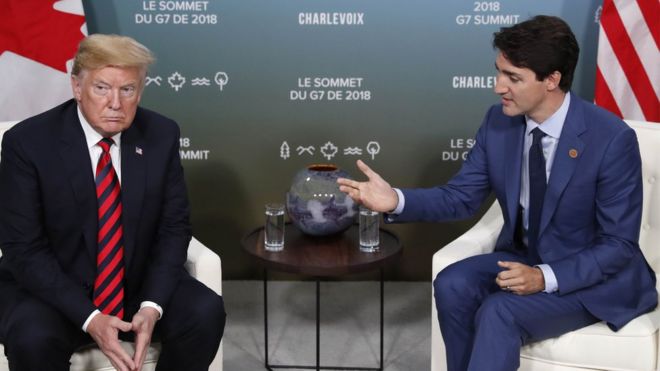
US President Donald Trump and Canadian PM Justin Trudeau
The Canada-US trade relationship has soured   Reuters
Actually, he wouldn't still be prime minister of the country. Brian Mulroney was an exceedingly unpopular prime minister. He did, however, have excellent country-to-country, diplomatic and personal relations with Ronald Reagan, and as such could be assured to have a sympathetic ear in the American president. It was, of course, Brian Mulroney as Canada's then-prime minister whose trade team successfully negotiated first the bilateral Canada-U.S. Free Trade Agreement, and its follow-up to trilaterally include Mexico, in the North American Free Trade Agreement.

An agreement that served all three countries well. And which ended up integrating their economies and their industrial production to make it an overall success for all three of the trade partners. Until, that is, Donald Trump showed up on the presidential campaign trail and stated up front his rejection of the NAFTA agreement, claiming it took advantage of American generosity at the expense of American workers and he would reject it; either renegotiating to U.S. advantage to address trade imbalances or cancel it outright.

And this, it appears, is precisely what he is aiming for, leaving Canada and Mexico in a trade quandary. What this obnoxious personality that is the American President who enjoys making news by throwing his considerable weight around has done in the process of reasserting American power politics is not only to have violated the trust held by its political and economic partners, but alienated them to the point where the structure of the G7 advanced economies is now in complete disarray. While Trump has abandoned America's friendly relations with its allies, he has embraced its challengers.

The bravado being expressed over Canada's intention to 'diversify' its trade and no longer be so wholly dependent on the U.S. market is just that; bravado. As it happens, Justin Trudeau's father, Pierre E. Trudeau as prime minister before him, went off on just such a tangent himself, determined to be less reliant on being pushed around by the U.S., likening the relationship to a mouse sleeping with an elephant, and exploring enlarging trade with Europe, as an alternative. And that fizzled monumentally. The bulk of Canada's trade is, naturally enough, with the U.S.; their market enormous, their population ten  times the size of Canada's, as next-door neighbours.

Justin Trudeau, in fact, has done more than his share of bungling trade agreements with other countries in an effort to be less dependent on the U.S. While the Trans Pacific Partnership agreement came close to being signed during a 'final' meeting between the countries' heads, Justin Trudeau chose to throw a spanner in works to the surprise of Japan and other nations, after he had introduced Canada's non-negotiable focus on women, gays and workplace standards and nothing was signed. Now, in a panic, Canada is prepared to be the first to ratify the CPTPP whose original name he insisted be changed to include the words "comprehensive and progressive", which neatly sums up his ideological vision.

After he scuppered that deal, he went directly to China where his ideals including "comprehensive and progressive", his arrogance in teaching China what a free trade deal should entail to please Canada's Liberal-led government -- concerned with the treatment of women and gays in the context of a free trade agreement excited both puzzlement and outrage in China -- that one was left floundering for air and nothing was signed. His trip to India which showed the world Trudeau's focus on beguiling costumery, also came up short of trade deals.

And now his absolute Liberal dedication to preserving Quebec's fondness for ripping off the Canadian consuming public in protectionism through quotas on milk, eggs and poultry drew anger first from the European Union which in trade talks attempted to steer Canada away from that degree of subsidies, although needless to say the EU does its own share of the very same as does the United States, despite President Trump's denials and protestations of Canada playing unfair with its traditional supply management system in view of the Quebec lobby and voting patterns.

"That's going to cost a lot of money for the people of Canada", Trump promised, after initiating a trade war, insisting on American protectionism in steel and aluminum imports was a matter of national security. Evidently considering extending it to the auto sector as well, again invoking national security. So Trudeau tells Trump that Canada won't be pushed around, and Trump tells Trudeau he's an ungrateful wretch and the contest for dumbfoolery is on.
“There’s a bit of a patriotic boost going on these past few days,” chuckled Prime Minister Justin Trudeau at an event hosted the other day by the supply-managed farmers who have been celebrating that we’re all blaming Trump for this mess instead of their politically powerful protectionist racket, the primary culprit. They were even giving out free milk and eggs near Parliament Hill, Tuesday. Trudeau has reason to raise a glass himself, now that this rush of pent-up anti-Trump Canadian catharsis has obscured how much he too is to blame for this trade-war disaster.
Largely missed in the sudden and furious reaction to Trump’s salty tweets Sunday was a report by CBC’s Rob Russo on The National that night, which clarifies just how wonderfully it appears trade talks were going between Canada and the U.S. That is, until Trudeau held his post-G7 press conference to remind Trump that Canada would “not be pushed around” by any American president and called the president’s treatment of Canada “kind of insulting.”
Trudeau wasn’t wrong, of course, but his comments were clearly ill-timed. Russo reported that Trump had offered a major giveaway to Trudeau in a NAFTA meeting on the G7 sidelines, finally agreeing to waive his longstanding demand for a sunset clause, the automatic expiry of the deal if it wasn’t renewed every five years, which had been one of the last sticking points. Russo said that Trump’s sudden concession was “surprising (to) his own chief negotiator, according to people who were there, and people (there) think that it’s great.” At the end of the summit, with a NAFTA deal perhaps within grasp, the celebrating was underway. Then came the news conference.
Kevin Libin, Financial Post


Labels: , , , , , , , ,

Thursday, December 21, 2017

United Nations -- True to Form

"[The 57-member group Organization of Islamic Cooperation remains committed to a] just and comprehensive peace based on the two-state solution." 
"[The United Nations must end] the Israeli occupation [of Palestine and declare the Trump administration liable for] all the consequences of not retracting from this illegal decision]."
"[We] consider that this dangerous declaration, which aims to change the legal status of the [city], is null and void and lacks any legitimacy."
Organization of Islamic Cooperation statement

"The OIC rejects and condemns the American decision. This is a violation of international law ... and this is a provocation of the feelings of Muslims within the world."
"It will create a situation of instability in the region and in the world."
Yousef al-Othaimeen, secretary general, Organization of Islamic Cooperation

"Now, Muslim countries in addition to a whole lot of others that are allied with the Palestinian cause will recognize Jerusalem as the capital of Palestine."
"And those Islamic countries are ready to sever relations to punish any one country that follows in the footsteps of the United States in recognizing Jerusalem as the capital of Israel."
Marwan Bishara, senior political analyst, Al Jazeera
Palestinian President Mahmoud Abbas speaks during an extraordinary meeting of the OIC
Palestinian President Mahmoud Abbas speaks during an extraordinary meeting of the Organisation of Islamic Cooperation (OIC) in Istanbul, Turkey, December 13, 2017. (photo credit: REUTERS/KAYHAN OZER/POOL)
"We are here today to say together and in clear language: Jerusalem was, still is and will always be the capital of the State of Palestine." 
"We will apply to the UN Security Council for the annulment of US decision to recognize Jerusalem as Israel's capital."
"We call on world nations to reconsider their recognition of Israel over its conduct toward Palestinians and its dismissal of decisions by the international community with the backing of the United States."
"We came to say 'no' to the Trump declaration and to the policy of occupation and ethnic cleansing carried out by Israel in Jerusalem."

Palestinian Authority President Mahmoud Abbas

Today's resolution brought before the United Nations to condemn the Trump administration's recognition of Jerusalem as the eternal capital of the State of Israel, saw most of the nation-members of the UN vote in favour. There were a handful of rejections of the resolution and a larger group of fence-sitters, among them Canada, all of whom abstained, but the resolution carried with a majority vote in favour, non-binding though it is. The Trump administration does not look favourably upon the craven submission of most UN member-countries in supporting this resolution and in so doing backhand-slapping the U.S.

Co-sponsored by Turkey, the current chair of the summit of the Organization of Islamic Cooperation and Yemen, chair of the Arab Group at the United Nations, Mahmoud Abbas characteristically and predictably called the event a resounding success. Believing that his contention that the Palestinians are a distinct and entitled group of Arabs whose heritage decrees that Jerusalem with its undeniable (supported by UNESCO's denying Judaism's historical, Biblical and archaeological links to Jerusalem) Arabic heritage must be recognized as the capital of a nascent Palestinian state despite the falsity of the claim.

Recep Tayyip Erdogan, whose hatred of Israel is clear in his spewing of vitriolic accusations of Israel as a genocidal, terrorist nation, confuses his own country's verifiably documented persecution and slaughter of Armenians, Greeks and Kurds with his version of a country whose civility and just and fair treatment in equality of citizenship with Israeli minorities, religious and ethnic groups are in stark contrast to Turkey's. The sectarian slaughter that is taking place in Yemen scarcely qualifies that country to condemn another in the region whose goal truly is peace. All that has occurred in this as in other instances of Muslim hostility to Judaism is sadly typical of Arab/Muslim countries.

As for the emergency conference called by Erdogan in Istanbul earlier this month to gather the 57 members of the Organization of Islamic Cooperation for the purpose of standing together in unified defiance of the American statement on Jerusalem and condemning Israel for thinking it could reclaim its history and heritage and deprive the Arab world of its claims that the heritage and history are its, when in fact it is a well documented usurper, the conference did not go quite as planned when its most important members failed to present themselves. A tepid showing serving to demonstrate just how divided the cooperative members truly are among themselves.

Palestinians protest in the West Bank town of Hebron on 13 December against Trump’s decision to recognise Jerusalem as the capital of the Israel last week.
Palestinians protest in the West Bank town of Hebron on 13 December against Trump’s decision to recognize Jerusalem as the capital of the Israel last week. Photograph: Abed Al Hashlamoun/EPA

Labels: , , , , , ,

Sunday, December 08, 2013

Exit Mandela, Enter Unease

"Even though Mandela was not the president, he was still controlling. Right now, people are scared of what is going to happen because Mandela was a father figure. These guys -- Zuma and the others -- they're not like him. We were just waiting for Mandela to die and now we don't know what is going to happen because people don't trust Zuma."
Tichaona Mutero, 30, Cape Town

"Ever since Nelson Mandela left office everything went wrong. If everyone was on Mandela's wavelength, South Africa would be a better place. I feel like our political leaders are misleading us. All we hear is of them hanging out in luxury hotels.
"Those in power now don't want to pursue the dream Mandela had. They drive past in their Mercedes and BMWs all the time."
Kenosi Dlamini, 18, Cape Town

"Life was harsh in exile. You gave up a lot. No longer -- joining the ANC is the gateway to opportunity and wealth. You go there to get rich, to get a top job. You really are a fool if you don't join."
Allister Sparks, former editor, Rand Daily Mail

"Yes, we were oppressed by white people; yes, it happened; yes, it hurt. But let us forgive each other so that we can move on fully and contribute fully to the South Africa we want to see in the future."
Nokuthula Magubane, 18, South African born-free [after Apartheid]

South Africa, though thought of as a success and a rising economic power, now part of the BRICS group of emerging national economies -- Brazil, Russia, India, China and South Africa -- has a fairly wobbly economy. There are those who argue that Mr. Mandela's vision for South Africa was betrayed by those who succeeded him.

When in power, the Mandela government courted foreign investors, slashed its spending, and began a long period of growth. That economic stability is coming under attack with a high and yet growing unemployment and continuing economic inequality. The jobless rate stands at 24.7%; average black household earnings remain a sixth of those of their white counterparts. One in five South Africans have no formal housing, 2.3 million households have no toilets.

"We still have racial unemployment, racial poverty and racial inequality", said Sidumo Dlamini, president of the 2.2-million-member Congress of South African Trade Unions, a member of the ruling alliance. "Our country is still in white hands." Does that statement auger well for continued colour-blind cooperation?

The state's anti-corruption body accuses a cabinet minister of "reckless dealings with state money and services, resulting in fruitless and wasteful expenditure."

New details emerged only a week ago about President Jacob Zuma's flagrant waste of public funds to rebuild his home at Nkandia in Kwa-Zulu Natal province. He insisted that state funds were used for essential security measures only, as required by his position as president. A swimming pool, an amphitheatre, housing for relatives, a cattle kraal and a chicken coop were all required security measures for the president's personal home.

In 2007, Jacob Zuma assumed control of the ruling African National Congress from Thabo Mbeki whose own leadership in the wake of Nelson Mandela's decision not to run for politics again was not a spectacular success. Under Mr. Mbeki crime soared, rapes were endemic, corruption had a field day, anti AIDs measures were ignored and ignorance ruled supreme. In that regard, nothing has changed under President Zuma.

Weeks after prosecutors dropped charges against Mr. Zuma for taking bribes from arms dealers he became president of South Africa, in 2009. In 2006 he had been acquitted of rape charges. Despite that he had most certainly raped a trusting young woman, a family friend who was afflicted with HIV. All of which left South Africa in capable hands, hands whose fidelity to corruption, nepotism and personal enrichment were skilled indeed.

"We need to practise more what he [Nelson Mandela] taught us. There are day-to-day squabbles and chronic problems, and instead of coming together to fix them, we are moving further apart", complained 22-year-old Faraz Laher. "That unity between races here, it's going. Perhaps now, with Madiba's passing, we will remember how important it is; maybe he can unite us again", said 25-year-old David Van Schalkwyk, optimistically.

Many historical analysts argue that Mr. Mandela's initiative for reconciliation had a cost: socio-economic disparities produced by apartheid have never been addressed fully. The ANC under Mr. Mandela's presidential mandate abandoned policies for nationalizing industries and redistributing wealth.

"You can argue this was a smart, judicious, pragmatic thing to do. I think, myself, you could as easily say it was a sellout. This is a hard call. The ANC ditched the people, and they made a separate peace with capitalism, and the society is unequal and full of discontent because of it", said John Saul, professor emeritus of political science, York University.
"Without more effective and sustained job creation, and soon, a mismatch between these expectations and the capacity of the economy to absorb young people is inevitable, and will have consequences."
Reconciliation Barometer; yearly gauge of public opinion

A well-wisher writes a message on a poster of Nelson Mandela on which she and others have written their messages of condolence and support, in the street outside his old house in Soweto, Johannesburg, South Africa Friday, Dec. 6, 2013. Flags were lowered to half-staff and people in black townships, in upscale mostly white suburbs and in South Africa's vast rural grasslands commemorated Nelson Mandela with song, tears and prayers on Friday while pledging to adhere to the values of unity and democracy that he embodied. (AP Photo/Ben Curtis)
Associated Press

Labels: , , , , ,

() Follow @rheytah Tweet