This is a blog dedicated to a personal interpretation of political news of the day. I attempt to be as knowledgeable as possible before commenting and committing my thoughts to a day's communication.
Much Ado About Nothing : Canada's Shakespearean Farce
"I
told her: 'I wish our people could grab you, drag you over to the
Kamloops residential school, put you into the basement, speak our
language to you, rape you, hurt you."
"And maybe you'd understand what our people went through."
Charlene Belleau, elder, Esk'etemc First Nation, British Columbia
"I
don't think they're a threat I think there's a lot of comments about
how she should be charged and punished in various ways, and I'm opposed
to that, because I think people should e able to speak freely about
everything, as long as they don't incite violence or engage in threats."
"I
think they're deplorable comments, and it reflects the fact that
Aboriginal leaders are pandered to constantly and never challenged, so
they become more and more unhinged as time goes on."
Frances Widdowson, academic; Economics and Indigenous Policy
"I'm
not sure what the member [MLA Tara Armstrong] is referring to, but I do
know what she's tried to do in the past, insisting that the bodies of
children who died at residential schools should be dug up."
"Something that you would never insist at any other place in t he world where holocausts or genocides occurred."
"That's
not how we do these things. [She is] trying to further divide us over
an issue that is very emotional, troubling and challenging."
B.C. Indigenous Relations Minister Spencer Chandra Herbert
The main administrative building of the former school is pictured in 1970. (Department of Citizenship and Immigration- Information Division / Library and Archives Canada)
In
2021 at the former Kamloops Residential School, the chief of
the Tk'emlúps te Secwépemc Kukpi7 (Chief) Rosanne Casimir made a
riveting public statement that sent shock waves through the country, a
statement picked up by international news media, and which prompted
then-PM Justice Trudeau to order Canadian flags at half-mast and held
them that way for six months, in honour of the 215 Indigenous children
Chief Casimir claimed lay in unmarked graves at the school site. Her
band had hired a specialist in ground-penetrating radar, the results of
which led her to make these remarks to the media:
"To our knowledge, these missing children are undocumented deaths."
"Some were as young as three years old. We sought
out a way to confirm that knowing out of deepest respect and love for
those lost children and their families, understanding that Tk'emlúps te
Secwépemc is the final resting place of these children."
That
shocking declaration galvanized Canada into a state of mourning, of
self-blame, of acceptance of the charges that a 'genocide' took place.
Government at every level genuflected in shame and remorse, pledged that
this horrible sin against humanity and Indigenous children who attended
Indian Residential Schools, who had suffered loneliness and misery,
neglect and humiliation, condemned if they spoke their native language,
were exposed to life-changing, long-lasting trauma that affected
following generations.
On
the rare occasion, some individuals who had attended these schools
denied those charges, countered that their exposure to educational
opportunities aided them in their later lives to make a life for
themselves outside of aboriginal communities, adjusting to the outside
world and finding professional occupations that satisfied their personal
aspirations. These voices were swiftly condemned and stilled. Then
someone observed there was no proof presented. And eventually Chief
Casimir altered her story in line with what she had been informed by the
professionals using the ground-penetrating radar, that it identified
underground 'anomalies', which could be anything, from dead wood to
inanimate buried items -- and just possibly bodies.
A plaque is seen outside of the former Kamloops Indian Residential School. (Andrew Snucins/The Canadian Press)
Funding
was made available to look deeper into the situation. Including
disinterring whatever lay underground identified as anomalies by the
ground-penetrating radar. In the years since the original 'discovery'
no attempts were made to investigate any further. The story of unmarked
graves continued and persist to this day, most particularly in British
Columbia. Professor Widdowson objected to this unquestioned and unproven
claim and paid dearly in her professional life, when her colleagues and
her university employment isolated her.
While
Professor Widdowson offered to civilly debate anyone who was interested
over the issue, her offer was rejected. During an event called 'My name is Charlene: Perseverance and poise in an era of truth, reconciliation, anger and rage',
hosted by the Office of Respectful Environments, Equity, Diversity and
Inclusion under the medical faculty of UBC, guest Charlene Belleau
recounted a comment she had made to Professor Widdowson at a campus
event; in disagreement with the professor's position, she had addressed
her saying she would like to see her beaten and raped.
When
the B.C. Legislature met last Friday, a question was put to the
Indigenous Relations minister to comment on Chief Belleau's statement.
Refusing to respond, the minister instead accused the questioning member
of attempting to foment confusion and division. Yet the B.C. government
in 2021 had allocated $12 million to finance First Nations'
investigation into the unmarked grave sites. At that time Chief Belleau
said it represented an "important first step in supporting the resiliency and healing of B.C. First Nations people". And then: nothing.
The former Kamloops Indian Residential School is seen on Tk’emlups te
Secwépemc First Nation in Kamloops, B.C., on May 27, 2021. The remains
of 215 children were purported to have been found buried on the site, the First Nation
said. (Andrew Snucins/The Canadian Press)
"The
UBC [University of British Columbia] faculty of medicine does not
condone any speech that endorses or promotes harassment or violence of
any kind."
"An
invitation for a community member to participate in an event does not
constitute endorsement of their specific remarks or views."
Mieke Koehoorn, vice-dean of academic affairs, Faculty of Medicine, UBC
The Cringeworthy Applause of the Victoria Police Department for 'Palestinian' Anti-Israel Marches
"After 126 weeks and 10,000 hours of support, Vic PD is asking that protesters peacefully conclude the marching portion of their weekly Palestine demonstrations."
"We strongly encourage organizers and participants to remain on the Legislature lawn, where the environment is safer and more controlled."
"This decision is not about the cause itself [the force remains committed to supporting the right
to peaceful protest]."
"This is about balance and about our
responsibility to ensure that we can continue to meet all public safety
needs across Victoria and Esquimalt."
Victoria Police Department, Victoria, British Columbia
"We will not stop marching."
"We will not stop until the Canadian state completely ends its complicity in apartheid, war crimes, and genocide in occupied Palestine."
Coast Salish to Palestine
Victoria police say they will no longer provide traffic control or other
resources for weekly pro-Palestine rallies in the city's downtown. (Chad Hipolito/The Canadian Press)
British Columbia's capital city Victoria police announced their intention to stop escorting anti-Israel marches after over two years and the cost of millions.Traffic control and 'related police resources' would no longer be provided to those who have been routinely illegally blockading roads every Saturday in the city's core. "Unsustainable strain" on officers led to the Victoria Police coming to the conclusion to put an end to their attendance on the marches.
The march organizers were unmoved; they had never asked for such escorts to begin with, they responded with scorn. As for the city of Victoria itself in their opinion is 'unceded Lekwungen and WSANEC territories', lacking the authority to tell them what they may and may not do. Subject to frequent anti-Israel demonstrations hard on the heels of the October 7, 2023 massacre in southern Israel by Palestinian terrorists led by Hamas from Gaza, the weekly Saturday march through the tourist core always took place with Victoria Police escorts.
Victoria residents became familiar with Victoria Police routinely alerting them several days in advance of upcoming anti-Israel demonstrations. "Traffic disruptions are expected due to a planned demonstration this Saturday at the front of the BC Legislature", a typical police alert would warn, with the population alerted they should expect about "two hours" road closures, the costs of which have added into millions for police resources.
At one rally, a speaker praised violent resistance against Israeli forces: "I feel very proud when I see young warriors in Gaza ... running up to a tank and delivering demolition charges". But should the IDF shoot any of these 'young warriors' prepared to kill Israeli soldiers, harsh condemnation of 'genocide' erupts at all the 'pro-Palestinian (read Hamas') marches throughout Canadian cities and at blockaded university campuses.
At one November march, a cordon was maintained by police around demonstrators blocking the city's main thoroughfare. While waiting cars were held back, a speaker in the middle of the blocked road pointed out that people passing by wearing Remembrance Day poppies memorializing the Canadian Armed Forces during the Second World War, a conflict that helped end the Holocaust which enabled European Jewish survivors to become 'victimizers' of 'Palestinians' were complicit; Arabs claiming to be the rightful indigenous people of Judean ancestral geography.
Victoria police, while issuing their statement, praised the "passion and commitment" of the demonstrators. "This decision is not a judgment on the merits of their cause, but a necessary step to ensure sustainable policing and protect the long-term health of our officers", explained VicPD Chief Constable Fiona Wilson. Under the Motor Vehicle Act it is illegal to block any roadway in Canada. In the instance of the pro-Palestine/anti-Israel marches it is public intimidation.
Pro-Palestinian protesters at the legislature in 2021. Photo: Colin Smith / Capital Daily
"Police have attended that residence in the past, approximately a couple of years ago, where firearms were seized."
"I can say that at a later point in time the lawful owner of those firearms petitions for those firearms to be returned and they were."
"I can say with confidence that from the moment the suspect encountered
police, there were no further injuries to any other students in the
school."
"In speaking with investigators, there was no specific targeting of
any individuals [at the school],"
"This suspect was, for lack of a better term, hunting. They were
prepared and engaging anybody and everybody they could come in contact
with."
"We're trying to determine how our suspect got that firearm, and that investigation is continuing."
RCMP Deputy Commissioner Dwayne McDonald
"Identifying individuals who are no longer eligible for a firearms licence as quickly as possible and ensuring they can no longer access firearms is an important public safety objective."
Canadian Firearms Advisory Committee
A vigil in Tumbler Ridge. (Ben Nelms/CBC)
Canada remains in mourning yet incredulous that a young man of 18 living in a remote British Columbia town of some 2,300 residents where everyone is reputed to know everyone else, chose to enter the Tumbler Ridge Secondary school with two lethal weapons to begin firing at random, killing six students from ages 12 to 13, and a 39-year-old teacher before his rampage came to an end with the intervention of two members of the local RCMP detachment.
That stunning attack with its consequent victims occurred just a short time after 18-year-old Jesse Van Rootselaar had killed his 36-year-old mother and 11-year-old stepbrother at the family home, located a short distance from the school.
The Tuesday killing represented one of Canada's worst mass murder events in recent history. A biological male who six years ago transitioned to female, the attacker had long brown hair and wore a dress as he rampaged through the school killing three 12-year-old girls, a 12 and a 13 year-old boy, and the teacher. Most of the deaths occurred in the school library. One of the boys was found dead in a stairwell.
It took a mere two minutes for two RCMP officers to respond and arrive at the scene when they were alerted at 1:00 p.m. Tuesday. They drew fire from the killer; failing to respond, they bought time by distracting the killer from hunting down any more victims; instead he turned his weapon on himself, committing suicide. A short while later, a young neighbour who had gone to the family home of the killer, discovered the mother and brother dead and she contacted the RCMP.
Getty Images
The mother, as it happened, was a gun aficionado. Who presumably taught her son to appreciate weapons for target practice and hunting...and, as the mother noted on a social media posting for 'self-reliance'. She had a gun licence and owned a number of long guns herself and took pride in using them. Her son had mental issues, well known to the RCMP who had responded on a number of occasions at the family home to issues related to the boy's mental health.
In Canadian gun law firearms are to be removed from any home that houses an individual with mental illness. Police, according to RCMP Deputy Commissioner Dwayne McDonald had gone to the home a number of times. There was more than one time when the killer, under the terms of the Mental Health Act was taken into custody. Jennifer Strang, the killer's mother (now deceased) in an August 2024 Facebook post, showed an image of a safe with six long guns, with the caption: "think it's time to take them out for some target practice".
An earlier post in 2021 had Jennifer Strang promoting a YouTube channel by her son, stating it was where "He posts about hunting, self-reliance, guns and stuff he likes to do". Canadian law enforcement can legally seize legal firearms without a warrant should an officer believe that to do so is in the "interests of the safety of the person or any other person". The Possession and Acquisition Licence of legal gun owners can also be unilaterally suspended.
The federal government mere weeks ago kicked off its Assault-Style Firearms Compensation Program, a 'buy back' program for firearms covered by the 2020 ban under the government bans through a 'freeze' on the sale or transfer of legal handguns. The SKS, a Russian-produced semi-automatic rifle had been overlooked in the banned list even though it has the same function as banned rifles like the Ruger Mini-14.
As it happened, an SKS was among one of the long guns in the possession of the Tumbler Ridge killer's mother. It was shown among those demonstrated in her Facebook post of 2014. This was the same rifle that appeared with an avatar of the YouTube channel her son started. In the annals of preventable homicides, all details pulled together, this horrible event rates a number one.
"Unless we get one heck of a boost, it's projected to take chunks out of our town and surrounding areas. It's looking very ugly right now."
"We're begging for air support [to help douse the fire]. It's really crucial."
Mayor of Flin Flon, Manitoba, George Fontaine
"It's a very serious situation that we're faced with. We do need some rainfall."
"We need that sooner rather than later, and in light of that not being in the forecast, we most certainly are putting in place every measure possible to prepare the province."
"Resources are stretched thin because of the severity of the situation
that we're facing and the intensity and the proximity of the fires."
Saskatchewan Premier Scott Moe
"My husband was trapped on the other side of the barricade with no
pills, no food, no nothing. They wouldn't let him come to me to
evacuate,"
"[Reunited], we're trying to register with Saskatchewan Red Cross; I've
tried numerous times."
"Worse happens,
we're sleeping in the car. We'll just keep traveling from town to town
to town to town till hopefully we find something."
Sandy Oosterlaken, evacuated from Denare Beach
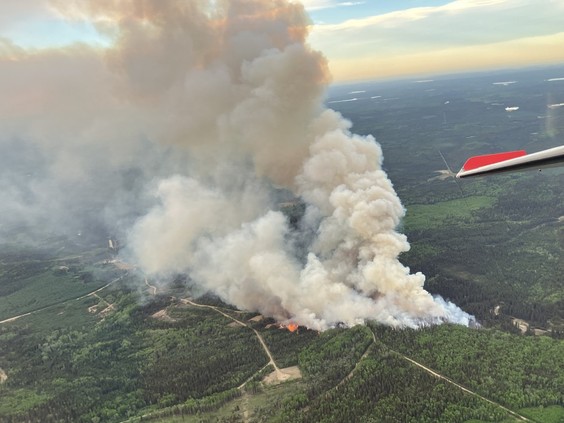
A wildfire in the Sherridon, Man.
area is shown in a government handout photo on Tuesday, May 27, 2025.
THE CANADIAN PRESS/HO - Manitoba Government
Fierce, shifting winds threatened to propel a nearby raging wildfire into the city of Flin Flon, Manitoba where buildings, both homes and civil infrastructure would be vulnerable to the flames. The municipality 630 kilometres northwest of Winnipeg served notice to its 5,000 residents to begin emergency evacuation. A wildfire that had started over the boundary in neighbouring Saskatchewan had swiftly reached Flin Flon's northern perimeter.
Another thousand people are resident in cottages and homes surrounding Flin Flon. All remaining residents were directed by the city to leave before noon on Friday. Buses were driving those who don't have shelter, to Manitoba's capital city, Winnipeg. A total of 17,000 residents in Manitoba have been forced to leave their towns and homes in the last several days.
Small communities and towns stretching from northern Ontario to British Columbia -- Canada's east-to-west geographic arc -- face an early fire season whipping through forests. From a blaze that started Monday near Creighton, Saskatchewan, after jumping the boundary into Manitoba and menacing Flin Flon, the wildfire has grown to 40 square kilometres, with firefighting crews struggling to contain it. As a result of heavy smoke and a drone incursion, water bombers were grounded intermittently.
A wildfire that broke out across the North Saskatchewan River, in Parkland County, on May 8. (Noam Olsson photos)Photo by HO /THE CANADIAN PRESS
Residents of Creighton, 1,200 in number, have been ordered out of the range of the wildfire. Over 4,000 people have fled wildfires raging in Saskatchewan, under a province-wide state of emergency. Alberta, which in recent years has suffered immense wldfire damage, this year has fared comparatively better. Northwest of Edmonton, however, the 1,300 residents of Swan Hills have been ordered to evacuate, along with the 900 residents of Chateh in Alberta's northwestern corner.
In Chipewyan Lake, about 450 kilometres north of Edmonton, a crew of eight firefighters were temporarily trapped overnight but finally were able to drive their way out to safety. A wildfire in British Columbia that prompted an evacuation order Thursday, quadrupled in size overnight while firefighters prepared for "intensifying conditions" in the parched northeast of the province where the concentration of most fire activity is located.
The blaze "displaying aggressive fire behaviour" in the Peace River Regional District near the community of Kelly Lake was about 46 square kilometres in size Friday, substantially larger from the 11 square kilometres it registered the day before, according to the British Columbia Wildfire Service.
Military aircraft and helicopters are being used to evacuate residents in Manitoba from fast-moving wildfires EPA
British Columbia has about 60 wildfires ongoing at the present time, 34 of which are classified as burning out of control. According to the B.C. Wildfire Service, 18 percent of the active fires were human caused, 77 percent started by lightning taking advantage of the drought situation and tinder-dry forests, and five percent of unknown causes.
"It's been another challenging day here in Manitoba."
"[Firefighters were using] water bombers flying overhead [and] helicopters dropping buckets of
water."
"But at the same time, all the smoke in the air is making the evacuation effort that much more difficult."
"Our provinces here in Canada are immense. By the time
somebody makes it to Winnipeg, some of them have been on the road
overnight. They've had to be on a flight for a few hours and then on a
bus for several hours after that."
Manitoba Premier Wab Kinew
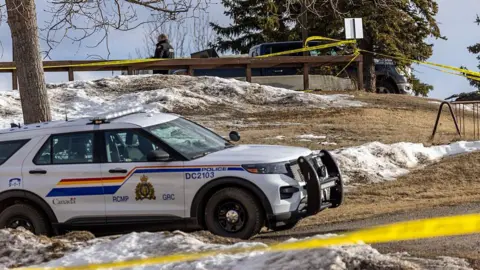
A Royal Canadian Mounted Police (RCMP) patrol vehicle is parked as
a water bomber flies over the plume of smoke from a wildfire near The
Pas, Manitoba, May 27, 2025. Manitoba RCMP/Handout via REUTERS
"Israel was established after its neighbours rejected a United Nations plan to partition the land between Jews and Arabs. As it was founded, [Israel] joined the United Nations in 1949. The legitimacy of Israel as a Jewish state is completely insusceptible to question, and the attempt to represent it as entirely a wrongful occupation of anyone else's territory is not even slightly sustainable."
"The Jews have transformed a primitive country in one lifetime into a sophisticated and prosperous democratic state where the deserts now bloom, and [as] a nuclear power."
"The Jews have been in what is now Israel for more than 5,000 years. The Phoenicians, Jews, Egyptians, Syrians, Persians, Macedonians, Seleucids Romans, Byzantines, Arabians, Turks, and British have governed there, but not the Palestinians."
"The elimination by force of Israel is impossible and all attempts to do so are doomed in advance, as well as illegal."
Conrad Black, Canadian businessman, publisher, writer, historian
"Over 700,000 Palestinians were forcefully expelled from their homes, more than 15,000 were massacred, and over 500 of their villages were destroyed."
"To uphold our commitment to social justice, decolonization and reconciliation, it is imperative that we ensure students do not leave the education system completely ignorant of the history of Palestine and Israel. We cannot have yet another generation grow up believing it's 'too complicated' or 'too sensitive'."
Pro-Palestinian 'activist' group letter, British Columbia
Action Alert #30 Demand That the Nakba Be Added to the BC Curriculum-- Muslim Alert
"[The proposal in the letter sent to the NDP British Columbia government] is a distortion of 'what happened in 1948'."
"It omits the fact that the [Arab] Palestinians launched the war in defiance of the proposal by the international community [UN partition plan]."
"That's not in there and neither is the second part of the war, which was launched by the Arab states when they invaded Israel in May 1948."
"It doesn't explain why 700,000 Jews were uprooted from the Arab states in which they had lived until 1948, under pressure by Arab societies and Arab governments, creating a Jewish refugee problem. None of this is explained or touched upon at all in that proposal they made."
"Students in British Columbia learn about history throughout the K-12 curriculum -- including references to international wars and global conflicts."
"At the local level, school districts and teachers us their professional judgement when choosing to incorporate current and historical conflicts into their lesson planning that align with the required learning standards of the curriculum."
British Columbia education ministry statement
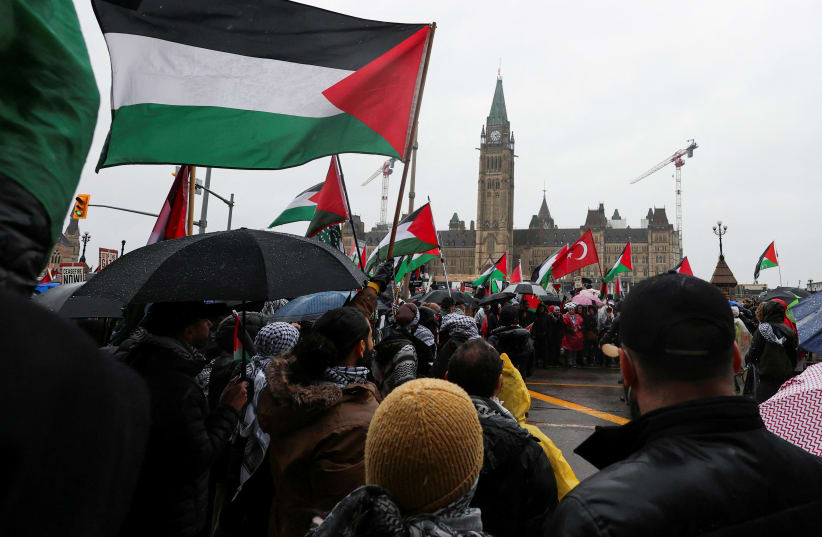
Protesters hold an effigy of Canada’s Prime Minister
Justin Trudeau during a rally to call for a ceasefire, amid the ongoing
conflict between Israel and the Palestinian Islamist group Hamas in
Gaza, on Parliament Hill in Ottawa, Ontario, Canada March 9, 2024. (photo credit: REUTERS/Ismail Shakil)
Organizers of an open letter demanding a new curriculum in British Columbia's school system that would feature politicized content on the conflict between Israel and the Palestinians include the Samidoun Palestinian Prisoner Network which has its headquarters in Vancouver, and which is known to have close associations with the Popular Front for the Liberation of Palestine, widely acknowledged as a terrorist group, listed on Canada's designated list of international terrorist organizations.
Samidoun has recognition from Germany -- the 20th century's infamous, most lethal proponent of acidic antisemitism -- as a major proponent of repulsive racist hatred toward Jews, and as such is not only deemed a terrorist group, but is proscribed from operating in Germany, in accord with its laws against Holocaust denial and antisemitism in a state dedication to rejecting its shameful past in recognition of its monumental debt to humanity.
In Justin Trudeau's Canada, with the Liberal leader's eye fixed on a large and growing voting bloc, unwilling to hazard alienating Arab/Palestinian/Muslim votes, Samidoun with its well-known penchant for demonizing Israel and Jews is nonchalantly permitted to operate. On October 7, even while Hamas began committing its widespread atrocities in southern Israel, Samidoun's statement glorified the ongoing massacre:
"The resistance is rising throughout occupied Palestine, smashing the siege on Gaza with a comprehensive offensive, confronting the occupier by land, air and sea", completing its jubilant sentiment over sadistic savagery with images of terrorists clad in keffiyehs.
The British Columbia education ministry responded to the letter non-committally, leaving open an opportunity for committed antisemites in its public school system to proceed with their own biased interpretation, apart from, or filling in the regular school curriculum by advising parents to contact their child's teacher or principal should they wish to discuss what is being taught in the school their children attend.
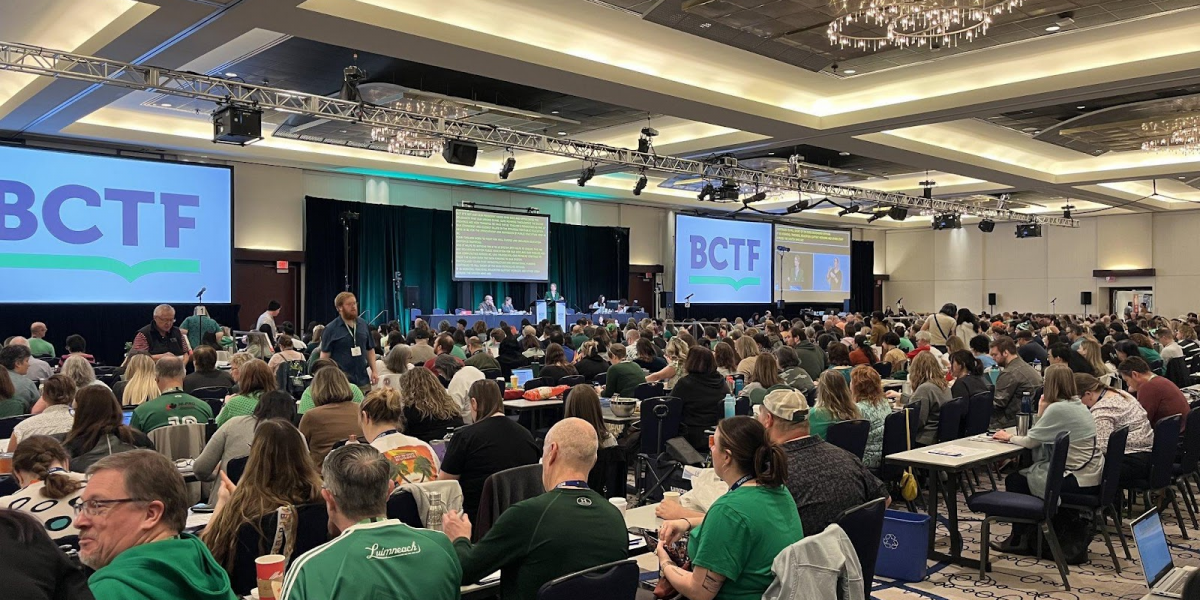
At the Annual General Meeting of the British Columbia Teachers’
Federation (BCTF), teacher delegates passed a historic
motion about Palestine. The motion asked the BCTF to push the Ministry
of Education to include the Nakba and the military occupation of Gaza
and the West Bank in the BC curriculum. Spring Magazine
These 'social activists' looking to improve on the reality of historical events they view with the jaundiced eye of cherished victimhood, sent their letter with its demands to Rachna Singh, British Columbia's minister of Education and Child Care, insisting social studies curricula in the province be overhauled to draw attention to the "Nakba" (catastrophe) that Palestinians mourn and Jews celebrate, as the formal rebirth of the State of Israel.
This refers to the time when five Arab countries responded to the declaration of statehood for Israel by amassing a collective military assault on the nascent Jewish State. Historian Gil Troy's thought was the implementation of a constructive lesson plan could alternately examine support for partition and the two-state solution from then-diplomat Lester B. Pearson, later Nobel Laureate, and Prime Minister of Canada. A lesson plan that would provoke students "to think for themselves" not reliant on "partisan lies" as a service to young students.
Samidoun was not alone in writing the letter with its appeal for justification in 'adjusting' history. There was input by other interested 'pro-Palestinian' (the preferred term to 'anti-Israel, anti-Jew) groups such as Teachers 4 Palestine BC, Palestinian Youth Movement Vancouver, and Independent Jewish Voices, a fringe group promoting Holocaust denial conspiracies which doesn't hesitate to participate in events staged by antisemites and sympathizers of terrorism aimed at Jews and Israel.
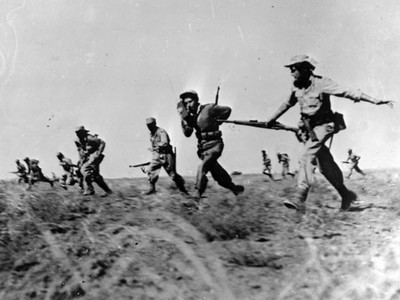
Israeli infantry making a full assault on Egyptian forces in the Negev area of Israel during the war of independence.Photo by Keystone/Getty Images
"By not acknowledging that most Palestinian Arabs rejected the compromise -- and encouraged terrorist attacks on their Palestinian Jewish neighbours -- the petition, and implicitly the curriculum doesn't explain how the war truly began."
"[The letter demanding school curricula be altered, is an example of] twistory, not history [framed to perpetuate a simplistic] misleading [narrative with no educational value]."
"And it, of course, ignores the invasion by outside Arab armies in May 1948, when the Jews, who accepted the compromise, launched Israel, as per the UN's vision."
"It overlooks the United Nations' attempt at compromise -- in its 1947 Partition Plan, which recognized the historical legitimacy of Jewish ties to the land. It also ignores the fact that Canada voted for the partition and that a great Canadian leader, Lester B. Pearson, had a leading role in drawing up the proposed compromise."
"The letter takes a complicated conflict, which could be taught sensitively and thoughtfully, with a nuance and respect for the truth, and reduces it to a one-sided opportunity to erase the history of Israel, the legitimacy of Zionism, the depth of Jewish ties to the land -- while bashing Canada along the way."
Distinguished historian Gil Troy, McGill University academic
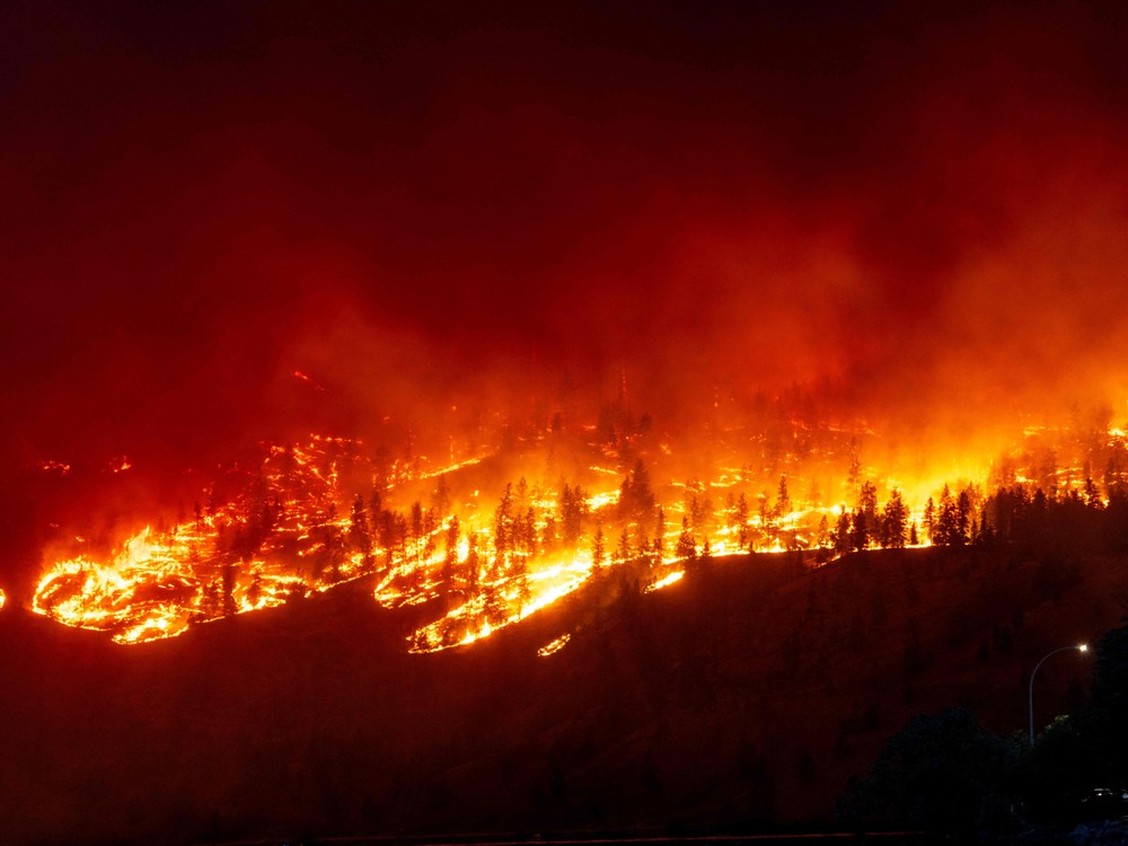
The McDougall Creek wildfire burns in the hills in West Kelowna on Aug. 17, 2023, as seen from Kelowna.Photo by DARREN HULL /AFP via Getty Images
"Then the flames started, and they started everywhere all at the same time because it was an ember shower."
"We're a pretty small fire department, we have three apparatus, so we tried to do our best but there was just absolutely no way that we could attack all of it. And as soon as you don't attack it, it spreads."
"We fought for as many houses as we could. We stopped the flame front and saved probably, I'd say, 65 to 75 percent of the houses in Traders Cove."
"I saw my house burn. When we were fighting the fires in Traders Cove, we literally had fire personnel with their backs to their house that was burning behind them, and they were fighting the neighbour's, trying to save the neighbourhood."
"It was extremely, extremely fast. The wind was blowing directly, I mean literally, at my house. It was a wall of fire 100, 125 feet high, travelling 35 kilometres an hour."
"It was surreal. It was watching nature at its worst. ... It just kind of ate my house."
Paul Zydowicz, chief, volunteer fire department, Wilson's Landing, British Columbia
"I quickly found myself in a pretty tricky battle. I was able to call in our own firefighters to come and help me. And that's when it became real for me that we were surrounded by fire and it was bearing down on our community hard. And we were all in the fight of our careers."
"I was thinking: If we just had one more fire engine we could save that house. And if we had one more fire engine, then we can save those other two houses. And if we had one more, we could get the other ones on the other side of the street. And, you know, of course you can never have enough resources in that situation."
"It's unprecedented. We are not used to fighting wildfire fire against six-storey condominium buildings."
Jason Brolund, West Kelowna, McDougall Creek wildfire
"It moved 20 km south in under 12 hours, which is extremely [aggressive] for fire behaviour in British Columbia."
"That is a force of nature similar to a tornado, similar to an earthquake or a tsunami."
Forest Tower, B.C. Wildfire Service Information officer
"[The fire that blew into this region] was something I've never seen before."
"When I saw the flames coming that day, it was something bigger than any of us could handle."
"but the community rallied together, they saved what they could save. It was actually just among the most impressive displays of community spirit I've ever seen."
"I want to stress the fact that we've lost structures, people are hurting, but we haven't lost lives -- not yet."
District deputy regional fire chief Sean Coubrough
"This MacDougall fire has been a very harrowing experience for everyone. I'm grateful that there has been no confirmed loss of life that we know of, and we hope that this remains."
"It's very devastating for the loss of property and the impact of businesses that has occurred. There's lots of collective grief and high emotions."
Chief Robert Louie, Westbank First Nation
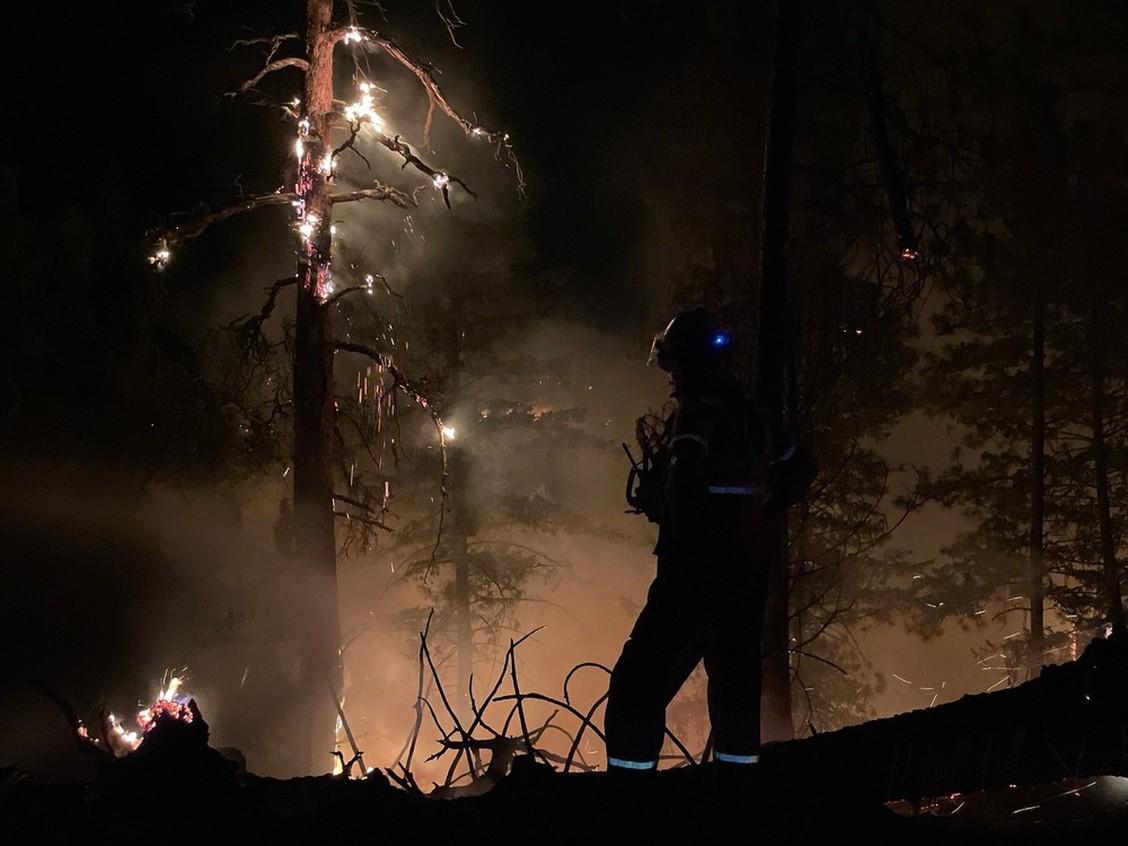
Photo from the frontlines as Wilson's Landing firefighters battled the McDougall Creek blaze north of Kelowna.Photo by Wilson's Landing Fire Department
As gusting winds whipped up the McDougall Creek wildfire, airplanes dumped fire retardant in the area. Fire chief Zydowlicz had firefighters staked out on the west side of Okanagan Lake, additional crews on a local forest road. As evening fell flames could be seen thrusting toward Wilson's Landing. The two dozen on-call firefighters with three trucks stared down the fast-moving blaze, leaping and growing voraciously.
That was August 17, the start of the worst week of the worst year for wildfires in the history of British Columbia, which led to hundreds of properties damaged, thousands of evacuations across the province, and hundreds of firefighters arriving from near and abroad to pitch in and work as an emergency team to address the crisis. A day later the McDougall Creek wildfire blew into West Kelowna, roughly 13 km south.
Jason Brolund, the city's fire chief spent the day organizing how best to attack the blaze, overseeing the command post in the city. On his way home August 18 for a few hours of sleep he stopped in West Kelowna Estates to check on his firefighters and an "overwhelming" scene assailed him. A colleague pointed him to a subdivision street not yet visited by the firefighters. He knocked on doors to check that residents had evacuated, and as the night sky glowed orange fluorescence, firefighters used water from swimming pools "right before it hits the person's lawn, like inches from the house".
The inferno melted street signs, uprooted large trees, and ripped propane tanks open, blowing them into the woods. At Wilson's Landing firefighters attacked the blaze roaring north along Westside Road, work that stretched into the next morning, staying one step ahead of the flames to protect small communities, but finally forced to retreat 10 km when they reached the Lake Okanagan Resort.
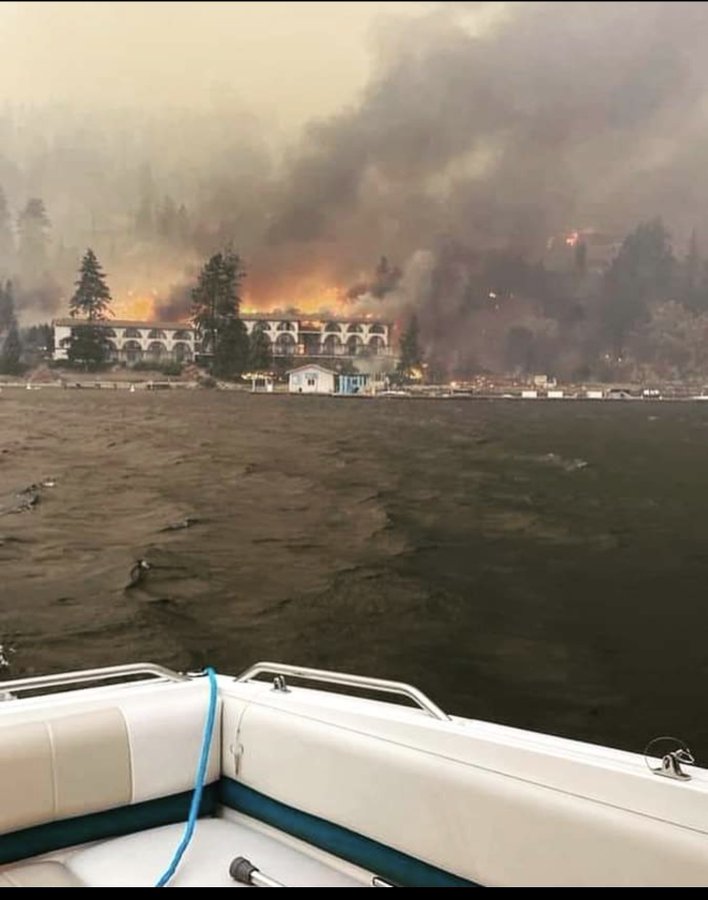
Lake Okanagan Resort on fire Photo: Tedd Buddwell
"The fire chased us out of Lake Okanagan resort" explained Chief Zydowicz. Boaters posted photographs of the 217-room historic resort engulfed fully in flames. The tradespeople, doctors, lawyers and entrepreneurs who formed the troop of volunteer firefighters experienced a harrowing 22 hours. Two were injured; one with facial burns, the other a broken wrist. "These two firefighters, after being treated at the hospital, called me from the hospital and said put me in a next shift please, and preferably earlier", said Chief Zydowicz.
Along with losing his own house, the fire had destroyed $150,000 in boats and other gear for his riverboat company, Northwest River Boats. Other Wilson's Landing firefighters lost everything and continued to fight the wildfire. The fire in the North Westside rural area destroyed or damaged about 90 properties in both Traders Cove and Wilson's Landing, as well as a children's summer camp. Most homeowners had heeded evacuation orders, even though a handful were rescued after waiting too long to leave.
In the city of West Kelowna and the Westbank First Nation another 84 properties were damaged or destroyed, along with four in Kelowna and three in Lake country. West Kelowna firefighters that afternoon fought a ground fire that was threatening a gas storage facility, a mobile home park and a number of new condominium developments. That day in mid-August was hot, dry and windy across most of the province. Other areas of the province saw mounting fire crises with several communities in the Columbia Shuswap Regional District given evacuation orders as the area faced "its most devastating wildfire day in history".
A base camp for 400 firefighters west of Adams Lake was forced to evacuate when the fire risk was acute and cold air whipped up the nearby Bush Creek East fire. Under 12 km from the camp the Lower East Adams Lake fire was increasing in intensity close to the Interfor Adams Lake Mill, a major area employer. It was saved, while flames tore south attacking other communities on the north side of Shuswap Lake. Losses of 100 homes were reported by residents in Scotch Creek and Celista.
By August 20 the situation began to change when Chief Broland said "We're now four days in. It feels like months. But things are looking better. We are finally feeling like we're moving forward rather than we're moving backwards, and that's a great feeling for all of us to have. In saying that, make no mistake, there will be difficult days ahead, and we are continuing to prepare and address those."
A recent photo of some of the Wilson’s Landing
firefighters. Thirteen people in the 24-member department lost their
homes in the blaze. Photo: GoFundMejpg
Vancouver's Downtown Eastside, the notorious drug capital of the nation. How to solve the problem of drug overdoses without exacerbating the problem of addictions to killing, mind-altering drugs? The answeer is so simple, it stared us all in the face and no one recognized it. The War on Drugs made people fiercely possessive about their right to procure drugs and ruin their lives. How to get around that? Simple enough, legitimize possession for personal use of all drugs, not merely marijuana, but the hard stuff, too. That will endow the users with a sense of comfort and self-respect, and a cure will take off from there.
And just think; it relieves police of the nasty work of harassing people, taking them into custody, keeping a sharp eye out for drug users who may go berserk. Drugged out bodies littering the pavement of an early morning on a beautiful winter day? Walk on by, none of your business Vancouver Police. Someone's got a syringe of heroin injecting and moaning with the pain of it all? Not your business, chum.
A man holds boxes containing tested cocaine, meth and heroin given out
by the Drug User Liberation Front in July 2021. It will not be a
criminal offence to possess up to 2.5 grams of certain illegal drugs in
B.C. starting Tuesday, Jan. 31. (Ben Nelms/CBC)
The gracious government of British Columbia has enacted a policy that adults in possession of 2.5 grams of heroin, fentanyl, cocaine, methamphetamine or ecstasy for personal use will no longer face arrest or their drugs seized. Isn't life wonderful, after all? Of course there are niggling, inconvenient realities like the fact that since 2015 over 11,000 British Columbians died from drug overdoses. That's life, waddyagonnado?
And what does the federal Minister of Health say about the issue? Time for "a monumental shift in drug policy". The goal "is to save lives". All well and good, right?
"Substance use is a public health issue, not a criminal one."
"By decriminalizing people who use drugs, we will break down the stigma that stops people from accessing life-saving support and services."
B.C.Minister of social development and poverty reduction, previously minister of mental health and addiction, Sheila Malcolmson
"The new role of the police in British Columbia is] to redirect people who possess small amounts of certain illegal drugs away from the criminal justice system and towards health and social services."
Staff Sgt.Kris Clark, Vancouver Police Service
"Every step of the way we need to make sure we are following science and data and that's what we're doing."
"You don't want to do it without the system and support in place. Of course we've heard of cities like Toronto and Edmonton wanting to take this on, and we're going to work with them every step of the way as, or if, we move forward."
Prime Minister Justin Trudeau
"Death due to drug toxicity remains the leading cause of unnatural death in British Columbia, and is second only to cancers in terms of years of life lost."
B.C. Chief Coroner, Lisa Lapointe
A woman holds a sign during a protest in May 2021. The decriminalization
pilot has been criticized for its low threshold, with advocates saying
it likely won't stop thousands of people dying from a tainted drug
supply. (Darryl Dyck/The Canadian Press)
Oddly, ironically, several weeks ago the federal government, concerned over the health of Canadians issued guidelines to updated recommendations addressing alcoholic beverages; no more than two drinks a week. Plans are afoot to have food marketers place warning labels on any food processed with high fat, sugar or salt contents. Canadians' poor health, obesity, diabetes, heart disease and more latterly, the coronavirus, has burdened the health care system beyond capacity, not to mention the costs involved.
British Columbia is convinced it has the solution to the issue of five people daily for the last six years dying of drug overdoses. Thinking well ahead, the 2021 provincial budget pledged $500 million for mental health and substance abuse services; $152 of the total meant for opioid user treatment; $133 million for treatment and recovery services; and $45 million for overdose prevention. What could go wrong?
This is in the nature of an 'experiment', meant to last for a three-year period when an analysis will presumably create a study document setting out the enormous success of this visionary plan to save the drug addicted from the fate of early mortality. Outreach worker James Harry, a former drug addict, confesses to being baffled by the reform project. "We're giving people the freedom to walk around with that poison in their pockets. It just doesn't make sense to me", he averred. What does HE know, after all?!!
In the House of Commons Justin Trudeau has been criticized by the leader of the official opposition, Pierre Poilievre who charged: "after eight years you have given in to Canadian cities that are turning into crime zones". Toronto, for example, where the proliferation of street crimes and particularly violent and sometimes deadly crimes in the transit system of sudden, random attacks by the homeless with mental illness and drug addiction problems has terrified the population.
While relaxing public and government censure under the law of personal drug use, the toxicity of street drugs such as fentanyl -- the synthetic opioid 50 times more powerful than heroin -- involved in 87 percent of overdose deaths, has been ignored. Fentanyl is on offer through prescription in British Columbia,with drug campaigners urging to have this "safe supply" expanded to include other substances.
The B.C. Coroners Service announced suspected drug toxicity was responsible for the loss of 2,272 lives in 2022; with 2,306 overdose fatalities racked up the year before, making for an average of six people expiring each day last year. "So the police won't arrest us now? I guess they'll just be here to help with the bodies", observed one woman addicted to crack cocaine.
An undated photo shows illicit drugs being prepared for use. CTV
"He is promoting addiction and trafficking. There is absolutely no way he will be able to stay open. [Jerry Martin, proposing to open a private shop in the Downtown Eastside to sell 'clean drugs' to users]."
If so, every other gangster or organized crime group would open up shop as well."
"If we allow stores to sell cocaine, it will be the dumbest thing in the world."
Andy Bhatti, drug addiction interventionist
"This action [British Columbia legalizing personal use of all drugs] will likely result in a dramatic increase in drug use, violence, trafficking and addiction."
"Something that health systems are already overburdened with."
"[He was found] suffering from gunshot wounds. The man was provided first aid by attending officers until Emergency Health Services took over his care. The injured man succumbed to his injuries on scene."
"This appears to be a targeted shooting. A suspect vehicle was located in the 12200-block of 82 Avenue fully engulfed in fire."
"The investigation is in the early stages and police are still looking for the suspects and a second vehicle that may have been used as a getaway vehicle."
Constable Sarbjit K. Sangha
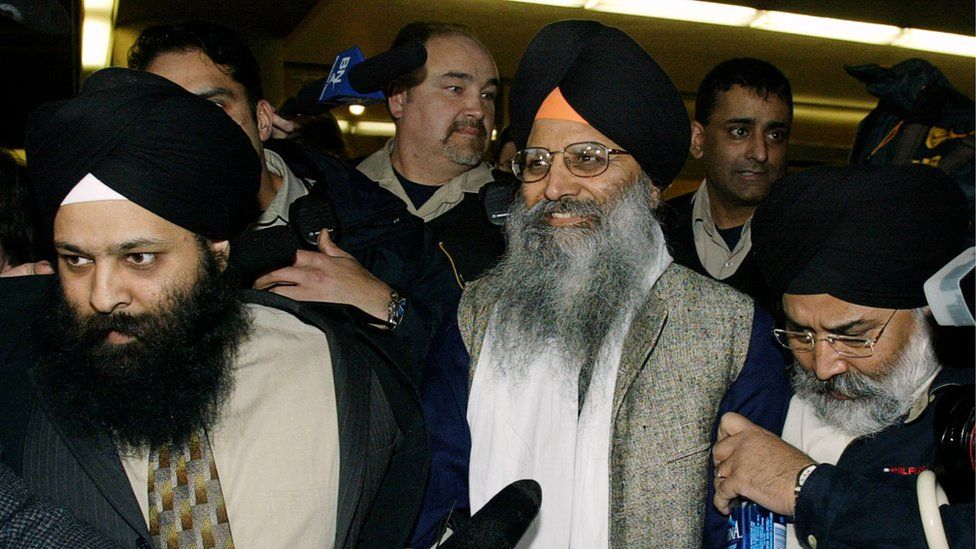
Sikh activist Ripudaman Singh Malik (centre) was found not guilty in the 1985 bombing of an Air India flight Reuters
Back in 1985 a dreadful terrorist attack took place that took the lives of hundreds of Canadian citizens of East Indian origin. Two suitcase bombs had been planted on two Air India passenger jets. One detonated prematurely and took the lives of two Japanese baggage handlers at Narita Airport in Tokyo. The other exploded over the Atlantic and all 320 passengers and crew of Air India Flight 182 were killed. That was June 23, 1985. This pre-dated the 9/11 attack that took thousands of lives as the handiwork of al-Qaeda.
At the time, there was an active anti-India group in British Columbia comprised of Canadian Sikhs who campaigned (illegally in India) for a separate homeland they called Khalistan. After 1948's partition when Pakistan broke away from India to become a Muslim state, and then Bangladesh broke away from Pakistan, it's likely that India felt it had surrendered more than enough of its territory. There is simmering resentment between Hindus and Muslims in the region.
The breakup of the territory that India claimed as its own gave rise to horrendous slaughter as Hindus and Muslims both lost tens of thousands in virulent bloodshed as Muslims streamed out of India to gather in Pakistan and Hindus left Pakistan to live among their own. Pakistan has the second largest Muslim community in the world, and India still ranks as the third largest home for Muslims in the world, after Indonesia, the most populous Muslim nation.
India has untold numbers of ethnic groups, religions and languages represented within her vast population. As a democracy it is not spared the universal conflict that occurs when tribal, ethnic, sectarian groups conflict with one another. The Khalistan movement representing the yearning for a Sikh homeland is one of those conflicts. A man living in Vancouver, Inderjit Reyat, was convicted of manslaughter in both bombings.
The mastermind behind the plot was thought to be Ripudaman Singh Malik. And his associate in the bombing Ajaib Singh Bagri. At the time in Canada, other Canadian Sikhs were aghast at the militant violence being expressed by the Babar Khalsa group. Those who publicly condemned them, including a Sikh B.C. newspaper editor, became victims of violence. One of those victims later became premier of British Columbia, and later yet a Member of Parliament; Ujjal Dosanjh.
It took until 2005 before the two accused in the bombings were to stand trial. Ultimately after a controversial trial, both men were acquitted by a provincial Supreme Court justice, cleared of murder and consp8ircy charges. After the assassination of Indian Prime Minister Indira Gandhi by two of her Sikh bodyguards in retaliation for the Indian military entering the Golden Temple of Amritsar, Sikhism's most holy gurdwara, to roust out militant Sikhs from using it as a weapons depot and headquarters.
Ripudaman Singh Malik was a free man, able to go about his business and he had many businesses, including schools for Sikh-centric education that he founded as a highly respected member of his community. At his trial, it was decided that the harrowing testimony of guilty involvement given by a former member of the group detailing Malik's role in the bombing could not be trusted, leading to his acquittal.
Yesterday a rather rough justice took centre stage, with Ripundaman Singh Malik's assassination. Just outside one of his businesses he was attacked, three gunshots rang out, an ambulance arrived to take him to hospital and he was pronounced dead. There will be an investigation. There will be an effort to discover the killers' identities and the reason for his assassination at this late date. The RCMP in its original investigation following Air India's bombing was unable to gather evidence to convict the man due to investigative incompetence. There may be a replay of that incompetence.
These videos shared by Jordan Jongema to his
Instagram detailed the devastation to his home in Yarrow and the
conditions that stranded him and his dog Bowser on Monday overnight
before crews rescued the pair.Photo by JORDAN JONGEMA / INSTAGRAM
Jordan Jongema
"Those ten hours were easily the most terrifying times I've ever experienced in my life."
"I had heard there were looters going around Yarrow to empty houses, so shame on me for staying just a few minutes too long to protect the place."
"As we were leaving, the water pooled over the road and it started like
fountaining, like a stream. I could have been driving into a
deeper pool so I just...went back to my house and we had to wait it out
in there. And as time went by, it got worse and worse.”
"A massive wave of water started to rush [over the roadway and into his front yard]."
"By the time it was midnight, I was wading through the kitchen, swimming in the backyard up to my chest, trying to find any flotation devices. Pitch black and freezing cold water for hours."
"The fear of the pump station breaking and the Fraser River flowing through made me want to die. Bows and I lay on my bed with the water half-an-inch from covering it."
Jordan Jongema, B.C. flood victim, Yarrow, British Columbia
"I believe it was Coquitlam Fire or Coquitlam SAR, actually, went and got that dog right near the end of the [rescue] queue."
"He's a service dog and so the fellow was just over the moon."
"So it was really cool that they were able to pull that off. That was good customer service, definitely worth the risk."
Abbotsford Fire Chief Darren Lee
Bowser, a 120-pound Bernese mountain dog, is
pictured in a rescue boat in the early hours of Tuesday after he and his
owner Jordan Jongema were rescued after flood waters breached his home
and left the pair stranded.Photo by HANDOUT
British Columbia's Interior was hit by a catastrophic rain event that started last Sunday with high winds and torrential rain. Between Sunday and Monday, more rain fell than normally would in a full month during the province's late fall rainy season. The local weatherman spoke of an 'atmospheric river' that drenched the province causing critical mudslides, rockfalls and floods leaving motorists stranded for 17 hours on highways between two road washouts. Rail lines were disrupted, bridges were washed out and so were highways.
Orders for evacuation went out for a number of places inundated by floods. Several hundred people stranded in their vehicles were airlifted by helicopter to safety. Farmers were desperately trying to lead their livestock to higher ground, many remaining behind on their farms despite orders to evacuate. The military was called in to provide logistical and rescue assistance. All of the province's many and varied rescue teams were tasked to endure unsafe conditions to rescue those trapped in flooded areas.
A person paddles a kayak past a submerged taxi after the
major flood event in Abbotsford. More federal assistance is on its way
to the province as reconstruction begins. (Ben Nelms/CBC)
Jordan Jongema was one of those trapped people. He and his dog Bowser, a 120-pound Bernese mountain dog, found themselves in a frightening impasse with rising flood waters. They were stranded when rising flood waters suddenly breached his home and property. He was in fact preparing to leave for safety from Yarrow where he lived, some 99 km east of Vancouver. He thought he had time to spare but was soon disabused of that reassurance.
"A massive wave of water started to rush" over the road and into his front yard as he began pulling out of his driveway. With thoughts of his car being flipped by the debris-filled water he turned back, deciding that he and Bowser would stay where they were, safe at home while the water raged outside. Nature had other plans, as he soon discovered. The flood waters entered his house and by 1:00 a.m. reached up to his knees.
He thought about seeking respite from the rising waters on the roof of his house, but found himself struggling with trying to figure out how he might manage to get Bowser onto the roof. And then, an hour later, his phone battery died, leaving him feeling "emotionally butchered". He lay with Bowser on his bed, just minimally above the water level and no doubt imagining what might happen as the water kept inching up.
And then, at about 3:30 a.m., a boat sounded outside his window. He leaped to the window and shouted, shining a flashlight, hoping to attract the attention of whoever it was in the boat. As the rescuers in the boat edged close to the house, Jongema held Bowser up and shoved him out the window, then crawled himself out to the raft. One they reached dry land some kilometres distant, Jongema and Bowser were then driven to a safe site.
According to officials, eleven people in the vicinity that night were rescued overnight. Forty farmers chose to remain in the eastern portion of the Sumas Prairie, tending their properties and their livestock.
Farmers carry their livestock out of a flooded barn in
Abbotsford. The city southeast of Vancouver is home to half of B.C.'s
dairy farms and has been hit badly by the devastating floods. (Ben Nelms/CBC)