
Politic?

This is a blog dedicated to a personal interpretation of political news of the day. I attempt to be as knowledgeable as possible before commenting and committing my thoughts to a day's communication.

Saturday, May 31, 2025

Wildfires Sweep Across Canada From East to West

"Unless we get one heck of a boost, it's projected to take chunks out of our town and surrounding areas. It's looking very ugly right now."
"We're begging for air support [to  help douse the fire]. It's really crucial."
Mayor of Flin Flon, Manitoba, George Fontaine
 
"It's a very serious situation that we're faced with. We do need some rainfall."
"We need that sooner rather than later, and in light of that not being in the forecast, we most certainly are putting in place every measure possible to prepare the province." 
"Resources are stretched thin because of the severity of the situation that we're facing and the intensity and the proximity of the fires."
Saskatchewan Premier Scott Moe 
 
"My husband was trapped on the other side of the barricade with no pills, no food, no nothing. They wouldn't let him come to me to evacuate," 
"[Reunited], we're trying to register with Saskatchewan Red Cross; I've tried numerous times."
"Worse happens, we're sleeping in the car. We'll just keep traveling from town to town to town to town till hopefully we find something."
Sandy Oosterlaken, evacuated from Denare Beach   
https://www.ctvnews.ca/resizer/v2/RIZQK456RBGMHCQEH7WZPRLUJA.JPG?auth=84b8ca47b9d19f362af71a3844f7de0980a108ed38e81748be592867698eb665&width=1440&height=664
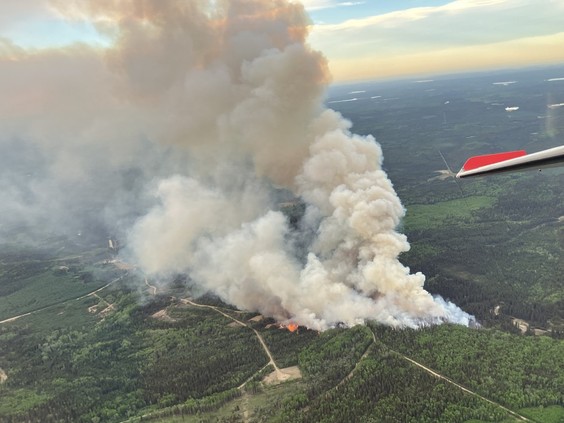
A wildfire in the Sherridon, Man. area is shown in a government handout photo on Tuesday, May 27, 2025. THE CANADIAN PRESS/HO - Manitoba Government
 
Fierce, shifting winds threatened to propel a nearby raging wildfire into the city of Flin Flon, Manitoba where buildings, both homes and civil infrastructure would be vulnerable to the flames. The municipality 630 kilometres northwest of Winnipeg served notice to its 5,000 residents to begin emergency evacuation. A wildfire that had started over the boundary in neighbouring Saskatchewan had swiftly reached Flin Flon's northern perimeter.
 
Another thousand people are resident in cottages and homes surrounding Flin Flon. All remaining residents were directed by the city to leave before noon on Friday. Buses were driving those who don't have shelter, to Manitoba's capital city, Winnipeg. A total of 17,000 residents in Manitoba have been forced to leave their towns and homes in the last several days. 
 
Small communities and towns stretching from northern Ontario to British Columbia -- Canada's east-to-west geographic arc -- face an early fire season whipping through forests. From a blaze that started Monday near Creighton, Saskatchewan, after jumping the boundary into Manitoba and menacing Flin Flon, the wildfire has grown to 40 square kilometres, with firefighting crews struggling to contain it. As a result of heavy smoke and a drone incursion, water bombers were grounded intermittently.  
 
https://smartcdn.gprod.postmedia.digital/vancouversun/wp-content/uploads/2025/05/wildfires-bc-20250529_295888309.jpg?quality=90&strip=all&w=564&h=423&type=webp&sig=eRS_OjNqnBsYfWkGKR4BZw
 
Residents of Creighton, 1,200 in number, have been ordered out of the range of the wildfire. Over 4,000 people have fled wildfires raging in Saskatchewan, under a province-wide state of emergency. Alberta, which in recent years has suffered immense wldfire damage, this year has fared comparatively better. Northwest of Edmonton, however, the 1,300 residents of Swan Hills have been ordered to evacuate, along with the 900 residents of Chateh in Alberta's northwestern corner.
 
In Chipewyan Lake, about 450 kilometres north of Edmonton, a crew of eight firefighters were temporarily trapped overnight but finally were able to drive their way out to safety. A wildfire in British Columbia that prompted an evacuation order Thursday, quadrupled in size overnight while firefighters prepared for "intensifying conditions" in the parched northeast of the province where the concentration of most fire activity is located. 
 
The blaze "displaying aggressive fire behaviour" in the Peace River Regional District near the community of Kelly Lake was about 46 square kilometres in size Friday, substantially larger from the 11 square kilometres it registered the day before, according to the British Columbia Wildfire Service.   
 
https://ichef.bbci.co.uk/news/1024/cpsprodpb/8630/live/96a0c090-3e3d-11f0-b6e6-4ddb91039da1.jpg.webp
Military aircraft and helicopters are being used to evacuate residents in Manitoba from fast-moving wildfires    EPA
 
British Columbia has about 60 wildfires ongoing at the present time, 34 of which are classified as burning out of control. According to the B.C. Wildfire Service, 18 percent of the active fires were human caused, 77 percent started by lightning taking advantage of the drought situation and tinder-dry forests, and five percent of unknown causes.  
"It's been another challenging day here in Manitoba."
"[Firefighters were using] water bombers flying overhead [and] helicopters dropping buckets of water."
"But at the same time, all the smoke in the air is making the evacuation effort that much more difficult."
"Our provinces here in Canada are immense. By the time somebody makes it to Winnipeg, some of them have been on the road overnight. They've had to be on a flight for a few hours and then on a bus for several hours after that."
Manitoba Premier Wab Kinew
https://www.reuters.com/resizer/v2/5WEAUMP6DBIXZCJOCHTVJHYLYA.jpg?auth=d8e748fd883d08c0de716255cd12d5aa99a2b20b82b93a6b39e80a7c3572bc4e&width=640&quality=80
A Royal Canadian Mounted Police (RCMP) patrol vehicle is parked as a water bomber flies over the plume of smoke from a wildfire near The Pas, Manitoba, May 27, 2025. Manitoba RCMP/Handout via REUTERS
 

Labels: , , , , , , , , ,

Tuesday, July 30, 2019

The InCredible Vanishing Act

"Our only road comes in the winter-time."
"If they don't make us that road after the ferry stops, we're stuck here until we can pass over the ice on snowmobiles."
"We're an isolated community, eh. We only have the air and the ferry."
"[The entire community is on edge]. Some people are scared, I mean, I am."
"Everyone is keeping their children inside. No one is out walking around at all. It's eerily quiet."
Judy Sinclair, resident, York Landing

"You have to know the land to get around here. If you don't, it will eat you up."
"It's heavily, heavily wooded area. Terrain is swamp and heavy woods. We're thinking of scenarios of how they made the trek here."
"They'd be noticed and pointed out immediately."
"We have our local First Nations Safety Officers that do searches for drugs and alcohol and just question persons entering the community about what their intentions are here."
"No possibility [attempting to travel from Gillam by the Nelson River, to York Landing], they'd be sucked into the current; they are very strong. You can't sit on a floater and drift down the river. There are hydro dams."
"No updates as to any sightings since yesterday. There's really a huge effort here to locate them."
"RCMP have notified us to remain vigilant and to report any information or tips you may have directly to the authorities."
Leroy Constant, chief, York Factory First Nation
Police continue to comb the wilderness near Gillam, Man., last week. The RCMP regrouped in the small community on Tuesday, searching for B.C. murder suspects Bryer Schmegelsky and Kam McLeod. (Gilbert Rowan/CBC)
The RCMP thoroughly investigated the possibility that the two fugitives, Kam McLeod, 19, and Bryer Schmegelsky, 18, of Port Albini in British Columbia wanted as suspects in three murders in northern British Columbia might be in York Landing, an inaccessible, remote community about 90 kilometres from Gillam, Manitoba, where police have been hunting for the two for the past week.
The exhaustive search yielded no clues whatever to their whereabouts, leading the RCMP to pack up and return to Gillam.

There had been a sighting by a band safety officer, a member of the Bear Clan Patrol watch group, of two men at the town garbage dump who fled into the nearby forest when they realized they had been spotted. That news, relayed to the RCMP in Gillam, spurred them to respond. And since the only way they could travel to York Landing was by air or sea, it took an hour by ferry for the first contingent of RCMP officers with their search gear to arrive. After which an intensive house-to-house search of the residences of the 500 Cree inhabitants commenced.

Police continue to search the Gillam, Manitoba area for two B.C. men suspected of killing three people.

It was a mysterious enough conundrum where the two might have got to in Gillam, the last stop on the sole road leading to it and the only road leading out. The two had torched the vehicle they had stolen, on their arrival at Gillam, and then just disappeared. Both Gillam and York Landing are isolated communities, where everyone knows everyone else. Strangers would immediately be noticed, their presence eliciting curiosity at best, and in the instance of the two fugitives an immediate alert of the police.

Presumably the two fugitive teens have retained the firearm they used to shoot dead Australian tourist Lucas Fowler, 24 and his 25-year-old American girlfriend, Chynna Deese, as well as the killing of University of British Columbia biology lecturer Leonard Dyck, for whose death they have been charged with second-degree murder. They are not seasoned, outdoorsmen and hunters, with limitless experience in wilderness camping and making use of resources available for those who can recognize them, to avoid starvation.

They would be  undergoing privation and danger of types they would likely never before have encountered as urban youth. If this is a hide-and-seek game they are playing at for excitement that their online gaming practise has prepared them for, they're succeeding admirably in evading capture by experienced hunters of psychopaths, well equipped and presumably more than capable of hunting down their lawful prey. The police are heavily armed, they have all-terrain quads, pickup trucks.


There is a Canadian Air Force Hercules at their disposal with thermal detecting devices to aid in the search. The RCMP search teams have re-assembled in Gillam, their search in York Landing concluded with no results gained whatever, no hints gleaned that might lead to the apprehension of two murderers. They are determinedly resuming their intensive search in Gillam and surrounding area, particularly the vast northern forest surrounding the community.
"I guess we're back to Square One."
"I just ultimately want everyone to still stay safe and vigilant to make sure that they still keep an eye out. You don't know if they're in the area or not." 
Dwayne Forman, mayor, Gillam
The RCMP are ending a checkstop of vehicles on the road leading to Gillam. (Lyzaville Sale/CBC)


Labels: , , ,

Monday, July 29, 2019

Eluding Capture in Manitoba

"Up here, all the towns and communities, they look like ghost towns. Like, everyone's inside. There's a high level of stress, anxiety and fearfulness because they're being kept in their houses."
"Quite a few people have even left the area altogether, kind of waiting for this to blow over."
"Some of the people, you can tell by their voice that they're almost at the point of breaking down crying. You could say it's traumatic."
Wade Taylor, Bear Clan Patrol Volunteer


Winnipeg-based aboriginal patrol volunteers received a request to fly to Gillam, to meet with and reassure residents of the town, in an attempt to instill confidence that their security and safety is being taken seriously. The Patrol volunteers who responded numbered eight, spending their time meeting and reassuring people at their doorsteps, on the streets, at public events the communities organized. People are not accustomed to being told their safety depends on their remaining indoors.

It is not only the town of Gillam where the two teen-age Port Albini, B.C. fugitives, Bryer Schmegelsky, 18, and 19-year-old Kam McLeod, are being sought by the RCMP, for second-degree murder of University of British Columbia biology lecturer Leonard Dyck, and as suspects in the murder of a young couple, Australian tourist Lucas Fowler and his American girlfriend, Chynna Deese, as they travelled in northern British Columbia, but surrounding First Nations communities as well.
Police officers complete door-to-door searches overnight Sunday in York Landing, Man. (Gilbert Rowan/CBC)

Police are using tracking dogs and drones, and going door to door to every residence in Gillam, Manitoba. Abandoned buildings, sheds, are all being investigated. The search has an aerial component with a helicopter joined by the arrival of a Canadian Air Forces Hercules aircraft equipped with high-tech thermal detection gear. Mounties are checking homes, abandoned buildings, garages, anywhere it is thought that fugitives from justice could find shelter. 

The two fugitives have managed to evade capture over a week, following the grisly discover of the bodies of the young travellers beside their vehicle adjacent the Alaska Highway, and soon afterward, some distance away, the body of the biologist, his vehicle torched. Police have appealed to the public for tips and they received 200, all of which have been followed. Some tips were posted to social media, not to police: "If the tips are valid, it can create a substantial delay on the response by police and be detrimental to the overall investigation", pointed out the RCMP.

The forest nearby Gillam has been searched, and nothing found. It was thought that if the two sought haven there they would be facing onerous circumstances of boggy forest floors, omnivorous insects, bear predation, but there are hunting cabins as well they could have accessed, and plentiful water and berries in season. Manitoba Hydro supplied police with information about their regional facilities, one a 600-room Keewatinohk Converter Station Camp close by Gillam, used during the construction of the Bipole 3 transmission line, and now vacant.
In Split Lake, Man., RCMP officers and vehicles take the ferry to York Landing at 7 a.m. Monday to search for fugitives Bryer Schmegelsky and Kam McLeod.
Photography by Melissa Tait/The Globe and Mail
And then came word that the fugitives could be in nearby York Landing. The RCMP dispatched its search teams to York Landing. A credible report by a member of the community patrol group that two unidentified men had been seen at the remote community's garbage dump, but had fled when they realized they were being watched, led the police to converge on the community for an intensive search there. Nothing was found in the community of about 500 people —  90 kilometres southwest of Gillam which is accessible only by air or a two-hour boat ride. 

So the intensive search has revered to Gillam. Questions abound: If the two were in the Gillam area how could they without any means of transportation make it to York Landing? RCMP suspect that someone in the area may inadvertently have given the two assistance without realizing that a manhunt is underway for them, which seems eminently unlikely since all the surrounding communities are well aware of the ongoing hunt for two killers. 
Heavily armed police officers are searching the community of York Landing, Man., for B.C. homicide suspects Bryer Schmegelsky and Kam McLeod. (Angela Johnston/CBC)
On the other hand, a week ago Monday, constables with Tataskweyak Cree Nation, also known as Split Lake, stopped the suspects in their vehicle at a gas bar, as they drove through the community, before the vehicle was found burned near Gillam. Because Split Lake is a dry community, the constables checked for alcohol, and had no reason at the time to suspect who the men were.  

"They did see … maps and camping gear within that vehicle they were driving", it was reported. So they might have been well provisioned to secure themselves in the wilderness area surrounding the communities. Under ordinary circumstances, perhaps, not in a northern muskeg forest facing all manner of dangers inherent in a true northern wilderness area.
The wilderness around Gillam is thick forest and swampy muskeg where wolves, black bears and even polar bears can be found

Labels: , ,

Saturday, July 27, 2019

Fugitives

"It really is [the end of the road]. The road ends here in Manitoba. This is the dead-end corner of the world. I see it as the perfect place to get caught."
"To leave, they [the fugitives] would have to backtrack along the road or walk through the forest. The only other routes of travel would be the Nelson River or the train tracks."
"Its doable. People lived here a hundred years ago, so you can do it. People have gone out in the forest and done fine, but it takes a certain kind of person to stick that out. You kind of gotta want to be there. Or need to be there."
"There's a lot of rivers they'd need to cross, a lot of swampy ground. It's wet, vegetative ground. Soft and hard walking. Depending on where you are, you could sink up to your waist."
"Right now, there's berries growing everywhere. I can't walk in my front yard without making jam. It's a bumper year on rabbits. I've never seen so many rabbits."
"Anything that floats will get out there [to Hudson Bay via the Nelson River] but the truth is, if they made it to the bay they would be facing a whole different element."
"They'd be dealing with tide-waters, very large waves and polar bears."
Jesse Taylor, 32, Gillam town employee, wilderness outdoorsman
RCMP search the area near Gillam, Man., for homicide suspects Bryer Schmegelsky and Kam McLeod on Friday. (RCMP/The Canadian Press )

So this is what 19-year-old Kam McLeod and 18-year-old Bryer Schmelgelsky may be coping with in their determination to evade capture as suspects in three grisly murders. Held to be responsible for the shooting deaths of Australian Lucas Fowler, 23, and his 24-year-old American girlfriend, Chynna Deese whose bodies were discovered close by their van as they parked close by the Alaska Highway not far from Liard Hot Springs in British Columbia.

Photos of Bryer Schmegelsky submitted to CBC News by an online gamer at Steam, a video game distribution platform, where the two met. (Submitted)

The two have been charged with second-degree murder in the death of University of British Columbia botany lecturer Leonard Dyck, 64, whose body was found on a turnout south of Dease Lake, B.C., on Highway 37, some 470 kilometres west of the first homicide scene. Their burned-out pickup stood about two kilometres from Mr. Dyck's lifeless body. They were then tracked to northern Saskatchewan and following that to northern Manitoba, a burned-out Toyota they had stolen attesting to their arrival there.
"There have been no confirmed sightings outside of the Gillam area, however we remain open to the possibility."
"Our plea today is that if anyone in and around those communities [of Gillam of and Fox Lake Cree Nation] may have inadvertently helped them get out of the community ... to just please come forward."
RCMP Cpl.Julie Courchaine
Officers comb the wilderness near Gillam, Man., on Thursday. (Gilbert Rowan/CBC)

The two were last reported having been seen in Gillam on the 22nd. Since then police have searched with dogs, drones, helicopters and patrols, hoping to unearth their presence. The military has been brought in for sighting by plane. Asking for help from the public in the hope that some clue might give investigators an idea where they might possibly look. Exiting Gillam would mean leaving the very same way they arrived. But they destroyed the stolen vehicle they arrived with. And there have been no local reports of vehicle theft since then.

At the end of the road there is the vast northern forest. With plentiful food and liquid available in its natural state, in an environment potentially hazardous to the well-being, much less survival of the uninitiated to outdoor survival. The town of Gillam has 1,200 residents, the Fox Lake reserve another 200. Everyone is familiar with everyone else; a strange face is noticed immediately, and noted. There have been no reports of the two fugitives appearing in public for the past week.

Without some kind of human intervention that might give the pair direction, support, advice and practical help of some kind, the mystery is where they might be in the forest with its boggy floor, the presence of bears, and blood-sucking bugs prevalent at this time of year, to drive animals and humans to distraction. If they are there, in the forest, they are not enjoying themselves.

"Everybody in this town knows everybody else and when somebody new comes into town, a new vehicle or a new face, people recognize that right away."
"As unnerving as this whole situation is, in my opinion, it's kind of the best scenario. Everybody knows everybody and there is only one road in and one road out. They'll find them, it's just a matter of time", assures Jesse Taylor, the informative outdoorsman.

In the interim, the hope must be that there be no further encounters with this deadly pair -- that anyone else might lose their lives. Two young men led by demons of destructive violence that only they know of, one entranced by the allure of violent fascism augmenting an already-disturbed psychotic personality, the other an unnervingly willing accomplice whose trail of bloodshed has left a nation stunned. Normal kids, their parents assure the public.


Labels: , , , ,

Saturday, February 16, 2019

A Country Divided

"I want to do all we can do to protect this headquarters and protect the thousands of good, well-paying jobs we have at SNC-Lavalin."
"We know that SNC-Lavalin, that they didn’t follow legal rules — in Libya especially — and they have to pay for that, especially the people that were involved. SNC-Lavalin, I met the president, they are ready to put on the table very large amounts of penalty [financial fines]."
"Right now there is no controlling shareholder, so there’s a real risk that this company could be bought by somebody, for example from the U.K. For me, it would be bad news for Quebec."
"Can you [Prime Minister Trudeau] settle as soon as possible in order that we keep those jobs? We need those jobs."
"When I discussed that with Justin Trudeau, I’m not asking him not to punish SNC-Lavalin, I’m just trying to say, can you settle as soon as possible, in order that we keep the jobs. We need those jobs."
Quebec Premier François Legault on the SNC-Lavalin criminal case controversy
Prime Minister Justin Trudeau and Quebec Premier François Legault before departing for Yerevan, Armenia, at the Ottawa International Airport on Oct. 9, 2018. iPolitics/Matthew Usherwood
"There is no social acceptability for oil in Quebec. We have hydro electricity surpluses. So I'll try to sell them."
"There is no social acceptance for a pipeline that would pass through Quebec territory."
"I am not embarrassed to refuse dirty energy [from Alberta oilsands extraction] while we are offering clean energy [James Bay electricity] at a competitive price."
Quebec Premier Francois Legault
The “United We Roll” convoy of semi-trucks travels the highway near Red Deer, Alta., Thursday, Feb. 14, 2019, on its way to Ottawa. Jeff McIntosh/THE CANADIAN PRESS
"The main message we are taking to Ottawa with this convoy is that our oil-and-gas sector is in trouble."
"We need a prime minister to be a champion for the industry that has done so much to fuel this country’s prosperity."
"We need to get our pipelines in the ground and soon. We need to abolish Bill C-69 and Bill C-48 and we need the carbon tax abolished."
Glen Carritt, convoy manager

"The carbon tax is killing us, our small town of Bonnyville is curling up and dying."
We've been told to hang on from our government, from five years ago, many, many people that we know and love up there, that we considered newfound oilfield family have moved, they've gone home, bankrupt."
"They're not only bankrupt financially, they're bankrupt emotionally."
Roberta Graham, Alberta protester, United We Roll group
The “United We Roll” convoy of semi-trucks prepares to leave Red Deer, Alta., Thursday, Feb. 14, 2019, on its way to Ottawa to draw attention to a lack of support for the energy sector and lack of pipelines. Jeff McIntosh/THE CANADIAN PRESS
The six-day trip by road in large transport and semi-trailers has set out to mount their protest; a message from Alberta and Saskatchewan to Ottawa, that the Canadian Western provinces whose economy has buoyed Canada's economy and hugely, disproportionately supported Canada's equalization payments to the 'have-not' provinces like Quebec, are losing vital infrastructure, investment, employment and hope and will no longer stand for being shunted aside.

The trip from Red Deer to Regina, on to Kenora, Ontario, to Sault Ste. Marie, then Arnprior and finally Parliament Hill to be reached on the 19th is on its sway. The protest is not only about the shut-down of Canadian oil transport by pipeline then tanker, but includes complaints respecting 'open borders' and illegal migrants, and Saudi oil imports and the failure of the Liberal government of Justin Trudeau to build the Trans Mountain pipeline. 

In putting roadblocks in the way of pipelines to transfer oil to deepwater ports like British Columbia which ships out more dirty-burning, environmentally disabling coal than any other place in North America [yet adamantly refuses to allow an oil pipeline to go through the province from Alberta], Canada's oil industry is faltering, and income from discounted oil sales because of delivery failures has caused an economic crisis that is unsustainable. Pressure is on Ottawa to regard the fortunes of the Western provinces as fondly as the Liberals do Quebec/

The Liberal voting base is basically Quebec. There is a paltry three seats for the Liberals in Alberta, one in Saskatchewan and seven in Manitoba, a whisper of a presence in the Prairies. But the United We Roll convoy is determined to deliver their message to Ottawa in as forceful a way as possible: the future of the oil and gas industry is vital to the well-being of the country and the current stalemate that has crippled the industry has victimized too many Western Canadians with uncertainty about the future through mass unemployment. 

Glen Carritt, organizer of United We Roll convoy spoke of more trucks joining his convoy as it crossed Manitoba and entered Ontario. A convoy from Newfoundland estimated at 50-strong would also join up once in Ontario, making up for those lost to the convoy when it completed its first day rolling across the country because not everyone was able to take the requisite time it would take to drive across the country, after completing the first leg of the journey. Of the original number that set out 70 remained steadfast in the convoy. 

Along the route the convoy drivers came across supporters holding signs of encouragement and Canadian flags as they drove past. Those unable to join the convoy supported it financially through donations made with a GoFundMe campaign which gathered in $80,000 on the first day of the convoy's trip. "I can't make my own trip down to Ottawa myself, so I figured that the fuel I would burn I may as well hand it off to somebody else. It's just a little part that I figured I could do and try to help out I guess", explained Kelly Keil in his black Dodge pickup, handing out gallon containers of diesel fuel. 

While temperatures fell below -20C, even in the middle of nowhere supporters waited, waved, took photographs and cheered the convoy on. The carbon tax is a particular irritant to rural Canadians lacking an option to take public transit or those who depend on heavy machinery for work. The cancellation of the Energy East pipeline and the Northern Gateway, then the halt of the Trans Mountain expansion by a Federal Court of Appeal ruling has disheartened all too many.

Leader of the Parliamentary official opposition, Conservative Party Leader Andrew Scheer is scheduled to join Saskatchewan Premier Scott Moe in Moosomin, near the Manitoba-Saskatchewan border for an associated rally. Polling in January from the Angus Reid Institute found almost two-thirds of Canadians view the lack of pipeline capacity in Canada as representative of a crisis. Quebec, with no agreeing majority saw 40 percent in agreement.

The Quebec Premier wails about the possibility of the corrupt activities of SNC-Lavalin earning it a guilty verdict in its criminal trial, resulting in a ten-year loss of government contracts, ending up with bankruptcy and thousands of jobs being lost for Quebecers. This is the same provincial leader who scorned the need for an energy east pipeline contaminating Quebec soil, a province that yearly takes in millions of tax dollars extracted from Alberta in equalization payments, yet has no concern that Alberta is suffering a loss of revenues and jobs.
More than 150 vehicles of various sizes took off from Red Deer Thursday morning en route to Ottawa. Robin Grant/Red Deer Express


Labels: , , , , , , , , ,

Tuesday, July 01, 2014

Coping With Nature

"We had a horrific amount of rain, but now we're going to have other issues. We'll be watching the Assiniboine carefully. It will take a couple days for the full impact to be clear."
Shari Decter Hirst, Mayor, Brandon, Manitoba

"The water is coming, it's ready to cross. I need pumps and no one is coming. My house is all I have."
"I'm stressed. So stressed."
Annette Warnatsch, Foam Lake, Saskatchewan
Heavy rains cut through farmland, roads and anything else that get in the way, including Highway 8, 22 Km south of Langenburg, Sask.  |  Robin Booker photo
Heavy rains cut through farmland, roads and anything else that get in the way, including Highway 8, 22 Km south of Langenburg, Sask. | Robin Booker photo
"I pinned 'er in reverse and got the rear end across. I didn't give it much thought. We had to get to that guy, and no way you could cross it by foot."
Calvin Annetts, Alida, Saskatchewan
It has been raining non-stop in parts of Saskatchewan and Manitoba, creating a flooding situation that seems impossible to deal with. Emergency officials in Saskatchewan are struggling to even grasp the entire scope of the disaster. Manitoba is bracing itself for the downstream flow to fully hit. Canada's Prairie flood zone is in emergency mode with a vengeance. Some fifty communities in both provinces have been placed under a state of emergency.


Ditches overflow with rain water near a car dealership in Melville, Saskatchewan on Sunday, June 29, 2014 . Highways are closing and communities are declaring states of emergency after a deluge of rain drenched southeast Saskatchewan and parts of Manitoba.
THE CANADIAN PRESS/Liam Richards    Ditches overflow with rain water near a car dealership in Melville, Saskatchewan on Sunday, June 29, 2014 . Highways are closing and communities are declaring states of emergency after a deluge of rain drenched southeast Saskatchewan and parts of Manitoba.

Water levels in communities subject to flash floods have seen the water beginning to recede, while other towns along the Souris and Assiniboine rivers, tasked by nature to carry all of that water ultimately, were bracing for high water and additional flooding. To aid the misery, heavy rainfall has continued, leaving no opportunity for the drenched land to absorb the water that previously fell over a prolonged period.

Residents of Fenwood try to pump out the town. Laurie Stopa, a resident of the town said a neighbour woke him up at 4 a.m. on June 30. He said the water was juststarting to run into the town, and within two hours his house was flooded.  |  Robin Booker photo
Residents of Fenwood try to pump out the town. Laurie Stopa, a resident of the town said a neighbour 
woke him up at 4 a.m. on June 30. He said the water was just starting to run into the town, and within 
two hours his house was flooded. | Robin Booker photo

One of the larger cities within the flood zone, Brandon, Manitoba, was experiencing dozens of flooded basements and overland flooding. Annette Warnatsch, a 46-year-old truck driver for whom the wet spring and early summer has left her out of work driving for the oil industry is distraught at the rising water flooding over Highway 310 which she relied upon as a dike to protect her home.

SaskEnergy, the provider of natural gas in the area had disconnected 1,150 flooded homes by Monday though municipal departments don't know how many people have fled their homes without alerting authorities. On Sunday night, a drama of truly humans-against-nature proportions took place when an oil rig worker failed to notice a sign that a road he was on was closed.

His rig went flying at 80 kilometres per hour over a three-metre trench that had been dug across the road to allow water to be re-directed. The crashing sound from the impact alerted a couple living nearby, and when they investigated its source, realizing what had happened, they were able to rescue the badly injured driver out of the flooded ditch.

With the arrival of emergency responders a new emergency arose; how to reach the injured man at the home of the couple who had rescued him. Another man living nearby and who works in the oil industry got into his pickup truck driving it directly into the trench to form a makeshift bridge enabling emergency personnel to walk across.

Flood water flows over a grid road on the south side of Highway 16, 3 Km. west of Foam Lake, Sask.  |  Robin Booker photo
Flood water flows over a grid road on the south side of Highway 16, 3 Km. west of Foam Lake, Sask. 
| Robin Booker photo

Volunteers tentatively walked across the hood, roof and box of the pickup truck: "I don't see we had much choice", commented volunteer firefighter Tracy Ross. Soon a forklift with extendable boom arrived and with its aid the injured man was hoisted to the ambulance to be taken to hospital in Oxbow, Saskatchewan.

As for Mr. Annetts' truck, it's still running though a little bashed up. "We just got 'er done and drank a few beers after", he said casually.

Labels: , , ,

() Follow @rheytah Tweet