Politic?

This is a blog dedicated to a personal interpretation of political news of the day. I attempt to be as knowledgeable as possible before commenting and committing my thoughts to a day's communication.

Saturday, May 31, 2025

Wildfires Sweep Across Canada From East to West

"Unless we get one heck of a boost, it's projected to take chunks out of our town and surrounding areas. It's looking very ugly right now."
"We're begging for air support [to  help douse the fire]. It's really crucial."
Mayor of Flin Flon, Manitoba, George Fontaine
 
"It's a very serious situation that we're faced with. We do need some rainfall."
"We need that sooner rather than later, and in light of that not being in the forecast, we most certainly are putting in place every measure possible to prepare the province." 
"Resources are stretched thin because of the severity of the situation that we're facing and the intensity and the proximity of the fires."
Saskatchewan Premier Scott Moe 
 
"My husband was trapped on the other side of the barricade with no pills, no food, no nothing. They wouldn't let him come to me to evacuate," 
"[Reunited], we're trying to register with Saskatchewan Red Cross; I've tried numerous times."
"Worse happens, we're sleeping in the car. We'll just keep traveling from town to town to town to town till hopefully we find something."
Sandy Oosterlaken, evacuated from Denare Beach   
https://www.ctvnews.ca/resizer/v2/RIZQK456RBGMHCQEH7WZPRLUJA.JPG?auth=84b8ca47b9d19f362af71a3844f7de0980a108ed38e81748be592867698eb665&width=1440&height=664
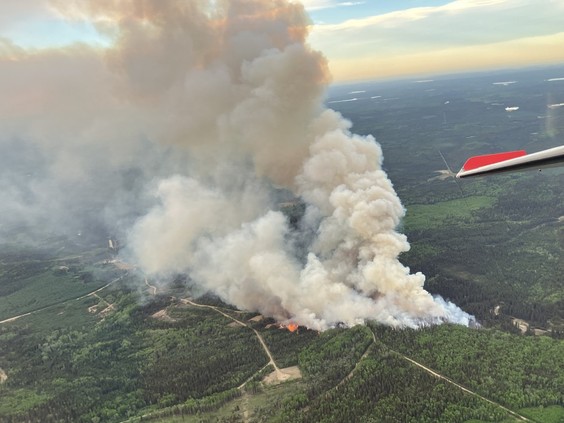
A wildfire in the Sherridon, Man. area is shown in a government handout photo on Tuesday, May 27, 2025. THE CANADIAN PRESS/HO - Manitoba Government
 
Fierce, shifting winds threatened to propel a nearby raging wildfire into the city of Flin Flon, Manitoba where buildings, both homes and civil infrastructure would be vulnerable to the flames. The municipality 630 kilometres northwest of Winnipeg served notice to its 5,000 residents to begin emergency evacuation. A wildfire that had started over the boundary in neighbouring Saskatchewan had swiftly reached Flin Flon's northern perimeter.
 
Another thousand people are resident in cottages and homes surrounding Flin Flon. All remaining residents were directed by the city to leave before noon on Friday. Buses were driving those who don't have shelter, to Manitoba's capital city, Winnipeg. A total of 17,000 residents in Manitoba have been forced to leave their towns and homes in the last several days. 
 
Small communities and towns stretching from northern Ontario to British Columbia -- Canada's east-to-west geographic arc -- face an early fire season whipping through forests. From a blaze that started Monday near Creighton, Saskatchewan, after jumping the boundary into Manitoba and menacing Flin Flon, the wildfire has grown to 40 square kilometres, with firefighting crews struggling to contain it. As a result of heavy smoke and a drone incursion, water bombers were grounded intermittently.  
 
https://smartcdn.gprod.postmedia.digital/vancouversun/wp-content/uploads/2025/05/wildfires-bc-20250529_295888309.jpg?quality=90&strip=all&w=564&h=423&type=webp&sig=eRS_OjNqnBsYfWkGKR4BZw
 
Residents of Creighton, 1,200 in number, have been ordered out of the range of the wildfire. Over 4,000 people have fled wildfires raging in Saskatchewan, under a province-wide state of emergency. Alberta, which in recent years has suffered immense wldfire damage, this year has fared comparatively better. Northwest of Edmonton, however, the 1,300 residents of Swan Hills have been ordered to evacuate, along with the 900 residents of Chateh in Alberta's northwestern corner.
 
In Chipewyan Lake, about 450 kilometres north of Edmonton, a crew of eight firefighters were temporarily trapped overnight but finally were able to drive their way out to safety. A wildfire in British Columbia that prompted an evacuation order Thursday, quadrupled in size overnight while firefighters prepared for "intensifying conditions" in the parched northeast of the province where the concentration of most fire activity is located. 
 
The blaze "displaying aggressive fire behaviour" in the Peace River Regional District near the community of Kelly Lake was about 46 square kilometres in size Friday, substantially larger from the 11 square kilometres it registered the day before, according to the British Columbia Wildfire Service.   
 
https://ichef.bbci.co.uk/news/1024/cpsprodpb/8630/live/96a0c090-3e3d-11f0-b6e6-4ddb91039da1.jpg.webp
Military aircraft and helicopters are being used to evacuate residents in Manitoba from fast-moving wildfires    EPA
 
British Columbia has about 60 wildfires ongoing at the present time, 34 of which are classified as burning out of control. According to the B.C. Wildfire Service, 18 percent of the active fires were human caused, 77 percent started by lightning taking advantage of the drought situation and tinder-dry forests, and five percent of unknown causes.  
"It's been another challenging day here in Manitoba."
"[Firefighters were using] water bombers flying overhead [and] helicopters dropping buckets of water."
"But at the same time, all the smoke in the air is making the evacuation effort that much more difficult."
"Our provinces here in Canada are immense. By the time somebody makes it to Winnipeg, some of them have been on the road overnight. They've had to be on a flight for a few hours and then on a bus for several hours after that."
Manitoba Premier Wab Kinew
https://www.reuters.com/resizer/v2/5WEAUMP6DBIXZCJOCHTVJHYLYA.jpg?auth=d8e748fd883d08c0de716255cd12d5aa99a2b20b82b93a6b39e80a7c3572bc4e&width=640&quality=80
A Royal Canadian Mounted Police (RCMP) patrol vehicle is parked as a water bomber flies over the plume of smoke from a wildfire near The Pas, Manitoba, May 27, 2025. Manitoba RCMP/Handout via REUTERS
 

Labels: , , , , , , , , ,

Thursday, April 30, 2020

Mass Murder in a Quiet Seaside Town

"There was a witness that saw a vehicle that was travelling through a field, which was not very common."
"The gunman was a collector of many things, including police memorabilia. He was in possession of multiple pieces of police uniforms from a variety of agencies."
"How he obtained the decals and how they were produced [for his look-alike police vehicle] is an investigation detail that I can't get into."
"He didn't hide that fact that he had cars or memorabilia -- from people that knew him."
"It appeared as if he was just targeting individuals that either he knew or individuals [at random] for whatever reason."
RCMP Superintendent Darren Campbell
A number of the 22 people murdered in Nova Scotia by a psychotic local denturist.

Police received frantic 911 calls from the small seaside town of Portapique in northern Nova Scotia on April 18 just after 10 p.m. By 10:26 police were on the scene. On their way they came across a severely wounded man driving his truck on the only road out of the town of 100 residents, on his way to the nearest hospital for treatment. As they continued on after speaking to the man they were to find thirteen people dead, inside houses the killer afterward set on fire, and outside on the street. Pets belonging to those shot to death were also killed.

Portapique Beach Road represents the sole access to the main highway leading to Truro, about 90 kilometers distant. And since there was only one road, the RCMP felt confident they would find and arrest the murderer before he could escape. Only as it happened they failed to. Later, they were to learn that a resident of the town had happened to see the gunman rushing away from the area nine minutes after the police had arrived. And that someone had seen the vehicle driving through a field to evade detection, and finally reach the main highway.

'The gunman had ... left the Portapique area through a field' 
Supt. Darren Campbell outlines the timeline of the N.S. shooter's deadly rampage


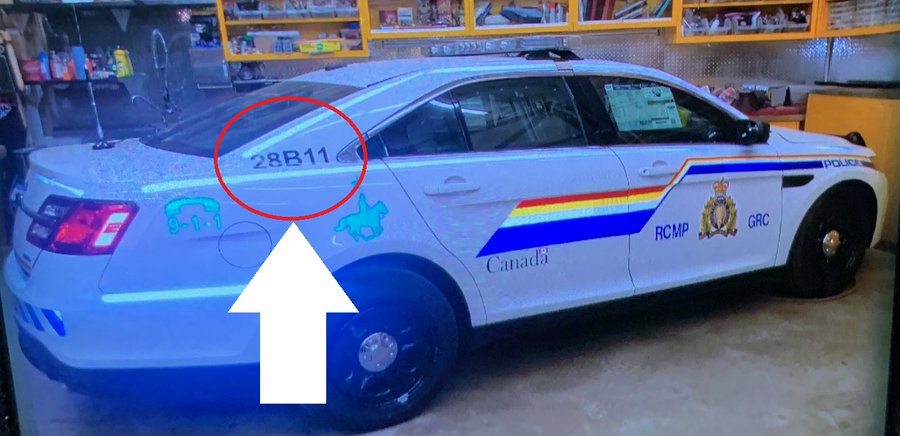
In the end, the killer, Gabriel Wortman -- who over a period of roughly thirteen hours shot 22 people to death -- drove east from Portapique to Debert, Nova Scotia, arriving there at 11:12 p.m. There, he spent the night in his vehicle, parked in an industrial park. When he headed out on his killing spree he was wearing a genuine Mountie uniform, and driving a replica police car, one of four he had bought at auction over the years. The one he was driving was fitted out with an emergency light bar and decals.

In that space of thirteen hours after the first killing spree that left 13 people -- friends, neighbours, acquaintances -- dead in Portapique, the 51-year-old gunman stopped cars on the highway with the authority of his uniform and vehicle randomly selecting and killing absolute strangers, while he drove on to specific addresses of people he knew and had a grudge against, with the intention of killing them, too. He succeeded to the extent that he took 22 lives altogether. In the process severely injuring one RCMP officer and killing a second.

RCMP investigators search for evidence at the location where Const. Heidi Stevenson was killed along the highway in Shubenacadie, N.S. (Andrew Vaughan/The Canadian Press)

In their many interviews with witnesses and those who had known the man, relatives of Wortman wo had retired from the RCMP were also interviewed, but could add nothing to the mystery of why a man well known in the community, with a thriving business in Halifax, would suddenly begin a killing rampage. Before he set out to murder and maim, set fire to buildings and vehicles, he had engaged in a violent confrontation with his long-time girlfriend, assaulted her, bound her in their house, before leaving.

She managed to escape to a nearby forest, injured and fearful, where she spent the night before emerging to alert police that her common-law partner was wearing a uniform and driving a police vehicle. "The word catalyst was used to express that that was the first victim in a series of very horrific events", stated Superintendent Campbell. "I want to be very clear that violence against women is intolerable. It's real. It exists. I don't want to be misunderstood, that the victim had any blame in relation to what occurred on those awful days."

Altogether, police identified 435 witnesses, and interviewed half of them, thus far in the ongoing investigation. Twenty legal applications have been processed, many among them for search warrants. Remains of eight of the victims were recovered from burned structures and vehicles. As far as investigators are concerned the motive for the horrendous slaughter is as yet unknown, and may never quite come to light.

A virtual vigil was held on Friday to mourn the 22 people killed during one of the deadliest mass killings in Canadian history. (Andrew Vaughan/The Canadian Press)


Labels: , , ,

Saturday, April 25, 2020

Nova Scotia's Tragedy : A Psychopath on the Loose

"This is by far the worst case I have ever heard of in Canadian history. The whole scenario: the police car, the police uniform, the indiscriminate and targeted shooting of subjects, the number of bodies, the number of crime scenes, it's unheard of."
"I would not expect perfection out of the police response in a case like this because there's nothing that can train you for something like it."
"Darkness, fires, an armed man and you don't know where he is, it adds to the complexity level over 100 percent. You can't just blindly send officers running in to find the suspect. Setting up the perimeter and containment was the absolute right course at that particular time, and it's just unfortunate that he escaped either before or some time after they set it up."
"Mass shootings just don't happen in these [rural] areas. So the police are suddenly confronted with something they have likely never experienced in their life."
"So the first thing you do is set up a perimeter and focus on containment, bringing in additional resources and then you start a methodical search of the area."
David Perry, CEO, Investigative Solutions Network

"I'm sure everyone could imagine what that scene looked like. Multiple victims, multiple structure fires. [They -- police responders -- thought it was a]  localized incident [that the killer was in the] heavily locked down [area]."
"We hear the families of the victims full force. They have every right to ask these questions and they have every right to be angry."
"To call this a tragedy would be an understatement."
RCMP Superintendent Darren Campbell
Police block the highway in Debert, N.S. on Sunday after a man disguised as a police officer went on a shooting rampage. (Andrew Vaughan/The Canadian Press)

David Perry, a former detective sergeant with the Toronto Police Services, who in that capacity before resigning from the Force was behind the initiative to launch the first Amber Alert in Ontario in 2003, felt the RCMP certainly should have used an emergency alert in warning to residents of the Portapique-and-beyond geographic area -- to cover all of Nova Scotia -- of the dangerous presence of a mass killer, advising people to remain in their homes for personal safety until such time as the suspect would be taken into custody.

The large perimeter that the RCMP was focused on in an effort to contain the presence of the murderer of at-that-time 13 people in and around the rural Portapique community of 100 permanent residents began at 10:25 p.m. following the discovery of the 13 shooting victims (some injured, most dead) at eight locations and faced with the extenuated simultaneous circumstances of multiple buildings on fire. A chaotic scene altogether, it was even thought the killer might have killed himself.
Darcy Sack, a Shubenacadie, N.S., resident, said she and her friend came across two burning police vehicles and the silver suspect vehicle while out driving on Sunday morning near Highway 102

No such thing, but it was a while before police fully understood that the killer, identified swiftly as Gabriel Wortman, had made good his escape, going on to travel 43 kilometres north wearing a police uniform and driving a look-alike RCMP vehicle. In the horrifying hours to come he would succeed in killing another 12 people. Failure to use the province's Emergency Measure Operation province-wide emergency alert represented a startling lack of decision-making.

The decision to use Twitter and Facebook was an ill-considered measure in alerting a vulnerable population. The first police to respond to the 911 call of an active shooter in Portapique came across a man driving the opposite way out of the only road connecting the community from the highway on his way to hospital. Bleeding from a gunshot wound, he informed the police that a police car driving in the other direction had fired at him; the shooter a middle-aged white man wearing an RCMP uniform.

At some point while police were setting up the perimeter around Portapique the killer had left the area to drive across northern Nova Scotia to reach properties of people known to him and whom he planned to kill. At one house the occupants saw him on arrival carrying a firearm and failed to respond when he banged on their door. On another occasion, shooting to death a couple and their daughter, he also shot to death an elderly man who had seen their house on fire and meant to offer help.

The raging psychopath saw a woman walking along the road with her dog, and shot her to death. He pulled two strangers over in his replica police car and shot each to death on two separate occasions on the highway, burning one vehicle and commandeering the other, torching his police car. A raging pyromaniac as well as a mass murderer, he had set seven buildings, mostly homes, on fire throughout his rampage.
RCMP are shown near a gas station in Enfield, N.S., shortly after the gunman's police chase came to an end around 11:40 a.m. local time. (Eric Woolliscroft/CBC)

Police called in backup inclusive of dogs, tactical officers, helicopters, negotiators, but failed to send out an emergency Orange Alert, vacillating over various drafts while Emergency Services several times urged them to send out an Orange Alert. Had people been advised, they might have stood a better chance protecting themselves from the death that stalked them. Sunday morning north of Portapique in Wentworth, a couple known to Wortman became his victims.

By the time he had racked up 19 people dead, as he drove along the highway, he saw an RCMP constable parked, awaiting the arrival of another constable he had arranged to meet. Constable Chad Morrison, parked in Shubenacadie between the cities of Halifax and Truro, was shot when Wortman pulled alongside. Severely injured, Constable Morrison headed out to a hospital for emergency care, radioing dispatch. He survived the massacre.

But Constable Heidi Stevenson, driving to the arranged destination to meet up with Constable Morrison, did not. As Wortman, still driving that look-alike police car began to approach, he rammed her car, and though Constable Stevenson responded, to engage her attacker he shot her to death. Then  he headed south to another home on Highway 224 to kill a woman he knew, and took her car, a red Mazda.
A person with the name Gabriel Wortman is listed as a denturist in the Halifax area on the Denturist Society of Nova Scotia website. He is listed as the owner of this property in Dartmouth, where police were Sunday afternoon. (Eric Woolliscroft/CBC)

He headed south to Halifax where his permanent home and his denturist business was located, but stopped at an Irving Big Stop gas station close by the Halifax airport. Two RCMP officers in a police tactical resources vehicle by chance happened to stop for gas as well. Realizing that they were in close presence to a man sought for mass murder in the province, they confronted him and one officer shot him dead.

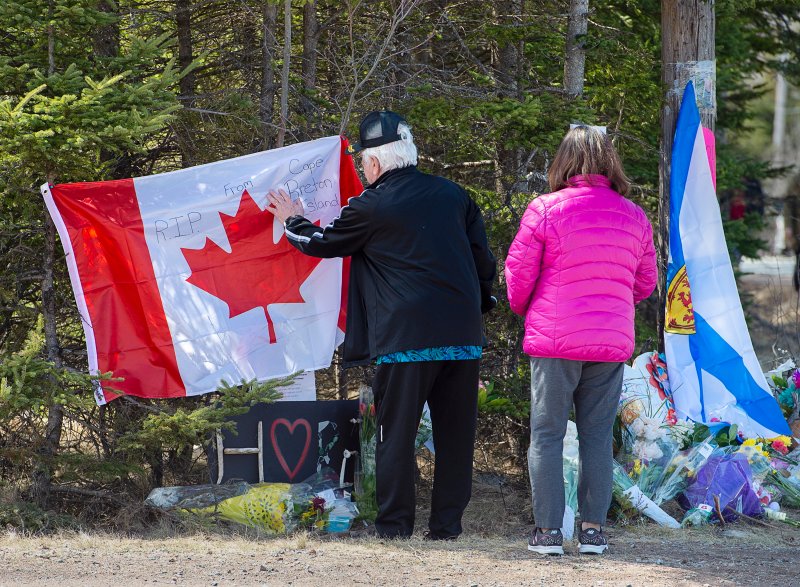
A couple place a flag at a memorial for shooting victims in Portapique, Nova Scotia on April 22, 2020.
Andrew Vaughanmdash;AP

Labels: , , ,

Friday, April 24, 2020

Absent Warning, Victims Died

"I could see a body laying on the side of the road. As I got closer, I could see it was my brother. I got one more step closer and I could see blood and he wasn't moving."
"I shut my flashlight off. I turned around and I ran for my life in the dark. I went up the first cottage road ... I turned around and looked down towards the road I had just run from to see a little flashlight flashing around looking for me."
Clinton Ellison, Portapique, Nova Scotia

"The more time you wait to give an answer, the more difficult it is to explain why you didn't use the dedicated alert system."
"And it's taken too long for them [RCMP] to provide answers."
"I think in order to gain the trust of the public they need to explain why they didn't use the system and be transparent about it."
"They need to ultimately take the fault for that."
Yannick Hemond, risk management specialist, professor, Universite du Quebec a Montreal

"Somewhere, somehow, they hit a wall."
"It would have been helpful yesterday if someone had said: 'We certainly could have done better'."
"It's important for leadership to recognize that more could have been done."
Terry Flynn, crisis and risk communications expert, McMaster University

"Some are asking questions about difficult senior operational decisions, without considering how little information is available to our first responders on the ground protecting the public in the middle of a rapidly evolving and highly dangerous crisis."
"Early speculation in advance of the investigation findings damages the morale of the brave men and women who responded to this situation, and who are grieving the loss of their colleague and community members."
Brian Sauve, president, National Police Federation

"The original call to the RCMP was to one of our members at headquarters. There was then a series of phone calls that had to be made to find the officer in charge, then speak to the incident commander, have a conversation about the issuing of a message."
"So a lot of the delay was based on communications between the EMO and the various officers. And then a discussion about how the message could be constructed and what it would say. In that hour and a bit of consultation, the subject was killed."
Nova Scotia RCMP Chief Supt.Chris Leather 
Care worker and first responder Alicia Cunningham looks at a makeshift memorial for RCMP Constable Heidi Stevenson, in Shubenacadie, N.S., on April 22, 2020.
Nothing, no explanations, no prevarications change the fact that a dreadful situation was unfolding where a psychotic killer, armed and raging, went about sacking and killing and injuring people undeterred in his killing lunacy targeting neighbours, friends, acquaintances, strangers. This was no sudden act of impetuous temporary insanity, but a well-thought-out act of vengeance for reasons yet unknown by a man within whom a sense of personal outrage had long simmered.

He had assembled a personal armoury of a variety of lethal weapons. A collector of old decommissioned police vehicles had him registering several and having one of them restored to emulate a current model with all requisite markings. From some source he acquired a genuine RCMP uniform. The murderous rampage he set out on was unstoppable and horrendous, leading to the deaths of 22 innocent people. From Saturday night to Sunday noon he tracked and hunted his victims.
Police block the highway in Enfield, N.S. on Sunday, April 19, 2020.  THE CANADIAN PRESS/Andrew Vaughan

Some just happened to wander either on foot or in vehicles into his line of operation as he travelled the 100 kilometres from Portapique the seaside rural town where everyone knew everyone else to nearby the city of Truro, maiming and killing people as he went. The RCMP resorted to posting several Tweets, and an alert on Facebook, but though the province's Emergency Measures Organization asked that an red alert go out, it ran into a bureaucratic hold-up.

A simple alert that would warn residents of the area to remain at home while a hunt for a mass killer was underway would have been sufficient to decrease the total number of victims. The alert would have been sent to cellphones and would appear on television screens. But high-level bureaucracy was more invested in a series of drafts to assure wording satisfactory to RCMP standards held to be more important than warning a vulnerable public.

Nothing might have prevented the first seven deaths of those attending a  house party that the killer and his girlfriend had been at before he returned and unleashed his killing agenda. Attending RCMP officers found at that scene in response to 911 calls "multiple casualties" inside and outside of the party house, the shooter gone. That first Twitter message asked people to remain within their homes, a message received by some of the RCMP's Twitter followers.
An RCMP investigator inspects vehicles destroyed by fire at the residence of Alanna Jenkins and Sean McLeod, both corrections officers, in Wentworth Centre, N.S. on Monday, April 20, 2020. A neighbour, Tom Bagley, was also killed on the property. Andrew Vaughan/The Canadian Press

Gabriel Wortman, 51, well known to the villagers, continued his rampage dressed in an RCMP uniform, driving a replica RCMP vehicle. He entered homes, killed residents, set the homes on fire. Returning to his cottage where he had left his girlfriend tied up to find she had escaped, he set that house on fire along with his collection of vehicles. More burned vehicles would follow during his 13-hour frenzy of death-dealing. There were, altogether, 16 separate crime scenes to account for the 22 people he murdered.

Eventually, nearing mid-day on Sunday, two RCMP constables stopping for gas, happened to come across the killer driving a vehicle taken from another of his victims. And unlike his run-ins with two other RCMP officers driving police vehicles, where he shot and seriously injured one and continued driving to come across another whose vehicle he rammed, then shot to death the woman officer with 23 years' experience in the Force, this time it was he who was shot and killed by two other RCMP.

RCMP investigators search for evidence at the location where Const. Heidi Stevenson was killed along the highway in Shubenacadie, N.S. on Thursday, April 23, 2020. THE CANADIAN PRESS/Andrew Vaughan

Labels: , , , , ,

Thursday, April 23, 2020

Maintiens le Droit [Fr, "Uphold the Right"

"[The province's Emergency Management Office] had reached out a number of times throughout the morning to the RCMP [asking for a message to be sent out as an alert]."
Nova Scotia Premier Stephen McNeil
RCMP Chief Superintendent Chris Leather Riley Smith/The Canadian Press
"We were in the process of preparing an alert when the gunman was shot and killed by the RCMP."
"From that initial call, our response was dynamic and fluid, with members using their training to assess what was going on while encountering the unimaginable."
"The original call to the RCMP was to one of our members at headquarters. There was then a series of phone calls that had to be made to find the officer in charge, then speak to the incident commander, have a conversation about the issuing of a message. So a lot of the delay was based on communication between the EMO and the various officers."
"And then a discussion about how the message would be constructed and what it would say. In that hour and a bit of consultation, the subject [Wortman] was killed."
"I would like nothing more than to provide the media and the public with a timeline [of events]. But it literally is still a work in progress [ongoing investigation]. It would be unfair and inappropriate for us to give that out in its current state. [We are still] piecing together the movements [of the gunman]."
Nova Scotia RCMP Chief Supt.Chris Leather
"We can confirm that around 10:30 a.m. there was gunfire at our hall and the gunfire caused considerable damage to our property, including taking one of our trucks out of service."
Onslow Belmont Fire Brigade hall

"They [two young sons of Greg and Jamie Blair] hid in the house until he [the killer] was gone and then they took off to the neighbour's house and hid inside with their two little kids next door until the cops came."
Tyler Blair, Portapique, Nova Scotia

"I knew from the gunshots I heard earlier, something was really wrong and I turned and ran for my life [after discovering his brother's dead body]."
"I'll be traumatized for the rest of my life. I'm having a really hard time with it. [I ran then lay in the woods for four hours] freezing to death [after seeing a flashlight beam pursuing him on the road]."
Clinton Ellison, Portapique, Nova Scotia
RCMP members pack up after the search for Gabriel Wortman in Great Village, Nova Scotia, Canada April 19, 2020. "We have to ensure that whatever happened there, there’s always going to be a better way to do things” source=””
Event:  Royal Canadian Mounted Police (RCMP) are investigating an active shooter event in Portapique, Nova Scotia, on Sunday, April 19. The public is asked to avoid Portapique Beach Road, Bay Shore Road, Five Houses Road, and the surrounding areas and stay in their homes with doors locked at this time for their safety.  Please follow instructions from local authorities and monitor local media for updates.
Security Alert - U.S.Consulate General, Halifax, Canada, April 19, 2020 
The bureaucrats at the RCMP division in Nova Scotia evidently spent 14 hours working on various draft alerts to go out as a 'red alert' to the public, over a killer on the loose. A killer who left 16 crime scenes, 5 buildings burnt to the ground, several vehicles torched, and 22 dead bodies behind him as he made his way driving through rural communities from seaside Portapique with its 200 residents on to Truro over a 13-hour murder rampage.

As the situation was unfolding, out of Halifax, the U.S.Consulate-General issued an alert of its own, to its U.S.constituency. This, while the RCMP vacillated, engaged in communication glitches, sent out two Twitter alerts to their 100,000 followers, along with a Facebook notice, and failed to issue an emergency alert message that would be transmitted to all cellular phones and television stations throughout the province with the use of a Ready Alert system.

The government's own Emergency Management Office had requested the RCMP to do so on Sunday morning. It was on Saturday evening at around 10:26 pm that the first call for a "possible shooting" in rural Portapique came through to the RCMP and the first of the weekend's murders was discovered. Multiple requests came from the provincial government for an emergency alert message. In the end, the issue solved itself when the force was finally prepared to issue the message only to discover that the mass killer had been apprehended. Shot dead, actually, just before noon.

Most people in the area had no idea that something was happening that could morbidly impact on their lives. Area residents went about their business as usual, with no inkling that they should be sheltering in their homes, because no alert had been issued, although one had been issued a week earlier reminding residents that despite the Easter holidays, a COVID-19 lockdown was in effect. Warned about one stealth killer, but not another.

One woman, a frequent trail-walker, went out with her dog as usual for a walk through nearby forest trails. In her absence, a neighbour, aware of her dedication to walking in the forest, and knowing the situation was dire, called to warn her, but it was too late, she was already out, and became a target for the killing rage of the murderer. And nor was she the only person who met death at the hands of a psychotic killer that day or the next. A man who killed friends, neighbours and strangers with no compunction, from retirees to newlyweds, to long-marrieds, to a teenager killed along with her parents.

With the use of a lookalike RCMP vehicle and a genuine RCMP uniform people seeing him would never have guessed that he was not a protector of the public. RCMP were alerted to his guise by his girlfriend who had been assaulted by him in his cottage after an argument while they were at a social gathering. He had tied her up, left the cottage to begin his murder spree by returning to the social event and shooting dead several acquaintances there before moving on to enter homes and deal in death.

"I feel strongly about that. I do feel if we had received an alert, an Amber Alert, we've had COVID-19 alerts ... then many people might have been spared", said Heather Matthews, a long-time friend of Lillian Hyslop the woman who had gone out for a walk with her dog, innocent of the knowledge that a killer stalked the area.

Labels: , , , , ,

Tuesday, April 21, 2020

Tragedy on Tragedy in Nova Scotia

"We've been unable to fully examine the crime scenes because, for instance, we have had five structure fires, most of those being residences, and we believe there may be victims still within the remains of these homes, which burnt to the ground."
To everyone hurting and trying to make sense of what has happened, please know that we too are doing so."
"We will be in this [investigation] for months to come. I know this is a challenging time for Nova Scotians and there are so many unanswered questions. I want to reassure you that we are working hard to find out as much information as possible."
"We'll never have an opportunity to interview the subject; however, we can say that his ability to move around the province undetected was surely greatly benefited by the fact he had a vehicle that looked identical in every way to a marked police car."
"Beyond that, he was wearing a police uniform which was either a very good fabrication of or actually a police uniform and that surely contributed to his ability to circulate."
"We don't know the origin of the uniforms but we certainly have reason to believe that they were either actual uniforms or very good facsimiles. We haven't recovered all of the garments."
RCMP Chief Superintendent Chris Leather
Royal Canadian Mounted Police officers surround a suspect at a gas station in Enfield, Nova Scotia on April 19. At least 22 people are dead plus the suspect following a shooting and arson rampage across the province. (Tim Krochak/Canadian Press)

It is now known as the worst mass killing in Canadian history. In twelve hours while the killer was being hunted by the RCMP, he set fire to six buildings, mostly peoples' homes on his murder spree that began on Saturday night and ended when Gabriel Workman, 51, a denturist by trade, began using a store of firearms to murder neighbours, co-workers, and strangers; at last count 22 innocent people ranging from a 23-year RCMP officer, nurses, teachers, a teen, elderly men and wounding countless others in a psychotic rage.

A collector of cars, he had bought old decomissioned RCMP vehicles one of which he had worked on and which he used during his murder rampage, one described by Chief Supt.Chris Leather "appear[ing] at least in part, very random in nature". And in the 200-resident seaside village of Portapique in Nova Scotia where the killer owned three properties and where he began his violent offence against humanity, ending 100 kilometres away on Sunday morning outside Halifax, people re in deep shock.

View image on Twitter

"This is one of the most senseless acts of violence in the province's history. We're in shock that such a thing could happen here n Nova Scotia and it's a heavy burden to bear on top of COVID-19", Nova Scotia Premier Stephen McNeil said, expressing the disbelief and grief of most of the province's population.

RCMP had responded to emergency calls, arriving to a "chaotic scene" in Portapique, casualties inside and outside a house. Soon helicopters, emergency task force officers, police dogs and other force members were deployed in a massive emergency response. Multiple buildings were on fire and they were among the 16 sites in total where the killer had expressed his fury caused by some mysterious and sinister psychological event causing an outburst of unstoppably vicious violence.

The killer was driving what appeared to be a police vehicle, dressed in an authentic-in-appearance RCMP uniform. At one scene of attempted arrest, two cars were seen on fire. The killer had changed to driving a silver SUV and at a gas station in Enfield, Nova Scotia on Sunday morning it was surrounded by dozens of police officers; one officer on one knee on top of the vehicle, assault rifle pointing through the sunroof into the car, others on their stomachs on the pavement, rifles at the ready aiming at the front door of the gas station.
Workers with the medical examiner’s office remove a body from a gas bar in Enfield, N.S. on Sunday, April 19, 2020. The Canadian Press

For some inexplicable reason a province-wide alert cautioning residents to remain in their homes was never requested nor broadcast. Instead, authorities involved took to Facebook and Twitter. Most people in the region had no idea what was transpiring. Innocent of knowledge they went about their normal activities, one woman, a dedicated walker out with her dog for an evening stroll would never return home.

Workman was not known to local police. He was a denturist practising his own business locally. Those who knew him either liked him or did not. One woman who befriended him from university spoke of his having been badly treated socially, but she spoke of a man she knew back that with sterling qualities as a human being. He was known to have produced dentures for a woman in need who was a cancer survivor at no cost to her, as an act of compassion on his part.

Other neighbours/acquaintances speak of his dysfunctional relationship with a long-time girlfriend of whom he was jealous when others noticed her because of her extreme attractiveness. Whatever led to the fury of violent attacks they may have been planned initially, then extended at random, the lunacy of hatred fuelled by psychosis to destroy lives.

"People are in shock. We're still in shock. We're a beautiful, quiet, peaceful little part of the world. Everyone is warm and caring and we'd prefer to be known as that."
"The mourning is going to go on for some time as the shockwaves keep growing and more and more people realize who was killed so senselessly. We all know each other here."
Lenore Zann, MP, Cumberland-Colchester

Labels: , ,

Sunday, June 30, 2019

Letting It All Hang Out

"Unfortunately, due to language in social posts that was unacceptable, the candidate for Dartmouth-Cole Harbour [Nova Scotia] has been removed as the NDP candidate."
"We expect our candidates to engage on important issues respectfully."
Melissa Bruno, national director, New Democratic Party

"If Israel is so advanced then why can't they avoid shooting defenceless para-medics and journalists, unless they're killing innocent people deliberately!"
"Thousands of Israelis came into Palestine and were welcomed when the world turned them away. Where's your heart?"
"I wonder if Israel borrowed this from the #Nazis after they saw how successful they were?"
"At the speed Israel is killing I wonder if they're aiming higher than 6 million #Palestinians?"
"#Gaza is the new #Auschwitz and #Israeli the gatekeepers!"
Rana Zaman, social activist, Muslim, Dartmouth, Nova Scotia
In her apology, Rana Zaman said she appreciates that her comments referencing the Nazis were “inappropriate, hurtful and sadly may be perceived as anti-Semitic.”    Facebook
Rana Zaman, described as a social activist, and strident 'Islamophobia' fighter was confirmed in May as the candidate for the New Democratic Party in the Halifax-area riding of Dartmouth-Cole Harbour in Nova Scotia for the upcoming October federal election. Evidently her 'activism' brought scrutiny to her candidacy and someone unearthed a number of incendiary and rather hateful tweets she had posted a year earlier. The content of the tweets, brought to the attention of the NDP executive, has earned her censure and removal as an NDP candidate.

The NDP doesn't mind a certain level of criticism of Israel, but it must be done discreetly so that it can be pointed out that it is Israel's purported record on human rights failings that is being criticized, and as such not a whiff of anti-Semitism is attached. The statements by Rana Zaman ooze anti-Semitism, quite in keeping with her status as a 'Muslim activist' whose major preoccupation is asserting that any criticism of Islam as a religion that tends to foster violence is beyond the pale.

The woman, in fact, betrayed colossal ignorance of history and reality in the tenor and vitriol of her comments, entirely out of whack with any vestiges of cerebral functioning. On the other hand, perfectly aligned with most 'Palestinian rights' campaigners who relish accusing Israel of committing genocide against Palestinians, despite Palestinians living in Israel having citizenship, voting rights, electing Knesset Members, holding Cabinet positions, sitting on the Supreme Court....

Canada's newly adopted definition of anti-Semitism as part of its anti-racism strategy includes "drawing comparisons of contemporary Israeli policy to that of the Nazis" in its adoption of the International Holocaust Remembrance Alliance's definition. A definition linked to a current-day example of anti-Semitism. To add to her sterling resume as a candidate for public political office, Rana Zaman supports the boycott, divestment and sanctions (BDS) movement, yet another Palestinian-branded delegitimization of Israel's right to exist, and one which all parties of the House of Commons rejected two years ago.

Labels: , , ,

Friday, March 03, 2017

Clearly the Justice is an Idiot : Rape Acquittal

"Clearly, a drunk can consent. [Someone] who is unconscious or is so intoxicated ... as to be incapable of understanding or perceiving the situation that presents itself [cannot provide consent under Canadian law]. This does not mean, however, that an intoxicated person cannot give consent to sexual activity."
"[Al-Rawi had a] moral or ethical [duty to see the complainant home safely, and he] is not somebody I would want my daughter driving with or any other young woman."
"Once he saw she had peed her pants, he knew she was quite drunk. He knew going along with any flirtation on her part involved him taking advantage of a vulnerable person."
Judge Gregory E. Lenehan, Halifax, Nova Scotia
The Nova Scotia provincial court on Spring Garden Road in Halifax.
George Lang / Wikipedia   The Nova Scotia provincial court on Spring Garden Road in Halifax.
"We should be concerned when a trial judge in a sexual assault case refers to a complainant as 'a drunk'."
"You can't consent if you lack capacity and to equate incapacity with unconsciousness is wrong. Lack of capacity presumably begins at some point prior to unconsciousness."
Elaine Craig, associate professor of law, Dalhousie University, Nova Scotia
This is not the first time that a Canadian judge has seen fit to acquit an accused rapist on the charges brought against them by a woman who has been violated. Recently in St. John's Newfoundland, a police officer had been acquitted of the charge of sexually assaulting a 21-year-old woman, because she was drunk at the time. "Drinking doesn't cause sexual assault, rapists do", stated Farrah Khan, co-ordinator of the office of sexual violence support and education at Ryerson University in Toronto.

Yet, she pointed out, intoxication is used as a mainstay in trials to discredit the reputation and veracity of complainants, despite evidence of the occurrence of assault. The infamous case of Justice Robin Camp stands as the standard-bearer for the incapacity of male justices to wrap their minds around rape as a crime committed against women whose physical frailty compared to the strength males can bring to overpowering women equals inequality.

He asked the young woman who had been raped in  he case that he heard, why she couldn't keep her "knees together", giving her the added paternal advice that "sex and pain sometimes go together". After the ignominious trial ending in the acquittal of the accused, this man went on to become a judge in the Federal Court of Canada. Once his infamous remarks and the acquittal were brought to public light there was such a reaction that an enquiry is now considering removing him from the Federal Court.

Judge Lenehan was a Crown prosecutor for decades before being appointed in 2010 to the bench. He, like the other justices before him has obviously had ample opportunity to witness testimony about sexual assaults. He is also, doubtless well aware of the pitfalls of speaking extemporaneously and in poor judgement, if he keeps abreast of such incidents occurring elsewhere, eliciting public concern.

In this particular case, a witness, Constable Monia Thibault, describes discovering the 20-something woman "naked from the breasts down", unconscious in the back seat of a cab. Yet Judge Lenehan seemed to find it reasonable that Bassam Al-Rawi, 40, not be deemed guilty of sexually assaulting the young woman.

The cab driver's trousers, according to the officer, were descended and in his hands were the woman's tights and underwear. For her part, the young woman was so intoxicated she has no memory of what had occurred. But she was unconscious when the police officer came across the scene, leading the judge to state it is "unknown" when she had passed out, and she might just have agreed to sex with the driver, in his exalted opinion.

The young woman's blood alcohol level was tested at 223 and 244 milligrams of alcohol in100 millilitres of blood. Which, according to the testimony of an expert, would have meant she was sufficiently drunk to have no memory of events, and to have lost track of her surroundings. If the penalty for drunkenness is certain rape, perhaps Canadian justice could cite complete responsibility for rape lies with those careless enough to become intoxicated.

Or have they already done that?

Labels: , , ,

() Follow @rheytah Tweet