
Politic?

This is a blog dedicated to a personal interpretation of political news of the day. I attempt to be as knowledgeable as possible before commenting and committing my thoughts to a day's communication.

Wednesday, February 05, 2025

The Scourge of Fentanyl
https://www.brookings.edu/wp-content/uploads/2024/10/us-china-counternarcotics-working-group.jpg?resize=2000,1333
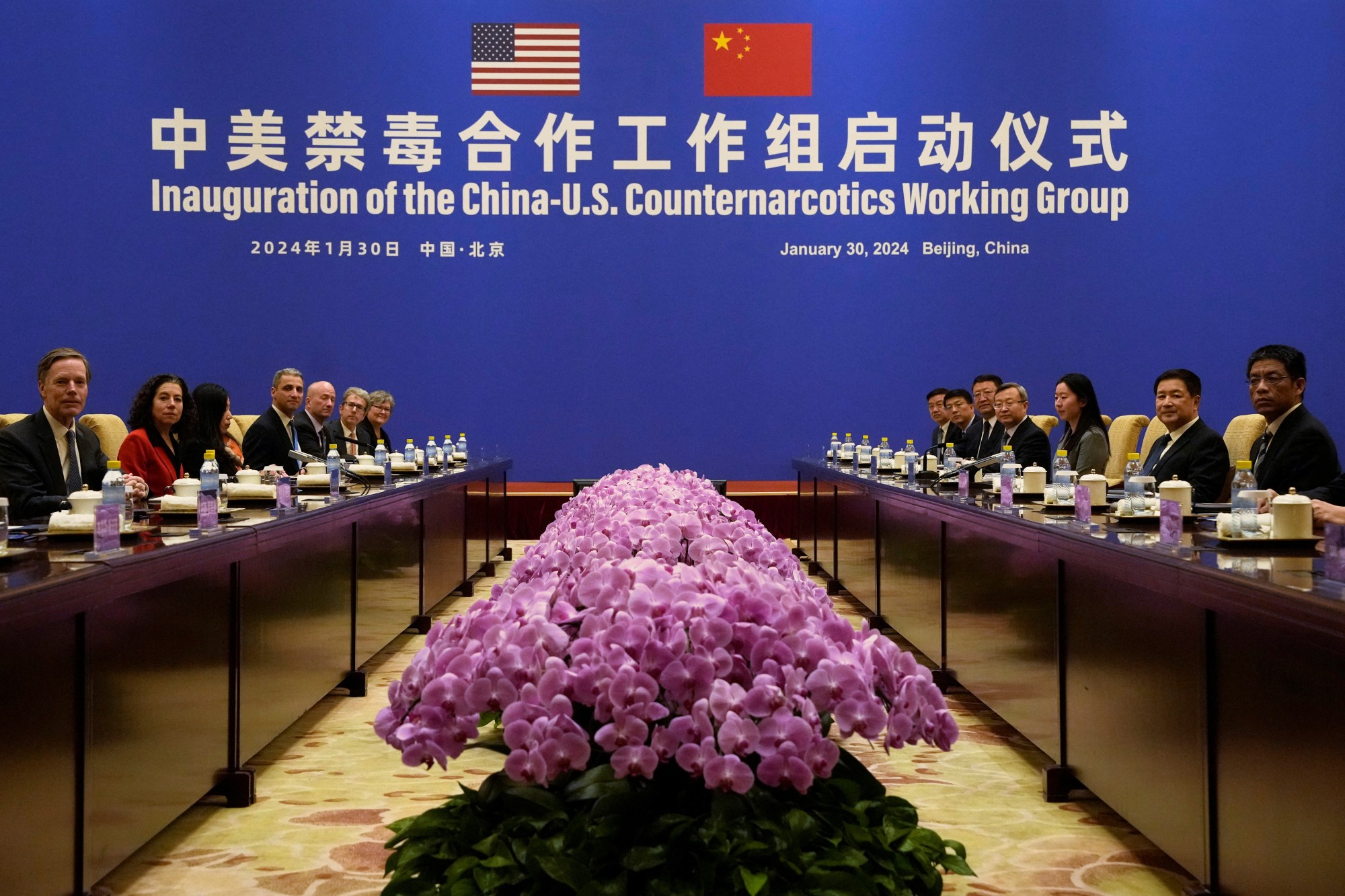
U.S. and Chinese officials before a meeting at the Diaoyutai State Guesthouse in Beijing, Tuesday, Jan. 30, 2024, to launch the U.S.-China Counternarcotics Working Group. (Ng Han Guan/Pool via REUTERS

"Fentanyl is an issue for the U.S."
"The U.S. needs to view and solve its own fentanyl issue in an objective and rational way instead of threatening other countries with arbitrary tariff  hikes." 
Chinese Foreign Ministry
 
"As long as there is a strong consumer market in the U.S., it is  unfair to blame China for producing these substances."
"China has consistently enforced strict measures to combat the fentanyl issue."
"However, if Trump continues to use tariffs to pressure China, Beijing may decide that it is unwilling to cooperate further."
Wang Towei, international affairs expert, Renmin University, Beijing
 
"It's going to be a very big national mobilization to identify where [the manufacturers] are."
"[Companies] can just quickly change the name and restart the business elsewhere."
Zongyuan Zoe Liu, senior fellow, Council on Foreign Relations 

"The truth is that if Xi Jinping and the CCP wanted to end the flow of precursors and synthetic opioids to the U.S., they can most certainly do so."
John Coyne, director of national security programs, Australian Strategic Policy Institute 
https://ichef.bbci.co.uk/news/1024/cpsprodpb/32d0/live/cd24e7e0-e2e9-11ef-a83b-bf768968ed36.jpg.webp
 
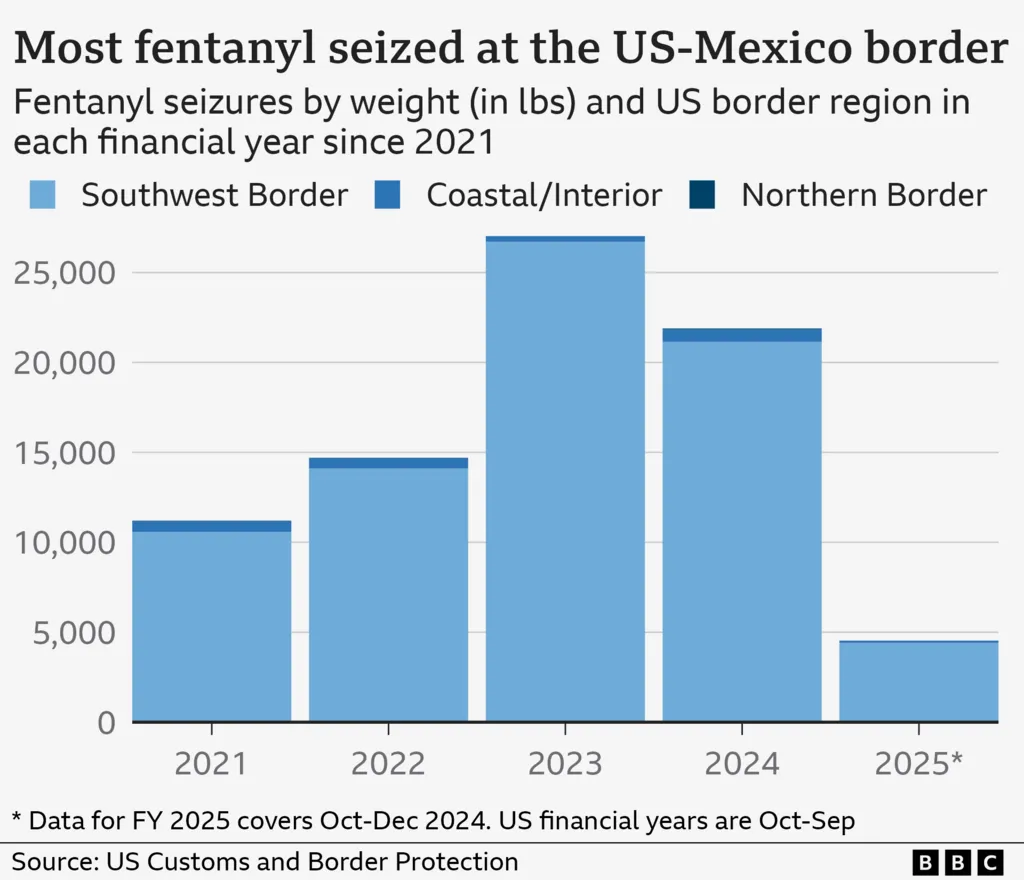
For reasons known only to himself, newly-returned-to-the-Presidency Donald J. Trump decided to economically thrash Mexico and Canada through the imposition of onerous tariffs, citing among other issues that propel him to take these measures, leaky borders through which the deadly opioid fentanyl finds its way across borders into the U.S. For Mr. Trump, outraged over illegal migrants flowing into the U.S. across borders and trade imbalances, an across-the-board 25% tariff on goods and materials seemed reasonable.
 
Three nations sharing a continent, all three considered to be friendly to one another, fellow democracies with shared values, yet two of the three are receiving punishing, unfriendly notices of punitive tariffs that will have the effect of spiralling them into a recession through diminishing their GDP with a barrier threatened across borders. Yet China, a restrictive autocracy at best, and a trade-threatening colossus that is challenging the U.S. in influence, trade and power now faces a 10 percent tariff.
 
Imposed for similar reasons to those placed upon America's near neighbours and once again the destructive power of fentanyl is cited. This scolding of China and holding it accountable to the U.S. for waylaying promises to put a halt to "poisonous fentanyl and other drugs from flowing into our country" while accusing the CCP of having "subsidized and otherwise incentivized" the shipment of fentanyl and other chemicals to the U.S. 

In response, Beijing's Commerce Ministry on Sunday promised countermeasures to address the tariffs along with its intention to file a lawsuit with the World Trade Organization. Beijing took no notice it seems, of how lightly it came off in Mr. Trump's allocation of 10% tariffs as opposed to the 25% imposed on friendly nations of the U.S., criticizing the U.S. President's actions as lacking rationale, emphasizing it is not China that is responsible for America's health issues.
 
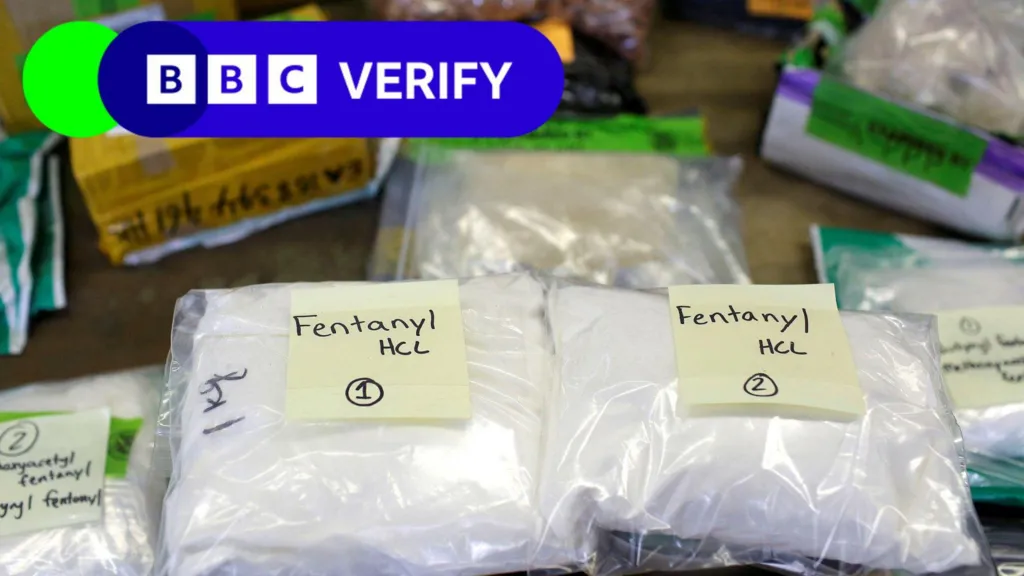
Prescription opioids like OxyContin, introduced in the 1990s as painkillers led to fentanyl, an artificial opioid, flooding the market. Chinese chemical manufacturers produced fentanyl which became the primary source of a new opioid trafficked in the United States. Following pressure from the U.S., Beijing agreed to designate fentanyl as a controlled substance policing fentanyl shipments to the U.S -- which merely slowed down the global supply chain.
 
China remained the major source of precursors of fentanyl, chemicals which were designed to produce the drug, shipped abroad to countries like Mexico where criminal gangs assembled the drugs, and where at the present, a booming online marketplace facilitates the trade in fentanyl, leading to overdose deaths from the potent, deadly drugs. In 2023, China's National Narcotics Control Commission warned companies against the sale of fentanyl precursors.
 
How increased tariffs imposed on Chinese imported trade goods will have any effect on staunching the flow of drug precursors from China, remains unclear. Zongyuan Zoe Liu of the Council on Foreign Relations, points out that China's sprawling chemicals industry includes a vast number of small companies involved in both illegal and legal operations. 
 
Counter-narcotics experts feel Beijing could crack down aggressively on precursor chemical makers in reflection of its expansive surveillance and law enforcement apparatus. The issue for Beijing, on the other hand, seems not to be of a sufficiently urgent nature to galvanize it into action to disrupt a booming Chinese industry. 
https://ichef.bbci.co.uk/news/1024/cpsprodpb/9b96/live/55084920-e242-11ef-a819-277e390a7a08.png.webp


Labels: , , , ,

Wednesday, February 01, 2023

Pick Your Poison ... Brave New World

Vancouver's Downtown Eastside, the notorious drug capital of the nation. How to solve the problem of drug overdoses without exacerbating the problem of addictions to killing, mind-altering drugs? The answeer is so simple, it stared us all in the face and no one recognized it. The War on Drugs made people fiercely possessive about their right to procure drugs and ruin their lives. How to get around that? Simple enough, legitimize possession for personal use of all drugs, not merely marijuana, but the hard stuff, too. That will endow the users with a sense of comfort and self-respect, and a cure will take off from there.
 
And just think; it relieves police of the nasty work of harassing people, taking them into custody, keeping a sharp eye out for drug users who may go berserk. Drugged out bodies littering the pavement of an early morning on a beautiful winter day? Walk on by, none of your business Vancouver Police. Someone's got a syringe of heroin injecting and moaning with the pain of it all? Not your business, chum. 
 
A man wearing a mask around his chin holds up three boxes, styled like cigarette cartons. They are marked 'Meth', 'Cocaine' and 'Heroin'. The man is surrounded by other people.
A man holds boxes containing tested cocaine, meth and heroin given out by the Drug User Liberation Front in July 2021. It will not be a criminal offence to possess up to 2.5 grams of certain illegal drugs in B.C. starting Tuesday, Jan. 31. (Ben Nelms/CBC)

The gracious government of British Columbia has enacted a policy that adults in possession of 2.5 grams of heroin, fentanyl, cocaine, methamphetamine or ecstasy for personal use will no longer face arrest or their drugs seized. Isn't life wonderful, after all? Of course there are niggling, inconvenient realities like the fact that since 2015 over 11,000 British Columbians died from drug overdoses. That's life, waddyagonnado? 

And what does the federal Minister of Health say about the issue? Time for "a monumental shift in drug policy". The goal "is to save lives". All well and good, right?

"Substance use is a public health issue, not a criminal one."
"By decriminalizing people who use drugs, we will break down the stigma that stops people from accessing life-saving support and services."
B.C.Minister of social development and poverty reduction, previously minister of mental health and addiction, Sheila Malcolmson 

"The new role of the police in British Columbia is] to redirect people who possess small amounts of certain illegal drugs away from the criminal justice system and towards health and social services."
Staff Sgt.Kris Clark, Vancouver Police Service
"Every step of the way we need to make sure we are following science and data and that's what we're doing."
"You don't want to do it without the system and support in place. Of course we've heard of cities like Toronto and Edmonton wanting to take this on, and we're going to work with them every step of the way as, or if, we move forward."
Prime Minister Justin Trudeau

"Death due to drug toxicity remains the leading cause of unnatural death in British Columbia, and is second only to cancers in terms of years of life lost."
B.C. Chief Coroner, Lisa Lapointe
A woman wearing a mask holds up a sign that reads 'For decrim to work, we need a safe supply'. She is at the head of a row of people marching on a street.
A woman holds a sign during a protest in May 2021. The decriminalization pilot has been criticized for its low threshold, with advocates saying it likely won't stop thousands of people dying from a tainted drug supply. (Darryl Dyck/The Canadian Press)

Oddly,  ironically, several weeks ago the federal government, concerned over the health of Canadians issued guidelines to updated recommendations addressing alcoholic beverages; no more than two drinks a week. Plans are afoot to have food marketers place warning labels on any food processed with high fat, sugar or salt contents. Canadians' poor health, obesity, diabetes, heart disease and more latterly, the coronavirus, has burdened the health care system beyond capacity, not to mention the costs involved.

British Columbia is convinced it has the solution to the issue of five people daily for the last six years dying of drug overdoses. Thinking well ahead, the 2021 provincial budget pledged $500 million for mental health and substance abuse services; $152 of the total meant for opioid user treatment; $133 million for treatment and recovery services; and $45 million for overdose prevention. What could go wrong?

This is in the nature of an 'experiment', meant to last for a three-year period when an analysis will presumably create a study document setting out the enormous success of this visionary plan to save the drug addicted from the fate of early mortality. Outreach worker James Harry, a former drug addict, confesses to being baffled by the reform project. "We're giving people the freedom to walk around with that poison in their pockets. It just doesn't make sense to me", he averred. What does HE know, after all?!!
 
In the House of Commons Justin Trudeau has been criticized by the leader of the official opposition, Pierre Poilievre who charged: "after eight  years you have given in to Canadian cities that are turning into crime zones". Toronto, for example, where the proliferation of street crimes and particularly violent and sometimes deadly crimes in the transit system of sudden, random attacks by the homeless with mental illness and drug addiction problems has terrified the population.

While relaxing public and government censure under the law of personal drug use, the toxicity of street drugs such as fentanyl -- the synthetic opioid 50 times more powerful than heroin -- involved in 87 percent of overdose deaths, has been ignored. Fentanyl is on offer through prescription in British Columbia,with drug campaigners urging to have this "safe supply" expanded to include other substances. 

The B.C. Coroners Service announced suspected drug toxicity was responsible for the loss of 2,272 lives in 2022; with 2,306 overdose fatalities racked  up the  year before, making for an average of six people expiring each day last year. "So the police  won't arrest us now? I guess they'll just be here to help with the bodies", observed one woman addicted to crack cocaine. 

An undated photo shows illicit drugs being prepared for use.
An undated photo shows illicit drugs being prepared for use.   CTV
"He is promoting addiction and trafficking. There is absolutely no way he will be able to stay open. [Jerry Martin, proposing to open a private shop in the Downtown Eastside to sell 'clean drugs' to users]."
If so, every other gangster or organized crime group would open up shop as well."
"If we allow stores to sell cocaine, it will be the dumbest thing in the world."
Andy Bhatti, drug addiction interventionist

"This action [British Columbia legalizing personal use of all drugs] will likely result in a dramatic increase in drug use, violence, trafficking and addiction."
"Something that health systems are already overburdened with."
Former Premier of Alberta, Jason Kenny

Labels: , , ,

Friday, January 25, 2019

Canada: The Rule of Law

"Corporal Catellier searched the accused’s vehicle with what I have found to be an absence of reasonable grounds to arrest the accused."
"This time, she [police service dog Doods] went to go sit and appeared to be startled by her rear-end hitting the concrete barrier on the passenger side of the van."
"He [expert witness] described the dog as very lackadaisical ... He said that dogs that make a find are typically happy, engaged, excited, and more alert because they expect to be able to play with a toy."
"The arrest of the accused and subsequent searches of the accused’s van incident to that arrest therefore violated s. 8 of the Charter."
"This was not a situation where the police merely opened the hood or the rear of the vehicle to take a quick peek inside. It was not a minor or technical breach. Rather, the breach was more blatant. The impact of state intrusion was thus relatively high."
B.C. Supreme Court Justice Michael Brundrett, pre-trial ruling

"The dog and the signal that the dog gives, we're relying on that to give the police officers what they don't have, and that is grounds to make an arrest, detain the person, start the criminal process."
"When you're looking at what the dog actually does, you're starting from a point when you don't have grounds to make an arrest or to engage in a search, so the dog has to get you over that hump of reasonable grounds."
"If the dog is equivocal in their behaviour, then it's, I think, a legitimate argument to say it doesn't give you that extra evidence you need."
Michael Spratt, Ottawa defence lawyer
RCMP drug-sniffer dog, PSD Doods -- still from video

Canada, like the United States, has an extremely serious problem with the criminally illegal proliferation of Fentanyl on the streets, sold for illicit profit as an opioid of choice, or used as filler in other types of drugs for greater profit. There has been an epidemic of drug overdoses linked to Fentanyl, a powerful synthetic drug used during surgeries to dull pain, and prescribed for patients suffering from chronic pain. It's a highly addictive drug, one that ensnares both non-recreational-drug users and those accustomed to using street drugs.

For police, it's a high priority to get dealers off the streets with their deadly wares. And this was what was in RCMP Cpl.Clayton Catellier's mind during traffic patrol on Highway 1 near Chilliwack, British Columbia in April of 2017 at a traffic stop when a brown Ford Windstar minivan sped behind his vehicle 15 kph over the speed limit, causing Cpl. Catellier to pull the van over. He noted that the driver was "shaking violently".

And then other signals alerted the police officer, well versed in the ways of drug runners, when he smelled the strong odour of air freshener or cologne permeating the vehicle, and noticed the presence in the vehicle of a number of cellphones, including BlackBerrys whose presence is suspicious since the encryption capabilities they come with has gained huge popularity with drug dealers. The driver, Sandor Rigo, explained he had just driven from Calgary to Vancouver and back, for used tires.

The judge noted in his statement that the van driver's explanation represented "one of the most illogical travel stories that (Catellier) had heard in the hundreds of traffic stops that he has conducted". Judge Brundrett acknowledged at the same time that Highway 1 between Chilliwack and Hope is notorious for drug running, so he was not completely ignorant of all the hints that a seasoned police officer could intuitively put together to reach an instant alert.

It just happens that this particular stretch of highway is known as a drug corridor. All of which hints spurred Cpl. Catellier to call on his search dog to do some serious sniffing. This was Doods, a trained police service dog with a good record of sniffing out the presence of drugs. She sniffed about the vehicle, tail wagging, nose busy at the van, and began to signal the presence of drugs. According to Cpl. Catellier, she placed her paws on the side of the vehicle, then attempted a 'sit' signalling the presence of drugs.
Fentanyl pills      Photo: The Canadian Press

The 'sit' position was incomplete, interrupted by the dog's back end coming in contact with a concrete barrier. The intention was obvious, however, spurring the police officer to arrest the driver in whose possession a quantity of cash had been found during a frisk. A search of the vehicle proceeded at the side of the highway, but nothing incriminating was found until the van was towed to town. There, the police officer searched the interior housing of the right wheel well, to discover five plastic bags full of fentanyl pills.

And it was then that the van driver was charged with possession for the purpose of trafficking. This was a discovery of a substantial amount of deadly fentanyl; 27,500 pills. At a pre-trial hearing, a U.S. expert witness, a former Anaheim County police officer testified for the defence, claiming it was his belief the dog gave no sign that drugs were present. And even though the judge viewing the dash cam video on the RCMP vehicle verified that Doods had committed a partial sit, he still ruled the sit was "highly ambiguous".

He ruled the sit not to be 'legitimate', and as such the arrest violated the van driver's Charter rights. He was acquitted of all charges. A perfectly idiotic ruling in view of the evidence the search of the van revealed, incriminating without an iota of doubt the man whom the judge had seen fit to acquit. When the law utterly lacks common sense, despite a crisis of drug overdoses from deadly drugs being dealt on the streets, leading to countless deaths, it's time to question why.

Doods is incensed, and anyone with an ounce of sensible thought processes should be outraged.

Upon sniffing the car — her tail wagging and nose bouncing off the van — Doods began to signal there were drugs, but her attempt to sit was impeded by a concrete barrier near the vehicle. Leann Parker/RCMP


Labels: , , , , , ,

() Follow @rheytah Tweet