Politic?

This is a blog dedicated to a personal interpretation of political news of the day. I attempt to be as knowledgeable as possible before commenting and committing my thoughts to a day's communication.

Saturday, January 18, 2025

Illegal Gold Mining in South Africa

"I felt like I have some bad luck because I had only been underground for two weeks when the operation started. That is when things started going bad, we stopped receiving food and we lost contact with the outside world, that could only mean that the police have arrived and probably arrested or scared off the people lowering the food."
"By September, things were really bad. People started getting hungry they started getting sick, some started dying. We started having dead bodies. There is nothing worse than seeing somebody die and there is nothing you can do about it."
(Name withheld) illegal miner
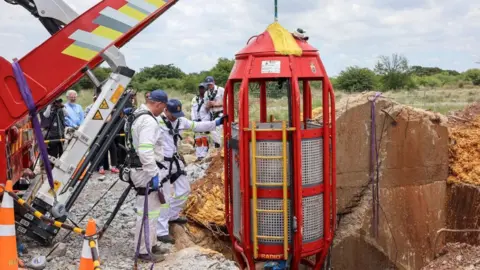
AFP Two men dressed in white boiler suits stand next to a red metal cage attached to a hoist as they get it ready to be lowered down into a mine shaft.
Rescuers lowered in a cage into the mine   AFP

Noxious odours permeated the area; whether from the corpses  wrapped in fabric and twine, laid out in rows, or emanating from the unwashed bodies of emaciated, starving miners, or stenches from the damp rock of the environment. Emaciated from lack of food since police had cracked down on illegal mining and had put a stop to the delivery of food supplies, water, fuel and other life-saving necessities. Their usual diet while underground was meat, bread and porridge cooked over propane-heated camp stoves. 
They had been reduced to eating rough salt to try to staunch hunger.

While they still had those supplies, they smoked cigarettes and marijuana, until they ran out. Cellphone videos and miners' testimonies shed light on the horror that hundreds of men suffered underground in an abandoned mine in South Africa following a police operation that cut off food and supplies in a strategy to "smoke them out", because authorities considered the 2,000 men working deep underground in one of South Africa's largest and deepest mines, to be criminals, illegally mining for gold.

Eventually police were forced by a court order to launch a rescue effort early in the week. When the mission was completed, they reported that no one had been left underground. Dozens of bodies had been pulled out, with a minimum of 87 confirmed dead. One miner speaking on condition of anonymity fearing reprisals, had surfaced Christmas Day, months after he entered the shaft in July. One among the two thousand who ventured there, he experienced extreme hunger and witnessed fellow diggers expiring from starvation and illness.

In August of last year when police targeted the mine near the town of Stilfontein as part of an operation aiming to tackle widespread illicit mining, the man, 40 years of age, father of six children, eventually exited the mine through a separate shaft clambering up and out laboriously on steep steel stairs extremely difficult to navigate, upon which he badly bruised his hands climbing out.
"As we were climbing out we saw dead bodies of other guys who had attempted to exit the same way. Others had fallen down, others were full corpses but there were also lots of bones, almost like skeletons."
"It's not easy to exit there, many people died trying to do that."
(Name withheld) illegal miner
Illegal mining represents one of the largest sources of income for poor families in townships located nearby an estimated 6,100 disused mines country-wide. And this is where illegal mining tends to be rife. Persuaded when he was told  he could earn about $5,300 for working a few weeks to a month in one of the country's deepest gold mines no longer officially operating, he took up the offer in a country with one of the highest unemployment rates in the world. 
 
Many of the miners arrive searching for employment from neighbouring countries like Mozambique, Zimbabwe, Lesotho, Malawi and Congo as illegal arrivals in South Africa where their presence is  generally held in contempt. Also working in the mine were 13 children.

Mmastona Mbizna explained that two of her sons were engaged in illegal mining as a result of poverty and steep unemployment. Her 22-year-old son was arrested when he left the mine in December. Another son was arrested at the same mine working as a runner on the surface, lowering supplies down to the miners. He was convicted for involvement in illegal mining. "Out of the blue the police came, firing rubber bullets and tear gas. The tear gas blinded me and I fell, broke my leg and collapsed", he said.

The government maintains what though the deaths were tragic, illegal mining is a criminal activity detrimental to the country's economy. "The people who must take responsibility for the deaths that have happened here are those who are benefiting from illegal mining", said Mines Minister Gwede Mantashe, in Stilfontein.
https://ichef.bbci.co.uk/news/1024/cpsprodpb/6ec3/live/20212e60-d4fb-11ef-9fd6-0be88a764111.jpg.webp
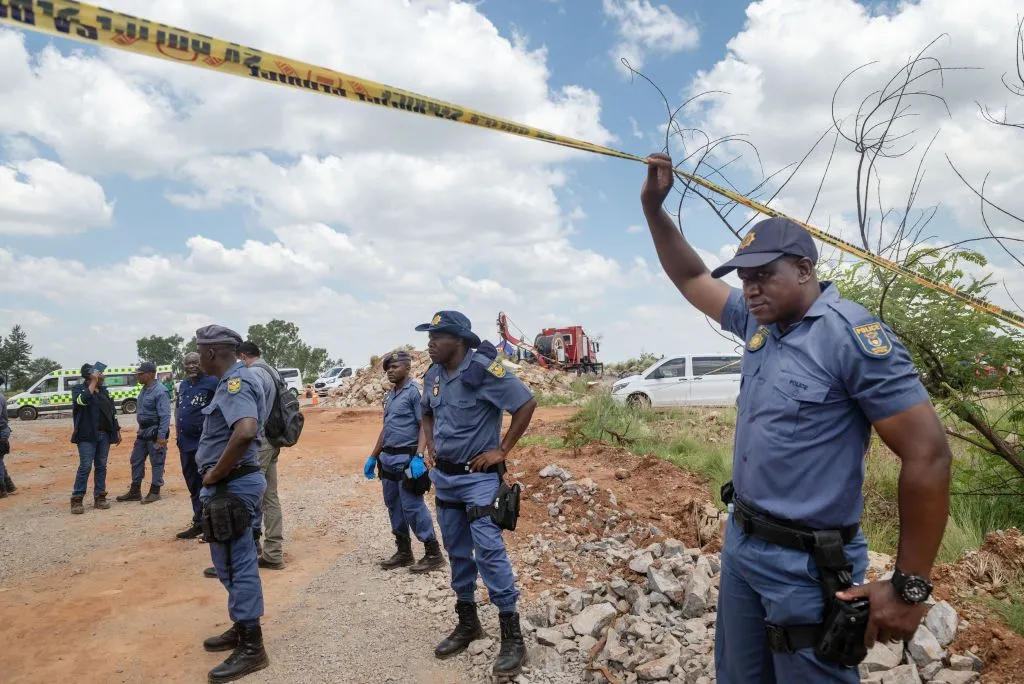
The police have defended the operation at Stilfontein, saying it was about dealing with criminality  Getty Images
"I heard from somebody in the neighbourhood that he [her 22-year-old younger son] had gone underground."
"His father died last year and he was not even here for the funeral because he was underground for months."
Mmastona Mbizana, Khumo township community member

Labels: , , , ,

Thursday, September 05, 2024

Palestinian Terrorism Carnage

"Following my urgent request, the UN Security Council will finally convene on Wednesday for the first time since the October 7 massacre to hold an official discussion on the hostages."
"The Security Council must condemn the terrorist organization Hamas and demand the immediate release of the [Israeli] abductees."
Israeli UN Ambassador Danny Danon
 
"These murderers executed six of our hostages, they shot them in the back of the head."
"And now, after this, we're asked to show seriousness? We're asked to make concessions [in a ceasefire agreement geared to the release of the remaining Israeli hostages held by Hamas]."
"No one is more committed to freeing the hostages than me."
Israeli Prime Minister Benjamin Netanyahu
https://res.cloudinary.com/hb0stl6qx/image/upload/w_900,c_scale,q_auto,f_auto,dpr_auto/v1725521387/Lobanov_and_Gat_mx53kb.png
Murdered Israeli hostages Carmel Gat and Alexander Lobanov were shown in a Hamas video published on their Telegram channel on Wednesday evening. (Photo: Screenshot)

After shooting six young Israeli men and women whom Hamas terrorist operatives captured on October 7 from the grounds that hosted the Nova Music Festival, killing them at point blank range by shooting them in the back of their heads, Hamas followed up by the threat it would release videos of the "last messages" of all six of the murdered hostages. Recordings produced shortly before their deaths. This is the psychopathic savagery of Palestinian terrorism, follow up sadistic violence with equally sadistic psychological torture. 

The more anguish and grief caused to Jews by Palestinians the more glee and satisfaction in their cause of destroying the Jewish state and its Jewish inhabitants. Each of the six hostages -- Eden Yerushalmi, 24, Ori Danino, 25, Almog Sarusi, 27, Alexander Lobanov,32, Carmel Gat, 40, and Hersh Goldberg-Polin, 23, were shown introducing themselves to a camera in a video shown on Telegram, while a line on the screen in Hebrew, English and Arabic reads: "Hours and we will show their last messages".

Palestinians are masters of malevolence, using their creative sadistic streak to indulge in the pleasure of striking terror in the hearts of their targets while creating narratives and scenarios of stark lethal horrors to cause the greatest pain conceivable, in the order of mutilating girls and women while raping them before murdering them. And in the instance of the six murdered Israelis, torturing them for over 300 days of abysmal confinement, starvation, abuse, then forcing them to enact a death-facing tableau before they're murdered.

All of which represents the psychological warfare they excel at while nursing their imagined state of 'victimhood' at the hands of the Jewish state. The Hamas 'armed wing' put the government of Israel on notice that they are operating under new instructions in the hostage situation; that the hostage-keepers, should they become aware that Israeli forces are approaching their location in Gaza, are to take lethal action to prevent Israeli troops from managing to rescue any of the hostages. The message to Israel is that only Hamas can control the live release of the hostages.
 
https://i.abcnewsfe.com/a/dba53e9f-9d37-4ffa-8bd5-eb20f7db97b3/israel-gaza-1-rt-gmh-240902_1725279482693_hpMain_16x9.jpg?w=992
A combination picture shows hostages Ori Danino, Carmel Gat, Hersh Goldberg-Polin, Eden Yerushalmi, Alexander Lobanov, and Almog Sarusi, who were kidnapped by Hamas during the October 7 attacks, and whose bodies have been found underground in the Rafah area of the Gaza Strip.   Bring Them Home Now via Reuters
These new instructions, revealed a spokesperson for the al-Qassam Brigades which claims control of the hostages, dictate the instructions, while stating it is not they who are responsible for the deaths of the hostages, but Israel itself which has demonstrated the effrontery of rescues such as that in June when Israeli forces freed four hostages through a raid that in turn saw the death of dozens of Palestinians. Hamas leaders clearly feel they have the upper hand, earned with their abduction of Israelis of all ages. Knowing how dear their lives are to Israel, in contrast to the Hamas condition of expendibility of Palestinian lives for their 'cause'.

Israel's commitment to its goal of destroying the Hamas capability of mounting attacks on Israel and Israelis is non-negotiable; a recent strike dispatched a Hamas operative who had appeared in a widely viewed video from the October 7 attack, the terrorist shown drinking cola in front of two children wounded in a grenade strike that killed their father. He was identified by the IDF as Ahmed Fozi Wadia, commander of a commando battalion, member of a paragliding unit.

He had flown into the community of Netiv HaAsara on a paraglider prior to launching the attack on Israeli civilians in the targeted farming community. IAF aircraft struck a compound in Gaza City where Hamas operatives were engaged, and where eight met their deaths, Wadia included. 

https://smartcdn.gprod.postmedia.digital/nationalpost/wp-content/uploads/2024/09/Screenshot-2024-09-03-at-11.17.10.jpg?quality=90&strip=all&w=1128&h=846&type=webp&sig=eBpw5Qfd4Reo78vePmrDPA

Labels: , , , , ,

Sunday, December 19, 2021

The Desperate Plight of Afghanistan's Indigent Poor

"We need to separate the politics from the humanitarian imperative."
"The millions of women, of children, of men in the current crisis in Afghanistan are innocent people who are being condemned to a winter of absolute desperation and potentially, death."
Mary-Ellen McGroarty, director for Afghanistan, World Food Program
 
?The humanitarian crisis is escalating daily in Afghanistan. Hunger in the country has reached truly unprecedented levels."
"Nearly 23 million people—that is 55 percent of the population—are facing extreme levels of hunger, and nearly nine million of them are at risk of famine."
"One single mother that I met, she has a six-month-old baby, a 12-year-old son, a 10-year-old daughter, and two parents to look after because the husband died in the fighting. So, she has to take care of the full family…Her children go hungry. So, the two kids, the 12-year-old and the 10-year-old—they have to work."
UNHCR spokesman Babar Baloch
 
"People are impoverished here. Yesterday I saw a woman who was going through the rubbish bins at the local hotel, collecting the leftover food."
"I asked her why she was doing so and she said she didn't have any other solution, she was trying to find food for her children."
Resident of Kandahar
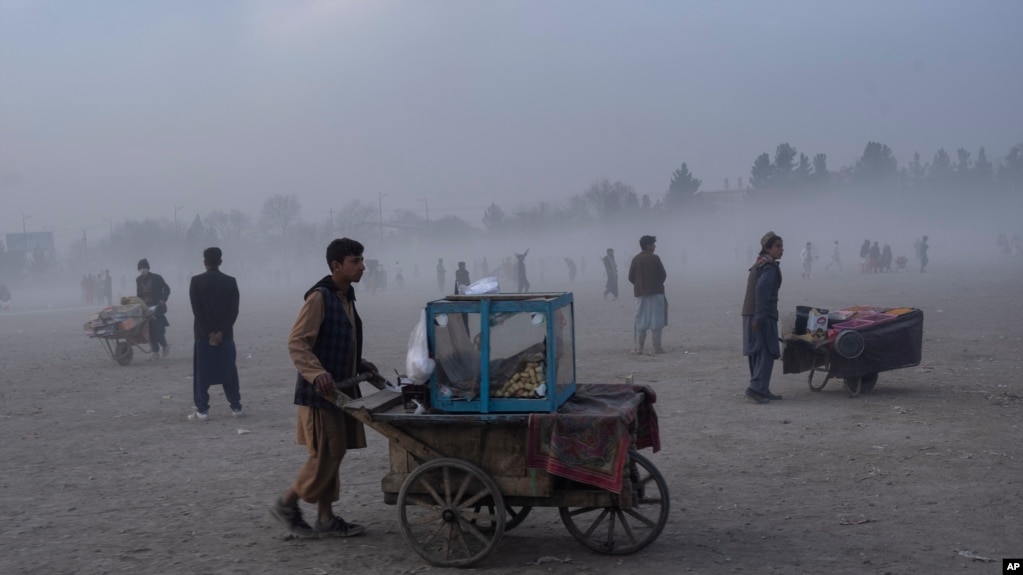
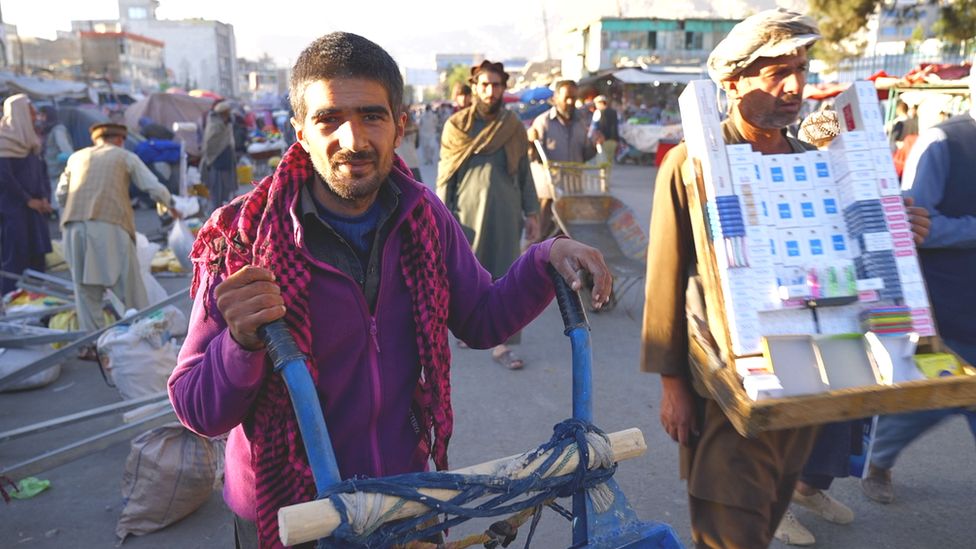
Street vendors push their carts in Chaman-e-Hozori park, Kabul, Afghanistan, Dec. 3 , 2021.

Women in towns and villages in southern Afghanistan bring their famished children folded into their burqas to clinics, walking long distances through a parched landscape in the process, hoping to be given medication and food for the children. Most families have been reduced to once-daily meals and even the ingredients for that sparse diet have become scarce thanks to failed harvests, dry wells and shopkeepers refusing further credit for flour.

On the brink of mass starvation aid groups fear threatens to take the lives of a million children this winter, the future for people in the country looks bleak. The dire societal problem of malnutrition has haunted the country for decades, but the current hunger crisis is dramatically worse, leaving an estimated 22 million people representing over half the population, susceptible to starvation. Life-threatening levels of food insecurity looms on the near horizon.

According to an analysis by the United Nations World Food Program and Food and Agriculture Organization, 8.7 million Afghans are facing famine, representing the most extreme stage of a food crisis. It is precisely this widespread hunger that reflects the most devastating symptom of the country's economic failure that has overtaken Afghanistan since its violent takeover by the Taliban.

Virtually overnight billions of dollars in foreign aid that had supported the previous government disappeared, while U.S. sanctions on the Taliban isolated the country from the global financial system, freezing Afghan banks and impeding reief work by humanitatian organizations. Millions of Afghans; day labourers to doctors and teachers have been months without incomes as food prices and other goods have soared.
 
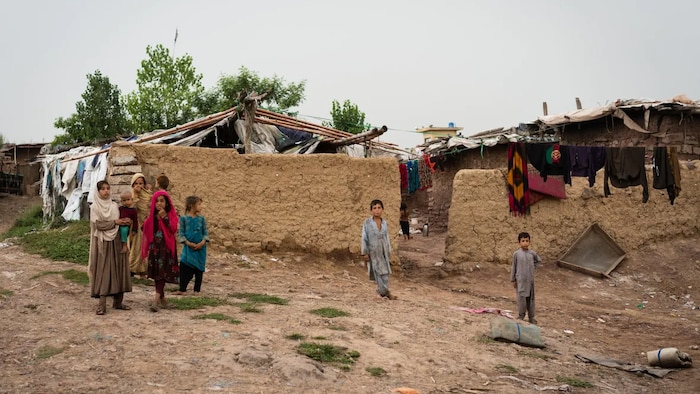
People in the Afghan Village refugee camp in Islamabad live in shacks with no running water or electricity.

People in the Afghan Village refugee camp in Islamabad live in shacks with no running water or electricity. Photo: (Jared Thomas/CBC)

Malnutrition wards of overcrowded  hospitals  have taken in emaciated children and their anaemic mothers. The hospitals themselves are ill equipped, with a shortage of medical supplies once provided by donor aid. At the same time, the country is in the grip of one of the worst droughts in decades. Humanitarian groups warn that as the lives of a million children are imperilled, the United States faces mounting international pressure to ease economic restrictions on the country.

The hunger that threatens Afghanistan is reflected elsewhere, as similar situations arise around the world, driven by the pandemic, by conflict, and by climate-related events. Crisis-level food shortages face 30 percent more Afghans compared with the same period last year. "It was never this bad", head doctor Sifatullah Sifat at the Shamsui Haq clinic on Kandahar city's outskirts stated, as malnutrition cases doubled in recent months. "Donors are shipping in medicine, but it's still not enough."

"They are crying to have food", said 20-year-old Zarmina, her 18-month-old son in her arms, her 3-year-old daughter standing behind her; a family that has survived mostly on bread and tea since her husband's day labourer work dried up. "I wish I could bring them something, but we have nothing."

The international community grapples with the dilemma of what action to take to avert a human disaster in the country while bypassing the new regime in fears of giving it legitimacy through the removal of sanctions or placing funds directly into the hands of the Taliban.

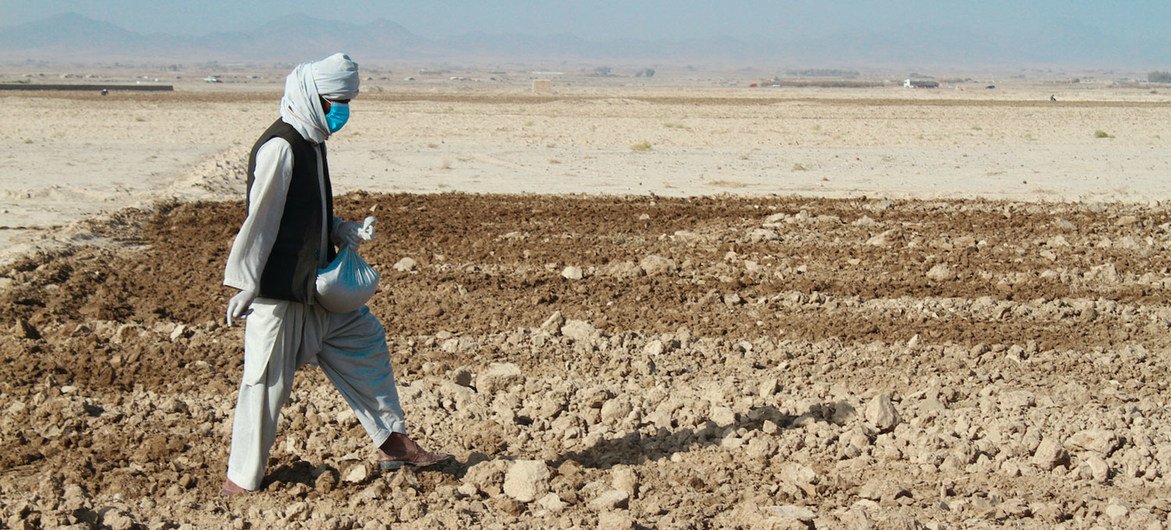
A farmer sows seeds he received from FAO wheat seed distribution in Kandahar in Afghanistan.
FAO/Hashim Azizi
A farmer sows seeds he received from FAO wheat seed distribution in Kandahar in Afghanistan.

Labels: , , , , , ,

Tuesday, October 26, 2021

Afghanistan, a Failed Country in Duress

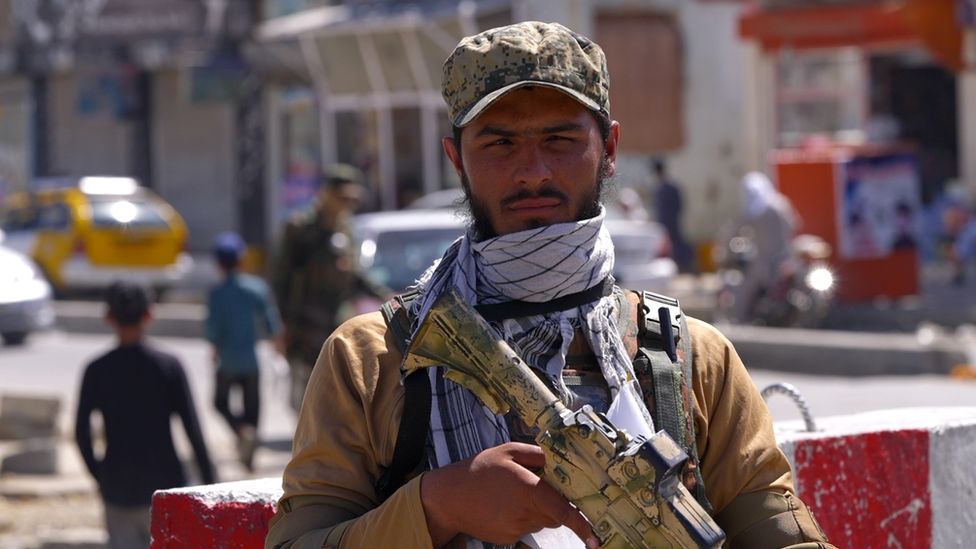
Taliban guard in Kabul
Taliban guards patrol the streets of Kabul
"Children are going to die. People are going to starve. Things are going to get a lot worse."
"I don't know how you don't have millions of people, and especially children, dying at the rate we are going, with the lack of funding and the collapsing of the economy."
"What we are predicting is coming true much faster than we anticipated. Kabul fell faster than anybody anticipated and the economy is falling faster than that."
"You've got to unfreeze these funds [repurposing development assistance to humanitarian aid] so people can survive."
David Beasley, executive director, World Food Program
Labourers in Kabul
Every day brings labourers looking for work - but there is little to go round

In the most sorrowful of sinister warnings, it has begun; children are dying and more will follow. Eight orphaned children, all under the age of ten, whose parents had died and who were left to fend for themselves, dependent on handouts from neighbours and strangers in a country where food is scarce and people are facing starvation, did die of starvation. Neglected, no one to be concerned for their welfare, they were simply unable to cope with the challenge of finding enough food somewhere to sustain their existence.
 
This happened in the capital city of Afghanistan. An estimated fifty percent of the population of poverty-wrenched Afghanistan now face food shortages. A serious situation is becoming utterly dire. The country looms on the brink of experiencing the worst humanitarian crisis in the world. Similar warnings are issued by the United Nations from time to time; starvation in Somalia, in Yemen, Democratic Republic of Congo, Liberia, Haiti, Central African Republic, and the list goes on. 
 
Tribal and sectarian conflict, internal and external challenges leading to war and persecution. Where there is war, farmers cannot cultivate their fields. Where there is conflict, people flee their towns and villages, becoming homeless and  refugees, finding both shelter and food and welcome hard to come by. A newly-impoverished Afghanistan, victimized by corruption, by ethnic, clan and sectarian violence, now the Islamic Emirate of Afghanistan, has seen international funding dry up, humanitarian charity unwilling to fund the Taliban.
 
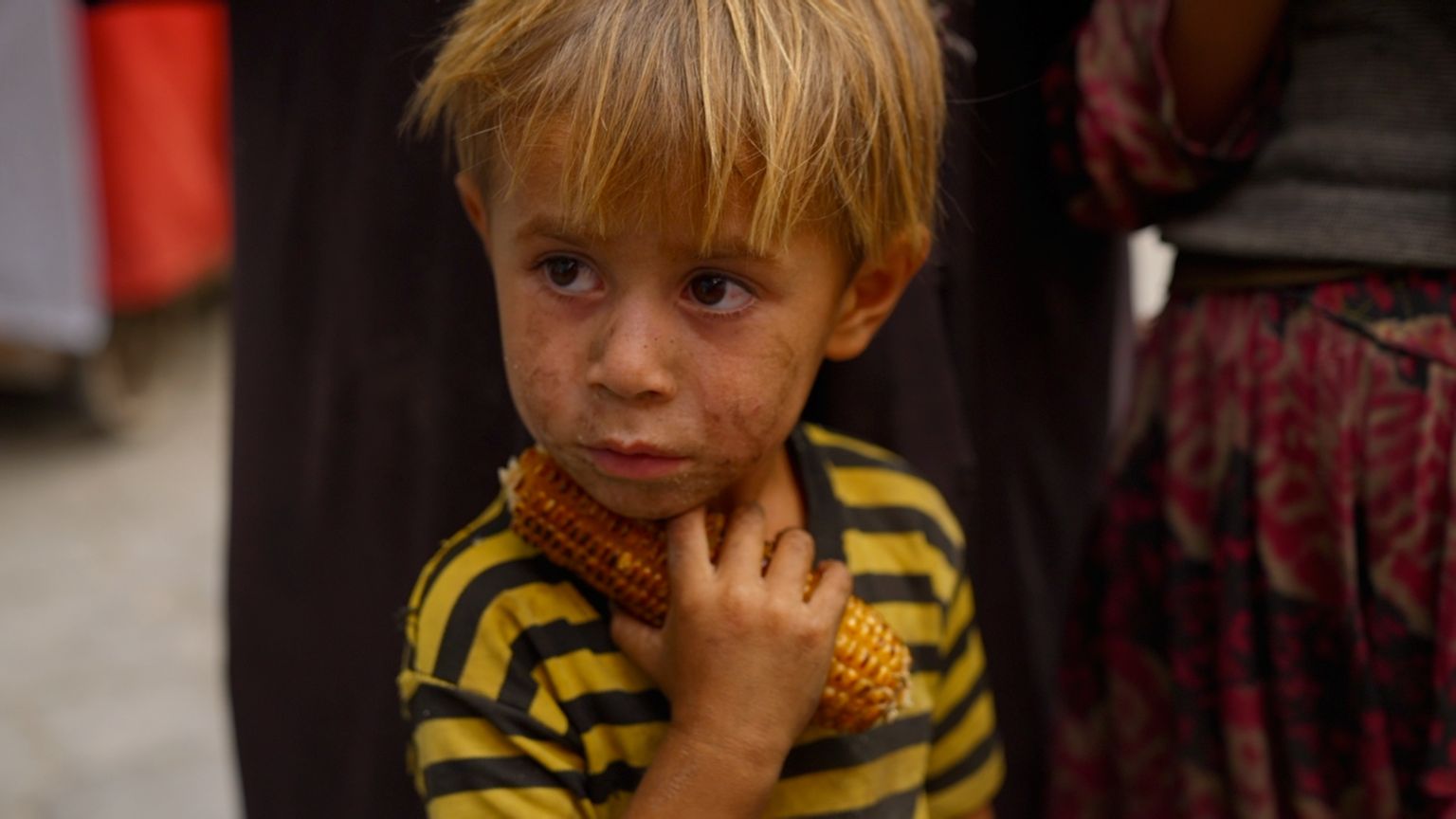
Kabul child with corn
Going to bed hungry is the new reality in a country that has seen decades of war

Drought, war and poverty have accompanied the rise to power of the Taliban; endemic, now acute. The eight dead children left on their own to survive, failed to and their bodies were found in West Kabul according to local leaders. Suffering from a tumour their bedridden father had died, and their mother, with heart disease soon followed their father in death, explained local cleric Mohammad Ali Bamiani. Neighbours occasionally brought them bread and water; it was their landlord who found the bodies.
 
The new Taliban administration in Afghanistan, nurtured by Pakistan, accepted by its near neighbours has been blacklisted from accessing overseas-located assets. Charitable funding meant to aid in reconstruction and development would be better used, suggested the World Food Program head, by transforming its purpose to feeding the hungry in Afghanistan. Who now resort to the desperate measures of selling anything they own to obtain food. 
 
To even hope to begin minimally feeding the 23 million food-vulnerable population as winter approaches, the UN food agency requires $220 million each month. Aid groups urge wealthy nations to swallow their distaste in dealing with a violently aggressive Islamist group by diplomatic engagement in hopes of preventing a social/economic collapse that could launch yet another catastrophic crisis of mass migration.
 
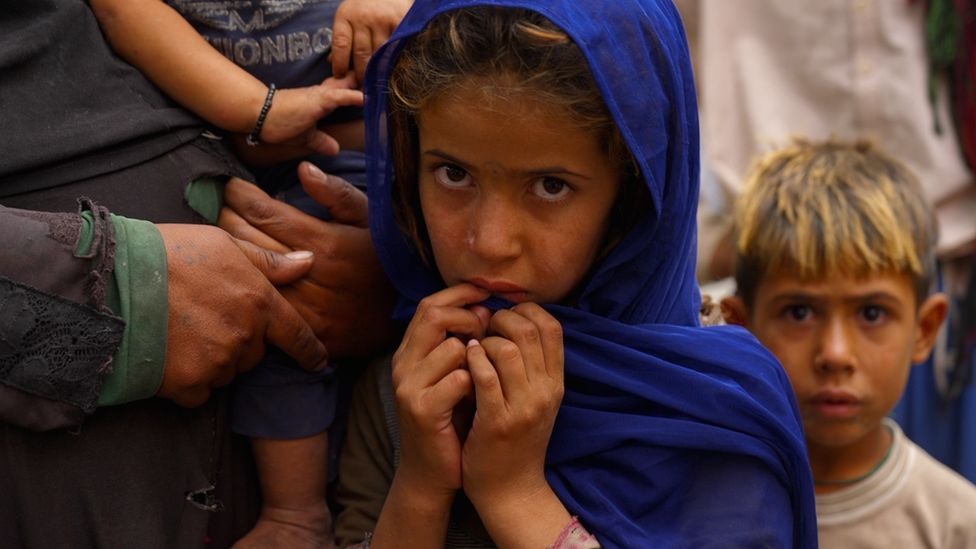
Children in Kabul
Most Afghans are now trying to feed themselves and their children after the economy collapsed


Labels: , , , ,

Sunday, December 17, 2017

Nigeria's Colossal Failure

"[Rain is a creation from god]. Like saying the world is a sphere. If it runs contrary to the teachings of Allah, we reject it. We also reject the theory of Darwinism."
Boko Haram spokesman

"I will not get killed until my time comes. You broadcast the news and published it in your media outlets that you injured me and killed me and here I am."
"Oh tyrants, I'm in a happy state, in good health and in safety."
"If you want your girls, [kidnapped Chibok schoolgirls] bring back our brethren."
Abubakar Sheka, leader, Boko Haram

"Boko Haram is once again committing war crimes on a huge scale, exemplified by the depravity of forcing young girls to carry explosives with the sole intention of killing as many people as they possibly can," 
"This wave of shocking Boko Haram violence, propelled by a sharp rise in suicide bombings, highlights the urgent need for protection and assistance for millions of civilians ... Governments in Nigeria, Cameroon and beyond must take swift action to protect them from this campaign of terror."
Alioune Tine, Amnesty International director, West and Central Africa

"[All praise to Nigerian troops for] finally entering and crushing the remnants of the Boko Haram insurgents at Camp Zero [located deep within  Sambisa Forest]."
"[The] long-awaited and most gratifying news of the final crushing of Boko Haram terrorists in their last enclave [has been achieved] the terrorists are on the run, and no longer have a place to hide."
"Further efforts should be intensified to locate and free our remaining Chibok girls still in captivity. May God be with them."
Nigerian President President Muhammadu Buhar, December 2016
A Nigerien soldier checks a building while on patrol in Duji
A Nigerian soldier checks a building while on patrol in Duji. Joe Penney, Reuters
According to the latest news out of Nigeria, its military has arrested over 400 people with Boko Haram, living on the islands of Lake Chad; among them jihadis, their wives and children in a two-week operation that wound up with the largest number of Boko Haram fighters arrested in northeast Nigeria in recent months. Yes, it's the very same Boko Haram, the Islamist hard-liners who proudly reject anything Western, from education to science. And no, it doesn't appear that Boko Haram was after all, entirely wiped out as Nigeria's president stated a year ago.

Boko Haram now associates itself with Islamic State of Iraq and the Levant, calling itself 'Islamic State West Africa Province'. In the Hausa language Boko Haram means 'Western culture is forbidden by Islam'. This does not reflect some new interpretation; it repeats in present-day language what the Koran itself forbids, so it is hardly surprising that Boko Haram's goal is the total Islamification of Nigeria, with the implementation of Sharia law. Nigeria is a hugely populous country in an extremely large geography.

It is comprised of a multitude of regions and various ethnic groups speaking 500 languages such as Hausa, Igbo, Yoruba and Urhobo. Sunni Muslims dominate the north of the country while Christians represent the majority in the south. From its colonialist past English remains the common language. The country's geology is one of those in which nature invested great oil wealth. While the current president is Muslim, his predecessor was Christian.

Boko Haram jihadis rampage through towns and villages, ransacking them, torching them, killing the inhabitants, kidnapping women and children. They're not too given to selecting only Christians for their atrocities; Muslims too fall under their marauding attacks. Teens and even younger children make excellent fodder for re-education the Boko Haram way; they are indoctrinated into jihad and persuaded to join; no doubt the examples made of those who protest encourage the others not to.

Women and teens are used unsparingly as suicide bomber fodder; instructed to seek out crowded venues and detonate the explosives belts they're equipped with.Women and girls who have been kidnapped, raped, borne children and who have escaped with those infants are shunned by Nigerian society, by their own families, by their villages; held in suspicion and unconcealed disgust as belonging to Boko Haram.

According to UNICEF, the first half of 2017 saw Boko Haram deploy 83 child suicide bombers, 55 who were girls mostly under fifteen, and one teen-age girl who had a baby strapped to her back, along with a suicide belt.

At 186-million population, the country represents the world's third most populous. It is a corrupt society, with the various appointed governors there to enrich themselves not to represent the best interests of those they govern. The military is traditionally ill equipped and inadequately trained. Funding to ensure that soldiers have the arms required to match those of Boko Haram is scarce; the military elite is known to habitually siphon off needed funds.

A typical African country in so many ways. Since 2009, an estimated 20,000 Nigerians have met violent deaths at the hands of Boko Haram, with over 2.6 million left homeless. Over five million Nigerians are on the verge of starvation; once dependable crops growing on farmland now devastated by the conflict are a thing of the past. Conflict has left farmers unable to plant, let alone cultivate crops, for the last several years.


Nigerian soldiers hold up a Boko Haram flag that they had seized in the town of Damasak, Nigeria in March 2015.
Nigerian soldiers hold up a Boko Haram flag that they had seized in the town of Damasak, Nigeria in March 2015. (Emmanuel Braun/Reuters)


Labels: , , , ,

Saturday, June 24, 2017

African Tribal Violence

"The briefing [between the Canadian diplomat and South Sudan's foreign minister in 2011] was repeatedly interrupted just because of the noise from the gunfire. Tank rounds going off. And the minister was saying, 'Do not worry. Everything is perfectly normal."
"Those 20,000 people at the airport? It's always busy at Christmas. We wish them happy holidays."
"We'd park our vehicle [at the airport in Juba]. To be honest, it was a bit like a football tailgate party. The [foreign] embassies would park their vehicles and put their flag up. The Canadians [South Sudanese with Canadian passports] would come to us."
"I was constantly negotiating with the friendly countries -- do you have any seats on aircraft? Or they would come to us and say: 'We've got some Canadians [Sudanese-Canadians]. Can you check their documents?"
"Within two days you had 20,000 camped out at the UN compound at the airport and another 20,000 in town who didn't dare come out to the fence. And there was a 6:00 p.m. curfew. At six, the military would start shooting."
"Some [Nuers] we had to literally hold their hands to get them out of the airport. We'd be taking them out by the arm and the soldiers would come and I'd have to push them away and say, 'No, no, no. Diplomatic. Diplomatic'."
Nicholas Coghlan, (retired) Canadian diplomat with the Canadian Embassy in South Sudan
Families wait in line as the World Food Program prepares to deliver food aid at the Bidi Bidi refugee camp on Feb. 22 in Arua, Uganda. The continued flow of refugees from South Sudan has pushed the camp's population to more than 270,000.   Dan Kitwood/Getty Images

South Sudan, after a long conflict with the government of Sudan, an Arab, Muslim hierarchy governing black Sudanese Christians and animists, as well as Black Muslim farming communities all of whom felt marginalized and ill-treated by Khartoum, became the newest nation in the world in 2011, after a referendum in the south resulted in Sudan finally agreeing to respect a breakaway portion of their geography in the creation of South Sudan.

For awhile competing political and ethnic and religious interests were set aside as the impoverished nation attempted to pull itself together. The rivalries that had been tamped down as the various interests cooperated in their greater struggle against the government in Khartoum didn't last long, however, and the majority Dinkas in South Sudan began to attack the minority Nuer people; their shared government fell apart. By 2013 the country was roiled by civil war.

Foreign embassies became frantically involved in trying to rescue South Sudanese refugees who had sought haven and achieved citizenship in the West, and then returned to South Sudan with the intention of helping the new nation become an independent, sovereign success. But things turned ugly and even their own ethnic group, the minority Nuer, rejected those that had left while the country was in its original turmoil: "They were told, 'Where were you? I was in the bush for 2 years while you were living the high life in Canada'." explained former diplomat Coghlan.

That was then; four years later nothing has been resolved, the ethnic conflict continues. About 1.8 million South Sudanese have fled the fighting in their new nation for haven abroad. Almost a million ended up in Uganda, with large numbers also finding haven in Sudan, Ethiopia, Kenya and the Democratic Republic of Congo, even though inner conflict and poverty strikes there as elsewhere in Africa. Aside from those leaving South Sudan, an additional two million forced from their homes remain within, living in camps, fending as best they can.
"We are managing but there is a severe shortage of funding. We are only getting about 15 percent of the funding we require. That is a serious gap that may drive us beyond the breaking point."
"This could force the government [of Uganda] to examine its generosity at some point."
"That [the $20 million of the $400-million required to operate refugee camps in Uganda for South Sudanese refugees] is a drop in the ocean. There are refugees suffering in a poor country that has given everything that it can. And the world is walking away from us."
Robert Baryamwesiga, commandant [mayor], Bidi Bidi, Uganda
The Bidi Bidi refugee camp in Uganda is home to about 274,000 people, making it the largest camp in the world.
The Bidi Bidi refugee camp in Uganda is home to about 274,000 people, making it the largest camp in the world. Photograph: Dan Kitwood/Getty Images

The Ugandan town of Bidi Bidi grew last August from a tiny enclave to become a refuge to 272,000 South Sudanese fleeing violence, starvation and death in their country. It has the distinction of representing the world's largest refugee camp. Masses of refugees registered with Ugandan authorities form long lineups daily for food, water and vaccinations. They have become the forgotten refugees; the world's attention focused on Syria and Iraq, with over a million refugees and migrants showing up in Europe.

As for China, with its deep interests in African investment and focus on furthering its presence there to gain influence and supply its own industries with food and minerals derived from African natural resources, its interests seem to stop short at the exploitation stage and feeding its own economy, not the refugee dregs of a desperately poor country. South Sudan and its violent upheaval has become a local event of disinterest to the global community fixated on the Middle East.

Famine stalks South Sudan. Partially because of a catastrophic drought. But then people were too frightened to plant, let alone harvest crops. And the issue of international aid with humanitarian shipments of food meant to stave off large-scale starvation has created a deadlock of another dimension when the competing sides often refuse to allow food aid through.

"They arrive, not having had food and water for weeks. That is what is mobilizing people to leave South Sudan", explains Elyas Mohammed, co-ordinator for the United Nations in Bidi Bidi for whom the focus is on the provision of food, water and shelter. Uganda requires at least $400-million for the operation of its network of refugee camps, but of that total, an insufficient $60-million was pledged, and merely $20 million received.

As Uganda struggles with its dedication to humanitarian aid offered to desperate refugees, though the country itself has experienced more than its share of conflict and desperation and is now yet another desperately poor African nation, it braces itself for a further influx of South Sudanese, with an anticipated additional 400,000 refugees expected to flood over the border in this year's remaining months.

Refugees gather at a settlement in Palorinya, northern Uganda
Refugees gather at a settlement in Palorinya, northern Uganda. In March, 2,800 people arrived in Uganda every day from South Sudan. Photograph: Dan Kitwood/Getty Images

Labels: , , , , , , ,

Monday, March 20, 2017

Desperately Seeking Haven

"There is a saying in Somalia: 'Choose between one of two hard things'. In Yemen, there is war. Here in Somalia, there is no good employment but at least there is peace."
"I saw bodies in the street [in Yemen]."
"We were all afraid the boat would sink. It was not safe [his family's passage across the Gulf of Aden, fleeing Yemen for Somalia]."
"Sometimes it [his meagre earnings] is enough, sometimes it is not enough [to feed his family]. Sometimes we are hungry. Life is very tough here."
Hassan Cabdoo, Yemeni refugee, Burao, Somaliland

"Due to the political situation in Yemen, more and more are coming. They face big challenges when they arrive."
"We need to be sure proper information is delivered. We can't allow people to come to Somalia with no knowledge about the situation, which includes dramatic issues with the drought."
Julien Navier, spokesman, UNHCR agency
THE United Nations compound in Mogadishu now bears the scars of the world body’s troubled return to Somalia’s battered capital. Suicide-bombers blew off its front gates on June 19th, letting gunmen of the Shabab, the al-Qaeda-linked movement that used to dominate the country, shoot their way in

Somalia is a ruined country. In the aftermath of its civil war it has been struggling to re-establish law and order and rebuild ruined infrastructure. It is also suffering from drought conditions, and like many other parts of Africa, the prospect of famine raises its ugly head. Hardly a place where anyone might want to migrate to, to find haven, to begin a new life, to aspire to prosper, to give their children another chance to gain opportunities for the future.

Somalia is neither safe, nor is its economy regenerated. Unemployment is high, and Mogadishu, like much of the country lies in a ruined state. Warlords, drug dealing, Islamist insurgents, kidnappers and pirates all make their home in this violent, dysfunctional country. This is no secret, that Somalia is a dangerous country to live in. Somalians have made their desperate way out of the country to seek haven in Europe, joining the vast throngs of other nationals fleeing conflict and danger.

But this is where tens of thousands of Yemeni refugees have sought to establish themselves, where they hope to find safety from the newer war ravaging their country. In Yemen the war is actively raging, with a Saudi Arabian-led military assault group fighting the Iranian-supported Houthi rebels who have challenged the official government. This is a proxy war between the Islamic Republic of Iran, seeking to enlarge its influence in the region, encompassing Shiite links with Iran in Syria, Lebanon (Hezbollah), Iraq, and Yemen.

The sectarian conflicts that have roiled the Middle East led to the situation where millions of Syrian Sunnis have fled their country to find refuge in Lebanon, Jordan, Turkey and elsewhere, spilling over when the opportunity presents itself, overland and by sea into Europe. Yemenites, desperate to escape the bombings and killings, have opted to find haven elsewhere. Their choices are not great, and some have risked their very lives to leave Yemen for Somalia.

Their choice is to remain where they are, and hope to survive the brutal onslaught where Sunni and Shiite challenge one another, where al-Qaeda and Islamic State have their own fanatical presence in the country, awaiting their opportunities, or to choose to leave their country of origin. Now struggling to remain alive in Somalia, a country where aid agencies warn that hundreds of thousands face the possibility of starvation, their dilemma has improved but marginally.

When Hassan Cabdoo fled Yemen for Mogadishu his family was among hundreds of other Yemenites loaded into an unseaworthy boat for the two-day crossing across the Gulf of Aden, facing a rough sea, insufficient food and night-time plunging temperatures. Now established in Burao among mostly nomads whose own fortunes have plummeted as their livestock succumbed to the drought, malnourished children crowd the local hospital.

A tailor who earned an average $15 daily in Yemen before the outbreak of civil war, if he can earn $5 a day he considers himself fortunate. And while there is no war in Somalia, there is crime and there is everpresent danger. And there is also the fact of high unemployment. In a relatively stable and wealthy country like South Africa, which has seen an increase in refugees from nearby warring states, unemployment is also high, and so is resentment, with South Africans blaming refugees for taking jobs from them.

How long before violence breaks out between the indigenous Somalians unable to find work, much less feed their hungry families, blaming the presence of Yemenite refugees for the worsening situation? And bearing in mind that the influx of Yemeni families is nowhere near finished, as greater numbers strive to leave the violence and the fear of death behind, to stake their claims in another impoverished nation like their own, broken by war and savagely beset by crime and starvation.

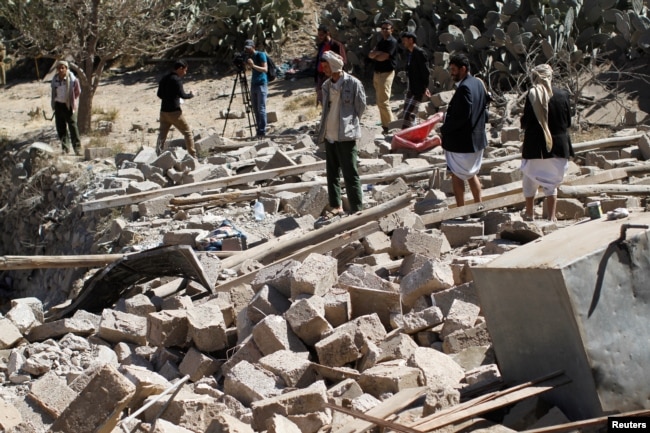
People walk on the rubble of a house destroyed by a Saudi-led airstrike in Sana'a, Yemen, Feb. 2, 2017.
              

Labels: , , , , , ,

() Follow @rheytah Tweet