
Politic?

This is a blog dedicated to a personal interpretation of political news of the day. I attempt to be as knowledgeable as possible before commenting and committing my thoughts to a day's communication.

Saturday, June 24, 2017

African Tribal Violence

"The briefing [between the Canadian diplomat and South Sudan's foreign minister in 2011] was repeatedly interrupted just because of the noise from the gunfire. Tank rounds going off. And the minister was saying, 'Do not worry. Everything is perfectly normal."
"Those 20,000 people at the airport? It's always busy at Christmas. We wish them happy holidays."
"We'd park our vehicle [at the airport in Juba]. To be honest, it was a bit like a football tailgate party. The [foreign] embassies would park their vehicles and put their flag up. The Canadians [South Sudanese with Canadian passports] would come to us."
"I was constantly negotiating with the friendly countries -- do you have any seats on aircraft? Or they would come to us and say: 'We've got some Canadians [Sudanese-Canadians]. Can you check their documents?"
"Within two days you had 20,000 camped out at the UN compound at the airport and another 20,000 in town who didn't dare come out to the fence. And there was a 6:00 p.m. curfew. At six, the military would start shooting."
"Some [Nuers] we had to literally hold their hands to get them out of the airport. We'd be taking them out by the arm and the soldiers would come and I'd have to push them away and say, 'No, no, no. Diplomatic. Diplomatic'."
Nicholas Coghlan, (retired) Canadian diplomat with the Canadian Embassy in South Sudan
Families wait in line as the World Food Program prepares to deliver food aid at the Bidi Bidi refugee camp on Feb. 22 in Arua, Uganda. The continued flow of refugees from South Sudan has pushed the camp's population to more than 270,000.   Dan Kitwood/Getty Images

South Sudan, after a long conflict with the government of Sudan, an Arab, Muslim hierarchy governing black Sudanese Christians and animists, as well as Black Muslim farming communities all of whom felt marginalized and ill-treated by Khartoum, became the newest nation in the world in 2011, after a referendum in the south resulted in Sudan finally agreeing to respect a breakaway portion of their geography in the creation of South Sudan.

For awhile competing political and ethnic and religious interests were set aside as the impoverished nation attempted to pull itself together. The rivalries that had been tamped down as the various interests cooperated in their greater struggle against the government in Khartoum didn't last long, however, and the majority Dinkas in South Sudan began to attack the minority Nuer people; their shared government fell apart. By 2013 the country was roiled by civil war.

Foreign embassies became frantically involved in trying to rescue South Sudanese refugees who had sought haven and achieved citizenship in the West, and then returned to South Sudan with the intention of helping the new nation become an independent, sovereign success. But things turned ugly and even their own ethnic group, the minority Nuer, rejected those that had left while the country was in its original turmoil: "They were told, 'Where were you? I was in the bush for 2 years while you were living the high life in Canada'." explained former diplomat Coghlan.

That was then; four years later nothing has been resolved, the ethnic conflict continues. About 1.8 million South Sudanese have fled the fighting in their new nation for haven abroad. Almost a million ended up in Uganda, with large numbers also finding haven in Sudan, Ethiopia, Kenya and the Democratic Republic of Congo, even though inner conflict and poverty strikes there as elsewhere in Africa. Aside from those leaving South Sudan, an additional two million forced from their homes remain within, living in camps, fending as best they can.
"We are managing but there is a severe shortage of funding. We are only getting about 15 percent of the funding we require. That is a serious gap that may drive us beyond the breaking point."
"This could force the government [of Uganda] to examine its generosity at some point."
"That [the $20 million of the $400-million required to operate refugee camps in Uganda for South Sudanese refugees] is a drop in the ocean. There are refugees suffering in a poor country that has given everything that it can. And the world is walking away from us."
Robert Baryamwesiga, commandant [mayor], Bidi Bidi, Uganda
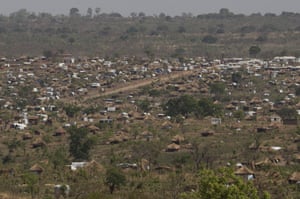
The Bidi Bidi refugee camp in Uganda is home to about 274,000 people, making it the largest camp in the world.
The Bidi Bidi refugee camp in Uganda is home to about 274,000 people, making it the largest camp in the world. Photograph: Dan Kitwood/Getty Images

The Ugandan town of Bidi Bidi grew last August from a tiny enclave to become a refuge to 272,000 South Sudanese fleeing violence, starvation and death in their country. It has the distinction of representing the world's largest refugee camp. Masses of refugees registered with Ugandan authorities form long lineups daily for food, water and vaccinations. They have become the forgotten refugees; the world's attention focused on Syria and Iraq, with over a million refugees and migrants showing up in Europe.

As for China, with its deep interests in African investment and focus on furthering its presence there to gain influence and supply its own industries with food and minerals derived from African natural resources, its interests seem to stop short at the exploitation stage and feeding its own economy, not the refugee dregs of a desperately poor country. South Sudan and its violent upheaval has become a local event of disinterest to the global community fixated on the Middle East.

Famine stalks South Sudan. Partially because of a catastrophic drought. But then people were too frightened to plant, let alone harvest crops. And the issue of international aid with humanitarian shipments of food meant to stave off large-scale starvation has created a deadlock of another dimension when the competing sides often refuse to allow food aid through.

"They arrive, not having had food and water for weeks. That is what is mobilizing people to leave South Sudan", explains Elyas Mohammed, co-ordinator for the United Nations in Bidi Bidi for whom the focus is on the provision of food, water and shelter. Uganda requires at least $400-million for the operation of its network of refugee camps, but of that total, an insufficient $60-million was pledged, and merely $20 million received.

As Uganda struggles with its dedication to humanitarian aid offered to desperate refugees, though the country itself has experienced more than its share of conflict and desperation and is now yet another desperately poor African nation, it braces itself for a further influx of South Sudanese, with an anticipated additional 400,000 refugees expected to flood over the border in this year's remaining months.
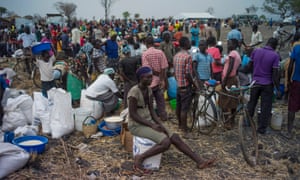
Refugees gather at a settlement in Palorinya, northern Uganda
Refugees gather at a settlement in Palorinya, northern Uganda. In March, 2,800 people arrived in Uganda every day from South Sudan. Photograph: Dan Kitwood/Getty Images

Labels: , , , , , , ,

Tuesday, August 16, 2016

United Nations to the Rescue

"Obviously, we regret the loss of life and the violence that the people who were in Hotel Terrain endured, and we take this incident very seriously."
"As you're aware, we have called on the national authorities to investigate this incident thoroughly and to bring the perpetrators to justice."
Farhan Haq, deputy spokesman, UN secretary-general

"They didn't venture out of the compound to help women being assaulted right outside, nor did they respond to rescue the people at Terrain just one kilometer away."
"There may be good reasons for this to do with the government's restrictions and the impact of fighting around the base, but [it] certainly stands out as an example of failure to uphold its protection role."
Jehanne Henry, senior researcher, Human Rights Watch

"Either you have sex with me, or we make every man here rape you and then we shoot you in the head."
"One in particular [of the South Sudan soldiers], he was calling you 'Sweetie, we should run away and get married'. It was like he was on a first date. He didn't see that what he was doing was a bad thing."
Female aid worker, South Sudan 

"We kill  you! We kill you! [the drunken soldiers shouted]."
"They would shoot up at the ceiling and say, 'Do you want to die?' and we had to answer 'No!'"
"All of us were contacting whoever we could contact. The UN, the US embassy, contacting the specific battalions in the UN, contacting specific departments."
Western female aid worker
FILE - Aid workers from various NGOs active in South Sudan arrive at Wilson airport in Nairobi, Kenya, July 13, 2016, from Juba.
Aid workers from various NGOs active in South Sudan arrive at Wilson airport in Nairobi, Kenya, July 13, 2016, from Juba. AP
In the tribal civil war that has erupted in the world's newest country of South Sudan where the army of supporters of the president is at war with the rival ethnic army of the former vice-president, the country is roiled with violence and its civilians are bearing the brunt. But the violence has reached out as well to touch the lives of foreign civilian volunteers entering the country from abroad to try to alleviate the dangers to civilians by offering humanitarian aid.

There is also the presence of United Nations peacekeepers, those famed blue-helmeted military personnel whose various countries have responded nobly to the call of the United Nations to lend a hand and a spear to the unenviable job of helping to protect civilian populations in theatres of conflict. South Sudanese troops after having won a battle in Juba, the capital, embarked on a rampage of celebration, on July 11. Good thing the UN peacekeepers were close at hand, right?

For four hours the south Sudanese soldiers stormed through a residential compound holding among others, a contingent of foreign aid workers. A local journalist was shot dead, as a bit of theatre for the foreigners forced to witness the execution. And then, singling out in particular Americans, the soldiers raped and gang-raped the women while beating men and looting them of their possessions. Mock executions added to the jollity of the theatrical performances.

The United Nations peacekeeping force was stationed under  two kilometres' distance from this drunken free-for-all. Despite anguished calls for help, none of the peacekeepers responded as the assaults went on for nightmarish hours on end. Fear must have been rampant among the foreign delegations since no embassies in the region, including that of the Americans made an effort to respond to the desperate pleas of those being attacked. Benghazi redux?

United Nations Mission in South Sudan (UNMISS) peacekeepers, seen here in a July 14, 2016, photo at a U.N. camp in Juba, South Sudan, are often criticized for not doing enough to protect civilians.

The foreign aid workers were stationed in a hotel complex and it seems obvious enough that they were particularly targeted as an expression of the high regard in which they are held by South Sudan's President Salva Kiir whose run-amok troops they represent. The conflict with rebel leader, former vice-president Rick Machar's troops has turned the country into a bloody conflict zone. But the president's troops have no monopoly on human rights abuses; their rivals appear just as guilty.

The government has refused to permit soldiers from neighbouring countries, Uganda, Sudan, Ethiopia and Kenya to take part in the UN's peacekeeping force. It was mostly comprised of troops from Ethiopia, China and Nepal, and "all refused to go" as requested as a Quick Reaction Force to respond to the desperation of the people being attacked.

A worker at the Terrain hotel complex from Uganda had seen about one hundred men break into the compound after knocking open the gate with tire irons and gunshots. The security guards tasked with the Terrain's protection were armed with shotguns, and outnumbered, leaving the soldiers free to wander without intervention, from door to door taking possession of cash, cellphones, laptops and car keys.

The apartment block in the Terrain was the next target and soldiers began breaking into the apartments ransacking the rooms and assaulting those inside. The women were violently sexually assaulted, some raped by as many as 15 men throughout the hours of vicious torment to which the complete absence of their UN protectors added a cruel twist of despair.

At agonizingly long last, South Sudanese security forces entered the hotel complex and rescued most of the women and about 16 staff of the Terrain hotel complex. Since the president of South Sudan is vexed with his belief that the West favours the rebels, it is entirely likely that he manipulated events to produce that savagery as a message to the Americans in particular that he is displeased with their focus.

south sudan aid worker attack
Debris lies in the Terrain compound after it was looted by South Sudanese troops during one of the worst targeted attacks on aid workers in country’s three-year civil war. Photograph: Adriane Ohanesian/AP

Labels: , , ,

Monday, December 23, 2013

Civil Africa, Again

"Bentiu is in the hands of a commander who has declared support for Machar. Bentiu is not in our hands."
Col. Philip Aguer, South Sudanese military spokesman

"You are urged to leave now by commercial means, as it may become increasingly difficult to do so if the situation deteriorates further."
Advisory, Foreign Affairs, Canada
South Sudanese refugee camp -- Getty Images
"We are here to stay, and will carry on in our collective resolve to work with and for the people of South Sudan. To anyone who wants to threaten us, attack us or put obstacles in our way, our message remains loud and clear: we will not be intimidated."
Hilde Johnson, secretary-general envoy, South Sudan

The war with Sudan is the past. Then, African tribes were beset by the Arab Sudanese, and it was a Muslim conflict against Christians and Animists over territory and opposition to rule from Khartoum. The long-awaited separation making South Sudan a sovereign state with oil assets of its own hasn't settled the conflicts between the two now-separate countries completely, but tribal conflicts, as is usual in African countries have risen to the fore.

One tribe simply is incapable of lending itself to the dominance of the other. Not even when state functions are shared. South Sudan was led by a president of the Dinka tribe, its deputy president a member of the ethic Nuer, and ethnic discord is a plague that haunts tribal societies. Former vice-president Riek Machar, dismissed from his position by President Salva Kiir responded.

A predictable enough response, given that it represents what might and should have been anticipated. President Kiir stated from the outset, though Mr. Machar strenuously denied it at first that the rebel opposition of renegade forces were loyal to and under the command of his former deputy president. And they have indeed seized two states, one the capital of oil-rich Unity state.

Since South Sudan is dependent on its oil revenues, which represent close to 99% of the impoverished country's budget, this is a situation whose impact on the stability of the world's newest country could be catastrophic. Little wonder there is reciprocal bloodshed and attacks meant to overturn the gains of the renegades.

All non-critical staff members of the UN Mission in South Sudan in its capital Juba, are being evacuated to neighbouring Uganda, despite the defiant statement of the UN's envoy. The prospect of civil war cannot be entirely surprising in a country with a history of ethnic violence and divided loyalties within the military.

The military, divided between the two tribes, appears to have been the flint that sparked the current violence. As Western powers and the United Nations wring their hands in despair, as much over the incontrovertible fact that tribal viciousness continues to grip Africa into the 21st Century, as the upheavals that blacken and make bleak the future of the continent, what more could UN Secretary General Ban Ki-moon say, other than urge the leaders of South Sudan "to do everything in their power" to put an end to the violence.

They might be convinced to do just that if they thought it would be in their self-interest.

Labels: , , , ,

() Follow @rheytah Tweet