Politic?

This is a blog dedicated to a personal interpretation of political news of the day. I attempt to be as knowledgeable as possible before commenting and committing my thoughts to a day's communication.

Sunday, February 02, 2020

Awaiting Palestinian Acceptance of Peace and Mutual Security

"We see the reaction from the Palestinians, we see the reaction of a wide range of Arab states which have sided with the Palestinians in rejecting the plan."
"This, obviously, makes one think about its feasibility."

Dmitry Peskov Kremlin Spokesman

"We've informed the Israeli side ... that there will be no relations at all with them and the United States including security ties."
"Trump asked that I speak to him by phone but I said 'no', and that he wants to send me a letter ... but I refused it."
Palestinian Authority President Mahmoud Abbas
אבו מאזן
Mahmoud Abbas speaks at the Arab League meeting in Cairo on Saturday
(Photo: AFP)
"The experience over the past fifty years has shown that without agreement among all sides, no peace plan has the chance to succeed."
"The U.S. plan challenges many of the internationally agreed parameters: the 1967 border, as agreed by both parties, with a state of Israel and an independent, viable state of Palestine, living side-by-side in peace, security and mutual recognition."
"We share the commitment to a two-state solution and respect for international law."
European Union foreign policy chief Josep Borrel
An Arab League emergency meeting to discuss US President Donald Trump’s peace proposal, at the league headquarters in the Egyptian capital Cairo on February 1, 2020. (Khaled Desouki/AFP)
Yesterday, the last day of January 2020, the 22-member Arab League of Nations met to discuss the Trump Peace Plan and to hear an address by PA Chairman Mahmoud Abbas. The League saw fit to unanimously reject U.S. President Donald Trump’s controversial Middle East plan,are being “unfair” to Palestinians. They felt moved as well to state they would plan “not to… cooperate with the US administration to implement this plan.” 

This, when after decades of negotiations, fruitless every one, failed to move the Palestinian Authority leadership to agree to a plan they would find commensurate with their demands, simply because every time their demands were accepted, they would find fault, and increase their entitlements and when those too were finally met, they declined to validate any such plan as being quite satisfactory enough to influence them to lay down their arms and dedicate time, energy and funding to creating a civil state that would meet the needs of Palestinians while living in peace with their neighbours.

Israel was established as a Jewish state, finally realizing the dream of the diaspora to return to their  heritage and turn desert into an agrarian miracle. This, they did, while at the same time having to establish a military presence capable of defending the state and its citizens from repeated attempts by Arab states to destroy the nation's presence. Each one of those violent efforts failed, each time leaving Israel in a stronger defensive position.

Palestinians burn cutouts of U.S. President Donald Trump, State Secretary Mike Pompeo, and Prime Minister Benjamin Netanyahu in 'day of rage' protests across the West Bank, November 26, 2019.
AFP
Arab states, forever at war both externally and internally, riven by corruption, by sectarian and tribal enmity, managed to accomplish little to bring their populations into stable economies outside of those oil states the world economy supported in search of an energy source. The Palestinians, portraying themselves as everlasting refugees on the world stage found support among the Arab States but no willingness to absorb them as citizens save for Jordan which fought a bloody conflict against Yasser Arafat's PLO, driving them out of Jordan and into Lebanon.

Jordan occupies the greater part of what was meant to be portioned to a Jewish State through the Balfour Declaration, which Britain had seconds thoughts of, when it sought to appease the Hashemites of Arabia, after Britain had 'given' the House of Saud control of what became Saudi Arabia. Two-thirds of the population of Jordan is Palestinian, the rest Hashemites from Arabia. What was left was apportioned by the United Nations as a Partition Plan between Palestinian Jews and Arab Palestinians.

Syria and Iraq, two of Israel's deadliest state enemies disintegrated into sectarian violence with no end in sight, creating a monumental refugee crisis, and a greater humanitarian plight with the state murder of hundreds of thousands in a situation where it became problematical in distinguishing the actions of Islamist terrorists with those of state military actors themselves. Lebanon's fractious relations between Christians, Druze, Sunni and Shiites led to its civil downfall and the current situation where the Iranian proxy terrorist Hezbollah now is the tail that wags the dog.
At least 10,000 Palestinian protesters marching against Israel's military offensive in the Gaza Strip have clashed with Israeli soldiers
At least 10,000 Palestinian protesters marching against Israel's military offensive in the Gaza Strip have clashed with Israeli soldiers and border police at the Israeli Qalandiya checkpoint, between Jerusalem and Ramallah.  Picture: AFP/Getty

While Israel continues to flourish in every index of human accomplishments, creating a vibrant and creative society where democratic equality of all its citizens -- Jews, Muslims, Christians, Druze -- contrasts sharply with those of its neighbours -- the Arab and Muslim (Iran) communities in the Middle East continue to face moral and civil crises, mired in corruption and violence. Among them the ongoing rise of Islamist terrorism wreaking horrors both there and in the West.

Advances in medical research, bioscience, on the defensive military arms front, on technology and food sciences advance the Israeli economy as well as the world order in shared progress such as desalination, agribusiness, medical research and computer sciences. Israel sends out its emergency response teams to give aid to other nations recovering from floods, landslides, wildfires and earthquakes, as well as giving expert aid in arable water solutions and agricultural best-practices.
IDF strikes terror targets in Gaza after rockets fired at Israel
Wahhabism in Saudi Arabia lent itself to nurturing the aspiration so al-Qaeda to attack Western values in symbolic deadly attacks, which culminated in the World Trade Towers aerial destruction. Sunni Islam bred terrorist groups such as Hamas, Islamic Jihad and ISIL and its countless offshoots, while Shiism gave birth to the 'Party of God' which has responded to Iran's orders in Syria and Yemen, destroying lives and creating mass homelessness, where bombing hospitals and suicide-bomb-attacks exemplify the virtues of jihad.

Until countries like Egypt's, Saudi Arabia's and the Gulf States' encounters with Turkish and Iranian hostile threats created sufficient trepidation to slant their perspectives toward the one nation that has proven itself a beacon of hope for the future and whose military is dedicated to its nation's protection and perseverance as theirs failed to. It is Islam that nurtured and created the Muslim Brotherhood, a viral threat both to established Middle East states and the West.

Palestinian women, one holding a picture of Hamas movement chief Ismail Haniyeh, attend a mass rally marking the 32nd anniversary of the founding of Hamas on December 14, 2019, in Gaza city. (AP/Khalil Hamra)

The PLO, Fatah and Hamas share a 'victim' hatred of Israel and all things Jewish; above all the existence of a Jewish state dominating a heritage geography of Judaic historical, Biblical establishment, even while they exude a deadly hatred for one another as regional rivals prepared at any given time to commit the other to the grave while each seek 'martyrdom' for their people. Both boast that they love death for it reunites them with Allah and the Prophet Mohammad, rewarding them with 'virgins'. What they really love is conflict irrespective of whether it leads to victory.

Israel's preoccupation is shielding its population from death, for there is no love there for the Grim Reaper at the behest of Islamist jihadists. The death fetishists of jihad think of death as a gift they prepare as IEDs, wrapped as presents and party balloons to entice the children of Israel to play with them and flirt with jihad-delivered death. Western supporters of the Palestinian 'cause' avoid any censure of those they champion as 'victims' who 'resist' the 'occupation', a narrative that has served the Palestinians well in demonizing Israel.

It is past time for a peace engagement to be introduced free of the now-predictable Palestinian reaction of rejection. One that will be implemented however it comes about, still permitting the Palestinian authorities to engage in its details and ask for changes rather than demand Israel's removal from what they insist is Palestinian territory; a complete reversal of historical and current reality but typified in Islamist ritual of destroying all evidence of the pre-existence of rightful residency and artifacts and portraying them as their own.

Hamas members (photo credit: REUTERS)
Hamas members
(photo credit: REUTERS)

Labels: , , , , , , ,

Sunday, September 02, 2018

Iqra Khalid, Here's a Cause Awaiting Your Devotion

"The Islamic Republic of Pakistan’s blasphemy laws present a continuous threat to religious minorities. In particular, section 295-C of the Pakistani Penal Code (PPC) states: “Whoever by words, either spoken or written, or by visible representation or by any imputation, innuendo, or insinuation, directly or indirectly, defiles the sacred name of the Holy Prophet Muhammad (peace be upon him) shall be punished with death, or imprisonment for life, and shall also be liable to fine”."
"In 1991, the death penalty became the mandatory punishment for blaspheming the Prophet Muhammad’s name. Since the enactment of these laws, over one thousand cases of blasphemy have been registered, over fifty people have been extra-judicially killed by Muslim mobs or individuals, and at least forty people are currently on death row or serving life sentences. Hundreds more have served or are serving prison terms ranging from three to ten years. Yes, most blasphemy charges are false."
"One prominent case is that of Asia Bibi, a Christian mother of five who was convicted of blasphemy for offering her co-workers water from her cup. The coworkers told Asia that she had made the cup ceremonially unclean by drinking from it. They ordered her to convert to Islam, but Asia refused and expressed her faith in Jesus Christ. She was charged with blasphemy, convicted, and sentenced to death. She has been in prison for the last nine years, waiting for the Supreme Court of Pakistan to hear her appeal. In spite of this clear injustice, the Pakistani government has generally remained indifferent to Asia Bibi’s harsh and unjust situation and to others similarly situated within Pakistan’s borders."
European Centre for Law & Justice

"Asia Bibi shar[ed] a bowl of water with fellow workers in a field, about 30 miles (48km) from Lahore, where they were working as farm labourers. It's alleged that an argument erupted after some of the women felt it was sacrilegious for Muslims to share the cup with a Christian. Within weeks, the allegations had escalated to the charge of blasphemy, with some fellow workers accusing her of insulting the Prophet Muhammad. She was arrested and imprisoned."
BBC
"I think it is not a very  high priority case for the [Pakistani Supreme] court."
"The last time I met the Supreme Court registrar, he told me that over two thousand appeals against death sentences were pending before the court."
Saif-ul-Malook, lawyer for Asia Bibi, Christian-Pakistani


Asia Bibi is a a minority Christian in a Muslim-majority country that takes its religion seriously. Religious minorities live in Pakistan under sufferance, they are discriminated against and their lives fraught with the danger of being accused of blasphemy against Islam. Bibi, a mother of young children, has been in prison for eight years, awaiting execution, although she has appealed to the Pakistan Supreme Court, against the judgement of the Lahore High Court which upheld her death sentence, imposed because the charge of blasphemy carries the death penalty in Pakistan.

In Canada, a Muslim woman was given legal permission by the Supreme Court of Canada to wear a niqab, the full face covering effected by some Muslim women of Pakistani origin, when she swore her oath of allegiance to Canada at a citizenship ceremony so she could be presented with her citizenship papers. She had originally been denied participation in the ceremony, requested to bare her face, but she refused. In so doing, giving ample indication that her values and her loyalties do not align with that of Canadian society in general.

A Liberal Member of Parliament, Iqra Khalid, saw fit to change Canadian social and cultural values by tabling an anti-Islamophobia motion, M-103, that in essence declares anyone who criticizes Islam for any reason -- be it its goal of achieving a supreme global caliphate by converting the international community to Islam and Sharia law, or striving to accomplish that same goal by terrorism, or inflicting carnage on women and girls through the cultural imperative of female circumcision, or belittling and slandering other religions -- as Islamphobic and to be condemned in a breathtaking display of sanctimonious hypocrisy.

This woman who achieved her goal because of a majority Liberal government led by a prime minister whose pandering support of elements within society who roil the common weal but who present as appreciative voting blocs when their foreign-nationalist tendencies, contriving to wreak unrest within Canada and violent mischief outside the country in their former countries of birth, has been enabled like the Pakistani-Canadian who insisted on her charter-right to shield her facial identity from public view at a ceremony meant to award citizenship on the deserving, undermines Canadian values.

While striving to change Canada to more closely resemble the country they left where strictures on personal freedom are rife, they have no interest whatever in coming to the defence of a woman whose 'crime' was to defend her own religious belief while refusing to convert to Islam. The notion of justice and fairness and human rights is not in these peoples' lexicon of values. Pakistan formally denies recognition to Ahmadi Muslims as Muslim, making it a crime for that Islamic sect to declare themselves Muslim.

Other Pakistanis did come to the defence of Asia Bibi, the Christian governor of Punjab state Salman Taseer who visited Asia Bibi in her jail cell then went on to publicly state his opinion on the erroneous judgment and the dangerous laws that support that judgment. He was rewarded by being murdered by his trusted bodyguard, Mumtaz Qadri. And Mumtaz Qadri received his reward by the support and adulation he received from joyful Pakistanis, commending him for his religious devotion. The Federal Minister for Minorities Affairs, Shahbaz Bhatti also spoke out against the blasphemy laws and for his trouble was assassinated. 

"My Jesus died for me. What did your Muhammad ever do for you?", Asia Bibi demanded to know, scandalizing the other women she was with, all Muslim, who had complained that in offering them water from her bowl on a  hot day after working in the fields, she had desecrated the bowl and the water, as a Christian, demanding she convert to Islam. Her response failed to please them, so they accused her of blasphemy and she was held to be guilty of the charge and condemned to death.

Aasiya Noreen before her 2009 arrest. She is widely known as Asia Bibi. (Photo: World Watch Monitor)


Labels: , , , ,

Monday, May 28, 2018

Reforming Iraq, Resisting Iran, Deposing United States

"[Sadr] insists that he is independent, [and] is sending messages to both the United States and Iran that he will not adopt policies that threaten their interests inside Iraq."
"In the past years, Sadr’s political behavior has varied. He has toned down the critical voice he once used against the United States. He has criticized the United States occasionally, but he hasn’t threatened the U.S. presence in Iraq as part of the international coalition fighting the Islamic State." "Sadr did not even hint at the possible formation of a military force outside the state to resist the United States, as he did in 2004 and 2008. The Mahdi Army has been completely disbanded."
"Sadr does not have a military force fighting in Syria, unlike most Iraqi military factions loyal to Iran. The latter have been fighting inside Syria alongside President Bashar al-Assad’s regime for years now. Sadr, for his part, has opposed the presence of any Iraqi force outside of the country and criticized those defending Assad’s regime, calling on the Syrian president to step down to pave the way for a democracy in Syria."
Ali Marmouri, Iraqi economist

"We have a steady relationship with Iran. [The] Sadrist movement and its partners will not yield to the U.S. will."
"[Iranian Ambassador Iraj Masjedi said] The relations between Iranian officials and Sadr are friendly and brotherly. Many of those officials, including Qasem Soleimani, [head of the Iranian Republican Guard Corps] harbor great feelings of friendship for Sadr."
Dhiaa al-Asadi, director, Sadr's political office
In this photo provided by the Iraqi government, Iraqi Prime Minister Haider al-Abadi (right) and Shiite cleric Muqtada al-Sadr hold a press conference in Baghdad on May 20. Sadr's coalition won the largest number of seats in Iraq's parliamentary elections. AP

The immediate after-effect of the U.S.-led invasion of Iraq was the cleansing of the Iraqi military of all Sunni Baathist officers. The Iraqi Sunni minority was dismissed as the Shiite majority oppressed under Saddam Hussein was favoured by the leaders of the international forces. It was the embittered Sunni military officers, voided of their authority and positions who ended up as leaders of the Islamic State. Long before that, however, the hateful enmity between the sects was unleashed and death squads of Shiites entered Sunni enclaves in Baghdad to conduct bloody cleansing exercises.

The Sunnis whose hatred for Shiites as 'apostates' was as vehemently deadly in their counter-attacks by their own death squads in Shiite neighbourhoods and blood spilled freely in an orgy of vicious vengeance. Moktada al-Sadr as an influential cleric who had been exiled by Saddam to the Islamic Republic of Iran where relations between the ruling Ayatollahs and the al-Sadrs, father and son were warm,  returned to Iraq to foment violence among his followers against the foreign presence, particularly that of the U.S.

But it was the mass slaughter that took place in Baghdad of Sunnis that al-Sadr engineered through his sermons when he incited followers to embrace their holy duty to attack both Iraqi Sunnis and American forces. His militia was entirely reliant on Iran to supply weapons, his alliance with Teheran's leaders was firm; his dependence on their help and their aspirations to enter Iraq and influence and control its future consolidated an alliance of symbiotic fulfillment.

That was then. Perhaps al-Sadr's revenge exercise satiated his thirst for blood. He has become an anti-corruption campaigner with an "Iraq First" campaign behind him, appealing to most Iraqis sufficiently so to have voted his bloc 54 seats in the recent Iraqi elections, giving him influence though not a majority in the 329-seat Iraqi Parliament. He plans to be the eminence gris behind whoever becomes the prime minister; preferably for him, Haider al-Abadi, the Shiite leader viewed as a moderate, content to partner with the U.S. in its battle against ISIL.

His hatred for the United States is somewhat abated, but not his intention to have it entirely vacate any positions it still maintains in Iraq. His Mahdi militia has been dismissed; he is no longer in the business of terrorism. And nor will he plan to express violence against the American presence given that honour is involved in that official Iraq had invited the U.S. to remain. He will exercise patience until the time is right to excise American presence from Iraq. And while his relations with Iran remain amicable, he will brook no interference in Iraq's official affairs from that source either, it seems.

This, from a theocratic figure of great repute and fiery oration who convened a rogue Shariah court to pass sentence on Iraqi Shiites scorned for their submissiveness toward the American presence in Iraq. Memories remain sharp as well of the slaughter that took place between the security forces and the Mahdi militia. "We have tried the Islamists and they failed terribly", a seasoned al-Sadr noted, dismissing his former militia as an remedy whose time had passed.

This is the man now being recognized by Iraqi communists, social democrats and anarchists who view him now as symbolic of achieving the kind of reform they champion. "Let me be honest: We had a lot of apprehensions, a lot of suspicions. So what if Moktada al-Sadr is now the face of reform? What should I care as long as the reforms happen? He's a man who can motivate millions", declared Raad Fahmi, a leader of the Communist Party of Iraq, now part of Sadr's alliance. "But actions speak louder than words. He's not the same Moktada al--Sadr" (as previously).


So then, if Sadr's plans are carried through successfully with a coalition that will express his intentions, Iraq will not be controlled by Iran, as has been feared would be the outcome of this protracted exercise in removing a totalitarian murderer from power and replacing him with a sectarian power-sharing administration. The deadly enmity between Iran and Iraq is no more; the devastating war of attrition they fought, history now. 
 
On the other hand, warm relations will continue between the two Shiite-led nations, and Iraq will remain in Iran's orbit of supporters in its Shiite axis.

Labels: , , , ,

Monday, March 20, 2017

Desperately Seeking Haven

"There is a saying in Somalia: 'Choose between one of two hard things'. In Yemen, there is war. Here in Somalia, there is no good employment but at least there is peace."
"I saw bodies in the street [in Yemen]."
"We were all afraid the boat would sink. It was not safe [his family's passage across the Gulf of Aden, fleeing Yemen for Somalia]."
"Sometimes it [his meagre earnings] is enough, sometimes it is not enough [to feed his family]. Sometimes we are hungry. Life is very tough here."
Hassan Cabdoo, Yemeni refugee, Burao, Somaliland

"Due to the political situation in Yemen, more and more are coming. They face big challenges when they arrive."
"We need to be sure proper information is delivered. We can't allow people to come to Somalia with no knowledge about the situation, which includes dramatic issues with the drought."
Julien Navier, spokesman, UNHCR agency
THE United Nations compound in Mogadishu now bears the scars of the world body’s troubled return to Somalia’s battered capital. Suicide-bombers blew off its front gates on June 19th, letting gunmen of the Shabab, the al-Qaeda-linked movement that used to dominate the country, shoot their way in

Somalia is a ruined country. In the aftermath of its civil war it has been struggling to re-establish law and order and rebuild ruined infrastructure. It is also suffering from drought conditions, and like many other parts of Africa, the prospect of famine raises its ugly head. Hardly a place where anyone might want to migrate to, to find haven, to begin a new life, to aspire to prosper, to give their children another chance to gain opportunities for the future.

Somalia is neither safe, nor is its economy regenerated. Unemployment is high, and Mogadishu, like much of the country lies in a ruined state. Warlords, drug dealing, Islamist insurgents, kidnappers and pirates all make their home in this violent, dysfunctional country. This is no secret, that Somalia is a dangerous country to live in. Somalians have made their desperate way out of the country to seek haven in Europe, joining the vast throngs of other nationals fleeing conflict and danger.

But this is where tens of thousands of Yemeni refugees have sought to establish themselves, where they hope to find safety from the newer war ravaging their country. In Yemen the war is actively raging, with a Saudi Arabian-led military assault group fighting the Iranian-supported Houthi rebels who have challenged the official government. This is a proxy war between the Islamic Republic of Iran, seeking to enlarge its influence in the region, encompassing Shiite links with Iran in Syria, Lebanon (Hezbollah), Iraq, and Yemen.

The sectarian conflicts that have roiled the Middle East led to the situation where millions of Syrian Sunnis have fled their country to find refuge in Lebanon, Jordan, Turkey and elsewhere, spilling over when the opportunity presents itself, overland and by sea into Europe. Yemenites, desperate to escape the bombings and killings, have opted to find haven elsewhere. Their choices are not great, and some have risked their very lives to leave Yemen for Somalia.

Their choice is to remain where they are, and hope to survive the brutal onslaught where Sunni and Shiite challenge one another, where al-Qaeda and Islamic State have their own fanatical presence in the country, awaiting their opportunities, or to choose to leave their country of origin. Now struggling to remain alive in Somalia, a country where aid agencies warn that hundreds of thousands face the possibility of starvation, their dilemma has improved but marginally.

When Hassan Cabdoo fled Yemen for Mogadishu his family was among hundreds of other Yemenites loaded into an unseaworthy boat for the two-day crossing across the Gulf of Aden, facing a rough sea, insufficient food and night-time plunging temperatures. Now established in Burao among mostly nomads whose own fortunes have plummeted as their livestock succumbed to the drought, malnourished children crowd the local hospital.

A tailor who earned an average $15 daily in Yemen before the outbreak of civil war, if he can earn $5 a day he considers himself fortunate. And while there is no war in Somalia, there is crime and there is everpresent danger. And there is also the fact of high unemployment. In a relatively stable and wealthy country like South Africa, which has seen an increase in refugees from nearby warring states, unemployment is also high, and so is resentment, with South Africans blaming refugees for taking jobs from them.

How long before violence breaks out between the indigenous Somalians unable to find work, much less feed their hungry families, blaming the presence of Yemenite refugees for the worsening situation? And bearing in mind that the influx of Yemeni families is nowhere near finished, as greater numbers strive to leave the violence and the fear of death behind, to stake their claims in another impoverished nation like their own, broken by war and savagely beset by crime and starvation.

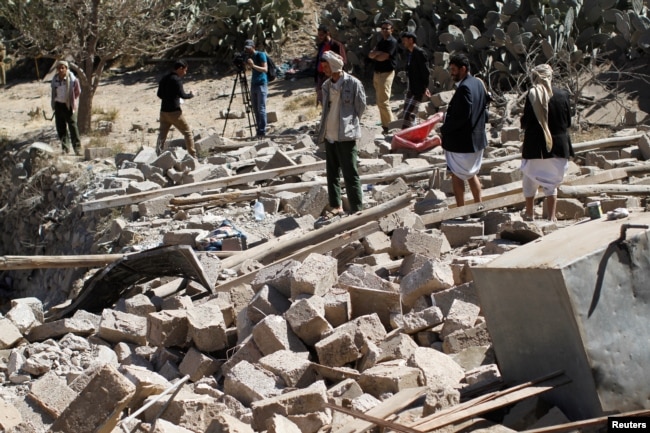
People walk on the rubble of a house destroyed by a Saudi-led airstrike in Sana'a, Yemen, Feb. 2, 2017.
              

Labels: , , , , , ,

Thursday, May 08, 2014

Syria conflict: Rebels 'complete Homs Old City evacuation'

BBC News online -- 8 May 2014
Government forces in the heart of Homs. Paul Wood reports
Rebel fighters have completed their withdrawal from the central city of Homs, Syria's state media say.

State television declared late on Thursday afternoon that the Old City was "totally clean of armed terrorist groups" although other reports said the evacuation was not fully over.

Earlier, Homs Governor Talal al-Barazi said more than 1,500 fighters and their relatives had left since Wednesday.

The evacuation marks the end of three years of resistance in Homs.
Syria's third city was once dubbed the "capital of the revolution".

Much of Homs fell to the opposition in 2011, but over the past two years government forces have gradually regained control by subjecting areas once home to tens of thousands to continuous siege and bombardment.

Government forces took full control of the heart of Homs on Thursday, state media said, after the last rebels in the Old City boarded buses and were transported to rebel-held territory to the north.
"Old Homs is totally clean of armed terrorist groups," state television said, using the government's term for those seeking to topple President Bashar al-Assad.

However, Mr Barazi and UN officials were later quoted as saying the evacuation was not fully over.
Mr Barazi said Homs would be declared a "secure city" once the UN-supervised evacuation was complete, and that reconstruction would begin immediately.

The army is not expected to move into the Old City until Friday, when it will be swept for explosives.
Buses carrying rebels from the Old City of Homs travel through the Khalidiya district (7 May 2014) Buses began transporting the rebels to rebel-held territory north of Homs on Wednesday morning
Syrian flags fly from a pole in the Old City of Homs (8 May 2014) On Thursday afternoon, Syrian state TV declared that the Old City had been "cleansed of terrorists"
Homs governor Talal al-Barazi (left) shakes hands with the UN resident co-ordinator in Syria, Yacoub El Hillo, in central Homs (8 May 2014) Homs Governor Talal al-Barazi and the UN's resident co-ordinator, Yacoub El Hillo visited the area
Damaged buildings in Old City of Homs (8 May 2014) The withdrawal was part of a deal that also saw rebels release dozens of captives and ease two sieges
 
Earlier, Hezbollah's al-Manar television broadcast footage of a group of rebel fighters walking past security forces personnel and boarding several green buses.
There were similar scenes on Wednesday, when 980 people were evacuated.

The fighters, who were each allowed to leave with a rifle and a bag of belongings, pledged to continue the armed struggle and one day return.

Speaking to the BBC at the end of the first day of the operation, the UN's resident co-ordinator in Syria, Yacoub El Hillo, said he hoped Homs would now be free from violence.

Battle for Homs

  • March 2011: Anti-government protests erupt in Homs within weeks of them beginning in Deraa
  • May 2011: Tanks sent into Homs to suppress the dissent; opposition supporters take up arms and oust security forces from several areas
  • February-March 2012: Military launches operation designed to crush the resistance in Homs; Baba Amr district subjected to month of relentless bombardment before rebels withdraw
  • May 2012: Between 15% and 20% of Homs under opposition control, including Old City
  • March 2013: Government launches major offensive to consolidate its control of Homs
  • July 2013: Rebels leave Khalidiya district after government assault including Hezbollah fighters
  • January 2014: Only Old City still held by rebels; up to 3,000 civilians trapped there, without access to food and medical supplies
  • February 2014: UN-Red Crescent operation evacuates 1,400 people from rebel-held areas
  • May 2014: Rebel fighters evacuated from Old City
He expressed hope that people would be able to return to their homes, but he cautioned against rushing back because the area was "inundated with unexploded ordnance, including landmines and booby traps".

The Old City was "incredibly and comprehensively destroyed" and was currently "uninhabitable", Mr Hillo said, adding that it would be a "huge task" to rebuild and restore homes and infrastructure.
The withdrawal is part of a deal that will also see rebels release 70 captives in Aleppo and Latakia provinces, and ease sieges of two predominantly Shia towns in the north - Nubul and Zahraa - that are loyal to President Assad.

Mr Barazi told the BBC that those released by the rebels were all Syrians, with the exception of an Iranian woman married to a Syrian man. Efforts to ensure the release of other captives were continuing, he added.

The agreement followed months of negotiations between security officials and rebel representatives, reportedly mediated by the Iranian ambassador to Syria.

There is now only one district in Homs - al-Wair in the north-western outskirts - that is still controlled by the opposition. However, Mr Barazi said he expected a similar evacuation deal to be reached in the coming weeks.

More than 150,000 people are believed to have been killed since the uprising against President Assad began in March 2011. Another nine million have fled their homes.

Despite the conflict, the Syrian government is planning to hold a presidential election on 3 June. The opposition have dismissed the poll, which Mr Assad is widely expected to win, as a farce.
Map of Homs, showing Old Homs


Labels: , , , , , ,

Sunday, January 05, 2014


Iraqi Al Qaeda claims Lebanese bombing. Sunni terror in hot pursuit of Shiites from Baghdad to Beirut

DEBKAfile Exclusive Report January 5, 2014, 11:12 AM (IDT)
Hizballah stronghold bombed
The forces of Iraqi Al Qaeda (ISIS), advancing Saturday, Jan. 4, on Baghdad from captured areas of Sunni Falluja and Ramadi, also claimed to have “penetrated the security system of the Party of Satan (Hizballah) and… crushed its strongholds.” This was a reference to the deadly bombing attack Thursday, Jan. 2, on Hizballah’s political headquarters in the Shiite Dahya quarter of Beirut, which accounted for at least 4 people dead and 77 injured.  
 
The Al Qaeda announcement added that this “was a small payment of the heavy account awaiting those wicked criminals.”

Shortly before this, the Lebanese army disclosed that Majd Al-Majid, head of the Abdullah Azzam Brigades tied to al Qaeda, had died in prison of “kidney failure.”

debkafile’s counter-terror and intelligence sources doubt the veracity of this claim. It is far more likely that this high-profile Lebanese al Qaeda operative died under interrogation - or else, under threat of being surrendered to Hizballah unless he came clean on his organization’s set-up in Lebanon, he chose to die by his own hand. He would have known that in the hands of Hizballah, he would be at the mercy of Iranian intelligence officers.

Al Majid was arrested on his return last week from Syria, where he forged a cooperation pact with Abu Muhammad Al-Jolani, head of the Al Qaeda Nusra Front fighting the Assad regime, as debkafile first revealed on Jan. 1st.  This would have provided the Syrian jihadists with a logistical base in South Lebanon.

All these events add up to Al Qaeda-Iraq, Al Qaeda-Syria and the Abdullah Azzam Brigades having come together for a mighty push to seize footholds in a vast swathe of Middle East territory, along a line running between three Arab capitals - Baghdad, Damascus and Beirut.

Al Qaeda is turning itself into the Sunni knife for slicing through the Shiite axis linking Tehran to Damascus and the Lebanese Hizballah in Beirut.

Our military sources say a major escalation of this violent confrontation is building up for the near term in Iraq, Syria and Lebanon and may not stop there; there may also be spillover into Israel and Jordan.

Over the weekend, Israel began putting its resources in order accordingly:

1. Preparation was made for Al Qaeda’s fronts in Iraq or Syria trying to penetrate Israel for terrorist activity on the same lines as its attacks on Lebanon.

It became clearer than ever before that Israel can on no account afford to consider evacuating its troops from its eastern border, i.e. the Jordan Valley - or abandoning its military and intelligence assets on the West Bank. Both are demanded by the Palestinians as their sine qua non for an agreement and have gained Secretary of State John Kerry’s endorsement.

2.  Israel finds itself caught between two equally hostile and dangerous radical forces, both of which enjoy powerful backing. On the one hand, the Obama administration is eager to maintain US rapprochement with Iran to the point of allowing the brutal Bashar Assad to remain in power. On the other, former US ally Saudi Arabia is willing to back Muslim elements close to Al Qaeda, like the Sunni forces in Iraq and their counterparts in Lebanon, for the sake of sabotaging Washington’s current policies.

In these circumstances, Israel finds it increasingly difficult to determine which are its friends in the Middle East arena - and worth helping - and which its foes.

3. Amid these fast-moving circumstances,  John Kerry can hardly expect to persuade Saudi King Abdullah when they meet in Riyadh Sunday, Jan. 5, to throw his support behind the Palestinian leader Mahmoud Abbas, who has made acceptance of the US framework proposal for advancing the peace talks with Israel conditional on authoritative Arab endorsement.  

Labels: , , , , , , , ,

() Follow @rheytah Tweet